




 RADIO
RADIO










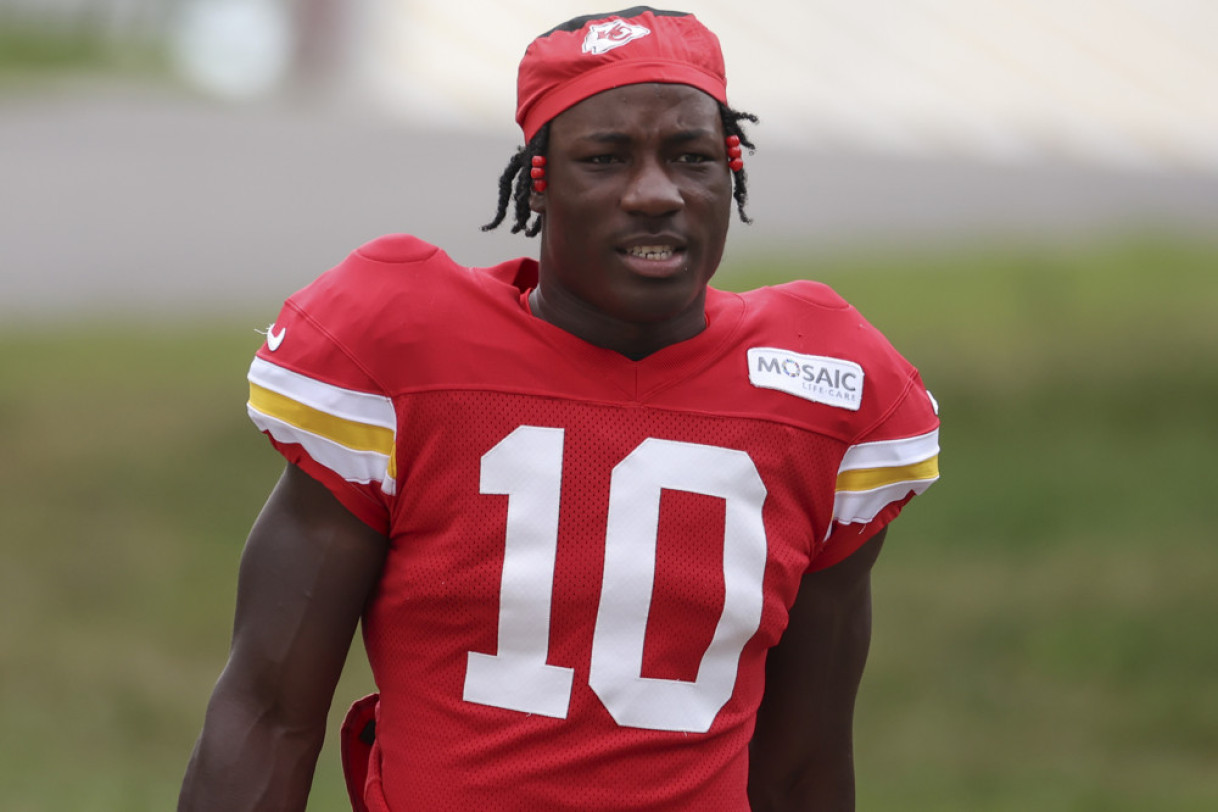
Matt Donnelly's fantasy football backup running backs to target. His top handcuff RBs to draft and stash, including Emmett Johnson and Racchad White.
Late-round running backs aren’t fillers. They’re calculated shots at players who have a realistic path to becoming 200-, 250-, or even 300-touch contributors, with the best late-round targets often checking more than one box.
When evaluating backup running backs, I’m looking for four specific categories that create that path: the 1B/standalone value back, the ambiguous backfield back, the contingent handcuff, and the explosive talent backup.
Here are four "backup" running backs who fit that profile and will have much larger roles than many fantasy managers anticipate in 2026.
Bookmark our updated and revamped fantasy football rankings portal for all league formats!PPR rankings | Half-PPR rankings | Standard rankings | Rookie rankings | Superflex rankings | Dynasty rankings | Who To Start? | Injuries | Matchup Ratings | Strength of Schedule
Backup Running Back Sleepers to Draft for Fantasy Football
Contingent / Handcuff RB: Emmett Johnson
The contingent handcuff is the classic “if the guy ahead of him gets hurt, this player becomes an RB1” profile.
You want the clear No. 2 running back with legitimate talent, three-down ability, receiving skills, goal-line potential, and an offense capable of producing fantasy points. Limited competition behind him is a bonus.
Most importantly, there needs to be a realistic path to 200-300-plus touches if the starter misses significant time. That’s league-changing upside. Emmett Johnson primarily falls into this category, but he also brings the explosive talent we want from a late-round investment.
Kenneth Walker III is clearly the lead back for the Chiefs after signing in free agency, which means Johnson’s immediate fantasy value is tied heavily to Walker’s health. But this isn’t a situation where we should view Johnson as an irrelevant backup who only matters if something goes wrong.
At Nebraska in 2025, Johnson handled 251 carries and 46 receptions, totaling nearly 300 touches and demonstrating he can handle a significant workload.
What makes him particularly interesting is the secondary explosive profile. In the Chiefs’ preseason opener, Johnson carried the ball 12 times for 59 yards while adding three receptions. Penalties wiped out several positive plays, but the overall performance still generated attention.
.@Chiefs rookie RB Emmett Johnson runs HARD.
LARvsKC on @NFLnetwork
Stream on @NFLPlus pic.twitter.com/ITzTG25Jpe— NFL (@NFL) August 15, 2026
Andy Reid praised Johnson’s physical running and ability to create yards after contact. Camp reports have also highlighted his receiving development, with Johnson pushing for third-down opportunities.
Johnson already has a potential path to standalone value through his receiving ability and his ability to climb the depth chart. More importantly, if Walker were to miss time, Johnson has already demonstrated the workload profile necessary to handle a massive role.
Good offense? Check.
High-volume college background? Check.
Receiving ability? Check.
Clear path to significant volume if Walker misses time? Check.
Late-round cost? Check.
Can Johnson become a 300-touch player if Walker misses time? If you believe the answer is yes, Johnson becomes one of the best examples of our 300-touch contingency concept. We aren’t drafting him because we expect 300 touches.
We’re drafting him because there is a realistic scenario where he gets them.
1B / Standalone Value RB: Mike Washington Jr.
The next category is different.
The 1B/standalone value back doesn’t need an injury to become fantasy relevant. Instead, you’re looking for a player who can carve out 8-15 touches per game through rushing attempts, receiving work, goal-line opportunities, or red-zone usage.
The goal is to find a back who has a usable fantasy floor today while still possessing significant upside if his workload expands. Mike Washington Jr. is an excellent example.
The Raiders give us an especially interesting situation because of Klint Kubiak’s history of using multiple running backs. In Seattle last year, Walker handled 221 carries while Zach Charbonnet still received 184. Kubiak has also demonstrated a willingness to involve running backs heavily in the passing game. During his time in New Orleans, Alvin Kamara saw 89 targets under Kubiak.
That matters for Washington because he doesn’t need Ashton Jeanty to get hurt to have fantasy value. The question is whether Washington can establish a role of roughly 10-12 touches per game while Jeanty remains healthy.
The rookie Mike Washington Jr. TAKES OFF for 53 yards 😤
Stream on @NFLPlus pic.twitter.com/dIDqYckE2T
— NFL (@NFL) August 14, 2026
At 6-foot-2 and 223 pounds, Washington has the size to handle physical rushing duties and potentially contribute around the goal line.
Washington's addition to the Raiders' backfield creates an interesting combination. You have a talented starter in Jeanty, but you also have an offensive system that has historically been comfortable distributing work between multiple running backs. Washington was viewed as a natural 1B candidate from the moment the Raiders drafted him, and that’s exactly the type of situation we want to attack in the late rounds.
You aren’t drafting pure hope. You’re betting that Kubiak creates enough of a two-back system for Washington to become a weekly FLEX consideration, while the injury scenario gives him the potential to become an RB1.
The bet is simple:
Kubiak creates fantasy-relevant roles for multiple running backs.
If Washington gets 10-12 touches per game with receiving or goal-line opportunities, he has standalone value.
If Jeanty misses time, the ceiling becomes massive.
That combination is exactly what the Hero RB strategy wants from a late-round running back.
Ambiguous Backfield RB: Rachaad White
The third category is the ambiguous backfield running back.
This is the situation where there isn’t a clearly established RB1. You’re looking for a player who can win the job outright, earn a 50/50 or 60/40 split, or emerge from a competition created by a new coaching staff or an unproven depth chart. The key difference is that you don’t need an injury.
The player needs to earn the workload. Rachaad White in Washington is one of the cleanest examples. White may begin the season in more of a complementary role, with an emphasis on receiving work, but the opportunity exists for that workload to grow significantly.
That’s exactly what makes ambiguous backfields so appealing. There isn’t a starter you have to wait to lose. White just has to outperform Jacory Croskey-Merritt and Kaytron Allen.
ANOTHER TOUCHDOWN FOR RACHAAD WHITE!
29.1 FANTASY POINTS!!!! pic.twitter.com/9JtO0CFbfI
— NFL Fantasy Football (@NFLFantasy) October 22, 2024
White brings something particularly valuable to the table: proven receiving ability. White has recorded 205 receptions across his first four NFL seasons, giving him a receiving floor that many of his competitors don’t possess.
White has also demonstrated that he can handle a massive workload. In 2023, White recorded 272 carries and 64 receptions, finishing with 1,539 total yards from scrimmage. That is the 300-touch history we’re looking for.
Now imagine getting a player with that workload history at an ADP that doesn’t fully account for his previous production or his potential role in Washington.
That’s why I would label him:
The bet isn’t that White is automatically Washington’s RB1.
Washington hasn’t established a definitive RB1, and White has the talent, receiving ability, and a proven track record to win a much larger share of the workload than his current draft cost would suggest. That’s a much smarter late-round investment than simply taking the lowest-upside running back listed first on a depth chart.
Explosive / Talent-Based Backup: Jonah Coleman
The fourth category is the explosive talent backup. This is the pure lottery ticket.
The player may not have much of a workload right now, but his talent, efficiency, and offensive environment suggest his role could expand dramatically. Unlike the contingent handcuff, you aren’t necessarily waiting for the starter to get hurt.
You’re betting that the backup is so productive that the coaching staff eventually has no choice but to give him more work.
That’s where Jonah Coleman comes in. Coleman fits this profile extremely well. Coleman brings the physical talent, rushing efficiency, receiving ability, and yard-creating skills we want from an explosive late-round running back. There is also an offensive environment that can create valuable scoring opportunities.
This is a different bet from Johnson. Johnson’s biggest path to a massive workload comes from Walker missing time. Coleman’s path can take multiple forms. Coleman could benefit from an injury ahead of him, but he could also earn additional opportunities simply by being more productive than the backs ahead of him. That distinction matters.
When evaluating these explosive talent backups, I want to see the underlying metrics that indicate whether the player can create fantasy value with limited opportunity. That means looking at yards after contact, missed tackles forced, explosive-run rate, yards per route run, receiving efficiency, college production, and draft capital.
Coleman has the profile we’re looking for. Other players can fit into this same explosive-talent category, including Keaton Mitchell and MarShawn Lloyd. Still, Coleman is one of the clearest examples of the type of player we want to target.
When we put all four categories together, the strategy for drafting key backup running backs becomes much easier to understand. We aren’t looking for four identical types of running backs. We’re looking for four different paths to massive opportunity.
You’re not drafting late-round running backs simply because you need depth. You’re drafting upside scenarios. The best late-round running backs are the ones where you can look at the depth chart, the offense, the player's talent, and the potential workload and say:
“If everything breaks right, this guy could get 300 touches.”
You don’t need all four to hit. You probably don’t even need two. If one of these late-round bets turns into a legitimate 250-300-touch running back, you can completely change the ceiling of your roster. That’s the goal.
Late-round picks aren’t fillers. They’re calculated shots at league-winning upside.
Who Should I Draft Fantasy Football Tool
Read more about the free Who Should I Draft tool here.
Compare up to four players and we'll tell you who to draft...

Using The Tool. This is a simple tool but very powerful. The first step is to enter the player names that you want to compare. In the first box, search for the first player's name. In the second box, search for the second player's name. Compare up to four NFL players at once, and then click the Who To Draft? button to see who the recommended draft picks are based on fantasy football rankings, projections, and more.
Improvements For Who Should I Draft? You may have noticed our Who Should I Draft? tool has gotten an overhaul. We've added lots of great features for you to give you as much information as possible to win your 2026 fantasy football drafts. You'll see NFL player tiles with bye weeks, stats, and projections, ADPs, strength of schedule, enhanced search results with data to compare, and a slick interface. We hope you enjoy!
How It Works. Our RotoBaller staff puts together their preseason fantasy football rankings and projections based on their research and updates them constantly throughout the preseason. That information is the core data that is powering the decision-making in this tool. When you search for player names, you will only see those players who are ranked.
Scoring Formats. Fantasy football managers play in various types of leagues, and this tool allows you to choose whether it's PPR scoring, Half-PPR scoring, or Standard (Non-PPR) scoring. The second thing you want to do is select the scoring format. There are three small radio buttons (small circles), so click on the scoring format you prefer. The results may vary based on the scoring format you select.
Popular Player Comparison Searches - Who To Draft
Below are some popular searches and comparisons from our Who To Draft tool for 2026 drafts for Emmett Johnson, Mike Washington Jr., Rachaad White, Jonah Coleman:
More Fantasy Football Analysis
Download Our Free News & Alerts Mobile App
Like what you see? Download our updated fantasy football app for iPhone and Android with 24x7 player news, injury alerts, rankings, starts/sits & more. All free!