




 RADIO
RADIO









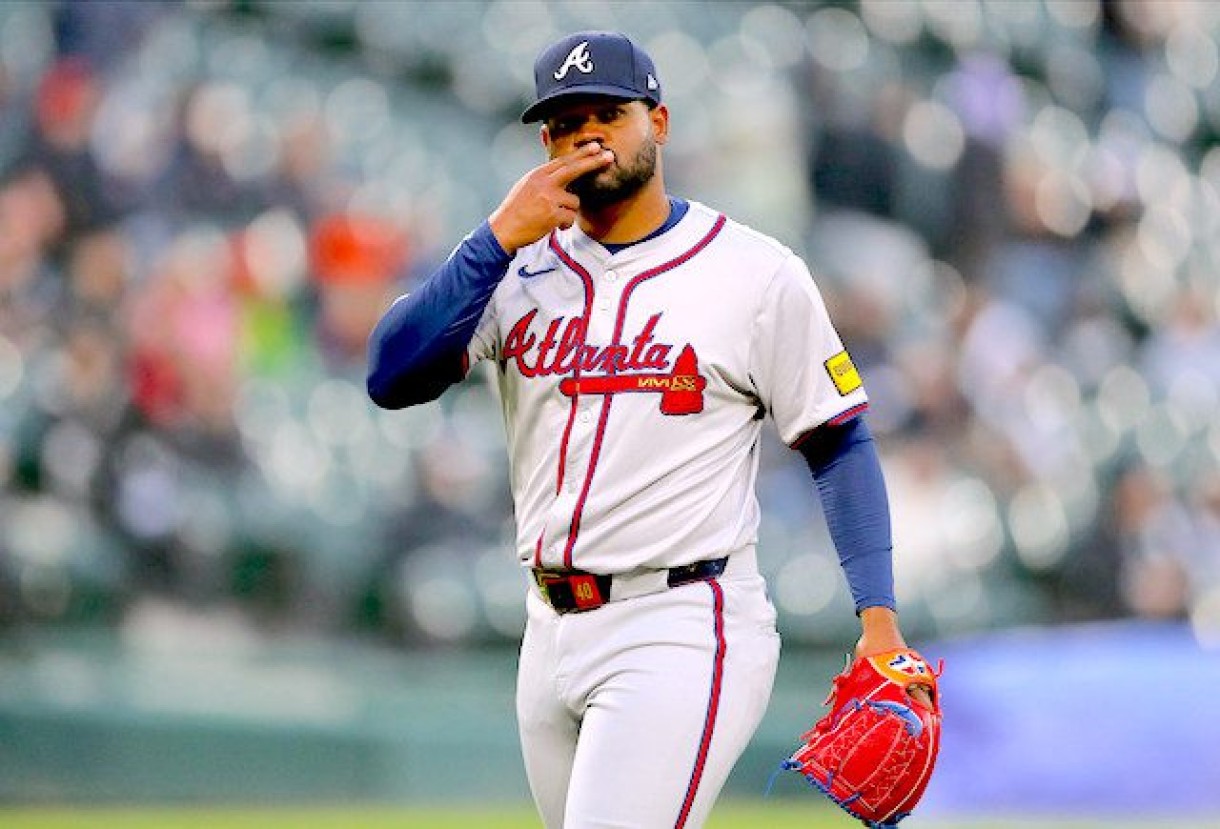
Elliott looks at pitchers with surprising starts recently. These SPs could emerge as fantasy baseball waiver wire targets for Week 18 in 2026, or just mirages.
Welcome to the "Are You For Real?" series as we dive into Week 18 of the 2026 fantasy baseball season. For those unfamiliar, this is a weekly column where we examine starting pitchers who had surprisingly strong starts over the past week and put them under the microscope to determine whether they're legitimate or just smoke and mirrors.
There are just two over two months remaining in the MLB season, and with the trade deadline looming, perhaps it's time to consider an acquisition for our fantasy teams. This week I'll be breaking down three veteran right-handers who have performed well as of late. First, we'll deep dive into Randy Dobnak's resurgence in Kansas City. Then, we'll examine Shane Bieber's comeback attempt in Toronto. We'll finish it off by looking at whether Reynaldo Lopez still has it, or if he's clinging to life on the mound.
Roster percentages are taken from Yahoo! and are accurate as of July 27.
Featured Promo: Save 50% off the regular price with discount code SUMMER, for a limited time. Exclusive access to our Team Sync platform, DFS cheat sheets, Lineup Optimizers, betting/prop picks, and exclusive content from Nick Mariano and Eric Cross! GAIN ACCESS NOW
Randy Dobnak, Kansas City Royals – 1% Rostered
2026 Stats (prior to this start): 14 IP, 1.93 ERA, 5.68 FIP, -1.6% K-BB%
07/23 @ DET: 5 IP, 4 H, 0 ER, 1 BB, 3 K
Dobnak was effective yet again on Thursday, blanking the Tigers for five innings of shutout ball, lowering his season-long ERA to 1.42 in the process. Dobnak has sort of teetered between AAA and the majors the last few years, but he currently has a spot in the Royals' rotation.
With Cole Ragans, Kris Bubic, and Stephen Kolek all shelved with injury, Dobnak certainly has the chance to carve out a permanent role for himself if he can continue performing. But is he worth the add to your fantasy team?
Originally an undrafted free agent, I must share with you that Dobnak pitched for an independent team called the Utica Unicorns before the Minnesota Twins gave him a shot with a minor league deal.
Dobnak had some success early on with Minnesota, pitching to a 1.59 ERA in 28.1 innings in 2019. That earned him a five-year, $9.25 million contract extension, though he never recaptured his rookie success. Dobnak works with a five-pitch mix, consisting of a sinker, sweeper, changeup, four-seamer, and slider.
Dobnak’s most used pitch this season has been the sinker, which he’s thrown 40.8% of the time. That is slightly under his 44.9% career mark, but right in line with how he’s been using the pitch in both the majors and minors in recent years.
A 91.8 mph offering, Dobnak isn’t exactly bringing the heat on the mound. In fact, he ranks in just the 14th percentile of fastball velocity this season. Velocity isn’t everything, but a lack of it can mean an uphill climb for a pitcher.
Dobnak’s sinker has been mostly effective thus far, with opponents hitting .273 with a .394 SLG and a .360 wOBA. Dobnak has done an excellent job inducing groundballs with the sinker, as he has a 73.3% ground-ball rate and a -6-degree average launch angle against. He’s only thrown 19 total innings, so this is a very small sample size, but this is exactly what we’d want to see from a sinkerball pitcher like Dobnak.
Unfortunately, the expected stats suggest regression could be coming for Dobnak. He has a .352 xBA, .455 xSLG, and a .412 xwOBA against his sinker. He is also allowing a 93 mph average exit velocity against. If he can sustain a high ground-ball rate, it should limit the damage with this pitch, but these expected stats are not encouraging.
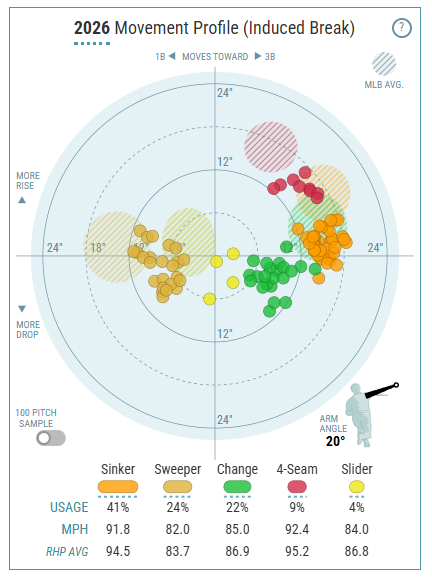
It’s sort of a strange pitch, from a measurables perspective as well. Dobnak gets a ton of drop and movement with the pitch, but it has an ultra-low 1953 RPM spin rate. Here’s a look at Dobnak’s pitch movement profile for this season (sinker in orange).
Now here’s a look at the pitch in action from this start.
— Elliott Baas (@ElliottBaasBB) July 27, 2026
Between the low arm angle, heavy drop, and lack of spin, this pitch definitely looks a little funky as it travels to home plate. With the sinker’s strong movement and a unique shape, it’s easy to see how Dobnak induces so many grounders with this pitch. It’s also easy to see how a mistake could be punished, as a missed spot could mean Dobnak is serving up meatballs, extra saucy.
If Dobnak had more of a reliable track record, I might be able to believe he can walk the tightrope and make it work with this 91 mph sinker as his primary fastball. But he’s barely pitched in the majors the last five years, and when he has, the results have been mixed. Pitchers can and have survived and even thrived with subpar velocity, but with Dobnak I need to see it first.
His next most used pitch has been the sweeper, which Dobnak has thrown 23.9% of the time this season. An 82 mph offering, Dobnak’s sweeper is best when it’s low and slow, not dissimilar to a good chili. Like the sinker, Dobnak’s sweeper has strong movement, with lots of vertical drop. It also has a high (for Dobnak) spin rate of 2630 RPM. Here’s an example of the pitch from this season.
— Elliott Baas (@ElliottBaasBB) July 27, 2026
Adjusts glasses. Hey dad, I don’t see too well. Is that Dobnak in that video?
In fact, that is Dobnak, slinging swoopy sweepers with a sunken arm slot. His sweeper has been quite effective thus far, with batters hitting just .167 with a .417 SLG and a .279 wOBA off the pitch. Dobnak also has an impressive 35.7% whiff rate with his sweeper.
But again, we are dealing with a very small sample size and the expected stats aren’t as rosy. Dobnak has a .269 xBA, .528 xSLG, and a .363 xwOBA with his sweeper, as well as a 94.1 mph average exit velocity.
It’s difficult to tell which way the tree will fall with Dobnak’s sinker, whether it’ll be an effective strikeout pitch, or a liability that gives up too much hard contact. Based on Dobnak’s track record, I’d lean towards the latter; however, with better command, I think this could be an effective pitch.
Dobnak’s third most used pitch this season has been the changeup, which he’s thrown 22.1% of the time, though he used it 33% of the time against Detroit on Thursday. An 85 mph offering, Dobnak’s changeup is hard relative to his fastball and has a ton of drop. Let’s have a look at Dobnak’s pitch movement profile again (changeup in green).
Here’s a look at the pitch itself.
— Elliott Baas (@ElliottBaasBB) July 27, 2026
Okay Dobnak, okay. The pitch has performed well thus far too, with a .176 AVG, .235 SLG, and .179 wOBA against. Unlike his other pitches, the expected stats don’t predict doom. Dobnak has a .195 xBA, .242 xSLG, and a .188 xWOBA with his changeup this season.
His 29.8% whiff rate is solid, but good for someone with his profile. He’s probably benefitting from some BABIP luck with the changeup so far, but of his big three pitches, the changeup has the best chance to serve as an effective offering.
It’s only been 19 innings for Dobnak, so it is hard to put too much stock into his performance so far; however, there are some concerning metrics in his peripherals.
He has an awful 1.3% K-BB% (it was actually negative prior to the Detroit game), his ERA estimators are all near five, and a big part of his success has been a .254 BABIP and a 99.1% LOB rate. The BABIP won’t last, and the LOB rate is comically high, even if it’s only been four appearances for Dobnak.
My big problem in rostering a pitcher like Dobnak is an unbalanced risk-reward scale. At his best, Dobnak can give you a start like last Thursday: 5-6 innings of shutout or low-run ball with maybe 2-5 strikeouts peppered in, and maybe a win, though perhaps not in Kansas City. At his worst, he can singlehandedly tank your ERA and WHIP for the week. Most of the time, that player isn’t worth rostering.
Verdict:
Dobnak has found some early success in Kansas City, and his pitches do have strong movement and unique shapes, which gives him a level of deception. He’s also been great at inducing groundballs, especially with his sinker. Unfortunately, there are a lot of question marks behind his 1.42 ERA.
Dobnak isn’t a big strikeout pitcher, which can work in fantasy, but it’s tough when a pitcher both lacks K potential and gives up tons of walks. K-BB% can be one of the single-most telling statistics for a pitcher, and Dobnak’s is barely positive.
Plus he has ugly expected stats on his sinker and sweeper, plus he has an unsustainably low BABIP and unsustainably high LOB rate, plus he has a 5.06 SIERA. Throw in the fact that he pitches for a bad team with perhaps a temporary role, and it’s difficult to be interested.
Dobnak’s best-case scenario would be to emerge as a reliable back-end veteran type, and for fantasy that would mean he could be the occasional streamer in good situations. I don’t think Dobnak is there yet, and unless you are in a deep league or AL-only league, I think he’s best left on the wire. I'm definitely a little intrigued, but I'm not ready to pull the trigger on a roster spot for him yet. With Dobnak, let's wait and see.
Shane Bieber, Toronto Blue Jays – 49% Rostered
2026 Stats (prior to this start): 23.2 IP, 5.70 ERA, 6.87 FIP, 6.5% K-BB%
07/23 vs. TB: 7 IP, 3 H, 1 ER, 0 BB, 3 K
Bieber was excellent last Thursday, holding Tampa Bay to just one run over seven innings en route to his second straight victory. Bieber has started to pitch better as of late, posting a 1.53 ERA over his last three outings. The accomplished right-hander has battled plenty of injuries these past few seasons, but is Bieber finally ready to return to past form? Or, at least return to fantasy viability?
Originally a fourth-round pick by Cleveland back in 2016, Bieber had some decent prospect hype behind his name coming up, and at the time, Cleveland could do no wrong developing young pitchers. He had a decent showing his rookie year with a 4.55 ERA but a 3.23 FIP in 114.2 innings, but he really took off the year after.
Between 2019-2022, Bieber had a 2.91 ERA, 2.96 FIP, 10.9 K/9, and a 24.8% K-BB%. Oh, and a Cy Young award. He was genuinely an ace-level pitcher, but injuries started to take their toll in 2023. Between 2024 and 2026, Bieber has only made 15 total starts and has struggled to recapture his previous abilities.
Bieber works with a six-pitch mix consisting of a four-seam fastball, changeup, knuckle curveball, cutter, slider, and sinker. The slider and sinker haven’t seen a ton of usage this season, but the other four pitches have been used at least 13.5% of the time by Bieber.
When Bieber was at his best, it was mostly about control and command, as well as dominating with his four-seamer and curveball, but he’s actually begun using the changeup more often this season.
An 88.1 mph offering, Bieber’s changeup is rather hard considering his fastball is just 92.3 mph. It’s been his second-most used pitch at 21%, which is by far the highest usage rate Bieber has ever had, considering his career mark is 5.9%. The changeup has been far and away Bieber’s best pitch as well, with opponents hitting just .087 with a .130 SLG and a .201 wOBA.
This pitch has been especially good at inducing weak groundballs, as Bieber has an 87.6 mph average exit velocity and a -1-degree average launch angle against, which translates to a 63.2% ground-ball rate.
That ground-ball rate and the results so far have been great, but can Bieber sustain these results? The expected stats certainly don’t think so, as Bieber has a .232 xBA, .268 xSLG, and .304 xwOBA with his changeup this season. Those would be solid results with the changeup, but also a big regression given how the pitch has performed thus far.
It's hard to envision a scenario where Bieber maintains his current .105 BABIP with the changeup, even with his propensity to get groundballs with the pitch. He also has an underwhelming 26.1% whiff rate with the changeup, which means he won’t be giving us many strikeouts and a lot of balls will be in play off this change. This changeup is a solid pitch, but it is undoubtedly going to experience regression at some point.
Bieber’s most used pitch has been the four-seam fastball at 36.8%, which really isn’t a surprise to anyone who’s followed Bieber’s career, as he’s always been a fastball-heavy hurler. The problem, however, is the quality of the fastball he’s tossing.
Bieber was never a flamethrower, but at his peak he could average around 94 mph. Now, he’s sitting around 92 mph, putting him in the 18th percentile in fastball velocity among major league pitchers. Bieber gets above-average spin and movement with the pitch as well, putting up 2384 RPM and averaging 17.2 inches of induced vertical break and 10.9 inches of arm-side run with his fastball.
The fastball has had mixed results as well. Batters are only hitting .235 off the pitch, but they have a mammoth .618 SLG and a .399 wOBA. They also have a .258 xBA, .577 xSLG, and a .396 xwOBA. This pitch has been crushed for a 94.1 mph average exit velocity and a 22-degree average launch angle. It’s no wonder the slugging against this pitch is so high; Bieber is giving up tons and tons of hard-hit flyballs.
The way I see it, this is happening to Bieber for two reasons. One, decreased fastball effectiveness. The pitch is just softer and lacks the same movement it once had, and he cannot use it the same way he could in his Cleveland days. Two, wavering command and control.
Command was Bieber’s elite skill, the thing that separated him from the pack. He had good stuff at his peak, but he really became a superstar due to how he could locate his pitches. Unfortunately, he has not displayed the same artistry with the pill this season.
With the fastball specifically, Bieber has a 38% ball rate, compared to a 32% ball rate for his career. He also has a career-low 49.2% zone rate, the first time he’s been below 55%. This could be Bieber struggling with command, or it could be a lack of confidence in the fastball, or both.
Because a zone-heavy approach like Bieber’s old style can be risky but effective for the right arm. Bieber doesn’t seem to have the physical gifts to pitch that way anymore, and if he can’t pitch like that, how will he have consistent success? That's a question only Bieber and his organization can answer.
Bieber’s third-most used pitch this season has been the knuckle curve, which he has thrown 18.1% of the time. The knuckle curve was once Bieber’s hammer, his go-to strikeout offering, but the pitch has been absolutely pulverized by opposing hitters this season.
Batters are hitting .423 with a .577 SLG and a .443 wOBA off Bieber’s curveball this season. The expected stats are technically better, but he still has a .356 xBA, .531 xSLG, and .393 xwOBA with the pitch, so we can't exactly expect better going forward.
There have been a few issues with the curveball for Bieber this season, and I think it comes down to inconsistent command. He has a 46.8% zone rate with the knuckle curve, which is 10% higher than his career mark.
When he executes with this pitch, it can have strong outcomes, as evidenced by his 44% outside contact rate and 50% outside swing (chase) rate. Unfortunately, when he misses, things tend to go boom. Bieber has a 92% zone contact rate against this pitch, as well as a 54.5% hard hit rate.
He may have a 1-degree average launch angle against, but he also has a 36.4% line drive rate with the curveball. Line drives are the most likely batted ball type to land for a hit, and a 36.4% rate is very high, especially for a breaking ball. Sure, he will likely experience regression from his .500 BABIP against with this pitch, but there’s nothing within these numbers that suggests a turnaround or consistency is around the corner for Bieber.
Verdict:
Bieber has been pitching better as of late, but it’s still difficult to trust him at this juncture. He’s shown inconsistent command, a lack of dominance and K upside, and he’s giving up homers left and right. It’s taken a .275 BABIP and an 81.9% LOB rate to get him to a 4.70 ERA. His 5.82 FIP and 7.23 xERA suggest that Bieber has pitched much worse than his surface stats tell.
He’s taken a more changeup-heavy approach, and while the changeup has been effective, it’s thrived in part due to an abnormally low BABIP and has underwhelming strikeout numbers. Bieber has lost two full mph on his heater, and that pitch has been crushed for a .618 SLG against. His most famous pitch, the knuckle curve, has been destroyed as well for a .423 AVG and .577 SLG against.
The good things about Bieber are that he pitches deep into games and has a veteran track record. He has earned quality starts in his last two appearances, and he likely has the leash to pitch deep into games if he can keep runs off the board, that is. He has also shown us the ability to perform at a high level in the past, which shouldn’t count for nothing, even if I think the days of ace-hood are behind him.
Bieber seems to be at a crossroads in his career right now. He can either rework himself into a viable veteran innings eater, maybe like current Seth Lugo, or he can bounce from team to team trying to find past success until he flames out completely, much like Noah Syndergaard or Matt Harvey.
For now, I don’t really want a player facing a crossroads on my fantasy team as we approach the final two months, so I think Bieber is best left on the wire in all but deep leagues.
Reynaldo Lopez, Atlanta Braves – 21% Rostered
2026 Stats (prior to this start): 66 IP, 3.95 ERA, 4.58 FIP, 11.3% K-BB%
07/26 @ BAL: 5.2 IP, 5 H, 0 ER, 1 BB, 6 K
Lopez was handed a tough-luck no decision on Sunday after blanking Baltimore for 5.2 innings, notching six strikeouts along the way. It’s been an up-and-down year for Lopez, who has bounced between the bullpen and rotation for Atlanta, never quite finding his footing in either role.
With Spencer Schwellenbach and Spencer Strider shelved for the foreseeable future, Lopez certainly has the opportunity to carve out a more permanent starting role for himself, if he can perform. He’s been an effective pitcher at times in the past, and he put up a 1.99 ERA and 19.5% K-BB% in his last full season, 2024. Can Lopez be a fantasy asset these last two months, or is this steak overdone?
Originally an international free agent signed by Washington out of the Dominican Republic, Lopez was a pretty big prospect in his day, often finding himself on top-100 prospect lists in the mid-2010s. He initially struggled as a starter and found life as a reliever, but Atlanta transitioned him back into the rotation in 2024 to great success. Lopez works with a four-pitch mix consisting of a four-seam fastball, slider, curveball, and changeup.
Lopez’s most used pitch this season has been the four-seam fastball, which he has thrown 54.8% of the time. His four-seam usage hasn’t changed much since rejoining the rotation on 6/26, as he has a 54.62% fastball usage rate in the six starts since that date.
A 94.2 mph offering, Lopez’s velocity is slightly below average, ranking in the 44th percentile of fastball velocity among MLB pitchers. Lopez has also experienced diminished velocity, as he could sit 97-98 during his peak as a reliever, and was throwing 95.5 mph in 2024, his last full season as a starter.
Lopez’s fastball has been handled rather well by opponents so far, as batters have a .281 AVG, .444 SLG, and .349 wOBA against Lopez’s heat. The expected stats align rather closely with the actual results, as Lopez has a .279 xBA, .464 xSLG, and .354 xwOBA with his fastball this season.
The velocity is below average, sure, but we’ve seen plenty of pitchers get by with below-average heat. But pitchers who can overcome that physical deficiency usually make up for it by being exceptional in some other way, such as movement, spin, extension, and command. Unfortunately for Lopez, he has proven to be average or worse in all those categories as well.
He only averages 2065 RPM with his fastball, averages about 16.6 inches of induced vertical break, and gets 6.5 feet of extension. When he’s at his best, Lopez has stellar command and does a great job limiting walks, but it’s been a struggle this season, as evidenced by his 3.64 BB/9 and 9.5% BB rate.
Lopez just doesn’t have the juice to patch over his other shortcomings. He does have a reduced 6.8% BB rate since rejoining the rotation, which is certainly an encouraging sign, but I’d still have a hard time trusting Lopez in my lineup based on how his fastball looks.
Lopez’s next most used pitch has been the slider, which he’s thrown 30.8% of the time. The fastball-slider combo has been Lopez’s bread and butter as a major leaguer, and is what made him such an effective late-game reliever in seasons past. But the slider’s velocity is also diminished, down all the way to 84.1 mph. Even so, it’s still been a strong secondary offering this season.
Batters are hitting just .211 off Lopez’s slider with a .355 SLG and a .292 wOBA. He also has a 34.6% whiff rate, a 4-degree average launch angle against, and a 51.9% ground-ball rate with the pitch. These are all positive markers for a breaking ball, and despite diminished velocity, Lopez still gets plus movement with the slider. Here’s an example of the pitch from this season.
— Elliott Baas (@ElliottBaasBB) July 27, 2026
Ok, so not exactly like his teammate Chris Sale, but still a very solid breaking ball. This pitch should be able to both generate whiffs and induce favorable contact for Lopez, and a strong set of secondaries could help extend his career as his fastball deteriorates.
The fastball-slider have made up 85.6% of Lopez's pitches this season, but it’s worth touching on his curveball as well. A 74.2 mph offering, it’s a relatively low-spin curveball averaging 2285 RPM, but Lopez gets tons of drop and break with the pitch. Here’s an example from this season.
— Elliott Baas (@ElliottBaasBB) July 27, 2026
That was such a lollipop; I wonder if there’s a tootsie roll at the center. It’s been a very effective offering for Lopez this season as well. Batters are hitting just .147 off the curve with a .412 SLG and a .268 wOBA. The expected stats support these results, with a .154 xBA, .319 xSLG, and a .238 xwOBA.
Opponents have a measly 79.2 mph average exit velocity off this pitch, along with a 48.3% ground-ball rate and a microscopic 6.9% line drive rate. To quote Austin Powers, get in my belly! But also, yeah baby, yeah! Cause that’s what we like to see with a curveball: big movement, soft contact, and lots and lots of groundballs.
Lopez only has a 21.7% whiff rate, so it’s not necessarily a strikeout pitch, but the curveball has been (mostly) effective for him throughout his MLB career, and I think it may benefit Lopez to ramp up his curveball usage, both to help him against lefties, whom he sometimes struggles with, and to take pressure off his fastball.
Verdict:
Lopez had a breakout season in 2024, but injuries and inconsistency have prevented him from recapturing past success. His fastball seems to have regressed to the point where it’s more of a liability than an asset on the mound. He is a full four mph below his peak velo, and a full tick below his 2024 four-seam velocity. He might be able to skate by with better command, but I’d need to see more before trusting Lopez every time out.
His slider is still an effective strikeout pitch, and his curveball has done a great job at inducing groundballs and weak contact. I would love to see Lopez reinvent himself as a breaking ball specialist and deemphasize the fastball, but a change that drastic may not occur midseason, or at all.
Lopez does seem like a more viable streaming option than the other two pitchers covered in this article. He’s had more recent success than Dobnak or Bieber, and he at least pitches for a good team that will support him and perhaps allows him to earn some wins. In deeper leagues, he’s a fine back-end rotation piece, but I would limit exposure against tough opponents and try to choose spots carefully.
More Fantasy Baseball Advice
Download Our Free News & Alerts Mobile App
Like what you see? Download our updated fantasy baseball app for iPhone and Android with 24x7 player news, injury alerts, sleepers, prospects & more. All free!