




 RADIO
RADIO










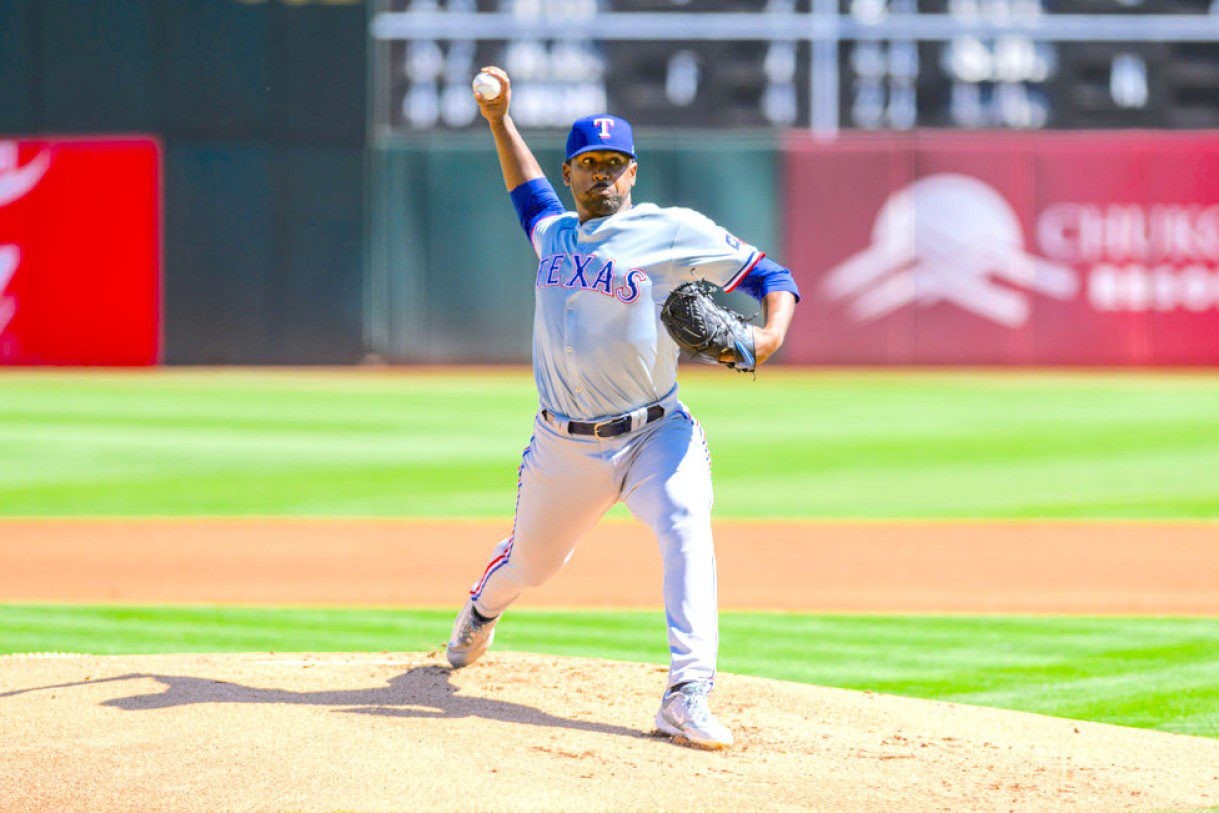
Elliott looks at pitchers with surprising starts recently. These SPs could emerge as fantasy baseball waiver wire targets for Week 11 in 2026, or just mirages.
Welcome back to the "Are You For Real?" series as we dive into Week 11 of the 2026 fantasy baseball season. For those unfamiliar, this is a weekly column where we examine starting pitchers who had surprisingly strong starts over the past week and put them under the microscope to determine whether they're legitimate or just smoke and mirrors.
We've got an interesting trio of hurlers to break down this week, as these guys have gone under the radar after pitching well in their last couple of starts. First, we'll deep dive into Zack Littell's recent success in Washington. In case you missed it, Littell has a 2.27 ERA since May 1 and five consecutive wins. Then, we'll analyze the recent success of Kumar Rocker, who shut down Cleveland on Friday. We'll finish with a look into the ever-intriguing Tatsuya Imai, who has pitched well lately despite injury and volatility.
Roster percentages are taken from Yahoo! and are accurate as of June 8.
Featured Promo: Save 50% off the regular price with discount code CHAMP, for a limited time. Exclusive access to our Team Sync platform, DFS cheat sheets, Lineup Optimizers, betting/prop picks, and exclusive content from Nick Mariano and Eric Cross! GAIN ACCESS NOW
Zack Littell, Washington Nationals – 18% Rostered
2026 Stats (prior to this start): 59.1 IP, 5.01 ERA, 6.22 FIP, 6.2% K-BB%
06/06 @ ARI: 5 IP, 2 H, 1 ER, 1 BB, 4 K
Littell was fantastic on Saturday, holding the Diamondbacks to just one run on two hits over five innings. Littell has quietly been rolling as of late, as Saturday’s start was his fifth consecutive victory, improving his record to 6-4. He’s been a different pitcher since the Calendar flipped to May, putting up a 2.27 ERA and 3.47 FIP in 35.2 innings since May 1. Going into May, Littell was sporting a 7.85 ERA and 9.04 FIP in 28.2 innings. What changed, and is he now relevant for fantasy?
Originally an 11th-round pick by the Mariners back in 2013, Littell was not considered a big prospect coming up and was expected to serve as a reliever in the big leagues. That’s exactly what he did for the first five years of his career before being converted into a starter by Tampa Bay in 2023. He’s been a mixed bag as a starter, sometimes maintaining solid ratios, other times serving up homers left and right. He works with a five-pitch mix consisting of a slider, four-seam fastball, splitter, sinker, and sweeper.
His most used pitch this season has been the slider at 28.6%, which just edges out his four-seam fastball usage at 28.2%. We’re going to start with the four-seamer here, because I think four-seam usage has been a key to Littell’s recent success. A 91.6 mph offering, Littell’s fastball is bottom-10 percentile in MLB for velocity. It also lacks significant spin or movement, with below-average marks in terms of average RPM and average fastball rise.
The four-seamer has also been hit pretty hard by opponents this season. Batters are hitting .310 off the pitch with a .563 SLG and a .424 wOBA. He also has a 94 average exit velocity against and just a 12.4% whiff rate.
Those are all bad results, and the measurables on Littell’s fastball suggest it could be one of MLB’s weakest offerings among starters. Yet, when trying to map out shifts and changes in Littell’s game during the hot streak, his four-seam usage is the clearest difference. Littell threw his four-seamer 23.3% of the time prior to May 1, but after May 1 has thrown it 31.8% of the time.
He’s also getting much better results, as batters were hitting .389 with a .778 SLG off his four-seamer prior to May 1, but are hitting .237 with a .368 SLG since May 1. The whiff rate has almost doubled after May 1 as well.
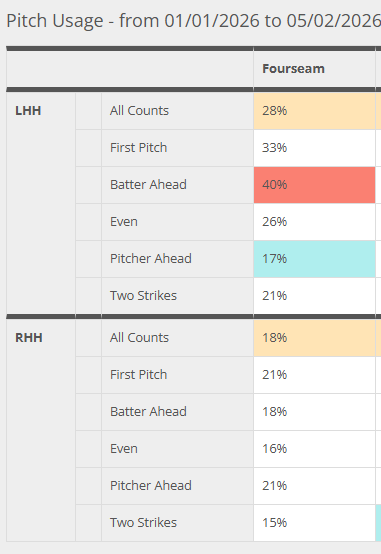
There weren’t any gains in velocity or movement to explain this shift either. How did Littell’s fastball go from liability to weapon on the mound? Since there doesn’t seem to be any improvements to the pitch itself, let’s look at how Littell has been using it. Here’s a comparison of Littell’s four-seam usage prior to May 3 and from May 3 on, which was the start of his hot streak.
Pre-May 3
Post-May 3
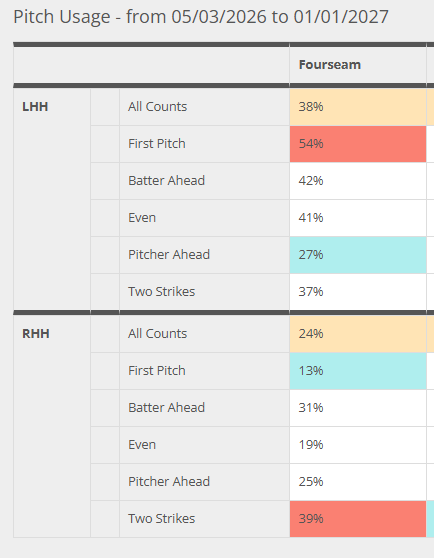
Obviously, he’s using the pitch a ton more, but he’s also using it differently. He’s thrown it with two strikes much more often, which is unusual since this isn’t your traditional strikeout pitch. He also really ramped up his usage when behind against righties, and overall against lefties.
But there has to be something more here. Even if Littell suddenly decided to be more aggressive with his fastball and make it more versatile, that doesn’t mean it should be effective. This is still the same low-spin, low-movement, 91 mph heater he was working with at the start of the season.
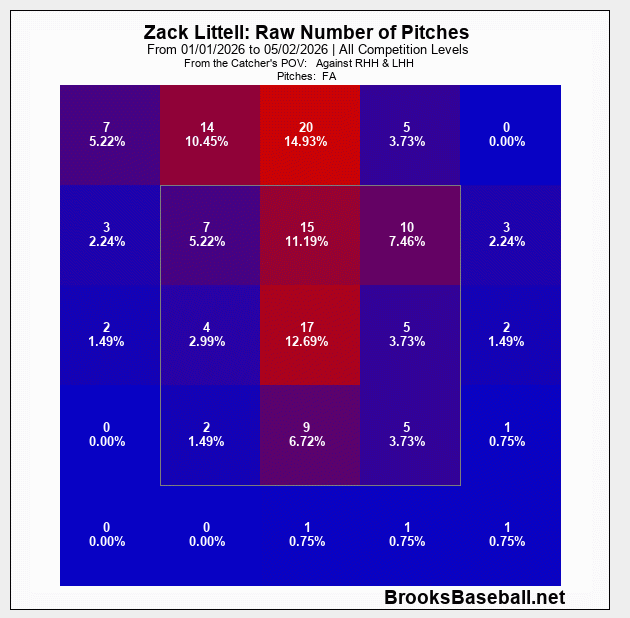
Part of this could be that Littell was signed late this offseason, inking a deal on March 10 with the Nationals after Spring Training had already begun. He could’ve been behind due to a late start in Spring and only recently got caught up. But also, I think it’s worth looking at Littell’s four-seam heatmaps from pre-May and May-now. Here they are below.
Pre-May 3
Post-May 3
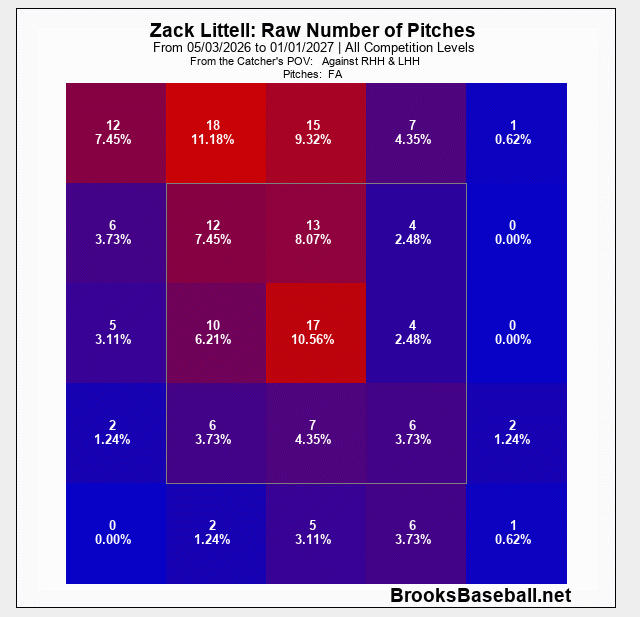
So maybe not a drastic shift, but Littell is less focused on hammering the middle parts of the zone and above the zone, and is more willing to try and paint corners. Control has always been one of Littell’s strong suits, and I think he would be capable of taking and executing a new approach like this.
Does this explain everything? Not quite, and I’m still rather skeptical of Littell’s recent hot streak. He’s been riding high on a .219 BABIP and 78.3% LOB rate since May 1, and his batted ball profile (including hard hit rate) did not change significantly during his hot streak. While I do think these changes in approach may have helped Littell, I think luck is a bigger factor in his recent success.
The slider has also been a big part of Littell's game this season, and has gotten better results than the four-seamer as well. An 87.9 mph offering, Littell’s slider is sort of hard relative to his fastball velocity. An 88 mph slider is above average, which is unusual since Littell is in the bottom-10th percentile in fastball velocity. It also has unique movement for a slider, with 10.8 inches of induced vertical break and 1.4 inches of glove-side movement. Here’s a look at Littell’s pitch movement profile (slider in yellow).
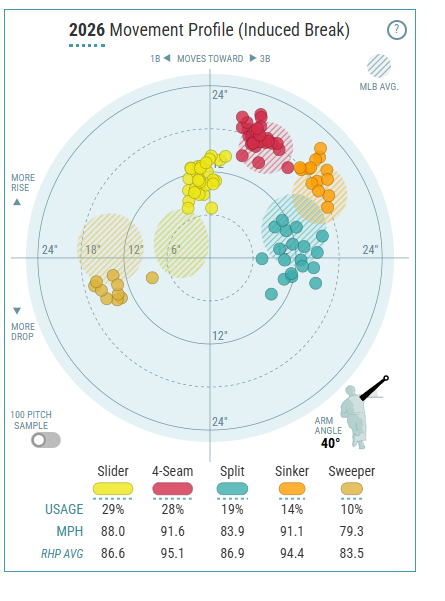
You don’t see many sliders with that shape. Here’s a look at the pitch itself from this season.
— Elliott Baas (@ElliottBaasBB) June 8, 2026
Ok, not exactly Chris Sale’s slider, but one can see how this pitch could be effective. Batters have really struggled against this pitch as well, with a .200 AVG, .333 SLG, and .274 wOBA against.
Unfortunately, the expected stats paint a much different picture of Littell’s slider. The pitch currently has a .284 xBA, .479 xSLG, and .372 xwOBA. He also has a pitiful 22.4% whiff rate with the pitch. I consider under 30% underwhelming for a breaking ball/slider, and 22.4% is just paltry. He had one measly whiff with the slider in this start as well, good for a 14% whiff rate.
The fact is, this slider doesn’t seem to have the juice to be even an average strikeout pitch. Littell has a long history of poor results and underwhelming strikeout numbers with his slider, and I don’t see that changing anytime soon. As it stands, his current 14% strikeout rate would be the lowest among qualified pitchers if Littell had enough innings to qualify.
As for his other pitches, the only real standout has been the splitter. An 83.9 mph offering, Littell’s splitter is a split-change with low spin (1076 RPM) and decent break. Batters are hitting .183 off the pitch, but a .233 xBA, .462 xSLG, and .300 xwOBA again tell another story. He also has a 91 mph average exit velocity against with this pitch, and just a 17.9% whiff rate. So even though this has been one of his best pitches, it’s still underwhelming with questionable results.
Verdict:
It’s hard to deny just how good Littell has been as of late, posting a 2.27 ERA in his last seven games and earning five straight wins. He’s made some shifts in how he uses his fastball, using it more aggressively in non-traditional counts. He’s also started changing his pitch location, peppering the four-seamer throughout the upper part of the zone instead of concentrating on the middle.
Even with this change, it’s hard to buy into recent success. Littell has been riding high thanks to a .219 BABIP and 78.3% LOB rate since May 1, but he’s still giving up a ton of hard contact and flyballs, and still not generating whiffs or strikeouts. At the end of the day, his stuff just isn’t exceptional, and he’s sort of always walking a tightrope on the mound.
For fantasy, I think he can be used in deeper leagues or as someone to ride the hot hand with, but don’t make him part of your long-term plans. If your season hinges on the continued dominance of Littell, I’m sorry, but it might be over for you. I think he can be left on waivers in most places, only to be added for the occasional stream against a weak opponent.
Kumar Rocker, Texas Rangers – 10% Rostered
2026 Stats (prior to this start): 56 IP, 3.54 ERA, 4.14 FIP, 7.9% K-BB%
06/05 vs. CLE: 5 IP, 6 H, 2 ER, 1 BB, 5 K
Rocker was effective once again on Friday, holding the Guardians to two runs over five innings in the no decision. Rocker is another pitcher who has been throwing it well lately, with a 1.88 ERA over his last five starts. He’s had a rocky (pun definitely intended) start to his big league career and hasn’t emerged as a consistent, reliable starter yet. Could this be the start of something for Rocker?
Originally the third overall pick by Texas in 2022, Rocker was a huge prospect coming out of Vanderbilt, alongside fellow Ranger Jack Leiter. He was dominant in college, and many thought Rocker would be a future frontline starter. His stock first took a tumble in 2021, after the Mets drafted him 10th overall and refused to sign him for medical reasons after the two sides could not agree on a signing bonus. Injuries have really held him back since then, though some scouts still hoped he could find his potential one day.
Rocker works with a five-pitch mix consisting of a slider, sinker, four-seam fastball, cutter, and changeup. It’s been all about the slider for Rocker this season, and that was especially true in this start. He threw the slider 43% of the time against Cleveland, and it has been a huge part of his game all season. His slider usage has even gone up slightly over his five-start run, going from 37% to 40% over his last five games.
An 83.4 mph offering, Rocker’s slider is soft relative to his 94 mph fastball. It also has three inches of drop, which is unusual for a slider. Let’s have a look at Rocker’s pitch movement profile so far this season (slider in yellow).
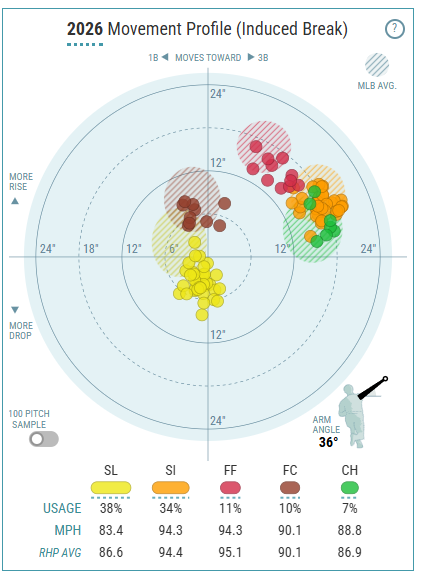
It’s sort of like the opposite of Littell. Littell’s slider is hard with a ton of rise, but Rocker’s is characterized by its heavy drop, soft velocity, and low spin rate. Here’s an example of the pitch from this season:
— Elliott Baas (@ElliottBaasBB) June 8, 2026
It sort of has a curveball quality to it, despite its low spin rate. Batters have really struggled against this pitch as well, with opponents only able to muster a .174 AVG, .239 SLG, and .196 wOBA. The expected stats support these results too, with a .176 xBA, .298 xSLG, and a .215 xwOBA. Rocker also has a 34.1% whiff rate with this pitch, which is solidly above average.
It makes sense that Rocker has relied on the pitch more often amid his hot streak. Not only is it his best pitch, but it was also touted as one of the best sliders among any pitching prospect. Sometimes called a “death ball”, Rocker’s slider has unique qualities that can make it an effective pitch, both at generating whiffs and inducing weak contact. Even when batters make contact, they only have an 87.5 mph average exit velocity and a 32.8% hard hit rate.
So Rocker has a great slider, but why hasn’t he pitched better up until now? He was awful last season and struggled at the beginning of 2026. Part of the reason is pitch selection. He only threw the slider 16% of the time last season, and has more than doubled his usage this year.
Another factor is…well…everything else. Rocker’s fastballs have been shown to be vulnerable against MLB hitters, and he has displayed poor control and command at times. Maybe this slider is good enough to make him a bullpen weapon, but he hasn’t put it all together to become a consistent starter yet.
Let’s first look at one of his biggest issues: his fastball. More specifically, his sinker. A 94.3 mph offering, Rocker began using the sinker as his primary fastball to marginal success last season, but the pitch has been pulverized by opponents this season. Batters are hitting .330 with a .505 SLG and a .422 wOBA off Rocker’s sinker. The expected stats are really close to the actual results, too, with a .331 xBA, .532 xSLG, and a .426 xwOBA.
Batters are crushing the pitch for a 91.4 mph average exit velocity, but what’s worse is the 8-degree average launch angle. Rocker had a 63.2% groundball rate with the pitch last season, but a 52.4% rate this season. It’s not a drastic shift, but every batted ball that isn’t a grounder is a line drive or flyball. Remember that Rocker is allowing an EV over 91 mph with this pitch. So for him, every time it’s not a grounder it could be trouble.
The sinker was more effective in every measurable way last season, including an extra mph of velo. There’s not a lot to be hopeful or optimistic about what we see in Rocker’s sinker this season. Even during this hot stretch, batters are hitting .303 with a .485 SLG off the pitch. The one positive would be that Rocker has reduced his sinker usage 5% over his last five starts. The less exposure this pitch has to major league bats, the better.
Then there’s his four-seamer, which Rocker has only thrown 10.7% of the time this season. He’s up to about 13% usage over his last five starts, so he is slowly trending up. Unlike the sinker, Rocker’s four-seamer has been bizarrely, almost unbelievably effective.
Batters are hitting .095 off the pitch with a .143 SLG and a .178 wOBA. He’s given up two whole hits—a double and a single—with his four-seamer this season. Also, 94.3 mph, Rocker’s four-seamer has an unusual shape. He doesn’t get much rise at all with just 11.9 inches of IVB, but he gets a ton of horizontal movement, averaging 9.8 inches.
The really interesting part about Rocker’s four-seamer is the stark contrast in performance when comparing last season to 2026. He may be dominating now, but last year the pitch was crushed for a .364 AVG, .709 SLG, and .475 wOBA. The shape has changed a little, with Rocker losing 1.3 inches of horizontal movement, but it’s still mostly the same pitch. The difference is how Rocker is using it.
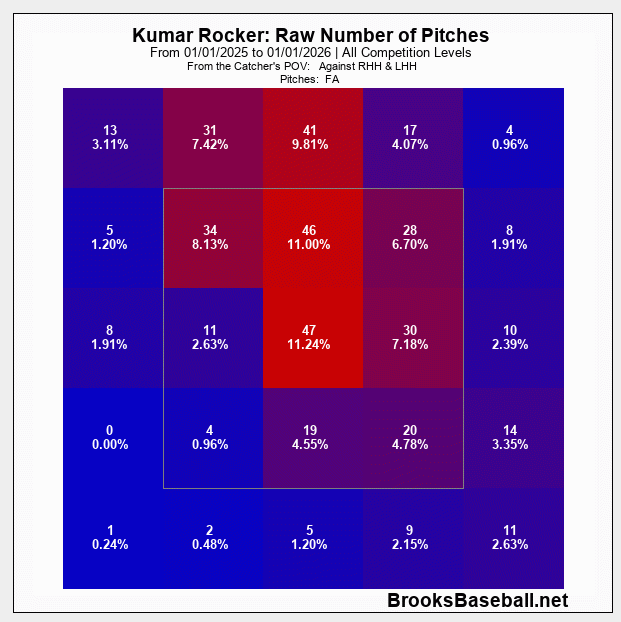
One of the biggest changes in Rocker’s four-seam usage is where he locates the ball. His zone rate was 64.3% last season with the four-seamer, but just 50% this season. Let’s compare his four-seam heatmaps from last season to this season.
2025:
2026:
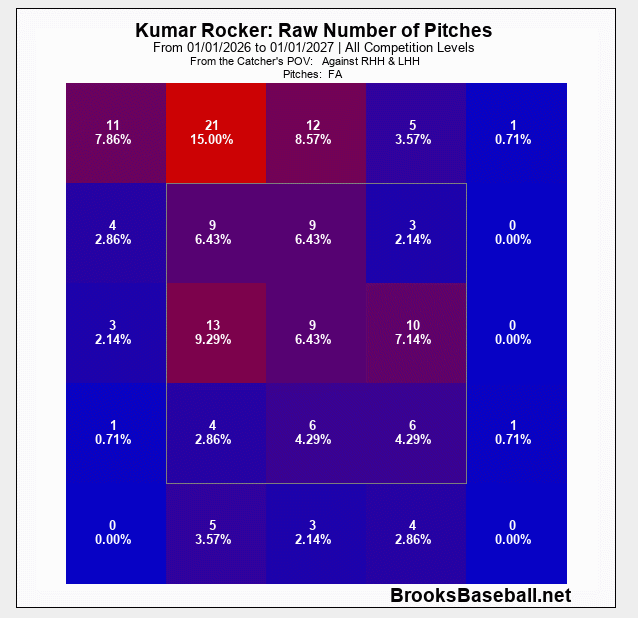
If 2025 was an expressionist Jackson Pollock painting, 2026 is a deliberate Chuck Close piece. He’s sort of all over the place in 2025, but you see a much more controlled location in 2026. Rocker wants the ball above the zone, period, and that’s going to be the best thing for a fastball like this, where hitters might struggle to pick up on its movement. I don’t think he’ll be able to maintain the .095 AVG or .125 BABIP against his four-seamer that he’s had so far, but this should be a more effective approach for him.
Truthfully, since command has always been an issue for Rocker, I think this four-seam usage is an encouraging sign. If he can overcome his wildness and locate consistently, he could become a strong starting pitcher. Remember, he still possesses an elite slider, so he could find success if the other pieces of his game click.
His cutter and changeup have been used less often, and they’ve had polar opposite results. The cutter has been crushed for a .333 AVG, .667 SLG, and .471 wOBA. Conversely, batters are hitting .154 with a .154 SLG and a .128 wOBA off Rocker’s changeup. Both pitches are thrown <10% of the time, and his usage hasn’t shifted significantly as it has with the slider.
Ultimately, I think the changeup could be a good tool against lefties, and the cutter has shown flashes at times itself, but these are tertiary options for Rocker. I do think he will need to develop or use one of these two pitches more often as he evolves as a starter, but for now, they aren’t his big focus.
Verdict:
Despite the injuries and loss of prospect status, Rocker still possesses a strong slider that could be one of the game’s best and most unique offerings. It’s been effective so far, and I think it will continue to be for Rocker. His low velocity, low spin, high drop “death ball” has proven to confound hitters, and I think he could have bigger strikeout upside than he’s shown so far.
The rest of his profile could be described as a work in progress. He’s shifted to using a sinker as his primary fastball these last two seasons, but has been slowly incorporating his four-seamer more often. Neither is an elite offering like the slider, but the four-seamer has decent movement and has gotten good results. More importantly, Rocker has located the pitch much better in 2026. I don’t think he’s on the precipice of a breakout necessarily, but there are real signs of growth here.
For fantasy, I don’t think Rocker is a finished product yet. I would love to see what he does with his four-seamer and other secondary pitches like the cutter and changeup, but he’s still raw and flawed at this time. Even during his hot streak of a 1.88 ERA in his last five starts, Rocker has a 3.94 FIP, 7.7% K-BB%, and 11.1% BB rate during that stretch. He also has a .215 BABIP and 89.4% LOB rate during that stretch, indicating that luck has played a big part in his recent success.
I think he's best used a streamer against good matchups at this time, and even then only if you're kind of desperate. Long term, I think he has a ceiling as a mid-rotation starter with K upside. Even if he were to flame out as a starter, I think he could be good in the bullpen.
Tatsuya Imai, Houston Astros – 42% Rostered
2026 Stats (prior to this start): 29.1 IP, 5.52 ERA, 5.76 FIP, 6.3% K-BB%
06/06 vs. ATH: 5 IP, 5 H, 2 ER, 3 BB, 8 K
Imai was outstanding on Saturday, shutting down the Athletics for two earned runs and eight strikeouts while picking up his third victory of the season. It was a rough start for Imai, but he’s locked in as of late, posting a 2.12 ERA over his last three starts. Is this the beginning of a turnaround for Imai?
Unlike many of the pitchers I cover, Imai had an unusual path to the big leagues. He spent parts of eight seasons pitching for the Saitama Seibu Lions in NPB in Japan. In NPB, Imai went from a wild youngster to one of the most dominant pitchers in the country, and came over to MLB last offseason for his age 27/28 season. Imai works with a six-pitch mix, consisting of a slider, four-seam fastball, sinker, splitter, changeup, and curveball.
Imai may have six pitches, but he’s effectively been a three-pitch pitcher thus far in MLB. He’s thrown his slider, four-seamer, and sinker a combined 95.3% of the time, barely using his other three pitches. You could even argue he is a two-pitch pitcher, throwing his slider and four-seamer a combined 86% of the time, and using no other pitch more than 10%. He was mostly a two-pitch guy on Saturday, as he threw either his slider or four-seamer a combined 87% of the time, and did not throw any other pitch more than 7% of the time.
The most used pitch for Imai this season has been the slider, which he has thrown 44.7% of the time this season. He threw it a whopping 52.2% of the time on Saturday, his highest usage in any single game so far this season. An 86.7 mph offering, Imai’s slider is noteworthy for its strong horizontal movement.
We’ve analyzed a few unique sliders in this piece already with Littell and Rocker, and Imai’s is plenty remarkable in its own right. Imai gets 1.6 inches of IVB with the pitch and 4.2 inches of arm-side movement. Here’s a look at his pitch movement profile for this season (slider in yellow).
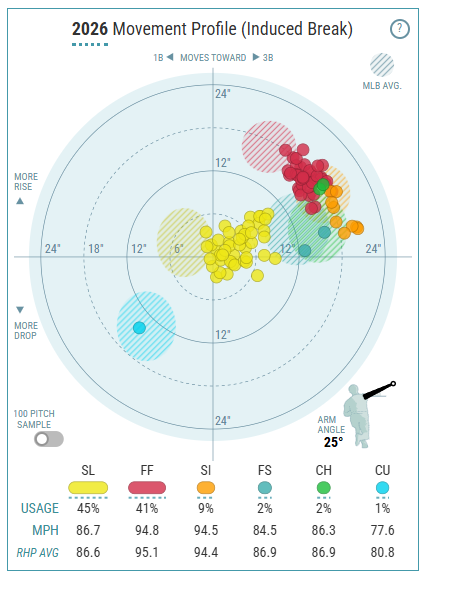
He gets a lot of horizontal movement, as you can see, and the deceptiveness is heightened by his low arm slot and compact delivery. Imai really slings the pitch in towards the plate and makes it difficult for hitters to read. Here’s an example of the pitch from this start.
— Elliott Baas (@ElliottBaasBB) June 8, 2026
Nasty stuff, and as you may’ve noticed in the clip, Imai has no problem throwing his slider to lefties. He’s used it heavily against both lefties and righties this season, and the slider has been incredibly effective.
Batters are hitting just .171 off Imai’s slider with a .314 SLG and a .277 xwOBA. The expected stats support these results too, with a .177 xBA, .290 xSLG, and a .268 xwOBA. He also has a 36.7% whiff rate with the pitch, and got 11 of his 17 whiffs with the slider in this start.
The slider was Imai’s most vaunted pitch coming over to MLB, and it has been as advertised thus far, even amid other struggles. Even when batters do make contact with the pitch, Imai has an 87.5 mph average exit velocity against and a 50% groundball rate with the pitch, so they aren’t generally striking the ball well.
The slider looks great, but if a good slider was enough to make a starter, Tyson Ross would be in the Hall of Fame. Imai’s next most used pitch has been the four-seam fastball, which he has thrown 41.3% of the time this season. A 94.8 mph offering, Imai’s four-seamer has slightly above average velocity, but it’s another pitch with strong, unique movement.
Imai has averaged 11.1 inches of IVB with the four-seamer thus far, which isn’t a lot, but he’s also averaged 13 inches of arm-side run with the four-seamer. Let’s have a look at that pitch movement profile again (four-seamer in red).
That is some fastball shape, and the pitch has been moderately effective for Imai. Batters are hitting .256 off the pitch with a .333 SLG and a .357 wOBA. The expected stats are a little worse, with a .271 xBA, .444 xSLG, and a .391 xwOBA. He’s also allowing a 92.2 mph average exit velocity with this pitch, and an 11-degree average launch angle. Frankly, I think the damage could’ve been even worse given the launch angle and velocity with which opponents are hitting the ball. 11 degrees is in the ideal zone for line drives, and 92 mph is scorching.
An even bigger problem for Imai—both with the four-seamer and generally—is his propensity to issue walks. He has a 50.4% zone rate and an 18.5% o-swing rate with the fastball, which means he isn’t finding the zone often, and batters aren’t chasing or giving him free strikes.
Walks have been a huge issue for Imai so far this season; he’s allowed multiple walks in all but one game so far, and has allowed three or more walks in all but two. He even had three walks in this surprising start against the Athletics, and has an ugly 15.3% BB rate this season. A 15% walk rate is simply untenable for a major league starter, even one with a dominant slider like Imai.
While the walks have certainly been a problem, I think there’s reason for hope with Imai’s control. Remember that despite his professional experience, he’s still new to MLB and has pitched a total of 34.1 innings. That’s nothing in the grand scheme of things, and it’s hardly enough to draw major conclusions about Imai.
He was known for control issues in Japan when he first started over there as well, but in his last few years in NPB, he really cut back the walks and became a superstar. I’m not saying that definitely will happen here, and if it does, it may not be anytime soon, but Imai has overcome this before. All I’m saying is, it’s far too early to peg Imai as a 10-15% BB rate pitcher.
Walks have been an issue for Imai, as have home runs. He’s allowed a 1.31 HR/9, far above his NPB numbers. Home runs are less common in NPB, but Imai was never remotely close to a number like this. The problem seems to be a combination of hard hits allowed and bad luck.
Imai has allowed a 91 mph average exit velocity and ranks in the eighth percentile in hard hit rate this season. Throw in a 17.9% HR/FB ratio, and you’ve got yourself an acute case of Gopheritis. Like with the walks, there’s reason to believe Imai can turn this around and that this isn’t the real Imai, but time will tell. He hasn't had big home run issues or flyball tendencies in the past, so I'm willing to consider the home runs more of a fluke compared to his walk issues.
Lastly, there’s also the concern of his limited repertoire. He has been all about the four-seamer and slider in MLB thus far, mixing in his sinker quite a bit, too. He threw his changeup and splitter more often in Japan, and my hope is that as Imai becomes more comfortable on an MLB mound, he’ll mix in more of his secondary stuff. These pitches were not as highly touted as his four-seamer and slider, but he needs some more diversity in his pitch mix. This fastball-slider stuff only works for so long in MLB, especially when the pitcher has control issues.
Verdict:
There was a lot of hype around Imai when he came over, and after eight starts, I think one thing is clear: Imai is still finding his footing in MLB. He was an ace in NPB, but it took some seasoning. Imai even told reporters that he was struggling to acclimate to America, not just in baseball but in day-to-day life. It’s hard for us to quantify things like that, but given his volatility on the mound so far, it’s easy to infer the impact of something like this.
Imai strikes me as very talented and still raw despite his professional experience in Japan. I do think there’s an MLB quality starter in there somewhere, maybe even a front-end rotation guy capable of big strikeout rates. But I suspect we will only see glimpses of that version of Imai this season, and I think it might be rocky for a while going forward. Even during his three-game hot streak, Imai has a 13.4% BB rate.
From a stuff perspective, his slider looks outstanding, and he has a plus fastball. I’d want to see more of his other pitches in MLB before drawing major conclusions. I think he definitely needs to broaden his arsenal at some point to remain an effective starter.
For fantasy, I think he can be used in certain situations. Such as streaming against a weak or high-whiff opponent, or streaming in an H2H league where one is far behind and needs to make up ground. As much as Imai is capable of going out and delivering eight strikeouts and a dub, he could just as easily give us 3-5 innings of 4-6 runs and 3-5 walks.
It might also be worth noting that Imai has racked up a disproportionate number of his strikeouts in two games against the Athletics. He has 17 strikeouts in 10.2 innings against the Athletics this season, a 15 K/9. Against all other teams, he has just 19 strikeouts in 23.2 innings, good for a 7.4 K/9.
Again, we’re dealing with a small sample size (that I’ve sliced up into even smaller bits), but interesting nonetheless, especially since the Athletics are a middle-of-the-road offense in terms of strikeouts and an above-average offense in terms of wOBA. I think it mostly tells us that Imai is talented but unpredictable at this juncture.
More Fantasy Baseball Advice
Download Our Free News & Alerts Mobile App
Like what you see? Download our updated fantasy baseball app for iPhone and Android with 24x7 player news, injury alerts, sleepers, prospects & more. All free!