




 RADIO
RADIO











Elliott looks at pitchers with surprising starts recently. These SPs could emerge as fantasy baseball waiver wire targets for Week 9 in 2026, or just mirages.
Welcome back to the "Are You For Real?" series as we dive into Week 9 of the 2026 fantasy baseball season. For those unfamiliar, this is a weekly column where we examine starting pitchers who had surprisingly strong starts over the past week and put them under the microscope to determine whether they're legitimate or just smoke and mirrors.
We saw lots of interesting starts from unheralded hurlers this past weekend. While none of the three pitchers we'll be analyzing today were considered big deal prospects, they've all shown some flashes recently that suggest we ought to take them more seriously. This week, we'll be breaking down three right-handers. First, we'll deep dive into Kai-Wei Teng's recent success for Houston. Then, we'll look at Grant Holmes' 10 K performance on Saturday. We'll finish it off by breaking down Walbert Urena's hot month of May.
Roster percentages are taken from Yahoo! and are accurate as of May 25.
Featured Promo: Save 50% off the regular price with discount code CHAMP, for a limited time. Exclusive access to our Team Sync platform, DFS cheat sheets, Lineup Optimizers, betting/prop picks, and exclusive content from Nick Mariano and Eric Cross! GAIN ACCESS NOW
Kai-Wei Teng, Houston Astros – 8% Rostered
2026 Stats (prior to this start): 31 IP, 2.61 ERA, 3.76 FIP, 14.4% K-BB%
05/23 @CHC: 6 IP, 2 H, 0 ER, 3 BB, 6 K
Teng continued to pitch well in a starting capacity, blanking the Cubs for six scoreless innings on Saturday. It was the best start of Teng’s young career, as it was the longest he’d ever pitched into a game and his first career quality start. Houston has asked Teng to step up, given their bevy of pitching injuries, and so far, Teng has answered the call. But is he worthy of being on our fantasy rosters?
Originally signed as an international free agent by the Twins out of Taiwan, Teng was traded twice before winding up in Houston. He wasn’t much of a prospect coming up, and most scouts believed Teng would settle into a bullpen role if he made it to the majors.
Teng had been pitching well in relief for Houston to begin the season, but they’ve suffered so many pitching injuries that they’ve needed him as a starter. Teng works with a six-pitch mix consisting of a sweeper, four-seam fastball, sinker, curveball, changeup, and slider.
Teng’s most used pitch this season has been the sweeper, which he’s thrown 36.5% of the time. He also threw the sweeper 40% of the time in this start against the Cubs. Relying so heavily on the sweeper makes sense for Teng, as it’s been his best-performing pitch, and it was considered his best pitch as a prospect.
An 84.6 mph offering, Teng’s sweeper is soft and high spin, averaging 2764 RPM this season. That’s not tippy top elite, but it puts Teng roughly in the top 10% of sweeper spin rate in MLB this season.
Batters have really struggled against Teng’s sweeper this season. Opponents are hitting .105 off the sweeper with a .140 SLG and a .172 wOBA. Teng’s sweeper doesn’t have exceptional movement; it averages 0.6 inches of rise and 15.3 inches of glove-side movement, which is rather typical for a sweeper. Here’s an example of the pitch from this season.
— Elliott Baas (@ElliottBaasBB) May 25, 2026
It’s a solid offering, but it doesn’t exactly pop off the screen. As such, Teng hasn’t racked up a ton of whiffs, at least not at a high rate. His 30.9% whiff rate with the sweeper is solid, but not quite high enough to be a consistent strikeout pitcher. He got five of his 10 whiffs with the pitch against the Cubs, good for a 36% whiff rate in that outing.
Not bad, not great. I also suspect that he will experience regression on these outcomes against his sweeper, mainly because he has a .154 BABIP against this pitch. The sweeper is a solid pitch, but it’s not one of the best breaking balls in baseball, and that’s how it’s performed so far.
Teng mixes in two fastballs with regularity, and while he used to lean more on his sinker, this season he’s shifted towards the four-seamer. A 94.2 mph offering, Teng’s four-seamer has roughly average velocity, though his velocity has dipped to around 93 mph when he’s worked as a starter.
It’s also a high spin fastball, with a 2492 RPM and 81% active spin rate this season. The high spin rate hasn’t quite made up for the below-average velocity, and Teng also hasn’t gotten great movement with his four-seamer either.
He’s averaged just 13.5 inches of induced vertical break and 10.5 inches of arm-side run. That’s made it quite difficult for Teng to be deceptive with the pitch, and he’s gotten just a 16.9% whiff rate with his four-seamer this season. He’s also surrendered a lot of power with the pitch. Batters have hit .259 off Teng’s four-seamer with a .481 SLG and a .382 wOBA.
He’s allowed a blistering 94.4 mph average exit velocity with this pitch and a 23-degree average launch angle. Teng’s four-seamer doesn’t measure out well and has had questionable results against it so far. It looks like a below-average offering that might even be a liability for Teng on the mound.
Teng also uses a 93.7 mph sinker, a pitch that has gotten better results than the four-seamer this season. He has thrown the sinker 17% of the time and used it 19% of the time against the Cubs. Batters have hit .235 off the pitch with a .294 SLG and a .304 wOBA. Unfortunately, the expected stats suggest that Teng is due for regression, and he has a .258 xBA, .416 xSLG, and .348 xwOBA against his sinker this season.
He’s also allowed a 92.5 mph average exit velocity and a 26.7% line drive rate. Those batted ball metrics suggest that Teng has overperformed with his sinker so far, and I have a hard time believing he can maintain his current .250 BABIP with the sinker based on the type of contact he’s allowing. The sinker got absolutely smoked in Teng’s previous brief big league stints, and I worry that regression will come and may affect Teng even more than the Statcast expected stats suggest.
On the topic of luck and regression, it’s hard not to look at Teng and see how much he’s benefited from good fortune. He currently has a .236 BABIP, 87% LOB rate, and 8.8% HR/FB ratio. All of those numbers are big deviations from league average, and from the types of numbers Teng put up in the minors. Teng is allowing a lot of hard contact, with a 90.7 mph average exit velocity overall. It’s hard to envision a world where Teng sustains such a strong performance.
Verdict:
Teng has burst onto the scene for Houston and provided the Astros with much-needed rotation relief after they've endured multiple injuries to their starting pitchers. It’s hard to deny just how good Teng has been, as the young right-hander has a 2.65 ERA as a starter this season.
His best pitch has been the sweeper, which he’s thrown 36.5% of the time and has a .105 AVG against. It’s not a big strikeout pitch, at least for a breaking ball, but Teng can get his fair share of whiffs every now and then. The sweeper’s high spin and horizontal movement make it difficult for hitters to square up.
Teng’s fastballs have technically performed well, but there are cracks in the numbers that suggest regression may be coming. Teng’s velocity has dipped since becoming a starter, down to around 93 mph. He was already below average, and this dip just puts him that much farther behind. He’s also allowing a ton of hard contact with both his sinker and four-seamer, and both pitches have high xSLGs, suggesting that more power could come against Teng.
Teng has pitched his way to a 2.19 ERA, but it’s mostly been because of a .236 BABIP, 87% LOB rate, and 8.8% HR/FB ratio. He will almost certainly experience regression on those numbers, and when he does, his ratios will rise and rise.
Teng also has a history of poor control and tends to issue free passes, which could raise WHIP to an untenable level, too. Most of his recent success seems built on good fortune. I think he’s usable in a streaming context while he’s hot, but I wouldn’t think twice about cutting him when the other shoe drops.
Grant Holmes, Atlanta Braves – 31% Rostered
2026 Stats (prior to this start): 47.1 IP, 3.80 ERA, 4.79 FIP, 8% K-BB%
05/23 vs. WSH: 5 IP, 6 H, 2 ER, 2 BB, 10 K
Holmes was electric on Saturday, fanning 10 Nationals in the tough-luck loss. It was only the third time in his career that Holmes had double-digit strikeouts, and the right-hander now has a 3.78 ERA and 21.5% K rate following this start. Holmes has sort of been on and off the fantasy radar since debuting for the Braves in 2024, but he’s been excellent over his last two appearances. Is Holmes ready to turn a corner?
Originally a first-round pick by the Dodgers in 2014, Holmes wasn’t a very big prospect despite his high draft cost. He was traded from the Dodgers to the Athletics in 2016, and wound up with the Braves organization after flaming out with the Athletics in 2022 without reaching the majors for them. He made his major league debut at 28, which is again a little unusual given his draft status. Holmes works with a six-pitch mix, consisting of a slider, four-seam fastball, curveball, sinker, changeup, and cutter.
Holmes may have a deep six-pitch arsenal, but he has been very reliant on two pitches as a big leaguer, and that would be his slider and four-seamer. He’s thrown these two pitches a combined 73.5% of the time this season, and the curveball is his third-most-used pitch at just 10.3%.
We will start with the slider, because that has been Holmes’ most used pitch this season, and his slider usage has only gone up since his debut. He’s using his slider a career-high 38.3% of the time this season, and threw it 40% of the time against the Nationals on Saturday. An 85.3 mph offering, Holmes’ slider is characterized by a high spin rate and heavy vertical movement. He’s averaged 2745 RPM with his slider this season, as well as four inches of drop and 1.8 inches of glove-side movement.
Here’s a look at Holmes’ pitch movement profile for this season (slider in yellow).
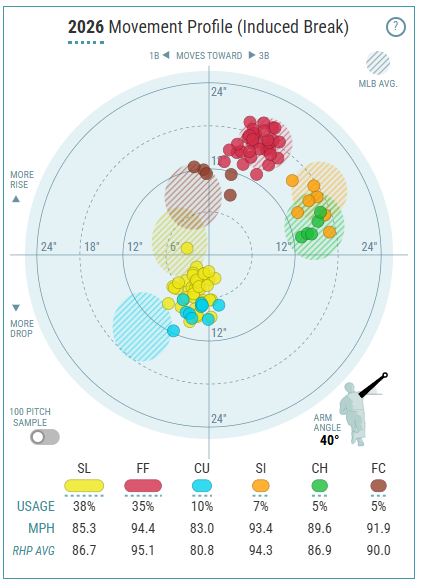
Here’s an example of the pitch from this season.
— Elliott Baas (@ElliottBaasBB) May 25, 2026
Nasty stuff, and batters have really struggled to hit Holmes’ slider this season. Opponents have a .203 AVG, .378 SLG, and .300 wOBA off Holmes’ slider, along with a .213 xBA, .388 xSLG, and .303 xwOBA.
Perhaps the most impressive number is the 45.2% whiff rate Holmes has with his slider this season. That is elite breaking ball territory, and the fact that Holmes is capable of producing this number suggests that more strikeout upside looms in this profile. Holmes had a whopping 18 whiffs on Saturday, and 10 of them came from the slider.
Holmes had a strikeout rate around 25% in his previous two seasons, and I think he can get there again, even though he’s at just 21.5% on the year after this ten-strikeout performance. His strong strikeout rates have been driven by his slider, a pitch that has been above a 40% whiff rate in each of Holmes’ major league seasons. I’m not saying we can expect double-digit strikeouts every time, but I think Holmes is capable of putting up better strikeout numbers going forward in 2026, compared to what we’ve seen in the beginning of the year.
Truthfully, the slider looks great for Holmes, but that’s really not a surprise. It was his best pitch as a prospect, and it has consistently been his best pitch as a big leaguer. For Holmes, the question marks come with the rest of his repertoire. His next most used pitch is his four-seam fastball, and as I previously mentioned, Holmes really relies on the slider/four-seam combo.
A 94.4 mph offering, Holmes’ fastball has middling velocity and also lacks significant movement. He’s averaged just 15.3 inches of IVB and 6.6 inches of arm-side movement, which makes his fastball shape painfully average.
Holmes has gotten somewhat good results with his four-seamer this season, but I am skeptical of these outcomes. He has a .250 AVG, .500 SLG, and .367 wOBA against his four-seamer this season, which already isn’t great. But he also has a .274 xBA, .517 xSLG, and .382 xwOBA. He’s also allowed a 91.1 mph average exit velocity against and has an underwhelming 14.9% whiff rate with the pitch.
What’s especially concerning for me about the results against Holmes’ four-seamer is the .211 BABIP against. This fastball got smoked for a .327 AVG on a .338 BABIP last season, and there isn’t a lot different about the shape or velocity of the pitch, or how Holmes is using it. I worry that this fastball could be a liability for Holmes on the mound, especially in terms of power. He’s allowed a 51.6% flyball rate with his fastball this season, along with a .250 ISO.
Power and home runs were a struggle for him last season, in big part due to this fastball, and I think it could continue to be a problem for him.
Other than the slider and four-seamer, Holmes also mixes in an 83 mph curveball about 10% of the time. Like with his slider, Holmes’ curveball also has strong movement and spin. He’s averaged 2787 RPM with the pitch and has gotten 8.5 inches of drop and 2.6 inches of glove-side movement with the pitch. Here’s a look at his pitch movement profile again (curveball in blue).
That’s quite a unique shape, and Holmes has gotten some strong results with the curveball this season. Batters are hitting .241 off the pitch with a .276 SLG and a .230 wOBA. The expected stats are even better, with a .186 xBA, .229 xSLG, and .180 xwOBA against Holmes’ curveball this season. Holmes has a solid 31.1% whiff rate with the pitch this season, and got five whiffs on eight swings with it on Saturday.
Batters have really struggled to square the curveball up and make decent contact, as opponents have an 88.1 mph average exit velocity and a 3-degree average launch angle against Holmes’ curveball, good for a 55% groundball rate. Holmes upped his curveball usage to 15% in this start, and that’s a good step for him. Not only has the curveball been effective for him this season, but it has been one of his best-performing pitches throughout his career.
Batters are hitting .204 with a .540 OPS and a 54.8% groundball rate off Holmes’ curveball all-time. It was a bigger part of his game in previous years, with Holmes throwing the curveball 21% of the time in 2024 and 15.2% of the time in 2025. His curveball usage has fluctuated this year, but it’s been trending upwards lately, and it would be nice to see Holmes use this pitch more often, as it’s proven to be effective for him.
Verdict:
Holmes was utterly dominant on Saturday, and his nasty slider gives him the ability to have these types of performances every so often. Holmes carved the Nationals up, thanks in big part to his slider, a pitch with an unreal 45.2% whiff rate on the year. Holmes’ slider has been a plus strikeout pitch since he debuted in 2024, and I think Holmes can raise his overall strikeout rate from its current 21.5% to around 24-25%, where he was in previous years.
Not only does he have an electric slider, but he also has an underrated curveball that has been great at limiting hard contact, generating groundballs, and getting whiffs. Holmes’ curveball usage is slightly down this season at 10.3%, but it has been trending upwards lately, which would be a positive development for Holmes. Increased curveball usage would both increase his strikeout upside and limit home runs against him.
His biggest drawback is a weak fastball. Not only does Holmes have below-average velocity at 94 mph, but his fastball lacks significant movement and spin, making it rather flat and hittable for opponents. A .211 BABIP against his fastball has kept the results against the pitch manageable, but the .500 SLG and .517 xSLG are worrying, especially because Holmes gave up plenty of power with his four-seamer last season.
It’s easy to be enticed by two plus breaking balls, but ultimately, I think Holmes will be inconsistent and frustrating for fantasy managers. Sure, he’s capable of starts like this one, but he’s also shown serious home run and control issues. His poor fastball will limit his upside on the mound, and I think at best we can hope for a season similar to his previous two years.
That would mean an ERA between 3.5-4 and a strikeout rate around 24-25% while averaging fewer than six innings per start. That certainly has some fantasy value, and Holmes should probably be rostered in deeper leagues, but he’s not a league winner or anything. Instead, he’s an inconsistent and sometimes volatile back-end starter with decent strikeout upside thanks to his breaking balls.
Walbert Urena, Los Angeles Angels – 15% Rostered
2026 Stats (prior to this start): 33.1 IP, 2.70 ERA, 3.86 FIP, 7.6% K-BB%
05/23 vs. TEX: 5 IP, 5 H, 1 ER, 3 BB, 6 K
Urena was outstanding once again, holding the visiting Rangers to just one run over five innings to earn his second victory of the season. Urena has really turned it on in May, pitching to a 1.67 ERA in five starts this month. Urena was a relatively unheralded prospect coming into the season, but could there be something here with the young right-hander?
Originally signed as an international free agent out of the Dominican Republic by the Angels in 2021, Urena didn’t garner much prospect clout coming up. His big fastball was certainly appealing, but he is also undersized at 6’0”, 210 lbs, and displayed some horrendous control issues in the minor leagues. Urena works with a four-pitch mix consisting of a changeup, sinker, four-seam fastball, and sweeper.
Urena’s most used pitch thus far has been the changeup, which he’s thrown 35.8% of the time. He threw it 37% of the time against the Rangers on Saturday. A 90.5 mph offering, Urena’s changeup is hard with lots of movement. He’s averaged five inches of rise and 17.4 inches of arm-side movement with the pitch so far. Here’s an example from this season.
— Elliott Baas (@ElliottBaasBB) May 25, 2026
Hard and sharp with lots of movement, that example was particularly nasty at 92.6 mph. Batters have really struggled against this pitch as well, with opponents hitting just .136 with a .220 SLG and a .221 xwOBA off Urena’s changeup. The expected stats support these results with a .140 xBA, .208 xSLG, and a .216 xwOBA. Urena also has a 35.7% whiff rate with the pitch, and had nine of his 16 whiffs with the changeup in this start.
Even when batters do make contact with the changeup, they don’t strike the ball well. Opponents have an 81.6 mph average exit velocity off Urena’s changeup and a 4-degree average launch angle against, good for a 56.4% groundball rate. It would be hard to envision Urena sustaining results this good off his changeup all season, but the pitch looks rather nasty.
It’s among the hardest changeups thrown by a starter and has strong movement to go along with it. Urena also had a .201 xBA and a 61.1% whiff rate with the changeup at AAA last season, so he’s got some history of these solid results. It’s too early to draw major conclusions about Urena, but this changeup has all the ingredients of a plus strikeout pitch.
His next most used pitch has been the sinker, which Urena has thrown 29.6% of the time. A 97.6 mph offering, Urena throws very hard and has even touched 100 mph with the sinker and four-seamer this season. Urena’s sinker also gets solid movement, with 6.6 inches of rise and 16.4 inches of arm-side run.
It has been incredibly difficult for opposing hitters to elevate this pitch, as Urena has a 60% groundball rate and a -1-degree average launch angle against his sinker. Urena has been a plus groundball pitcher throughout his minor league career, and this sinker could certainly help translate those skills to the major leagues. He’s been excellent at suppressing power, and he’s only surrendered two homers so far this season.
While the groundballs and power suppression have been great for Urena, batters have still had tons of success off his sinker. Opponents are hitting .410 off the sinker with a .538 SLG and a .447 wOBA. The expected stats are better with a .316 BA, .483 xSLG, and .394 xwOBA, but that’s still not very encouraging.
Urena is definitely getting unlucky with this pitch as it currently has a .441 BABIP against, but these results are still a little concerning. He gives up a lot more hard contact with the sinker with an 89.9 mph average exit velocity against, and this pitch could prove to be much more hittable than the changeup. It remains to be seen how this pitch (and any of Urena’s pitches, really) will normalize over a larger sample.
He also mixes in a 97.7 mph four-seam fastball, a pitch that has gotten much better results than the sinker. Batters are hitting .156 off the four-seamer with a .219 SLG and a .261 xwOBA. The expected stats are somehow even better, with a .131 xBA, .169 xSLG, and a .232 xwOBA. Urena also has an impressive 25% whiff rate, which is good for a fastball.
He doesn’t have a ton of movement with the pitch, but it has still been difficult for batters to handle. I suspect he will experience regression on the .227 BABIP against his four-seamer, but he’s also allowed weak contact with an 86.8 mph average exit velocity and a 21-degree average launch angle against. Weak flyballs are likely to be outs, so it is a favorable outcome for a pitcher when he cannot get a strikeout.
The changeup and fastballs are Urena’s bread and butter, but he also uses an 86 mph sweeper. He’s thrown the sweeper 13.5% of the time, mostly against right-handed hitters when he does not trust the changeup. It’s a soft offering, especially compared to his other pitches, and has strong horizontal movement. Here’s an example of the pitch from this season.
— Elliott Baas (@ElliottBaasBB) May 25, 2026
It’s a stark contrast to his other pitches, but it has been effective. Batters are hitting .154 with a .154 SLG and a .167 wOBA off this pitch. The expected stats tell a different story, with a .358 xBA, .716 xSLG, and a .461 xwOBA. The main issue is that Urena has allowed a 90.5 mph average exit velocity and a 25% line drive rate with the pitch.
He’s only thrown 90 sweepers total, so it’s hard to ascertain how sticky any of these numbers will be. The pitch got hit pretty hard in the minors last season, so we’ll need to see sustained success before we can trust that this is a reliable secondary offering for him.
Given how hard he throws and how nasty his changeup looks, it’s a wonder that Urena wasn’t a bigger prospect. Fangraphs had him as the Angels’ 23rd-best prospect coming into the season, viewing him as a future swingman/reliever type. His biggest flaw is poor control, which is something Urena has consistently displayed during his professional career. His walk rate in the minors last season was 12.1%, and that represented an improvement for him.
He has routinely had high walk rates and low zone rates, leading to single-digit K-BB% and bloated ERAs and WHIPs. Even now, he has a 1.38 WHIP despite a 2.58 ERA, and he issued three walks in this start against Texas. He hasn’t made a single appearance all season without issuing at least one walk, and has issued multiple walks in all but one start.
Urena has also failed to produce a plus strikeout rate in the minors despite wielding such nasty velocity. He should’ve been able to blow his stuff by minor league hitters, but he has a 4.67 ERA, 1.48 WHIP, 8.5 K/9, and 5.5 BB/9 across all minor league appearances. If that’s how he performed in the minors, I worry how he’ll hold up in the majors. There’s definitely some talent here, and from a stuff perspective, Urena looks nasty, but he’s a very raw talent.
Verdict:
Urena has burst onto the scene with his hard fastball and nasty changeup, pitching to a 2.58 ERA in his first nine appearances. That should certainly have fantasy managers intrigued, and there’s a lot to like about Urena’s game. He throws exceptionally hard at 97.7 mph and has even touched 100 mph this season.
His sinker has been effective at generating groundballs, while his four-seamer has had great results against it so far. Overall, Urena has been excellent at inducing grounders and preventing home runs during his minor league career, and with these pitches, I believe those skills can translate to the major leagues.
While he throws quite hard, the gem of his repertoire is probably the 91 mph changeup. Urena has diced hitters up with this pitch so far, and its plus horizontal movement, coupled with sharp velocity, has made it tough to hit for opponents. The changeup has been dominant at both the major and minor league levels, and Urena could generate plenty of whiffs with this pitch.
While he looks great from a stuff perspective, it’s important to remember that Urena is very young and is a raw talent, just finding his footing in MLB. My biggest concern for him is poor control.
He has routinely displayed poor control throughout his professional career, and it’s been a little rough so far. He has a 5.17 BB/9 thus far, and has issued at least one walk in every appearance he’s made this season. Even if he can sustain a low ERA, he might be a WHIP liability. He has a 1.38 WHIP now despite a sparkling 2.58 ERA.
I like the talent here, and I think Urena has what it takes to make it as an MLB pitcher, either as a starter or reliever. His big velocity and nasty changeup sort of fit the reliever profile. If he is a starter, expect some lumps along the way as he establishes himself in the big leagues. I think he’s worth an add in most leagues because the talent is intriguing, even if I don’t expect him to put it all together this year.
More Fantasy Baseball Advice
Download Our Free News & Alerts Mobile App
Like what you see? Download our updated fantasy baseball app for iPhone and Android with 24x7 player news, injury alerts, sleepers, prospects & more. All free!