




 RADIO
RADIO






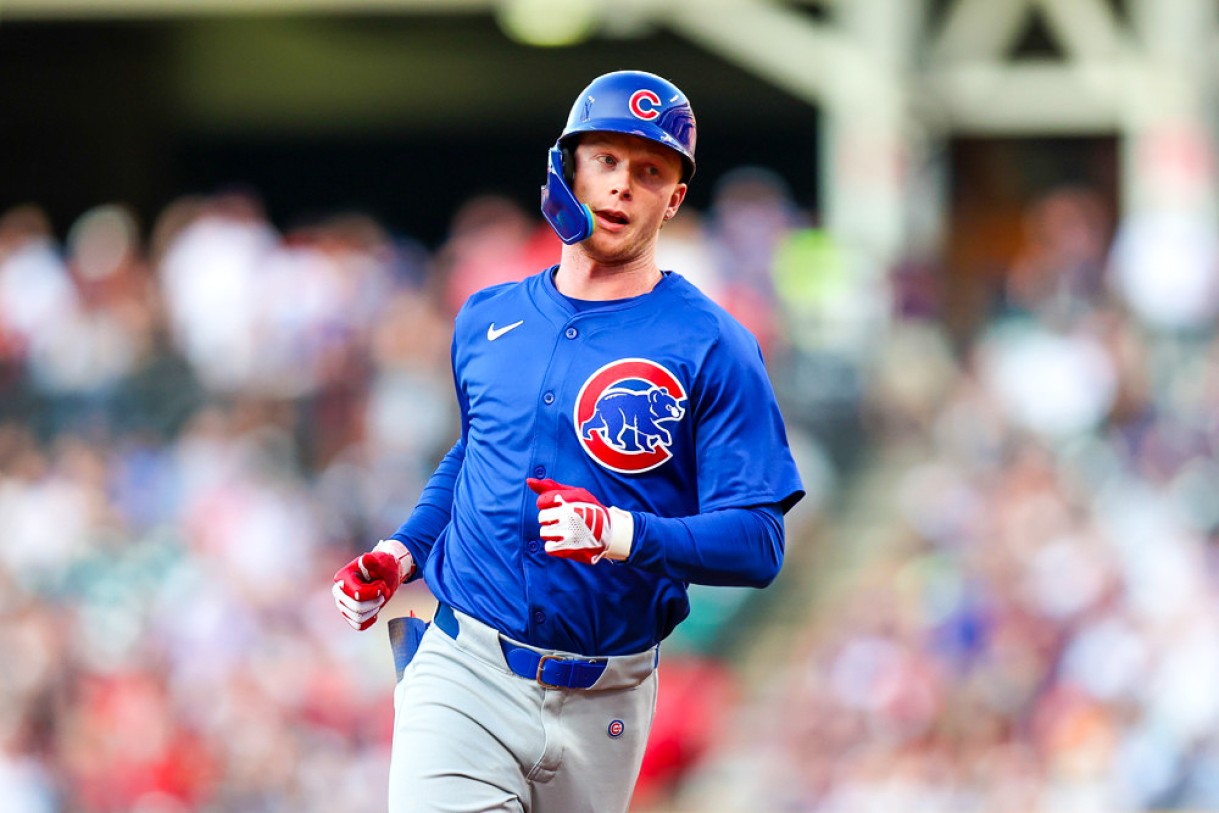
Elliott Baas looks at 3 second-half fantasy baseball busts from the 2025 season. Read his 2026 fantasy baseball outlooks for second-half underachievers such as James Wood, Pete Crow-Armstrong and Oneil Cruz.
It was the best of seasons, it was the worst of seasons. At least, that's how it felt for fantasy managers who rostered these second-half slumpers. During the first half, these players were good enough to earn All-Star nods, generate MVP buzz, and enter the Home Run Derby, but these guys fell off a cliff following the break.
In this article, I will take a look at three fantasy stars who faded in the second half, leaving us with more questions than answers after the season ended. I'll be taking a look at Nats slugger James Wood, the ever-exciting Pete Crow-Armstrong, and everyone's favorite Statcast stud, Oneil Cruz.
These guys have question marks heading into 2026 thanks to their poor finishes, and I try to identify the possible causes of their struggles. We know each one of these players is supremely talented and could be a fantasy difference maker next season. Can these hitters rebound, or are their second-half woes signs of deeper problems?
Featured Promo: Save 50% off the regular price with discount code CHAMP, for a limited time. Exclusive access to our Team Sync platform, DFS cheat sheets, Lineup Optimizers, betting/prop picks, and exclusive content from Nick Mariano and Eric Cross! GAIN ACCESS NOW
James Wood, Washington Nationals
Wood was looking like one of the young breakout superstars of the 2025 season in the first half, slugging 24 home runs with a .915 OPS and 150 wRC+ before the break. That performance earned Wood an All-Star nod and a spot in the Home Run Derby. Fantasy managers had to be feeling pretty good about the 6’7” 23-year-old phenom, but Wood’s performance cratered in the second half.
He hit just .223 with seven home runs and a .690 OPS. His 93 wRC+ meant Wood was a below-average hitter in the second half. One look at Wood at the plate and it’s easy to see the talent and allure, so why did he struggle so much in the second half?
The first thing that jumps out in Wood’s second-half numbers is his strikeout rate. Wood, like many big-bodied sluggers, has always had some swing-and-miss in his game. He struck out 27.6% of the time in the first half, which is above league average, but manageable for a big power hitter like Wood. Unfortunately, that strikeout rate skyrocketed to 39% following the All-Star break. 39% is untenable no matter who you are, and Wood’s entire game suffered because of it.
His plate discipline deteriorated, too, as Wood’s walk rate went from 14% in the first half to 9.7% in the second half. Still solid, but not elite like it was before the slump.
One possible reason for Wood’s second-half struggles could be a change in approach from opposing pitchers. Wood is a fastball annihilator, hitting .315 with a .593 SLG and .418 wOBA off heaters last season, but he struggles against off-speed pitches and breaking balls. Left-handed pitchers threw him sliders 7% more often in the second half, a whopping 42% of the time.
Wood hit just .208 against sliders in 2025 and had a 44.2% whiff rate against breaking balls. Right-handers approached him differently, too, increasing changeup usage by 4% against Wood. Outside and away changeups are kryptonite for Wood, who managed to hit just .177 off changeups in 2025, and .107 against them in the second half.
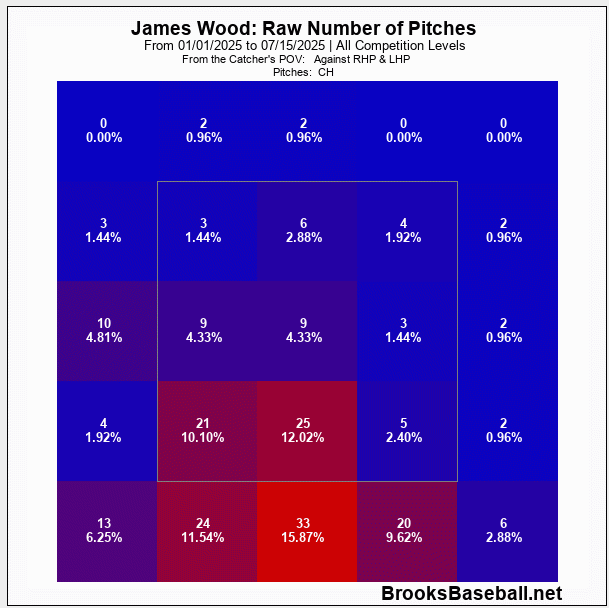
Let’s compare Wood’s changeup heatmaps from the first half and second half and see if we notice anything different.
First half:
Second half:
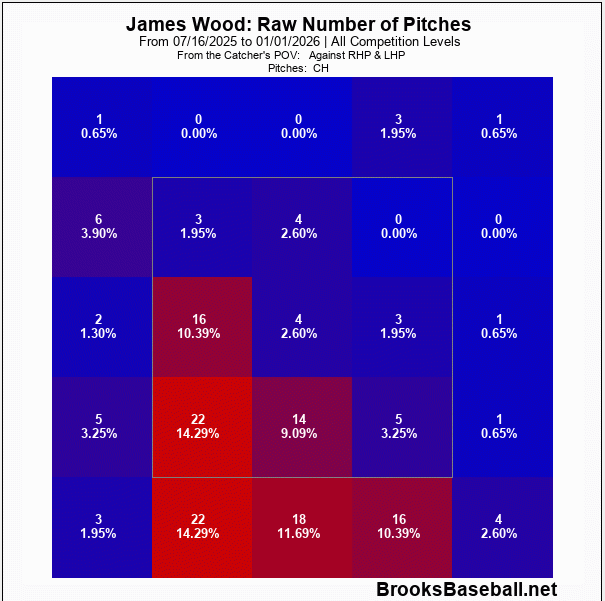
Outside and away, and lots of it. This isn’t a revolutionary approach by the opposition; low and away changeups are effective against most hitters, but Wood has been especially susceptible to them. Wood is a patient hitter with a good batter’s eye, but he still had a 16.6% swinging-strike rate against changeups and a 17.7% swinging-strike rate against sliders last year.
Furthermore, the fastball annihilator saw 9% fewer sinkers and 5% fewer four-seamers in the second half against lefties, and 3% fewer four-seamers and 2% fewer sinkers against righties. Wood is talented, patient, and young, so he could overcome this with tweaks to his approach and some solid coaching. However, last year, his susceptibility to off-speed pitches contributed significantly to his slump.
Another stat that jumps out in Wood’s second half is the shift in batted ball distribution. In the first half, Wood had a 19.3% line-drive rate, a 50.2% ground-ball rate, and a 30.5% fly-ball rate. The ground-ball rate was a little high for a power hitter, but nothing out of the ordinary. Oddly, his line-drive rate and fly-ball rate practically flipped in the second half.
Wood had a 31.4% line-drive rate, a 48.9% ground-ball rate, and a 19.7% fly-ball rate post All-Star break. That tells me his swing path or launch angle has changed.
While researching this piece, I stumbled on this excellent article from Jack McGuire of District on Deck that dives into Wood’s second-half struggles. Wood saw an increase in his attack angle in the second half. Attack angle measures the vertical direction of the bat as it makes contact with the ball. Let’s have a look at his attack angle month-by-month for the 2025 season.
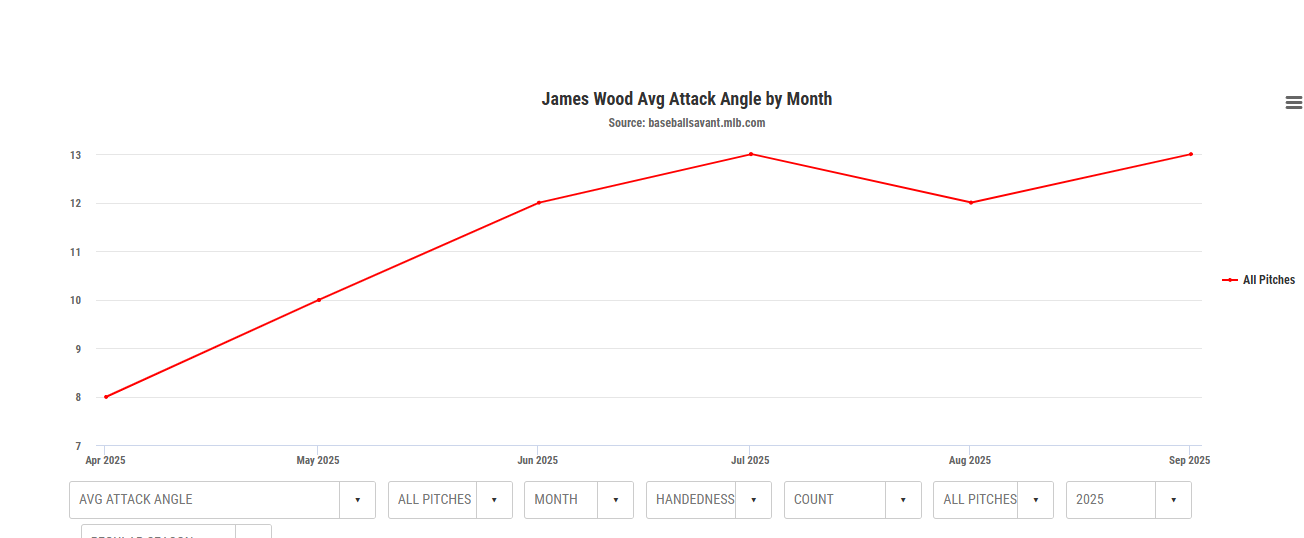
His attack angle went up and up as the season progressed. The average attack angle for an MLB hitter is 10 degrees, but Wood had a 22-degree attack angle against off-speed pitches and a 20-degree attack angle against breaking balls in September. Wood isn’t a high launch angle hitter at just 6.3 degrees, so perhaps this was an effort to elevate the ball, which seems to have backfired.
Wood performed significantly worse against fastballs in the second half as well, as his attack angle rose. In the first half, he hit .347 with a .658 SLG off fastballs, but in the second half, he had a much more pedestrian .265 AVG and .479 SLG. Wood really struggles against off-speed stuff, so he needs to crush fastballs to succeed.
The good news for Wood is that he still pulverizes the ball with a 94.3 mph average exit velocity and a 56.3% hard hit rate. And he still has a great batter’s eye, good plate discipline, lots of pedigree, and he’s just 23 years old. While Wood’s second-half slump was frustrating for fantasy managers and exposed some flaws, there is plenty of reason to think he can turn things around.
If there is any discount on Wood going into 2026, I’d be all over him in drafts. The talent is there, and his approach and his flaws can be fixed with coaching and persistence.
Pete Crow-Armstrong, Chicago Cubs
PCA was a revelation in the first half, combining his elite defense with an aggressive approach at the plate that dazzled fans and fantasy managers alike. Crow-Armstrong was drawing MVP buzz because of his .265/.302/.544 triple slash, 25 homers, 27 steals, and the best centerfield defense in the game. While beating out Shohei Ohtani was always a long shot, Crow-Armstrong was looking like a force on the diamond that would produce in all five categories.
Things took a turn south in the second half, with Crow-Armstrong slashing just .216/.262/.372 post All-Star break with six homers and eight steals. His final numbers were still good for fantasy, but he was a liability in the second half. What happened?
First, let’s look at Crow-Armstrong’s second-half power outage. His slugging percentage dropped 228 points in the second half, and he hit just six homers. Looking at his batted-ball data, one change Crow-Armstrong experienced throughout the season was a dip in average launch angle. Here’s a look at his launch angle month-by-month throughout the season.
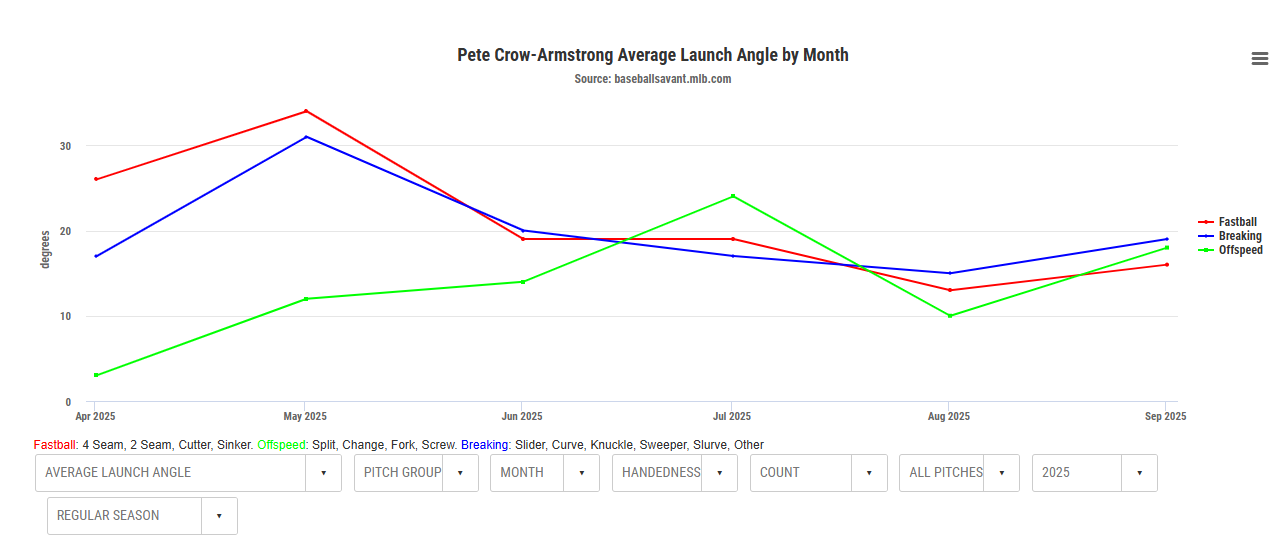
A clear dip from the beginning of the season, and Crow-Armstrong hit nearly half of all his home runs before June 1. He wasn’t able to continue elevating the ball for the entire season, and his power game suffered as a result.
Crow-Armstrong had a flyball-heavy approach in both the first half and the second half, with a 50.9% fly-ball rate in the first half and a 47.5% fly-ball rate post All-Star break. What did change is how many of those flyballs went over the fence. Crow-Armstrong had a 17.6% HR/FB ratio in the first half, which is about 6% higher than the league average.
That fell to 7.8% in the second half, about 4.0% lower than the league average.
Crow-Armstrong doesn’t hit the ball particularly hard with just an 89.5 mph average exit velocity, so it would be tough for him to maintain an above-average HR/FB ratio over the course of a full season, especially given how many flyballs he hits. Between weak contact and a lowered launch angle, PCA was hitting a lot more lazy flyballs in the second half.
In addition to the lowered HR/FB ratio, Crow-Armstrong also had just a .259 BABIP in the second half, a strangely low number for such a speedy player. His high fly-ball rate certainly contributed to this low BABIP, but it could also be some plain bad luck.
Bad luck may’ve played a role in Crow-Armstrong’s second-half struggles, but luck wasn’t the only culprit behind the slump. Crow-Armstrong’s plate discipline is horrific; his 4.5% walk rate was the fifth-lowest among qualified hitters, and Crow-Armstrong was the only one of those five hitters to post an above-average wRC+.
He also had a 45.6% chase rate last season, third-highest in the league behind just Yainer Diaz and Michael Harris II, two big fantasy busts of 2025.
He swings at everything; his 59.5% swing rate was tied for the highest among qualified hitters. Pitchers weren’t giving him much to hit with a 40% zone rate on the year, so he was swinging at plenty of bad pitches. Lefties stopped throwing him fastballs in the second half as well, as PCA saw four-seamers 30% of the time versus lefties in the first half, but just 19% of the time in the second half.
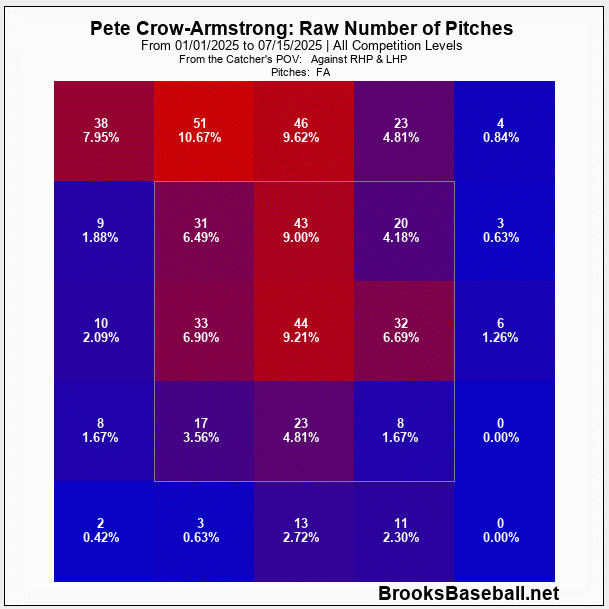
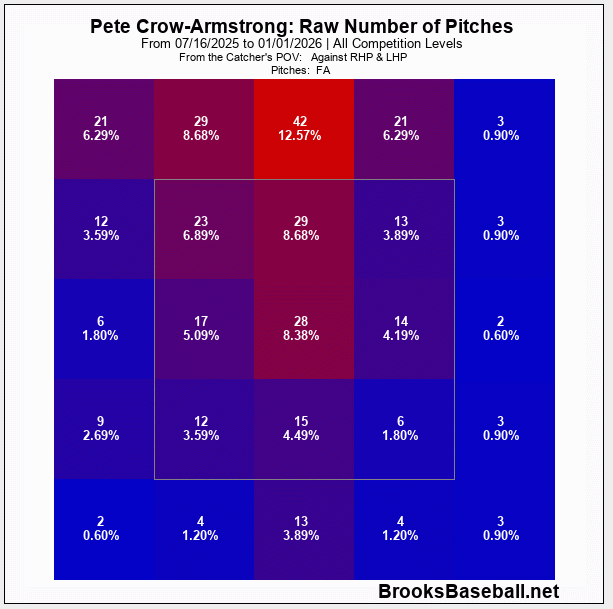
PCA was not a good fastball hitter last season either, and opposing pitchers are just hammering him upstairs with high heat. Let’s compare his fastball heatmaps from the first half and second half.
First half:
Second half:
Now let’s have a look at his whiff rate heatmap.
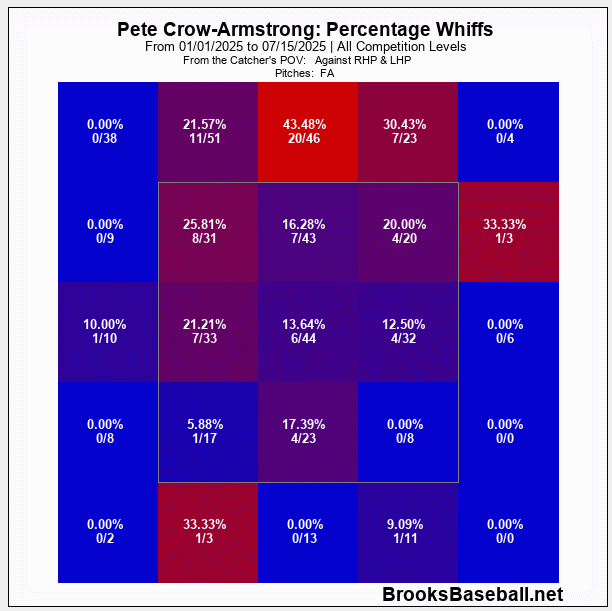
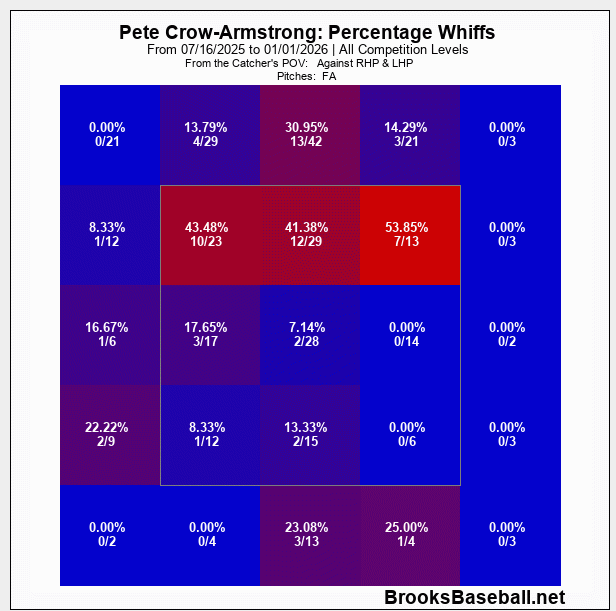
Wow, that in-zone whiff rate against upper fastballs is astonishing. He chases high heat, and it's a pretty bad flaw. Crow-Armstrong wasn’t necessarily supposed to be a great power hitter coming up through the minors; it’s a skill he developed as he progressed. Perhaps he overperformed in the first half and experienced a tough correction in the second half.
There are a lot of flaws in Crow-Armstrong’s approach, and I’m not sure how much he can fix them. We don’t often see drastic changes in plate discipline, though Crow-Armstrong is just 23 years old, so perhaps he could develop a better eye. One positive for Crow-Armstrong is that his strong defense should keep him in the lineup, thus allowing him to work through struggles and grow as a hitter.
That being said, I’m less confident in a Crow-Armstrong bounce-back compared to Wood. Wood takes a better approach at the plate and makes better contact (when he makes contact).
I think Crow-Armstrong might struggle to reach 30 homers again, and his approach makes him a liability in points leagues and OBP leagues, but don’t take him off your draft boards altogether. At the end of the day, Crow-Armstrong still had a 31-35 season and was a fantasy monster for the first half. His power and speed combo will give him plenty of 5x5value next season.
I mostly play 5x5 leagues or leagues with OBP or OPS, so personally, I’m not a fan of players with such bad plate discipline and wildly aggressive approaches on my fantasy team. They’re prone to deep slumps, like Crow-Armstrong experienced, and they can be liabilities in specific categories or for long periods of time.
PCA will likely be an avoid for me unless he falls to a nice value.
Oneil Cruz, Pittsburgh Pirates
A breakout candidate heading into the 2025 season, Cruz looked like he was on his way to stardom in the first half. Sure, he only hit .212 and had a 32.2% strikeout rate before the break, but he also smacked 16 homers and swiped 29 bases with a 13.1% walk rate. That performance was enough to earn Cruz a spot in the Home Run Derby, where he made it to the semifinals before being ousted by Cal Raleigh.
Unfortunately, things took a turn for the worse for Cruz following the derby, and he slashed just .177/.255/.311 in the second half with four home runs and nine steals. Cruz still finished strong with 20 homers and 38 swipes, but his .200 AVG was the lowest among qualified hitters, making him a liability in 5x5 leagues.
What happened to Cruz? And can he turn it around next year?
When Cruz is slumping, it might make sense to assume his strikeout rate is the culprit. Cruz has a ton of swing-and-miss in his game, and with such pitiful second-half numbers, one might think his K rate was approaching 40%, like with Wood. But that wasn’t the case for Cruz, as his strikeout rate stayed the same at 31.5% in the second half.
He was still making contact at the same rate, but the quality of contact was getting worse. He also displayed worse plate discipline in the second half, his walk rate falling four points to 9.2%.
The first thing that jumps out when comparing Cruz’s first-half metrics to his second-half metrics is the batted ball distribution. Cruz saw his line-drive rate dip to 11.1%. For context, the league average in 2025 was 19.7%, and the lowest qualified hitter had a line drive rate of 14.3% (Jazz Chisholm), while Cruz had the second-lowest line drive rate at 14.6%.
Line drives are the most likely batted ball type to land for a hit by a wide margin, so a lack of line drives could help explain a dip in batting average. Cruz has never been a big line drive hitter, but 11% is painfully low even for him.
A dip in line-drive rate wasn’t the only notable change for Cruz’s batted ball profile in the second half. He also saw a 9% increase in ground-ball rate, up to 53.7%. Cruz is a fast runner with the ability to beat out grounders, but given how hard he hits the ball, we’d really like to see him elevate. Hard grounders are often outs, and Cruz can go yard with any swing.
Like with Wood, Cruz saw his attack angle fluctuate throughout the season. Have a look at his attack angle month-by-month.
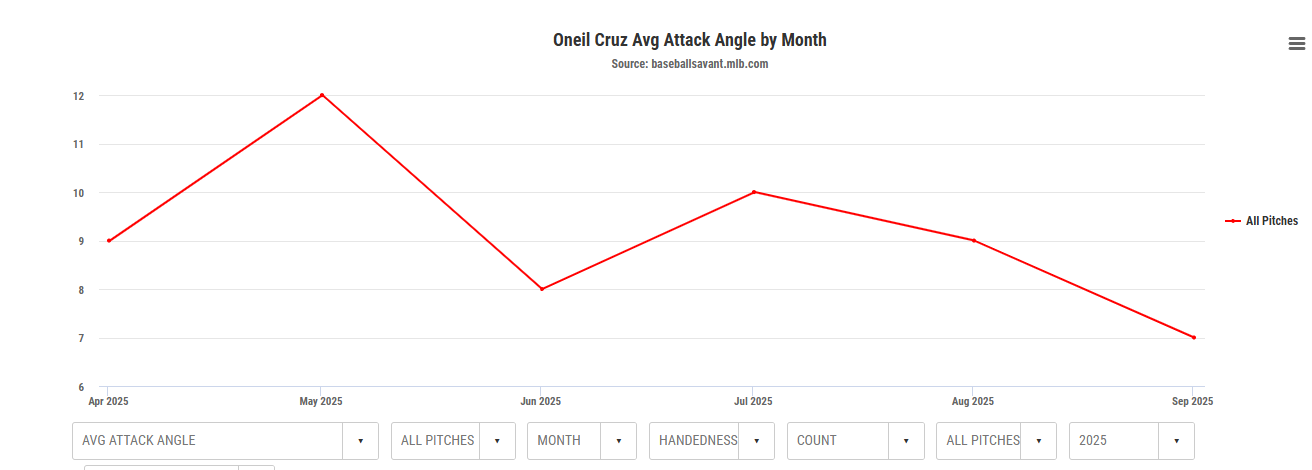
It was highest in April and May, his best two months. Perhaps it was a change in approach, or the home run derby messed with his swing, but this is something Cruz will likely have to work out mechanically. Not only did his attack angle dip, but he also saw his swing path tilt drop by one degree following the All-Star break.
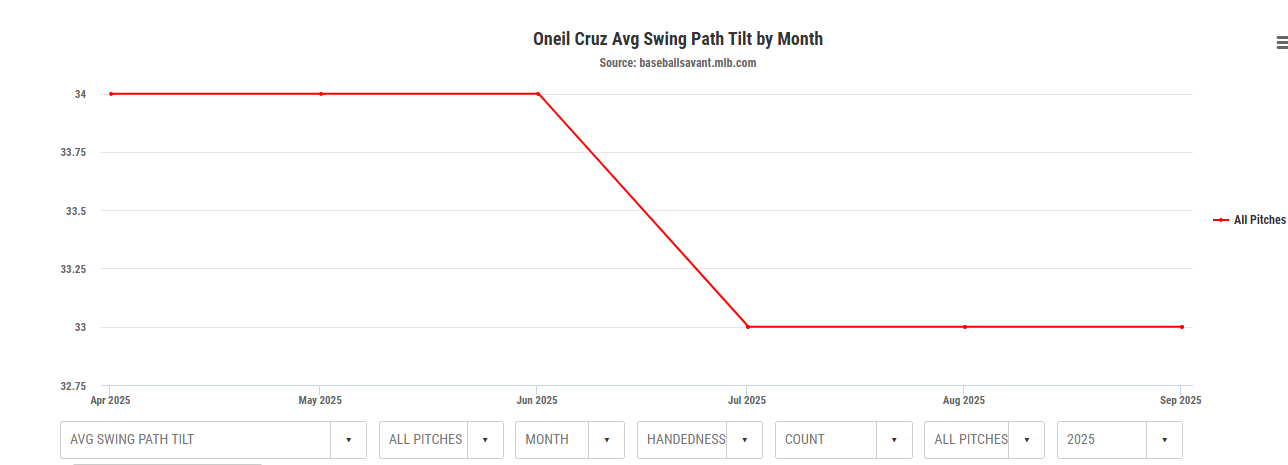
Swing path tilt measures the vertical angle formed by the swing path compared to the ground. A lower number represents a flatter swing, and a higher number represents a more uppercut swing. Cruz is around league average, but even a minor tweak to his swing path could lead to a slump and to changes in batted ball distribution. A slightly flatter swing could mean more grounders and fewer flyballs.
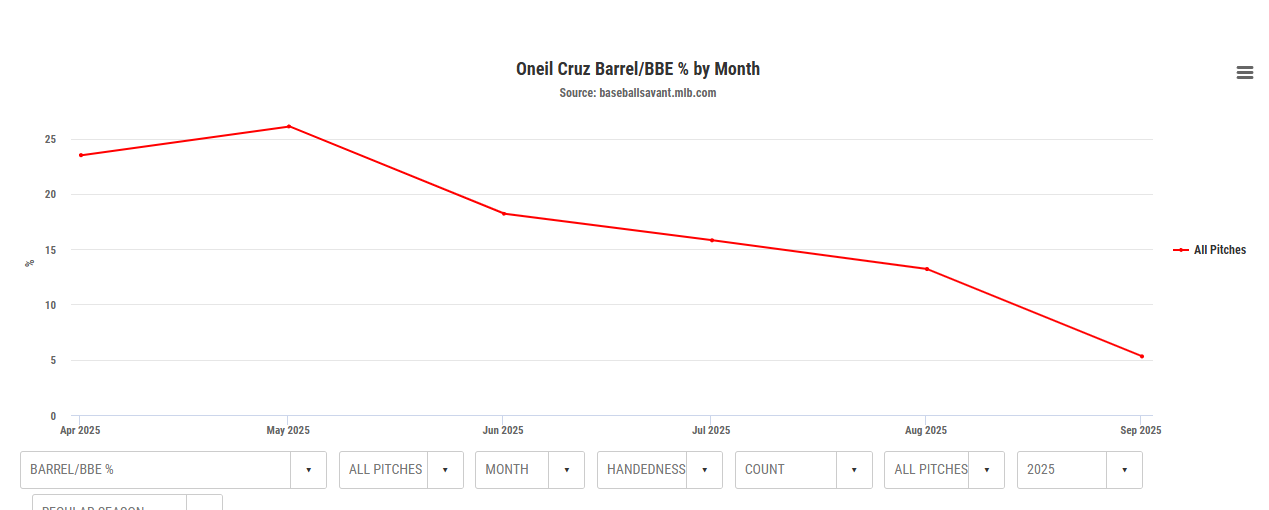
Something Cruz is known for is being a “savant superstar” because he is near the top of the league in many key metrics, such as average exit velocity (95.8 mph), max exit velocity (122.9 mph), hard hit rate (56.6%), and barrel rate (17.9%). His high strikeout rate limits his upside as he struggles to make contact, but when he does strike the ball, it’s usually with force.
Unfortunately, we saw some of these numbers dip towards the end of the season with Cruz’s slump. Here’s a look at his barrel rate per batted ball event month-by-month.
And his average exit velocity:
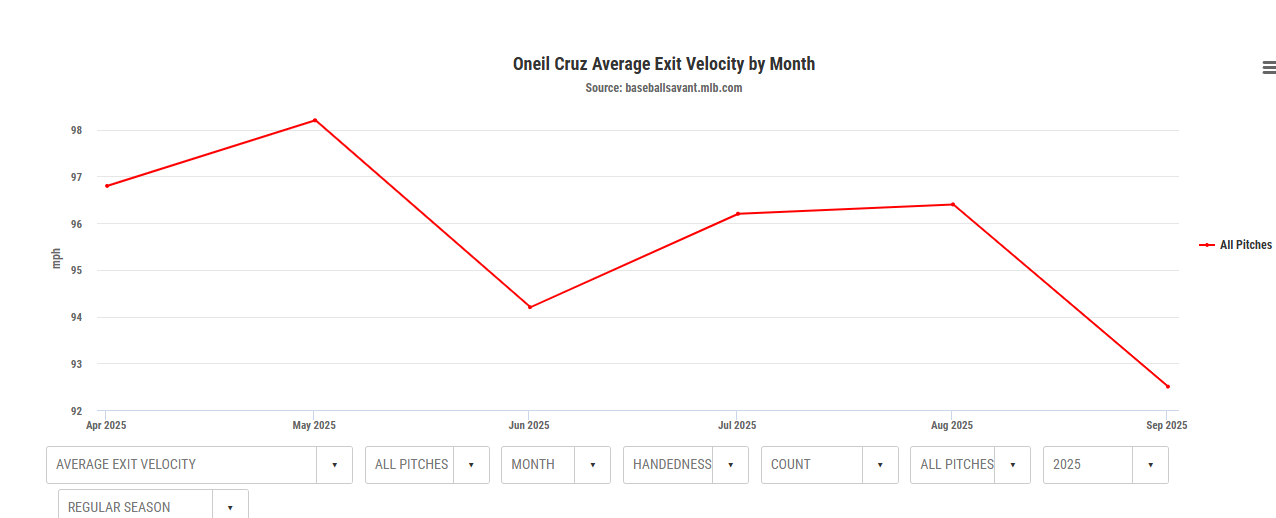
Downward trends, and it could be a result of swing mechanics, at least in part. Cruz also dealt with some injuries in the second half of the season, suffering a concussion after an outfield collision in August and hurting his ankle in September, both of which may’ve played a contributing role in his struggles.
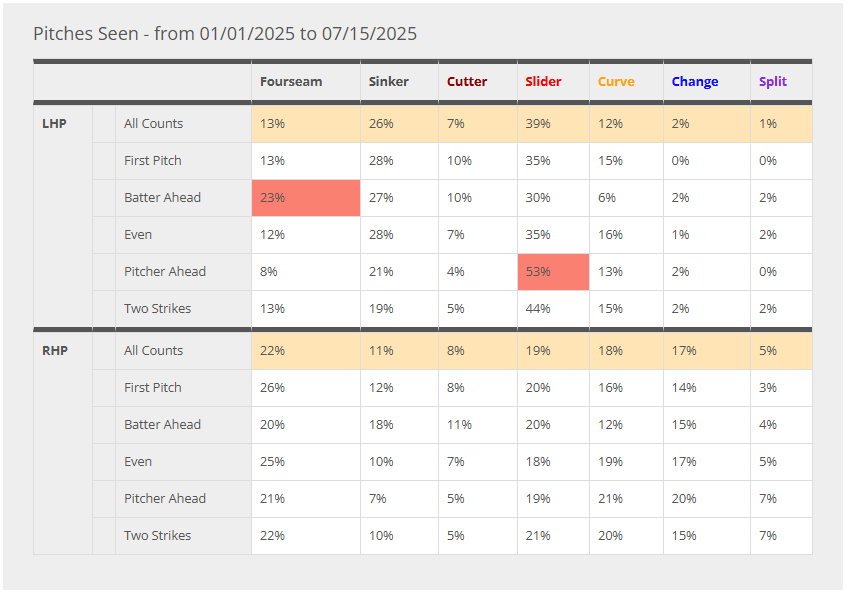
Injuries and mechanics aside, another factor in Cruz’s slump may’ve been the approach taken by opposing pitchers. He saw 9% more sliders versus lefties in the second half, and 10% fewer sinkers against lefties in the second half. Cruz crushed sinkers for a .296 AVG and .432 SLG in 2025, but hit under .200 against four-seamers, sliders, changeups, and curveballs.
Have a look at his pitches seen in the first half compared to the second half.
First half:
Second half:
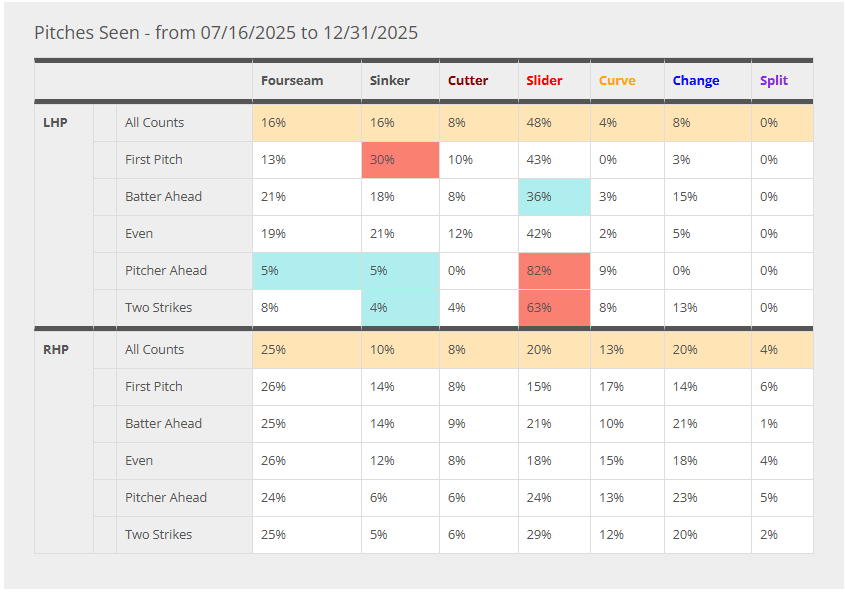
He saw sliders a whopping 82% of the time when the pitcher was ahead in the count against lefties—a 29% increase compared to the first half. Cruz also saw more four-seamers and changeups versus righties and fewer sinkers and curveballs. He struggled against four-seamers and changeups in 2025, but Cruz pulverized four-seamers for a .381 AVG and .684 SLG in 2024.
If healthy, perhaps Cruz could recapture that success while also displaying his strong plate discipline again, which could force pitchers to throw him strikes or more hittable pitches. Cruz had the fourth-lowest zone rate among qualified hitters at 38.5% and had the second-highest CSW rate (called strike + swinging strike rate) among qualified hitters at 31.8%.
Cruz will never be a great contact hitter, but if he could cut his strikeout rate to below 30%, he could see some nice gains in his hitting numbers.
A lot seems to have gone wrong for Cruz in the second half, and he will need to get right physically, mentally, and mechanically for 2026. We know there’s plenty of talent in this bat, and Cruz has enough power and speed to give himself a decent season-long floor, even if he has his ups and downs.
If there’s a discount on Cruz heading into 2026, I’d be happy to take a chance on him. 2025 sort of feels like a step back for Cruz, but progress isn’t always linear, and he only just turned 27. If he can straighten out his swing, get healthy, and recapture his strong plate discipline, he could bounce back in 2026.
More Fantasy Baseball Advice
Download Our Free News & Alerts Mobile App
Like what you see? Download our updated fantasy baseball app for iPhone and Android with 24x7 player news, injury alerts, sleepers, prospects & more. All free!