



 RADIO
RADIO







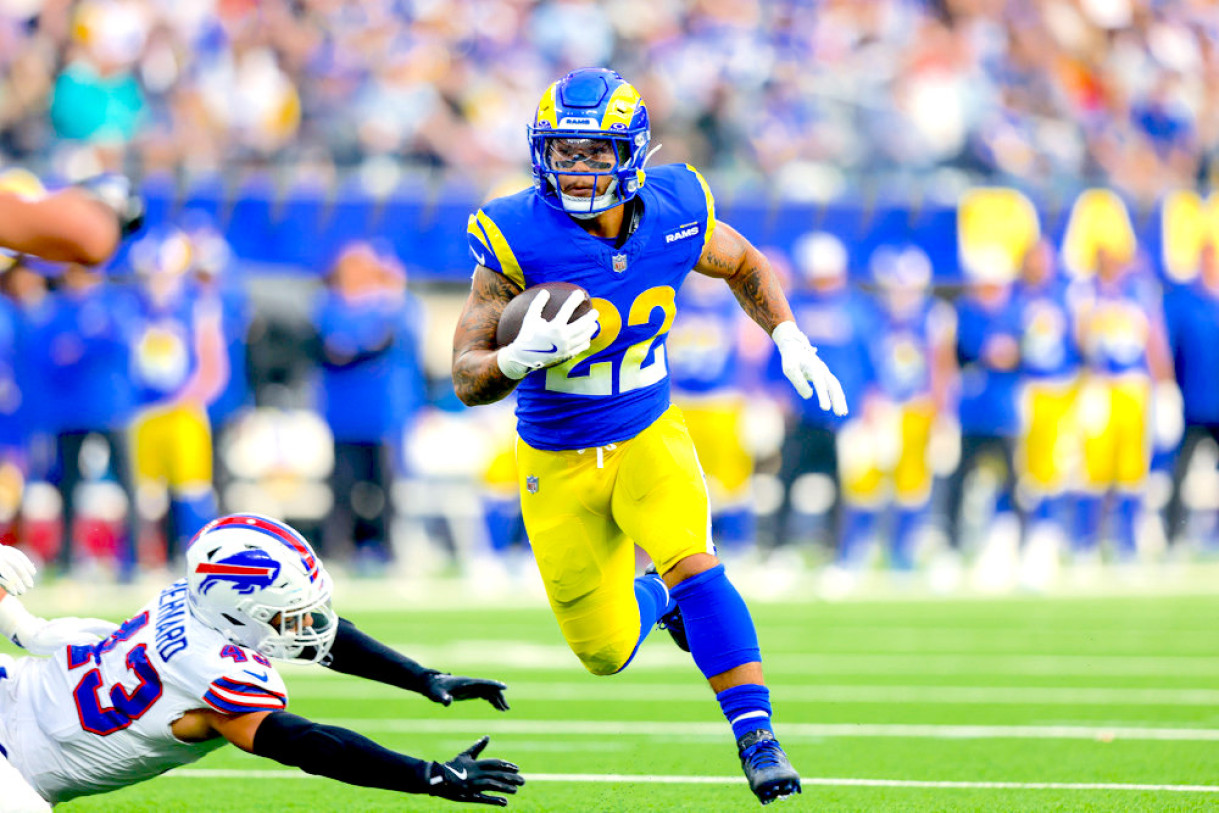
Corbin Young examines 12 fantasy football breakout candidates for redraft leagues. His top player targets, sleepers, and breakouts to draft for your team.
To define breakouts, we're looking at players who haven't yet scored 200 fantasy football points. The 200 fantasy point threshold is often a marker for a breakout season since it weeds out the points per game monsters, who scored well in 2-3 games.
Besides the 200 fantasy point threshold, finding players within their first 3-5 years of the league tends to be the best bet. Breakout players can come from various points throughout our fantasy football drafts, including the early, middle, and later rounds.
The draft market continues to become smarter, making it more challenging to find edges throughout fantasy football drafts. Since it's still early in the summer, we're using Average Draft Position (ADP) from the best ball leagues in the Fantasy Football Players Championship (FFPC). We'll examine why these 12 players could break out in 2026 fantasy football leagues.
Bookmark our updated and revamped fantasy football rankings portal for all league formats!PPR rankings | Half-PPR rankings | Standard rankings | Rookie rankings | Superflex rankings | Dynasty rankings | Who To Start? | Injuries | Matchup Ratings | Strength of Schedule
Luther Burden III, WR, Chicago Bears
FFPC Best Ball ADP: 44.5
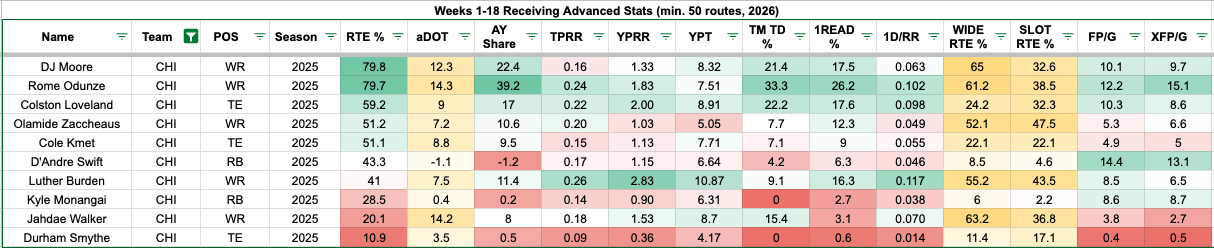
Luther Burden III had two WR1 games when he totaled over 100 receiving yards and caught a touchdown in Weeks 3 and 17. The season-long route percentage (41%) doesn't look great, as he trailed DJ Moore (79.8%), Rome Odunze (79.7%), Colston Loveland (59.2%), Olamide Zaccheaus (51.2%), and Cole Kmet (51.1%). However, Burden was a per-route king with a 26% target rate, 2.83 yards per route run, and an 11.7% first down per route.
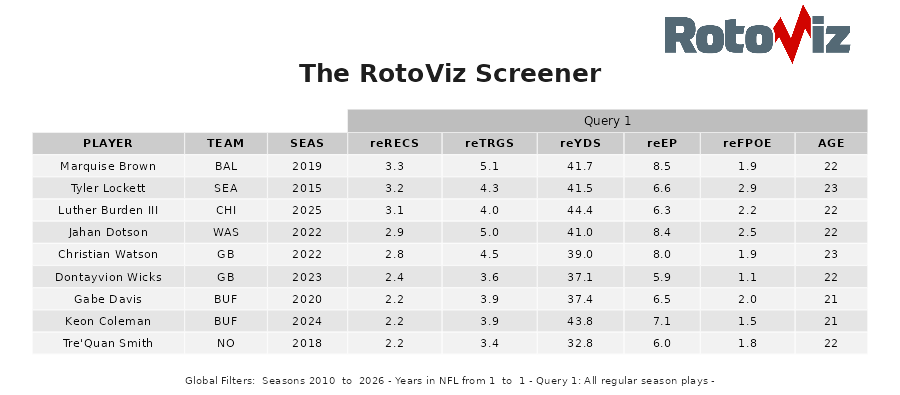
Since 2010, Burden's rookie season has compared closely to those of Marquise Brown, Tyler Lockett, Jahan Dotson, Christian Watson, Dontayvion Wicks, Gabe Davis, Keon Coleman, and Tre'Quan Smith. Lockett didn't have a breakout season until Year 4, but had six consecutive seasons with over 200 fantasy points. Interestingly, Watson hasn't reached 200 fantasy points, but injuries have been problematic, though he continues to be an efficient receiver when healthy.
The Bears ran the sixth-highest rate of 12 personnel (32.6%) while passing at the 16th-highest rate (48.1%). Without Moore on the Bears, Burden should be on the field in two-wide receiver sets, especially if they continue to use 12 personnel. That will benefit Burden, who can produce against man (2.60 yards per route run) and zone coverage (2.92 yards per route run).
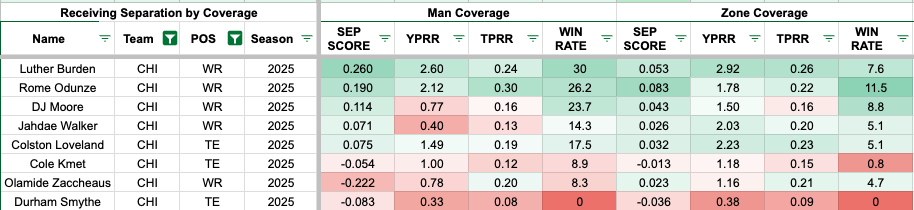
Burden is the first Bears receiver drafted behind Loveland at pick 18 in FFPC leagues, a favorable scoring format for tight ends. Heading into Year 2, Burden remains a medium-risk, high-reward profile. This is the mold of a breakout receiver, with the market being sharper and valuing him highly.
Blake Corum, RB, Los Angeles Rams
FFPC Best Ball ADP: 87.5
Fantasy football is a game of upside and volume, especially at the running back position. One stat that tends to correlate well with fantasy points at running back is a player's percentage of snaps.
Kyren Williams has been a fade of mine because of speculating on what happens if the volume regresses. That hasn't been favorable for me after ranking as a top-12 running back over the past three seasons.

In Blake Corum's second season, he started eating into the snap share for Williams. Corum handled 29% of the team's snaps with Williams at 68% last season. For context, Williams had an 87% snap share, with Ronnie Rivers (26%) and Corum (13%) trailing him in 2024. Corum had 15% of the team rushing opportunities in Year 1, which increased to 31% in Year 2.
Though Williams had over 100 more rush attempts last season, Corum bested him in explosive rush rate (6.9%), missed tackle rate (18%), and yards before contact per attempt (2.90). Often, a player's advanced numbers regress across a larger sample. From Weeks 13-16, Corum ranked ninth in PPR/G, given the highest FPOE/G (7.7), as seen below.
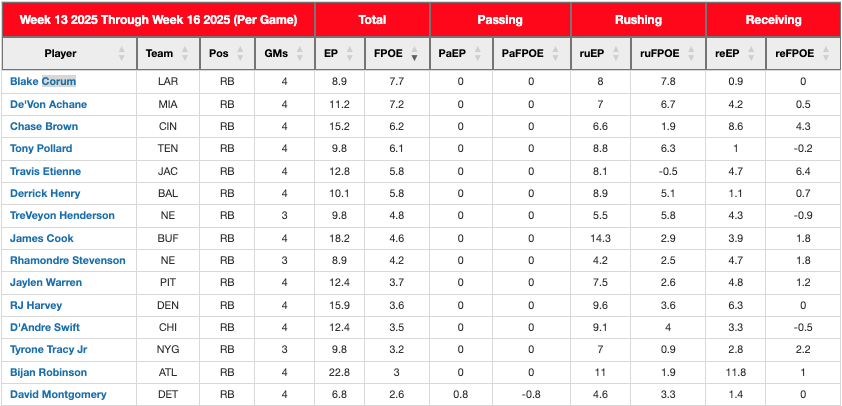
The market is valuing Corum highly. It might be hard to draft Corum at his price within the top 100 picks, but he can produce as an RB3. Corum can be an efficient rusher, teasing us with more upside if he garners more of the running back opportunities.
Ricky Pearsall, WR, San Francisco 49ers
FFPC Best Ball ADP: 108.5
Ricky Pearsall might be a better best ball draft pick because of his injuries and small sample size. Pearsall posted two games (10%) as a WR1, three games as a WR2 (25%), and 15 games as a WR3 or worse (65%). Furthermore, Pearsall missed 39% of his career games, aligning with the injury concerns.
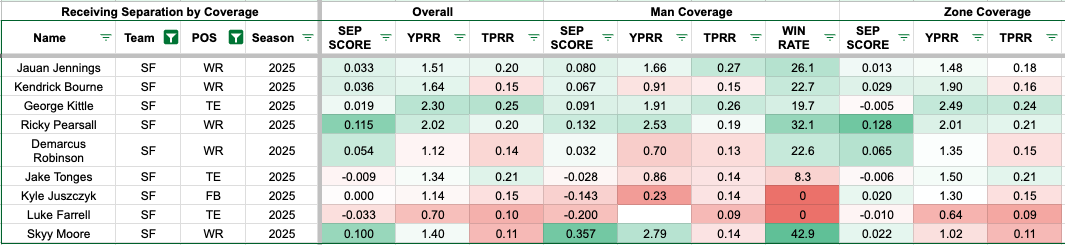
Pearsall led the team in average separation score overall. He boasted a 2.53 yards per route run against man coverage. Meanwhile, Pearsall showed he can separate and be productive (2.01 yards per route run) in zone coverage.
The draft market values Pearsall highly, going inside the top 125 picks. That said, Pearsall fits the mold of a middle-round wide receiver breakout candidate.
Jalen Coker, WR, Carolina Panthers
FFPC Best Ball ADP: 122
Coker has been pretty efficient on limited volume, given his 2.2 fantasy points over expected per game (FPOE/G), ranking 14th last season. Furthermore, Coker has the 24th-ranked Receiving Air Yards Conversion Ratio (RACR). That indicates Coker converted 91% of his air yards into receiving production.
He might be priced slightly ahead of where he should be for a player with a 15% target share who never earned 50 targets in a season. However, we're dreaming about his per-game efficiency as a player who hasn't scored 100 fantasy points in either of his first two seasons in PPR formats.

Coker thrives against man coverage, posting a team-high 2.63 yards per route run while earning a target on 25% of his routes. He bests his teammate Tetairoa McMillan in yards per route run and win rate against man coverage, with McMillan garnering a higher target rate (30%).
The biggest question mark is pass volume, with the Panthers ranking 28th in neutral-script pass rate last season. If the Panthers pass slightly more, it benefits Coker and McMillan to avoid relying mainly on efficiency.
Jonah Coleman, RB, Denver Broncos
FFPC Best Ball ADP: 146.5
It's somewhat of a crowded backfield. RJ Harvey (91 ADP), J.K. Dobbins (105.5 ADP), and Coleman (103.5 ADP) are all going within 30-40 picks. This is a bet on the cheapest option in the Broncos backfield. The Broncos under Sean Payton tend to deploy three running backs.
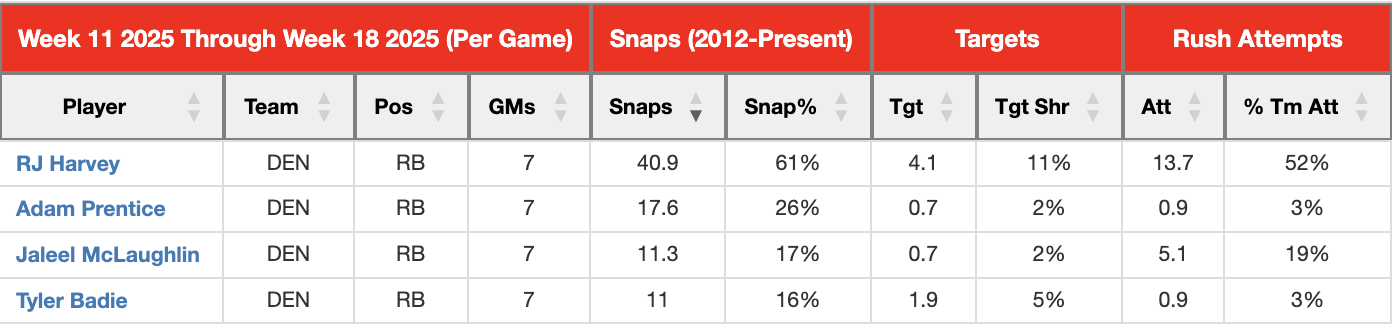
Dobbins logged a 51% snap share with Harvey (42%), Tyler Badie (18%), and Jaleel McLaughlin (16%) trailing in snaps. After Dobbins suffered an injury, Harvey hogged most of the snaps (61%), though they still mixed in McLaughlin and Badie 16-17% of the time.
Since the Broncos prioritized Dobbins in free agency, there's a good chance that he earns a healthy percentage of the snaps and touches this season when healthy. Coleman closed his collegiate career with an 80% Running Back Dominator and 12% receiving yardage market share.
Throughout Coleman's career, he has a 31.2% missed tackles force rate and a 38.2% breakaway rush rate. Both have been above-average metrics relative to the rest of the 2026 NFL Draft class, showing Coleman can be a productive rusher and receiver for fantasy purposes.
Denzel Boston, WR, Cleveland Browns
FFPC Best Ball ADP: 150.5
KC Concepcion is the highest-drafted Browns wide receiver, so this is a bet on cost and uncertainty. Jerry Jeudy goes within the top 200 picks (199 ADP) as the latest positional player drafted from the Browns. The Browns used 12 personnel with two tight ends on the field at the highest rate (41.2%) last season.
They don't have David Njoku this year, but they added two tight ends in the draft on Day 3. There's a good chance Harold Fannin Jr. will be the focal point at the tight end position, but the Browns may deploy a second tight end on the field.
With Kevin Stefanski gone, Todd Monken joins the Browns as their head coach after formerly working with the Ravens. As the Ravens offensive coordinator, Monken had them using 12 personnel at the third-highest rate (35.9%) behind the Browns and Falcons.
Unfortunately, the Browns were awful in 12 personnel from a passing perspective, ranking 31st in EPA per pass while passing often (57.8%, No. 7). The Browns invested their first three picks on Concepcion, Boston, and Spencer Fano (LT). Let's hope they can maintain their pass rate in 12 personnel while being more efficient with better offensive options.
If their use of 12 personnel continues, it means the Browns will often have two receivers on the field. Concepcion had played out wide 65.3% of the time in his final collegiate season. However, Concepcion averaged a 69.5% slot rate throughout his career.
If the Browns deploy Concepcion in the slot, there might be some overlap with Fannin, given that he ran routes 41.9% of the time in the slot last season. That said, Boston could benefit as one of the two primary outside receivers alongside Jeudy. Boston and Concepcion were back-to-back on my spreadsheet, though they can win in different ways.

At the University of Washington, they targeted him all over the field. Boston had a 27.9% target rate when deep (20+ yards downfield), 38.4% in the medium parts (10-19 yards), and in the short areas (32.6%). Besides Boston being solid at contested catches, with a 61.1% career contested catch rate on 36 contested targets, he can win against man coverage (2.58) and zone (2.20) in yards per route run.
Both Concepcion and Boston should be solid rookie and dynasty assets, but we're taking the discounted potential breakout with Boston.
Tank Bigsby, RB, Philadelphia Eagles
FFPC Best Ball ADP: 142.5
If we had told you that Saquon Barkley played in 16 games last year, you wouldn't expect him to regress to an RB2. Barkley ranked ninth in expected fantasy points per game and 66th in FPOE/G. That's after Barkley had a peak season since his rookie year, ranking fifth in EP/G and fourth in FPOE/G in 2024.
We never hope for an injury, but targeting Tank Bigsby is a bet on the backup for the Eagles star running back. Bigsby continues to be an efficient rusher, ranking second in yards per rush attempt and averaging 0.3 rushing FPOE/G last season. There's plenty of upside for Bigsby if Barkley misses time.
Jalen McMillan, WR, Tampa Bay Buccaneers
FFPC Best Ball ADP: 145
With Mike Evans gone, Jalen McMillan should garner more routes and targets on the outside. The Buccaneers used 11 personnel at the second-highest rate (68.7%) last season. However, Tampa Bay had the 17th-highest pass rate and the 20th-best EPA per pass attempt out of 11 personnel.

McMillan only played in four games after recovering from a severe neck injury last season, so maybe we're dreaming of the touchdown efficiency from his rookie season. From Weeks 14-18 in 2024, McMillan trailed Evans in target rate (20%) with 25.8% of the team's air yards and seven touchdowns (43.8% TD%), leading to 44.8 FPOE (No. 1 among all WR/RB/TE).
We're betting on more routes and opportunities for McMillan, with some upside contingent on Emeka Egbuka and Chris Godwin Jr. missing time.
Nicholas Singleton, RB, Tennessee Titans
FFPC Best Ball ADP: 185.5
Like other rookie running backs, we're looking at Nicholas Singleton as an RB3 who could have a path for spike weeks. Singleton had a balanced profile with a 62% RB Dominator and a 10% receiving market share in his final collegiate season. He struggled to create yards after contact (2.69 YAC/Att), miss forced tackles (15.3%), and break off explosive runs (23.4%).
The Titans ranked tied for 12th in neutral script rush rate last season. They brought in Robert Saleh as head coach and Brian Daboll as Titans offensive coordinator. Under Daboll, the Giants ranked tied for seventh in neutral script rush rate in Weeks 1-10. However, the Titans ranked 18th in neutral script rush rate from Week 11 under Mike Kafka.
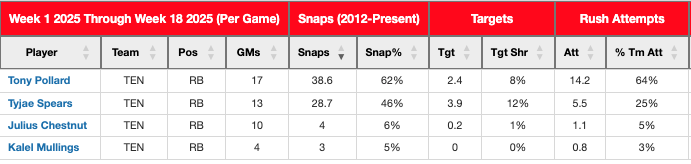
The neutral script pace data indicates that Daboll may prefer a balanced offense. Tony Pollard and Tyjae Spears shared the Titans backfield for most of the season. Pollard handled most of the snaps (62%) and rush attempts (64%), with Spears leading the backfield with a 12% target share.
We're betting on the cheapest option in the Titans backfield because there could be value in a shared role if Pollard or Spears miss time.
George Holani, RB, Seattle Seahawks
FFPC Best Ball ADP: 180.5
Rookie Jadarian Price is the highest-priced Seahawks running back at 60.5, with Zach Charbonnet at pick 109. There have been positive notes on Charbonnet's recovery timeline, though there's a good chance he misses the first month of the season. Price expects to take on the early down role to begin the season.
Given a career sample of 25 rush attempts and three targets in his career, no advanced stats are pointing toward George Holani as a breakout. That said, Holani might be more of a sleeper than a breakout candidate. It's a matter of early season opportunity for Holani as the potential third-down back who can soak up a handful of carries per game.
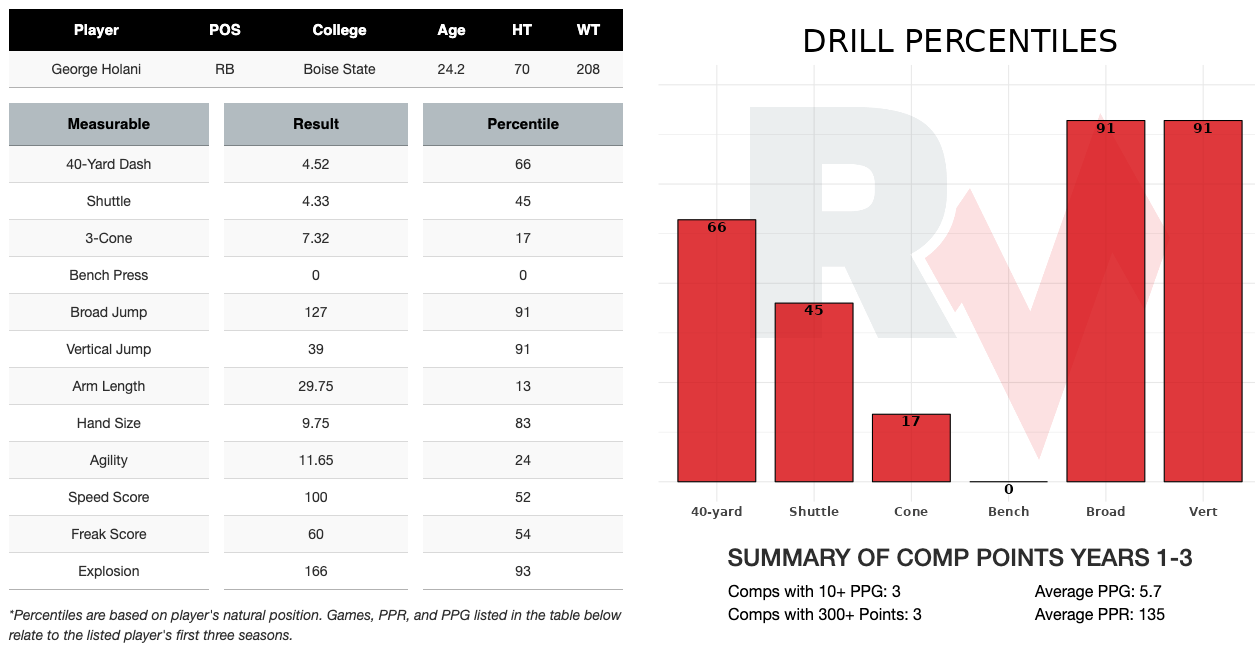
Holani has above-average athleticism with a 93rd-percentile Explosion Score and workout numbers similar to those of Tyjae Spears, Kerryon Johnson, and Alvin Kamara. Under Klint Kubiak last season, Kenneth Walker III (47%) and Charbonnet (49%) shared the backfield from a snap share perspective.
Assuming there's a similar backfield split, Price and Holani could split snaps until Charbonnet returns. Any running back projected for 40% or more of the snaps to begin the season should be valued as an RB3. Holani remains the cheapest entry point into the Seahawks backfield.
Malik Willis, QB, Miami Dolphins
FFPC Best Ball ADP: 185
In the seven games when Malik Willis rushed five or more times during his career, he averaged 16.3 fantasy points. However, three of those seven games came with fewer than 100 passing yards. With Tua Tagovailoa gone, the Dolphins invested in Willis for a three-year contract worth $67.5 million in the offseason.
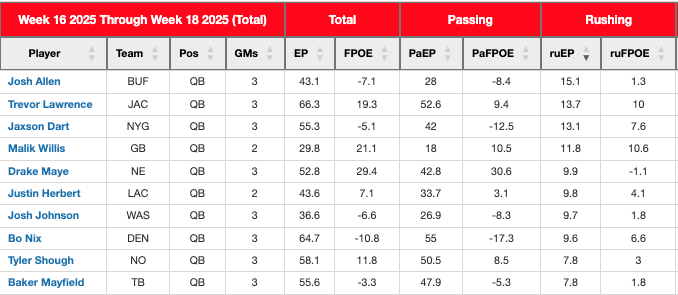
In the final two games of the season, when Willis played more after Jordan Love left with a concussion, Willis ranked fourth in rushing expected points behind Josh Allen, Trevor Lawrence, and Jaxson Dart in Weeks 16-18. Don't look at Willis' passing expected points (18) since it's a small sample for a quarterback who hasn't had tons of starting reps.
Besides Willis' rushing upside, there's a chance that the Dolphins could be trailing and playing from behind, which means garbage time and pass volume. Willis should be valued as a QB2, though the rushing upside could make him a discounted version of Jaxson Dart.
Ryan Flournoy, WR, Dallas Cowboys
FFPC Best Ball ADP: 211
The Cowboys ranked fifth in their usage of 11 personnel, with three receivers on the field. They ranked 16th in pass rate while being the sixth-most efficient in EPA per pass out of 11 personnel. Flournoy was used out wide (65.1%) and in the slot (34.9%), though the usage was sporadic, given injuries.
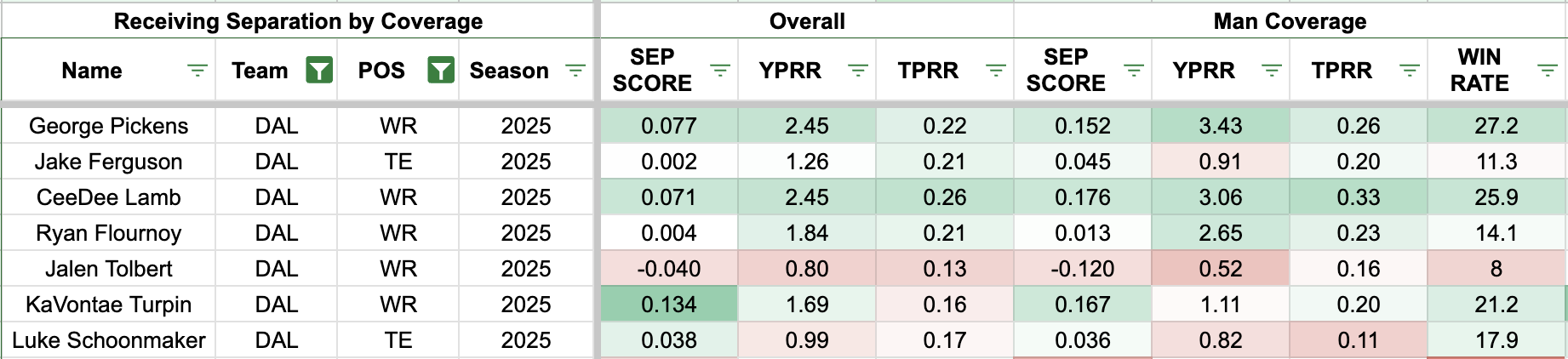
Unsurprisingly, Flournoy trailed CeeDee Lamb and George Pickens in most categories (target rate, yards per route run, and average separation score). However, Flournoy produced an above-average yards per route run (2.65) against man coverage, making him a viable receiving option in three-receiver sets for the Cowboys.
There's contingent value for Flournoy if Pickens or Lamb were to miss time.
Who Should I Draft Tool
Read more about the Who Should I Draft tool here:
2026 Player Decisions. Today's focus is on specific players - Luther Burden III, Blake Corum, Ricky Pearsall, Jalen Coker, Jonah Coleman, Denzel Boston, Tank Bigsby, Jalen McMillan, Nicholas Singleton. These are some common searches for 2026 fantasy football drafts.
Using The Tool. This is a simple tool but very powerful. The first step is to enter the player names that you want to compare. In the first box, search for the first player name. In the second box, search for the second player name. Compare up to four NFL players at once, and then click the Who To Draft? button to see who the recommended draft picks are based on fantasy football rankings, projections and more.
Improvements For Who Should I Draft? You may have noticed, our Who Should I Draft? tool has gotten an overhaul. We've added lots of great features for you to give you as much information as possible to win your 2026 fantasy football drafts. You'll see NFL player tiles with headshots and bye weeks, stats and projections, ADPs, strength of schedule, enhanced search results with data to compare, and a slick interface. We hope you enjoy!
How It Works. Our RotoBaller staff puts together their preseason fantasy football rankings and projections based on their research, and update it constantly throughout the preseason. That information is the core data that is powering the decision-making in this tool. When you search for player names, you will only see those players that are ranked.
Scoring Formats. Fantasy football managers play in various types of leagues, and this tool allows you to choose whether it's PPR scoring, Half-PPR scoring, or Standard (Non-PPR) scoring. The second thing you want to do, is to select the scoring format. There are three small radio buttons (small circle), so click on the scoring format you prefer. The results may vary based on the scoring format you select.
Popular Draft Searches. Curious to see some tough draft decisions for 2026? Below you will find a list of some popular Who Should I Draft? searches that RotoBaller readers are looking at this. Click any of the links to see the result and recommendation.
Popular Player Comparison Searches - Who To Draft
Below are some popular searches and comparisons from our Who To Draft tool for 2026 drafts for Luther Burden III, Blake Corum, Ricky Pearsall, Jalen Coker, Jonah Coleman, Denzel Boston, Tank Bigsby, Jalen McMillan, Nicholas Singleton:
More Fantasy Football Analysis
Download Our Free News & Alerts Mobile App
Like what you see? Download our updated fantasy football app for iPhone and Android with 24x7 player news, injury alerts, rankings, starts/sits & more. All free!