




 RADIO
RADIO










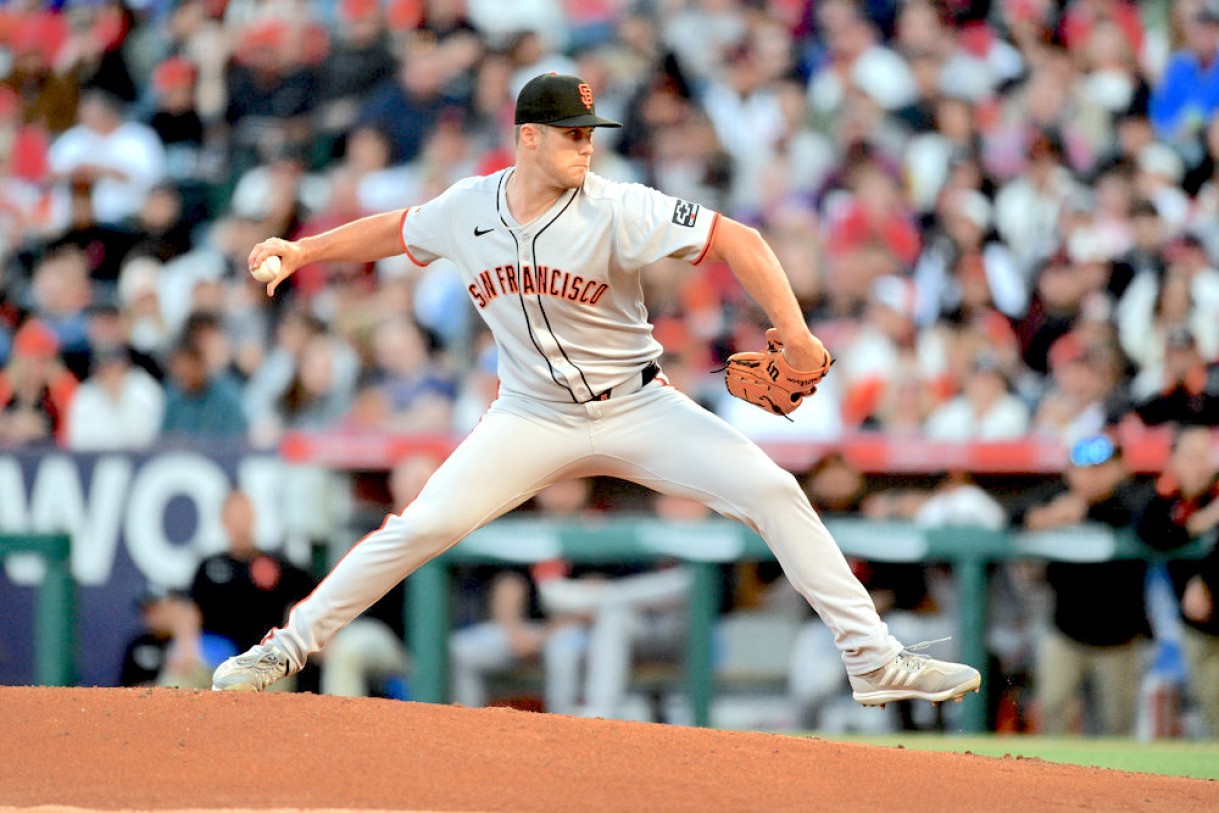
Elliott looks at pitchers with surprising starts recently. These SPs could emerge as fantasy baseball waiver wire targets for Week 13 in 2026, or just mirages.
Welcome back to the "Are You For Real?" series as we dive into Week 13 of the 2026 fantasy baseball season. For those unfamiliar, this is a weekly column where we examine starting pitchers who had surprisingly strong starts over the past week and put them under the microscope to determine whether they're legitimate or just smoke and mirrors.
Attractive names on waivers are becoming more and more scarce as we march towards the All-Star break, and this week I will be looking at three guys still available in over half of Yahoo leagues that have been pitching well lately. First, we'll look at Landen Roupp's strong start in Miami. Then, we'll deep dive into Gage Jump's hot start for the Athletics. We'll finish by examining the ever-persistent Martin Perez, who finds himself in an important role for a contender once again.
Roster percentages are taken from Yahoo! and are accurate as of June 22.
Featured Promo: Save 50% off the regular price with discount code CHAMP, for a limited time. Exclusive access to our Team Sync platform, DFS cheat sheets, Lineup Optimizers, betting/prop picks, and exclusive content from Nick Mariano and Eric Cross! GAIN ACCESS NOW
Landen Roupp, San Francisco Giants – 44% Rostered
2026 Stats (prior to this start): 74.1 IP, 4.24 ERA, 2.97 FIP, 16% K-BB%
06/19 @ MIA: 6 IP, 7 H, 2 ER, 1 BB, 7 K
Roupp was excellent Friday night, holding Miami to two runs over six innings in the quality start, while striking out seven. He lowered his ERA to 4.15, which isn’t all that exciting, but Roupp does have a 3.01 FIP and 16.6% K-BB% on the season, both of which suggest better days could be ahead. Is it time to add Roupp, or should we leave him on the wire?
Originally a 12th-round pick by San Francisco in 2021, Roupp wasn’t a big prospect coming out of college, but rose through the ranks to strong minor league performance. He began as a reliever in 2024, but put up a 3.80 ERA in 22 starts last season, which had many pegging Roupp as a breakout heading into 2026.
It hasn’t quite turned out that way yet, but Roupp still displays plenty of interesting traits and has flashes like Friday that suggest there’s deeper potential here.
Roupp works with a five-pitch mix, consisting of a sinker, curveball, changeup, cutter, and four-seam fastball. He doesn’t throw the four-seamer often, with just a 4% usage rate this season, but he throws every other pitch at least 12% of the time. Roupp sort of has a big three when it comes to pitching—the sinker, changeup, and curveball—and all three play a big role in his start against Miami.
His most used pitch this season has been the sinker, which Roupp throws 36.3% of the time. A 93.3 mph offering, Roupp’s sinker is rather soft by today’s standards, ranking in just the 28th percentile for fastball velocity in MLB. Roupp’s sinker may be soft, but it has been quite effective this season.
Batters are hitting .255 with a .443 SLG and a .357 wOBA, which are pretty good results for a primary fastball, especially a soft sinker. He also has a 4-degree average launch angle against and a 53.4% groundball rate with the pitch, so it’s done a great job at generating groundballs.
Roupp is able to overcome his velocity thanks to the exceptional movement on his sinker. His sinker movement represents a strong deviation from the typical MLB sinker, especially the 17.5 inches of arm-side run and heavy drop. Here’s a look at his pitch movement profile for 2026 (sinker in orange).
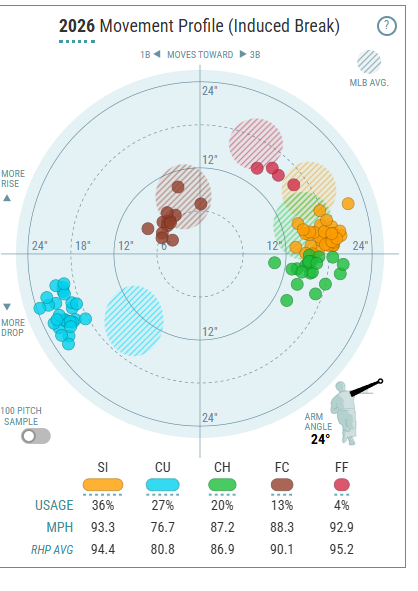
See how there’s a cluster of dots below the MLB average sinker shape? That’s a good thing, because it makes the pitch both hard to read and hard to square up. A pitcher is never going to rack up a bunch of strikeouts with a sinker, but Roupp has allowed just an 87.7 mph average exit velocity with the sinker this year.
Here’s a look at the pitch from this season:
— Elliott Baas (@ElliottBaasBB) June 22, 2026
It’s gnarly, but subtly, because that strong movement happens late enough to freeze a batter or force a bad adjustment. When it comes to fastballs, I would always pick movement over velocity (to a degree). I’ve seen more pitchers get by with weak velocity and strong movement than vice versa. And I think Roupp’s sinker has the juice to be a solid MLB offering, despite its velocity.
His next most used pitch has been the curveball, which Roupp has thrown 27% of the time this season. A 76.7 mph offering, Roupp’s curve is both sharp and soft, can be loopy, and has a ton of spin and movement. His 3074 average RPM spin rate makes him just one of 11 qualified pitchers with a curveball spin rate greater than 3000 RPM.
He also gets some wild movement with this pitch, including 8.5 inches of drop and 19.2 inches of glove-side movement. Let’s look at his pitch movement profile again (curve in blue).
I would say that’s an atypical curveball shape, wouldn’t you? Here’s a look at the pitch itself.
— Elliott Baas (@ElliottBaasBB) June 22, 2026
Nasty stuff, and opponents have really struggled to hit this pitch. Batters have a .207 AVG, .299 SLG, and .263 wOBA off the pitch. Somehow, the expected stats are even better, with Roupp posting a .167 xBA, .213 xSLG, and .216 xwOBA. Roupp has a 37% whiff rate with this pitch as well, which is very good for a curveball.
Even when batters do make contact, they’ve only averaged an 83 mph average exit velocity, which is a big reason why Roupp has been able to limit the damage. This pitch has all the ingredients of a strong secondary offering, and if he can command it, the curveball should be a good weapon for Roupp on the mound.
Then there’s the changeup, which Roupp throws 20% of the time. Believe it or not, Roupp’s changeup has extreme movement and measurables, too. An 87.2 mph offering, Roupp’s 2.7 inches of drop and 15.9 inches of arm-side movement give the changeup a unique shape and movement. I am once again asking you to look at Roupp’s pitch movement profile (changeup in green).
Here’s an example of the pitch from this season.
— Elliott Baas (@ElliottBaasBB) June 22, 2026
It’s hard and sharp for a changeup, and has that nasty movement that’s so hard to read and make solid contact against. Batters have struggled against the changeup as well, hitting just .209 with a .269 SLG and a .243 wOBA. Like with the curveball, Roupp has done an excellent job at limiting hard contact with this pitch.
Opponents have averaged just an 83.5 mph average exit velocity against and a 3-degree average launch angle. Roupp also has a 34.4% whiff rate and a 55.3% groundball rate this season. When a pitch can both consistently generate whiffs and groundballs, it has my attention.
Zooming out, there’s a lot to like just looking at the surface and underlying stats Roupp has produced. Forget about the 4.15 ERA and 1.29 WHIP for a moment, and consider his 3.01 FIP, 3.39 xFIP, and 3.72 SIERA, all career bests by far. He also has a 16.6% K-BB%, which isn’t elite, but it’s a solid ratio and suggests that Roupp is doing something right on the mound.
He’s also done a great job keeping the ball in the yard, with just a 0.56 HR/9 this season. Between the soft contact and groundballs he’s generating, his home ballpark, and his history of home run suppression, I think this is a totally realistic number for Roupp. It may regress a little bit, but limiting home runs and power has always been a strength for him.
There are flaws here, the biggest one being shaky command and control at times. His 3.70 BB.9 is technically the lowest of his career, but if Roupp could take the next step and lower it by a few percentage points, he could really take off.
I also have a few concerns about the team he plays for. There hasn’t been much to like about the Giants' on-field product this season, and other than Harrison Bader and Matt Chapman, they are full of defensive question marks.
Verdict:
Roupp has been shaky and inconsistent on the mound, but when digging deeper, there’s quite a bit to like in this profile. He’s a soft thrower, but his sinker, curveball, and changeup all display unique movement and measurables that should allow the pitches to be effective, when Roupp commands them that is.
The sinker, curve, changeup combo should be close to enough to work as his primary arsenal as a starter, with the occasional cutter or four-seamer. These three pitches look to be at least above average, and should allow Roupp to both rack up strikeouts and groundballs, a fantasy manager’s favorite combination.
It’s not all sunshine and rainbows for Roupp, however, as he’s taking a few poundings on the mound this season. He gave up eight earned runs against Milwaukee on 6/1 and has given up four or more runs in six of 15 starts this season.
He’s also struggled to pitch deep into games, as last Friday’s start was the first time in a month he made it out of the sixth inning. His poor control has played a big role in these bad games, as many of them involved Roupp unraveling on the mound.
He’s definitely talented, and it would not surprise me one bit to see Roupp take a star turn at some point and become a high-K SP3, but he’s not quite there yet. If he can string together a few more starts like this, I’d be very interested. For now, I think he’s someone that you deploy selectively, against weak opponents and in favorable ballparks.
Gage Jump, Athletics – 40% Rostered
2026 Stats (prior to this start): 23.1 IP, 3.09 ERA, 2.51 FIP, 13.8% K-BB%
06/18 vs. LAA: 7 IP, 1 H, 0 ER, 3 BB, 7 K
Jump had his best start as a big leaguer Thursday night, blanking the Angels over seven innings, allowing just one hit and striking out seven. Jump has been rolling ever since being promoted in late May, and he has a 2.37 ERA through his first five starts. Should you jump on this waiver wire arm, or keep your feet on the ground?
A third-round compensatory balance selection in 2024, Jump quickly became a highly touted pitching prospect, with many outlets ranking him inside the top-100 prospects in baseball coming into 2026.
Jump is an undersized lefty at 6’0”, 200 pounds, but he became a top prospect anyway, thanks to his electric stuff. He’s been blowing heaters and sliders past minor leaguers since 2025, and it’s working in the big leagues now.
Jump works with a five-pitch mix, consisting of a four-seam fastball, slider, curveball, changeup, and sweeper. Jump may have five pitches, but he takes a fastball-heavy approach, using the four-seamer 48.6% of the time so far in the majors. A 96.4 mph offering, Jump throws quite hard; his velocity is one of the signature qualities that made him a big prospect.
He’s in the 80th percentile for fastball velocity in MLB, and the four-seamer has performed quite well so far. Batters have hit .229 with a .250 SLG and a .259 wOBA off Jump’s four-seamer thus far. He also has a solid 19% whiff rate and an 88.9 mph average exit velocity against.
Jump lands on the opposite side of the spectrum compared to a pitcher like Roupp. Roupp is a soft thrower with lots of movement, and Jump is a hard thrower with less movement. It’s not a totally flat fastball, though, as Jump has averaged 16.7 inches of IVB and 8.4 inches of arm-side movement with the pitch so far.
It’s not a wild and wonky shape like Roupp’s fastball, but paired with plus velocity, this type of movement can be effective. Here’s an example of the pitch from this season.
— Elliott Baas (@ElliottBaasBB) June 22, 2026
Looks nasty there, and one thing Jump has done well with the pitch is induce flyballs and weak contact. He has a 24-degree average launch angle against with the four-seamer so far, and a 42.1% flyball rate and 25% infield flyball rate with the pitch as well.
Flyballs are the least likely batted ball type to land for a hit, so a flyball-heavy approach can work, although I worry that there could be regression for Jump in this regard.
Home runs have never been a problem for Jump, but he does have flyball tendencies and is playing home games in Sacramento. I don’t think he’s going to start giving up bombs left and right, but I don’t think he can sustain a 0.0% HR/FB ratio for long either.
Jump’s most used breaking ball has been the slider, which he has thrown 24.6% of the time this season. An 87.5 mph offering, Jump’s slider is sort of hard, but not all that hard relative to his fastball. He also isn’t getting a ton of movement with the pitch, just 5.4 inches of glove-side break. This is pretty much in line with how the pitch looked in the minors, and it’s gotten some up-and-down results in the majors so far.
Batters have struggled to get hits off Jump’s slider with a .179 AVG, .214 SLG, and .245 wBOA against. But the expected stats tell another story, with a .298 xBA, .392 xSLG, and .353 xwOBA. I could overlook all that, especially because it’s a small sample size for Jump, but what I cannot overlook is a paltry 24.1% whiff rate with the slider.
That is a poor number for a breaking ball, especially a slider. Jump only had two whiffs on 11 swings with the slider against the Angels, good for an 18% whiff rate.
This is something of a pattern for Jump, as he only had a 31% whiff rate with the slider in the minors despite a 13.26 K/9 at AAA this season. He also had a .481 xSLG and .377 xwOBA with the slider at AAA.
This was in the PCL and in Las Vegas, but these are not pretty numbers, regardless. Jump’s slider was considered one of his best pitches coming up, and usually grades pretty well on models like Stuff+, but I need to see better results before I can believe this is a major league quality breaking ball.
Jump also mixes in an 82.8 mph curveball, which he’s thrown 12.2% of the time so far, mostly to righties. He’s only thrown 55 curveballs so far, but opponents are hitting .067 with a .101 wOBA against it, along with a 79 mph average exit velocity and a 33.3% whiff rate.
He also had a .203 xBA and .235 xwOBA with the pitch at AAA before being promoted. The pitch is noteworthy for its 11.9 inches of drop and 6.9 inches of glove side movement, and from a results perspective, this pitch has looked much better than the slider thus far, even though the slider was a more vaunted pitch coming up for Jump.
His changeup has been quite effective, too, as opponents have yet to get a hit off the 88.3 mph offering. He’s only thrown 40 changeups in the majors, all to righties, but the results have been encouraging. He has a .161 xBA, .219 xSLG, .165 xwOBA, and a 41.7% whiff rate.
He also has a 75.1 mph average exit velocity and a 3-degree average launch angle against with the pitch. It has 8.8 inches of IVB and 12.1 inches of tail as well, giving it strong movement. Like the curveball, this pitch performed well in the minors with a .150 xBA and .139 xwOBA against.
The curveball and changeup both sit in a similar spot right now. Great results, strong whiff rates, good movement, but too small a sample to judge.
It would be interesting to see Jump play around with his pitch mix a bit and try using these secondary offerings more, but the fastball-slider combo has been his bread and butter; it’s what got him to the major leagues. He did throw the curveball a season-high 22% in this one, and it did have a 31% whiff rate, but we just need to see more at this point.
Verdict:
Seeing more is exactly what I want to do with Jump, as he’s been impressive and electric on the mound since coming up to the majors. It’s always exciting when a top prospect comes up and does well right away, and it’s hard to throw cold water on someone with a 2.37 ERA. But I will anyway.
Jump’s early success has been aided by a .259 BABIP, 75% LOB rate, and 0% HR/FB ratio, and regression will almost certainly come for him at some point. He may have a 2.37 ERA and 2.48 FIP, but he also has a 4.21 xFIP and 4.09 SIERA, suggesting that he hasn’t been as good as his ERA.
I am also a little concerned about his strikeouts translating to the major leagues. He had a monster 33.1% K rate at AAA before promotion, and while I wouldn’t expect that in the big leagues, I would hope he could be above average.
So far, it’s been a 22% K rate, 7.71 K/9, and 23.8% overall whiff rate. That doesn’t seem like a dominant strikeout pitcher to me, especially since his most used breaking ball, the slider, has a 24.1% whiff rate itself.
Jump certainly has potential and has one of the more awesome baseball names we’ve seen in a while. But for 2026, I’m not sure he’s going to elevate into a breakout or huge difference maker.
If and when these numbers regress, he could really run into trouble, especially if command wavers or the ball starts flying in Sacramento. For now, I think he’s an okay bench stash that you start occasionally, but he hasn’t earned my trust to use every time yet.
Martin Perez, Atlanta Braves – 36% Rostered
2026 Stats (prior to this start): 62 IP, 2.90 ERA, 3.83 FIP, 12.2% K-BB%
06/19 vs. MIL: 6 IP, 6 H, 1 ER, 2 BB, 5 K
Death, taxes, and Perez signing a minor-league deal and somehow becoming a crucial piece to a team’s playoff run. These are certain things in life, and Perez is back at it again for his 15th MLB season in Atlanta. The crafty southpaw has pitched his way to a 2.78 ERA and 1.07 WHIP this season, and after outdueling Jacob Misiorowski on Friday, Perez is becoming difficult to ignore.
Originally an international free agent signing by Texas out of Venezuela, Perez was actually a pretty big prospect in his day, making many top-100 lists in the early 2010s.
He never became that frontline starter, but he has been a consistent innings eater with the occasional burst of success since 2012, and that’s impressive in its own right. Perez works with a five-pitch mix consisting of a changeup, sinker, cutter, curveball, and four-seam fastball.
Part of the reason Perez has been able to hang on so long is that he’s often changed his approach and pitch mix. When he first came up, he used a lot more four-seam fastballs, but then he transitioned to a sinkerballer. He also developed a cutter over the course of his career and has been using his changeup more and more over the last few years. 2026 is the first time ever that the changeup is Perez’s most used pitch.
An 82.3 mph offering, Perez has thrown his changeup a career-high 32.7% of the time this season. This pitch has stymied opposing hitters, with batters posting a .133 AVG, .233 SLG, and a .191 wOBA against Perez’s changeup this season. He also has a 33.5% whiff rate and an 80.6 mph average exit velocity against, along with a 2-degree average launch angle.
So, batters are whiffing a lot, and when they do make contact, the ball just putters to the ground. That’s a great combination for Perez, but can he sustain it?
The expected stats on the changeup suggest regression is due, with a .211 xBA, .307 xSLG, and a .266 xwOBA. Those aren’t catastrophic numbers, but they do indicate that Perez has overperformed to a degree.
I’m not sure he can maintain a .154 BABIP with the pitch all season, and I also think the 80.6 mph average EV could regress. Perez has always done a great job at limiting hard contact with the changeup, but 80 mph is low even for him.
His next most used pitch has been the sinker, which Perez has thrown 30.6% of the time. An 89.5 mph offering, Perez is in the second percentile of fastball velocity in the majors. He and Bailey Ober are the only two pitchers in MLB with a sinker averaging under 90 mph (min. 60 IP). It may be soft, but Perez gets decent movement with it, averaging 8.7 inches of IVB and 16.4 inches of tail.
Batters have struggled against the sinker as well, hitting .257 with a .357 SLG and a .380 wOBA. But, like the changeup, the expected stats tell another story. Perez has a .296 xBA, .459 xSLG, and a .380 xwOBA with the sinker this season. Batters have a blistering 91.4 mph average exit velocity off this pitch and a 46.7% hard hit rate.
So, unlike the changeup, I am very concerned about the quality of contact Perez is allowing. His saving grace has been a 63.3% groundball rate, which is likely sustainable for him, but when hitters do elevate the pitch, look out below. This is probably about as good as it gets for a sub-90 mph fastball these days, so while regression is to be expected, I don’t think this is a fatal flaw for Perez.
His next most used pitch has been the cutter, which he’s thrown 21.4% of the time. An 85.7 mph offering, Perez’s cutter is soft, but has decent vertical break for a cutter at 9.3 inches. He began throwing the cutter in 2019, as back then sinker ball pitchers were falling out of fashion.
It became a supplement to his other fastballs because, at that time, sinkerball pitchers were falling out of fashion. The pitch has performed well this season, with batters hitting .232 with a .482 SLG and a .333 wOBA off the pitch. Okay, the power is ugly, but he does have a .238 xBA, .385 xSLG, and a .302 xwOBA, so perhaps there could be regression.
Something that concerns me a little bit when digging into the cutter is the number of line drives Perez has allowed so far. He has a 33.3% line drive rate off the pitch so far, and line drives are by far the most likely batted ball type to land for a hit. He’s also giving up an 88.9 mph average exit velocity, a 17-degree average launch angle against, and a 45% hard hit rate.
The cutter is never going to be a strikeout pitch, so the amount of quality contact Perez is allowing is a little alarming. Perez has been a soft contact wizard for much of his career, and the 33.3% line drive rate is a 6% deviation from his career mark, so it could certainly regress too, but it’s hard to have confidence in a pitch with a .482 SLG against, a 33.3% line drive rate, and just a 19.8% whiff rate.
Verdict:
Perez’s stuff isn’t great, that’s not news to anyone. Even so, I think he can be a useful fantasy option once again at age 35. If nothing else, Perez has proven he knows how to get outs and hang tough in this league, and I think his best role is as a back-end innings eater type.
Maybe someone you deploy against weak and average lineups and at home (1.64 ERA at home this season), and limit exposure to on the road or against strong lineups.
Perez may not be a superstar, but one thing I like about him compared to other similar low-dominance “innings eater” types is that the risk for blowup seems relatively minimal. He could get blasted in his next outing, anyone could, but I don’t think the risk of a 6+ run shellacking is that big with Perez.
He hasn’t given up more than four earned runs in a start yet this season, and he has a knack for getting out of jams. Compare him to someone like Bailey Ober or Javier Assad, who I think are in the same tier of stuff, and Perez is far more trustworthy.
That doesn’t mean he’s flawless, and he is likely due for regression on his current 2.78 ERA and 1.07 WHIP. His .240 BABIP and 81.1% LOB rate will both certainly regress towards league average and Perez’s career marks. I think the best-case scenario for Perez is a high 3s ERA and hopefully lots of wins and quality starts along the way.
More Fantasy Baseball Advice
Download Our Free News & Alerts Mobile App
Like what you see? Download our updated fantasy baseball app for iPhone and Android with 24x7 player news, injury alerts, sleepers, prospects & more. All free!