




 RADIO
RADIO






Elliott looks at pitchers with surprising starts recently. These SPs could emerge as fantasy baseball waiver wire targets for Week 20 in 2026, or just mirages.
Welcome to the "Are You For Real?" series as we dive into Week 20 of the 2026 fantasy baseball season. For those unfamiliar, this is a weekly column where we examine starting pitchers who had surprisingly strong starts over the past week and put them under the microscope to determine whether they're legitimate or just smoke and mirrors.
The trade deadline is behind us, and we've officially entered the dog days of summer. Does your pitching staff need a refresher? Then you're in the right place, because I've got deep dives on Tyler Mahle, Andrew Alvarez, and Jackson Jobe this week.
Roster percentages are taken from Yahoo! and are accurate as of August 10.
Featured Promo: Save 50% off the regular price with discount code CHAMP, for a limited time. Exclusive access to our Team Sync platform, DFS cheat sheets, Lineup Optimizers, betting/prop picks, and exclusive content from Nick Mariano and Eric Cross! GAIN ACCESS NOW
Tyler Mahle, Atlanta Braves – 10% Rostered
2026 Stats (prior to this start): 94.2 IP, 5.13 ERA, 4.37 FIP, 12.9% K-BB%
08/07 @ NYY: 6 IP, 3 H, 0 ER, 2 BB, 9 K
Mahle was fantastic Friday night, carving up the Yankees for nine strikeouts over six scoreless innings. Mahle was traded from the Giants to the Braves at the deadline, and now the veteran righty has the opportunity to contribute for a contender. Can he contribute for our fantasy teams as well?
Originally a fifth-round pick by Cincinnati all the way back in 2013, Mahle spent the first five and a half seasons in Cincy, establishing himself as a reliable SP2/3 who could rack up strikeouts and navigate a tough pitching environment in Great American Ball Park. It’s been a down year for Mahle so far, but he does have a 3.18 ERA and 3.27 FIP in eight starts since returning from a hamstring injury. Mahle works with a five-pitch mix consisting of a four-seam fastball, splitter, cutter, slider, and sinker.
Mahle may have five pitches at his disposal, but he’s compressed his repertoire lately to focus on three pitches, the four-seamer, the splitter, and the cutter. Mahle has drastically reduced his slider usage, going from 10.75% before his IL trip to 4.55% since returning. He also hasn’t thrown a sinker since 4/15 and has only thrown 17 total sinkers all season. Mahle has tried to focus on his best stuff, and he’s begun to see better outcomes as a result.
Mahle’s most used pitch this season has been the four-seam fastball, and that was true on Friday as he threw it 53% of the time. A 92.7 mph offering, Mahle’s thrown the pitch 48.1% of the time this season. Mahle’s four-seamer won’t blow hitters away with velocity, but it’s still been quite effective this season. Batters are hitting .224 against the four-seamer with a .435 SLG and a .331 wOBA. The expected stats support these results as well, with a .214 xBA, .377 xSLG, and a .309 xwOBA.
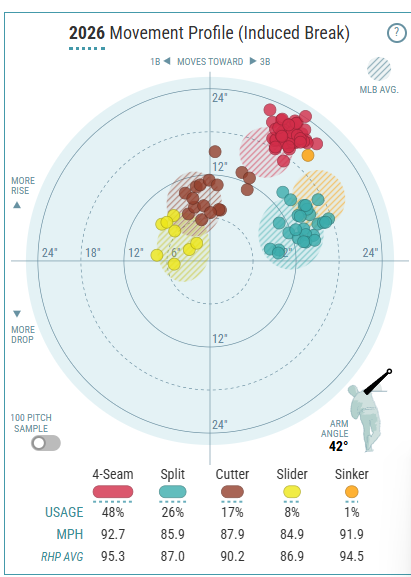
Mahle’s four-seamer may not have the velo, but it has certainly punched above its weight class in terms of results. What makes it so effective? Movement and spin. Mahle’s four-seamer has averaged 2315 RPM this season, which is about average, but he gets 100% active spin, meaning all of the spin contributes to the pitch’s movement. Mahle has also averaged 17.7 inches of induced vertical break (IVB) and 11.2 inches of arm-side run.
Let’s have a look at Mahle’s pitch movement profile from this season.
And here’s an example of the pitch.
— Elliott Baas (@ElliottBaasBB) August 10, 2026
96 mph?! That pitch was actually the hardest fastball Mahle has thrown all season. Mahle’s fastball ties up hitters with its unique combination of spin and movement, and Mahle gets plus extension at 6.7 feet, so his 92.7 mph can play up to a degree.
The one thing that gives me pause about Mahle’s fastball is the 90.4 mph average exit velocity against, which is rather high. This number isn’t exactly out of the ordinary for Mahle—batters usually hit his fastball hard—but he’s already struggled with homers this season and he moved from a pitcher-friendly park to a neutral one. It’s not enough to scare me off Mahle, but it does make me wonder if Mahle’s fastball numbers could rise despite strong expected stats.
Mahle’s next most used pitch this season has been the splitter, which he threw 34% of the time against the Yankees and has thrown 25.6% of the time this season. An 85.9 mph offering, Mahle’s is a split-change notable for its low spin at 1617 RPM and 13.2 inches of arm-side run. Here’s an example from this season.
— Elliott Baas (@ElliottBaasBB) August 10, 2026
Nasty stuff, and Mahle has gotten solid results with the pitch this season. Batters are hitting .252 off the splitter with a .374 SLG and a .297 wOBA. Mahle also has a .234 xBA, .359 xSLG, and a .283 xwOBA with the pitch. It’s been his best strikeout pitch as well, with a 27.8% whiff rate, which is rather modest for an off-speed pitch.
Mahle was a big strikeout guy in his Cincy days, but his strikeout rates have dropped as he’s deemphasized the slider and focused more on his splitter and cutter as his main secondary offerings. It’s not a gravity-defying GIF-able strikeout machine like say Yoshinobu Yamamoto’s splitter, but it’s a strong pitch that can get groundballs and generate weak contact and get a whiff or K when needed.
I mentioned previously that Mahle has reduced his slider usage over the course of the season, and he’s replacing sliders with cutters. He was throwing the cutter 15.68% of the time before going down with the hamstring injury, and he’s thrown it 19.89% of the time since returning.
An 87.9 mph offering, Mahle’s cutter is soft, even relative to his below average fastball. Batters have hit the cutter better than Mahle’s other main pitches, batting .271 against the pitch with a .414 SLG and a .323 wOBA. Not terrible numbers by any means, but it is an elevated batting average. The expected stats support these results too, with a .266 xBA, .390 xSLG, and a .310 xwOBA. Mahle’s cutter is noteworthy for its 10.6 inches of rise. Here’s an example from this season.
— Elliott Baas (@ElliottBaasBB) August 10, 2026
It’s not blow-you-away good, but it doesn’t have to be. Mahle can utilize this cutter to keep hitters off balance and generate groundballs, something that’s never been a strength of his.
Altogether, when we look at Mahle from a fantasy perspective I think he could be a sneaky under-the-radar add at this juncture. He got off to a horrendous start in San Francisco so his overall stats aren’t pretty, but he’s really picked things up since returning from the IL, and a trade to Atlanta will only help him. He’s in a better situation with a better opportunity to win, plus he’s a veteran who can pitch deep into games and give us those sweet, sweet quality starts.
He probably won’t be a plus strikeout pitcher, but he’s been around league average at 23%. Is he perfect? No. Is he going to win you your league? Probably not. But let’s not forget that Mahle had a 2.18 ERA and 3.37 FIP in 16 starts for Texas last season. He’s not that far removed from being a reliable fantasy starter, and I think he can be a back-end veteran innings eater type to finish out the season.
Verdict:
Mahle has quietly pitched to a 3.27 ERA in eight starts since returning from a hamstring injury, and a midseason trade really improved his situation as he went from the lowly Giants to the contending Braves. He isn’t going to be an ace or a strikeout king, but Mahle still has a strong arsenal of pitches he can command and he’s got a good track record of reliable performance in the majors prior to this season. I think Mahle is worth an add in 12-team leagues or deeper if you need a back-end innings eater type, who will probably help most with wins and quality starts.
Andrew Alvarez, Washington Nationals – 3% Rostered
2026 Stats (prior to this start): 64 IP, 3.94 ERA, 3.12 FIP, 11.6% K-BB%
08/08 vs. CIN: 5.1 IP, 3 H, 1 ER, 1 BB, 2 K
Alvarez was outstanding last Saturday, holding Cincinnati to just one run over 5.1 innings in the no decision. Alvarez has been pitching better as of late, posting a 2.25 ERA over his last three appearances. With Washington thin on reliable starters, Alvarez certainly has the chance to remain in the rotation for the remainder of the season. But does he have any fantasy appeal?
Originally a 12th-round pick by Washington in 2021, Alvarez wasn’t a huge prospect coming up, but he had some strong minor league performances and gained some hype due to his groundball prowess. Alvarez works with a five-pitch mix consisting of a curveball, four-seam fastball, slider, sinker, and changeup. Alvarez uses all of his pitches regularly, and other than the changeup he throws each pitch at least 14% of the time.
Alvarez’s most used pitch this season has been the curveball, and that was no different on Saturday when he threw his curveball 42% of the time. An 82.8 mph offering, Alvarez has used his curveball 30.1% of the time this season. Batters have really struggled against the pitch as well, hitting just .189 with a .253 SLG and a .215 wOBA.
The expected stats are almost exactly the same with a .187 xBA, .240 xSLG, and a .214 xwOBA. Alvarez also has an impressive 32.9% whiff rate and a 61.1% groundball rate with the curveball this season. Alvarez’s curveball is effective thanks to its strong movement and spin. He’s averaged 2718 RPM with the curveball this season, as well as 13 inches of drop and 10.4 inches of glove-side movement. Here’s an example of the pitch from this season.
— Elliott Baas (@ElliottBaasBB) August 10, 2026
It’s big and loopy, with lots of horizontal action in addition to the drop. This pitch has been incredibly difficult to elevate for opposing hitters, and the curveball is a big reason for Alvarez’s elite 0.26 HR/9 and his 86th percentile groundball rate of 51.8%. Alvarez has even gotten a decent number of whiffs from his curveball so far. If he can command it, this curveball certainly has the makings of a plus offering.
The curveball may look effective for Alvarez, but what about his heaters? His most used fastball and second-most used pitch this season has been the four-seamer, which Alvarez has thrown 28.1% of the time. A 92.4 mph offering, velocity isn’t Alvarez’s strong suit, ranking in the 17th percentile of fastball velocity in MLB. The four-seamer has been hit much better than the curveball as well, with opponents managing a .292 AVG, .403 SLG, and .361 wOBA against Alvarez’s fastball.
Batters haven’t struck the ball particularly hard against this pitch with an 87.9 mph average exit velocity, but batters also have a 29.7% line drive rate against the pitch. Line drives are by far the most likely batted ball type to land for a hit, and a near 30% rate is very high. It’s why I don’t think we can bank on regression for Alvarez’s .317 BABIP against his four-seamer. If you’re giving up tons of line drives, you’re going to have a high BABIP against, it’s unavoidable.
Alvarez also uses a 91.9 mph sinker, though only 14.2% of the time and he only threw five total sinkers against Cincinnati. Alvarez’s sinker usage was abnormally low in this most recent start, but perhaps this is a trend he should lean into, because the sinker has been pulverized by opponents this season. Batters are hitting .313 with a .344 SLG and a .335 wOBA off Alvarez’s sinker. Those numbers may not seem so bad, but the .390 xBA, .517 xSLG, and .427 xwOBA are quite alarming.
Opponents have a blistering 93.3 mph average exit velocity off this pitch, meaning they’re sending it back more than a full mph harder than Alvarez throws it. He also has a 35.5% line drive rate against this pitch, which is a big contributor to his ugly expected stats. Both of these fastballs look to be below average for Alvarez and both could be liabilities for Alvarez on the mound.
Alvarez also throws an 84.1 mph slider, a pitch he’s used 23.8% of the time this season. It has been one of his better performing pitches, with opponents hitting .264 with a .453 SLG and a .378 wOBA. The expected stats are roughly the same, but what’s most impressive for me is the 36.8% whiff rate Alvarez has with this pitch. Between that, the 32.9% whiff rate on his curveball, and the 43.8% whiff rate on his seldom used changeup, Alvarez seems to have some swing and miss potential.
Alvarez’s slider is noteworthy for its high spin at 2662 RPM, and for its strong movement with 2.3 inches of drop and 1.6 inches of glove-side movement. Here’s an example from this season.
— Elliott Baas (@ElliottBaasBB) August 10, 2026
It's not one of those sliders that makes you question whether that Newton fellow was wrong about the whole gravity thing, but a solid breaking ball nonetheless. Alvarez did have a 30.8% K rate in seven Triple-A starts this season, but he’d never really had high strikeout rates prior to that, so it’s hard to say with certainty that there’s more in him, or that the strikeouts can translate to the majors.
Ultimately, I think his bad fastballs may hold him back. The best case scenario for someone like Andrew Alvarez would be to become like Joey Cantillo, who’s secondary stuff is so good he can overcome a bad fastball. Alvarez is in the same boat, but it’s hard to trust someone with no track record, shaky control, and a 92 mph heater in the thick of things. At best, Alvarez looks like a low-end streaming option for 2026.
Verdict:
Alvarez has shown one exceptional skill so far, and that’s the ability to induce groundballs and prevent home runs. His curveball looks like a plus offering, while his slider is generating plenty of whiffs. His four-seam fastball and sinker have both been crushed, and their poor velocity and movement will limit Alvarez’s upside with the fastball. He’ll also be a WHIP killer thanks to poor control and lots of singles sneaking through, so I think his only use case for 2026 is as a deep streamer in easy matchups.
Jackson Jobe, Detroit Tigers – 29% Rostered
2026 Stats (AAA): 15.1 IP, 1.76 ERA, 2.56 FIP, 20% K-BB%
08/08 @ SF: 5 IP, 1 H, 0 ER, 1 BB, 4 K
Jobe was excellent in his season debut on Saturday, blanking the Giants over five innings and picking up the victory. A former top pitching prospect, Jobe is back after undergoing Tommy John surgery last season. Is he ready to contribute in fantasy, or is he best left on the wire?
Originally the third overall pick by Detroit in 2021, Jobe was once a huge pitching prospect, and considered among the best young arms in baseball. Injuries have prevented him from showcasing his full abilities, but we’ve seen plenty of flashes, such as the game on Saturday. Jobe works with a five-pitch mix consisting of a four-seam fastball, slider, sinker, changeup, and curveball.
Jobe’s most used pitch on Saturday was the four-seamer, which has been the case for him in the minors as well. A 98.3 mph offering, it was nice to see that Jobe’s plus velocity not only remained intact, but improved to a degree. He was throwing 96.5 mph in 2025 before surgery, and this start was nearly two full mph higher. It’s just one game, but it’s exactly what we’d want to see from Jobe.
Jobe’s fastball shape seems to be intact as well, as he averaged 17.2 inches of IVB and 7.7 inches of arm-side movement in this game, very close to where he was in 2025. Velocity isn’t the only positive attribute for Jobe’s fastball, as he’s displayed strong movement with the pitch as well. It was only one game and it was against a weak opponent, but it was still nice to see Jobe dominate with his heater.
Jobe’s next most used pitch on Saturday was the slider, a 90.1 mph offering that he threw 25.4% of the time. The slider has long been Jobe’s breaking ball of choice, and again it was nice to see the velocity bumped up to 90 mph. Jobe’s slider is hard and sort of has unique movement. There isn’t much vertical movement, but plenty of glove-side break. Here’s an example of the pitch from this start.
— Elliott Baas (@ElliottBaasBB) August 10, 2026
It doesn’t have the big, sweeping movement we sometimes associate with sliders, but it’s very hard and can keep hitters off balance when paired with 98 mph heat. Jobe has never had big whiff rates with the pitch, and I don’t think this is a big strikeout slider necessarily, but it could be effective at getting weak contact and keeping hitters guessing.
One pitch that could be an effective strikeout offering for Jobe is the changeup. Jobe only threw eight changeups in this start, but he did have a 33% whiff rate and had a 44.1% whiff rate with the changeup in 2025. An 85.8 mph offering, Jobe really slows it down with the changeup. He also gets lots of horizontal movement with the pitch. Here’s an example from this start.
— Elliott Baas (@ElliottBaasBB) August 10, 2026
Rafael Devers went fishing and came up empty on that one. The changeup has been Jobe’s best strikeout pitch at times in the minors as well, and I’m hoping he can command it as a strikeout hammer, especially against left-handed hitters.
Jobe certainly has big prospect upside, both due to his pedigree and the quality of his stuff, but it might be tough for him to put everything together this season. He didn’t exactly set the world on fire in 2025 during his debut, pitching to a 4.22 ERA and 5.18 FIP along with a 17.9% K rate and 5.5% K-BB%. Those numbers aren’t good enough to be stream-worthy, much less a regular piece of a fantasy rotation. And yes, maybe he was injured last season, but we’ve also never seen him perform at a high level for an extended period in the majors before.
Jobe has also struggled to maintain his elite strikeout numbers as he’s progressed levels, and though I was quite impressed with what we saw on Saturday, it’s only one start. I do think Jobe is worth an add in deeper than 12 team leagues, mostly because we’re at a point in the season where exciting pitchers to add will be few and far between. We’ve mostly got prospect callups and injury returns to look forward to, and Jobe sort of qualifies as both.
Verdict:
Jobe was very impressive on Saturday, and it was great to see that Jobe maintained his velocity and fastball shape after surgery. However, it’s hard to bank on him breaking out or suddenly becoming a reliable fantasy starter. Jobe certainly has the potential and talent to break through, but he’s also on the mend and has been inconsistent in past MLB experience. He is worth an add in deeper leagues or for the pitcher-needy, but I don’t think he’s an every time kind of starter yet.
More Fantasy Baseball Advice
Download Our Free News & Alerts Mobile App
Like what you see? Download our updated fantasy baseball app for iPhone and Android with 24x7 player news, injury alerts, sleepers, prospects & more. All free!