



 RADIO
RADIO










2026 U.S. Open betting and fantasy golf preview with key stats, Aronimink Golf Club course breakdown, field analysis, and TV times for this week’s PGA Tour event.
The PGA TOUR heads to Southampton, New York, this week for the U.S. Open, the third major championship of the season. A field of 156 players will take on Shinnecock Hills Golf Club, one of the most historic and demanding venues in championship golf, with the top 60 players and ties advancing to the weekend.
The biggest storyline entering the week surrounds World No. 1 Scottie Scheffler, who will make his first competitive start at Shinnecock Hills while chasing the career Grand Slam. Scheffler's U.S. Open record has been outstanding, recording four top-10 finishes in his last five appearances, including a runner-up finish at The Country Club in 2022.
Featured Promo: New Novig users get a $25 purchase match (50% discount up to $25) on your first Novig deposit, and 6 free months of RotoBaller's "Big-4" Premium Pass (NFL, NBA, MLB, NHL) which includes exclusive tools for Betting, Props, DFS and more! CLAIM IT NOWFor those who have followed my work in the past, you know my betting picks are usually included within this article. This year will be a little different, as my official plays will be part of our RotoBaller PGA Premium packages. To get access to my top plays throughout the 2026 season, check out our awesome options now.
U.S. Open - Tournament Information
- Dates: June 18th – June 21st, 2026
- Location: Southampton, New York, United States
- Course: Shinnecock Hills Golf Club
- Course Type: Technical, Links
- Par: 70 (4x 3’s / 10x 4’s / 2x 5’s)
- Length: 7,440 yards
- Format: 72-hole stroke play
- Greens: Bentgrass / Poa annua 0.100"
- Fairways: Bentgrass / Poa annua / Ryegrass 0.400"
- Rough: Fescue 5-8"
- Bunkers: 160
- Water Hazard(s): 1 (In-Play on 1 Holes)
- Average Green Size: 7,500 sq. ft.
- Stimpmeter: 12.0 ft.
- Purse/ Winner: N/A (2025: $21,500,000 /$4,300,000)
- FedEx Cup Points: 750
- Field: 156 Players
- Cut: Top 60 and Ties – 36 Holes
- Playoff Format: 2-Hole Aggregate
- Course Scoring Average:
- 2018: 74.65 (+4.65), PGA Tour Difficulty Rank 1 of 51
U.S. Open - Course Information
Course Architect:
Comparable Courses:
- Pinehurst No. 2 – 2024 U.S. Open – RESULTS
- Pinehurst No. 2 may be the strongest modern comparison to Shinnecock Hills. Both venues place a premium on precision rather than power alone, forcing players to carefully manage their way around the golf course. While Pinehurst's turtleback greens differ architecturally from Shinnecock's large, undulating putting surfaces, both courses heavily reward elite approach play, scrambling, and patience.
- Winged Foot Golf Club (West Course) – 2020 U.S. Open– RESULTS
- Another classic Northeastern U.S. Open venue, Winged Foot shares many similarities with Shinnecock Hills. Both courses demand complete control from tee to green and punish players who consistently miss fairways. Winning scores are often close to par, making patience and mistake avoidance critical.
- Oakmont Country Club – 2025 U.S. Open – RESULTS
- Oakmont is arguably the closest comparison from a difficulty standpoint. While the architecture differs, both courses feature extremely fast greens, penal rough, demanding approach shots, and little room for error. Players who thrive at Oakmont typically possess elite tee-to-green games and the mental toughness necessary to survive difficult scoring conditions.
- Pebble Beach Golf Links – AT&T Pebble Beach Pro-Am / 2019 U.S. Open – RESULTS / RESULTS
- Although significantly shorter than Shinnecock, Pebble Beach shares several key characteristics. Both courses sit along the coastline and are highly influenced by wind. Players must control ball flight, manage difficult approach shots, and remain patient when conditions become challenging. Pebble also rewards strong short-game play and putting on Poa Annua greens, skills that should prove valuable this week.
- Kiawah Island Golf Resort (Ocean Course) – 2021 PGA Championship – RESULTS
- The Ocean Course at Kiawah Island provides another strong coastal comparison. Both venues are exposed to the elements, allowing wind to become a major factor in scoring. Distance can be an advantage at both courses, but controlling ball flight and avoiding mistakes become increasingly important when conditions worsen.
- Royal St. Georges – 2021 Open Championship – RESULTS
- Royal St. George's shares many strategic similarities with Shinnecock despite being a traditional links course. Both reward creativity, shot-making, and the ability to adapt to changing conditions. Players must navigate uneven lies, firm surfaces, and unpredictable bounces while avoiding costly mistakes.
- Royal Troon – 2024 Open Championship – RESULTS
- Royal Troon offers another useful links comparison due to its emphasis on ball striking and wind management. Like Shinnecock, players are frequently required to hit long irons into greens while controlling trajectory in challenging conditions. The ability to grind out pars and remain patient throughout difficult stretches is a common trait among contenders at both venues.
- The Renaissance Club – Genesis Scottish Open – RESULTS
- The Renaissance Club provides one of the better regular-season comparisons available. Located on the Scottish coastline, the course rewards strong driving, quality long-iron play, and the ability to perform in windy conditions.
Comparable Location (Southampton, New York):
- Winged Foot Golf Club (West Course) – Mamaroneck, New York – 2020 U.S. Open
- Bethpage State Park (Black Course) – Farmingdale, New York – 2019 PGA Championship, 2009 U.S. Open
- Baltusrol Golf Club (Lower Course) – Springfield, New Jersey – 2016 PGA Championship
Designer Link (William Flynn):
- The Country Club – William Flynn Renovation – 2022 U.S. Open
- Philadelphia Cricket Club (Wissahickon Course) – William Flynn Renovation (1928) – 2025 Truist Championship
- Merion Golf Club East Course – William Flynn Renovation – 2013 U.S. Open
Designer Link (Bill Coore & Ben Crenshaw):
- Kapalua Resort (Plantation) – Bill Coore and Ben Crenshaw Renovation (2019) – The Sentry
- The Riviera Country Club – Bill Coore and Ben Crenshaw Renovation (1992) – The Genesis Invitational
- Yokohama Country Club (West Course) – Bill Coore and Ben Crenshaw Renovation (2014/15) – Baycurrent Classic
- Pinehurst No. 2 – Bill Coore and Ben Crenshaw Renovation (2009-11) – 2024 U.S. Open
Comparable Yardage (7,440 Yards):
Comparable Greens (Bentgrass / Poa annua):
- TPC San Antonio (Oaks Course) – Bentgrass w/ Poa trivialis overseed .110” – Valero Texas Open
- TPC Toronto at Osprey Valley (North Course) – Bentgrass / Poa mix .100” – RBC Canadian Open
- TPC River Highlands – Bentgrass / Poa annua .110” – Travelers Championship
- Detroit Golf Club – Bentgrass / Poa annua .100” – Rocket Classic
- Silverado Resort and Spa (North Course) – Poa annua / bentgrass .110” – Procore Championship
Comparable Average Green Size (7,500 sq. ft.):
U.S. Open - TV Information (ET)
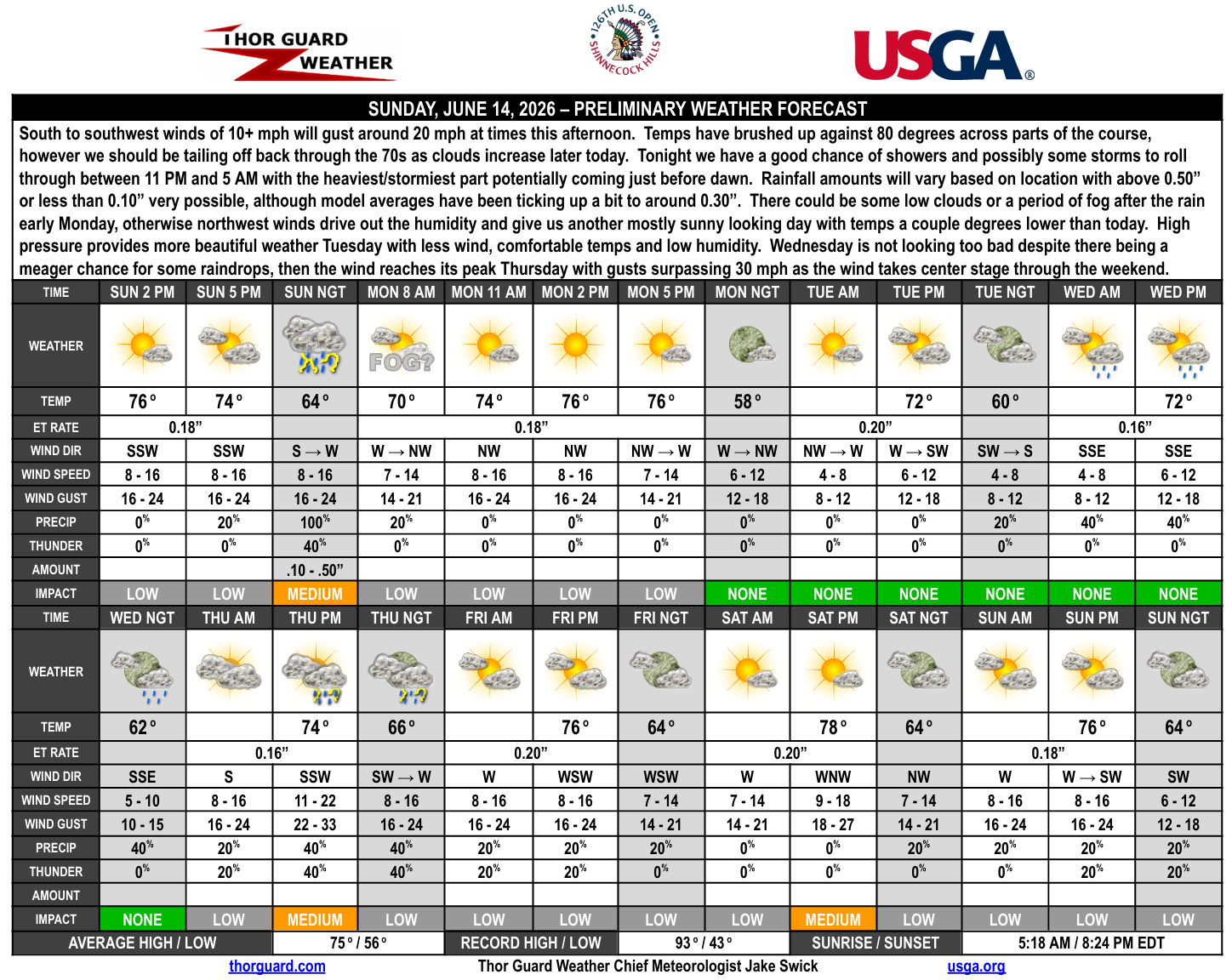
U.S. Open - Weather
U.S. Open - Course/Tournament History
The U.S. Open is one of golf's four major championships and is widely regarded as the toughest test in professional golf. Conducted annually by the United States Golf Association, the championship has become one of the most prestigious events in the sport, challenging players with demanding course setups and rewarding those who can excel in every aspect of the game.
The tournament was first played in 1895 at Newport Country Club in Rhode Island. The inaugural championship featured just 11 professionals and one amateur competing in a 36-hole event contested over a single day. English golfer Horace Rawlins captured the first title and earned a winner's prize of $150.
In the early years, the championship was dominated by British-born professionals who had immigrated to the United States. That changed in 1911 when John J. McDermott became the first American-born player to win the U.S. Open. His victory helped spark the rise of American golf and marked the beginning of a new era for the championship.
Throughout its history, the U.S. Open has been contested at many of the most iconic venues in the country. Courses such as Oakmont Country Club, Pebble Beach Golf Links, Winged Foot Golf Club, and Shinnecock Hills Golf Club have all hosted multiple championships and helped create some of golf's most memorable moments.
The championship has earned a reputation for producing some of the most difficult scoring conditions in golf. Narrow fairways, thick rough, firm greens, and demanding pin positions place a premium on accuracy, patience, and mental toughness. Unlike many PGA TOUR events, where birdies come in bunches, the U.S. Open often turns into a battle of survival where limiting mistakes becomes just as important as making birdies.
Over the years, the tournament has delivered countless memorable finishes. Legends such as Ben Hogan, Jack Nicklaus, and Tiger Woods have all etched their names into championship history through remarkable performances on some of golf's biggest stages.
The format of the event has evolved over time as well. For many years, ties after 72 holes were settled with an 18-hole playoff on Monday. Beginning in 2018, the USGA adopted a two-hole aggregate playoff format, followed by sudden death if necessary, bringing the championship in line with the other major tournaments.
Today, winning the U.S. Open remains one of the highest accomplishments in professional golf. In addition to lifting one of the sport's most coveted trophies, the champion receives exemptions into future major championships, a PGA TOUR exemption, and a place in the history of a tournament that has tested the game's greatest players for more than 130 years.
Shinnecock Hills Golf Club is one of the most historic and revered venues in American golf. Located in Southampton, New York, the club was founded in 1891 and is considered one of the five founding member clubs of the United States Golf Association. It is also one of the oldest golf clubs in the United States and has played a significant role in the growth and development of the game in America.
Designed primarily by William Flynn in the early 1930s, Shinnecock Hills is widely regarded as one of the finest examples of links-style golf in the United States. The course sits on rolling terrain overlooking the Atlantic Ocean and is known for its natural dunes, firm playing surfaces, fescue rough, and constant exposure to coastal winds. Unlike many modern championship venues, Shinnecock relies on strategic design and natural elements rather than excessive length to challenge the world's best players.
Shinnecock Hills holds a unique place in major championship history. It became the first club in the United States to admit women as members from its inception and was also one of the first American clubs to welcome golfers regardless of social status. The club hosted the U.S. Open for the first time in 1896, making it the second U.S. Open ever contested and the first played on a full 18-hole course.
Over the years, Shinnecock Hills has become one of the USGA's most trusted championship venues. The club has hosted multiple U.S. Opens, including championships in 1896, 1986, 1995, 2004, 2018, and 2026. Its ability to provide a stern but fair test has made it one of the most respected venues in the major championship rotation.
The course has produced numerous memorable moments throughout U.S. Open history. In 1995, Corey Pavin famously hit a 4-wood into the final green to secure victory. In 2004, Retief Goosen survived brutal scoring conditions to claim his second U.S. Open title. The 2018 championship saw Brooks Koepka successfully defend his title, becoming the first player since Curtis Strange to win back-to-back U.S. Opens.
Today, Shinnecock Hills remains one of the crown jewels of championship golf. Its rich history, timeless architecture, and ability to challenge every aspect of a player's game have solidified its reputation as one of the greatest golf courses in the world and one of the premier stages for the U.S. Open.
Previous Tournament Venues:
| Year | Venue | Location |
| 2026 | Shinnecock Hills Golf Club | Southampton, New York |
| 2025 | Oakmont Country Club | Oakmont, Pennsylvania |
| 2024 | Pinehurst Resort (No. 2 Course) | Pinehurst, North Carolina |
| 2023 | Los Angeles Country Club (North Course) | Los Angeles, California |
| 2022 | The Country Club | Brookline, Massachusetts |
| 2021 | Torrey Pines Golf Course (South Course) | San Diego, California |
| 2020 | Winged Foot Golf Club | Mamaroneck, New York |
| 2019 | Pebble Beach Golf Links | Pebble Beach, California |
| 2018 | Shinnecock Hills Golf Club | Southampton, New York |
| 2017 | Erin Hills | Erin, Wisconsin |
| 2016 | Oakmont Country Club | Oakmont, Pennsylvania |
| 2015 | Chambers Bay Golf Course | University Place, Washington |
| 2014 | Pinehurst Resort (No. 2 Course) | Pinehurst, North Carolina |
| 2013 | Merion Golf Club | Ardmore, Pennsylvania |
| 2012 | Olympic Club | San Francisco, California |
| 2011 | Congressional Country Club | Bethesda, Maryland |
| 2010 | Pebble Beach Golf Links | Pebble Beach, California |
| 2009 | Bethpage State Park (Black Course) | Farmingdale, New York |
| 2008 | Torrey Pines Golf Course (South Course) | San Diego, California |
| 2007 | Oakmont Country Club | Oakmont, Pennsylvania |
| 2006 | Winged Foot Golf Club | Mamaroneck, New York |
| 2005 | Pinehurst Resort (No. 2 Course) | Pinehurst, North Carolina |
| 2004 | Shinnecock Hills Golf Club | Southampton, New York |
| 2003 | Olympia Fields Country Club | Olympia Fields, Illinois |
| 2002 | Bethpage State Park (Black Course) | Farmingdale, New York |
| 2001 | Southern Hills Country Club | Tulsa, Oklahoma |
| 2000 | Pebble Beach Golf Links | Pebble Beach, California |
| 1999 | Pinehurst Resort (No. 2 Course) | Pinehurst, North Carolina |
| 1998 | Olympic Club | San Francisco, California |
| 1997 | Congressional Country Club | Bethesda, Maryland |
| 1996 | Oakland Hills Country Club | Bloomfield Hills, Michigan |
| 1995 | Shinnecock Hills Golf Club | Southampton, New York |
| 1994 | Oakmont Country Club | Oakmont, Pennsylvania |
| 1993 | Baltusrol Golf Club | Springfield, New Jersey |
| 1992 | Pebble Beach Golf Links | Pebble Beach, California |
| 1991 | Hazeltine National Golf Club | Chaska, Minnesota |
| 1990 | Medinah Country Club | Medinah, Illinois |
| 1989 | Oak Hill Country Club | Rochester, New York |
| 1988 | The Country Club | Brookline, Massachusetts |
| 1987 | Olympic Club | San Francisco, California |
| 1986 | Shinnecock Hills Golf Club | Southampton, New York |
| 1985 | Oakland Hills Country Club | Bloomfield Hills, Michigan |
| 1984 | Winged Foot Golf Club | Mamaroneck, New York |
| 1983 | Oakmont Country Club | Oakmont, Pennsylvania |
| 1982 | Pebble Beach Golf Links | Pebble Beach, California |
| 1981 | Merion Golf Club | Ardmore, Pennsylvania |
| 1980 | Baltusrol Golf Club | Springfield, New Jersey |
| 1979 | Inverness Club | Toledo, Ohio |
| 1978 | Cherry Hills Country Club | Englewood, Colorado |
| 1977 | Southern Hills Country Club | Tulsa, Oklahoma |
| 1976 | Atlanta Athletic Club | Duluth, Georgia |
| 1975 | Medinah Country Club | Medinah, Illinois |
| 1974 | Winged Foot Golf Club | Mamaroneck, New York |
| 1973 | Oakmont Country Club | Oakmont, Pennsylvania |
| 1972 | Pebble Beach Golf Links | Pebble Beach, California |
| 1971 | Merion Golf Club | Ardmore, Pennsylvania |
| 1970 | Hazeltine National Golf Club | Chaska, Minnesota |
| 1969 | Champions Golf Club | Houston, Texas |
| 1968 | Oak Hill Country Club | Rochester, New York |
| 1967 | Baltusrol Golf Club | Springfield, New Jersey |
| 1966 | Olympic Club | San Francisco, California |
| 1965 | Bellerive Country Club | Town and Country, Missouri |
| 1964 | Congressional Country Club | Bethesda, Maryland |
| 1963 | The Country Club | Brookline, Massachusetts |
| 1962 | Oakmont Country Club | Oakmont, Pennsylvania |
| 1961 | Oakland Hills Country Club | Bloomfield Hills, Michigan |
| 1960 | Cherry Hills Country Club | Englewood, Colorado |
| 1959 | Winged Foot Golf Club | Mamaroneck, New York |
| 1958 | Southern Hills Country Club | Tulsa, Oklahoma |
| 1957 | Inverness Club | Toledo, Ohio |
| 1956 | Oak Hill Country Club | Rochester, New York |
| 1955 | Olympic Club | San Francisco, California |
| 1954 | Baltusrol Golf Club | Springfield, New Jersey |
| 1953 | Oakmont Country Club | Oakmont, Pennsylvania |
| 1952 | Northwood Club | Dallas, Texas |
| 1951 | Oakland Hills Country Club | Bloomfield Hills, Michigan |
| 1950 | Merion Golf Club | Ardmore, Pennsylvania |
| 1949 | Medinah Country Club | Medinah, Illinois |
| 1948 | Riviera Country Club | Pacific Palisades, California |
| 1947 | St. Louis Country Club | Ladue, Missouri |
| 1946 | Canterbury Golf Club | Beachwood, Ohio |
| 1945 | No tournament (World War II) | |
| 1944 | No tournament (World War II) | |
| 1943 | No tournament (World War II) | |
| 1942 | No tournament (World War II) | |
| 1941 | Colonial Country Club | Fort Worth, Texas |
| 1940 | Canterbury Golf Club | Beachwood, Ohio |
| 1939 | Philadelphia Country Club | Gladwyne, Pennsylvania |
| 1938 | Cherry Hills Country Club | Englewood, Colorado |
| 1937 | Oakland Hills Country Club | Bloomfield Hills, Michigan |
| 1936 | Baltusrol Golf Club | Springfield, New Jersey |
| 1935 | Oakmont Country Club | Oakmont, Pennsylvania |
| 1934 | Merion Golf Club | Ardmore, Pennsylvania |
| 1933 | North Shore Country Club | Glenview, Illinois |
| 1932 | Fresh Meadow Country Club | Flushing, New York |
| 1931 | Inverness Club | Toledo, Ohio |
| 1930 | Interlachen Country Club | Edina, Minnesota |
| 1929 | Winged Foot Golf Club | Mamaroneck, New York |
| 1928 | Olympia Fields Country Club | Olympia Fields, Illinois |
| 1927 | Oakmont Country Club | Oakmont, Pennsylvania |
| 1926 | Scioto Country Club | Columbus, Ohio |
| 1925 | Worcester Country Club | Worcester, Massachusetts |
| 1924 | Oakland Hills Country Club | Bloomfield Hills, Michigan |
| 1923 | Inwood Country Club | Inwood, New York |
| 1922 | Skokie Country Club | Glencoe, Illinois |
| 1921 | Columbia Country Club | Chevy Chase, Maryland |
| 1920 | Inverness Club | Toledo, Ohio |
| 1919 | Brae Burn Country Club | West Newton, Massachusetts |
| 1918 | No tournament (World War I) | |
| 1917 | No tournament (World War I) | |
| 1916 | Minikahda Club | Minneapolis, Minnesota |
| 1915 | Baltusrol Golf Club | Springfield, New Jersey |
| 1914 | Midlothian Country Club | Midlothian, Illinois |
| 1913 | The Country Club | Brookline, Massachusetts |
| 1912 | Country Club of Buffalo | Buffalo, New York |
| 1911 | Chicago Golf Club | Wheaton, Illinois |
| 1910 | Philadelphia Cricket Club | Philadelphia, Pennsylvania |
| 1909 | Englewood Golf Club | Englewood, New Jersey |
| 1908 | Myopia Hunt Club | South Hamilton, Massachusetts |
| 1907 | Philadelphia Cricket Club | Philadelphia, Pennsylvania |
| 1906 | Onwentsia Club | Lake Forest, Illinois |
| 1905 | Myopia Hunt Club | South Hamilton, Massachusetts |
| 1904 | Glen View Club | Golf, Illinois |
| 1903 | Baltusrol Golf Club | Springfield, New Jersey |
| 1902 | Garden City Golf Club | Garden City, New York |
| 1901 | Myopia Hunt Club | South Hamilton, Massachusetts |
| 1900 | Chicago Golf Club | Wheaton, |
| 1899 | Baltimore (Roland Park Course) | Baltimore, Maryland |
| 1898 | Myopia Hunt Club | South Hamilton, Massachusetts |
| 1897 | Chicago | Wheaton, Illinois |
| 1896 | Shinnecock Hills | Shinnecock Hills, New York |
| 1895 | Newport | Newport, Rhode Island |
Previous Tournament Names:
| Duration: | Tournament Name: |
| 1895-1916, 1919-1941, 1946-Present | U.S. Open |
Tournament Records:
- Most Wins at Event:
- 4 – Willie Anderson 1901, 1903–1905; Bobby Jones 1923, 1926, 1929–30; Ben Hogan 1948, 1950–51, 1953; Jack Nicklaus 1962, 1967, 1972, 1980
- Largest Margin of Victory:
- 15 Strokes, Tiger Woods (2000 at Pebble Beach)
- 72-Hole Record:
- 268, Rory McIlroy (2011 at Congressional CC)
- 18-Hole Record:
- 62, Rickie Fowler (Round 1, 2023 at Los Angeles Country Club), Xander Schauffele (Round 1, 2023 at Los Angeles Country Club)
Course Records:
- 72-Hole Record (Shinnecock Hills Golf Club):
- 276, Retief Goosen (2004)
- 18-Hole Record (Shinnecock Hills Golf Club):
- 63, Tommy Fleetwood (Round 4, 2018)
U.S. Open - Course Guide/ Scorecard
Originally designed by William Flynn in 1931, Shinnecock Hills Golf Club is one of the most iconic championship venues in golf. The historic Long Island layout plays as a par 70 featuring four par 3s, twelve par 4s, and two par 5s. Set atop rolling terrain exposed to the Atlantic winds, Shinnecock has long been regarded as one of the purest tests in the game and returns as a U.S. Open host for the sixth time.
Over the years, the course has undergone several restoration projects aimed at preserving Flynn's original design while adapting it to the modern era.
The most significant came in 2013 when Bill Coore and Ben Crenshaw restored many of the course's original characteristics by expanding greens, reintroducing short-grass runoff areas, and widening fairways. Those tightly mown collection areas around the greens place a premium on creativity and touch, forcing players to execute a variety of recovery shots rather than relying solely on traditional bunker play.
One of the biggest storylines entering this year's championship is how differently the course will play compared to 2018.
Prior to that U.S. Open, the USGA narrowed many of the fairways in response to concerns over scoring following Brooks Koepka's 16-under victory at Erin Hills the year before. This time, however, Shinnecock will be allowed to play much closer to its natural state. The fairways are there to be found, but the strategic bunkering and preferred angles into the greens still demand precision off the tee.
At 7,440 yards, Shinnecock remains one of the longest par-70 layouts in championship golf. While the scorecard yardage is identical to what players faced in 2018, advances in distance have effectively shortened the course.
The fairways average approximately 48 yards wide, making them among the widest fairways players will see all season. However, any advantage gained from those generous landing areas can quickly disappear.
Thick fescue borders the fairways, and players who miss in the wrong spots will often be forced to simply advance the ball back into play. The greens average roughly 7,500 square feet and are relatively large by U.S. Open standards, but their severe contours, firm surfaces, and difficult pin locations make them extremely challenging targets.
Shinnecock's most recognizable defense may be its bunkering. With roughly 160 bunkers spread throughout the property, sand comes into play on nearly every hole.
These hazards do far more than punish poor shots. They influence strategy, dictate angles, and force players to make difficult decisions throughout the round.
Combined with dramatic elevation changes, firm conditions, and the ever-present threat of wind, Shinnecock Hills demands complete control from tee to green and remains one of the most challenging venues in championship golf.
Did you know RotoBaller has a Premium PGA DFS and Betting subscription? Check out the recent big winner below! Show your support for Patrick by using discount code GATOR to save 50% on any PGA Premium Pass, this week only. Gain full access to all Premium articles, DFS and betting tools, Lineup Optimizer, Research Station and weekly picks from proven winners!
The King of DFS did it again in R3 Showdown. @draftmasterflex pic.twitter.com/NojMJ9uJp8
— RotoBaller PGA (@RotoBallerPGA) March 8, 2026
It’s always fun to hit an outright, especially when it’s over 100/1 and with a player that has a story like Gary Woodland!
Catch my @Novig picks FREE every week @RotoBaller 🔥 pic.twitter.com/RDWt2asRnA
— Joe Nicely (@JoeNicely) March 29, 2026
U.S. Open - Notable Par 3s
Shinnecock Hills Golf Club’s par 3s range from 157 to 252 yards, with three falling in the 150-200 yard range. Despite their beauty, these holes present a significant challenge. In the 2018 U.S. Open, every par 3 had a scoring average over par with No. 2, playing as the third toughest hole for the tournament with a scoring average of 3.439.
Hole 2 | 'Plateau' | Par 3 | 252 Yards | 2018 Stroke Average: 3.439 (Difficulty Rank - 3)
The second hole is the longest par-3 on the course and with a deep green, it can effectively play anywhere from 200 yards to 260+ yards depending on where tee-markers are placed and the hole is located. Over the course of the championship, players could hit anything from a 5-iron to a fairway wood. The opening at the front of the green allows for players to use the ground to get their ball onto the putting surface.
Hole 7 | 'Redan' | Par 3 | 187 Yards | 2018 Stroke Average: 3.238 (Difficulty Rank - 12)
A classic example of the Redan, this iconic hole features a green that angles from front right to back left, guarded by a pair of bunkers both right and left of the green. A well-played shot uses the slope of the green to feed the ball from the front-right of the green down to the left. Players who attempt to use the redan feature but who miss to the right side will leave a delicate pitch shot down the slope of the green. A miss long or left is a popular miss, but one that leaves a challenging recovery shot back up the slope. While most players will hit between a 7 or 8 iron, this hole has stood the test of time and par is still a tremendous score.
Hole 11 | 'Hill Head' | Par 3 | 157 Yards | 2018 Stroke Average: 3.276 (Difficulty Rank - 8)
Although the shortest on the scorecard, it certainly is one of Shinnecock’s most challenging holes. A tiny green that slopes from back left to front right makes recovery shots from long and left of the green very difficult. With nothing visible behind this green, players will see the top portion of a lonely flagstick rising from the green into the sky. This infinity look can play tricks on the eyes despite the calculated yardage.
Hole 17 | 'Eden' | Par 3 | 176 Yards | 2018 Stroke Average: 3.175 (Difficulty Rank - 14)
The final par 3 at Shinnecock Hills requires the utmost precision as players look to close out their round. The prevailing breeze is a cross-wind from the player’s left, and factored with the angle of the green, an excellent shot is required to get the ball close to the hole. A player who bails out just a bit to the right could find himself in the bunker, because the angle of the green and the cross-breeze will accentuate the miss.
U.S. Open - Notable Par 4s
There are twelve Par 4s at Shinnecock Hills Golf Club, with the majority of those holes ranging between 450 and 500 yards. No. 13 is the shortest, listed at 371 yards, with the longest being No. 14, playing 520 yards. In terms of scoring average, the toughest par 4 at the 2018 U.S. Open was the 14th hole.
Hole 1 | 'Westward Ho' | Par 4 | 394 Yards | 2018 Stroke Average: 4.121 (Difficulty Rank - 15)
Appropriately named “Westward Ho”, the opening tee shot for the players gives players a sweeping westward view of the fairway below. While the landing area appears generous, the fairway quickly narrows at the 300-yard mark. As the crow flies, the hole measures 365 yards to the front edge of the green and with a southeast wind at the players’ back, there may be some players that attempt to hit driver close to or onto the putting surface. While it is certainly a birdie opportunity, the steep run-off behind the green and a pair of challenging bunkers flanking the green create plenty of opportunities for bogey or worse.
Hole 9 | 'Ben Nevis' | Par 4 | 482 Yards | 2018 Stroke Average: 4.265 (Difficulty Rank - 10)
Players begin the final hole on the front nine with a blind tee shot, but even if they find the fairway, their work is far from over. The putting green sits well above the drive zone on the same hillside as the clubhouse. Players will only be able to see the top portion of the flagstick on the green, which is severely sloped from back right to front left. Keeping the ball below the hole is critical, but it is difficult to achieve.
Hole 14 | 'Thom's Elbow' | Par 4 | 520 Yards | 2018 Stroke Average: 4.567 (Difficulty Rank - 1)
The 14th hole features a dramatic drop in elevation from the teeing area to the fairway, which pitches from right to left. The preferred angle of approach is from the left. A player who finds the rough could chase the ball onto the green through the narrow opening. The second shot plays slightly uphill to a green that pitches gently from back to front, with a runoff behind it.
Hole 18 | 'Home' | Par 4 | 490 Yards | 2018 Stroke Average: 4.312 (Difficulty Rank - 7)
The finishing hole features a somewhat blind tee shot with a stunning view of America’s 1st clubhouse as its backdrop. The prevailing breeze is from right to left off the tee, with more of a helping wind on the second shot. The preferred tee shot is to the right side of the fairway, both for a better look at the green as well as a better angle of approach, although the player is likely to only see part of the flagstick. The green has a significant amount of pitch from back to front.
U.S. Open - Notable Par 5s
There are only two Par 5s on the course: No. 5 and No. 16. These were the only two holes that had a scoring average under par in 2018. Hole No. 5 was the easiest hole on the course in 2018, with a scoring average of 0.22 below par.
Hole 5 | 'Montauk' | Par 5 | 592 Yards | 2018 Stroke Average: 4.78 (Difficulty Rank - 18)
This reachable par-5 plays downwind in the prevailing breeze and presents the best opportunity for a birdie on the opening nine. The tee shot offers a split fairway, and most players will opt to play to the left side, rather than negotiating the right fairway, which ends at 315 yards. The green sits perched above the fairway and is surrounded by closely mown turf and a menacing bunker short, right of the putting surface. Any players choosing to go for the green in two will need to be precise and avoid missing left or right, as the pitch back up to the green is quite challenging from areas far below the putting green surface.
Hole 16 | 'Shinnecock' | Par 5 | 614 Yards | 2018 Stroke Average: 4.993 (Difficulty Rank - 17)
| Hole | Name | Yards | Par | Hole | Name | Yards | Par | |
| 1 | Westward Ho | 394 | 4 | 10 | Eastward Ho | 415 | 4 | |
| 2 | Plateau | 252 | 3 | 11 | Hill Head | 157 | 3 | |
| 3 | Peconic | 501 | 4 | 12 | Tuckahoe | 469 | 4 | |
| 4 | Pump House | 476 | 4 | 13 | Road Side | 371 | 4 | |
| 5 | Montauk | 592 | 5 | 14 | Thom's Elbow | 520 | 4 | |
| 6 | Pond | 495 | 4 | 15 | Sebonac | 409 | 4 | |
| 7 | Redan | 187 | 3 | 16 | Shinnecock | 614 | 5 | |
| 8 | Lowlands | 440 | 4 | 17 | Eden | 176 | 3 | |
| 9 | Ben Nevis | 482 | 4 | 18 | Home | 490 | 4 | |
| Out | 3,819 | 35 | In | 3,621 | 35 | |||
| Total | 7,440 | 70 | ||||||
Featured/ Signature Hole(s): 7, 9, 11, 14, 18
U.S. Open - Key Statistics
Strokes Gained: Tee to Green
Shinnecock Hills is one of the most demanding tests in championship golf, requiring players to excel in every aspect of their ball striking and short game. With firm fairways, thick rough, challenging green complexes, and ever-present wind, players who consistently gain strokes from tee to green will have the best chance to contend. U.S. Opens are rarely won with one aspect of the game alone, making this one of the most important statistics to target.
Strokes Gained: Off the Tee
Success at Shinnecock begins on the tee box. The course rewards players who can combine distance with accuracy, allowing them to avoid the penal rough while setting up manageable approach shots. Players who consistently drive the ball well gain a significant advantage, particularly on the course's lengthy par 4s.
Strokes Gained: Approach
Approach play is arguably the most important skill at Shinnecock Hills. The firm greens, challenging slopes, and difficult pin positions place a premium on precise iron play. Missing greens in the wrong spots often leads to difficult up-and-down opportunities, making elite approach players strong candidates to contend.
Strokes Gained: Around the Green
Even the best ball strikers will miss greens at Shinnecock. The tightly mown runoffs, deep bunkers, and difficult lies around the greens require creativity and touch. Players who can consistently save par when they miss greens will separate themselves from the field over four rounds.
Strokes Gained: Putting (Poa Annua/ Bentgrass)
The greens at Shinnecock feature a Poa Annua and Bentgrass blend that can become extremely fast and difficult to navigate as the week progresses. While putting is often volatile, players with strong records on Northeast Poa surfaces tend to have an advantage. Lag putting and converting key par saves become especially important in a U.S. Open setup.
3-Putt Avoidance
Fast, sloping greens create plenty of opportunities for costly three-putts. Avoiding mistakes from long range is critical, as a single three-putt can quickly derail momentum in a championship where every stroke matters.
Driving Distance
At nearly 7,500 yards, Shinnecock Hills remains one of the longer tests in championship golf. Longer hitters can attack certain holes with shorter clubs into the greens and may have an easier time handling the demanding par 4s. Distance alone will not win the tournament, but it certainly provides an advantage.
Good Drives Gained
While driving distance is important, simply finding fairways is not enough at Shinnecock. Good Drives Gained measures a player's ability to either hit the fairway or still advance the ball effectively toward the green after missing it. With thick rough and firm conditions expected, this statistic becomes extremely valuable.
Scrambling %
U.S. Opens are often decided by which players can limit mistakes. Since greens will inevitably be missed, scrambling becomes a key statistic. Players who consistently convert difficult up-and-down opportunities can maintain momentum and avoid damaging bogeys.
Greens in Regulation %
Finding greens at Shinnecock is no easy task. Players who rank highly in Greens in Regulation will naturally face fewer difficult recovery shots and put themselves in position to capitalize on scoring opportunities when they arise.
Sand Saves Gained
Shinnecock's deep, penal bunkers are among its primary defenses. Players who can consistently escape sand and save par will have an advantage, particularly when conditions become firm and greens become harder to hold.
Par 3 Scoring: 176-200 Yards
Several of Shinnecock's par 3s fall within this range and can play as some of the most difficult holes on the course. Players who excel with mid-to-long irons will have a better chance of avoiding mistakes and maintaining scoring momentum.
Par 4 Scoring/ Par 4 Scoring: 451-500 Yards
This is arguably the most important scoring range of the week. Many of Shinnecock's longest and most demanding par 4s fall within this distance, forcing players to hit quality drives and long-iron approaches.
Par 5 Scoring
Unlike many PGA TOUR venues, Shinnecock offers limited easy scoring opportunities. Players must take advantage of the par 5s whenever possible, as birdies can be difficult to find elsewhere on the course.
Bogey Avoidance %
The U.S. Open is often more about limiting mistakes than making birdies. Players who consistently avoid bogeys and manage difficult situations effectively tend to rise to the top of the leaderboard. Patience and discipline are critical traits at Shinnecock Hills.
Birdies or Better %
While avoiding mistakes is important, players still need to capitalize on their scoring chances. Birdie opportunities may be limited throughout the week, making efficiency on those opportunities a valuable indicator of success.
Proximity Gained: 200+ Yards
Shinnecock demands a large number of long-iron approach shots due to its length and difficult setup. Players who excel from 200 yards and beyond will create more birdie opportunities while avoiding the costly misses that often lead to bogeys or worse.
Comparable Courses and Event History
U.S. Open - The Field
This year’s U.S. Open will feature a total of 156 competitors. Remarkably, 48 of the top 50 Official World Golf Ranking players will be contending, with only J.T. Poston and Margo Penge absent from the list. The field is composed of 113 PGA Tour Players, 13 LIV Tour Players, 9 DP World Tour Players, 18 Amateurs, and 3 Japan Golf Tour players.
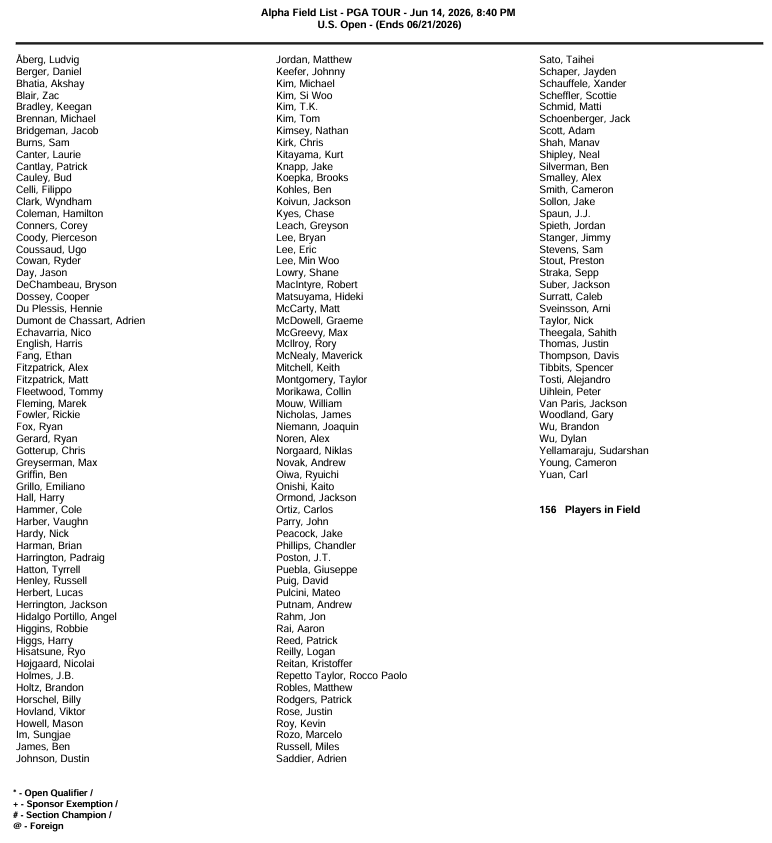
Basis of qualification for each entrant this week:
- Winners of the U.S. Open for the last ten years
- Winner and runner-up from the previous year’s U.S. Amateur and winners of the previous year’s U.S. Junior Amateur and U.S. Mid-Amateur
- The runner-up from the U.S. Amateur, the winner of the U.S. Junior Amateur, and U.S. Mid-Amateur must remain an amateur.
- The winner of the U.S. Amateur, however, may turn professional after winning the U.S. Amateur and retain his eligibility.
- Winner of the previous year’s Amateur Championship
- The previous year’s Mark H. McCormack Medal winner for the top-ranked amateur golfer in the world
- Winners of each of Masters Tournament, Open Championship and PGA Championship for the last five years
- Winners of the last three Players Championships
- Winner of the current year’s BMW PGA Championship
- Winner of the last U.S. Senior Open
- Players who win multiple U.S. PGA Tour events during the time between tournaments, provided the tournaments each offer 500 or more points to the winner, and are not opposite-field events.
- In the year after the Olympic golf tournament, the reigning men’s gold medalist
- Top 10 finishers and ties from the previous year’s U.S. Open
- Players who qualified for the previous year’s Tour Championship
- The top 60 in the Official World Golf Ranking (OWGR) as of two weeks before the start of the tournament
- The top 60 in the OWGR as of the tournament date
- The top player in the PGA Tour second-tier developmental series points, based on combined points from the Regular Season and Finals, from the previous season
- Special exemptions selected by the USGA
- All remaining spots after the second top 60 OWGR cutoff date filled by alternates from qualifying tournaments.
LIV TOUR Representation at This Year’s U.S. Open
- Laurie Canter
- Bryson DeChambeau
- Tyrrell Hatton
- Lucas Herbert
- Dustin Johnson
- Graeme McDowell
- Carlos Ortiz
- David Puig
- Jon Rahm
- Cameron Smith
- Caleb Surratt
- Peter Uihlein
- Joaquin Niemann
DP World Tour Representation at This Year’s U.S. Open
- Filippo Celli
- Ugo Coussaud
- Angel Hidalgo
- Matthew Jordan
- Nathan Kimsey
- Niklas Norgaard
- Patrick Reed
- Rocco Paolo Repetto Taylor
- Jayden Schaper
Japan Golf Tour Representation at This Year’s U.S. Open
- Ryuichi Oiwa
- Kaito Onishi
- Taihei Sato
Amateurs at This Year’s U.S. Open
- Hamilton Coleman – won 2025 U.S. Junior Amateur Championship and American Junior Golf Association's Junior Players Championship
- Ryder Cowan – Final Qualifying
- Ethan Fang – won The Amateur Championship
- Marek Fleming – Final Qualifying
- Vaughn Harber – Final Qualifying
- Jackson Herrington – Runner-up in the 2025 U.S. Amateur
- Brandon Holtz – won 2025 U.S. Mid-Amateur
- Mason Howell – won 2025 U.S. Amateur
- Jackson Koivun – won 2025 Mark H. McCormack Medal (recently announced he is turning professional and will accept PGA TOUR membership that he earned through PGA TOUR University Accelerated)
- Chase Kyes – Final Qualifying
- Eric Lee – Final Qualifying
- Jackson Ormond – Final Qualifying
- Giuseppe Puebla – Final Qualifying
- Mateo Pulcini – won 2026 Latin America Amateur Championship
- Logan Reilly – Final Qualifying
- Matthew Robles – Final Qualifying
- Miles Russell – Final Qualifying
- Preston Stout – won 2026 NCAA Division I Men's Individual Championship
- Arni Sveinsson – Final Qualifying
Debutants in the Field (Event):
- Adrien Saddier, Alejandro Tosti, Alex Fitzpatrick, Angel Hidalgo Portillo, Arni Sveinsson, Brandon Holtz, Caleb Surratt, Carl Yuan, Chase Kyes, Cooper Dossey, Eric Lee, Ethan Fang, Filippo Celli, Giuseppe Puebla, Greyson Leach, Hamilton Coleman, Jackson Herrington, Jackson Osmond, Jackson Van Paris, Jake Peacock, Jake Sollon, Jayden Trey Schaper, Jimmy Stanger, Kaito Onishi, Kevin Roy, Logan Reilly, Manav Shah, Marcelo Rozo, Marco Penge, Marek Fleming, Mateo Pulcini, Matthew Robles, Max McGreevy, Miles Russell, Nathan Kimsey, Preston Stout, Robbie Higgins, Rocco Repetto, Ryder Cowan, Ryo Hisatsune, Ryuichi Oiwa, Sudarshan Yellamaraju, T.K. Kim, Taihei Sato, Ugo Coussaud, Vaughn Harber
Exemptions:
-
N/A
Previous Winners in the Field (Event):
- J.J. Spaun – 2025
- Bryson DeChambeau – 2024, 2020
- Wyndham Clark – 2023
- Matthew Fitzpatrick – 2022
- Jon Rahm – 2021
- Gary Woodland – 2019
- Brooks Koepka – 2018, 2017
- Dustin Johnson – 2016
- Jordan Spieth – 2015
- Justin Rose – 2013
- Rory McIlroy – 2011
- Graeme McDowell – 2010
Previous Winners in the Field (Course):
- Brooks Koepka – 2018 U.S. Open
Players with ties to New York in the Field:
Birthplace:
- Kevin Roy – Syracuse, New York
- Alex Smalley – Rochester, New York
- Cameron Young – Scarborough, New York
Notable Withdraws/ Changes:
- N/A
U.S. Open - The Odds
Here’s a breakdown of the top players in the field for this year’s U.S. Open at Shinnecock Hills Golf Club, ranked by current betting odds (via DraftKings). The table below details each player’s five most recent finishes on the PGA Tour/ DP World Tour/ LIV and their last result at the U.S. Open. My top plays of the week are included in the PGA Premium package.
| Golfer | Odds | Last 5 Finishes on the PGA TOUR/ *DPWT/ LIV** (Recent -> Past) |
Last 5 Finishes at the U.S. Open (Recent -> Past) |
Previous Finishes at the Shinnecock Hills Golf Club (Recent -> Past) |
| Scottie Scheffler | +455 | T12-3-T14-2-2 | T7-T41-3-T2-T7 | - |
| Rory McIlroy | +940 | T12-T7-T19-WON-T46 | T19-2-2-T5-T7 | MC |
| Jon Rahm | +1025 | 2**-T16**-T2-T8**-WON** | T7-T10-T12-WON-T23 | MC |
| Xander Schauffele | +1850 | T29-T7-T60-T12-T9 | T12-T7-T10-T14-T7 | T6 |
| Cameron Young | +2000 | T46-T26-T10-WON-T25 | T4-T67-T32-MC-MC | - |
| Matt Fitzpatrick | +2500 | 2-T36-T14-T52-WON | T38-T64-T17-WON-T55 | T12 |
| Tommy Fleetwood | +2500 | T11-T4-MC-T5-T23 | MC-T16-T5-MC-T50 | 2 |
| Ludvig Aberg | +2600 | 39-T17-T4-T8-T4 | MC-T12 | - |
| Bryson DeChambeau | +2700 | T11**-3**-MC-3**-WD** | MC-WON-T20-T56-T26 | T25 |
| Brooks Koepka | +2900 | WD-T14-T55-T11-MC | T12-T26-T17-55-T4 | WON |
| Collin Morikawa | +3300 | T29-T55-T62-T4-T7 | T23-T14-T14-T5-T4 | - |
| Sam Burns | +3700 | T20-T4-T26-T37-T38 | T7-T9-T32-T27-MC | T41 |
| Russell Henley | +3700 | T22-WON-MC-T49-T25 | T10-T7-T14-MC-T13 | T25 |
| Si Woo Kim | +3900 | T10-2-T35-T65-T4 | T42-T32-T39-MC-T40 | MC |
| Justin Rose | +4200 | MC-T12-T10-T45-T65 | MC-MC-MC-T37-MC | T10 |
| Wyndham Clark | +4200 | T11-3-WON-MC-T20 | MC-T56-WON-MC-MC | - |
| Chris Gotterup | +4400 | T27-T10-T14-T38-T25 | T23-T43 | - |
| Justin Thomas | +4400 | T19-T13-T4-13-T23 | MC-MC-MC-T37-T19 | T25 |
| Tyrrell Hatton | +4500 | WON**-MC-17**-T5**-T3 | T4-T26-T27-T56-MC | T6 |
| Patrick Cantlay | +4500 | T17-T35-T10-T8-T12 | MC-T3-T14-T14-T15 | T45 |
| Patrick Reed | +4800 | T10-T12-T10*-T29*-WON | T23-T56-T49-T19-T13 | 4 |
| Viktor Hovland | +5300 | 3-MC-T31-T38-T42 | 3-MC-19-MC-WD | - |
U.S. Open - Recent Horses for Courses (Event)
| U.S. Open | U.S. Open | U.S. Open | U.S. Open | U.S. Open | |
| Oakmont Country Club | Pinehurst Resort (Course No. 2) |
Los Angeles Country Club (North Course) | The Country Club (Composite Course) |
Torrey Pines (South Course) |
|
| Golfer | 2025 | 2024 | 2023 | 2022 | 2021 |
| Rory McIlroy | T19 | 2 | 2 | T5 | T7 |
| Xander Schauffele | T12 | T7 | T10 | T14 | T7 |
| Collin Morikawa | T23 | T14 | T14 | T5 | T4 |
| Scottie Scheffler | T7 | T41 | 3 | T2 | T7 |
| Brooks Koepka | T12 | T26 | T17 | 55 | T4 |
| Hideki Matsuyama | T42 | 6 | T32 | 4 | T26 |
| Jon Rahm | T7 | - | T10 | T12 | WON |
| Tom Kim | T33 | T26 | T8 | 23 | - |
| Russell Henley | T10 | T7 | T14 | MC | T13 |
| Patrick Cantlay | MC | T3 | T14 | T14 | T15 |
| Min Woo Lee | MC | T21 | T5 | T27 | - |
| Sam Burns | T7 | T9 | T32 | T27 | MC |
| Bryson DeChambeau | MC | WON | T20 | T56 | T26 |
| Nick Hardy | - | - | T20 | T14 | - |
U.S. Open - Recent Donkeys for Courses (Event)
| U.S. Open | U.S. Open | U.S. Open | U.S. Open | U.S. Open | |
| Oakmont Country Club | Pinehurst Resort (Course No. 2) |
Los Angeles Country Club (North Course) | The Country Club (Composite Course) |
Torrey Pines (South Course) |
|
| Golfer | 2025 | 2024 | 2023 | 2022 | 2021 |
| Justin Rose | MC | MC | MC | T37 | MC |
| Corey Conners | WD | T9 | MC | MC | MC |
| Alexander Noren | - | MC | MC | MC | - |
| Kurt Kitayama | - | MC | MC | MC | - |
| Matt McCarty | MC | - | - | MC | - |
| Lucas Herbert | - | - | MC | MC | - |
| Benjamin James | MC | MC | - | - | - |
| Sepp Straka | MC | T56 | MC | MC | - |
| Nick Taylor | T23 | MC | MC | MC | - |
| Taylor Montgomery | - | - | MC | MC | T57 |
| Nico Echavarria | MC | 54 | MC | - | - |
| Jason Day | T23 | MC | MC | - | - |
| Sungjae Im | T57 | MC | MC | MC | 35 |
U.S. Open - Recent Horses for Courses (Course)
| U.S. Open | U.S. Open | |
| Shinnecock Hills | Shinnecock Hills | |
| Golfer | 2018 | 2004 |
| Brooks Koepka | WON | - |
| Tommy Fleetwood | 2 | - |
| Dustin Johnson | 3 | - |
| Patrick Reed | 4 | - |
| Xander Schauffele | T6 | - |
| Tyrrell Hatton | T6 | - |
| Daniel Berger | T6 | - |
| Justin Rose | 10 | - |
| Matthew Fitzpatrick | 12 | - |
| Hideki Matsuyama | 16 | - |
| Rickie Fowler | 20 | - |
| Bryson DeChambeau | T25 | - |
| Russell Henley | T25 | - |
| Justin Thomas | T25 | - |
| Alexander Noren | T25 | - |
| Brian Harman | T36 | - |
| Gary Woodland | T36 | - |
| Sam Burns | T41 | - |
| Patrick Rodgers | T41 | - |
| Ryan Fox | T41 | - |
| Patrick Cantlay | 45 | - |
| Peter Uihlein | 48 | - |
| Padraig Harrington | - | 31 |
| Justin Rose | MC | 10 |
U.S. Open - Recent Donkeys for Courses (Course)
| U.S. Open | U.S. Open | |
| Shinnecock Hills | Shinnecock Hills | |
| Golfer | 2018 | 2004 |
| Adam Scott | MC | MC |
| Kristoffer Reitan | MC | - |
| Lucas Herbert | MC | - |
| Sungjae Im | MC | - |
| Keegan Bradley | MC | - |
| Emiliano Grillo | MC | - |
| Graeme McDowell | MC | - |
| Si Woo Kim | MC | - |
| Shane Lowry | MC | - |
| Cameron Smith | MC | - |
| Jordan Spieth | MC | - |
| Jason Day | MC | - |
| Jon Rahm | MC | - |
| Rory McIlroy | MC | - |
| Adam Scott | MC | - |
U.S. Open - Previous Winners' Scores, Prices, and Strokes Gained (Rank at Tournament)
- 2025: J.J. Spaun (-1) – Oakmont Country Club
- Price: 150-1
| SG: Off the Tee | SG: Tee to Green | SG: Approach | SG: Around the Green | SG: Putting |
| 31st | 28th | 31st | 24th | 2nd |
- 2024: Bryson DeChambeau (-6) − Pinehurst Resort (Course No. 2)
- Price: 20-1
| SG: Off the Tee | SG: Tee to Green | SG: Approach | SG: Around the Green | SG: Putting |
| 4th | 3rd | 9th | 17th | 12th |
- 2023: Wyndham Clark (-10) − Los Angeles Country Club (North Course)
- Price: 66-1
| SG: Off the Tee | SG: Tee to Green | SG: Approach | SG: Around the Green | SG: Putting |
| 2nd | 7th | 49th | 3rd | 4th |
- 2022: Matt Fitzpatrick (-6) − The Country Club (Composite Course)
- Price: 25-1
| SG: Off the Tee | SG: Tee to Green | SG: Approach | SG: Around the Green | SG: Putting |
| 2nd | 1st | 10th | 1st | 42nd |
- 2021: Jon Rahm (-6) − Torrey Pines (South Course)
- Price: 10-1
| SG: Off the Tee | SG: Tee to Green | SG: Approach | SG: Around the Green | SG: Putting |
| 5th | 5th | 11th | 17th | 20th |
U.S. Open - Previous Winners Incoming Form (Last 5 Starts)
- 2025: J.J. Spaun
- MC – the Memorial Tournament (PGA)
- T6 – Charles Schwab Challenge (PGA)
- T37 – PGA Championship (MAJ)
- T17 – Truist Championship (PGA)
- T42 – RBC Heritage (PGA)
- 2024: Bryson DeChambeau
- T18 – LIV Houston (LIV)
- 2 – PGA Championship (MAJ)
- T27 – LIV Singapore (LIV)
- T26 – LIV Adelaide (LIV)
- T6 – Masters Tournament (MAJ)
- 2023: Wyndham Clark
- T12 – the Memorial Tournament (PGA)
- MC – PGA Championship (MAJ)
- WON – Wells Fargo Championship (PGA)
- T24 – Mexico Open (PGA)
- 3 – Zurich Classic of New Orleans (PGA)
- 2022: Matt Fitzpatrick
- T10 – RBC Canadian Open (PGA)
- MC – the Memorial Tournament (PGA)
- T5 – PGA Championship (MAJ)
- T2 – Wells Fargo Championship (PGA)
- MC – RBC Heritage (PGA)
- 2021: Jon Rahm
- WD – the Memorial Tournament (PGA)
- T8 – PGA Championship (MAJ)
- T34 – AT&T Byron Nelson (PGA)
- MC – Wells Fargo Championship (PGA)
- 7 – Zurich Classic of New Orleans (PGA)
U.S. Open - Previous Winners Incoming Major Championship Form
2025: J.J. Spaun
| PGA Championship | Masters Tournament |
| Quail Hollow Club | Augusta National Golf Club |
| 2025 | 2025 |
| T37 | 50 |
2024: Bryson DeChambeau
| PGA Championship | Masters Tournament |
| Valhalla Golf Club | Augusta National Golf Club |
| 2024 | 2024 |
| 2 | T6 |
2023: Wyndham Clark
| PGA Championship | Masters Tournament |
| Oak Hill Country Club (East Course) |
Augusta National Golf Club |
| 2023 | 2023 |
| MC | - |
2022: Matt Fitzpatrick
| PGA Championship | Masters Tournament |
| Southern Hills Country Club | Augusta National Golf Club |
| 2022 | 2022 |
| T5 | T14 |
2021: Jon Rahm
| PGA Championship | Masters Tournament |
| Kiawah Island Golf Resort (Ocean Course) |
Augusta National Golf Club |
| 2021 | 2021 |
| T8 | T5 |
U.S. Open - Previous Winners' Finishes at Event
2025: J.J. Spaun
| U.S. Open |
| Torrey Pines (South Course) |
| 2021 |
| MC |
2024: Bryson DeChambeau
| U.S. Open | U.S. Open | U.S. Open | U.S. Open | U.S. Open | U.S. Open | U.S. Open | U.S. Open | U.S. Open |
| Los Angeles Country Club (North Course) |
The Country Club (Composite Course) |
Torrey Pines (South Course) |
Winged Foot (West Course) |
Pebble Beach Golf Links | Shinnecock Hills Golf Club | Erin Hills | Oakmont Country Club | Chambers Bay |
| 2023 | 2022 | 2021 | 2020 | 2019 | 2018 | 2017 | 2016 | 2015 |
| T20 | T56 | T26 | WON | T35 | T25 | MC | T15 | MC |
2023: Wyndham Clark
| U.S. Open | U.S. Open |
| The Country Club (Composite Course) |
Torrey Pines (South Course) |
| 2022 | 2021 |
| MC | MC |
2022: Matt Fitzpatrick
| U.S. Open | U.S. Open | U.S. Open | U.S. Open | U.S. Open | U.S. Open | U.S. Open |
| Torrey Pines (South Course) |
Winged Foot (West Course) |
Pebble Beach Golf Links | Shinnecock Hills Golf Club | Erin Hills | Oakmont Country Club | Chambers Bay |
| 2021 | 2020 | 2019 | 2018 | 2017 | 2016 | 2015 |
| T55 | MC | T12 | T12 | T35 | T54 | T48 |
2021: Jon Rahm
| U.S. Open | U.S. Open | U.S. Open | U.S. Open | U.S. Open |
| Winged Foot (West Course) |
Pebble Beach Golf Links | Shinnecock Hills Golf Club | Erin Hills | Oakmont Country Club |
| 2020 | 2019 | 2018 | 2017 | 2016 |
| T23 | T3 | MC | MC | T23 |
Best of luck, and as always, you can find me on X @GatorBetting and Instagram @Gator_Sports_Betting!
More PGA Analysis and Picks
Win More With RotoBaller
Win more with expert tools and advice from proven winners! RotoBaller's PGA Premium Packages feature several savvy analysts and proven winners for DFS and betting.
Our very own Joe Nicely took down a big DraftKings DFS tournament for the Travelers Championship. And as an encore, RotoBaller subscriber @tenndolly2 won $100K on FanDuel with the help of Joe and the rest of our Premium PGA team:
If you read my articles @RotoBaller or listen to @TheTurnGolfPod I’ve been telling y’all it was #WinningSeason when golf came back! Shoutout to the entire @RotoBallerPGA squad and all you guys that support my work for all the ❤️ pic.twitter.com/07a4ynvbSU
— Joe Nicely (@JoeNicely) June 28, 2020
Between all the incredible Premium PGA DFS and Betting content and tools we put out each week, and our Premium Slack Community where we chat with our subscribers before lineups lock, RotoBaller PGA subscribers are armed with the tools, analysis, and advice to win more.Congrats @tenndolly2 ???
— RotoBaller PGA (@RotoBallerPGA) August 10, 2020
Thanks for being a @RotoBaller PGA DFS Premium subscriber & checking out all the amazing golf content that @JoeNicely produces every week! https://t.co/tHKZVsPbbt