




 RADIO
RADIO











Elliott looks at pitchers with surprising starts recently. These SPs could emerge as fantasy baseball waiver wire targets for Week 12 in 2026, or just mirages.
Welcome back to the "Are You For Real?" series as we dive into Week 12 of the 2026 fantasy baseball season. For those unfamiliar, this is a weekly column where we examine starting pitchers who had surprisingly strong starts over the past week and put them under the microscope to determine whether they're legitimate or just smoke and mirrors.
Another week, another SP breakdown. This week, we've got another interesting trio of starters to look at. First, we'll deep dive into Javier Assad's return to the rotation in Chicago. Then, we will take a peek at Anthony Kay's hot streak on the south side (1.95 ERA in May). We will finish it off by analyzing Griffin Jax's transition from reliever to starter in Tampa Bay.
Roster percentages are taken from Yahoo! and are accurate as of June 15.
Featured Promo: Save 50% off the regular price with discount code CHAMP, for a limited time. Exclusive access to our Team Sync platform, DFS cheat sheets, Lineup Optimizers, betting/prop picks, and exclusive content from Nick Mariano and Eric Cross! GAIN ACCESS NOW
Javier Assad, Chicago Cubs – 9% Rostered
2026 Stats (prior to this start): 32.1 IP, 4.73 ERA, 4.37 FIP, 8.5% K-BB%
06/12 @ SF: 6 IP, 3 H, 0 ER, 1 BB, 5 K
Assad returned to the Cubs’ rotation with a bang on Friday, blanking the Giants for six innings and picking up his fourth victory of the season. The Cubs have suffered multiple injuries in their starting rotation, and Assad is in the perfect position to step up into a larger role. Is he ready to make a difference for our fantasy teams?
Originally signed by the Cubs as an international free agent out of Mexico, Assad didn’t have a lot of prospect hype coming up. He was a little undersized, a little stocky, and didn’t have strong velocity. Most scouts viewed Assad as a back-end rotation guy or a swingman. Assad works with a deep seven-pitch mix consisting of a sinker, cutter, four-seamer, changeup, curveball, sweeper, and slider.
Assad may throw a lot of pitches, but he relies on some more than others, especially his sinker. He throws the sinker 40.5% of the time, and throws no other pitch more than 16.5% of the time. A 93 mph offering, Assad’s sinker has served as his primary fastball throughout his big league career.
Assad’s sinker is well below average in terms of velocity, and it also doesn’t grade well in terms of spin or movement. He’s averaged 2012 RPM for spin rate, 11.1 inches of induced vertical break (IVB), and 14.4 inches of arm-side movement. Those are not exceptional measurements for a left-hander, and the results against the sinker have been mixed.
Batters are hitting .275 with a .391 SLG and a .309 wOBA against Assad’s sinker this season. They also have a .275 xBA, .395 xSLG, and a .316 xwOBA, suggesting that those results were earned by Assad. When digging into the results against this pitch, one thing that alarmed me was the sheer amount of contact batters are making against it. Opponents have a 94.4% contact rate and a 96.6% zone contact rate off Assad’s sinker this season, which is much higher than in previous years.
Sinkers are not usually strikeout pitches, but this amount of contact is concerning. Assad’s current 87.5% contact rate is the highest among any pitcher with a minimum of at least 30 innings this season. Other starting pitchers ranking near him in contact rate include Miles Mikolas, Zack Littell, and Erick Fedde, so not exactly anyone’s Cy Young ballot.
Assad’s sinker has not exactly been a groundball machine in the majors either. He has a 50% ground-ball rate with the pitch this season, which is fine, but nothing special for a sinker. In fact, I’d consider a sub-55% ground-ball rate for a sinker to be lacking. This has always been the case for Assad, who has a 48.2% ground-ball rate with his sinker all-time.
When this sinker is at its best, it induces weak contact and popups for easy outs, but Assad has allowed more hard contact this season. He has a 90.6 mph average exit velocity off his sinker, his highest ever. He also has a 54.1% hard hit rate with the sinker this season, a huge spike considering his career mark is 41.5%. Overall, Assad has had a 48.3% hard hit rate against, ranking in just the fifth percentile in MLB.
Assad’s sinker (and the rest of his arsenal) is not strong enough to overcome this amount of contact and hard contact. He’s never going to blow his stuff past MLB hitters; he needs to play the difficult game of trying to induce weak or favorable contact and hoping for the best. What’s strange is, Assad actually has a career-low .232 BABIP against despite so much contact and hard contact against him.
Some of his other pitches have contributed to his batted ball success, chiefly his cutter and four-seamer. We’ll start with the cutter, which is an 88.1 mph offering that Assad has used 16.5% of the time this season. Assad actually gets decent movement with the cutter, including 5.7 inches of IVB and 5.6 inches of glove-side movement. The horizontal movement is solidly above average for a cutter, as cutters don’t often have big, exaggerated movement like other secondary offerings. Here’s an example of the pitch.
— Elliott Baas (@ElliottBaasBB) June 16, 2026
Not a GIF-able pitch normally, but a solid offering. Batters have really struggled against this pitch as well, hitting just .167 with a .250 SLG and a .255 wOBA off Assad’s cutter. Those are great results, but are they sustainable? The expected stats don’t seem to think so, as Assad has a .280 xBA, .397 xSLG, and a .351 xwOBA against his cutter this season.
Another area of concern with this cutter is the amount of hard contact Assad is allowing. Batters have a 90.9 mph average exit velocity and a 50% hard hit rate off the cutter this season. Sure, he has a 58.3% ground-ball rate that leads to outs, but there’s just no way Assad can sustain his current .167 BABIP with the cutter.
As for the four-seamer, the pitch has been similar to the cutter. It’s not hard at 93.1 mph, and it doesn’t have a ton of rise with just 16.5 inches of IVB. He does get 4.8 inches of arm-side movement, which is above average for a lefty, but neither the velocity nor the movement can explain the four-seamer’s strong results.
Batters are hitting .222 off the four-seamer, with a .389 SLG and a .308 wOBA. But again, the expected stats paint a different picture. Assad has a .319 xBA, .508 xSLG, and .387 xwOBA off his four-seamer this season. Assad somehow has a .200 BABIP off his four-seamer despite a 58.8% hard hit rate against and a 37.5% line drive rate. It’s a very small sample size, but I can’t recall seeing such a big disparity between the quality of contact allowed and the actual results. Batters are smoking this pitch, and don’t have much to show for it.
The sinker, cutter, and four-seam have been used 72.8% of the time this season, and none of his other four pitches has been used more than 8.2% of the time. With his secondary stuff, Assad really tailors his approach based on the handedness of the batter. Lefties will see changeups and curveballs, and righties will see sweepers and sliders.
Some of these pitches have performed well, such as the sweeper with its .099 wOBA, .093 xwOBA, and 40% whiff rate. But it’s hard to buy into it when Assad has thrown a total of 38 sweepers all season. Perhaps he will begin using these pitches more now that he’s going to work as a starter, but that wasn’t the case on Friday.
Verdict:
All in all, I have a hard time recommending Assad as anything but a desperation streamer. From a stuff perspective, he is quite lacking. He has below-average velocity, spin, and movement on his fastballs. None of his secondary pitches has proven to be a real standout either, though perhaps increased usage could help change our perception. I don’t have a lot of faith in this sinker, nor do I have much faith in the continued success of his cutter and four-seamer.
In addition to poor stuff, another issue I have with Assad is the quality of contact he’s allowing. We’ve seen pitchers get by with mediocre stuff by inducing weak or favorable contact, but that really hasn’t been the case for Assad. He’s in the 16th percentile for average exit velocity against and the fifth percentile for hard hit rate against.
His one saving grace has been an abnormally low 15.8% line drive against. Line drives are the most likely batted ball type to land for a hit, so the fewer one allows the better. Still, I don’t see how a slightly lower line drive rate can sustain his current .232 BABIP over a full season, especially given how much hard contact he’s allowing. If anything, I’d expect the line drive rate to regress towards his career mark of 18.5% and for his other numbers to rise along with it.
Assad is the perfect example of a pitcher who is better in real-life baseball than fantasy. He is a valuable innings eater and versatile swingman for the Cubs, but his low-strikeout, high-variance performances make him difficult to trust in fantasy. He has been shellacked for nine runs and six runs in two separate outings this season, and he’s the type of pitcher who can get bombed in any given start. It would be easier to stomach that risk if Assad had big strikeout upside, but as it stands, he is one of the worst strikeout pitchers in the big leagues.
At his best, you might get a start like Friday, where Assad limits runs and gives you six strong innings with less than a strikeout per nine. At his worst, he could single-handedly torpedo your ratios in H2H for the week. That’s not worth the risk, most of the time.
Anthony Kay, Chicago White Sox – 11% Rostered
2026 Stats (prior to this start): 61.1 IP, 4.40 ERA, 5.49 FIP, 7.2% K-BB%
06/12 vs. LAD: 5 IP, 4 H, 2 ER, 1 BB, 7 K
Kay was fantastic on Friday night, helping lead the charge in a surprise series win over the mighty Dodgers. Kay has quietly been pitching well as of late. In six May starts, Kay went 4-0 with a 1.95 ERA. Is this actually a sign of better things to come, or are we okay to ignore Kay?
Originally a first round pick by the Mets in 2016, Kay was had some prospect hype as a future starter, but mostly worked in relief between 2019-23. He flamed out of MLB and spent two seasons in NPB in Japan, where he transformed himself into an ace overseas. In 2025, Kay had an impressive 1.74 ERA in 155 IP in NPB. His strong performance led him back to MLB, where he’s now trying to make it as a starter for the Sox.
Kay works with a six-pitch mix consisting of a four-seam fastball, sweeper, sinker, cutter, changeup, and slider. The slider is the only seldom-used pitch in his repertoire, using it just 3.9% of the time. He throws all of his other pitches at least 13.9% of the time. His most used pitch has been the four-seamer at 25.1%, but we’re actually going to start with the sinker, since that’s the pitch Kay developed to become a star in Japan.
A 95-mph offering, Kay’s sinker boasts plus velocity along with strong movement. He’s averaged 5.5 inches of IVB and 16.1 inches of arm-side movement with the sinker this season, making it difficult to read and square up for opponents. Still, batters have had plenty of success off Kay’s sinker, including a .300 AVG, .517 SLG, and .390 wOBA. The expected stats support these results too, with a .319 xBA, .533 xSLG, and a .410 xwOBA.
The pitch has done its job well in one regard, as Kay has a 0-degree average launch angle and a 64.7% ground-ball rate with the sinker this year. The big issue for Kay’s sinker is the amount of hard contact he’s allowed. Batters have a blistering 92.2 mph average exit velocity and a 54.9% hard hit rate off the pitch. That means more groundballs will get past infielders, and it means big damage when hitters do manage to elevate the ball.
Kay isn’t giving up as much hard contact with his other pitches, so perhaps these numbers could improve over time, but our only sample of the sinker in the majors shows the pitch being crushed. It’s also worth noting that sinkers like this are especially hittable for opponents. Kay actually has an 18.8% whiff rate with this pitch, which is pretty good for a sinker, but we should also consider the 93.5% zone contact rate. Batters make contact with the sinker often, and when they do, it’s hard and loud.
This pitch does have good movement and has done a great job at inducing grounders, so if Kay can find a way to limit or reduce hard contact, it could be quite effective. We’ll need to see it first, because even in this game against the Dodgers, Kay had an 89.4 mph average EV with his sinker and a 92.1 average EV overall.
Even though the sinker generated intrigue when Kay came back to America, his four-seamer is still his most used pitch. A 95.8 mph offering, Kay again boasts plus velocity on his heater. Unlike the sinker, Kay does not have exceptional movement on his four-seamer. He’s averaged just 15.2 inches of IVB and 7.3 inches of arm-side movement, giving it a rather typical four-seam shape for a lefty. Let’s have a look at his pitch movement profile for 2026 (four-seamer in red).
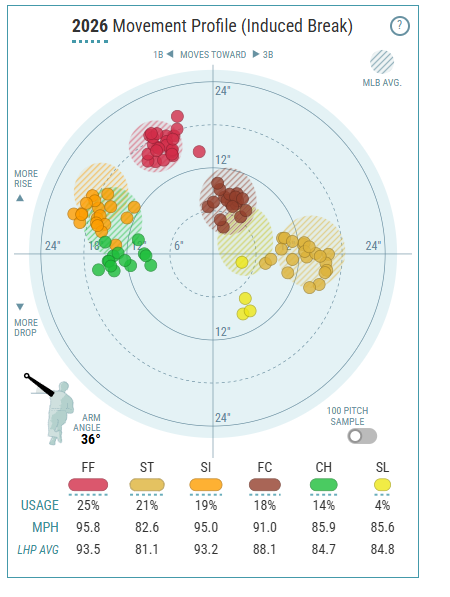
See how all his pitches cluster around the “MLB AVG” circle? That’s not a good thing because it means his fastball doesn’t have strong, deceptive movement and is easier to read for opponents. Baseball is a game of micro-moments and micro-decisions, and the easier it is to read a fastball, the easier it is to hit the pitcher overall.
If a batter can more easily pick up a fastball, they can also more easily react to and hit the pitcher’s secondary stuff. Of course, there are pitchers who can get by with mediocre fastballs, but it’s much, much harder for them to succeed.
Kay’s four-seamer hasn’t performed all that well this season either. It’s technically been better than the sinker, but batters are still hitting .274 with a .507 SLG and a .385 wOBA off this pitch. Like the sinker, the expected stats support these results with a .299 xBA, .477 xSLG, and a .396 xwOBA. Interestingly, if we narrow in on Kay’s hot month of May, the four-seamer has performed much better.
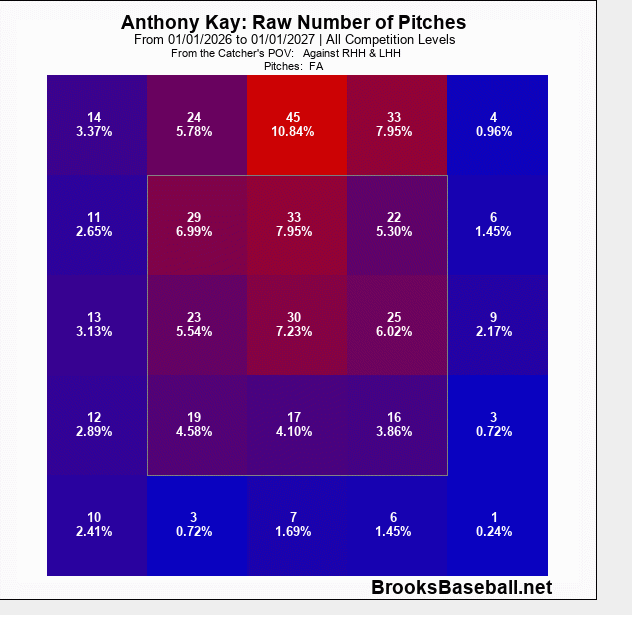
During May, batters hit .179 with a .321 SLG off Kay’s four-seamer, a stark contrast to his season-long stats. What changed? Firstly, Kay began throwing the pitch less often, 20.5% of the time in May versus 25.1% overall. He also started sequencing a little differently, throwing it more with two strikes or when ahead in the count. The most interesting difference can be seen in the fastball heatmaps for May compared to a full season. Comparison below.
Full 2026:
May 2026:
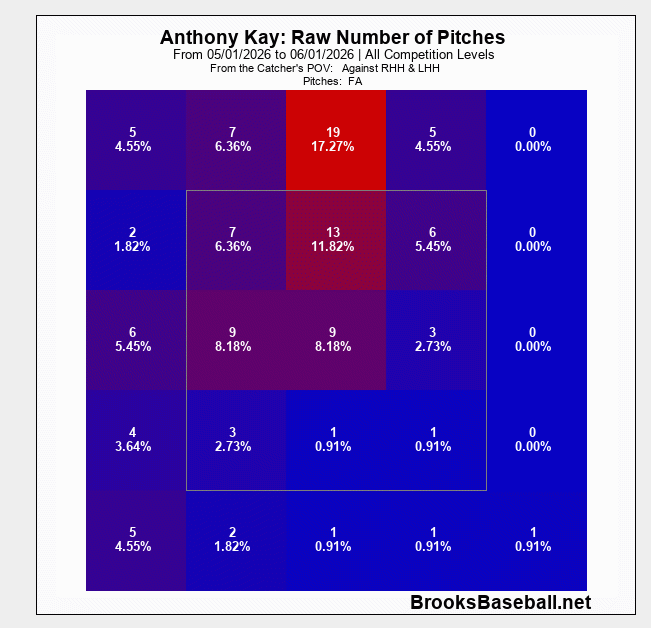
You can see more concentration towards the upper middle and above the zone. It’s maybe not a drastic difference, but I think this shows signs of better command for Kay. He was able to more consistently locate the pitch where he wants it and got better results. I don’t think he can maintain the .179 AVG against his four-seamer that he had in May (it took a .222 BABIP and an 82.3 mph average EV, both likely unsustainable), but better command never hurt anyone.
There are other indicators that Kay improved his command in May, the most obvious being the drop in walk rate. He had a 5.04 BB/9 in March/April, but a 2.78 BB/9 in May. Control and walks were a big issue for Kay during his first MLB stint, but he cut his walk rates in Japan and perhaps is starting to see those gains in America. I don’t think Kay has the stuff to rack up big strikeout numbers, so he needs to limit walks to have a respectable K/BB ratio, and more importantly, to prevent runs from scoring.
I’ve talked plenty about Kay’s fastball, but what about his secondary stuff? His most-used breaking ball is an 82.6 mph sweeper, which he’s thrown 20.6% of the time this season. Batters have sort of handled it well, with a .250 AVG, .357 SLG, and a .343 wOBA against, but unlike Kay’s fastballs, the expected stats are more favorable on the sweeper. Kay has a .197 xBA, .310 xSLG, and a .315 xwOBA against his sweeper. He also has a 30.7% whiff rate, which isn’t that great for a breaking ball, but it’s the best strikeout pitch for him besides a seldom-used slider.
Kay’s sweeper is soft and does not have exceptional spin or movement. His 2422 RPM spin rate and 13 inches of glove-side movement are alright, but nothing special, especially when one considers his weak fastballs. This pitch probably has the most potential of any of Kay’s secondary offerings, but in the grand scheme of things, it’s not a standout offering.
One last pitch worth touching on is Kay’s changeup. The changeup was considered one of his best pitches as a prospect, and it’s been rather effective this season. He uses it exclusively against righties, and opponents have a .225 AVG, .325 SLG, and a .251 wOBA off this pitch. What’s made it perform so well is the -4-degree average launch angle against, leading to a 64.7% ground-ball rate with the pitch.
With almost zero drop and a low spin rate, the pitch can be difficult to read and square up for opponents, and batters have really struggled to elevate it thus far. He still has an underwhelming 22.1% whiff rate with the changeup, so I’m not suggesting it’s going to transform him into a superstar, but it has all the makings of an effective offering and looks to be a solid change.
Verdict:
Kay is sort of an interesting profile—he has hard velocity, throws lots of pitches, and had success in Japan—but I’m not sure it’s going to translate into a useful fantasy option. These fastballs have been hit hard at times, and unless Kay has near-perfect command, they will get hit hard in the future.
He’s been susceptible to home runs and power despite a propensity for groundballs, and I think that’s a consequence of how much hard contact he allows. It’s all fine and dandy to allow a 92.2 mph average EV when the hits result in grounders, but what happens when a batter elevates? It hurts your ERA, that’s for sure.
Kay also doesn’t have any standout breaking balls either, and I think he’ll struggle to maintain even a league-average K rate of around 22%. He’s at 17.6% this season, and only raised it to 19.9% during his hot month of May.
He sort of lands in a similar bucket to Javier Assad, where he can perform well at times, but it’s hard to trust, and the risk is severe. Best-case scenario with Kay, you get 5-6 innings and maybe a win or QS. Worst case, you get a dynamite thrown into your ratios for the week. That’s just not worth it in more circumstances, and unless Kay builds on his hot May, I think he’s best left on the wire. Stream if desperate, ignore if not.
Griffin Jax, Tampa Bay Rays – 32% Rostered
2026 Stats (prior to this start): 39 IP, 4.15 ERA, 4.98 FIP, 11% K-BB%
06/13 @ LAA: 5 IP, 5 H, 1 R (0 ER), 0 BB, 5 K
Jax was a tough-luck loser on Saturday, allowing zero earned runs over five innings against the Angels but still taking the loss. A longtime reliever, the Rays have begun stretching Jax out as a starter this season, and he’s completed five innings in back-to-back outings. Once hailed as a nasty late-game reliever with Minnesota, it’s been shakier for Jax since joining the Rays last season. We know there’s talent in this right arm, but is Jax ready to step up as a reliable starting pitcher?
Originally a third-round pick by the Twins in 2016, Jax was not considered a big prospect coming up, and he struggled to a 6.37 ERA as a starter in 2019, his rookie year. Things clicked for him once in the bullpen, and that’s exactly where he stayed up until this season. His 2024 with Minnesota was especially nasty, with Jax posting a 2.03 ERA and 29% K-BB% in 71 innings. Jax works with a six-pitch mix, consisting of a sweeper, changeup, sinker, four-seamer, curveball, and cutter.
Unlike many starting pitchers, Jax’s most used pitches are not his fastballs. Instead, his top two pitches this season have been the sweeper and changeup. That hasn’t changed as a starter either, as the changeup and slider have been his top two pitches since joining the rotation on 4/26 as well. We’ll start with the sweeper, since it is the pitch Jax is most known for.
An 88.3 mph offering, Jax throws this pitch very hard for a sweeper. In fact, Jax is just one of four qualified pitchers to throw a sweeper harder than 88 mph, and nobody throws harder than 88.9 (Will Klein). He is also just one of eight qualified pitchers with a spin rate above 3,000 RPM with his sweeper (3,004 RPM average thus far).
The pitch has been quite effective as well, with a .188 AVG, .406 SLG, and a .286 wOBA against. Jax also has an impressive 41.1% whiff rate with the sweeper this season. Even when hitters make contact, they don’t strike the ball well, as Jax has an 85.8 mph average exit velocity against his sweeper as well. Here’s an example of the pitch from this season.
— Elliott Baas (@ElliottBaasBB) June 16, 2026
It’s hard and sharp for a sweeper, as sweepers tend to be soft and loopy when compared to a traditional slider. Jax’s sweeper has been dominant from day one, even when he was struggling as a starter all the way back in 2019. This has all the makings of a plus strikeout pitch, and Jax should have no problem racking up the whiffs with his sweeper.
Then there’s his changeup, which Jax has thrown 20.4% of the time this season. His changeup usage has been the most meaningful shift in pitch mix in Jax’s transition from bullpen to rotation. He was throwing the changeup 18.7% of the time before entering the rotation, and has thrown it 21.3% of the time as a starter.
Part of this may simply be more exposure to left-handed hitters, as Jax mostly used the changeup against lefties. Although, one of the only noteworthy shifts in his changeup sequencing as a starter is his increased usage against righties. Jax has begun using the changeup more often against righties when ahead in the count, or with two strikes. The sweeper is still his go-to, but he’s mixing in changeups more often to keep hitters off balance.
The big question, of course, is whether the changeup has been effective. The results are mixed, as batters are hitting .273 off the changeup, but have a .295 SLG and a .272 wOBA. Jax has a strong 35.6% whiff rate with the changeup, but even better is the weak contact he’s induced. When batters strike a Jax changeup, the ball putters off the bat at just 81.7 mph. Even worse, this weak little hit is being sent directly into the ground, with a -4-degree average launch angle against the change.
Jax has a 63.3% ground-ball rate with the changeup, and his history suggests he can sustain this over a full season. Given the high whiff rate and poor quality of contact against the changeup, I think it’s reasonable to expect regression on his current .375 BABIP off the changeup.
Jax’s sweeper looks awesome, and his changeup has been consistently effective over the years for him. But what about the fastballs? Jax uses both a sinker and a four-seamer, opting to throw the sinker mostly to righties and the four-seamer mostly to lefties. We’ll start with the sinker, since it is his most used heater at 20.3%. A 95.8 mph offering, Jax boasts plus velocity, but batters have had no trouble with Jax’s sinker this season.
Opponents are hitting .306 with a .306 SLG and a .334 wOBA against. It’s sort of amazing that Jax has not allowed an extra-base hit with this pitch, but the expected stats suggest that won’t stay true for long. Jax has a .297 xBA, .401 xSLG, and a .359 xwOBA with his sinker this season.
Batters have a 2-degree average launch angle, an 87 mph average EV, and a 63.6% ground-ball rate against this pitch, so there is reason to believe Jax can sustain his performance to a degree. In fact, the sinker has a .274 AVG and a 69.7% ground-ball rate against all time, so there’s even reason to believe Jax can perform better with the pitch going forward.
The four-seamer is another story, as batters have crushed the pitch even harder than the sinker. A 96.3 mph offering, Jax has plus velocity and has maintained that velocity as a starter. Unfortunately, that hasn’t stopped opponents from teeing off on this fastball for a .346 AVG, .846 SLG, and a .529 wOBA. Sure, the expected stats are better, but how could they not be? The real concern is the scorching 93.2 mph average exit velocity against this pitch, along with the 47.6% hard hit rate and the 57.1% fly-ball rate.
Flyballs can be favorable outcomes for a pitcher at times, since flyballs are the least likely batted ball type to land for a hit. But that becomes a dangerous game when the pitcher is allowing so much hard contact. Jax’s home run rate has exploded to 1.43 HR/9 this season, and his four-seamer is a big reason why. As long as Jax is allowing this much hard contact and this many flyballs, the home runs will continue, although it's worth noting that his current home run rate is heavily influenced by a three HR outing against Detroit on 6/1/26.
What’s even more concerning is the pattern over Jax’s career. His four-seamer has a 93.1 mph average exit velocity against all time, and has been above 92 mph in all but two seasons for Jax. The fly-ball rate is a deviation for Jax, but I think this may be a consequence of a new approach with the four-seamer.
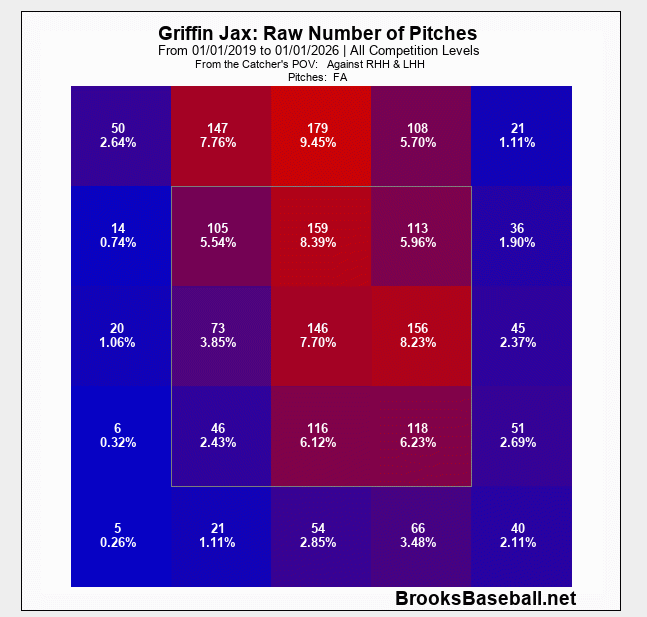
One thing that stood out during the research for this piece was the big drop in zone rate on Jax’s four-seamer. He has a career 58.3% zone rate with the pitch, but just a 49.6% zone rate this season. Let’s have a peek at his fastball heatmaps for this season, and for prior to 2026.
2019-2025:
2026:
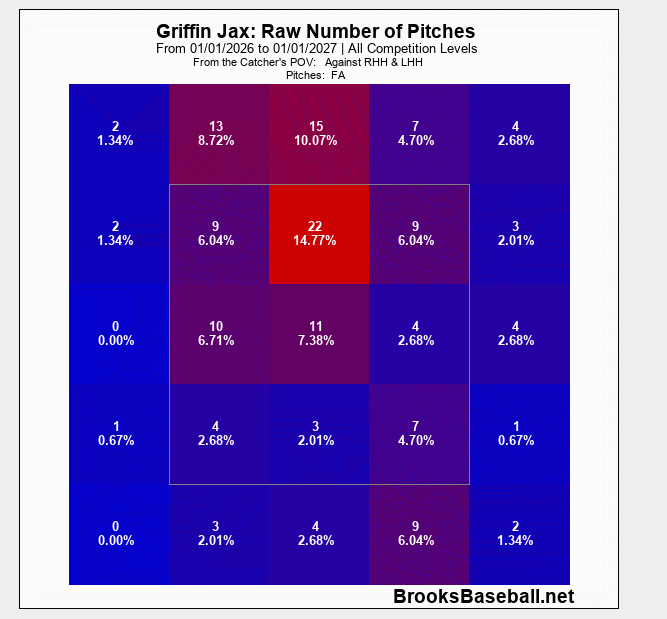
He’s a lot more focused in 2026, keeping it in the upper part of the zone or above the zone. This can lead to more flyballs, especially with a pitcher like Jax, specifically. Jax, for all his crazy sweeper movement and his plus velocity, doesn’t get a ton of movement on his four-seamer. He’s averaged 17.7 inches of IVB and 7.4 inches of arm-side movement. That’s not terrible, but the lack of rise means batters can more easily read a high fastball and thus make solid contact with it.
It can be difficult for hitters to elevate high fastballs, especially hard ones, since they don’t align with their natural swing path. But when the fastball is flatter or lacks rise, like with Jax, a hitter can follow the trajectory more easily and adjust their swing to make solid contact more often. Basically, the lack of movement allows hitters to make strong contact, even against high heat that's traditionally effective at limiting power.
Is Jax doomed? I don’t think so, mostly because his secondary stuff is so good he can get away with having a bad fastball. It’s not really “bad”, necessarily; it just lacks movement. It’s still hard and still averages 2520 RPM with an 86% active spin rate. I think Jax will experience some regression on his fastball results, though it will still pale in comparison to his sweeper and changeup.
Also, I’m not sure Jax’s surface stats tell the full story. For instance, I think he is very capable of producing a strikeout rate better than his current 22.3%. He has a career 26.8% mark and has been much higher in previous seasons. His sweeper and changeup both have strong whiff rates and have proven to be strikeout weapons in the past.
I also think he could improve upon his current 9.8% walk rate. He’s never been this high before, and there isn’t a meaningful change in his chase rate or zone rate this season (despite the changes to his four-seam zone rate).
An improvement in these areas would lead to a better ERA,WHIP, FIP, and other ratio stats. The big question, though, is whether Jax can carry over his bullpen success to the rotation. We’ve seen mixed results on this transition as it's gained popularity over the past few years. We’ve seen pitchers like Clay Holmes and Reynaldo Lopez have success as starters, but we’ve also seen guys like Jordan Hicks slink back to the bullpen after a failed experiment.
Verdict:
Out of the three pitchers covered in this article, Jax undoubtedly has the best raw stuff and the best overall potential. His sweeper has all the makings of a dominant strikeout pitch, with its plus velocity, high spin, and tight movement. It has consistently produced Ks for Jax, and I think it will continue to serve as his best pitch.
His changeup has also been quite effective, with a 35.6% whiff rate and a -4-degree average launch angle against. His biggest issues tend to come from hittable fastballs, especially the four-seamer. Jax throws hard at 96.3 mph, but he lacks strong movement, and the fastball has proven vulnerable to hits and power at times. When it comes to it, give me average velocity and plus movement over plus velocity and average movement, the latter describing Jax.
I think there’s potential here, but whether Jax realizes it, and realizes it this season, is another story. There is the potential for an effective, high-strikeout starter, but he will likely need to work through some lumps first. Jax also has a frustratingly short leash, as he hasn’t completed more than five innings or thrown more than 72 pitches in any start this season.
That caps his upside, but I think he’s more usable than Assad or Kay. He is someone I’m interested in watching develop, but I’m not ready to throw him out every fifth day in fantasy. For now, he’s someone I would either watch on waivers or use selectively if on my team.
More Fantasy Baseball Advice
Download Our Free News & Alerts Mobile App
Like what you see? Download our updated fantasy baseball app for iPhone and Android with 24x7 player news, injury alerts, sleepers, prospects & more. All free!