




 RADIO
RADIO










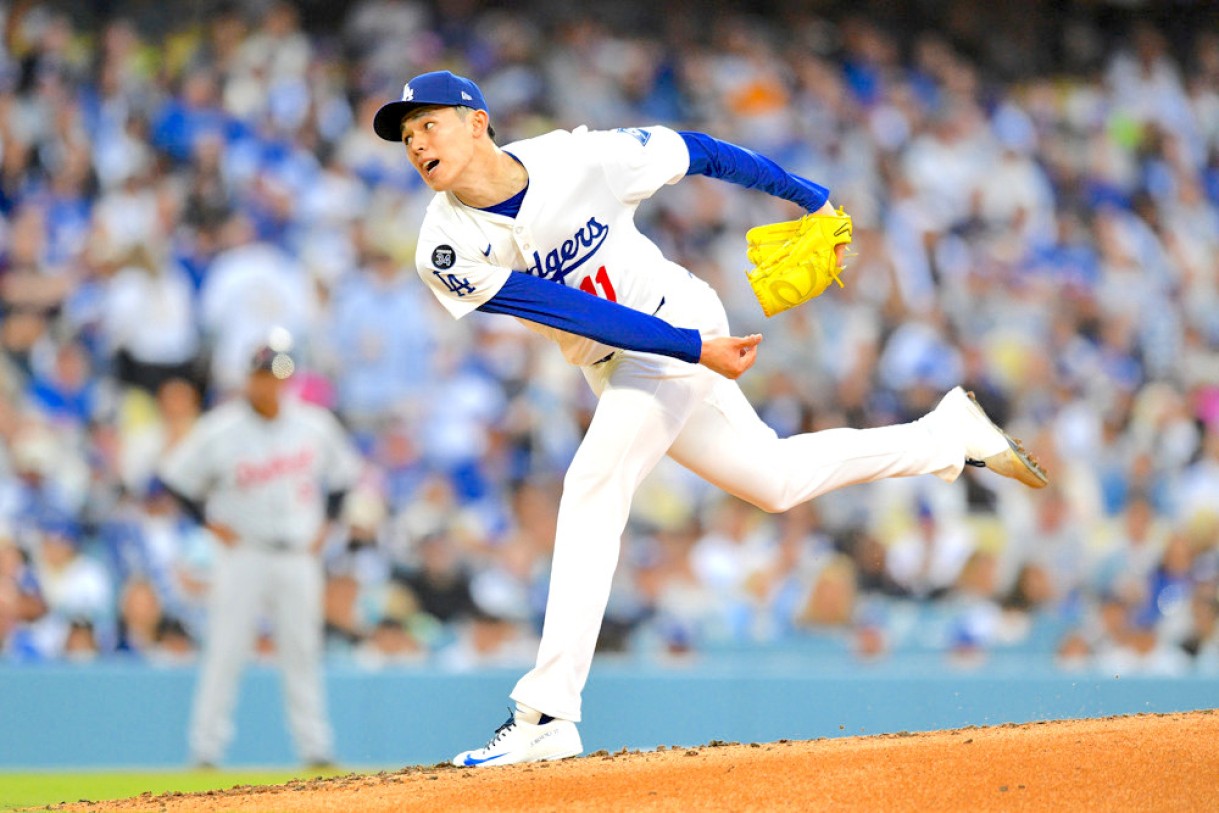
Elliott looks at pitchers with surprising starts recently. These SPs could emerge as fantasy baseball waiver wire targets for Week 10 in 2026, or just mirages.
Welcome back to the "Are You For Real?" series as we dive into Week 10 of the 2026 fantasy baseball season. For those unfamiliar, this is a weekly column where we examine starting pitchers who had surprisingly strong starts over the past week and put them under the microscope to determine whether they're legitimate or just smoke and mirrors.
Another week, another slate of surprising pitching performances to dissect. This week, we're looking at a trio of right-handers who have been pitching well as of late, beyond the one start highlighted in this article. First, we'll break down Roki Sasaki's long-awaited emergence for the Dodgers. Then, we'll delve into Christian Scott's hot stretch for the Mets. We'll finish it off by looking at Brandon Young's step-up performance for the Orioles.
Roster percentages are taken from Yahoo! and are accurate as of June 1.
Featured Promo: Save 50% off the regular price with discount code CHAMP, for a limited time. Exclusive access to our Team Sync platform, DFS cheat sheets, Lineup Optimizers, betting/prop picks, and exclusive content from Nick Mariano and Eric Cross! GAIN ACCESS NOW
Roki Sasaki, Los Angeles Dodgers – 44% Rostered
2026 Stats (prior to this start): 45.2 IP, 4.93 ERA, 5.20 FIP, 12.4% K-BB%
05/30 vs. PHI: 5.1 IP, 3 3 H, 1 ER, 1 BB, 7 K
Sasaki kept on rolling Saturday night, holding the Phillies to one run over 5.1 innings while striking out seven in the no-decision. Sasaki has begun to pitch better as of late, pitching to a 2.08 ERA and 24.6% K-BB% over his last three starts. Sasaki has been one of the most volatile pitchers since coming to MLB from NPB. He was viewed as an elite talent who could be a top-of-the-rotation starter from the beginning.
There have also been a myriad of cases of players jumping from Japan or Korea and finding fast success, and many expected that of Sasaki as well. He’s pitched to a 4.53 ERA in 87.1 MLB innings since coming over ahead of the 2025 season, and has only been on the precipice of rosterability in standard mixed leagues for most of his time in MLB.
Originally an international free agent signing by the Dodgers, Sasaki was considered a huge prospect when he came over from Japan. He was still considered a prospect when he signed his deal despite four seasons in NPB, and he was instantly catapulted to the number one prospect spot by many outlets. Sasaki works with a four-pitch mix consisting of a four-seam fastball, slider, splitter, and the rare forkball.
His most used pitch this season has been the four-seam fastball, which he has thrown 43.9% of the time. His fastball usage has pretty much stayed the same during his recent hot streak, and he threw it 45% of the time in this start. A 97.1 mph offering, Sasaki’s fastball is noteworthy for its big velocity. That velo was a big reason why Sasaki was so touted as a prospect when he came over, because scouts could just dream on how he’d pair 97-98 mph heat with his strong arsenal of secondary stuff.
Sasaki’s fastball may be hard, but it’s also been hit hard this season. Batters are hitting .319 with a .582 SLG and a .431 wOBA off Sasaki’s fastball, which are some rather ugly numbers. The expected stats suggest that Sasaki has earned these results as well, with a .328 xBA, .597 xSLG, and .434 xwOBA.
On the one hand, it would be easy to paint these results as bad luck for Sasaki. He throws very hard, but he has a .319 BABIP and 18.8% HR/FB ratio off his fastball, inflating the numbers against it. Sasaki has also seen a lot of improvement in some of the underlying numbers with his fastball compared to last season.
His whiff rate and chase rate have both seen significant gains, while his contact rate and line drive rate have fallen. He’s also gained about 100 RPM in spin rate and 1.4 inches of induced vertical break (IVB) compared to last season, as well as a full tick in fastball velo.
Despite all those gains, his fastball is performing much worse than it was last season. One of the biggest drivers behind this seems to be an increase in average exit velocity against, which went from 91.8 mph in 2025 to a blistering 94 mph in 2026. His launch angle against also went from 12 degrees in 2025 to 19 degrees in 2026, which means more flyballs and more power against, especially considering how hard opponents are hitting the pitch.
Sasaki’s fastball is notable for its velocity, but it lacks strong movement and has a rather flat shape. He did increase his IVB as previously mentioned, but he is still only averaging 15.7 inches of IVB and 9.1 inches of arm-side movement. His fastball lacks rise, which is often a key component in generating whiffs and getting outs.
A pitcher with a high-rise 94 mph fastball might have better luck than a pitcher with a 96 mph flat heater due to its increased deceptiveness and ability to fool hitters.
That doesn’t mean Sasaki can’t find success with the fastball, but it might struggle to live up to its high velocity. It may not be able to generate the swing and miss one would expect from a 97 mph heater, and it may have worse than expected outcomes as well.
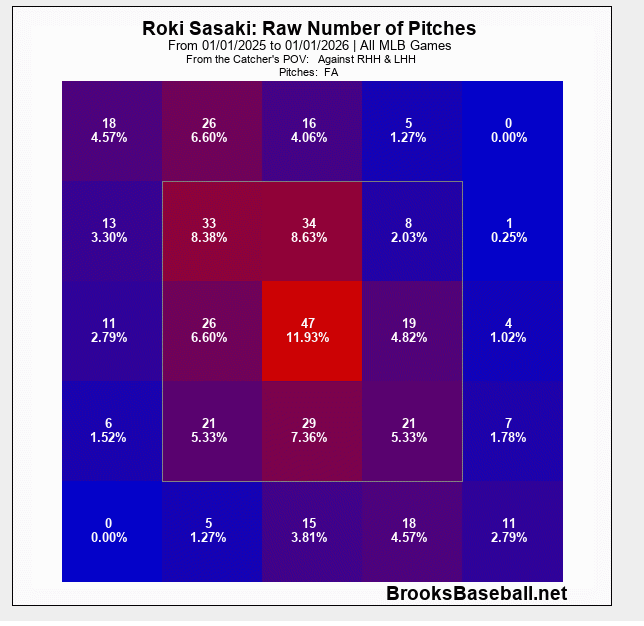
Sasaki does seem to be taking a different approach with the pitch in 2026. He started throwing higher in the zone and even above the zone and outside the zone more often, with his zone rating dropping from 64.7% in 2025 to 56% in 2026. Here is a comparison of Sasaki’s four-seam heatmaps for 2025 and 2026.
2025:
2026:
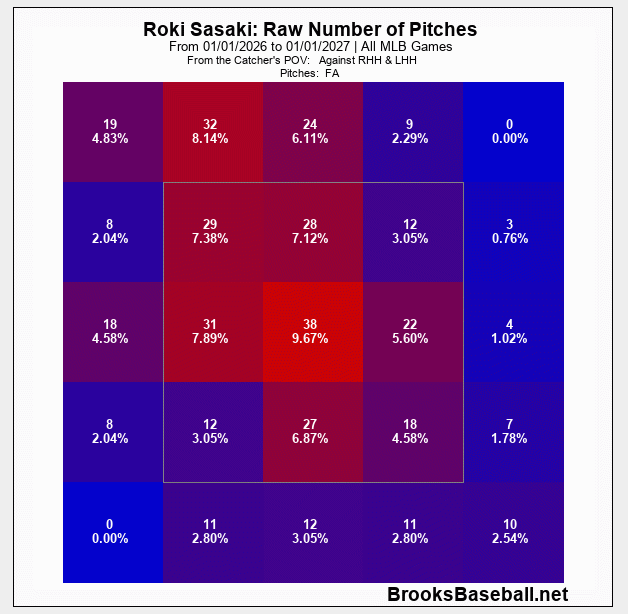
It’s a little less “right down the middle” for Sasaki, and even though some of the batted ball outcomes haven’t been as favorable, he still raised his whiff rate by 8.7% from 2025 to 2026. I don’t think Sasaki’s fastball is ultimately going to be known as his best pitch, but he could produce better numbers going forward, especially if he can be more consistent with his command.
Sasaki’s next most used pitch has been the slider, which he has thrown 21.4% of the time. An 86.4 mph offering, Sasaki’s slider is rather slow relative to his velocity. I might’ve expected it to average a few ticks higher on the gun thanks to his upper-90s fastball. It’s more of a softer, loopier slider, not as hard or intense as one might expect given his hard fastball. Here is an example of this pitch.
— Elliott Baas (@ElliottBaasBB) June 1, 2026
Sasaki has gotten really good results with this pitch so far, with batters hitting .182 with a .333 SLG and a .286 wOBA off this pitch. The expected stats are somehow even better, with Sasaki sporting a .146 xBA, .217 xSLG, and .228 wOBA. There have been plenty of swings and misses with this pitch, as Sasaki has a dominant 42% whiff rate with the slider following this start. Seven of his whopping 18 swinging strikes came on the slider in the start against Philadelphia as well, good for a 50% whiff rate.
Part of the reason for the dominance of Sasaki’s slider is the 80.2 mph average exit velocity against, a piddly number in today’s game. Even if batters make contact with this slider, they do not generally strike the ball well. In addition to the soft exit velocity, Sasaki also has just a 15% line drive with his slider and an average launch angle of six degrees. While the fastball is hard but flawed, the slider looks great.
Both the measurables and performance support these numbers, though I think it’d be fair to expect some regression. It’s still a rather small sample size as Sasaki only began throwing the slider this year. Even so, Sasaki’s slider seems to have all the makings of an effective strikeout weapon.
Sasaki also mixes in his splitter 19% of the time, and much like the slider, the splitter has gotten great results against it so far this season. Batters are hitting just .171 off the pitch with a .268 SLG and a .215 wOBA. Some of the surrounding metrics aren’t as strong as the slider, such as the .204 xBA, .354 xSLG, and 33.7% whiff rate. Those are still some promising metrics, and this splitter has really served as Sasaki’s go-to knock-out pitch, the one he throws most often when ahead in the count or with two strikes.
A 90.2 mph offering, Sasaki’s splitter is a hard split-change with ultra-low spin and tons of movement. He has averaged just 994 RPM with this pitch so far, and a low spin rate can be ideal for a pitch like a splitter. Pitchers tend to want high spin on their fastballs to increase backspin and make it so the pitch doesn't drop as much as hitters expect, and they misjudge their swings, leading to poor quality contact or a complete miss.
For splitters, a pitcher might want the opposite effect. He wants the batter to think his splitter is a fastball until it’s too late, so if he can throw it with low spin, it will drop more than the batter expects. It doesn’t have the same force of the backspin affecting its trajectory, and instead has more of a straight path down.
Sasaki has also averaged 1.5 inches of induced vertical break and 8.7 inches of arm-side movement, giving the pitch strong movement in addition to its low spin rate and high velocity. Here is an example of this pitch from this season.
— Elliott Baas (@ElliottBaasBB) June 1, 2026
It looks especially nasty there, and that’s exactly what Sasaki is capable of with this pitch. His splitter was considered his best pitch coming over, and many thought it could eventually become one of the best splitters in all of baseball. I wouldn’t give him that crown yet, but this is yet another pitch with very favorable measurables and strong outcomes thus far.
His least used pitch has been the forkball, which he has only thrown 15.7% of the time. He only used it 4% of the time in this start against Philadelphia as well. An 85.2 mph offering, Sasaki’s forkball is soft with decent movement and really low spin. He’s averaged a mere 599 RPM with that pitch this season, making it the second-lowest spin rate of any pitch by a qualified pitcher, with just Cade Smith’s splitter below it.
It’s sort of a unique pitch and quite uncommon in MLB, with only Sasaki and Kodai Senga being registered as throwing a forkball in 2026. Here's an example of the pitch from this season.
— Elliott Baas (@ElliottBaasBB) June 1, 2026
The pitch has been quite effective, with batters hitting .242 with a .515 SLG and a .346 wOBA. Ok, that's not great, but the .193 xBA, .323 xSLG, and .249 xwOBA paint a different picture. Batters only have a 6-degree average launch angle and an 87.2 mph average exit velocity off this pitch, so it’s another case of opponents simply driving weak hits into the ground.
Sasaki’s forkball was also quite effective last season, and while we don't have a ton of modern forkballs to compare it to, I do think this could serve as another plus pitch for Sasaki.
Verdict:
Fantasy managers have been waiting since the beginning of 2025 for Sasaki to take a star turn, and after many false starts and flashes of brilliance that would soon dissipate, it may finally be time for Sasaki to take the next step.
From a stuff perspective, Sasaki seems like a standout. He throws hard, very hard, and can keep hitters on their toes with his fastball, even if it’s a little underwhelming in terms of spin and movement. He debuted a slider in 2026, and it’s already dominating, with a .182 AVG and 42.2% whiff rate against. His splitter and forkball also remain effective offerings, both at limiting hard or quality contact and at generating whiffs.
Sasaki’s two biggest flaws are his poor control and home run tendencies, which can be a difficult combination of problems for a pitcher to have. Not only is he putting people on for free, but he’s also making sure they get home safely, too. There is certainly room for improvement here, and Sasaki has already shown some signs.
His walk rate this season is down to 8.6%, which is still high but more manageable than his 13.7% walk rate last season. He began to dial it in even more after a five-walk outing against the Rangers on April 12. In his seven starts following that game, he has a 5.7% walk rate, which is well below league average. He also has not allowed more than two walks in a game since that Rangers start, so there are reasons to think Sasaki is improving.
His home run rate could fall as well, as he currently has a 1.76 HR/9 and 16.7% HR/FB ratio. The HR/FB ratio will likely normalize towards league average, and Sasaki has been allowing fewer longballs over his last few starts as well. He allowed three home runs on April 25 against the Cubs, but has only given up three combined home runs in his next five starts.
The talent is certainly there with Sasaki, and he may be improving on his biggest flaws. If everything somehow magically clicked for him, Sasaki has the upside to become a frontline starter. That’s why he should be rostered in all leagues. The upside and potential are too great to ignore.
Christian Scott, New York Mets – 18% Rostered
2026 Stats (prior to this start): 25.1 IP, 3.20 ERA, 3.47 FIP, 14% K-BB%
05/30 vs. MIA: 5 IP, 1 H, 1 ER, 2 BB, 8 K
The good times continued to roll for Scott on Saturday, as the right-hander held Miami to just one run over five innings, also picking up the win and striking out eight. Scott has taken on an unexpectedly larger role so far this season, thanks to numerous pitching injuries for the Mets. Even though he was sort of on the fringes coming into the year, the Mets have a serious dearth of healthy arms right now, and Scott’s likely a permanent part of this rotation for the foreseeable future. But is he a fantasy asset?
Originally a fifth-round pick by the Mets in 2021, Scott became a pretty big prospect for the Mets ahead of his debut in 2024. He wasn’t an elite prospect, but he was viewed as a safe mid-rotation starter profile. He was sort of a jack of all trades on the mound, boasting a deep arsenal of above-average pitches and solid command, but lacking one big standout skill or pitch. Scott works with a six-pitch mix consisting of a four-seam fastball, sweeper, cutter, splitter, sinker, and slider.
Scott may have six pitches to choose from, but he’s tended to rely on a few pitches a lot more than others. Mainly, his four-seamer, sweeper, and cutter, which he has thrown with a combined 91.5% usage rate. His other three pitches are all thrown under 5% of the time, and his reliance on his main three pitches was apparent in this past Saturday's outing.
Really, it was a two-pitch show for Scott against Miami, as he threw his four-seamer and sweeper a combined 80% of the time on Saturday. His most used pitch has been the four-seam fastball, which he has thrown 51.2% of the time this year.
A 95.5 mph fastball, Scott throws it slightly above league average. He improved his fastball velocity since he last played in the majors in 2024, throwing 94.2 mph back then. He demonstrates solid spin and horizontal movement as well, though, like Sasaki, Scott’s fastball is only about league average in terms of rise.
Scott has gotten some okay results with the pitch so far, with opponents hitting .250 with a .346 SLG and a .361 wOBA. Not terrible, but nothing special either. He does have a 20.7% whiff rate with the pitch, which is solid for a fastball. He also has an exceptionally soft 84.8 mph average exit velocity against, meaning batters have struggled to make hard, solid contact off Scott’s four-seamer.
Scott has some decent measurables on his fastball, and I think it would be fair to classify it as an average or maybe slightly above average four-seamer. It’s not a big liability on the mound as we see with some pitchers, but it’s also far from an elite offering. My biggest issue with Scott’s fastball at this time would be its heavy usage. He is throwing this pitch over the half the time, and while it’s working now due to the soft contact allowed, that may not last forever.
Scott has actually induced a ton of soft contact so far. His top four thrown pitches (four-seam, sweeper, cutter, splitter) all have an average exit velocity under 86 mph. His overall average exit velocity against is 86.8 mph, putting him in the 86th percentile for this metric. That would all be well and good, but it’s worth noting that Scott had an 89.2 mph average exit velocity in 2024, and his fastball was hit much harder at 93.2 mph average exit velocity.
In both instances, we’re dealing with too small a sample size to draw major conclusions about batted ball quality against. He only threw 787 pitches in 2024 and 559 so far this season, and we’ve seen some big deviations in outcomes already. It makes it difficult to buy into Scott’s soft contact prowess. Scott has also had just a 3.9% barrel rate and a 31.6% hard hit rate this season, and part of me can’t help but ask for more data.
These would all be very strong metrics for Scott if he can maintain them, but 30.1 innings isn’t enough to draw a definitive conclusion. I think it’s fair to anticipate a little regression just because Scott has done so well, but it remains to be seen where these metrics might end up.
After the four-seamer, his next most used pitch has been the sweeper, and he threw it 38% of the time against the Marlins. An 81.1 mph offering, Scott’s sweeper is quite soft, especially considering his above-average fastball velocity. It has a lot of movement too, with 6.1 inches of IVB and a whopping 17.6 inches of glove-side movement. The pitch has almost a frisbee-like quality, spinning and slinging its way towards the strike zone. Here is an example of the pitch from this season.
— Elliott Baas (@ElliottBaasBB) June 1, 2026
That’s pretty nasty stuff, and this pitch has tied opposing hitters up. Batters are hitting .222 off the pitch with a .333 SLG and a .260 wOBA. The expected stats are even better, with a .163 xBA, .270 xSLG, and a .203 xwOBA. It has been by far Scott’s best strikeout pitch, with an impressive 35.1% whiff rate. Even when batters do make contact, they haven’t struck the ball well, with an 83.7 mph average exit velocity and a 28-degree average launch angle against.
That combination of low exit velocity and a high launch angle means Scott has been able to induce a lot of weak flyballs and pop-ups with the pitch as well. Flyballs are the least likely batted ball type to fall for a hit, and it’s especially hard to get a hit with weak flyballs. These are often easy outs for fielders, as one really needs some exit velo or some distance (or a lucky location) to do some damage on a flyball.
Scott’s sweeper has a lot of positive attributes to suggest that its strong early performance is sustainable. Like with the fastball, I expect regression on the absurdly low exit velocity against, but this could still be a very effective pitch for Scott.
Scott also uses his cutter about 18.1% of the time, though his usage was way down in this start at just 7%. This was a pretty big outlier compared to the rest of his starts, and I found the usage a little strange because Miami deployed six left-handed hitters in their lineup. Scott has used his cutter much more often against lefties, so it was a little unusual to see this drop in usage despite a left-heavy opposing lineup.
The cutter has gotten some really good results against it this season as well, with a .130 BA, .174 SLG, and a .199 wOBA against. Again, Scott has benefited from lots of soft contact against this pitch. Batters have an 84.8 mph average exit velocity off this pitch and a 28.6% infield flyball rate. It hasn’t been a great source of strikeouts with a 13.2% whiff rate, but it has been good at generating weak contact.
I’ve expressed some doubt about Scott’s ability to sustain the soft contact against him to this degree, and the pitch I’m most skeptical of is the cutter. It has a .167 BABIP against thus far, which is sure to regress as the season progresses. The expected stats are quite a bit different on the cutter as well, with a .257 xBA, .327 xSLG, and .306 xwOBA providing a stark contrast to the microscopic .130 BA batters have off Scott’s cutter so far.
An 89 mph offering, the pitch sort of has high spin for a cutter at 2441 RPM, and sort of has good movement with 5.3 inches of rise and 3.6 inches of glove-side movement. Still, it seems pretty clear that good fortune is playing a role in the success of Scott’s cutter, and I would be most confident in this pitch experiencing regression as time goes on.
One issue I have with Scott’s fantasy outlook is his inability to pitch deep into games. At first, he was just getting stretched out, but he’s thrown 94 and 96 pitches in his last two starts, respectively, and he still couldn’t complete six frames. He has proven to be inefficient and has been prone to walks so far this season, which is not something he struggled with as a prospect. Could he be useful in a standard league or deeper? Sure, but he probably isn’t going to break out as a star, and if he did, it likely wouldn’t be during this season.
Verdict:
Scott has found some success since being recalled, pitching to a 2.97 ERA and 28.1% strikeout rate. He is sort of a post-hype prospect since he had to undergo Tommy John surgery shortly after his debut in 2024, which put him at the back of managers’ minds.
His best pitch is his sweeper, which is almost mesmerizing in the way it spins and glides to the plate. It has dominated hitters for a 35.1% whiff rate and a .203 xwOBA against. The sweeper has been a big reason behind Scott’s high strikeout rate so far, and this pitch has all the makings of a plus breaking ball that can consistently generate whiffs.
The rest of his pitches leave a little to be desired. He relies heavily on his 95.5 mph fastball, which has solid velocity and spin but lacks significant rise and has been hittable at times. It’s a rather average four-seamer in comparison to the rest of MLB.
He also leans heavily on a cutter, though he only threw it 7% of the time in this start. Batters are hitting just .130 off the cutter, but a pitiful 13.2% whiff rate and unfavorable expected stats suggest regression could be coming.
Scott is probably not a league winner or a 2026 breakout, but he could be used as a decent streamer or back-end rotation guy. He’s the type of pitcher that I’ll keep in my lineup until the hot streak stops and some regression starts creeping in, and if that happens, he’s probably an easy cut.
Brandon Young, Baltimore Orioles – 6% Rostered
2026 Stats (prior to this start): 36.1 IP, 3.47 ERA, 4.75 FIP, 6.2% K-BB%
05/30 vs. TOR: 6.2 IP, 7 H, 2 ER, 1 BB, 7 K
Young continued his successful run in the Orioles rotation on Saturday, holding the Blue Jays to just two runs over 6.2 innings in the no-decision. Young has been a surprising source of steadiness for the Orioles this season, who have dealt with multiple significant injuries to existing rotation pieces, such as Zach Eflin, Dean Kremer, and Cade Povich. Young has been able to step up for the Orioles, but can he step up for our fantasy teams?
Originally an undrafted free agent out of the University of Louisiana at Lafayette, Young wasn’t a very big prospect coming up. His strong performances in the minors had him on some prospect radars as a potential back-end starter or swingman for Baltimore going forward, but he was a far cry from Sasaki and Scott in terms of prospect pedigree.
He actually had quite an unusual and impressive path to the majors, hanging on as an undrafted free agent and making a name for himself as a prospect. He managed to reach the majors in under five years, which is pretty impressive since most undrafted free agents like this never sniff the majors. Young works with a five-pitch mix, consisting of a four-seam fastball, splitter, slider, sinker, and curveball.
Young likes to mix in all of his offerings with some degree of regularity, throwing every pitch at least 11.6% of the time this season. His most used pitch has been the four-seam fastball, which he has thrown 41.2% of the time this season and 33% of the time in this start. A 93.9 mph offering, Young’s fastball is slightly below average in velocity but not really a soft fastball. Young has some good movement with this pitch as well, averaging 18.1 inches of IVB and 5.6 inches of arm-side movement.
I’ve talked about Sasaki’s and Scott’s fastballs as being flat due to their lack of vertical movement and rise, but Young does not have that problem. 18.1 inches is a very healthy amount of IVB, and it gives his fastball sort of a unique shape. Here’s a look at Young’s pitch movement profile for this season.
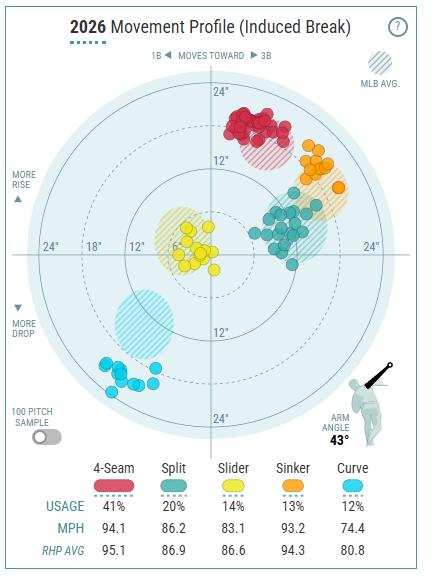
Its high amount of IVB can make the pitch difficult to read and square up for opponents, and batters have really struggled against Young’s four-seamer this season. Opponents are hitting .125 with a .281 SLG and a .239 wOBA against. Those are some great numbers, but there’s a good reason to be skeptical of this performance.
Young has a comically low .102 BABIP against his four-seamer, despite an 89.7 mph average exit velocity. His .405 xSLG and .308 xwOBA tell us the pitch has overperformed as well, and he will likely experience regression with it going forward.
Even so, there’s a little more to like about this pitch beneath the surface. Young only made 12 starts last season, but we can see a few drastic differences in how he’s using the fastball. The zone rate went from 60% in 2025 to 46.3% in 2026, and his chase rate skyrocketed to an impressive 42.5%.
Young has done a great job of getting hitters to chase this season, and even though his below average in nearly every Statcast metric, one area he does stand out is chase rate. His 34.1% overall chase rate puts him in the 84th percentile, while everything else on his page is solidly blue.
This doesn’t necessarily mean this will translate to better outcomes or more strikeouts for Young, but he does deserve some credit for his ability to make hitters swing at pitches outside the zone.
I noted some big changes with his fastball, so let’s compare his 2025 fastball heatmap to his 2026 fastball heatmap.
2025:
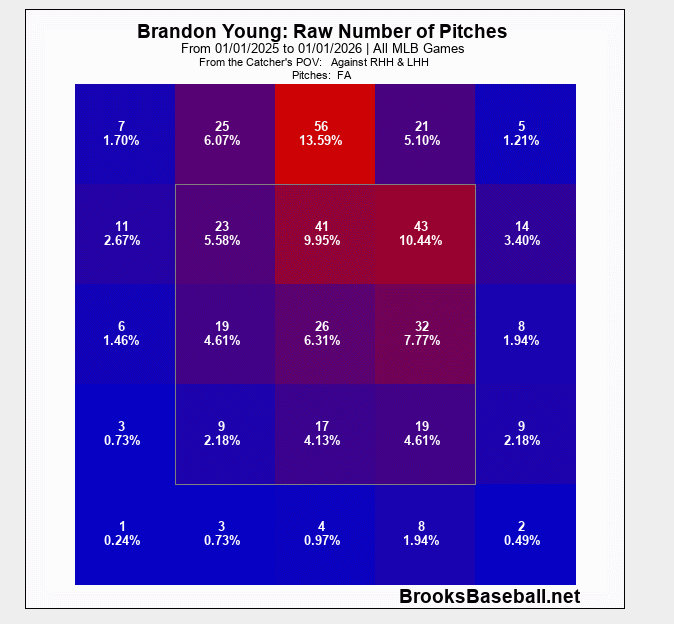
2026:
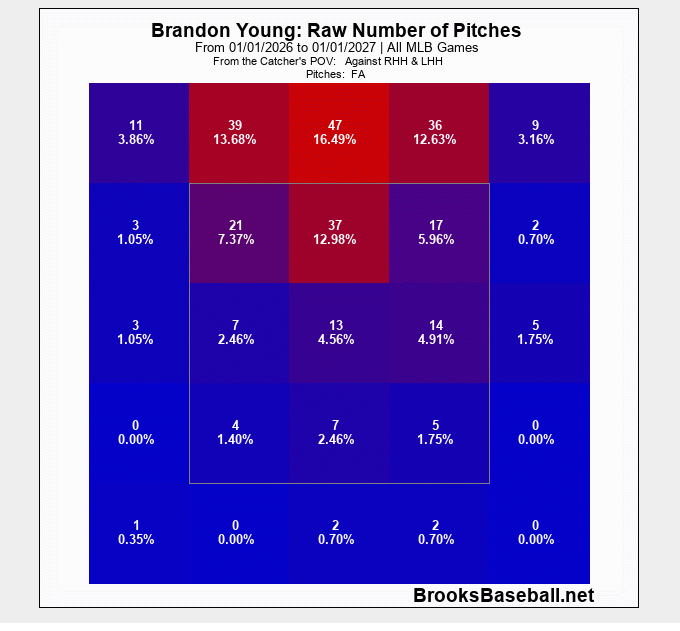
Young was going for the high fastball in both cases, which is the right approach for a pitch like his with so much rise. But in 2026, he has practically refused to throw his fastball anywhere but above the zone, or in the upper third of the zone. He will still likely experience regression, but if he can maintain solid command, his fastball might be able to perform better than its velocity would suggest.
His next most used pitch has been the splitter, which Young has thrown 20.2% of the time this season. An 86.2 mph offering, it’s a low-spin, split-change offering. He doesn’t get a ton of movement with the pitch, averaging 4.3 inches of IVB and 10.7 inches of arm-side run. It hasn’t been very effective either. Batters have pulverized this pitch for a .400 AVG, .500 SLG, and .403 wOBA against.
This is an extremely bad outcome for a pitch thrown with such frequency, and the expected stats all but confirm the bad results with a .354 xBA, .526 xSLG, and .392 xwOBA. Young also has just a 16.1% whiff rate with the splitter, and a 90.8 mph average exit velocity against.
Surely, luck is playing a role in these outcomes, much like with his four-seam fastball. It would be hard to envision a .429 BABIP or a 35.7% line drive rate off this pitch all season, but there isn’t much here to inspire confidence. It’s a soft, low movement offering that has failed to generate whiffs at anything approaching a good rate. It doesn’t have a unique shape or exceptional spin either. This seems like a below-average offering that could be a liability for Young on the mound.
His next most used pitch has been the slider, which Young has thrown 14.2% of the time. An 83.1 mph offering, it’s a soft, slow slider without a ton of movement, differentiating it from league average. He has gotten some good results with the pitch so far, including a .233 BA, .367 SLG, and .289 wOBA. He also has a surprisingly strong 39.6% whiff rate with the slider.
Young hasn’t been a big strikeout guy in the majors with just a 17.5% K rate this season, well below league average. Young got seven strikeouts in this start, which was actually a career-high for him. He didn’t use the slider a ton against Toronto, but he did get three whiffs on six swings, and after running some calculations in Excel, I’ve determined that was a 50% whiff rate.
It’s hard to tell just how real any of these numbers are on Young’s slider. He didn’t throw it much in 2025 at 8.9%, and it's had a mere 19.4% whiff rate. It would be hard to envision Young maintaining such a high whiff rate with this pitch over a full season, and these numbers also might suffer if Young began throwing the pitch more often and increasing the number of pitches, events, and batted ball outcomes. a 39.6% slider whiff rate is All-Star level.
The pitch is performing really well, but I just don’t buy it as an elite or sub-elite offering. This is another situation where more data and information would be quite helpful, because this is still a very small sample size.
He throws both a sinker and a curveball about 12% of the time as well, although his curveball usage has really shot up lately. He threw his curveball 21% of the time against Toronto, a season high. At 74.4 mph, Young’s curveball feels sort of like a throwback, like a pitch from a less optimized era. It’s very soft, even considering his below-average fastball velocity. He also gets lots of spin with a 2714 RPM spin rate, and gets a ton of drop at -16.7 inches.
Here’s a look at his pitch movement profile for 2026 again (curveball in blue).
Here’s an example of the pitch.
— Elliott Baas (@ElliottBaasBB) June 1, 2026
It’s a little satisfying to watch the pitch make a rainbow arc and land in the bottom third of the zone for a strike, though the results against this pitch have been a mixed bag. Batters are hitting .250 with a .375 SLG and a .287 wOBA, but they also have a .278 xBA, .509 xSLG, and .366 wOBA. I would expect a curveball like this to have a high groundball rate, but Young only has a 31.3% groundball rate and a 16-degree average launch angle against, which is certainly in the range of ideal launch angles.
It has also been a pitiful strikeout pitch, with just a 15.2% whiff rate, low even for a curveball. He used the curveball more often in 2025 and had a 68.4% groundball rate that year, so perhaps there will be some correction. This is a pitch that seems to have some solid attributes, but we need to see Young use it effectively and consistently on the mound.
Verdict:
Young has quietly been an important piece to the Orioles rotation for the past month, making five starts in May with a 2.86 ERA, 3.68 FIP, and 9.9% K-BB%. Those aren’t great numbers besides the ERA, but he is pitching well enough and helping keep his team afloat amid multiple injuries to the pitching staff.
Stuff-wise, Young seems rather unremarkable. He has below-average fastball velocity, though his strong movement should allow the pitch to play better than its 93.9 mph velo. His splitter has been downright bad, getting crushed by opponents for a .400 AVG and a .403 wOBA. It lacks significant movement and has failed to generate whiffs. Not a lot to like under the hood with Young’s splitter.
His best strikeout pitch has been the slider, which has a 39.2% whiff rate despite soft velocity and average movement. I’m not sure if Young can sustain this with his slider, and it hasn’t really translated to a high strikeout rate anyway. Young will probably always be a below-average strikeout pitcher, at least as a starter.
From a fantasy perspective, there isn’t a ton to like here. I already mentioned his low strikeout rates, but he also has a 9% walk rate and a 1.37 WHIP despite a 3.35 ERA. There is practically no way Young maintains an ERA this low, and I’d be surprised if he puts up something below four.
Most projection models have him over a 4.50 ERA, and I think that is definitely possible. You could choose to ride hot hand here, but I would most likely leave him on waivers and try to add someone more exciting. We’re probably already seeing the best Young has to offer.
More Fantasy Baseball Advice
Download Our Free News & Alerts Mobile App
Like what you see? Download our updated fantasy baseball app for iPhone and Android with 24x7 player news, injury alerts, sleepers, prospects & more. All free!