




 RADIO
RADIO










Elliott looks at pitchers with surprising starts recently. These SPs could emerge as fantasy baseball waiver wire targets for Week 19 in 2026, or just mirages.
Welcome to the "Are You For Real?" series as we dive into Week 19 of the 2026 fantasy baseball season. For those unfamiliar, this is a weekly column where we examine starting pitchers who had surprisingly strong starts over the past week and put them under the microscope to determine whether they're legitimate or just smoke and mirrors.
This week, oops, all lefties! I've got three NL Central southpaws to break down. We'll start with a deep dive into Shane Drohan's emergence in Milwaukee. Then, we'll analyze Quinn Mathews' major league debut against Toronto. We'll finish with a look at Matthew Liberatore's recent hot streak for St. Louis.
Just a note. As I write this, the trade deadline has not been completed. I am aware of the earth-shattering Brent Suter for Nacho Alvarez Jr. deal, but for all I know, the Rays may've acquired Reid Detmers, or the Braves may've acquired MacKenzie Gore, or the Dodgers may've acquired the entire Cincinnati Reds organization. I just can't know.
Featured Promo: Save 50% off the regular price with discount code CHAMP, for a limited time. Exclusive access to our Team Sync platform, DFS cheat sheets, Lineup Optimizers, betting/prop picks, and exclusive content from Nick Mariano and Eric Cross! GAIN ACCESS NOWRoster percentages are taken from Yahoo! and are accurate as of August 3.
Shane Drohan, Milwaukee Brewers – 40% Rostered
2026 Stats (before this start): 82 IP, 3.51 ERA, 3.00 FIP. 17.3% K-BB%
07/31 @ LAA: 6 IP, 4 H, 2 ER, 1 BB, 7 K
Drohan earned himself a victory and another quality start Friday night, holding the Angels to just two runs over six innings with seven strikeouts. Drohan has now completed at least six innings in each of his last five starts, and had a quality start in four of those five outings. As the Brewers and our fantasy teams gear up for the big playoff push, Drohan seems to be emerging as a reliable southpaw, but can we trust him yet?
Originally a fifth-round pick by Boston in 2020, Drohan came to Milwaukee this past offseason in the Caleb Durbin trade, a deal that also brought Kyle Harrison to the cream city. Drohan works with a six-pitch mix consisting of a four-seam fastball, sinker, slider, curveball, cutter, and changeup. Other than the changeup, which he throws just 4.7% of the time, Drohan mixes in all of his pitches with some degree of regularity, using his big five at least 11% of the time.
His most used pitch this season has been the four-seam fastball, which Drohan has thrown 29.4% of the time. A 94.8 mph offering, Drohan’s velocity is slightly above average, but what really makes this fastball special is the movement. Drohan averages 14.3 inches of induced vertical break and 11.5 inches of arm-side run. Here’s an example of the pitch from this season.
— Elliott Baas (@ElliottBaasBB) August 3, 2026
The horizontal movement is the real standout, as the pitch’s late action can eat hitters alive, especially high in the zone. Opponents are hitting .131 with a .190 SLG and a .188 wOBA off Drohan’s four-seamer this season, along with a .138 xBA, .226 xSLG, and a .202 xwOBA. He also has a 31.5% whiff rate with the pitch, which is good for a fastball.
Batters have really struggled to make solid contact against Drohan’s four-seamer, with a 24-degree average launch angle and an 84 mph average exit velocity. Flyballs are the least likely batted ball type to land for a hit, so, as one might imagine, weak flyballs are among the worst contact a hitter can make.
Weak flyballs are almost always outs, and batters have a 54.7% flyball rate and a 31.5% hard-hit rate against Drohan’s four-seamer. This is still a small enough sample size where I don’t think we can consider this a known, repeatable skill for Drohan, but it’s certainly encouraging. If Drohan can continue to induce weak flyballs at this rate, his four-seamer could be an effective pitch.
His second most used pitch is also a fastball, a 94.7 mph sinker. Drohan has thrown this pitch 20.8% of the time, though it hasn’t been nearly as effective as the four-seamer. Batters have crushed Drohan’s sinker for a .364 AVG, .571 SLG, and a .421 wOBA. The expected stats are better with a .281 xBA, .466 xSLG, and a .362 xwOBA, but the sinker has still been Drohan’s worst pitch this season.
Drohan has done a decent job at inducing groundballs with the sinker with his 4-degree average launch angle and 55.1% groundball rate, but the issue is the sheer amount of contact and hard contact he’s allowing. Batters have a 92.1 mph average exit velocity and a 50.7hard-hitit rate off Drohan’s sinker.
They also have an 89% contact rate and a 92.5% zone contact rate, and Drohan is peppering the zone with a 61.8% zone rate, 9% higher than his four-seamer. Drohan’s sinker doesn’t have the same strong movement as the four-seamer, and is easier for hitters to square up and punish mistakes. Of the two fastballs, the four-seamer appears to be the superior pitch.
Drohan’s most used breaking ball is his slider, which he has thrown 20.4% of the time this season. Like with the four-seamer, batters have been virtually unable to hit this pitch. Opponents have a .193 BA, .330 SLG, and a .238 wOBA off Drohan’s slider.
The expected stats support these results too, with a .192 xBA, .271 xSLG, and a .220 xwOBA. Most impressive is perhaps Drohan’s ability to generate whiffs with the pitch, as he has a monster 40.8% whiff rate with his slider so far. He notched seven of his 13 whiffs with the pitch on Friday as well.
What makes the pitch so special? Drohan’s slider isn’t all that hard at 86.1 mph, but it has big, loopy movement with a healthy amount of drop. Here’s an example from this season.
— Elliott Baas (@ElliottBaasBB) August 3, 2026
It sort of looks like a slurve there, with its rainbow arc dropping the pitch below the zone. Drohan’s slider also has plenty of spin at 2836 RPM. This puts him in the top-10 for slider RPM among qualified pitchers, and in the top-5 among starting pitchers. Like with the four-seamer, even if hitters manage to make contact with the slider, er they don’t strike the ball well. Batters have an 86.2 mph average exit velocity and a 30.4hard-hitit rate off Drohan’s slider this season. Again, this is a small sample size, but these are very encouraging results for Drohan.
Drohan also uses a curveball and a cutter, mostly against righties, es though he will occasionally throw the cutter to lefties as well. The curveball is soft at 80.3 mph and has lots of spin at 2865 RPM, but it lacks strong drop and break, making it somewhat hittable for opponents. Batters have hit .289 off the pitch with a .447 SLG and a .354 wOBA this season, and the expected stats support these outcomes.
His 90.5 mph cutter has performed a little better with a .263 BA, .368 SLG, and a .298 wOBA, though .323 xBA, .503 xSLG, and .371 xwOBA are scary. The cutter has lots of vertical movement but lacks significant horizontal movement, and horizontal movement can often make or break a cutter.
The most promising thing about both of these pitches is the amount of soft contact Drohan has been able to induce. Drohan has below-league-average exit velocity on every one of his pitches besides the sinker, which is great to see. He certainly has a deep repertoire with plenty of options to neutralize both lefties and righties, a valuable skill for a southpaw.
Verdict:
Is Drohan another Milwaukee pitching lab success? It’s probably too early to say, but there are some reasons to be excited about the young left-hander. First, he has dominated with his four-seamer, as batters are hitting .131 with a .188 wOBA and a 31.5% whiff rate against that pitch. The slider has been just as good, with a .193 BA, .238 wOBA, and a 40.8% whiff rate this season.
Drohan’s other pitches have not been as effective, and in fact his sinker has been crushed for a .364 AVG against, while batters have a .284 xBA off the curveball and a .323 xBA off the cutter. Still, there are some encouraging aspects about each of these pitches; heck, even the sinker is at least generating groundballs at a respectable clip. It’s also been impressive that Drohan has consistently been able to complete six innings, which will make him valuable in leagues where wins and quality starts hold lots of weight.
Drohan isn’t a finished product yet, but there is a lot to like about what he’s done so far, and what he’s done since joining the rotation. At this point in the season, there aren’t going to be a lot of arms emerging on waivers unless a big prospect gets promoted, so Drohan could be worth adding and using remaining FAB on if you need pitching help.
Unless the Brewers acquire a starter or two at the deadline (which is looking less and less likely), I think Drohan’s rotation spot is safe even with the return of Kyle Harrison. Drohan is someone I’m interested in adding.
Quinn Mathews, St. Louis Cardinals – 12% Rostered
2026 Stats (AAA): 92 IP, 3.13 ERA, 4.67 FIP, 15.9% K-BB%
08/01 @ TOR: 5 IP, 6 H, 2 ER, 3 BB, 3 K
Mathews made his MLB debut on Saturday and was able to hold Toronto to two runs over five innings in a tough-luck loss. Mathews figures to get an extended look in the rotation as the Cardinals finish out the season, but is the 25-year-old lefty ready for the show? And, more importantly, could he be useful for our fantasy teams?
Originally a fourth-round pick in 2023, Mathews has had some prospect hype behind his name, though his prospect status has waned this season. Inconsistent minor league performances along with poor control soured scouts on Mathews, but he’s still an intriguing name at this point in the season when the wire is looking awfully thin. Mathews works with a five-pitch mix consisting of a four-seam fastball, slider, changeup, sinker, and curveball.
Mathews’s most used pitch in the minors has been the four-seam fastball, which he has thrown 37.7% of the time this season. A 94 mph offering, Mathews is roughly average in terms of velocity, but he’s averaged 17.48 inches of induced vertical break in the minors, giving it plenty of rise that pairs nicely with Mathews’s high release point, making the fastball difficult to read for opponents. Here’s an example from this start.
— Elliott Baas (@ElliottBaasBB) August 3, 2026
Mathews got five of his 12 swinging strikes with the pitch on Saturday, and had a solid 25.8% whiff rate with the pitch at Triple-A. He also had a .190 xBA, .324 xSLG, and .333 xwOBA with his four-seamer at Triple-A this season. The fastball was never Mathews’s signature pitch as a prospect, and this pitch is not exemplary, but it does have the makings of a serviceable or even slightly above-average heater, and that’s nothing to sneeze at.
Mathews’s next most used pitch has been the slider, which he has thrown 22.9% of the time in the minors, and threw 24% of the time in this start. An 86 mph offering, Mathews’s slider truthfully doesn’t measure out all that well. It’s league-average movement and below-average spin, but it has performed quite well in the minor leagues. First, here’s an example from this start.
— Elliott Baas (@ElliottBaasBB) August 3, 2026
Again, not a world-beater, but a solid breaking ball to complement his heater. This pitch has been great at generating whiffs for Mathews as well, with a 43.3% whiff rate at Triple-A this season. Batters also had a .152 xBA, .273 xSLG, and a .239 xwOBA against Mathews’s slider at Triple-A.
It remains to be seen whether this slider can put up those kinds of numbers in the majors, but based on the measurables it seems unlikely. A whiff rate above 40% is entering elite territory, and I’m not sure if Mathews has the juice to produce the same number of whiffs or strikeouts in the majors.
Strikeouts have been one of Mathews’s strengths as a prospect, and he had a 29.8% strikeout rate in the minors before his promotion. The problem, however, is those pesky walks. Mathews has long struggled with command and control, and had a bloated 14% walk rate at Triple-A this season.
And 14% is actually his lowest Triple-A walk rate ever, which is not encouraging for a 25-year-old with lots of college and minor league experience. Mathews’s biggest challenge will be control, which is sort of antithetical to St. Louis’s style, but perhaps they can find a way to rein in the walks and get Mathews to throw more strikes. If Mathews could wave a magic wand and fix his control, his value would increase exponentially.
Mathews’s next most used pitch is the one many scouts and prospect-heads believe to be his best, the changeup. An 82.7 mph offering, Mathews’s changeup is a soft, low-spinning offering with lots of arm-side movement. Mathews sort of struggled to command this pitch against Toronto, with a 41.2% ball rate and just a 22% chase rate in this game. Mathews also got just a pair of whiffs with the changeup in this start, a far cry from his 36.7% whiff rate with the changeup at Triple-A this season.
Despite his control issues, one thing Mathews has always been able to do well is rack up strikeouts, but if he can’t command the changeup and other pitches, es it’ll be difficult for his big minor league K rates to translate to the major leagues. Mathews did have 12 whiffs in this game, which is very respectable, especially for a first MLB start, but he also had just three strikeouts. And truthfully, if Mathews isn’t giving us strikeouts, he may not provide much value.
He’s been a walk machine at times, and thus could be a ratio killer in 5x5 roto or H2H categories, especially for WHIP. Also, if he struggles to throw strikes, es that means he’ll often find himself in full counts and long at-bats, driving up his pitch count and ruining his efficiency. It’ll be tough for him to complete six innings and be in line for quality starts or wins.
At the end of the day, we are talking about a 25-year-old who had a 5.09 BB/9 at Triple-A, and that was an improvement for him. He may’ve had a 3.13 ERA in the minors, but it took a .214 BABIP and 78.3% LOB rate to get him there. His 4.67 FIP and 4.30 xFIP tell a different story, one I’m not interested in having told on my fantasy roster at this juncture.
Verdict:
Mathews was once a big prospect, but his status has waned as he’s struggled to correct longstanding control issues. His strikeout rates in the minors are certainly eye-catching, but his walk rate and ERA estimators suggest that Mathews may have trouble adjusting to the big league game.
Mathews’s stuff is solid, especially his secondary offerings like the slider and changeup, but he doesn’t have elite or transcendent pitches that will let him overcome his walk and control issues. We’ve seen plenty of pitchers with even better offerings flounder due to poor control (hello, Joe Boyle).
There is a world where Mathews becomes an effective MLB starter, but he will need to bring down the walks and throw strikes more consistently. He has a rotation spot for now, but it might be tough for St. Louis to stomach growing pains from a guy like Mathews as they cling to their wild card hopes. As I was writing this, the Cardinals traded away Dustin May, so perhaps there might be a bigger opportunity for Mathews on the horizon. Still, he's not trustworthy in standard leagues at this time.
Matthew Liberatore, St. Louis Cardinals – 10% Rostered
2026 Stats (before this start): 102.2 IP, 5.26 ERA, 4.84 FIP, 13.2% K-BB%
08/02 @ TOR: 6 IP, 1 H, 0 ER, 1 BB, 7 K
Quinn Mathews wasn’t the only St. Louis Cardinals pitcher named Matthew to have a surprising start last weekend, as we saw southpaw Matthew Liberatore carve up Toronto for six innings of scoreless ball, allowing just one hit and striking out seven. Liberatore has been pitching better as of late, with a 3.48 ERA, 3.10 FIP, and a 19.2% K-BB% in his last six appearances. Is this Liberatore turning a corner, or just a hot streak?
Originally a first-round pick by Tampa Bay in 2018, Liberatore was considered a pretty big pitching prospect in his day and came to St. Louis in a deal that sent Randy Arozarena to Tampa. Liberatore has struggled to live up to his prospect hype, having posted a career 4.72 ERA and 4.31 FIP in 442.2 innings. He works with a six-pitch mix consisting of a four-seam fastball, slider, curveball, changeup, sinker, and cutter.
Liberatore’s most-used pitch this season has been the four-seam fastball, but we’re going to start with the slider because it’s the more interesting pitch. An 86.5 mph offering, batters have really struggled to hit this pitch this season. Opponents have a .218 AVG, .420 SLG, and a .297 wOBA off Liberatore’s slider, along with a .189 xBA, .350 xSLG, and a .261 xwOBA.
Perhaps most impressive is Liberatore’s 36.9% whiff rate with the pitch. That’s a bona fide strikeout offering, and we are seeing it translate, te as Liberatore has a career-high 22.5% K rate this season and a 28.5% K rate over his last six starts. Liberatore’s slider is characterized by moderate velocity, high spin, and roughly average movement for a lefty. Here’s an example of the pitch from this season.
— Elliott Baas (@ElliottBaasBB) August 3, 2026
Solid pitch, and one thing you may’ve noticed in that clip is that Liberatore threw the slider to a righty. He’s had no problem using the slider against hitters from both sides of the plate, which is certainly a point in Liberatore’s favor.
I am a fan of pitchers who are confident enough and have enough command to use their best pitch against any hitter and in any situation, and that’s sort of been the case for Liberatore. He’s had zero qualms about using the slider ahead in the count, behind in the count, in even counts, as the first pitch, or with two strikes. I love a versatile breaking ball, and Liberatore’s slider fits the bill.
I mentioned that Liberatore has pitched better as of late, and the most noteworthy change during his last six starts was an increase in slider usage. He was throwing the slider 21.34% of the time in his first 16 starts, but has upped the usage to 30.97% in his last six outings. The slider is arguably his best pitch, and, much like cowbell in “Don’t Fear the Reaper”, we need more.
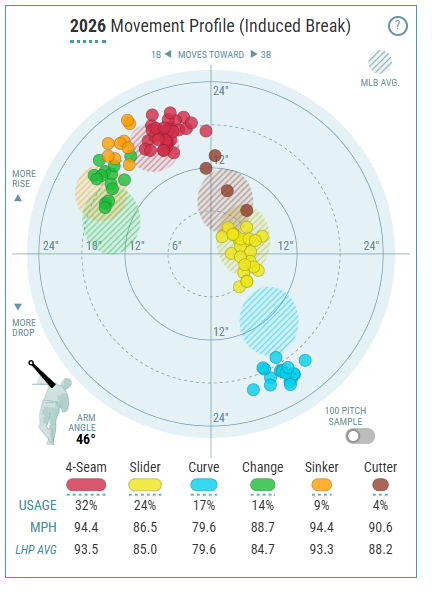
If the slider isn’t Liberatore’s best pitch, then that honor belongs to his curveball. A 79.6 mph offering, Liberatore’s curveball is quite soft and has a very high spin rate at 3054 RPM. He also has exceptional movement, with 17.4 inches of drop. Here’s a look at his pitch movement profile from this season.
And here’s an example of the pitch.
— Elliott Baas (@ElliottBaasBB) August 3, 2026
That one was so pretty, ty. I think a trail of fairy dust followed it to the plate. And Liberatore has carved up opponents with his curveball this season, with batters hitting .170 with a .447 SLG and a .279 wOBA thus far. Even better, Liberatore has a .177 xBA, .350 xSLG, and a .246 xwOBA, as well as a 38% whiff rate, very high for a curveball.
Even when batters make contact,ct they don’t strike the ball well, as Liberatore has a 36.4hard-hitit rate and a 4-degree average launch angle against his curveball. The curveball was considered Liberatore’s best pitch as a prospect, and this is the best we’ve ever seen the pitch perform in the majors. The curveball is mostly a weapon he uses against righties, but it has been an effective one nonetheless.
The slider and curveball are Liberatore’s two most prominent breaking balls, but his most used pitch this season has been the four-seam fastball, which he’s thrown 31.5% of the time. A 94.4 mph offering, Liberatore’s velocity is practically smack dab in the middle of the bell curve. The pitch has been handled quite well by opponents this season, with batters posting a .291 AVG, .463 SLG, and a .366 wOBA off it this season.
The expected stats aren’t any better, with a .298 xBA, .511 xSLG, and a .384 xwOBA. Liberatore also has a pitiful 12.9% whiff rate and a blistering 91.1 mph average exit velocity against his four-seamer this season. It’s not enough that batters are hitting it hard;d, they also have a 28.1% line drive rate and a 40.4% flyball rate, leading to much of the power against this pitch.
It’s not just that Liberatore lacks he;t, he lacks significant spin and movement to help him overcome his average velo. He has a 2110 RPM spin rate with his four-seamer so far, and just 16.6 inches of rise and 6.4 inches of arm-side run. Let’s peek at that pitch movement profile again (four-seamer in red).
See how the pitches are all clustered in the circle that represents MLB average? That’s not a good thing, especially when you lack velocity and spin. Liberatore’s four-seam has consistently been crushed by opponents, and batters are hitting .301 with an .882 OPS and a .228 ISO off the pitch all time.
The silver lining here is that Liberatore seems to be decreasing his reliance on his mediocre cheese. He was throwing the four-seamer 32.73% of the time in his first 16 starts, but over his last six games his usage has dropped to 27.53%. He obviously can’t stop throwing his four-seamer entirely, but decreased usage means decreased exposure to major league-caliber bats, which is a good thing for Liberatore.
Liberatore hasn’t been great this season, but he has put together a nice little run, and there’s reason enough to believe he might be turning a corner. Even if we zoom out and look at the big picture, his 4.19 xFIP and 4.19 SIERA are both the best of his career as a starter, as is his 22.5% strikeout rate and 13.9% K-BB%. He’s been a little unlucky with a .334 BABIP and 14.6% HR/FB ratio against, and I could envision a world where Liberatore is a valuable fantasy asset this season.
Verdict:
A former top prospect, Liberatore has struggled to find his footing in the majors in parts of five seasons. Yet, there’s enough in this profile to intrigue. His slider and curveball have both been dominant, with batters hitting under .200 against each pitch, along with whiff rates north of 36%. Liberatore became a big prospect thanks to his breaking balls, and he might be learning how to wield them on a major league mound.
His season-long statistics aren’t that impressive, but over his last six starts Liberatore has a 3.48 ERA, 3.10 FIP, and 19.2% K-BB%. He’s ramped up his slider usage, while relying less on his middling four-seam fastball. Liberatore has shown us flashes of brilliance in certain moments, but he’s now strung more than a good month together.
Is Liberatore going to win you your league? Probably not, but I think there could be something here. He’s only 26 years old, has the pedigree and the stuff, and pitches for a smart organization that seems to know how to maximize their starters’ talents.
Should you drop all your remaining FAAB on Liberatore? Probably not, but you probably won’t have to. He’s flown under the radar, and I think Liberatore could be a sneak late-season add for savvy fantasy managers. If you’ve got an open roster spot, or an injury, or someone you really want to cut, consider adding Liberatore.
More Fantasy Baseball Advice
Download Our Free News & Alerts Mobile App
Like what you see? Download our updated fantasy baseball app for iPhone and Android with 24x7 player news, injury alerts, sleepers, prospects & more. All free!