



 RADIO
RADIO







Matt's tight end (TE) fantasy football start 'em, sit 'em picks for Week 3 of 2026. His TE lineups advice for Week 3 fantasy football start/sit decisions.
Week 3 is where the early-season fantasy football picture starts to come into focus. We’ve now seen two games of usage, targets, routes, and red-zone opportunities, giving us a much better idea of which tight ends are actually involved in their offenses—and which ones are relying on touchdowns to save their fantasy weeks.
At tight end, matchup matters, but opportunity matters even more. Players like Tucker Kraft and Mark Andrews enter Week 3 with favorable situations and the potential for more involvement. In contrast, others face tough defenses or simply aren’t seeing enough targets to trust in your lineup.
So, who should fantasy managers start, and who should find their way to the bench? From potential breakouts to tight ends whose volume is trending in the wrong direction, here are the Week 3 tight end starts and sits you need to know before setting your fantasy lineup.
Bookmark our updated and revamped fantasy football rankings portal for all league formats!PPR rankings | Half-PPR rankings | Standard rankings | Rookie rankings | Superflex rankings | Dynasty rankings | Who To Start? | Injuries | Matchup Ratings | Strength of Schedule
Week 3 - Potential Fantasy Football Booms
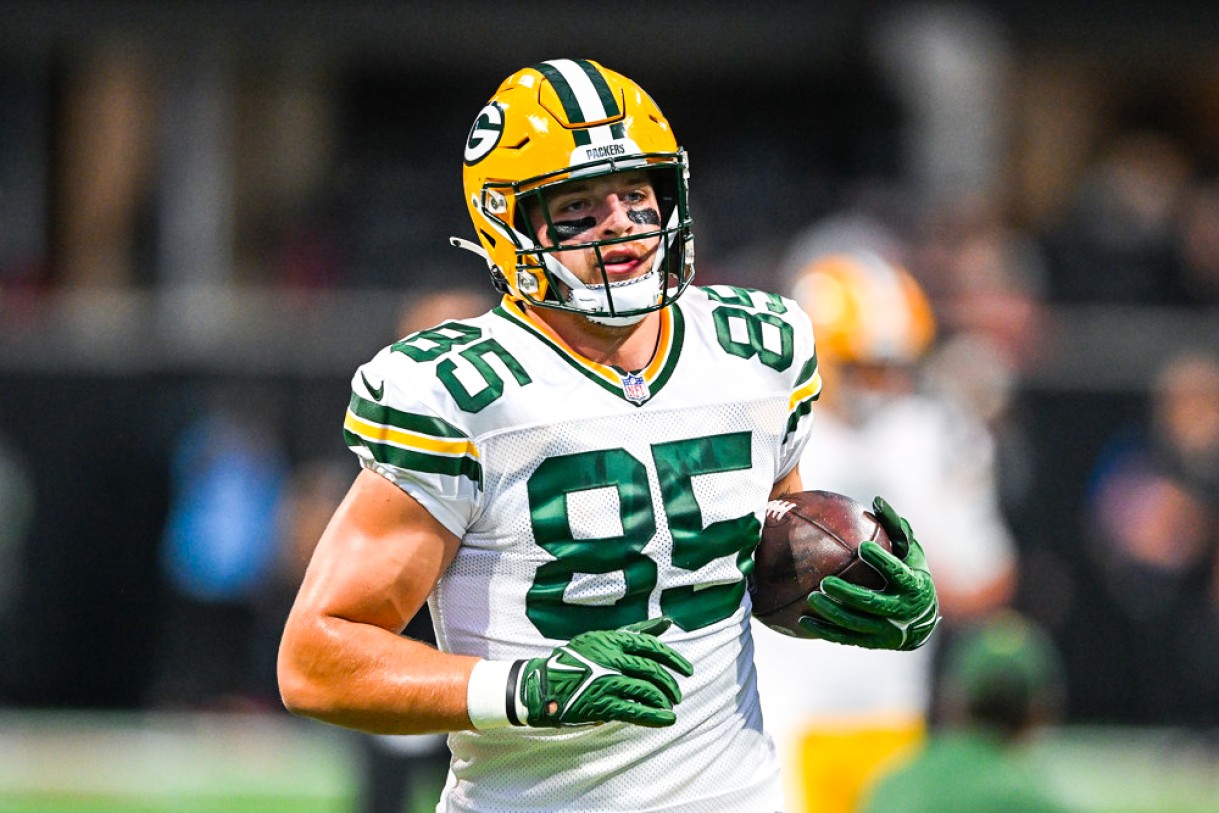
Tucker Kraft - TE, Green Bay Packers vs Atlanta Falcons
With Jayden Reed (neck) likely out for an extended period, Kraft is the Packers' pass-catching option who will likely see his role grow.
Green Bay continues to exercise caution in bringing Kraft back post-ACL repair, but they may be forced to increase that workload this week against the Atlanta Falcons. The good news: Atlanta just allowed a pair of touchdown grabs to Darren Waller, who is still somehow in the league, and has allowed 19.4 fantasy points per game to opposing tight ends this season, the seventh-most.
KRAFT WILL NOT BE DENIED.
A 66-YARD TOUCHDOWN!#GBvsLAR pic.twitter.com/7cK5YPTP2o
— Green Bay Packers (@packers) October 6, 2024
From Week 1 to Week 2, Kraft's snap share and route share each increased by 30 % while he played on 82% of the Packers' run calls. That route share jumped to 94% once Reed left the game; 94% over an entire game would have been a career high for Kraft.
Good matchup, increased workload, that’s the fantasy production formula.
Mark Andrews - TE, Baltimore Ravens at Dallas Cowboys
Speaking of good matchups, could I introduce you to a defense that has allowed a league-high 29.7 fantasy points per game at tight end through two weeks? That’s what we have here in the Dallas Cowboys. A healthy portion of that came courtesy of Isaiah Likely’s eight catches, 78 yards, and two touchdowns in Week 1.
Similar to the Giants, the Ravens are looking at Andrews as the second option in the passing game at worst. Andrews gets bumped up if Zay Flowers misses this contest, but early indicators suggest Flowers should be able to suit up.
Andrews’ role has been encouraging recently. He just recorded six catches on seven targets for 49 yards, and the Ravens have increasingly needed him as a reliable middle-of-the-field and red-zone option.
The Ravens’ receiver situation can concentrate targets. Andrews commanded a 33% target share after Flowers left and rookie Ja'Kobi Lane (wrist) was unavailable. If Flowers or another key receiver misses Week 3, Andrews’ ceiling rises further.
Andrews hasn’t been spectacular, but he's been consistent, posting 8.9 and 10.9 fantasy points over his first two games, which suggests a fairly reasonable floor in this contest. Bottom line: start Mark Andrews because Dallas has been a highly attackable pass defense, and Andrews offers rare touchdown upside at tight end.
AJ Barner- TE, Seattle Seahawks at Washington Commanders
Seattle continues to use multiple tight ends. The Seahawks feature motion, shifts, and frequent 2-TE formations, with AJ Barner and Elijah Arroyo playing major roles. That creates a path to consistent routes and red-zone snaps. Against Arizona, neither Barner nor Arroyo was needed in the passing game, as Jaxon Smith-Njigba led the offense, hauling in nine passes for 155 yards and a trifecta of touchdowns.
Against the Commanders, Drew Lock will once again have his choice of where to go with the ball. Washington is a very favorable matchup for opposing tight ends as they are allowing 23.7 fantasy points per game to the position this season, which is on par with last season when they surrendered the fourth-most to the position.
Barner isn’t without risk, but touchdown upside can matter at tight end. Barner’s projected role is more valuable if Seattle reaches the goal line repeatedly or if Washington focuses coverage on the Seahawks’ wide receivers.
Dalton Schultz - TE, Houston Texans at Indianapolis Colts
The Colts have historically been vulnerable to tight ends. Indianapolis allowed the second-most receiving yards per game to opposing TEs last season and is currently allowing 12.6 fantasy points per game this season after Travis Kelce hauled in nine passes for 101 receiving yards and a touchdown on Sunday Night Football.
C.J. Stroud finds Dalton Schultz for a 35-yard first down gain!
CINvsHOU on CBS/Paramount+
Stream on @NFLPlus pic.twitter.com/6Sqe19LbQ3— NFL (@NFL) September 20, 2026
With Nico Collins nursing a hamstring injury, Schultz tied Kayshon Boutte for second in routes run for the Texans against the Bengals while leading the way in receptions (12), targets (14), and receiving yards (140). After that Week 2 contest, Schultz now has 92 yards after the catch, the fifth-most in the NFL. Schultz saw 28.6% of his targets on early downs and 26.7% on late downs.
Indianapolis has been exploitable. With Houston’s receiving corps thinned, Schultz is the safest short-area target and a viable streamer/low-end TE1.
Week 3 - Potential Fantasy Football Busts
Kyle Pitts Sr. - TE, Atlanta Falcons at Green Bay Packers
At the time this article went to the press, Cooper Rush was still the starting quarterback of the Atlanta Falcons, which means any player not named Bijan Robinson is a sit. Sadly, the Packers are a favorable matchup, having allowed 17.8 fantasy points per game this season, the eighth-most, yet that is not nearly enough for one to bet on Pitts again.
Truth time: right now Matt Donnelly has one fewer reception and 15 fewer yards than Kyle Pitts. One of us has multiple hip replacements, is fat, out of shape, and nowhere near an NFL roster, while the other is allegedly the starting tight end for the Atlanta Falcons.
Pitts’ target floor has collapsed. Pitts went catchless on one target in the opener despite running a route on roughly 81% of Atlanta’s dropbacks, then followed that with one reception and 15 yards on three targets in Week 2. That is especially concerning because the problem was not simply a lack of playing time—it was a lack of involvement.
Consider Pitts as a decoy or low-volume perimeter player. A high route share doesn't necessarily mean a high target share, and Pitts’ Week 1 usage showed that distinction.
Juwan Johnson - TE, New Orleans Saints vs Las Vegas Raiders
Tyler Shough has completed 62 passes this season for 662 receiving yards, yet Juwan Johnson has been targeted just seven times, for 120 yards so far. For a tight end, that is great, but given this offense's overall production, it leaves us wanting more; yes, fantasy managers are a selfish breed.
Las Vegas was once a smash start play for opposing tight ends. Still, last season they rectified that, limiting opposing tight ends to 8.1 fantasy points per game, the fourth-fewest, and followed that up by adding Nakobe Dean and Quay Walker to the lineup, reducing that fantasy production even further this season (3.8 fppg).
Johnson is also trending in the wrong direction here. The target trend declined from seven to four. While the Week 2 production was efficient, four targets is not a particularly strong tight-end floor.
Noah Fant remains a role concern. Fant received eight targets in Week 1, and the Saints have used him more as the in-line tight end while Johnson operates in the slot. If Fant’s route share expands, Johnson’s floor becomes more volatile.
Hunter Henry - TE, New England Patriots at Jacksonville Jaguars
In two games this season, the Jaguars have held Evan Engram and Harold Fannin Jr. to a combined three receptions for 38 receiving yards, and 6.5 fantasy points per game.
Bottom line: New England is an offense still searching for an identity after A.J. Brown landed on the injured reserve. Most expected Henry’s utilization to increase after Brown's injury, and to a degree it has, but not enough to make it obvious. In Week 1, Henry had three catches on three targets for 26 yards, while Week 2 saw targets increase to five, but receptions stayed at three, for 40 receiving yards.
The target floor is too low. Henry has received only eight targets through two games. His Week 2 increase to five targets is encouraging, but it still is not a secure volume profile. Henry has yet to be a major part of New England’s scoring offense. Without a touchdown, Henry has not exceeded seven PPR points in either game. He needs a score to produce a strong fantasy result.
Colston Loveland - TE, Chicago Bears vs Philadelphia Eagles
Last season, no team allowed fewer fantasy points to opposing tight ends than the Philadelphia Eagles (6.2). On the best days, this is a difficult matchup; add low volume and a backup quarterback, and Loveland faces a daunting task. Loveland has only three receiving yards and 1.3 PPR points through two games. He has not caught a touchdown or topped two targets in either contest.
DALLAS TURNER WALKOFF SACK FOR THE VIKINGS pic.twitter.com/8wGRHUIMKW
— NFL (@NFL) September 20, 2026
Given the Eagles are once again among the elite at defending opposing tight ends in fantasy (6.9), you can’t recommend sending Loveland out there. Route participation has not translated into opportunity. This is the key distinction. Loveland ran routes at an excellent rate in Week 1— 84% route share—and he was on the field heavily. But he still received only two targets. A high route share without targets gives him a very fragile fantasy floor.
Against a quality opponent, the Bears may have fewer clean, sustained drives. The Bears have multiple competing pass catchers. Cole Kmet, Luther Burden III, Rome Odunze, and Kalif Raymond can all compete for targets. Loveland’s heavy personnel usage may get him on the field, but it doesn't guarantee he is a primary read in standard passing formations.
With Caleb Williams unlikely to play this week and Loveland not being used much in this Bears offense early on, it’s hard to trust the Bears tight end in your fantasy lineup.
Who Should I Draft Fantasy Football Tool
Read more about the free Who Should I Draft tool here.
Compare up to four players and we'll tell you who to draft...

Using The Tool. This is a simple tool but very powerful. The first step is to enter the player names that you want to compare. In the first box, search for the first player's name. In the second box, search for the second player's name. Compare up to four NFL players at once, and then click the Who To Draft? button to see who the recommended draft picks are based on fantasy football rankings, projections, and more.
Improvements For Who Should I Draft? You may have noticed our Who Should I Draft? tool has gotten an overhaul. We've added lots of great features for you to give you as much information as possible to win your 2026 fantasy football drafts. You'll see NFL player tiles with bye weeks, stats, and projections, ADPs, strength of schedule, enhanced search results with data to compare, and a slick interface. We hope you enjoy!
How It Works. Our RotoBaller staff puts together their preseason fantasy football rankings and projections based on their research and updates them constantly throughout the preseason. That information is the core data that is powering the decision-making in this tool. When you search for player names, you will only see those players who are ranked.
Scoring Formats. Fantasy football managers play in various types of leagues, and this tool allows you to choose whether it's PPR scoring, Half-PPR scoring, or Standard (Non-PPR) scoring. The second thing you want to do is select the scoring format. There are three small radio buttons (small circles), so click on the scoring format you prefer. The results may vary based on the scoring format you select.
Popular Player Comparison Searches - Who To Draft
Below are some popular searches and comparisons from our Who To Draft tool for 2026 drafts for Tucker Kraft, Mark Andrews, AJ Barner, Dalton Schultz, Kyle Pitts Sr., Juwan Johnson, Hunter Henry, and Colston Loveland:
More Fantasy Football Analysis
Download Our Free News & Alerts Mobile App
Like what you see? Download our updated fantasy football app for iPhone and Android with 24x7 player news, injury alerts, rankings, starts/sits & more. All free!