



 RADIO
RADIO






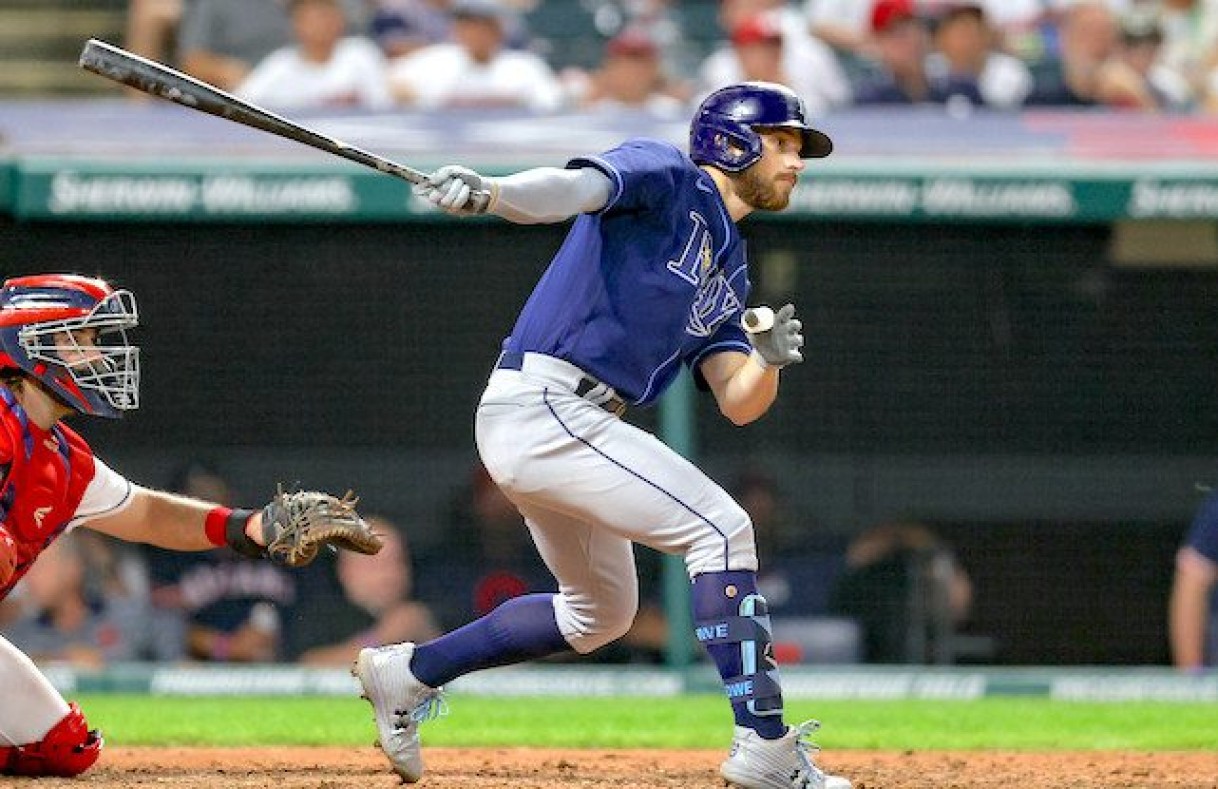
Eric Samulski evaluates the Statcast leaderboard for hitters at the top of the chase rate list. These batters could be undervalued in 2022 fantasy baseball drafts.
As the MLB and MLBPA keep working towards ending the lockout and getting baseball back into our lives, we've been keeping the offseason content going by digging into some 2021 stats. While we all obviously want the lockout to end, this is a useful time to do your research and have a better understanding of the player pool before drafts begin.
So far this offseason, I've covered barrel rate with one article on gainers and another on fallers. Then I moved on to some x-stats, covering xBA here and xSLG here, before discussing exit velocity leaders here and pull rate here. Today, we're going to look at an often overlooked stat when it comes to hitters: chase rate.
All ADP figures in this article are using NFBC ADP for drafts from January 13th to February 3rd.
Featured Promo: Save 50% off the regular price with discount code CHAMP, for a limited time. Exclusive access to our Team Sync platform, DFS cheat sheets, Lineup Optimizers, betting/prop picks, and exclusive content from Nick Mariano and Eric Cross! GAIN ACCESS NOW
Overview
As the name suggests, a hitter's chase rate suggests the rate at which he swings at a pitch outside of the zone. While there are a few metrics that try to show this, my favorite is O-Swing%, which measures the rate at which a hitter swings at a pitch outside of the zone. It's simple but effective. We like hitters who have a solid understanding of the strike zone, attacking pitches they can do damage with, and leaving pitches that will induce soft contact or swings-and-misses. Hitters that have a good understanding of the strike zone often have better pitch recognition and a more locked-in approach at the plate, which leads to more consistent success.
It also shouldn't come as a surprise that pitches that are in the strike zone are often easier to make meaningful contact on. Pitches that are outside of the zone are often harder to hit because they are away from a hitter's power areas of contact. When a hitter chases pitches outside of the strike zone, they are often playing into the pitcher's hand and chasing a pitch that they either can't hit or can't hit well. However, as with all stats, we need to keep the context in mind. Some hitters have really strong plate coverage and can hit pitches off the plate relatively well. For example, Josh Harrison had the 10th-highest O-Swing% of any qualified hitter last year, but he also made contact on pitches outside of the zone at a really high rate (75.4% O-Contact), which means that, even though Harrison swung at a lot of pitches out of the zone, many of them were pitches that he still knew he could hit.
So in this article, I will give you the leaderboard of hitters who decreased their O-Swing% the most in 2021 (good) and also the leaderboard of hitters who increased their O-Swing% the most (bad). I've limited this to hitters with over 200 plate appearances, and I'll dig into a few of the names I think are most noteworthy to provide more context for the numbers and discuss if the hitter is a solid value at his current ADP.
O-Swing% Decreases
Remember that for the purposes of chase rates, a decrease is something we want to see.

Carlos Correa, SS, Free Agent
NFBC ADP: 102
It seems like Correa has been around forever, so it may come as a bit of a surprise that he's only 27-years-old and entering the prime of his career. With six years of Major League Baseball experience heading into last season, it's clear that Correa is evolving as a player and made some obvious changes in his approach last year. The first is, of course, the drastic decrease in O-Swing%. It's important to note that Correa never really had a swing-and-miss problem to begin with. He mostly hovered around a 23% strikeout rate and a swinging strike rate (SwStr%) just under 10%. Those are fine numbers. He also had an O-Contact% (contact on pitches out of the strike zone) around 66%, which is generally just outside the top-50 rates in baseball. So Correa didn't NEED to fix his plate discipline, but it sure helped.
We can see that Correa was far more patient overall last year. In addition to cutting his O-Swing%, he also cut his overall swing rate (Swing%) by nearly 5%, dropped his zone swing rate (Z-Swing%) almost 6% back to the 63% mark he had most of his career and was a little less aggressive on the first pitch. As a result, his Z-Contact% and Contact% were career highs and his SwStr% was a career-low. He also forced pitchers to attack the zone more since he wasn't chasing pitches off of the plate, and the Zone% against him went up nearly 5% from 2020. He also set career bests in both walk rate and strikeout rate and continued an upward trend in his xBA.

There is no better way to identify his improved contact profile than to see that he was in the 74th-percentile in all of baseball in terms of contact rate after never finishing above the 56th-percentile in any other season and spending most of his years under the 40th-percentile. Not only did his patient approach lead to more contact but it led to a better quality of contact. His barrel rate jumped up to 9.4%, which started to creep closer to his 2019 high point. He also nearly doubled his rate of barrels hit over 100 mph and hit the ball in the air at 94 mph, which is just under his 2019 levels.
Yet, despite all of these gains, I still think there is growth for Correa. He showed in 2019, when he hit 21 home runs in just 75 games, that there is another level to his power. He came close to unlocking that in the first half of the season, hitting 16 home runs in 82 games, but in the second half of the season, we saw his launch angle decrease to 10.9-degrees and his pull rate fall to just over 32%, which led to more live drives and fewer home runs. However, his groundball rate continues to come down and his exit velocity on balls in the air continues to improve, so I think there is some upside for Correa to push 30 home runs this year. He may no longer be a stolen base option (and really hasn't since 2016), but if he can hit .275 with 30 HRs and 190 RBI+Runs, that's great value at his current ADP. I know people are hesitant to buy into him without knowing where he is going to play, but I find it hard to anticipate a scenario in which he signs with a team that will hurt his potential upside.
Austin Hays, OF, Baltimore Orioles
NFBC ADP: 227
In the pull rate article, I discussed the impact of the Camden Yards dimension changes on Ryan Mountcastle's outlook, but it's worth just covering the stadium changes again since it pertains to Hays as well. "Baltimore will move the left-field wall at Camden Yards back 30 feet, while also raising the fence from seven feet to twelve feet. As Nathan Ruiz covered, "As of 2020, Camden Yards’ 333-foot distance from home plate to the left-field corner was about average for the 30 major league stadiums, though its 364-foot distance to left-center was one of the league’s most reachable for batters. Oriole Park was one of only eight ballparks with a wall shorter than 8 feet in left and had the shortest wall in left-center field of any venue. A 12-foot left-field wall would be tied for the sixth-tallest in the majors."
I added this tweet for visual illustration as well:
This is not great news for Hays since he hits 75.8% of his balls to left and center field. He also only hits the ball in the air at an average exit velocity of 93 mph, which is in the 45th-percentile in Major League Baseball. That's not good news for a hitter who only had 22 home runs last year, but would have, according to Statcast, hit 13 home runs if he played in Kansas City, 15 home runs if he played in Pittsburgh, and 16 home runs if he played in Texas. I just don't see how projection systems have him hitting 25 home runs next season given the new ballpark.
But, let's dive into his decrease in O-Swing% because that's what this article is about. Dropping 6% on the O-Swing is certainly a good thing and his overall contact rate remains strong, in the 67th-percentile. However, despite chasing outside of the zone less, his overall contact rate actually decreased slightly from 2020 and 2019. What's more, his O-Contact dropped by 12%, and both his SwStr% and called strike rate went up! So, Hays chased fewer pitches outside of the zone, but he actually swung and missed more overall, took more called strikes, and made less contact outside of the zone. None of that is particularly enticing, and honestly, a hitter swinging at fewer pitches outside of the zone but making LESS contact outside of the zone tells me that either he's still chasing awful pitches or his swing is simply not as locked in as it was in 2020 and pitches he usually hits are now ones he was not able to.
When you then see that Hays' SwStr% went up in the second half of the season and that he had surgery in the offseason to fix a core muscle injury he was apparently playing through, you can start to get a clearer sense of the picture. It's possible that Hays' injury simply didn't afford him the plate coverage or hip mobility to make contact on pitches he normally would. This could also explain why he had a 3% drop in barrel rate in the second half and a drop in average exit velocity. However, injuries have also always been a part of Hays' career, unfortunately. At the end of the day, given the new stadium dimensions, Hays' mediocre exit velocity on balls in the air, and his injury history, I just can't get behind the projections for him. I see him more as a 15-20 home run hitter with an average contact profile who will hit around .260 in a bottom-tier lineup. I'd simply much rather draft many of the outfielders going after him, like Charlie Blackmon, Jo Adell, Andrew Vaughn, and even Tommy Pham.
Robbie Grossman, OF, Detroit Tigers
NFBC ADP: 174
Robbie Grossman became a trendy name last year as a waiver wire darling en route to a season where he hit 23 home runs while knocking in 67 runs, scoring 88, and stealing 20 bags. That made him only one of 10 players to put together a 20/20 season, joining certified studs like Trea Turner, Jose Ramirez, Shohei Ohtani, Fernando Tatis Jr, and Cedric Mullins. Now, heading into the 2022 season, there's some helium around Grossman as his ADP is now hovering just outside the top-150. That's what concerns me.
But, let's start with the good news. Grossman went from a patient hitter to an uber patient hitter. He's only had an O-Swing% over 20% once in his career and his overall swing rate was in the sixth-percentile in 2018, fourth-percentile in 2019, and then up to the 30th-percentile in 2020. Last year, he had just a 38.4% swing rate, which was good for the second-percentile in the league. The dude LOVES to keep the bat on his shoulder; however, that also seems to be working for him since he posted a 14.6% walk rate last year and has had double-digit walk rates in every year where he's played over 66% of the season. He also has a minuscule 7.4% SwStr% and makes contact at an 80.6% rate, so when he does swing, he's often able to get his bat on the ball. This solid plate approach seems to make him an ideal lead-off hitter, only this is where we run into issues.
While Grossman has become more patient of late, it seems to be because he's hunting pitches to drive more often. In addition to swinging at fewer pitches, he also raised his launch angle six degrees (to 21.1-degrees) and registered a career-high 46.2% fly-ball rate. He also jumped his Pull% up to 47.7% in 2020 and kept it relatively close in 2021 with a 44.1% rate. So, it's pretty clear from those numbers that Grossman is trying to lift the ball and drive it to the pull side, most likely to unlock the power that saw him hit 23 home runs last year and eight in 51 games in 2020 despite never having hit over 11 in any full season before that.
Clearly, the approach worked for Grossman in 2021, but I just don't think it's optimal for him going forward. He only had a 7.6% barrel rate and 87.8 mph average exit velocity last year, both below average. He also only hit the ball an average of 90.7 mph in the air, which was good for the 14th-percentile in all of baseball. So, we have a hitter with strong plate discipline who is opting to lift the ball and drive it to the pull side despite his below-average power and barrel rate. I just can't see that as an approach that maximizes his effectiveness. It's also why his batting average and xBA have dropped in essentially every year since 2018 and both his xBA and xSLG from last year suggest that he overperformed his batted ball quality.
Grossman will be 32-years-old this season, and I think we're going to see some regression in his home run totals. Statcast had his xHR from 2021 at 20 and I think we can realistically see him finish with something closer to 15-17. To top that off, Grossman had never had double-digit steals in a season before and ranked 168th in baseball last year in time from home to first, actually tied with Kris Bryant and Didi Gregorious. If you're more of a fan of Sprint Speed, he ranked 204th (tied with Mark Canha and Alec Bohm), and his 90-foot split times ranked 193rd (tied with Ian Happ and Xander Bogaerts). What that means is that I think you just got Grossman's career year. He's likely a 15/15 player who will hit .240. I simply can't justify taking that kind of production almost 50 picks before Ramon Laureano (who I think can get to 15/15 even with his suspension), 90 picks before Tommy Pham, or 150 picks before Rafael Ortega.
Enrique Hernandez, 2B/OF, Boston Red Sox
NFBC ADP: 214
For years, many in the baseball community looked at Hernandez and thought, "If only he had a full-time job." Well, he finally got one in 2021 and responded with a .250/.337/.449 season with 20 home runs, 84 runs scored, and 60 RBI. He had over 100 more at-bats than any other year in his career, and we need not gloss over how important that is, especially when it comes to plate discipline metrics. Hitting is so much about rhythm and timing that the more reps a hitter gets, the more likely he is to iron out any wrinkles and make the necessary adjustments to fix his swing. Hitting is also reliant on focus and a clear mental approach, so showing up every day and knowing you are going to be in the lineup is a very real benefit. As somebody who experienced a season of pinch-hit appearances and spot starts, the pressure you put on yourself in those moments is evident and often harmful to overall performance.
So, it's not a shock to see that Hernandez's plate discipline improved with more playing time. He registered the second-lowest strikeout rate of his career and the second-lowest SwStr% of his career. In addition to chasing fewer pitches out of the zone, he also was more patient overall, cutting his Swing% by 5%; yet, he still posted a strong 87.8% zone contact rate and 77.7% contact rate overall, which was good for 68th-percentile in the majors. As a result, I think the on-base and batting average gains were real and most projections agree, penciling him in for a batting average over .250 and an on-base percentage over .330.
Yet, what really intrigues me about Kiké this season is the potential power gains. Last season, he had a career-high 46.2% fly-ball rate (up 7% from 2020) while also registering a career-low 32.6% groundball rate. In addition, he also had a career-high 47.2% pull rate, which, when combined with the fly ball rates, makes it seem pretty clear that he was tailoring his swing for the Green Monster in Fenway Park. Yet, despite all of that, he actually had the lowest HR/FB ratio of his entire career.
Considering his average exit velocity on balls in the air was also a career-high 93.7 mph (59th percentile), his new pull-heavy approach should have led to more home runs. In fact, Statcast had his xHR total at 29.2. That's a pretty large difference; however, it's one I'm buying into. In the second half of the season, Hernandez upped his barrel rate to 9.9%, was 70th-percentile on balls in the air hit over 100 mph, and was 74th-percentile in average exit velocity on balls in the air. He also hit the ball in the air (fly ball or line drive) 61.3% of the time, up 4% from the first half of the season. I think more home runs are coming, which means I could easily see Kiké being a 25 home run bat hitting atop a solid Red Sox lineup which, given his multi-position eligibility, makes him a favorite target of mine.
Jose Altuve, 2B, Houston Astros
NFBC ADP: 71
I covered him in my pull rate article, so check that out for a more detailed breakdown.
O-Swing% Increases
Remember here that, on the surface, an increase is bad as it means a player is swinging and missing outside of the zone far more than in 2020.

I covered some of these guys already, like Joey Votto in this article, Jesse Winker in this one, and Jorge Polanco in this one.
Sean Murphy, C, Oakland Athletics
NFBC ADP: 235
The number here for Sean Murphy immediately raises concerns. Forgetting Jason Heyward, who not many people are drafting, Murphy's O-Swing% rose more than any other regular player in baseball last season. That's a problem. Even though his O-Swing% in 2021 is pretty similar and actually better than what he registered in his 20 game debut in 2019, it's still a regression from both his 43 game sample in 2020 and his minor league career. Although we don't have O-Swing% for minor league numbers, Murphy's SwStr% in his minor league career was pretty consistently below 8%. However, his MLB average is now 11.5% and his strikeout rates have continuously hovered around 25%. All of which is to say that the .308 average he put up in Triple-A in 2019 before his promotion is likely a mirage.
However, there might be some cause for optimism that the .245 average he posted in his 2019 debut is a potential outcome for him. While I know that doesn't immediately excite you, remember that this is a catcher going off the board in the 19th round in 12 team leagues. Murphy was only 26 years old last season and had only appeared in 63 MLB games coming into the season, so we have to expect that he's still making adjustments. I think we began to see those in the second half of the season. He cut his SwStr% by 3% down to 10.5% and raised his walk rate to 9.8%. He also registered an xBA of .253 and an xSLG of .423 despite his actual second-half numbers being a .207 average and .366 slugging percentage. Now, we know x-stats aren't predictive, but Murphy also had a .253 BABIP in the second half despite producing a .273 mark in 2019 and .278 mark in 2020, which would suggest some unluckiness with his average.
While the improving plate discipline is nice to see and his xwOBA on contact remains in the 73rd-percentile and his hard-hit rate (42.2%) and 112.8 mpg max exit velocity are all strong for a catcher, my big concern that is his barrel rate dipped to 9.6% in the second half and his average exit velocity on balls hit in the air all season was 93.5 mph, which is down from 96.6 mph in 2019 and 97.1 mph in 2020. Given his home park, he can't be hitting balls in the air that aren't stung. I'd love to see him get back to the line drive focused approach he had when he first came up since I think that, when coupled with improving plate discipline, could lead to a .240 average. That, plus his strong defense, would make me feel better about drafting him in fantasy, but right now I have him ranked as my 16th catcher, behind Elias Diaz and Gary Sanchez and just ahead of Max Stassi. This means I'm not getting Murphy anywhere and likely won't until we can see some evidence of approach changes or signs that his lack of exit velocity in the air was a one-year fluke.
Brandon Lowe, 2B, Tampa Bay Rays
NFBC ADP: 72
Brandon Lowe has many fans in the fantasy community, and it's not hard to see why after hitting .247/.340/.523 in 2021 with 39 home runs, 97 runs, 99 RBIs, and seven SBs. As a result, he's being drafted just after Jose Altuve in front of a talented string of 2B options like Jazz Chisholm, Jorge Polanco, Ketel Marte, and Tommy Edman. However, I had some concerns when I started doing my draft prep.
Lowe's 33.8% O-Swing is a huge step back from his 2020 numbers but is in line with the 34.1% rate he put up in 82 games in 2019. His 16% SwStr% was eighth-worst in all of baseball among qualified hitters and his Pull%, FB%, and GB% didn't look much different from his 2019 and 2020 numbers despite the spike in home runs. He also still hit only .198 against lefties in 2021 with a 34% strikeout rate and only a .401 SLG. It all seemed like a volatile profile that, considering the presence of Vidal Brujan and Taylor Walls, could end in Lowe going back to sitting against left-handed pitching.
However, as I dug in, I saw some interesting changes in his first and second half splits that had me reconsidering. For starters, his overall contact rate skyrocketed from 62.5% in the first half to 76.1% in the second half, which was just 51st-percentile in the league but a huge 13.6% growth for Lowe in one season. He also cut his SwStr% by almost two percent, down to 15.1%, and started being a little more aggressive, raising his overall swing rate up three percent to 54%, which was in the 89th-percentile in the league. So, he made more contact by being slightly more aggressive and swinging and missing less, which would seem to indicate that he was being more aggressive on pitches he could hit, earlier in the count. As a result, his strikeout rate in the second half plummeted to 21.1% after putting up a 32.2% rate in the first half.

What's more, the changes in approach also led to a .291 batting average in the second half which was supported, for the most part, by a .270 xBA. Yet, he did this despite his barrel rate falling to 11.6% in the second half from 16.6% in the first half and his average exit velocity on balls in the air falling 3.5% down to 92.2 mph, which is just 36th-percentile in all of baseball. To me, a big reason for the increase in batting average despite a drop in quality of contact is the massive gain in line drive rate. Lowe hit the ball in the air almost six percent more in the second half of the season and much of that is due to him raising his line drive rate from 17.4% to 25.8%. Making more contact and hitting fewer groundballs is a major component of driving his batting average up and shows clear progress in plate discipline and approach for the 27-year-old.
Yet, before I run out and draft Lowe everywhere, I can't overlook his huge drop in exit velocity on balls in the air. Pair that with his drop in barrel rate and his drop in rate of balls hit over 100 mph and it's pretty clear that the quality of contact regressed a bit in the second half of the season. You can also see that in the rolling breakdown.

Personally, it makes me believe Lowe settles a little bit closer to a 30 HR bat rather than one who pushes for 40 HR. However, I also think that he can be a .250-.260 hitter who also chips in seven or more stolen bases. That's valuable but perhaps doesn't make him too different from Jorge Polanco, who I believe is due for more power gains and is currently projected by ATC to hit 26 HR with a .268 average and nine stolen bases. Given Lowe's continued issues with left-handed pitching, I find myself feeling more comfortable drafting Altuve, Marte, and Polanco as my starting 2B, but I am no longer planning to fade Lowe at his cost and having all of those 2Bs ranked in the mid-70s.
Just as a gift, I'll end with the SwStr% leaders and fallers just so you have another point of reference for chase rates.
SwStr% Increases (Bad)

SwStr% Decreases (Good)

Download Our Free News & Alerts Mobile App
Like what you see? Download our updated fantasy baseball app for iPhone and Android with 24x7 player news, injury alerts, sleepers, prospects & more. All free!

More Fantasy Baseball Advice