



 RADIO
RADIO









Corbin's top rebound candidates - fantasy football draft values, sleepers with upside that should deliver better performances in 2026 based on improved usage.
The process for identifying rebound candidates involves examining players who underperformed or were inefficient. It could be for various reasons, like an injury, the offensive environment, or small samples. These potential rebound candidates fit those molds.
When other players rise, some may fall, including ones on their own teams. It can be tricky to figure out whether it's recency bias or an outlier season. Like usual, we'll provide data-focused reasons for why they could rebound in 2026.
These players fall into the bucket of ones that could provide medium hits with low risks, including the potential for several spike weeks. Should we target or fade these players? Let's dive into why these players can rebound in 2026.
Bookmark our updated and revamped fantasy football rankings portal for all league formats!PPR rankings | Half-PPR rankings | Standard rankings | Rookie rankings | Superflex rankings | Dynasty rankings | Who To Start? | Injuries | Matchup Ratings | Strength of Schedule
Mike Evans, WR, San Francisco 49ers
FFPC ADP: 60.9, WR26
Evans missed a few games with a hamstring injury, then suffered a concussion and a broken collarbone, which sidelined him for most of the season. He had seven straight seasons with a positive fantasy points over expected per game (FPOE/G), meaning he was consistently efficient throughout his career.
For context, it was the first season of Evans's career in which he played fewer than 13 games. That said, Evans lands in the bounce-back group based on the injury issues and new team context. Evans ranked third in Average Separation Score (0.147) last season, behind Tyreek Hill (0.189) and Davante Adams (0.187).
The visual below shows the top 20 receivers sorted by Average Separation Score.
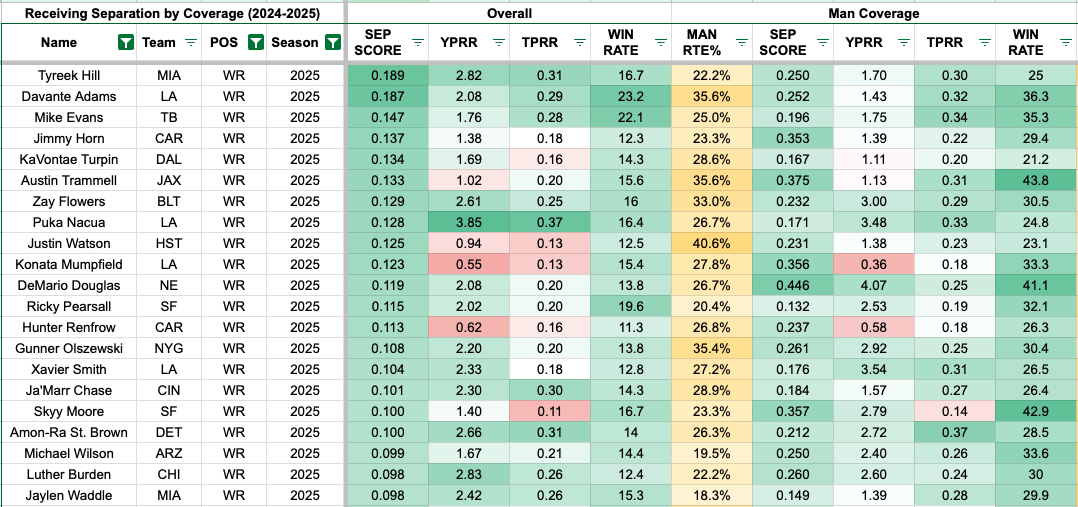
Evans continued to show that he can separate against man and zone coverage, hinting that he still has juice left to produce for fantasy purposes as he heads into his 13th season. He ranked 5th in his route win rate against man coverage and first versus zone coverage.
However, Evans produced 1.75 yards per route against man (No. 54) and 1.85 yards per route run against zone coverage (No. 48), which dropped from over 2.50 yards per route run against both coverages.
Summary
There's a chance Evans's efficiency bounces back this season with the 49ers, who ranked sixth in EPA per pass compared to the Buccaneers (No. 21). Evans will slide into the WR1 role for the 49ers, with other veteran additions in Deebo Samuel Sr. and Christian Kirk, with Ricky Pearsall on the shelf.
Evans has been dealing with a quad injury in training camp, so that's something to monitor, though they labeled it as minor. The age and injury issues from last season might make some skeptical, though it's easy to dream on Evans bouncing back for another 1,000 receiving yards and 10+ touchdowns this season, especially since he has been priced as a WR2 with WR1 upside.
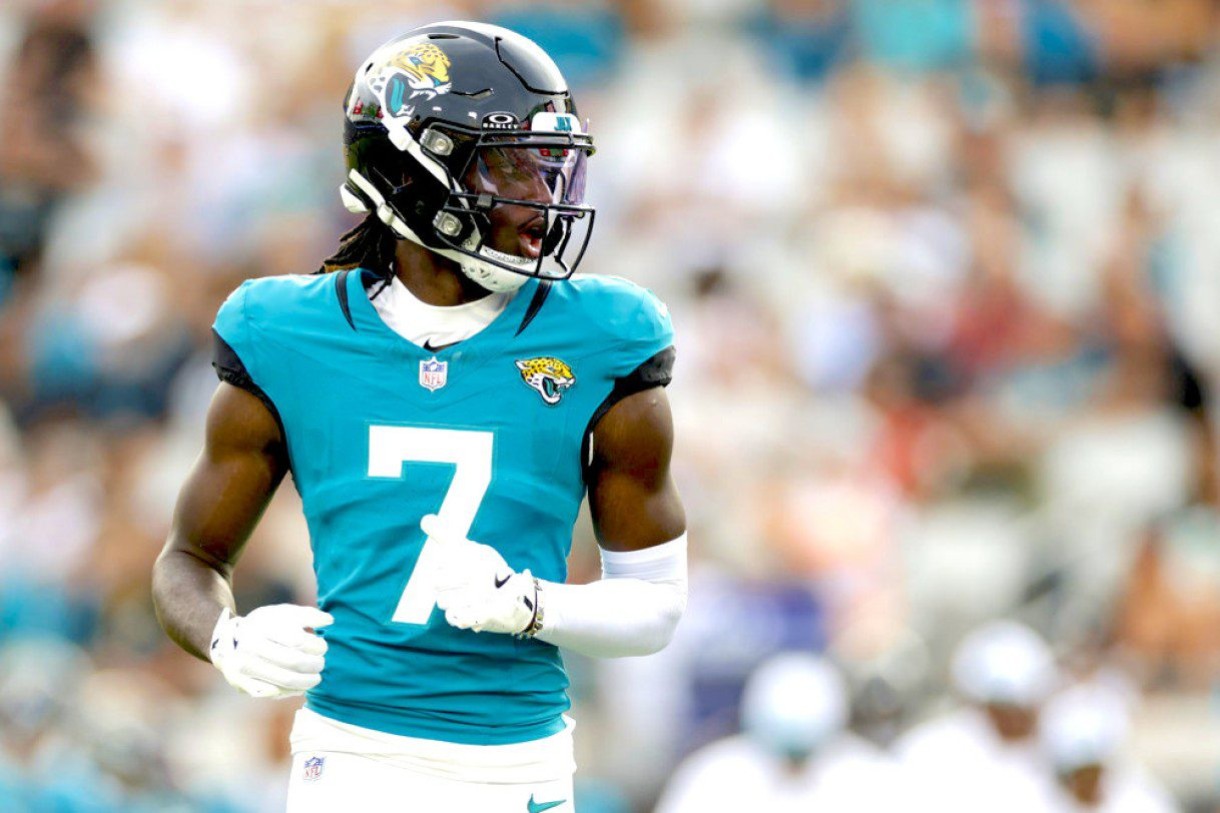
Brian Thomas Jr., WR, Jacksonville Jaguars
FFPC ADP: 81.2, WR33
After a breakout rookie season, Thomas's production fell from WR12 in 2024 to WR47 in PPR/G. The Parker Washington drumbeat might be drowning out the bounce-back conversation around Thomas. However, even though Thomas's receiving advanced stats dipped, his usage was relatively similar over the past two seasons.
The visual below shows the Jaguars' pass-catchers who posted a route rate of 50% or higher over the past two seasons.

Thomas averaged 14.3 expected fantasy points in Year 1, dropping to 12 in Year 2. His target rate dropped to 20%, with a 22.6% first-read target share, 1.62 yards per route run, and 7.6% of his routes going for first downs. In June, Thomas said it doesn't hurt to run anymore, which is notable coming from an elite athlete.
That's evident in Thomas's 98th-percentile Speed Score, 98th-percentile Freak Score, and an 80th-percentile Explosion Score. Some of Thomas's top athletic comparables include Denzel Mims, DeVante Parker, D.J. Chark, and Martavis Bryant. The difference is that Thomas has produced as a WR1 as a rookie.
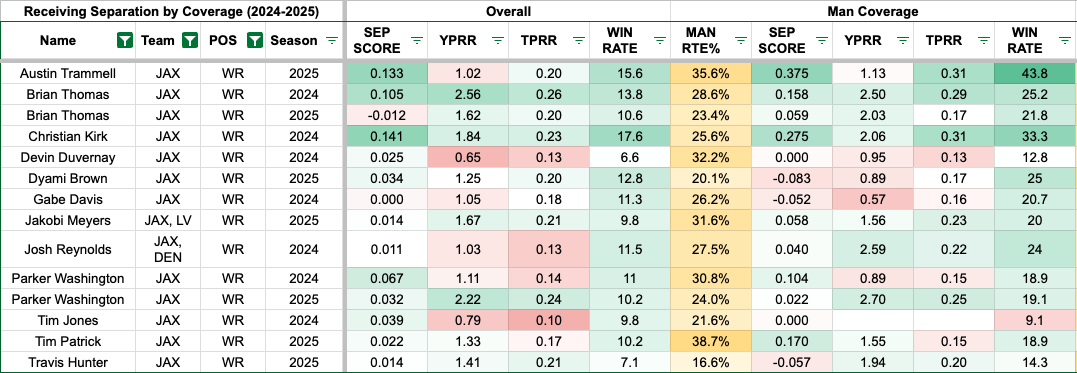
We're highlighting Thomas's health because he went from an above-average separation score (0.105) in 2024 to a below-average score (-0.12). However, Thomas showed he can still separate and produce 2.03 yards per route run against man coverage.
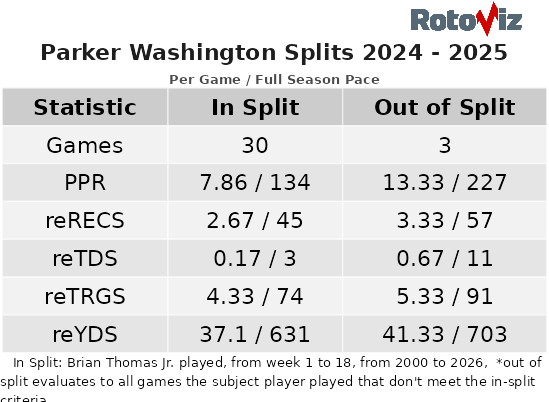
Over the past two seasons when Washington and Thomas played together, Washington averaged 13.3 PPR/G with one more target, four more receiving yards, and nearly four times as many touchdowns per game. That indicates touchdowns were a heavy part of Washington's production when Thomas wasn't in the game.
Meanwhile, Thomas has averaged more fantasy points (13.7 PPR/G) with Washington healthy across 30 games played in 2024 and 2025. Using the arbitrary Weeks 12-18 threshold, Washington ranked 11th in PPR/G last season. However, let's examine Thomas's usage in Weeks 1-11 compared to Weeks 12 -18.
Weeks 1-11:
- Washington: 22% TPRR, 1.58 YPRR, 16.8% first-read target share, 10 xFP/G
- Thomas: 23% TPRR, 1.60 YPRR, 23.9% first-read target share, 13.6 xFP/G
Weeks 12-18:
- Washington: 26% TPRR, 3.11 YPRR, 25.4% first-read target share, 13.2 xFP/G
- Thomas: 17% TPRR, 1.65 YPRR, 20.6% first-read target share, 9.8 xFP/G
Unsurprisingly, Thomas's usage dipped since Week 12, making him a bounce-back candidate if he can earn more opportunities this season. Thankfully, the Jaguars deployed 11-Personnel at the eighth-highest rate. Meanwhile, the Jaguars passed at the 20th-highest percentage and ranked 10th in EPA when using 11-Personnel.
Summary
The continued usage of 11-Personnel should bode well for Thomas and Washington if the Jaguars continue to use three-receiver sets. Based on Thomas's usage, his historical comparisons through his first two seasons include Alshon Jeffery, Dez Bryant, Brandon Aiyuk, Chris Olave, CeeDee Lamb, Jeremy Maclin, DeVonta Smith, and DK Metcalf since 2010.
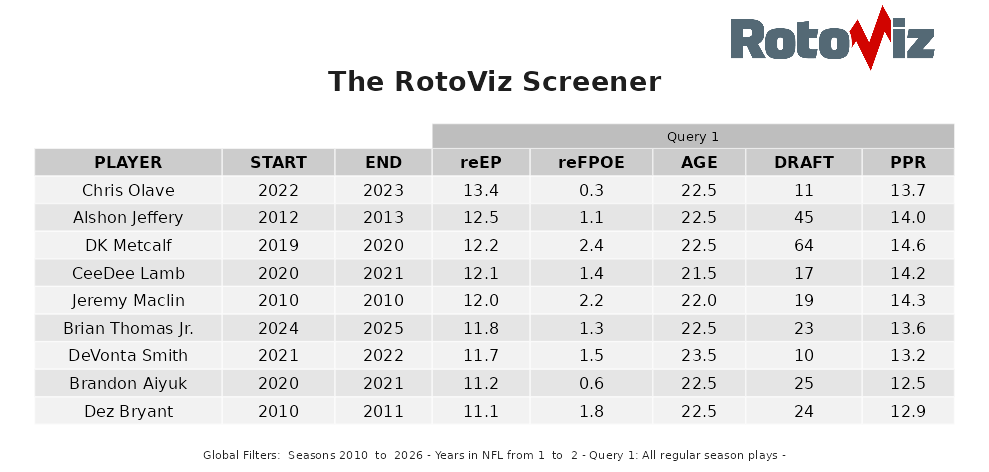
The peak outcomes were Bryant, who scored over 303 fantasy points (WR3), and Lamb, who scored 301.6 PPR (WR6) in Year 3. Meanwhile, Aiyuk was WR14, Olave dealt with injuries, Smith was WR19, Jeffery was WR10, and Maclin was WR31 in Year 3. Take the discounted price on Thomas as a high-upside bounce-back candidate.
Kyler Murray, QB, Minnesota Vikings
FFPC ADP: 109.2, QB17
As I was drafting this article, Murray was announced as the Vikings' starting quarterback. Murray dealt with a foot injury, causing him to miss most of the season. Since 2023, Murray ranked 15th in PPR/G among quarterbacks. Furthermore, Murray ranked ninth in rushing expected points per game (ruEP/G), with a minimum of 10 games.
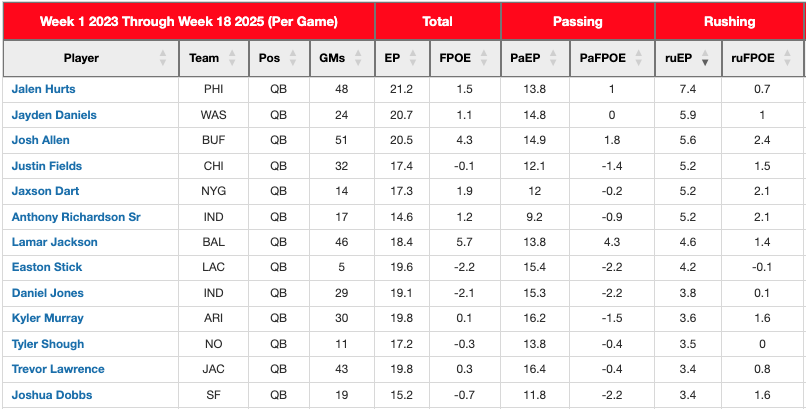
That indicates Murray has the high-end rushing upside we yearn for at quarterback. Murray joins the Vikings, who ranked 28th in EPA per play after being inside the top-15 in the previous two seasons (2023-2024). The Vikings ranked ninth in plays under center, compared to the Cardinals at 21st.
Murray ranked 45th in adjusted yards per attempt, 23rd in completion rate over expected (CPOE), and the 10th-best off-target percentage last season while playing under center. Though fantasy managers target Murray for his rushing upside, there's a chance his passing efficiency bounces back with the Vikings.
The Vikings ran the ninth-most plays last season and the second-most under center in 2024. For context, the Cardinals were 21st (2025) and 18th (2024) in plays under center with Drew Petzing as their offensive coordinator. Murray ranked 35th in adjusted yards per attempt and eighth in CPOE when under center last season, though it was a tiny sample of 16 dropbacks.
In 2024, Murray ranked 10th in adjusted yards per attempt and 26th in CPOE while logging the second-most scrambles for 107 rushing yards and one score under center. He has been decent under center from a passing standpoint, which could raise his ceiling outcomes if he masters the Kevin O'Connell offense.
Summary
Murray has been priced as mid-QB2 before the starting announcement. However, Murray's ADP will likely rise to the high-end QB2 to back-end of the QB1 range in FFPC leagues. Before 2025, Murray ranked as a QB1 in four of the previous five seasons in fantasy points per game. Murray's 2024 season, as QB13, was the lone outlier, though he totaled QB10 in total fantasy points.
Assuming health, Murray moves to a better offense with a high probability to produce as a high-end QB1 this season, making him a prime bounce-back candidate at the position.
Xavier Worthy, WR, Kansas City Chiefs
FFPC ADP: 132.1, WR48
Worthy is dealing with a shoulder injury during training camp, so this might be a high-risk, high-reward receiver. Maybe Worthy is pushing the boundaries as a bounce-back candidate because he has been WR45 and WR62 in his first two seasons.
Before Rashee Rice returned in Week 7, Worthy was third on the team in target share (16%) and second in air yards share (28%). Worthy trailed Hollywood Brown (21%) and Travis Kelce (18%) in target share, with Tyquan Thornton leading them in air yards (35%).
Once Rice returned, he commanded 29% of the team's targets with Worthy at 16%. However, Worthy led the team in air yards share (25%) from Weeks 7-18. The pros in Worthy's profile involve his air yards and decent first-read target share (18%) with a 10.7 xFP/G, nearly three points higher than his actual fantasy points (7.9).
The visual below shows the Chiefs' pass catchers from last season.

That indicates Worthy's season-long usage was better than his output, making him a bounce-back candidate. Though Worthy has the straight-line speed, we love that the Chiefs deployed Worthy on more horizontally breaking routes (35.1%) last season.
That's over five points higher than his horizontally breaking route percentage (29.5%) as a rookie. Worthy's Average Separation Score on horizontally breaking routes dipped, yet he was more efficient with 2.29 yards per route run than in Year 1. The data suggests Worthy might be better used on horizontally breaking routes to use his speed across the field.
Summary
We can project more horizontally breaking routes and better usage for Worthy, considering that Rice is being eased into training camp while recovering from a reportedly minor knee surgery in May. Kelce is heading into Year 13 as an ironman who has played in 15 or more games each year.
Beyond Rice and Kelce, Cyrus Allen is garnering some buzz, though the Chiefs lack pass-catching depth. They have their downfield threat in Thornton and the unproven Year 2 deep sleeper Jalen Royals. If Rice misses time or Kelce's production diminishes, Worthy could be a boom-or-bust WR3 priced as a WR4 or WR5.
After Worthy nearly broke out in Year 1, scoring 187.2 fantasy points, there's a good chance he bounces back to surpass the 200 fantasy point mark, which is the breakout threshold from a fantasy perspective.
Jerry Jeudy, WR, Cleveland Browns
FFPC ADP: 184.7, WR67
Betting on an offense projected for the 30th-highest implied team points per game ahead of the Jets and Cardinals probably isn't ideal. However, their offensive additions should help. Rookie WRs KC Concepcion and Denzel Boston have been drafted before Jeudy, making them the more favorable options with untapped upside.
Jeudy ranked 40th in xFP/G yet had averaged the third-worst FPOE/G (-2.9). That indicates he had the 40th-best receiver usage, yet he was brutally inefficient last season. Jeudy continued to show above-average separation scores, with similar route win rates overall and against man coverage (23.6%).
Unfortunately, Jeudy's 1.09 yards per route run fell from an above-average 1.84 in 2024. He boasted a 25.3% first-read target share, hinting he should be a priority in the passing offense unless Concepcion and Boston take off early.
The visual below shows the pass catchers sorted by the worst catchable target rate over the past two seasons.
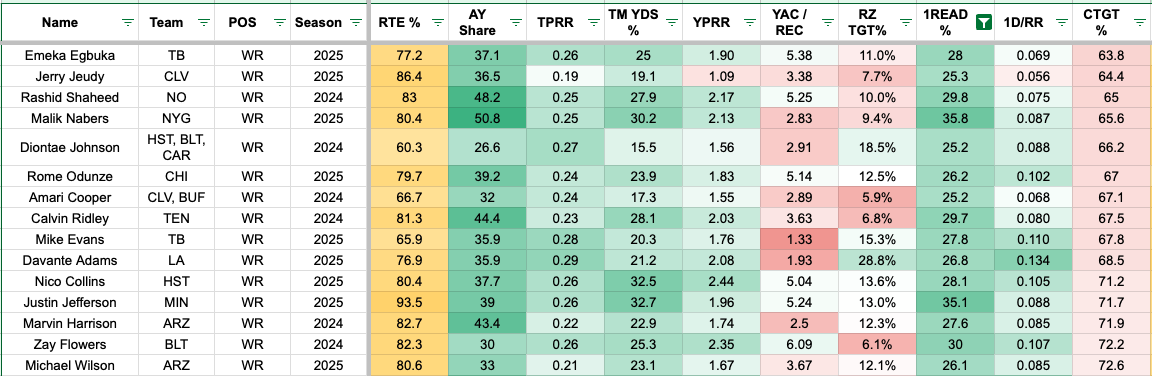
Among pass catchers with a 25% first-read target share, Jeudy ranked second-worst in catchable target rate ahead of Emeka Egbuka. For context, Jeudy had a 26% first-read target share in 2024 with a 77.5% catchable target rate. Jeudy played with Jameis Winston and Deshaun Watson in 2024 before garnering targets from Dillon Gabriel, Shedeur Sanders, and Joe Flacco last season.
During neutral game scripts, the Browns ranked 22nd in pass rate, though they threw at the fifth-highest rate (60%) overall last season. There's a chance the defense takes a step back without Myles Garrett, though Jared Verse and Quincy Williams are valuable additions.
The Browns' defense allowed the fourth-fewest yards per play and sixth-fewest first downs, with the third-most sacks. If their defense regresses, that means more plays and passing attempts per game while trailing. For context, the Browns had the seventh-most plays when trailing by seven or more points, which could rise, boosting the pass volume this season.
Summary
The Browns hired Todd Monken as their new head coach with Travis Switzer as offensive coordinator. Monken was the offensive coordinator with the Ravens for the previous three seasons. Switzer served as the Ravens' run game coordinator from 2024 to 2025.
Monken used 12-Personnel at the third-highest rate with the Browns ranked first. They both passed out of 12-Personnel at the seventh-highest (Browns) and eighth-highest rate (Ravens) last season. If Monken continues to deploy 12-Personnel, the top two receivers will benefit, assuming it's Jeudy and Boston on the outside.
The main difference might be whether they have confidence in a second tight end on their roster with David Njoku gone. Jeudy probably won't matter in shallower leagues, but he can be a deep-league target to regress via efficiency and potential volume this season.
Who Should I Draft Fantasy Football Tool
Read more about the free Who Should I Draft tool here.
Compare up to four players and we'll tell you who to draft...

Using The Tool. This is a simple tool but very powerful. The first step is to enter the player names that you want to compare. In the first box, search for the first player's name. In the second box, search for the second player's name. Compare up to four NFL players at once, and then click the Who To Draft? button to see who the recommended draft picks are based on fantasy football rankings, projections, and more.
Improvements For Who Should I Draft? You may have noticed our Who Should I Draft? tool has gotten an overhaul. We've added lots of great features for you to give you as much information as possible to win your 2026 fantasy football drafts. You'll see NFL player tiles with bye weeks, stats, and projections, ADPs, strength of schedule, enhanced search results with data to compare, and a slick interface. We hope you enjoy!
How It Works. Our RotoBaller staff puts together their preseason fantasy football rankings and projections based on their research and updates them constantly throughout the preseason. That information is the core data that is powering the decision-making in this tool. When you search for player names, you will only see those players who are ranked.
Scoring Formats. Fantasy football managers play in various types of leagues, and this tool allows you to choose whether it's PPR scoring, Half-PPR scoring, or Standard (Non-PPR) scoring. The second thing you want to do is select the scoring format. There are three small radio buttons (small circles), so click on the scoring format you prefer. The results may vary based on the scoring format you select.
Popular Player Comparison Searches - Who To Draft
Below are some popular searches and comparisons from our Who To Draft tool for 2026 drafts for Mike Evans, Brian Thomas Jr., Xavier Worthy, Jerry Jeudy:
More Fantasy Football Analysis
Download Our Free News & Alerts Mobile App
Like what you see? Download our updated fantasy football app for iPhone and Android with 24x7 player news, injury alerts, rankings, starts/sits & more. All free!