




 RADIO
RADIO







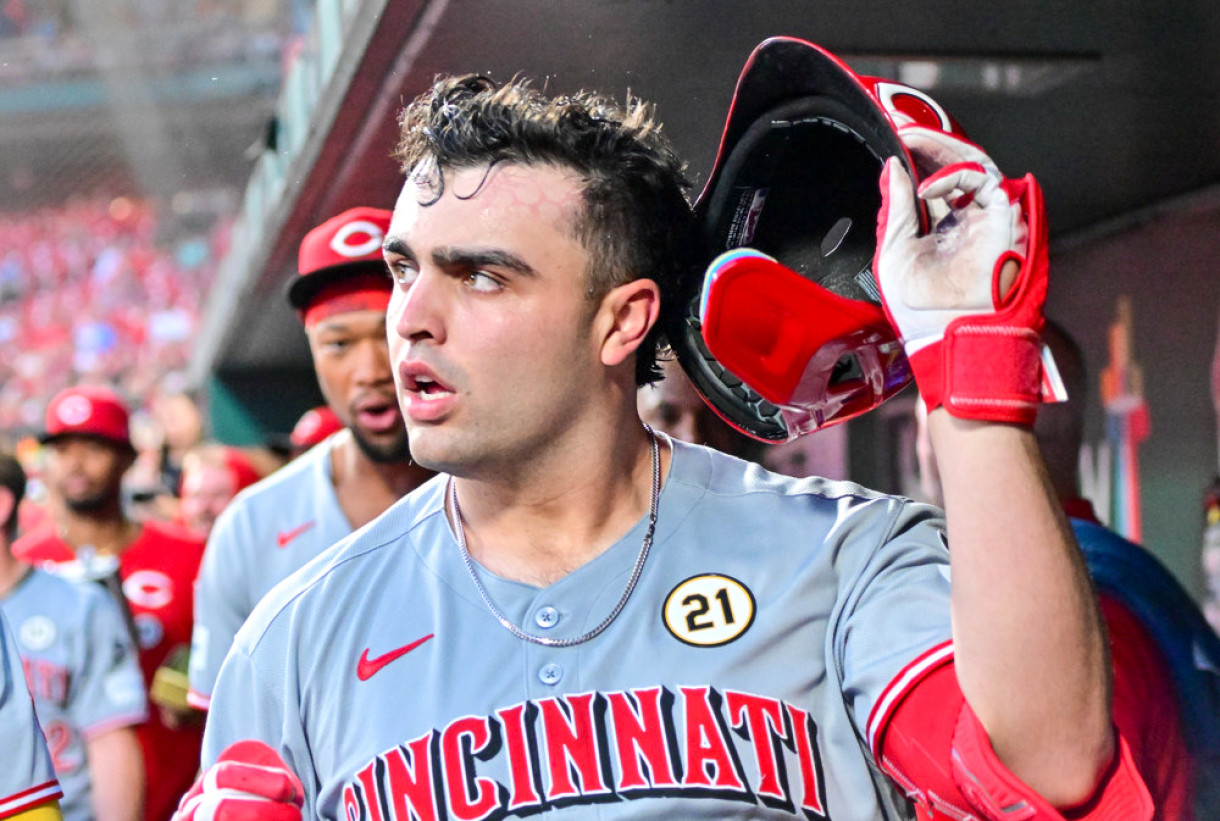
Jeremy gives you his surprise fantasy baseball breakouts. His biggest surprises at every position in fantasy baseball for the 2026 season, including Jordan Walker, Miguel Vargas, Parker Messick, more.
With the 2026 fantasy baseball season officially wrapped up, it’s time to look back at the most surprising breakouts of the year. Even though you can’t go back in time and draft these players, it’s still worth reflecting on this past season’s results to learn as much as you can before 2027 drafts roll around.
This isn’t just a list of the best-performing players at each position, as a lot of players came into the year already expected to break out in a big way. What’s more helpful is to look at the most surprising ones, who many didn’t see coming, in hopes that we can recognize potential 2027 risers before they happen.
Players also don’t always keep up their new rate of production after breaking out. That’s especially true for the completely out-of-nowhere ones, so we’ll also dive into a brief 2027 outlook for these guys to see how sustainable their play really is.
Featured Promo: Save 50% off the regular price with discount code CHAMP, for a limited time. Exclusive access to our Team Sync platform, DFS cheat sheets, Lineup Optimizers, betting/prop picks, and exclusive content from Nick Mariano and Eric Cross! GAIN ACCESS NOW
Catcher: Liam Hicks
The catcher position has gone from one of the shallowest positions in fantasy to a respectable one over the past few years, particularly in one-catcher leagues. Several backstops had offensive breakouts in 2026, but Liam Hicks was by far the most surprising. He entered the season with a murky playing time situation, as Agustin Ramirez was the catcher to know for fantasy from the Marlins.
However, Ramirez struggled and was eventually sent back to the minors, while Hicks slashed a ridiculous .315/.365/.576 with seven home runs in March and April. That pace was unsustainable, of course, but the 27-year-old ultimately finished as the ninth-best catcher in standard Roto leagues, batting .284 with 18 home runs, 82 RBI, 66 runs, and three stolen bases.
His strong suit is making contact, as he posted an 11.4% whiff rate (98th percentile) and a 9.9% strikeout rate (97th percentile). While his quality of contact metrics are poor, he makes up for it with a great 20.4% pull-air rate, allowing him to still get the ball out of the yard.
Hicks was dealt to the Rays at the trade deadline, and for the most part, his skill set remained nearly identical. You would assume that would mean his fantasy value would only rise, as he would have more opportunities to score and drive in runs on the first-place Rays. Unfortunately, that wasn't the case, as he fell into a strong-side platoon role rather than playing every day.
That makes him an interesting case for 2027. He showed no signs of slowing down from a production standpoint, but with how Tampa Bay operates, he will likely remain a platoon bat.
With a .192 batting average against lefties in 2026, it's hard to blame them. That makes it tough to fit him into the top 10 at the position next year, with so many other young catchers with much greater power upside and more playing time.
HM: Gabriel Moreno, Dillon Dingler
First Base: Sal Stewart
Sal Stewart is surely going to be named the NL Rookie of the Year in November, as the newcomer surpassed everyone's expectations. He ended the season slashing .263/.330/.457 with 32 home runs, 111 RBI, 87 runs, and 15 stolen bases, making him an elite all-around fantasy contributor.
His quality-of-contact metrics were great, but not elite, as his xSLG, average exit velocity, and barrel rate all fell between the 76th and 83rd percentiles. However, that's enough to get the job done when your home park is one of the best offensive environments in baseball.
There's still room for improvement, as his 41.6% hard-hit rate was average and his 27.0% whiff rate ranks in the 33rd percentile, but at only 22 years old, you couldn't have asked for a better debut season.
Only two hitters in MLB history have had 30+ HR, 100+ RBI, and 15+ SB in their rookie season.
Jose Canseco (1986)
Sal Stewart (2026)
#ATOBTTR
https://t.co/u7tIl1OvvP— Eric Cross (@EricCrossMLB) October 5, 2026
One thing to watch heading into next year is his stolen-base output, since his 28th-percentile sprint speed isn't anything impressive. Stewart stole seven bases in March and April and three in May before only tacking on five more over the final four months of the year.
Still, he has the makings of an elite fantasy asset for 2027. While he played mostly first base in 2026, he'll head into next season with first and third base eligibility, making him one of the best options at a shallow third base position. That should likely make him an early third-rounder if I had to guess, and I'd have no problem drafting him there.
HM: Alec Burleson
Second Base: Kody Clemens
Kody Clemens is right up there with Liam Hicks for the most out-of-nowhere, unexpected breakouts of 2026. He was drafted in the deepest of leagues as a versatile bench bat with triple eligibility, and he became a standout contributor, especially for a second baseman.
The 30-year-old slashed .239/.298/.460 with 27 home runs, 81 RBI, 74 runs, and 10 stolen bases. Clearly, getting on base isn't his strong suit, but he proved a true middle-of-the-order slugger with a 91.9 mph average exit velocity (91st percentile), .456 xSLG (81st percentile), and 46.1% hard-hit rate (80th percentile).
He finished as the seventh-most-valuable second baseman in fantasy, transforming him from a deep-league bench bat to a must-roster play in leagues of all sizes. However, you don't often see this type of breakout from a 30-year-old journeyman, which raises questions about how real it was.
After all, his underlying metrics look very similar to how they did in 2025. He still hit 19 home runs in 119 games that season, which is only a slightly smaller pace than he did in 2026. But his batting average was .213, which would be much more harmful to your fantasy team.
While I think he could still provide some decent power in 2027, I don't think he's worth drafting as a legitimate starting option. This likely represents a peak season for the veteran, and there are many younger second basemen with higher-end upside.
Clemens will still be nice in deeper leagues thanks to his triple eligibility, but you don't want to leave a draft with him as your starting second baseman.
HM: Luke Keaschall (Second Half)
Third Base: Miguel Vargas
Miguel Vargas turned out to be the ultimate post-hype sleeper. After years as a top prospect in the Dodgers organization, buried behind a loaded depth chart, he was dealt to the White Sox in 2024 and delivered 1.5 mediocre seasons there. That all changed in 2026, when he slashed .250/.363/.474 with 33 home runs, 93 RBI, 106 runs, and 22 stolen bases.
Players with 100+ Runs, 30+ Home Runs, and 20+ Steals this season.
Pete Crow-Armstrong
James Wood
Miguel Vargas
https://t.co/VnIEt2y6M4— Eric Cross (@EricCrossMLB) September 20, 2026
Calling it an unexpected breakout is an understatement, as no one saw this coming after his 2025 season, when he hit only 16 home runs and stole six bases. The youngster's walk rate ballooned from 9.8% to 14.3%, making him one of the most prolific on-base threats in the sport.
The underlying metrics back it up, too, as his .496 xSLG ranks in the 93rd percentile and suggests he got slightly unlucky this season. The quality-of-contact metrics are way up across the board, and this didn't happen randomly. Vargas' bat speed jumped up from 70.6 mph (25th percentile) in 2025 to 73.9 mph (70th percentile) in 2026.
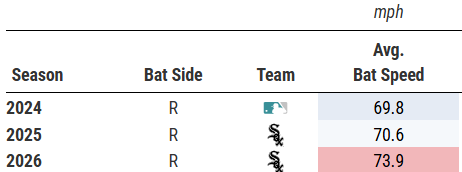
That's a massive change that perfectly explains the breakout, and it's a good sign that he can repeat this in 2027. Especially with third base being one of the weakest positions in fantasy, the 26-year-old should be a popular pick in the third round next draft season.
Surrounded by a young and exciting offense, he should once again rack up counting stats and provide a great mix of power and speed.
HM: Nolan Arenado
Shortstop: Otto Lopez
Otto Lopez entered the season with some sleeper appeal, but he blew expectations out of the water with an elite fantasy season. He showcased an intriguing blend of power and speed in 2025, hitting 15 homers and stealing 15 bases, which is why he was at least somewhat on the fantasy radar in deeper leagues heading into the year.
However, no one envisioned him contending for the NL batting title, as his batting average jumped from .246 last year to .305 in 2025, ranking him third in the National League and fifth in all of baseball. To go along with the elite average, Lopez put up 11 home runs, 71 RBI, 94 runs, and 34 stolen bases.
In many ways, he became a much better version of teammate Xavier Edwards, who was drafted much earlier than him in 2025. It's certain to be the reverse of that in 2027, although it is unfortunate that Lopez is going to lose his second base eligibility, which makes him even more of a fantasy standout.
Even at the most loaded position in fantasy, the 28-year-old still figures to be a lock for the top 12 at the position in terms of ADP next draft season. There could be some slight batting average regression, as his .281 xBA doesn't look quite as good as his actual mark, but that would still make him a top asset in that category.
HM: CJ Abrams
Outfielder: Pete Crow-Armstrong
Remarkably, Pete Crow-Armstrong was also featured in this piece last October for being a surprising breakout in 2025. Yet, he finished the season so badly that most people disregarded his first-half breakout, leaving him as a mid-to-late third-round pick in most leagues coming into the year.
Still, a third-round pick is pricey, so it would take a truly historic season to become a surprising, league-winning breakout at that price. That's exactly what the 24-year-old did, slashing .280/.372/.570 with 45 home runs, 107 RBI, 119 runs, and 41 stolen bases.
PETE CROW-ARMSTRONG HAS A 40/40 SEASON! https://t.co/Ltc5YX110L
— MLB (@MLB) September 24, 2026
While his 25.8% strikeout rate remains bad and contributed to a slump early in the season, his tools were simply too good not to shine through eventually. It would be redundant to list all his statistical improvements from 2025 to 2026, since every quality-of-contact metric increased dramatically, as you'd expect.
One thing that is worth mentioning is his walk rate going from 4.5% to 11.4%, as he turned one of his biggest weaknesses into a strength. This shows that he developed some much-needed patience in his sophomore season, and it makes me much less concerned about another catastrophic three-month slump ever happening again.
Do I think he's going to be a yearly 40-40 contributor moving forward? Probably not, but there's no shame in this going down as the best season of his career. Shohei Ohtani and Ronald Acuna Jr. both joined the 40-40 (or better) club in recent years, and even though neither of them ever repeated the historic feat, that didn't stop them from being worth an early first-round pick in fantasy.
Crow-Armstrong made his case to be the first overall pick in 2027, and it's tough to argue against it. Ohtani still gets my vote in daily Roto leagues where you can use his hitting and pitching stats at the same time, but regardless, expect the youngster to be one of the best players in fantasy next season.
Outfielder: Jordan Walker
Speaking of post-hype breakouts, Jordan Walker is another perfect example. After getting called up as a 20-year-old in 2023, he never really got things going at the major league level. There were rumblings of a potential breakout this offseason after he went to Driveline to improve his swing, and that's exactly what happened.
His bat speed was already at a 99th-percentile 78.1 mph in 2025, but he improved it to 79.3 mph this season while lowering his ground-ball rate from 47.5% to 42.8% and raising his pull-air rate from 11.3% to 15.9%. That resulted in an elite offensive season, as the youngster slashed .269/.327/.466 with 29 home runs, 102 RBI, 97 runs, and 22 stolen bases.
His raw tools are off the charts with elite power and speed, and this is the type of potential that we all were waiting to see for so long. The strikeouts are still a concern, as he punched out at a rate of 26.1%, but that's not as big of a deal for someone with his type of power. His expected stats were almost spot on with his actual marks, too, as he posted a .263 xBA and .462 xSLG.
However, it's not all positive news, as he did regress heavily in the second half. Maybe it was the Home Run Derby curse, as the slugger took home the trophy in that competition, or maybe he was just simply overperforming in the first half. After the All-Star break, he slashed just .234/.287/.373 with seven home runs and nine steals.

Most people probably remember his first-half heroics more than his second-half slump, positioning him as a possible second-round pick in 2027 fantasy drafts. I can't say I'm the biggest fan of that idea, but as we just discussed, Crow-Armstrong was dismissed into the third round after a second-half slump in 2025, which clearly was a mistake.
For that reason, I won't fault anyone for taking Walker that early, but just know that it's probably not one of the safer picks out there.
Outfielder: Jake McCarthy
Jake McCarthy was a league-winner who many of you found on the waiver wire, breaking out hugely after a non-eventful career up until this point. Obviously, a big part of that was his move to the Rockies, and he finished with .291, 15 home runs, 83 RBI, 80 runs, and 32 steals.
As you'd expect, he was much better at home, batting .312 in Colorado compared to .267 away from it. While 15 home runs isn't exactly impressive, it's still a surprise that he hit that many, considering a fourth percentile average exit velocity and a seventh percentile hard-hit rate. The 29-year-old's xSLG ended up at .410, which was significantly lower than his actual mark of .475.
While it was fun to ride out the hot streak in 2026, it's hard to see this being the norm moving forward. Obviously, Coors Field enhances offense, but there's been a strange trend with Rockies outfielders over the recent years having breakout seasons before completely falling off the map.
Remember when Nolan Jones hit 20 homers and stole 20 bases with a .297 average in 2023, or when Brenton Doyle hit 23 homers and stole 30 bases with a .260 average in 2024? They both became unusable in fantasy immediately following their one elite season, and it's easy to see a similar path for McCarthy.
I do think things will turn out slightly better for him than the two previously mentioned names, as at least McCarthy does have a history of being a good option for fantasy, at least in terms of stolen bases and batting average. I would still draft him as a starting outfielder in three-outfielder leagues in 2027, but just don't expect him to come close to repeating as a top-10 option at the position.
HM: Jake Bauers, Randy Arozarena, Carson Benge
Starting Pitcher: Jacob Misiorowski
Like Crow-Armstrong, Jacob Misiorowski got tons of hype in 2025, but concerns scared people away on draft day and made him one of the biggest steals of the 2026 draft. He immediately flashed his strikeout upside as a rookie last season with a 32.0% strikeout rate, but his 11.0% walk rate was very concerning.
The walks and inefficiency, combined with the Brewers micromanaging his innings late last season, left too many concerns for many fantasy managers heading into 2026. Those concerns proved unfounded, as the youngster blossomed into the sport's most dominant pitcher, posting a 1.80 ERA and 0.80 WHIP with 252 strikeouts in 174 2/3 innings.
It turns out that his fastball, averaging 100.6 mph, is just too much for hitters to overcome. He posted a ridiculous 37.9% strikeout rate while walking batters at an 81st percentile clip of 6.6%. There were absolutely no holes in Misiorowski’s game this season, and he’s clearly established himself as the No. 1 pitcher for fantasy in 2027.
JACOB MISIOROWSKI
105 MPH TO START THE GAME
WELCOME TO THE NLDS 🔥 https://t.co/t0QfPCgkrA— MLB (@MLB) October 4, 2026
There’s also no reason to believe he can’t continue to be this dominant, at least on a year-by-year basis. Every starting pitcher faces injury risk, but it can be even worse for someone who relies so much on velocity. Just ask Spencer Strider, who became unusable in fantasy once he lost a few ticks on his fastball following surgery.
That’s not to say I’m predicting an upcoming injury for the phenom, as I have no hesitation taking him in the first round next year, but it will likely be a hurdle he has to overcome eventually in his career.
Starting Pitcher: Cam Schlittler
The second biggest surprise at starting pitcher was Cam Schlittler. He was drafted around the same point as Misiorowski and finished close to him, establishing himself as the second- or third-best pitcher in fantasy, depending on your preference between him and Tarik Skubal.
The 25-year-old impressed in the playoffs last season and carried that momentum into 2026, posting a 1.95 ERA and 0.92 WHIP with 239 strikeouts and 49 walks in 193 2/3 innings. He excels through the use of a unique arsenal that consists primarily of three different fastballs.
His four-seam fastball was his most-used pitch at 44.5 percent, and he throws it at 98 mph on average, which ranks in the 98th percentile. He complements that with a cutter thrown at 94.6 mph and a sinker thrown at 97.8 mph, giving him three elite fastball variants that he threw for a combined 89.4 percent of the time.
Hitters are left guessing at the plate with a one-in-three shot of being right, as the three distinct late movements are incredibly tough to distinguish. Like Misiorowski, he’s given us no reasons to doubt him in 2027. Expect Schlittler to be a late first- or early second-round pick in 2027 drafts, a price he’s rightfully earned.
Starting Pitcher: Parker Messick
Parker Messick took a different path to stardom than the previous two mentioned here. While the other two entered the year as borderline top-30 starters with real breakout potential, Messick didn’t officially earn his spot in Cleveland’s starting rotation until the very end of spring training.
He made a solid first impression through seven starts in 2025, posting a 2.72 ERA and 1.31 WHIP over that span, but the 25-year-old took things to the next level in 2026. The youngster posted a 2.56 ERA and 1.06 WHIP with 193 strikeouts and 49 walks in 186 1/3 innings.
While his fastball averages only 93.9 mph, it was one of the best heaters in baseball, thanks to a unique delivery and arm angle that make it tough to hit. The lefty posted a 25.8% strikeout rate, 6.6% walk rate, and 5.0% barrel rate, which all ranked well above average.
This allowed him to finish as the ninth-most-valuable starting pitcher in fantasy this year, turning himself from a late-round draft pick into an ace. He’s shown enough over the first 39 starts of his career for me to trust that he’s a great pitcher.
However, I’d bet against him finishing as a top-10 pitcher in 2027. He doesn’t get quite as many strikeouts and whiffs as you'd typically expect from an ace, and he also isn’t a prolific ground-ball pitcher. That leaves his main value as his low ERA, which is typically one of the more volatile pitcher stats.
A couple of bad outings on days when a starter is off can drastically shift a pitcher's ERA for an entire season, so it’s usually better to invest in guys who provide outlier strikeout numbers, which are less luck-based. That’s not to say I’m fading Messick in 2027, but I’ll be targeting him as a top-15 or top-20 pitcher, rather than a top-10 one.
HM: Drew Rasmussen, Logan Henderson, Cade Cavalli
Relief Pitcher: Bryan Baker
There were plenty of good options at relief pitcher for this exercise, as 11 closers reached 30 saves in 2026, up from eight in 2025. Four of those players were barely on fantasy radars at all headed into the season, with Bryan Baker, Riley O'Brien, Louis Varland, and Jacob Latz all stepping up to be full-time closers for their clubs.
I’ll give Baker the honor of being the biggest breakout of the bunch, who tied for the major league lead in saves with 41. Sometimes closers rack up tons of saves without being all too effective (see O’Brien), but that wasn’t the case with Baker. The 31-year-old posted a 1.44 ERA and 0.91 WHIP to be a true lockdown option in the ninth.
I don’t blame anyone for not seeing the breakout coming, as the righty posted a 4.06 ERA in 2025 with a first-percentile barrel rate and third-percentile hard-hit rate. It was a strange case in that his strikeout rate actually dropped from 30.3% to 25.8%, yet his effectiveness increased dramatically.
The change was a simple one, as he just stopped throwing his slider, which was consistently hit hard all of last season. He threw it just 3.3% of the time in 2026 after routinely using it at a rate of 25.0% last year. This turned him into a two-pitch pitcher, relying entirely on his fastball and changeup.
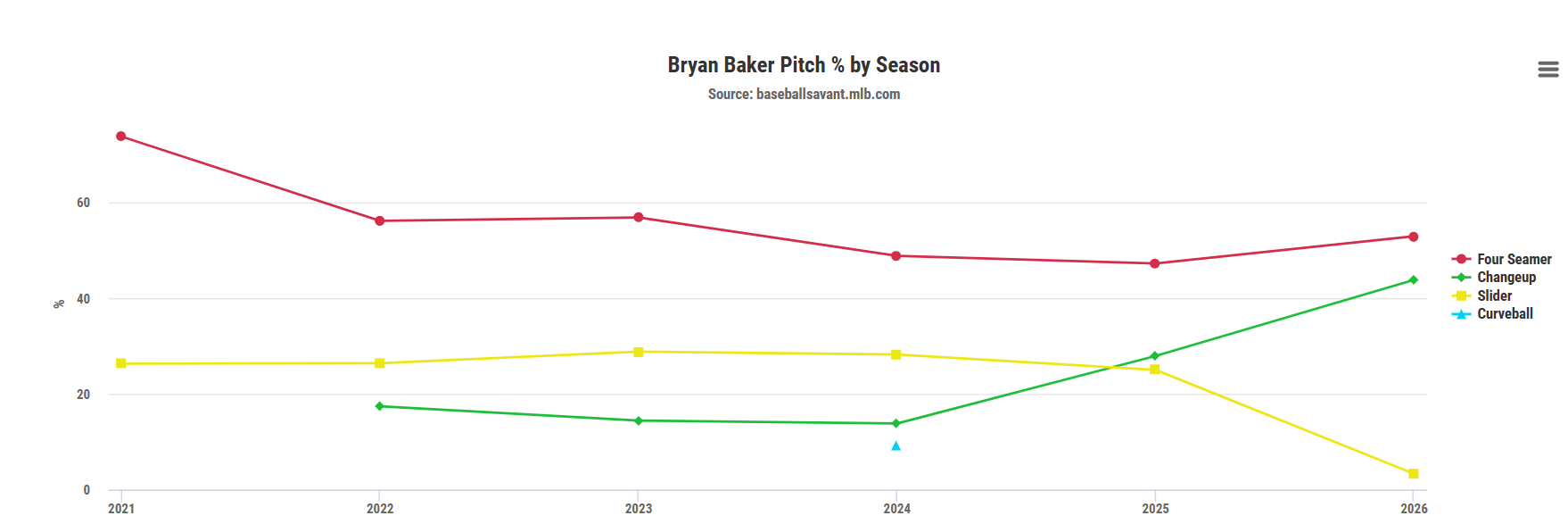
It clearly worked, and he’s set up to be a top fantasy closer again in 2027, as long as he’s still the clear ninth-inning guy for the Rays. It’s hard to predict exact closer rankings with so many moving parts each offseason, but he’ll likely be drafted as at least a top-six option at the position, which is a fair price.
HM: Jacob Latz, Louis Varland
More Fantasy Baseball Advice
Download Our Free News & Alerts Mobile App
Like what you see? Download our updated fantasy baseball app for iPhone and Android with 24x7 player news, injury alerts, sleepers, prospects & more. All free!