



 RADIO
RADIO









Jon Anderson dives into batted ball data to determine what statistics are sticky, and what to make of some 2023 fantasy baseball hitters because of it.
MLB data has become so rich that there are countless things we can study and write about. It's really the best sport by a large margin for player and event analysis.
One of the most useful and interesting data points we have available to us concerns batted ball data. We hear a lot about launch velocity, launch angle, and batted ball type - and for good reason. You can learn a lot about a hitter from studying this data.
The one thing I was curious about is how good we can get at predicting what type of hitter (meaning ground ball, line drive, or fly ball) a hitter will be in future years by looking at previous years' batted ball data. I went to the numbers and did some studying, so I want to share the results with you here.
Featured Promo: Save 50% off the regular price with discount code SUMMER, for a limited time. Exclusive access to our Team Sync platform, DFS cheat sheets, Lineup Optimizers, betting/prop picks, and exclusive content from Nick Mariano and Eric Cross! GAIN ACCESS NOW
Prerequisites
First, some things we must nail down before proceeding. One thing to note is that the two main sources of batted ball data, FanGraphs and Baseball Savant, classify batted balls differently. Because of this, you will usually not see a player's FB%, LD%, and GB% exactly matching between the two sources, but it will be close. I use Baseball Savant data, so let me give you some information about that.
Baseball Savant uses launch angle and launch speed to classify a batted ball into a category. This means that a line drive that is hit very hard can be classified as a line drive by FanGraphs, but it can make it into the fly ball category by Baseball Savant.
Here's a [ugly, albeit useful] plot to break down how this works (green=GB, red=LD, purple=FB):

We see an overlap between GB & LD and between LD % FB - but no overlap between GB & LD. The overlap depends on velocity. FanGraphs does not do this overlap, which is the cause of the difference. I don't think one data source is necessarily better than the other, I would just say that it's important each analyst picks one and sticks to it for consistencies sake.
Now, let's look at some numbers to get an idea of how these batted ball types perform. A lot of this is just common sense, but here's a table to summarize:
| BB Type | % of BB | AVG | SLG | HR% |
| Ground Ball | 44% | .241 | .265 | 0% |
| Line Drive | 25% | .633 | .904 | 6% |
| Fly Ball | 24% | .284 | .885 | 38% |
| Popup | 7% | .019 | .022 | 0% |
Takeaways:
- The most common occurrence is a ground ball, which makes sense because ground balls belong to the largest angle range and almost every pitch thrown has a downward movement from the start.
- Homers come from fly balls, but not exclusively (92% of homers in 2022 were classified as fly balls, and the remaining 8% were line drives).
- Batting average comes from line drives, and all of the extra hits you get on line drives catch the LD category up in SLG. If you're looking for run-production, you really want guys hitting line drives and fly balls.
Once we get into classifying hitters into a type, we want to keep that first bullet point in mind. A hitter with a 45% GB% is not really a ground ball hitter since that's just one point above the league average in that category. A hitter might have a higher GB% than LD%, but they could still be a "line drive hitter" because they're beating the league average in LD more than they are in GB. That's how I will do my hitter classification later in this post.
Correlation & Consistency
We can use some rudimentary statistics to get a feel for how consistent these things are year-to-year.
Quick statistics lesson! Correlation is measured with a single number (a coefficient) that results from the comparison of two lists of numbers of equal length. A correlation coefficient of 1 signifies a perfect positive correlation (as one number goes up, its compared number will also go up – at a constant rate), and a coefficient of -1 signifies a perfect negative correlation (as one number goes up, its compared number will go down – at a constant rate). The closer you get to zero, the weaker the correlation. I think it's fair to say that anything between -0.5 and 0.5 signifies that the lists of numbers are not truly correlated).
If that didn't make sense, don't worry about it – I will summarize it at the end of all this. To test this out, I took all of the hitters that put at least 200 balls in play in both 2021 and 2022 and ran the correlation coefficients from GB%, LD%, FB%, and average launch angle. Here are the results:
| Stat | Coefficient |
| GB% | .69 |
| LD% | .36 |
| FB% | .72 |
| LA | .78 |
We see the strongest correlation with the average launch angle. This makes inherent sense since there's one less step in getting the number – there's no classification being done. With classifying into a BB Type, 25 degrees will be a line drive sometimes and a fly ball other times, but when you aren't doing that classification – it is just always 25 degrees. The other correlations we see are with ground balls and fly balls, with a slightly stronger correlation going to fly balls.
We do not see a correlation in line drives. This also makes some sense since a line drive is between a ground ball and a fly ball. A hitter whose average batted ball was right in the center of the line drive range could turn into a ground-ball hitter or a fly-ball hitter the next year without much movement in either direction. Meanwhile, an extreme fly ball hitter has a long way to go downward before he turns into a line-drive hitter.
I found 140 hitters in this sample (hitters with 200+ balls in play each of the last two seasons). To give some more information about the change in average launch angle:
- Overall range: 19 degrees
- Minimum: Avisail Garcia (2.7 degrees)
- Maximum: Nolan Arenado (21.7 degrees)
- Biggest change: 8.2 degrees by Raimel Tapia (-4.7 degrees in 2021, 3.5 degrees in 2022)
- Smallest change: 0.0 degrees by Eduardo Escobar (20.5 degrees)
- Average change: 3 degrees
- Number of hitters with changes above 5 degrees: 16 (just 11%)
Every player that had an average launch angle above 20 degrees in 2022 had an average launch angle above 15 degrees in 2021. This is definitely more of a "skill" rather than a result of randomness.
More conclusions:
- There is a decently strong year-over-year correlation in average launch angle. It's far from a perfect correlation (there are very few perfect correlations in life), and there are plenty of exceptions we will find, but it makes mathematical sense to use last year's average launch angle as the projection for the next season's average launch angle for each hitter.
- Extreme fly ball hitters one year are very likely to stay fly ball hitters next year.
- Extreme ground ball hitters one year are very likely to stay ground ball hitters next year.
- Line drive hitters will probably stay something close to a line drive hitter, but it's not uncommon whatsoever for them to classify differently the following year since slight changes in either direction can change the classification.
Now, let's peruse through each category and put some names down here. This will help us understand the content a bit better, and will also provide some helpful information for next year's fantasy season (that is the whole reason this website exists, after all!).
The Ground Ball Hitter
We really do not love to see these types of hitters for fantasy purposes. We want homers from our fantasy hitters, and you can't hit a home run on a grounder. You also have a much tougher time finding extra bases with a ground ball, which takes away from runs scored and RBI opportunities.
That said, ground ball hitters that are very fast often hit for a good batting average since they beat out so many infield ground balls. Your speed doesn't help you on fly balls, either it will be caught for an out or will fall in and you'll be safe. The worst combination is a slow ground-ball hitter, they very rarely do much for us in the fantasy realm. Here are 2022's top ground-ball hitters along with the data from 2019 and 2021 as well (if there were any, you will see plenty of blanks here and that means they did not put 200 balls in play in those other seasons) and my classification for each year of what type of hitter they were based on where their numbers lined up against the league average:

There's not a ton to love on this in terms of fantasy production. The fantasy-relevant names we do see are typically getting there with their speed (steals, batting average) and placement in the batting order (runs scored). The only players here that hit homers at a good rate are a pair of young Braves hitters (Michael Harris II and William Contreras), and I would say that their presence on this list is bad news for their power projection in 2023.
One other thing we notice is that very few of these hitters weren't labeled ground-ball hitters in 2021. Of the 19 hitters shown above with data in both years, 16 of them were also ground-ball hitters in 2021. Only Nelson Cruz and Tucker Barnhart changed from fly-ball hitters to ground-ball hitters.
I don't have any hard data on this next claim, but I would say that it's much less concerning to see a very young player showing up on the list as we see with Harris, Alek Thomas, Riley Greene, and then Jarren Duran and Nick Madrigal to a lesser extent. Provided those hitters are hitting the ball hard (all of those names were besides Madrigal), it's not something to be overly worried about until we see it stay a problem over a longer sample. It can be a sign of a hitter that just needs more reps to get the swing path figured out at the game's highest level – but overall, I would call it bad news.
The Line Drive Hitter

Most of the players on this list hit a good-to-great batting average in 2022. The exceptions (Trayce Thompson, Chris Taylor, and others) were exceptions because of high strikeout rates. Most of these hitters didn't have high strikeout rates, which I think is a testament to bat skill. Consistently hitting line drives is a tricky thing to do, since the angle range there is pretty thin.
We tend to find the highest line drive rates among very talented hitters that don't swing with much authority (the Jeff McNeil and Luis Arraezs of the world). This type of hitter is almost marginally useful for fantasy purposes, especially if they don't steal a bunch of bases – but they can be fully relied upon for high batting averages and on-base percentages, which leads to runs scored.
The elite hitters on the list (Freddie Freeman, Bryce Harper, Manny Machado) had lower GB% – they kept most of their balls in play at line drive or fly ball angles.
In terms of previous years, we see very little consistency here. More than half of the line-drive hitters shown above were not line-drive hitters in 2021. That's because there are two other options, and a line-drive hitter can easily slip into either one rather than staying in the same category as a line-drive hitter. This "revelation" isn't all that meaningful, however, because we're still mostly talking about a 2-5 degree difference year-over-year, and an 8-degree ground ball isn't all that much different than an 11-degree line drive, per se.
The verdict here is that line drives are very useful for base hits, but only the best hitters in the league can give us a high supply of homers while leading their profile with line drives.
The Fly Ball Hitter
This is the most interesting category in my mind. Here's the list:

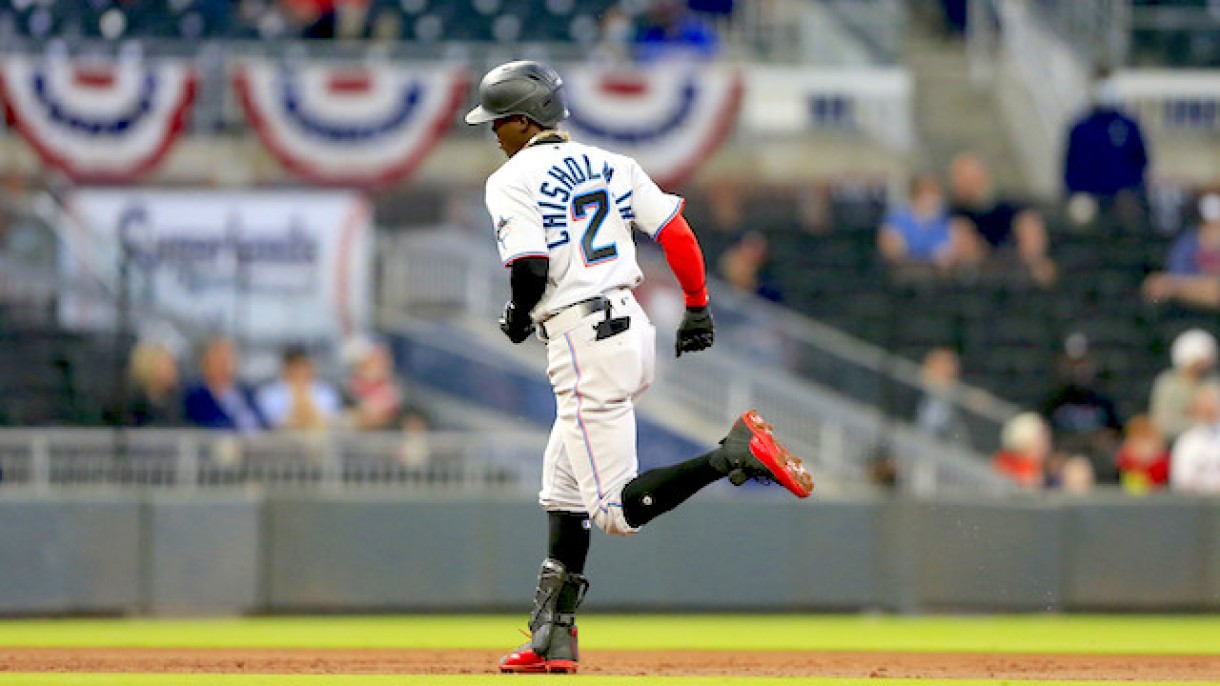
We see just one hitter turning from a ground-ball hitter in 2021 to one of the top fly-ball hitters in 2022 (Jazz Chisholm Jr., a very young player like we talked about above).
The reason fly ball hitters are so interesting to me is there is another essential component to getting a story out of this – launch velocity. A heavy fly ball hitter with low launch velocity is really not a good situation, but a heavy fly ball hitter with a high average launch velocity quickly turns into one of the game's best fantasy hitters. Here's a scatter plot showing both fly ball rates and average exit velocity on fly balls:
The biggest standouts here are Mike Trout, Cal Raleigh, Max Muncy, Eugenio Suarez, Joey Gallo, Aaron Judge, Nolan Gorman, Byron Buxton, Jazz Chisholm Jr., and Kyle Schwarber. These hitters hit homers at high rates. Some of their rates were completely elite (Judge hit a homer every 10.9 PA, Trout every 12.3, Buxton every 13.6), and others were more just "good" (Gallo 21.6, Gorman 22.4, Muncy 26.9). The difference between elite and good here is strikeouts. If you can live in the top-right of this scatter plot and keep a strikeout rate under 27% or so, you are going to hit a ton of dingers.
The Sweet Spot for Homers
The sweet spot for angle range is something like a batted ball between 22 and 35 degrees, and you really want to get above 97 miles per hour on the launch velocity. This idea is where the stat "barrel rate" comes from. Each batted ball is classified into one of six categories based on the launch angle and velocity, and the barrels (the best classification) mostly fall into the range I just described.
Here are the top-10 hitters in the total number of batted balls hit in this "sweet spot" range.
- Aaron Judge - 76
- Corey Seager - 54
- Shohei Ohtani - 51
- Kyle Schwarber - 51
- Freddie Freeman - 50
- Christian Walker - 50
- Yordan Alvarez - 49
- Mookie Betts - 49
- Alex Bregman - 49
- Austin Riley - 48
Here are the top 10 hitters in terms of the percentage of total balls in play that fell in our sweet spot (150 BIP minimum).
- Aaron Judge - 19%
- Nolan Gorman - 17%
- Cal Raleigh - 15%
- Jazz Chisholm - 15%
- Mike Trout - 15%
- Byron Buxton - 14%
- Yordan Alvarez - 13%
- Kyle Schwarber - 13%
- Joey Gallo - 12%
- Brandon Belt - 12%
The hitters here that fell short of fantasy glory in 2022 (Gorman, Gallo, Belt) mostly had to do with a lack of playing time and/or a high strikeout rate. This is all pretty exciting news for Jazz Chisholm, who was hitting the ball marvelously well before his injury (he was slugging .535 with a 16.6% barrel rate and a manageable 27.4% K%). Of course, we should wary of the small sample, but the changes Jazz made and the authority with which he was hitting the ball in 2022 gives him an immense power ceiling in 2023 to go with his speed.
Final Takeaways, Conclusions, and Resources
The biggest lesson to learn here is that the average launch angle is pretty sticky year-to-year for hitters. We should be projecting the 2023 average launch angles to be within a few points of the marks from 2022. This helps us get a step closer to accurate projections on things like batting averages and home run rates.
That said, we have only been looking at one piece of the puzzle here. We would need to incorporate many other things (ballpark, player history, lineups, strikeout rates, etc.) to feel very confident with takeaways, but here's some stuff I learned here that will at least slightly influence my drafting for 2023:
Stay away from high ground-ball rates (52%+):
They are very unlikely to turn into fly-ball hitters next year, which severely limits their power production and takes away a ton of fantasy ceiling. The names I'm thinking of here are Christian Yelich, Riley Greene, Alek Thomas, Avisail Garcia, Michael Harris II, William Contreras, C.J. Abrams, and Amed Rosario.
Be wary of line-drive hitters:
We can still feel confident that those hitters will continue to hit a lot of line drives, but it doesn't take much of a change to turn them into ground ball or fly ball hitters, which makes their batting average projection less stable. This doesn't really apply to players like Luis Arraez, Jeff McNeil, and Michael Brantley who have shown to consistently have this skill, but here are some names I am skeptical of here that benefited from high line drive rates that I think might not stick in 2023: Trayce Thompson, Bryan De La Cruz, Bryce Harper, Vinnie Pasquantino, Garrett Cooper, Chris Taylor, Keibert Ruiz
Shy away from hitters with high fly ball rates but low exit velocity:
LaMonte Wade Jr., JJ Bleday, Cavan Biggio, Oswaldo Cabrera
Buy into hitters with high fly ball rates and high exit velocity, they just might be primed for a power breakout:
Jazz Chisholm Jr., Nolan Gorman, David Villar, Danny Jansen
Resources
Here is a link to the full data from which I posted screenshots above.
And here's an interactive tool embedded from my MLB Tableau Dashboard. It lets you see each hitter's max, average, and median launch angle along with a histogram of all their batted balls if you select an individual hitter in the pulldown. Click here for a full-screen experience.

Download Our Free News & Alerts Mobile App
Like what you see? Download our updated fantasy baseball app for iPhone and Android with 24x7 player news, injury alerts, sleepers, prospects & more. All free!

More Fantasy Baseball Advice