




 RADIO
RADIO






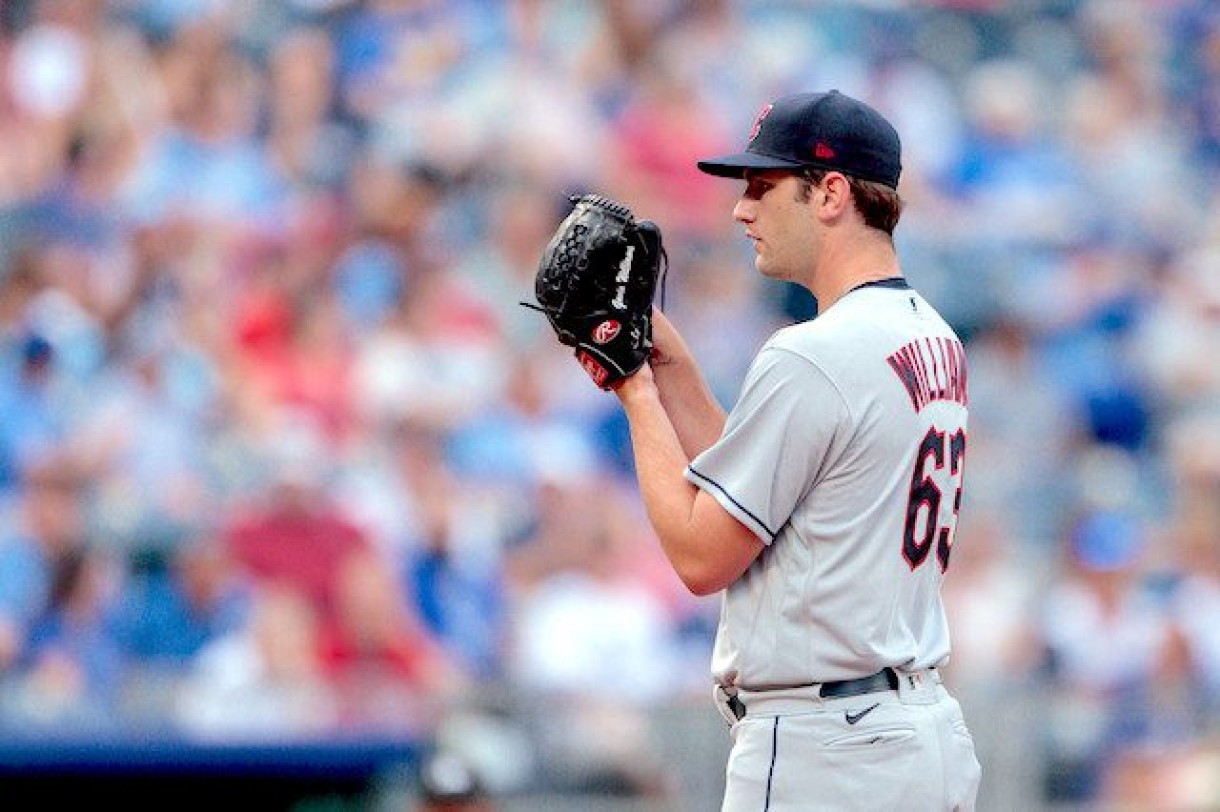
Corbin's starting pitcher fades and potential fantasy baseball busts, avoids for 2026. He thinks these pitchers are too expensive in drafts and may disappoint.
As someone who examines plenty of data, researches which advanced stats matter, and individual pitch profiles, there comes a point when players stand out in both positive and negative ways. There's a saying about not avoiding players but fading their prices, which might be the case for most of these players.
For transparency, we had Corbin Burnes, Yoshinobu Yamamoto, Michael King, and Tyler Glasnow as the starting pitcher fades heading into 2025. This was before Burnes had season-ending surgery, with Yamamoto as the one who was way wrong, mainly because he pitched well with plenty of volume, especially into the playoffs. Although we want to hit on the player targets and fades, the process should lead us toward identifying these players. Often, projection systems might not account for pitch mix changes, small samples, and unknown information that hasn't occurred yet.
Sometimes, a player surprises us and stays healthy for most of the season, leading to an unexpected outcome. Two of them have health concerns heading into the 2026 season, which should add caution to their profile. We'll examine the skills and underlying factors to consider when fading these four starting pitchers at their current Yahoo! prices.
Featured Promo: Save 50% off the regular price with discount code CHAMP, for a limited time. Exclusive access to our Team Sync platform, DFS cheat sheets, Lineup Optimizers, betting/prop picks, and exclusive content from Nick Mariano and Eric Cross! GAIN ACCESS NOW
Joe Ryan, SP, MIN
Yahoo ADP: 65.2
Joe Ryan has already been dealing with a back injury in spring training. That leads us to be concerned about the early price, especially since he missed time in 2024 with a strained back and shoulder. After missing 20 or more days on the injured list (IL) from 2022 to 2024, Ryan didn't land on the IL in 2025.
Besides the early injury concern, it's hard to poke holes in Ryan's skill set. That's evident in Ryan's 34 percent ball rate, 22 percent strikeout minus walk rate (K-BB%), and 12.3 percent swinging-strike rate in 2025. Ryan's skills in 2025 were consistent with his career norms.
Among Ryan's primary pitches, the four-seam elicits an above-average 12.9 percent swinging-strike rate in 2025, over two percentage points higher than the league average. Ryan's slider (12.1 percent) and splitter (8.3 percent) were quite underwhelming from a swinging-strike standpoint. Overall, Ryan's swinging-strike rates by pitch haven't varied from his career norms.
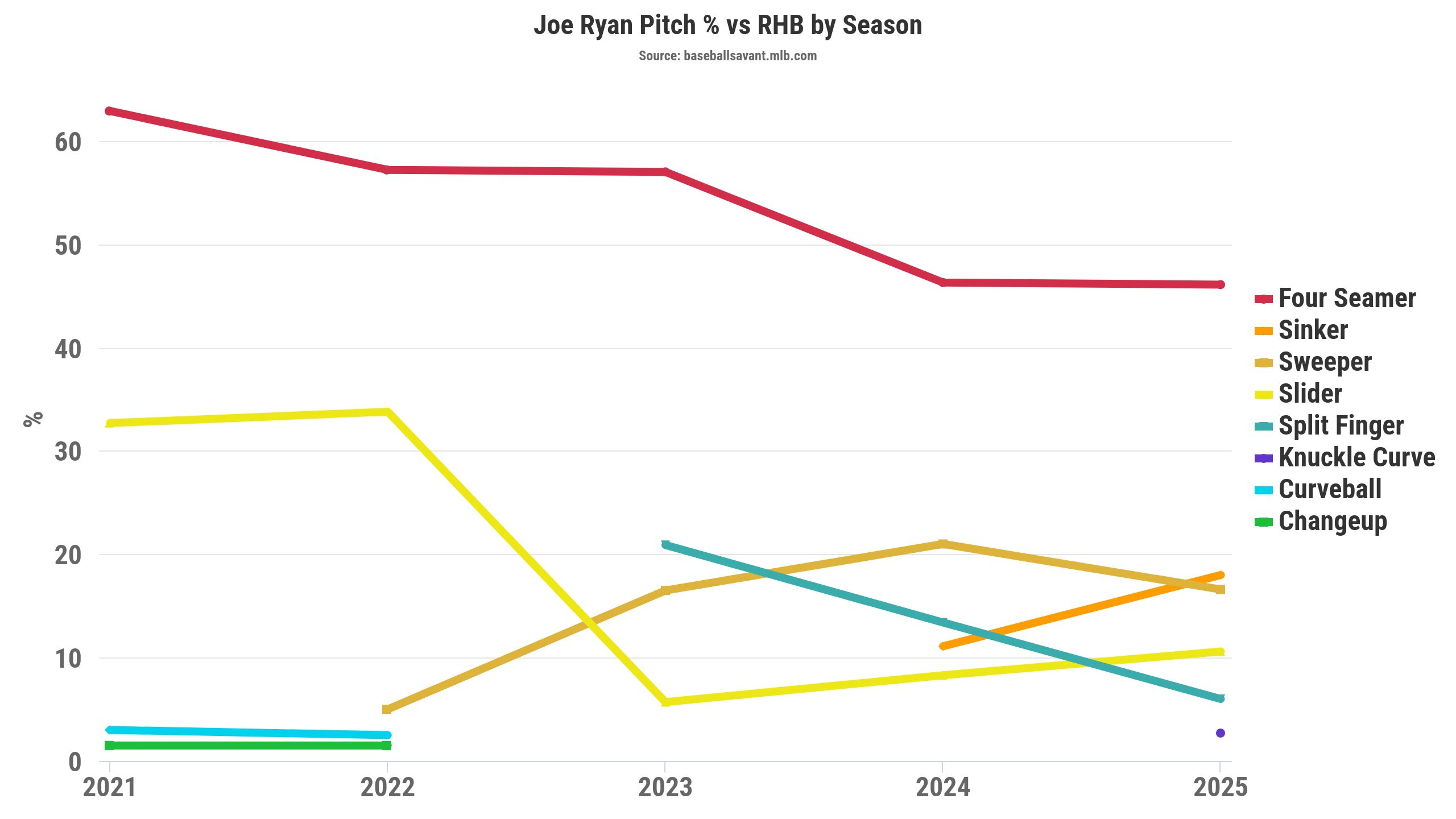
Ryan used to throw four-seamers (57 percent), splitters (20.9 percent), and sweepers (16.5 percent) to right-handed hitters in 2023. However, Ryan introduced a sinker in 2024, throwing it 11.1 percent of the time to right-handed hitters, allowing a .334 wOBA (.400 xwOBA). Interestingly, Ryan threw more sinkers to right-handed hitters in 2025 (18 percent) after lowering his splitter usage (6 percent).
Meanwhile, Ryan's pitch usage to left-handed hitters didn't change much. Since Ryan comes from a lower arm angle (25 degrees), most of his pitches tend to possess more horizontal movement than vertical. That said, Ryan's sweeper was the only pitch that dropped a significant amount, going from 39.2 inches (2024) to 42.3 inches (2025).
Since Ryan's sweeper generates sweep and drop, it tends to allow positive outcomes. That's evident in Ryan's sweeper, allowing a .242 wOBA (.224 xwOBA) and a 16.7 percent swinging-strike rate against right-handed hitters. Somehow, Ryan's splitter went from a quality offering in 2023 and 2024 to a worrisome one against left-handed hitters (.395 wOBA, .335 xwOBA).
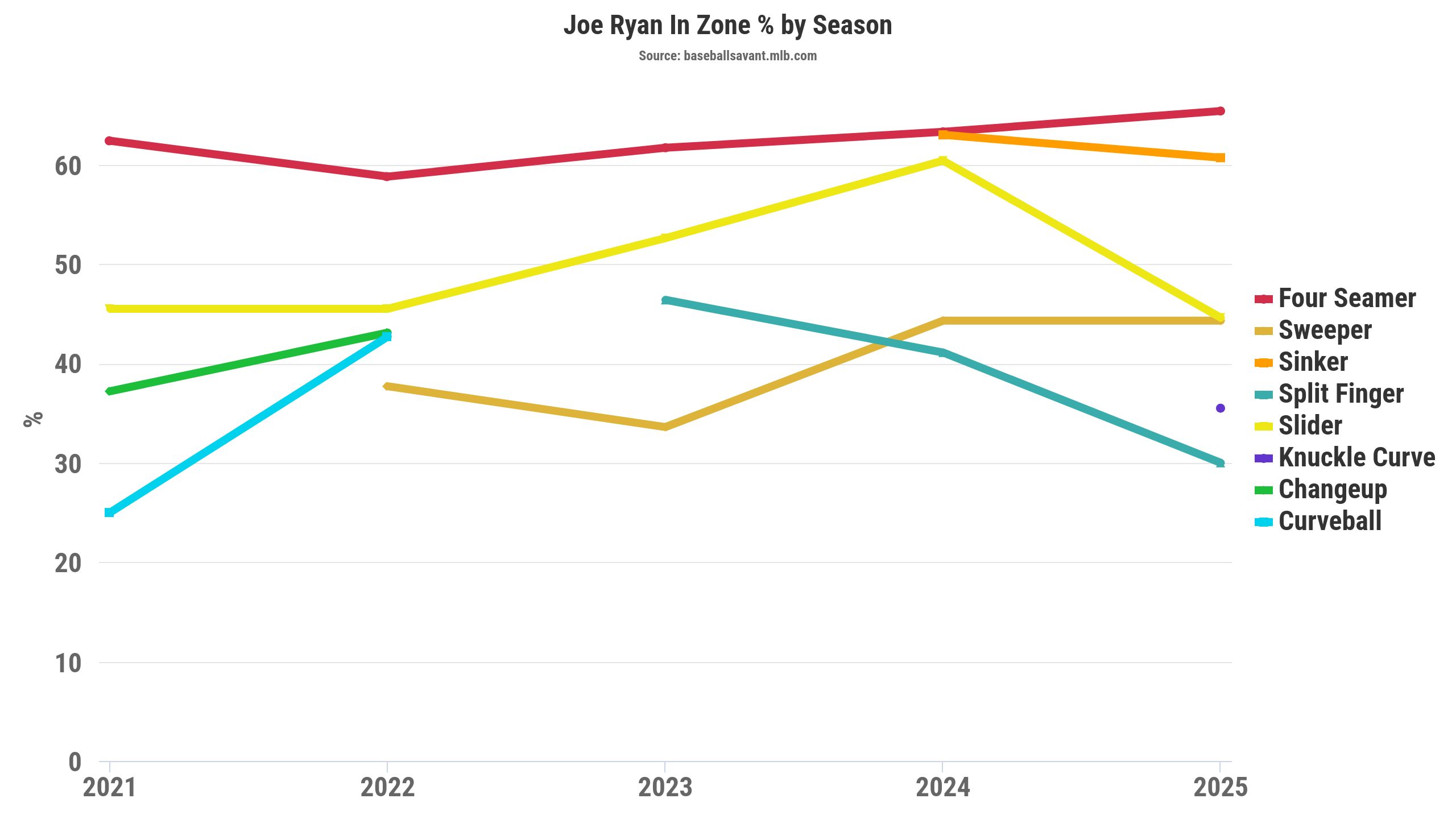
Since the splitter's movement profile hadn't changed significantly, there's a chance Ryan had an outlier season from a location standpoint. Throughout Ryan's career, he threw the splitter in the zone 40.4 percent of the time, over 10 percentage points below 2025 (30.2 percent). It's a small sample, but Ryan's splitter was destroyed (.462 wOBA, .416 xwOBA) when thrown in the zone in 2025, notably worse than 2024 (.301 wOBA, .314 xwOBA).
It's hard to fade a starting pitcher with a career 3.76 xERA and 1.06 WHIP. Ryan's skills have been slightly above-average and not in the high-end range, though the draft price expects him to be a high-end starting pitcher. Besides the early injury, there might be more risk than we realized under the hood for Ryan.
Blake Snell, SP, LAD
Yahoo ADP: 91.7 (trending down with injury)
Blake Snell projects to be on the injured list when Opening Day hits. The current report states that Snell is dealing with shoulder fatigue. He already missed four months with shoulder inflammation last season, returning two months beyond the projected return date.
In 2024, Snell hurt his groin and missed one month. Then he had another groin strain, causing him to miss another month. Snell's shoulder injury, possibly lingering into the 2026 season, might be more concerning than his groin. We've seen Snell maintain his arm angle and release points over the past two seasons. Sometimes pitchers adjust their release points before and after an injury.
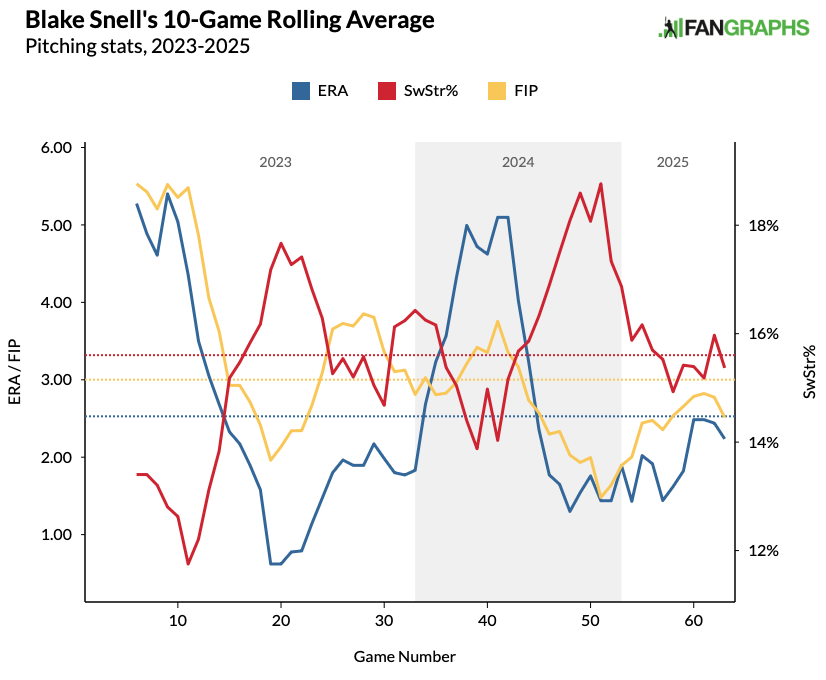
There's no denying Snell's ability to miss bats, with two pitches eliciting a swinging-strike rate at 20 percent or higher, including the changeup (21.8 percent) and slider (21.9 percent), similar to their career averages. Meanwhile, Snell's curveball generates an above-average swinging-strike rate at 18.8 percent, though we've seen it fluctuate to 22 to 23 percent.
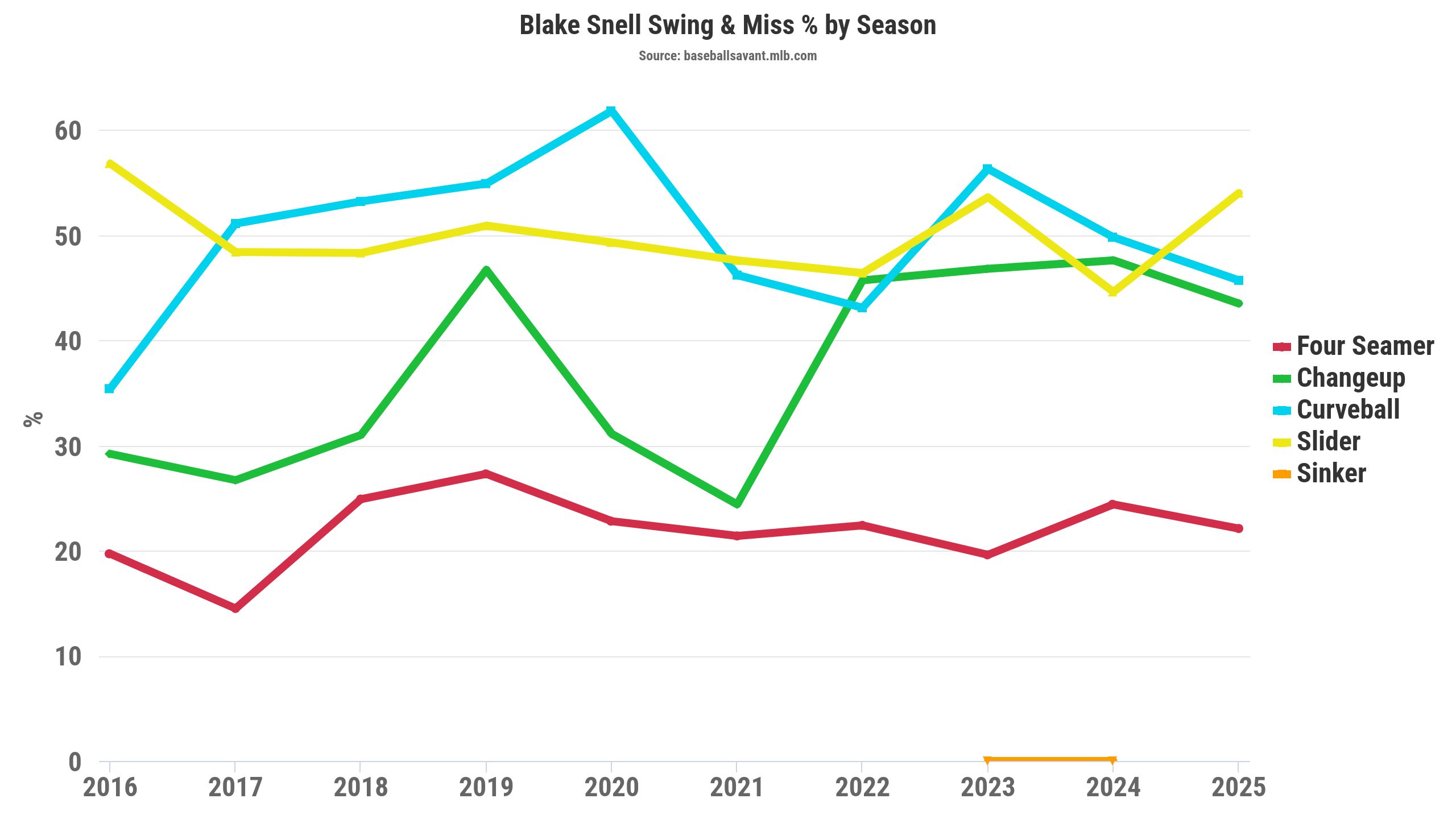
There have been minor and insignificant pitch movement profile changes to Snell's pitches over the past two seasons (2024-2025). However, there's a small trend of the curveball losing an inch of downward movement, compared to the 2023 season. Snell surprisingly has sneaky good pitch locations when looking at the heatmaps.
The changeups tend to be low and away to right-handed hitters, sliders and curveballs low and below the zone, plus four-seamers in the upper third of the zone. That's been a consistent approach that helps Snell's stuff play up.
Snell is a high-end starting pitcher when healthy, but we want to be cautious at this current price tag, just outside the top-100 picks. Monitor the injury updates as we inch closer to the season.
Cam Schlittler, SP, NYY
Yahoo ADP: 127.9
Cam Schlittler popped up in the data for the fades based on ATC Projections. When a pitcher succeeds (2.96 ERA, 1.22 WHIP), we need to examine the expected ERA (3.72) and skills. Schlittler's walk rate should regress to single digits since a double-digit walk rate doesn't align with a 34 percent ball rate. That's slightly above average for Schlittler's control.
Schlittler had a decent 11.1 percent swinging-strike rate, though most of his arsenal was underwhelming from a swinging-strike standpoint. Besides Schlittler's high-velocity four-seamer that generated a 12.1 percent swinging-strike rate, his cutter (10.4 percent), curveball (9.1 percent), and slider (6.7 percent) were brutal.
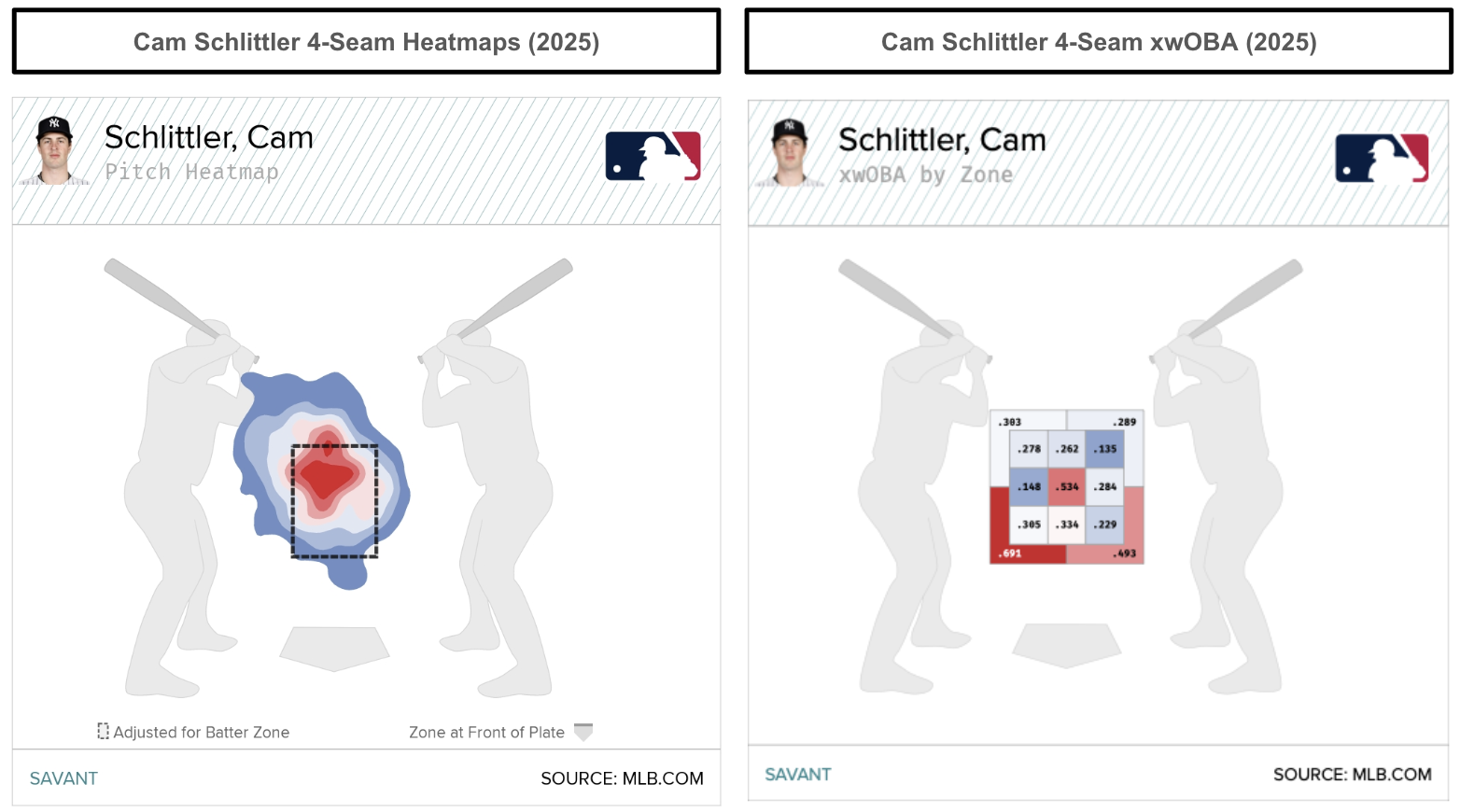
Although Schlittler's four-seam elicits a slightly above-average swinging-strike rate compared to the league norm (10.7 percent), it doesn't have the pitch shape we want. That's evident in Schlittler's four-seam, averaging 16.3 inches of induced vertical break, which hovers around the league average. It might suggest that Schlittler locates the four-seam well in the upper third of the zone.
Schlittler's four-seam has been decent, allowing a .296 wOBA against right-handed hitters, though the expected wOBA (.374) says caution. Thankfully, Schlittler's four-seam performs well against lefties, giving up a .257 wOBA (.281 xwOBA). The cutter is odd. Schlittler's cutter has 7.4 inches of glove-side movement, turning into 5.2 inches more than the average pitch, the most among right-handed pitchers with 250 cutters thrown.
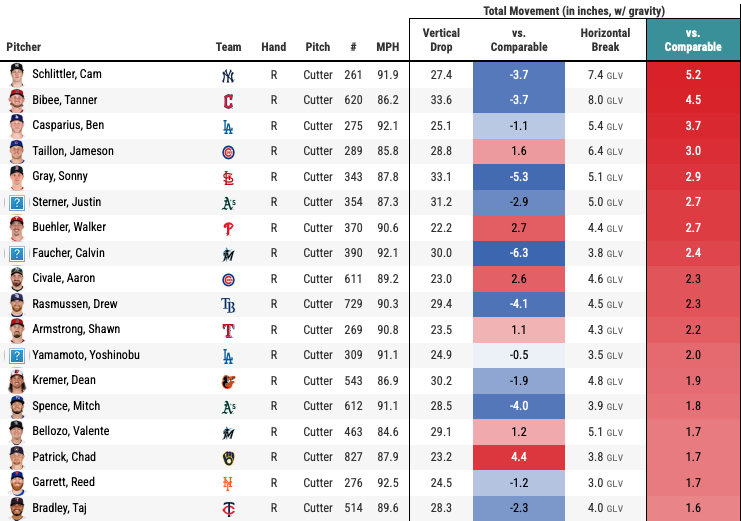
Besides Tanner Bibee, Jameson Taillon, Ben Casparius, Sonny Gray, Valente Bellozo, and Justin Sterner, no other pitchers had a cutter moving five or more inches toward their glove side. Like Bibee, we could see Schlittler increase cutter usage for right-handed hitters, since it was relatively successful (.192 wOBA, .202 xwOBA).
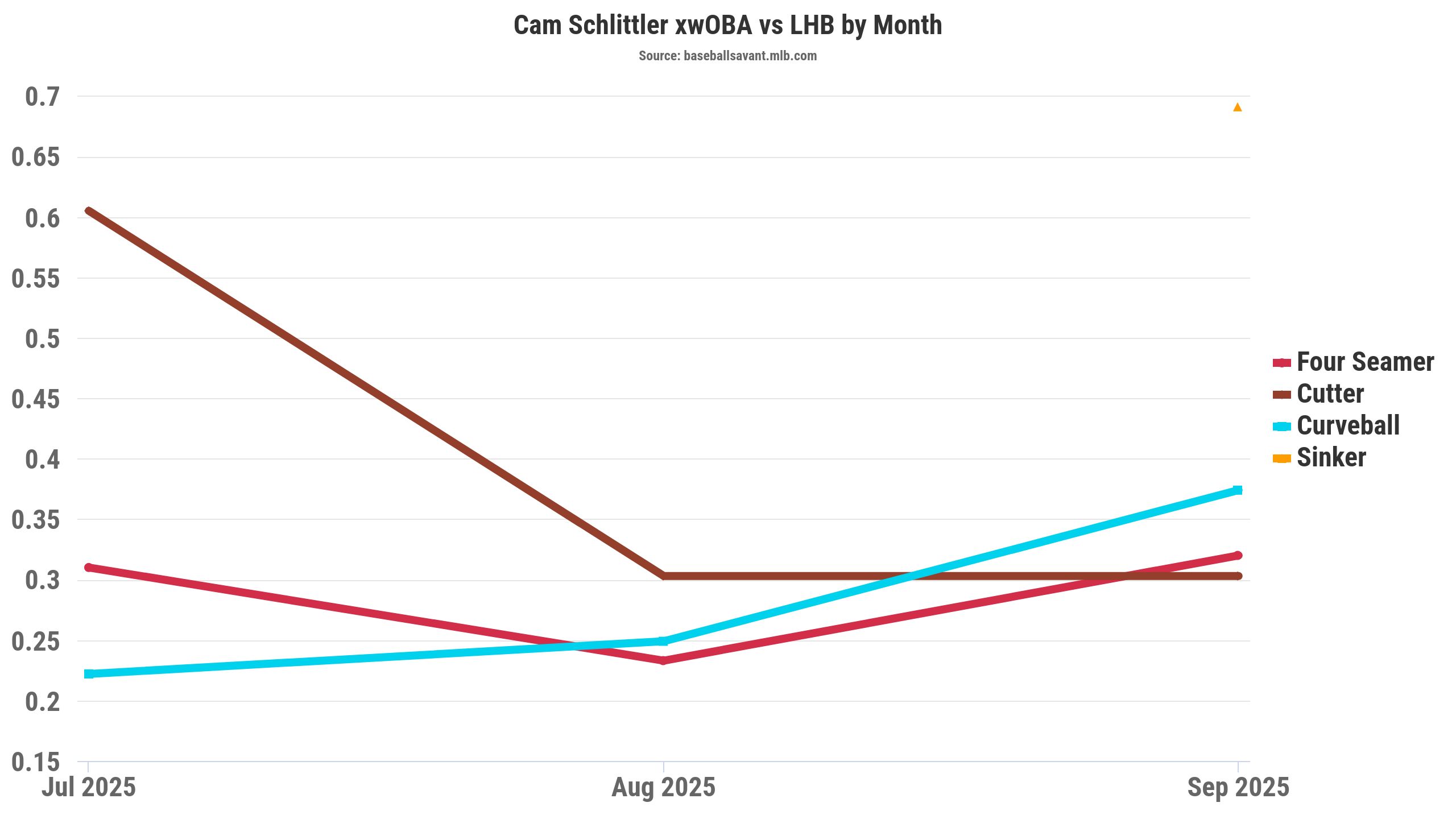
The biggest concern involves how Schlittler adjusts to left-handed hitters. When we see a pitcher cut their cutter more than the average, we guess they're a supinator, meaning they tend to have pitches that move more toward their glove side. We've seen pitchers add a sinker, splitter, or changeup to find success against left-handed hitters, potentially.
If Schlittler struggles to find a consistent weapon against left-handed hitters, it could be a bumpy ride, with some regression. There's still an above-average pitcher within the range of outcomes, though expect an ERA somewhere around 3.80, which feels like a slight overpay at the draft cost.
Gavin Williams, SP, CLE
Yahoo ADP: 156
There's some trepidation about Gavin Williams after posting a 3.06 ERA and 1.27 WHIP across 167 innings. Typically, pitchers like Williams would be going higher in drafts after a relatively successful season. However, Williams's 4.08 xERA suggests regression.
Control remains an issue for Williams, with a 38 percent ball rate in 2025, similar to his career average. The strikeout skills have been decent, but not mindblowing, with a 12 percent swinging strike rate. Since the four-seamer was crushed, Williams threw fewer four-seamers to right-handed hitters (30.9 percent) in 2025, down from 53.7 percent in 2024.
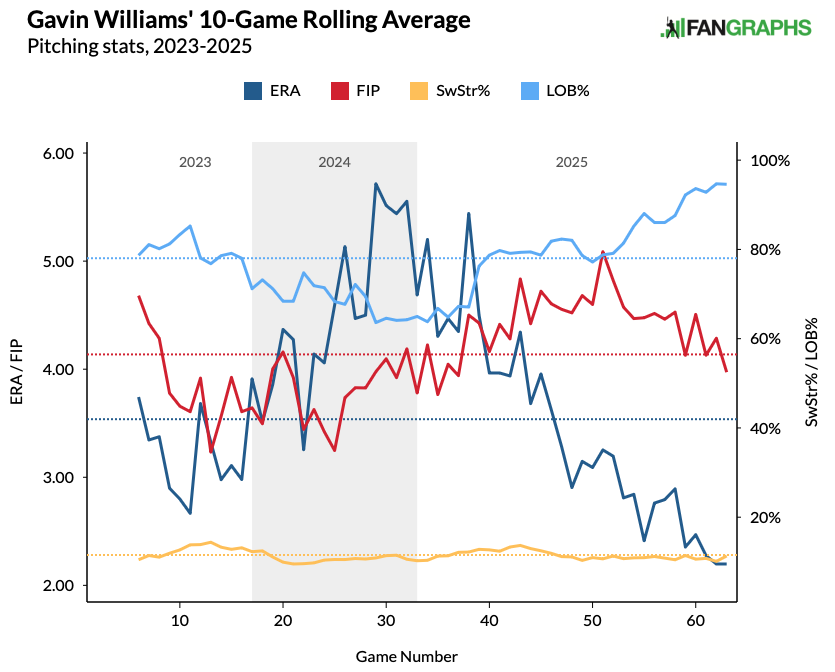
Williams started lowering the four-seam usage in June. From March to May 2025, Williams had a 4.27 ERA (4.53 SIERA), 1.58 WHIP, .323 BABIP, 78 percent strand rate, 38.8 percent ball rate, and a 13.3 percent swinging-strike rate. From June and beyond, Williams had a 2.50 ERA (4.26 SIERA), 1.13 WHIP, .221 BABIP, 88 percent strand rate, 38.2 percent ball rate, and an 11 percent swinging-strike rate.
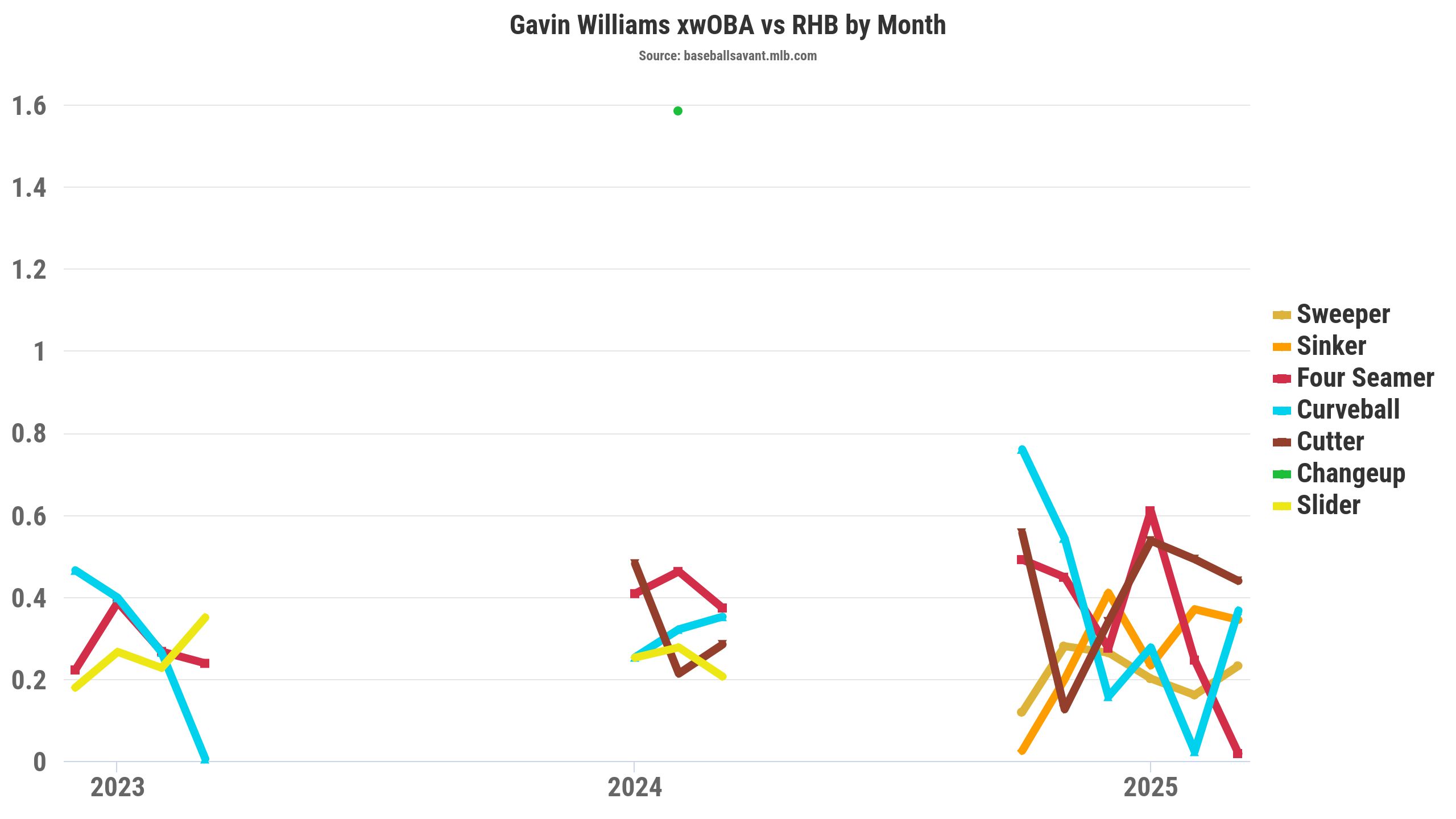
Although Williams's four-seam was still being destroyed by right-handed hitters (.445 wOBA, .414 xwOBA), he added a sweeper and threw it 33 percent of the time in 2025. That's a notable pitch mix change, which seems favorable since it allowed a .191 wOBA (.210 xwOBA) against right-handed hitters in 2025. There's a chance Williams could take a step forward, making this a medium risk fade.
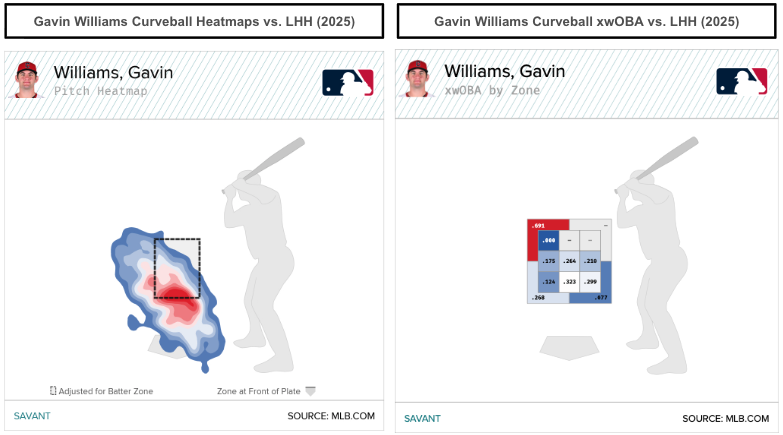
The curveball was successful against left-handed hitters, leading to a .146 wOBA (.220 xwOBA). Interesting, Williams threw his curveball more (32.8 percent) to left-handed hitters in 2025 from 21.8 percent in 2024 while lowering his four-seam usage (43.1 percent) by six percentage points.
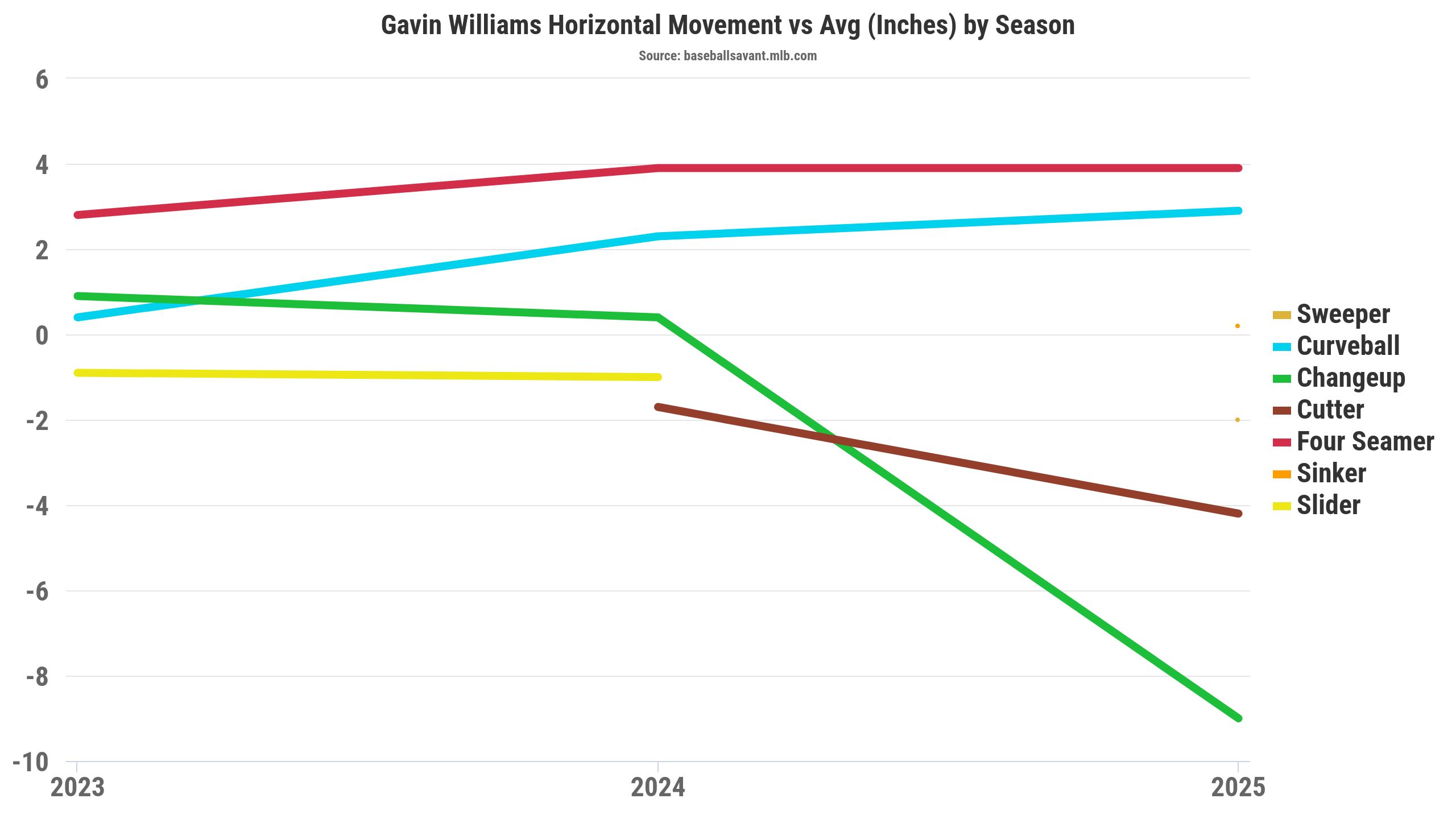
Currently, Williams has 1 to 1.5 pitches against either side of the plate, potentially putting him at risk for some struggles, specifically against left-handed hitters. That's notable because Williams throws from a lower arm slot (34 degrees) and seems to have a supinator bias, given the above-average horizontal movement via the four-seam (+3.9 inches versus average) and curveball (+2.9 inches versus average).
Typically, the pitch mix would warrant interest, but there's a volatility with a pitcher with poor control and mediocre strikeout upside like Williams. In shallower leagues, we can take the risk, yet be cautious in deeper formats.
More Fantasy Baseball Advice
Download Our Free News & Alerts Mobile App
Like what you see? Download our updated fantasy baseball app for iPhone and Android with 24x7 player news, injury alerts, sleepers, prospects & more. All free!