




 RADIO
RADIO






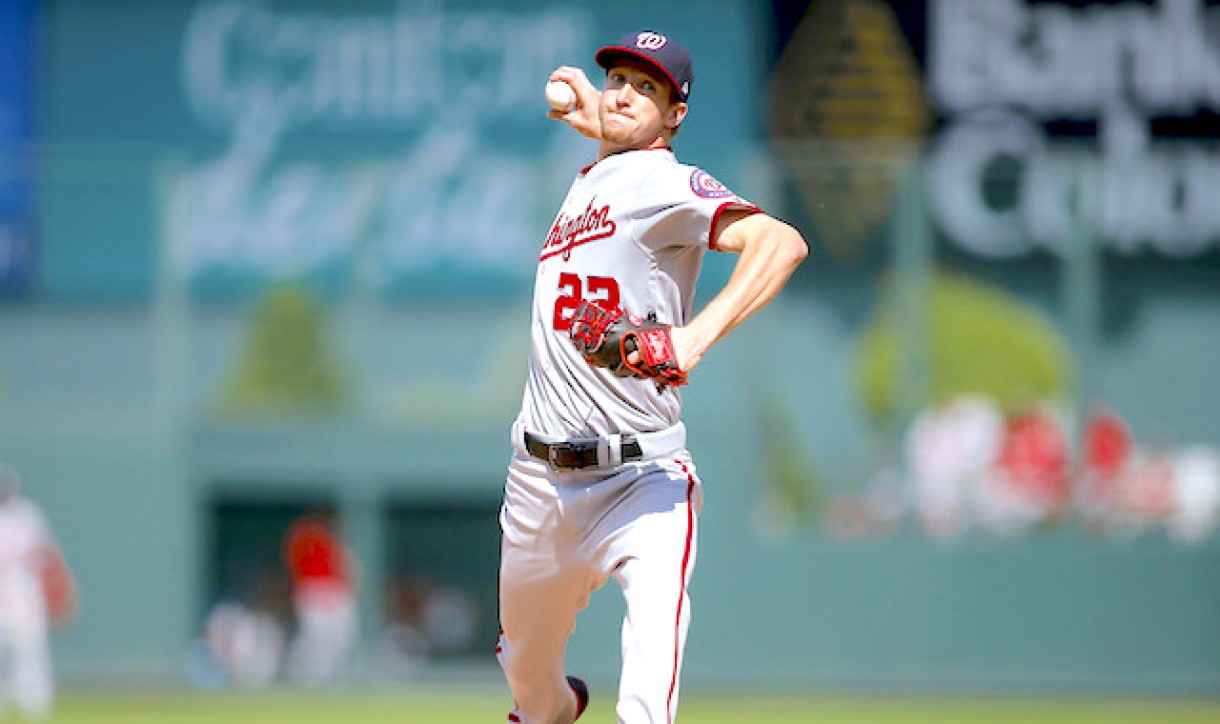
Elliott Baas looks at starting pitchers who turned in surprising starts recently. These SP could emerge as waiver wire targets and sleepers for Week 13, or simply mirages.
Welcome back to "Are You For Real?", a weekly column where we take starting pitchers who had surprisingly good starts over the past week and put them under the microscope to determine whether they're legit or just smoke and mirrors.
The east coast bias is in full effect this week, as we're taking a deep dive into three pitchers who call eastern divisions home. We'll be looking at the recent success of longtime National Erick Fedde, the emergence of Josh Winckowski in Boston, and the season-long performance of ex-reliever Tyler Wells in Baltimore.
Roster percentages are taken from Yahoo and are accurate as of 7/4/22.
Featured Promo: Save 50% off the regular price with discount code CHAMP, for a limited time. Exclusive access to our Team Sync platform, DFS cheat sheets, Lineup Optimizers, betting/prop picks, and exclusive content from Nick Mariano and Eric Cross! GAIN ACCESS NOW
Erick Fedde, Washington Nationals – 8% Rostered
2022 Stats (before this start): 73.2 IP, 4.40 ERA, 4.31 FIP, 7.8% K-BB%
07/03 vs. MIA: 6 IP, 3 H, 2 ER, 3 BB, 6 K
Fedde earned himself another quality start on Sunday, allowing just two runs over six innings in a no-decision against Miami. This fine outing is the continuation of a mini-hot streak for Fedde, who has a 2.12 ERA across 17 innings over his last three starts. The 29-year-old right-hander has been something of a forgotten name this season, scarcely garnering attention in the fantasy realm despite being a fixture in Washington’s rotation since the start of the season. Is there something more to the often overlooked Fedde, or does he belong on the fringes of fantasy viability?
A first-round pick back in 2014 by the Nationals, Fedde was a high school teammate of Bryce Harper in Las Vegas. Perhaps the Nationals were hoping to hit the jackpot twice out of the city famous for gambling, but things continuously came up snake eyes for Fedde. He underwent Tommy John surgery ahead of the 2014 draft and struggled to maintain his effectiveness as he advanced through the minors. Fedde seemed destined for a career in the bullpen before injuries to the infamously fragile Stephen Strasburg and Joe Ross opened the door to a starting role. Fedde’s repertoire certainly suggests that he could be a starter, as Fedde can throw between 92-93 MPH and uses a four-pitch mix consisting of a sinker, curveball, cutter, and changeup. The curveball has been Fedde’s best pitch throughout his career, and would likely be the driving factor behind his newfound success.
Sometimes categorized as a slider, other times as a curve, and sometime as a slurve Fedde’s primary breaking ball moves in line with a more traditional curveball, and for the sake of consistency, this pitch will be referred to as a curveball going forward. He doesn’t throw it all that hard with just a 78.2 MPH average exit velocity, and it has heavy vertical movement, which we typically see more of from curveballs. Where things get hazy are the spin rate, which is well below average for a curveball at 2386 RPM, and the heavy horizontal movement, which is more typical of a slider. Fedde himself once refused to define the pitch, though acknowledging it as a hybrid. Here’s an example of the pitch in action:

Looks pretty good there, and one can definitely see both the slider and curveball aspects of the pitch in that example. If we think of breaking balls as a spectrum, with one end being a hardline traditional curveball and another being a hardline traditional slider, this pitch belongs well on the curveball side of things. The classification of the pitch is but a small issue, however, with the larger problem being the quality of the pitch itself. Slider, curveball, spaceball, whatever it’s called, the fact remains that the pitch—supposedly Fedde’s best—just does not stack up.
Batters have enjoyed seeing Fedde’s curveball this season, posting a .311 average and .467 SLG off the pitch in 2022. It may be Fedde’s best strikeout pitch, but Fedde still generates pitiful numbers with it compared to the rest of the league. He has a 10.1% swinging strike rate and 28% chase rate with his curveball, numbers that some pitchers can eclipse with their fastballs, let alone what a more effective breaking ball could do. During his three-start hot streak, Fedde has an abysmal 5.9% swinging strike rate, nearly a full percentage point lower than the lowest qualified starting pitcher (Madison Bumgarner at 6.8%). This is the best Fedde has to offer, and it lags far behind the rest of the league.
It would be easier not to pile on to the deficiencies of Fedde’s game if he were doing something new or novel that might lend insight into his recent success, but from the looks of it, everything has remained the same for Fedde. He’s used his fastball a little more and his cutter a little less over his three-start stretch, but between his past track record and measurable qualities of the pitches, these changes would likely bear scant effect on his game over the long run and could be as easily chalked up to situational circumstance as they could deliberate change. Further exacerbating this writer’s skepticism is the competition which Fedde faced over his hot streak. Major league players are always tough opponents, but it’s hard to buy into anyone whose only success comes against the trio of Miami, Baltimore, and Pittsburgh. Fedde offers little to inspire prospective fantasy owners and is best used in a streaming capacity against weak lineups if used at all.
Verdict:
Not much seems to have changed for Erick Fedde, who is still using the same pitches and sequencing that has earned him a 5.06 ERA and 5.02 FIP over 407 career innings to date. His mediocrity is compounded by the fact that he’s on a poor team and has a short leash, meaning wins will be few and far between. He doesn’t help in the strikeout department either, as Fedde’s underwhelming 19% K rate this season is actually above his career average of 18.1%. There’s not much in this profile to suggest Fedde is more than a mid-4s ERA rotation filler, and he should be avoided by fantasy players except in deeper leagues where his solid role as a starter carries value by itself.
Josh Winckowski, Boston Red Sox – 15% Rostered
2022 Stats (prior to this start): 20 IP, 3.60 ERA, 3.37 FIP, 8.1% K-BB
07/02 @ CHC: 6 IP, 6 H, 2 R (1 ER), 1 BB, 6 K
Winckowski made headlines following this start, letting the media know he was underwhelmed by the 108-year-old home ballpark of the Chicago Cubs. Winckowski certainly had his way on the mound of Wrigley Field, allowing just one earned run over six innings while putting up a career-high six strikeouts. It was another strong start from the unheralded 24-year-old righty, who now has a 3.12 ERA over his first five starts. Injuries to the ever-fragile Rich Hill and Nathan Eovaldi have Boston’s rotation in shambles and Winckowski has been a welcome boon to their pitching staff, but is Winckowski someone noteworthy, or is he just “stock standard”?
Originally a 15th-round pick by Toronto back in 2016, Winckowski has never been much of a prospect. He was a throw-in piece to the Mets in the Steven Matz deal, and a throw-in piece yet again to Boston in the Andrew Benintendi trade. Just making the majors is an impressive feat for Winckowski given his background, but to thrive as a starter, even if ultimately fleeting, is all the more impressive. Winckowski works with a five-pitch arsenal consisting of a four-seam fastball, cutter, sinker, changeup, and slider. Winckowksi may feature a wide variety of pitches, but for him, it’s all about two: the sinker and the slider.
One of the more standout pieces of Winckowski game is his fastball velocity, which, while not overpowering like a Spencer Strider type, is solidly above average at around 94-95 MPH. This velocity is likely one of the biggest factors that helped Winckowski get noticed in the minors despite having such little pedigree to his name. Again, 94 MPH isn’t quite athletic freak territory, but that above-average velocity coupled with consistent results helped Winckowski advance as a starter. Winckowski’s minor league numbers are rather impressive, and the sinker looks to be one of the biggest driving forces behind this success.
Winckowski is a machine at keeping the ball on the ground and in the yard. He routinely had groundball rates above 50%, and had a microscopic 0.46 HR/9 between 2018-2022 in the minors, ranging from High-A to Triple-A. These trends have been present thus far for Winckowksi in the majors, as he has a 56.1% groundball rate and a 2.8-degree average launch angle through five starts. It takes a long time for batted ball numbers to normalize, but his pitching style and minor league track record suggest that Winckowski has strong groundball tendencies, and this may be a repeatable skill for him going forward.
In addition to the sinker, Winckowski’s got a solid breaking ball at his disposal with his slider. A slow-ish offering relative to his fastball, Winckowski's slider has exceptional vertical movement and late break, making it an especially frustrating pitch for opponents waiting on his sharp two-seamer. Batters have been flummoxed by the pitch as well, hitting just .207 off Winckowksi’s fastball along with a .276 SLG and a 16.5% swinging strike rate. Here’s an example of the pitch from earlier this year.

This example demonstrates the trickiness of the late vertical break, as the poor hitter, Austin Hedges, was almost certainly sitting fastball in a 3-2 count with runners on base. The pitch looks so much like a fastball out of the hand that Hedges had no choice but to overcommit and wound up looking foolish. The fact that Winckowksi had the fortitude to throw his slider in that situation is impressive considering this was just his fourth career start. He’s shown a willingness to throw his slider in risky or nonconventional situations as well, using it almost 40% of the time when behind in the count to a right-handed hitter. The apparent strengths of the slider along with Winckowski’s aggressive use of the pitch may lead to better strikeout numbers ahead, especially considering he regularly had strikeout rates above 9.0 K/9 in the minor leagues.
Verdict:
It’s far too early to make sweeping judgments for Winckowksi’s future, but there’s a lot to like in what we’ve seen thus far. His sinker-slider combination looks like a reliable source of groundballs that may bring better strikeout numbers over time, this winning duo is buoyed by a deeper arsenal of pitches that includes a four-seamer, cutter, and changeup. Winckowksi will likely experience lumps as most young pitchers do, but he may emerge as a semi-dependable arm over the summer, and it might be easier for fantasy managers to take those lumps with the might of Boston’s offense supporting him. Even when Rich Hill and Nathan Eovaldi return there could be a spot for Winckowski, as Boston’s rotation is mostly comprised of injury-prone pitchers like those just mentioned, and miraculous but unsustainable performances from spare parts like Nick Pivetta and Michael Wacha. There is a good chance that something somewhere will give out and Winckowski’s role could be secured.
Tyler Wells, Baltimore Orioles – 39% Rostered
2022 (prior to this start): 69.2 IP, 3.23 ERA, 4.34 FIP, 9.7% K-BB%
07/03 @ MIN: 6 IP, 3 H, 1 ER, 1 BB, 7 K
Based on his season-long stats (7-4, 3.09 ERA, 75.2 IP) Wells doesn’t belong in a piece like this. He’s continuously and repeatedly been effective despite pitching in one of the toughest divisions in baseball with little talent around him. However, the fact that he’s only rostered in 39% of leagues tells you exactly why Wells still deserves further analysis. Nobody believes in this guy. More people are holding out for the Kyle Hendricks turnaround (Hendricks is 41% rostered) than adding Wells, but are they wrong to doubt him? Wells’s 4.68 xFIP is over 1.5 runs higher than his actual ERA, and his 5.95 K/9 looks like a number out of the 1980s rather than the strikeout rate of a successful starting pitcher in 2022. Just how exactly is Wells doing it?
Listed at 6’8” and 255 pounds, Wells is built more like a power forward than a power arm, and his mid-90s fastball velocity might seem underwhelming given his enormous frame. Even if Wells isn’t a standout in fastball velocity he is firmly above league average, throwing about as hard as Josh Winckowski. Wells uses a four-seamer as his primary fastball however and rounds out his arsenal with a slider, changeup, and curveball. Wells might not have been a totally unfamiliar name to fantasy players ahead of 2022, as the hulking hurler was in Baltimore’s closer mix last season, notching four saves in seven chances.
While perhaps not his best or most effective pitch, Wells’s fastball has been at the center of his success, with the pitch’s oddities offering insight into the confounding nature of Wells’s success. Opponents have hit just .248 against the pitch this season, though batters have been able to generate a decent amount of power off the pitch. Opposing hitters have crushed seven homers off Wells’s fastball this season, along with a .495 SLG and an even more concerning .671 xSLG. The power Wells surrenders with this pitch is merely a side effect of Wells’s style, however, as Wells displays extreme flyball tendencies driven mainly by his fastball, an approach that inevitably leads to allowing extra base hits.
Batters have a 29-degree average launch angle against Wells’s four-seamer this season and a 20.1-degree average launch angle against him overall, which is the third highest in the majors (min. 200 batted ball events). His 47.4% flyball rate is the fifth highest in the majors (min. 70 IP), and his fastball has a staggering 54.6% flyball rate by itself. While giving up home runs is a forgone conclusion for pitchers with this style, a flyball-heavy approach has its benefits as well. Flyballs have the lowest hit probability of any batted ball type, with infield flyballs especially unlikely to drop in. Wells has an impressive 17.6% infield flyball rate this season, and his infield flyball rate was routinely above 25% as a minor leaguer. Wells can induce flyballs at such a prodigious rate due to two things, the high fastball, and an elite spin rate. Here’s a look at his fastball distribution this season.

Wells will not throw his fastball lower than belt-high, making it difficult to square up unless he makes a mistake. Wells’s fastball also averages 2447 RPM, putting him in the 94th percentile of spin rate on his fastball. We usually think of spin rate as aiding in deception and therefore boosting strikeout numbers, but that doesn’t always have to be the case. A high spin fastball is deceptive due to the Magnus Effect, where the backspin of the ball fights against gravity, so the ball doesn’t follow the typical trajectory for an object of its size traveling at its speed. It’s how a fastball can have a “rising effect” even as the ball is being pulled down by gravity. The ball isn’t actually rising, it’s just not falling as fast as the human with the bat anticipates and the ball ends up in a different spot than the hitter expects. This all happens in a matter of microseconds and is based on reaction, so even if the batter has the foreknowledge that the ball cannot rise once it leaves the pitcher’s hand, they are still susceptible to its effect.
How does this apply to Wells? Let’s bring it back to deceptiveness because Wells’s pitiful 5.95 K/9 has few viewing him as a deceptive pitcher. However, that’s only if we view Wells through the binary of contact/no contact. A swing-and-miss is the best possible outcome for a pitcher, but it’s not the only good outcome. If high spin causes a player to misjudge where a pitch will wind up, that player will likely produce poor contact if he strikes the ball at all. In short, Wells is throwing high spin fastballs high in the zone from a 6’8” frame, causing batters to habitually swing under the ball and produce weak flyballs. It’s not as straightforward as a nasty slider piling up whiffs, or a sinkerball pitcher inducing groundballs, but there’s enough to suggest this could be a repeatable skill for Wells, and if sustainable Wells will most likely outperform his underlying metrics throughout this season and perhaps even his career. He is reminiscent of former Toronto righty Marco Estrada, who also used a high spin fastball to induce weak flyballs and routinely outperformed his underlying metrics.
While Wells appears to be using an unconventional style to find success with his fastball, the rest of his profile is a tad suspect. He’s been coasting off a .225 BABIP all season, and while Wells’s style is conducive to a better-than-average BABIP, .225 is extraordinarily low even with his style. His breaking balls were quite effective out of the bullpen, but Wells has had to dial things back to pitch deeper into games. He lost 1.2 MPH and an inch of drop on his slider compared to last season, changes that resulted in a mediocre 11.5% swinging strike rate with the pitch, compared to a 17.5% swinging strike rate last season. Other than his skill at inducing flyballs, nothing much stands out about Wells and his ERA and WHIP will likely climb closer to 4.00 over time.
Verdict:
Almost everything about Wells is weird, at least in terms of his baseball arc and pitching style. He was a rule 5 pick turned so-so closer turned effective starter. He went two years without throwing a professional pitch due to TJ surgery and COVID between 2019-2021. He’s one of the biggest people in baseball; his 6’8” frame would have even Aaron Judge standing on his tiptoes. He pitches intending to induce flyballs in a division where the ball flies like no other and in an era where the goal of many opponents is to hit a flyball. It’s the strangeness of Wells that has likely kept fantasy managers away, and with good reason. There’s not much in his peripherals one can point at to explain his success, at least not straightforwardly. Even with all these concerns, it’s hard to ignore what Wells has accomplished thus far. He is doing it like no one else, and his ability to generate weak flyballs appears legitimate. Wells will have a tough time keeping an ERA this close to 3.00 over the full season, but he is a legitimate back-end rotation piece. Don’t believe the 3.09 ERA, but don’t be afraid of the 4.68 xFIP either. The true Tyler Wells is likely somewhere in the middle.
Download Our Free News & Alerts Mobile App
Like what you see? Download our updated fantasy baseball app for iPhone and Android with 24x7 player news, injury alerts, sleepers, prospects & more. All free!

More Fantasy Baseball Advice