




 RADIO
RADIO










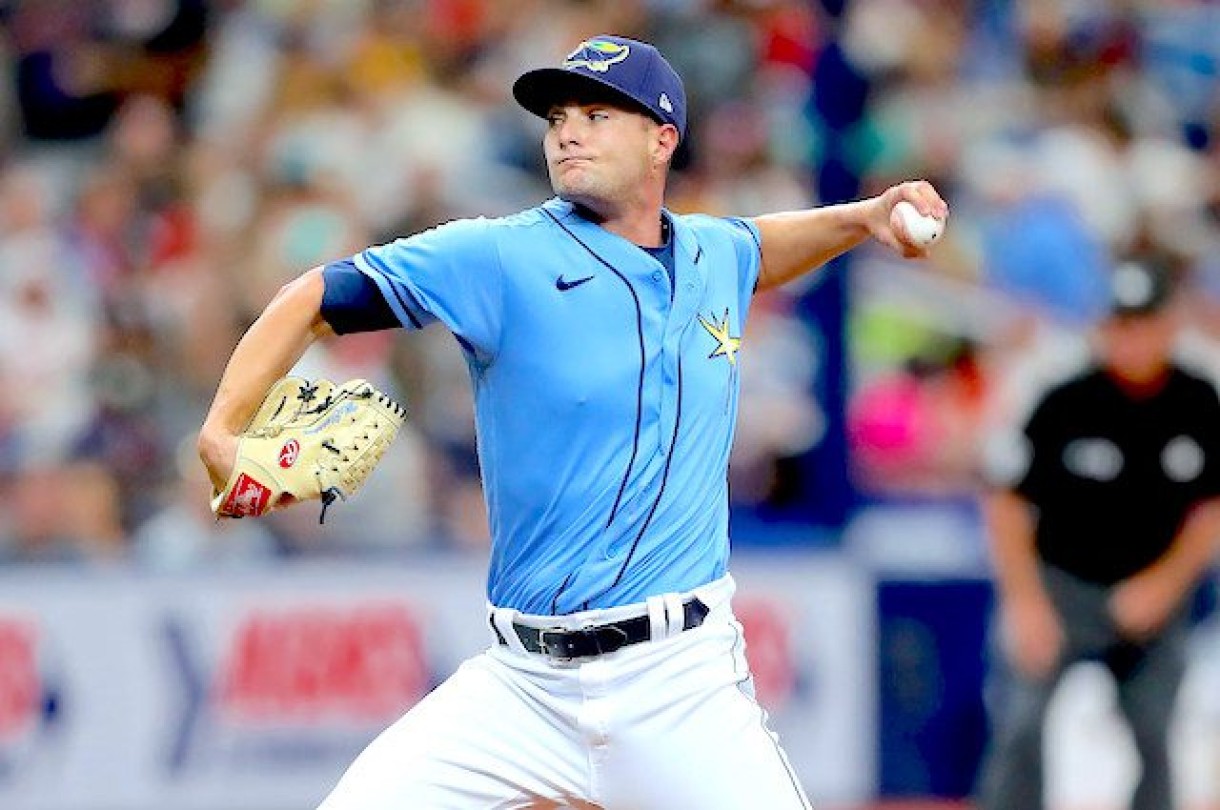
Elliott picks 6 high-upside starting pitchers, fantasy baseball sleepers and 2026 draft targets. His favorite SP values include Kris Bubic, Shane McClanahan, Grayson Rodriguez, and more.
We're deep into draft season, and with spring training underway, many young, exciting players are getting lots of helium in draft lobbies. You don't need to spend a top-100 pick to get an exciting young sleeper, as there are plenty of pitchers going after pick 200 that present tons of upside at a cheap cost.
In this article, I'm going to make the case for six arms going after pick 200 as breakout candidates. These are not your typical top prospects, and each of these guys carries his own flaws and set of risks on the mound. Still, I'd rather target a high ceiling than safety late in the draft, and each of these guys presents his own unique brand of upside.
I've included ADP data from NFBC, sourced from drafts as of February 28.
Featured Promo: Save 50% off the regular price with discount code CHAMP, for a limited time. Exclusive access to our Team Sync platform, DFS cheat sheets, Lineup Optimizers, betting/prop picks, and exclusive content from Nick Mariano and Eric Cross! GAIN ACCESS NOW
Kris Bubic, Kansas City Royals
NFBC 208.26
Bubic seems to be a forgotten man after experiencing a breakout first half in 2025. Last season, Bubic posted a 2.55 ERA, 2.89 FIP, and 16.2% K-BB% in 116 1/3 innings before going down with a rotator cuff strain. Shoulder injuries are always scary for pitchers, but Bubic is expected to be ready for Opening Day and has a spot in Kansas City’s rotation.
While he probably can’t sustain a 2.55 ERA over a full season, there’s plenty of reason to jump back on the Bubic train for 2026.
Bubic has a deep five-pitch repertoire, consisting of a four-seam fastball, changeup, sweeper, slider, and sinker. These pitches have all shown to be effective at times, but for Bubic, it’s mostly about the four-seamer and changeup.
Bubic’s fastball doesn’t jump out at just 92.4 mph; in fact, it was in the 18th percentile of fastball velocity last season. Despite being a soft pitch, the four-seamer was still quite effective in 2025. Batters hit .241 off the pitch with a .370 SLG and .299 wOBA. The expected stats suggest that he earned these results, with a .223 xBA, .356 xSLG, and .287 xwOBA. He also had a 27.2% whiff rate, which is good for a fastball.
How does he do it with below-average velocity? It’s all about location and pitch shape. Bubic got 18.1 inches of induced vertical break and 4.3 inches of arm-side movement with the pitch last season, both plus movement. The IVB number is the big standout, as it means his fastball has a strong rise. A thrown pitch doesn’t literally rise as that would be impossible, but the break means the pitch does not drop along a typical trajectory, giving the batter the perception of rise and making the ball difficult to read, often causing batters to swing over the pitch.
Bubic was keeping his fastball up in the zone or even above the zone routinely in 2025, which is exactly where he should locate for whiffs. Let’s have a look at his pitch movement profile from 2025 (four-seamer in red).
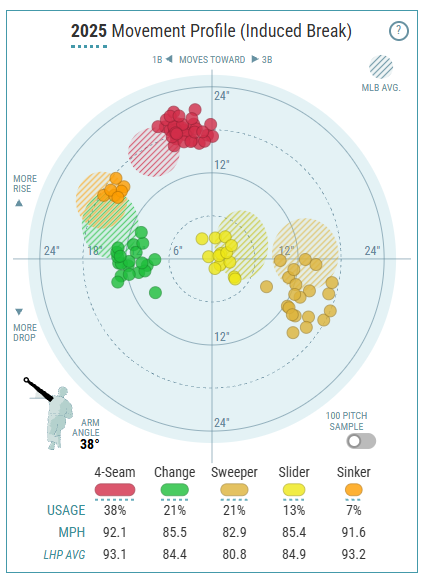
See how much the pitch deviates from league average. That’s what makes it special, and as long as the fastball shape is intact following his injury, the pitch should still be effective.
If a 92 mph fastball doesn’t excite you, perhaps his changeup will. An 85.5 mph offering, Bubic shut hitters down with this pitch in 2025. Opponents hit .198 with a .242 SLG and .247 wOBA off the pitch last season, and had a .185 xBA, .247 xSLG, and .253 xwOBA, suggesting that he earned those strong results. He also a 38.4% whiff rate and a -5-degree average launch angle against.
Whiffs and grounders are what we want from a changeup, and Bubic got plenty of both last season.
The changeup had some exceptional movement in 2025, with plus drop and 11.3 inches of arm-side movement. Let’s peek at that pitch movement profile again, this time focusing on the changeup (green).
And here's an example of the pitch itself.
Last season, batters had a .185 xBA, .247 xSLG, and .253 xwOBA against Kris Bubic's changeup, along with a monster 38.1% whiff rate. This is a special offering from a pitcher going far too late in drafts this season. pic.twitter.com/QjNUMnzkns
— Elliott Baas (@ElliottBaasBB) February 28, 2026
It’s another unique shape, and it makes the pitch both hard to hit and hard to make solid contact against. The changeup was the pitch that got Bubic to the majors, and it has been dominant for him over the past two seasons. He had a 24.4% K rate last season, and while that’s probably at or near his strikeout ceiling, I think he’s plenty capable of putting up an above-average strikeout rate once again.
He rounds out his repertoire with a sweeper, slider, and sinker, and the two breaking pitches performed well last season. The sweeper was especially strong, with batters hitting .194 with a .286 SLG and .224 Woba against, as well as a 26.7% whiff rate. The sweeper has 4.7 inches of drop and 13 inches of glove-side movement, making it a pitch with a unique shape as well.
The sweeper gives him a tool that works against both lefties and righties, as he rarely throws his change to left-handed batters.
Bubic definitely benefited from some good fortune last season, such as a 77.5% LOB rate and a 5.7% HR/FB rate, both of which will likely regress (especially with the changes to Kauffman Stadium) and pull his ERA closer to estimators like his 3.63 xFIP and 3.85 SIERA. Still, we’re looking at a pitcher who’s shown us how good he can be, possesses a deep arsenal with some plus secondary stuff, and has a secure rotation spot on what should be a competitive Royals team.
The big risk is injury, but if healthy, he could pick right up where he left off last season.
Shane McClanahan, Tampa Bay Rays
NFBC: 214.26
Shane McClanahan is back (we hope) after missing the last two full seasons thanks to Tommy John surgery costing him all of 2024 and a triceps injury costing him the entire 2025. It’s been so long since we’ve seen him pitch in the majors that it’s easy to forget how good McClanahan was at his peak. In 2022, he finished sixth in Cy Young voting (in a stacked year) with a 2.54 ERA, 2.82 SIERA, and 24.3% K-BB% in 166 1/3 innings.
Those are frontline starter numbers, and while it might be tough for him to recapture that level of success, at least right away, he’s still never posted an ERA above 3.43 or a strikeout rate below 25.8%. McClanahan could perform like a top-20 starter if healthy, and all reports out of Tampa say he’s going to start the season in the rotation.
The big thing for McClanahan is going to be whether his velocity returns and whether his fastball shape is intact. He was one of the hardest-throwing starters in the game with a 96.8 mph four-seamer last we saw him in 2023. He also had 17.6 inches of induced vertical break and 9.9 inches of arm-side run with the pitch, giving it a unique, tough-to-read shape on top of excellent velocity.
This will be one player and one pitch I watch closely this spring, because if it looks anything like it did pre-TJ, McClanahan would be on his way back to ace-hood again.
McClanahan was more than a big fastball; he’s got a trio of strong secondary offerings, including a changeup, curveball, and slider. The changeup has been nothing short of dominant at the major league level, and last we saw him in 2023, batters hit just .153 off the change, along with a .191 SLG and .161 wOBA.
He had a monster 54.5% whiff rate that year as well. For secondary pitches, above 30% is good, above 40% is dominant, and above 50% is practically unheard of for a starter. Seriously, not even Tarik Skubal or Paul Skenes has done this over an extended period. While I wouldn’t expect a whiff rate quite that high again, McClanahan’s changeup is a deadly offering that confounds hitters. Here’s an example of the pitch from 2023.
The last time we saw Shane McClanahan, he put up a 54.5% whiff rate and a .179 xBA with his changeup. If healthy, he has frontline starter potential pic.twitter.com/E05aeDvvYI
— Elliott Baas (@ElliottBaasBB) February 28, 2026
Good night, that is gnarly. With 6.6 inches of IVB and 16.2 inches of arm-side run, it’s got outstanding movement for a changeup.
Batters are hitting .169 against the changeup all-time, which is the same exact batting average that they have against McClanahan’s curveball all-time as well. The curveball isn’t as big of a strikeout offering, but it had a strong 31.4% whiff rate in 2023. It’s a harder, sharper curveball at 83.5 mph with 8.5 inches of drop. Here’s an example from 2023.
Batters are hitting .169 with a 57.7% groundball rate and a 12.7% swinging strike rate against Shane McClanahan's curveball all time. Between the plus fastball velo, nasty changeup, and this curve, he's got all the ingredients for a comeback. pic.twitter.com/zFkME5iYS8
— Elliott Baas (@ElliottBaasBB) February 28, 2026
The curveball gives him two weapons against righties, and McClanahan has actually handled righties a little better than lefties in his career (.278 wOBA vs. R, .289 wOBA vs. L).
What worries me with McClanahan, aside from health, is control. His control was starting to waver before he went down with a torn UCL, as his walk rate ballooned from 5.9% in 2022 to 8.7% in 2023. Control and command are where pitchers tend to struggle coming back from Tommy John surgery (see Sandy Alcantara’s 2025), and McClanahan is coming back from Tommy John and a triceps nerve injury.
Injury is again the big risk here, but if McClanahan could give us anything close to 150 innings, he’d be a good value at this price. He’s shown he has the stuff to be a frontline starter in the past, which makes him a good dice roll around pick 220.
Braxton Ashcraft, Pittsburgh Pirates
NFBC ADP: 268.63
The Pittsburgh rotation gets a lot of attention with the likes of Paul Skenes and Bubba Chandler leading the way, but Ashcraft is a lesser-known arm that flashed some intriguing upside last season. He had a 2.71 ERA, 2.78 FIP, 3.61 SIERA, and 16.1% K-BB% in 69 2/3 innings between the bullpen and rotation. He performed better as a starter, posting a 2.16 ERA, 2.42 FIP, and 18.5% K-BB% with a 25.9% raw K rate in eight starts.
Now a likely candidate to remain in Pittsburgh’s rotation, Ashcraft can be had quite cheaply on draft day. He’s going around pick 350 in NFBC leagues, which is a pretty good price for someone with a likely rotation spot in a pitcher’s park. But how good can Ashcraft be?
Ashcraft possesses a deep arsenal of five pitches, consisting of a four-seam fastball, slider, curveball, sinker, and changeup. His best pitch is probably the slider, which he threw most often at 31.2% last season. Batters struggled against the pitch to the tune of a .225 AVG, .333 SLG, and .273 wOBA. The expected stats are even better, with a .214 xBA, .298 xSLG, and .257 xwOBA.
He had a 32.4% whiff rate, and batters had just an 83 mph average exit velocity against this pitch. It’s a hard, sharp gyro slider at 92 mph. Here’s an example of the pitch from last season.
At 92 mph Braxton Ashcraft's slider was the second-hardest slider among qualified pitchers last season. The pitch was good for a .214 xBA against and a 32.4% whiff rate. Routinely going after pick 300, Ashcraft is an interesting sleeper this season. pic.twitter.com/PlvkJPs4s8
— Elliott Baas (@ElliottBaasBB) February 28, 2026
That’s harder than many fastballs, and Ashcraft didn’t lose any velocity when he moved to the rotation. In fact, he threw it nearly 1 mph harder in his final seven starts. It doesn’t have extreme movement, which is typical for a hard gyro slider like this, but it’s got plenty of strikeout potential as his primary breaking ball. He often used it when ahead in the count or as a two-strike hammer for punchouts.
His other breaking ball is an 84.3 mph curve, which he threw 21.1% of the time last year. It’s much softer than his other pitches, though still hard for a curveball. Opponents really struggled against this offering in the majors, with batters hitting .122 with a .204 SLG and .190 wOBA against Ashcraft’s curveball last season.
He also had a 36.6% whiff rate, which is very high for a curve, and he got 12.4 inches of drop and 8 inches of glove-side movement, giving it a unique shape. Here’s an example of the pitch from last season.
Batters hit .122 with a .190 wOBA and a 36.6% whiff rate against Braxton Ashcraft's curveball last season. With 12.4 inches of drop, it's a softer, loopier pitch that he can use to neutralize lefties. pic.twitter.com/ytxcGvPR2w
— Elliott Baas (@ElliottBaasBB) February 28, 2026
It’s a soft, loopy pitch that deviates from the rest of his arsenal. I wouldn’t expect it to perform quite as well next season (he had a .231 BABIP against the pitch), but this is another strong breaking ball and a tool to use against lefties.
Ashcraft has some good breaking balls, but his fastball is noteworthy for its plus velocity. He averaged 97 mph on the radar gun last season and sustained that velocity as a starter. Unfortunately, Ashcraft’s four-seamer was hit hard last season. Batters hit .323 off the pitch with a .462 SLG and .376 wOBA. The expected stats were in line with those numbers, too, as Ashcraft had a .293 xBA, .493 xSLG, and .375 xwOBA against his four-seamer.
The problem with Ashcraft’s four-seamer, despite plus velo, is his lack of pitch movement. His 15.7 inches of IVB and 7.3 inches of arm-side run are aligned with the league average. Here’s a look at his pitch movement profile from last season (four-seamer in red).
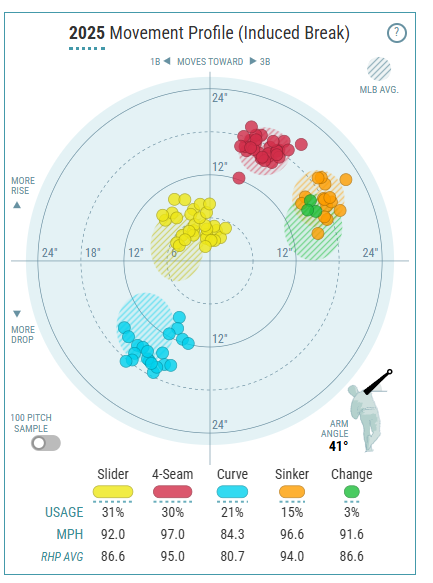
The four-seamer is right in line with MLB average, which is not where one wants to be if they aim to be deceptive. MLB hitters can handle 97 when it’s straight like this, and even though Ashcraft kept the ball up above the zone, hitters had no problem crushing his four-seamer. Sure, he might experience some regression on the .365 BABIP against this pitch, but it’s still likely to be the pitch most susceptible to hits for him.
On the bright side, Ashcraft did get some solid results with his sinker last season. Batters hit .237 off the pitch with a .289 SLG and .263 wOBA. The expected stats suggest he overperformed with the pitch, with a .281 xBA, .379 xSLG, and .315 xwOBA, but he still had a -9-degree average launch angle against, which led to a 62.5% ground-ball rate with this pitch.
The sinker was the better-performing pitch in the minors, too, and he upped his sinker usage to nearly 18% over his final seven starts. He primarily threw it to righties, and it might be a beneficial approach for Ashcraft to incorporate the sinker more frequently next season, dialing back his four-seam usage.
Altogether, while the four-seamer isn’t perfect, Ashcraft displayed the ability to get whiffs and ground-balls at an above-average rate last season and pitches in a great ballpark. He could put up a sub-4 ERA with a plus strikeout rate this season, and he figures to be a key piece of Pittsburgh’s rotation. It’s hard to find upside at this point in the draft, but Ashcraft is a young arm with two good breaking balls in a good situation.
Give me that over the likes of Brady Singer and Brayan Bello every time.
Joey Cantillo, Cleveland Guardians
NFBC: 296.74
Cantillo impressed in his time between the bullpen and rotation in 2025, posting a 3.21 ERA, 3.55 FIP, and 16.5% K-BB% along with a raw 26.9% K rate in 95 1/3 innings. He finished the season strong in Cleveland’s rotation, and even performed better as a starter versus as a reliever, putting up a 2.96 ERA and 3.21 FIP from the rotation.
Now poised to begin the year as a starter, Cantillo presents an interesting late-round choice. He’s a four-pitch pitcher, his arsenal consisting of a four-seam fastball, changeup, curveball, and slider.
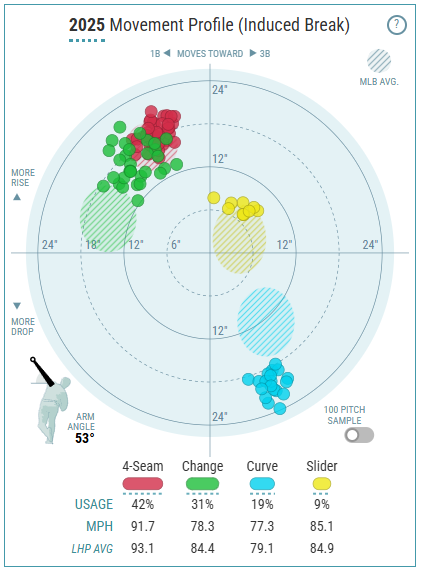
The four-seamer was Cantillo’s most used pitch last season at 42%, but it wasn’t his best pitch. That honor goes to his 78.3 mph changeup, which he threw 30.5% of the time to great results. Opponents hit .165 off the changeup, along with a .270 SLG and a .228 wOBA. The expected stats suggest that Cantillo earned these results with a .170 xBA, .226 xSLG, and .216 xwOBA.
Cantillo had a monster 49.4% whiff rate with the changeup as well; it was the big reason behind his plus strikeout numbers.
What makes the pitch so effective? Cantillo has 12.4 inches of induced vertical break and 10.3 inches of arm-side movement, giving it plenty of rise and making it tough to read for opposing hitters. Here’s a look at his pitch movement profile from 2025 (changeup in green).
And here’s an example of the pitch.
Joey Cantillo confounded hitters with his changeup last season, holding opponents to a .165 AVG and .228 wOBA, along with a monster 49.4% whiff rate. With 12.4 inches of rise and 10.3 inches of arm-side run, it's a truly devastating pitch. pic.twitter.com/KjJfJffsBS
— Elliott Baas (@ElliottBaasBB) February 28, 2026
It’s a frustratingly deceptive pitch for hitters, and while a 49.4% whiff rate probably isn’t sustainable over the long term, he did have a 51.7% whiff rate at Triple-A last season and a 43.4% whiff rate in the majors in 2024. Cantillo has a proven track record of plus strikeout rates in the minors, and this changeup may be able to get him there in the majors. It’s not often that we see starters with double-digit K/9 potential going so late in drafts.
One reason for the skepticism on Cantillo may be the poor measurables on his fastball. Not only is it a meager 91.7 mph offering, glacially slow in today’s game, but it has a very low spin rate at 1842 RPM and has roughly average movement, with 16.9 inches of IVB and 7.1 inches of arm-side run. Let’s have a look at his pitch movement profile again (four-seamer in red).
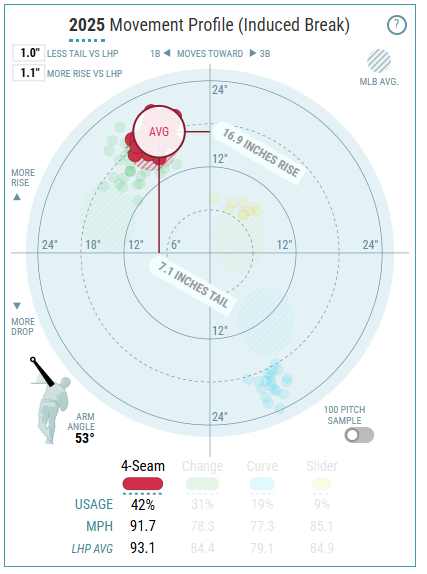
It sort of lines up with the MLB average, which is not where you want to be with a 91 mph fastball. Cantillo was kind of all over the place with his fastball in 2025, have a look at his four-seam heatmap.
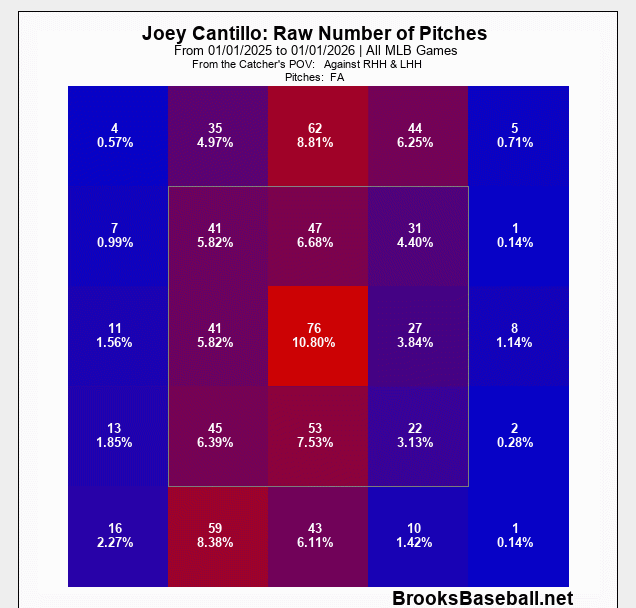
He’s up, he’s down, he’s in the middle. This may be a sign of poor command from Cantillo, which is not one of his strong suits. Ultimately, he had a 61% zone rate and an 89.5% zone contact rate against his fastball last season, with just a 16% chase rate and a 14.9% whiff rate. I love Cantillo’s changeup, but this fastball may be a liability for him.
Cantillo also has a big, loopy 77.3 mph curveball, a pitch that had a .199 xBA, .261 xSLG, and .206 xwOBA against last season. He also had a 1-degree average launch angle against the curveball with a 53.8% ground-ball rate. The curveball has a whopping 18 inches of drop and 8.2 inches of glove-side movement, giving it a unique shape and making it difficult to elevate for hitters. Let’s have yet another peek at that pitch movement profile (curveball in blue)
And here's an example of the pitch from last season.
With 18 inches of drop, Joey Cantillo had the second-most drop on his curveball among qualified pitchers last season. That made the pitch tough to elevate, with a 1-degree average launch angle against and a .199 xBA. It's not just about the change for Cantillo. pic.twitter.com/gG8CDehz0H
— Elliott Baas (@ElliottBaasBB) February 28, 2026
That is a lot of drop, and while its 24.3% whiff rate is okay for a curveball, this is another pitch that Cantillo can use against righties, along with the changeup, to produce outs.
He rounds out his arsenal with an 85.1 mph slider, a pitch he threw just 8.7% of the time last season. The slider isn’t particularly hard or sharp, and he only had a modest 28.6% whiff rate with it last season. This pitch isn’t a liability like his four-seamer, but it is a rather underwhelming offering. It’s soft with poor movement and has never been a big strikeout generator.
The poor quality of his fastball and slider, and the strong quality of his changeup and curveball, gave him big reverse platoon splits last season. Righties hit .204 with a .272 wOBA off Cantillo, but lefties hit .258 with a .334 wOBA. That’s because his arsenal is better suited to take on opposite-handed hitters. There are a lot more righties than lefties in the majors, so this isn’t necessarily a bad thing.
One more flaw to be aware of with Cantillo is his poor control. We saw it in his fastball heatmap, but he’s routinely posted double-digit walk rates throughout the minors and had a 10.5% BB rate last season. He’s not the perfect sleeper, and he wasn’t a big prospect like some of these other pitchers, but the changeup is undeniable, and the strikeout potential is real.
He could be a WHIP killer, but he’s also a good dart throw around pick 300. There are not many pitchers going around him with major league jobs and plus strikeout upside.
Grayson Rodriguez, Los Angeles Angels
NFBC: 272.56
A former top pitching prospect, Rodriguez missed all of 2025 thanks to an elbow injury. He also got a situational downgrade, being shipped from Baltimore to Anaheim in exchange for Taylor Ward. It was a low-risk, high upside move for the rebuilding Angels, because if they can get Rodriguez right, he’s got plenty of years of control. Rodriguez pitched well the last time we saw him.
In 2024, he made 20 starts and pitched to a 3.86 ERA, 3.61 SIERA, and a 19.1% K-BB%. It was a very promising season for the then 24-year-old, and though he didn’t get a chance to build on it in 2025, he does have a secure role in the Angels’ rotation and should have plenty of opportunities in 2026 if he can stay healthy.
Something I want to watch closely with Rodriguez is his fastball velocity and shape. Rodriguez is a hard-thrower, averaging 97.4 mph in 2023, though that dipped to 96.1 mph in 2024. He was averaging 96.1 mph in his first spring start on 2/24/26, and even touched 98 mph. We’ll also want to pay close attention to his fastball shape. Rodriguez never had exceptional IVB, but he averaged 12.7 inches of arm-side movement with his four-seamer in 2024, giving it a unique shape on top of the plus velocity.
Batters hit .287 off the four-seamer in 2024, but he had a .239 xBA, .395 xSLG, and .320 xwOBA against, along with a solid 27% whiff rate. Rodriguez also averaged 7.3 feet of extension on his fastball delivery, putting him in the 97th percentile. That elite extension increases the fastball’s perceived velocity because it’s coming at the hitters from a shorter distance. Rodriguez certainly has all the ingredients of a plus fastball; it’ll come down to health and command for him.
It would be awesome if Rodriguez’s fastball was right for the season, because his secondary stuff has looked electric at times in the major leagues. His most used secondary pitch in 2024 was the changeup, which he threw 21% of the time. This pitch dominated opponents, with batters hitting .161 off the change with a .306 SLG and .241 wOBA.
He also had a 34.8% whiff rate with the pitch, and batters struggled to make solid contact when they did hit it, with an average exit velocity of 86.6 mph.
An 83.1 mph offering, there is a big velocity gap between the changeup and fastball. A 13 mph gap is perfect for a changeup like this, because it’s not hard enough for the hitter to adjust, and it’s not soft enough for a hitter to read early. The changeup also has plus movement with two inches of rise and 12.2 inches of arms-side run. Here’s an example of the pitch from 2024.
The last time we saw Grayson Rodriguez, he allowed a .161 AVG and .241 wOBA off his changeup, along with a 34.8% whiff rate. If healthy, he has the chance to be a plus strikeout pitcher once again. pic.twitter.com/UOdBPoKrV7
— Elliott Baas (@ElliottBaasBB) February 28, 2026
That’s nasty stuff, and this has proven to be a dominant pitch for Rodriguez in the majors. He throws it to both righties and lefties, making it a dynamic strikeout offering.
Rodriguez’s slider has also been a good strikeout pitch for him in the majors, with a 36.1% whiff rate in 2024. It’s harder than the change at 86.5 mph, but still relatively soft considering how hard he throws the fastball. It doesn’t have crazy movement for a slider, but it’s a strong offering he can use to get righties out and generate whiffs. Rodriguez had an above average 26.5% strikeout rate in 2024, and he’s got the arsenal to be a plus strikeout pitcher once again.
Aside from health, the biggest concern I have with Rodriguez is control. It was one of his biggest flaws as a prospect, and he was starting to improve before missing all of 2025. He lowered his walk rate to 7.3% in 2024, which is manageable for a high strikeout, good stuff pitcher, but things could get ugly if this number balloons. Rodriguez didn’t undergo Tommy John surgery, but he could still struggle with control upon return.
If the velocity is back, if the movement is intact, and if his control is manageable, he could perhaps recreate the 2024 season. Looking at the other pitchers going around him (Bailey Ober, Jameson Taillon, Sean Manaea), I’d much rather take a stab at a post-hype sleeper like Rodriguez than some bland innings eater at this point in the draft.
If he blows up in your face, cut him after a few starts and pick up another lotto ticket or an innings eater type. If he works out, you’ve got a great value pick.
Jacob Lopez, Athletics
NFBC: 486.30
Lopez’s final numbers from 2025 don’t look all that special. He had a 4.08 ERA, a 4.26 FIP, and a 1.27 WHIP. But he went down with a flexor strain in late August and missed the rest of the season. I mention that because he was tagged for nine earned runs in two innings in Seattle right before going on the injured list.
If we subtract that start from his numbers, they look a lot better, with Lopez pitching to a 3.28 ERA, 3.84 FIP, 1.17 WHIP, 21% K-BB%, and an impressive 29.1% raw strikeout rate.
He was starting to look like a quiet breakout in Sacramento. And now he’s going around pick 370 in Yahoo leagues this draft season. Lopez wasn’t a big prospect and doesn’t have a lot of hype around his name, but he could look to build upon last year’s success as an above-average strikeout lefty.
First thing to point out is that Lopez is a very unorthodox pitcher. His four-seam fastball putters to the plate at 90.7 mph, putting him in the eighth percentile for fastball velocity in the majors. He also slings the ball with a low 21-degree arm angle, giving him one of the lowest arm slots in the majors among left-handed pitchers. He gets 7.1 feet of extension with this delivery as well, increasing his slow fastball’s perceived velocity.
Here’s a look at one of his fastballs from 2025.
Despite throwing just 90.7 mph, Jacob Lopez had a .169 xBA and .305 xwOBA with his four-seamer last season. His funky delivery gives him 7.1 feet of extension and 13.8 inches of arm-side movement, making it deceptive despite it's weak velo. pic.twitter.com/0p4Jcl0twE
— Elliott Baas (@ElliottBaasBB) February 28, 2026
Funky delivery, and it sort of makes sense that he made his big league debut for the Rays and wound up in the Athletics’ system, as both organizations are known for taking chances on unconventional talents. Lopez’s fastball may not have a lot of velocity, but it has a ton of horizontal movement with 13.6 inches of arm-side run. That movement was on display in the above clip, as the ball just tailed away from poor Victor Caratini.
Opponents really struggled against Lopez’s fastball as well, hitting .209 with a .407 SLG and .339 wOBA. The expected stats were even better, with a .169 xBA, .353 xSLG, and .305 xwOBA against. He also had a strong 28.7% whiff rate, which is great for a 90 mph fastball.
Batters struggled to make hard contact against this pitch, with an average exit velocity of just 84.4 mph. This was a huge strength for Lopez in 2025 across all his pitches, and overall, he had an 86.9 mph average exit velocity against and an impressive 33.2% hard-hit rate allowed. These were both in the 94th percentile in the big leagues last season, and Lopez may continue to have success if he can repeat this in 2026.
The four-seamer was his most used pitch in 2025 at 35.2%, but right behind it was his slider, which he threw 30.6% of the time. A 78.1 mph offering, Lopez’s slider was the third-slowest in the majors (min. 500 pitches). It’s a soft slider with 9.2 inches of break and a 2370 RPM spin rate. Those aren’t exceptional measurables by any means, but his low arm angle and odd pitch shape make it difficult to read. Batters really struggled against this pitch in 2025 as well, hitting just .201 with a .324 SLG and .265 wOBA.
The expected stats suggest that Lopez earned these results with a .194 xBA, .299 xSLG, and .253 xwOBA. Again, batters could not make solid contact against this pitch, with a meager 82.4 mph average exit velocity against, along with a 32.7% whiff rate. The slider was Lopez’s main strikeout weapon when he was on, and he actually had eight or more strikeouts in eight of his 17 starts last season.
The slider and four-seamer work against both righties and lefties, but as a southpaw, Lopez also wields a cutter, changeup, and sinker, all of which he primarily throws to right-handed batters. The cutter was hit the hardest with a .283 AVG and .453 SLG against, along with an 89 mph average exit velocity, but Lopez had a .241 xBA and .408 xSLG with the pitch suggesting he may’ve been a little unlucky.
The same can be said about his changeup, which had a .275 AVG, .490 SLG, and .344 wOBA against, but had a .234 xBA, .362 xSLG, and .279 xwOBA. The changeup is especially interesting because Lopez had a 31.1% whiff rate with it last season, and it has some exceptional measurables. He has a 2129 RPM spin rate (high for a changeup) and 97% active spin with the pitch.
He also gets 18.4 inches of arm-side movement with the pitch, giving it a unique shape. This could serve as another strikeout weapon for Lopez, who’ll look to repeat (or come close to) his 10.97 K/9 from 2025.
Of course, a pitcher like Lopez is not without flaws. That’s why he’s going so late in drafts, after all. He is an extreme flyball pitcher with a 50.4% flyball rate against last season and had a 1.46 HR/9 last year. Your first instinct may be to blame Sutter Health Park for his Gopheritis, but he was actually much worse on the road.
Lopez had a 2.64 ERA, 3.45 FIP, and 1.22 HR/9 at home, but had a 5.40 ERA, 5.00 FIP, and 1.64 HR/9 on the road. Lopez did have two nightmare starts on the road last season, the aforementioned nine-run outing in Seattle and a seven-run shellacking in 1 2/3 innings in Toronto.
Those certainly inflated his road numbers, but Lopez is hardly someone who’s earned our trust not to blow up again. He generally gives up weak contact, which is great because weak flyballs are often outs, but batters have been able to get a hold of him and elevate him when he makes a mistake. I don’t see his flyball tendencies drastically changing next season, so home runs might remain an issue.
Lopez has also struggled with control at times. His 9.3% walk rate last season represented an improvement over where he’d been in years past in the minor leagues. He only had a 50.2% zone rate last season and a 46.8% zone rate with his fastball. When you’re throwing 90 from a weird arm angle, it’s tough to live in the zone. This will lead to walks, and the homers could lead to those walks coming around to score.
I think his soft contact and strikeout skills give him an okay shot at a sub-4 ERA with a plus strikeout rate, but he’s also someone who carries ratio risk. He’s going late enough in drafts and seemingly has a rotation spot when healthy, so he’s a fine sleeper if you’re chasing strikeouts and upside late in the draft. There aren’t many pitchers going this late who can come close to a 29% strikeout rate.
More Fantasy Baseball Advice
Download Our Free News & Alerts Mobile App
Like what you see? Download our updated fantasy baseball app for iPhone and Android with 24x7 player news, injury alerts, sleepers, prospects & more. All free!