




 RADIO
RADIO







Elliott looks at pitchers with surprising starts recently. These SPs could emerge as fantasy baseball waiver wire targets for Week 22 in 2026, or just mirages.
Welcome to the "Are You For Real?" series as we dive into Week 22 of the 2026 fantasy baseball season. For those unfamiliar, this is a weekly column where we examine starting pitchers who had surprisingly strong starts over the past week and put them under the microscope to determine whether they're legitimate or just smoke and mirrors.
While much attention has been dedicated to draft season for a certain game with an egg-shaped ball, us fantasy baseball nuts are still in the thick of things looking to bring home a title. And this week I'm breaking down three pitchers who are widely available and could help managers have a strong finish.
First, I'll deep dive Hayden Wesneski's return in Houston. Then I'll analyze Cody Bradford's comeback in Texas. And I'll finish off with the resurgence (or just surgence?) of Andrew Painter in Philly.
Featured Promo: Save 50% off the regular price with discount code CHAMP, for a limited time. Exclusive access to our Team Sync platform, DFS cheat sheets, Lineup Optimizers, betting/prop picks, and exclusive content from Nick Mariano and Eric Cross! GAIN ACCESS NOWRoster percentages are taken from Yahoo! and are accurate as of August 24.
Hayden Wesneski, Houston Astros – 16% Rostered
2026 Stats (prior to this start): 22.2 IP, 5.16 ERA, 3.70 FIP, 11.6% K-BB%
08/21 vs. ATH: 5 IP, 1 H, 0 ER, 3 BB, 4 K
Wesneski had his best start since coming off the IL this season, blanking the Athletics over five innings while picking up his third victory of the season. Wesneski returned from Tommy John surgery at the end of July, and while the results have been up and down, Wesneski does seem poised to keep a rotation spot in Houston. Can Wesneski be a difference maker these final weeks, or is he best left on waivers?
Originally a sixth-round pick by the Yankees in 2019, Wesneski was a decent prospect who was considered a future starter, but not an elite prospect. He’s been traded twice as well, once from the Yankees to the Cubs for reliever Scott Effross, and as part of the Kyle Tucker deal, going from Chicago to Houston. Wesneski works with a five-pitch mix consisting of a sweeper, four-seam fastball, sinker, cutter, and changeup.
Wesneski’s most used pitch this season has been the sweeper, which he has thrown 30.8% of the time. His usage was up in this start, as Wesneski threw the sweeper 36% of the time against the Athletics. An 80.8 mph offering, Wesneski’s sweeper is soft and loopy, with high spin at 2796 RPM. Here’s an example of the pitch from this season.
— Elliott Baas (@ElliottBaasBB) August 24, 2026
Nasty stuff, and batters have really struggled against this pitch thus far. Opponents are hitting .160 with a .200 SLG and a .191 wOBA off Wesneski’s sweeper this season. He also has a monster 44.6% whiff rate with the sweeper, and batters have a meager 79.1 mph average exit velocity against this pitch.
Even when batters make contact, they aren’t striking the ball well. That is clear in the expected stats as well, as Wesneski has a .173 xBA, .284 xSLG, and a .237 xwOBA with his sweeper this season.
Wesneski’s sweeper isn’t just exceptionally soft, it has exceptional movement as well. He averages four inches of drop and a whopping 19.6 inches of glove side movement with the sweeper. Here’s a look at Wesneski’s pitch movement profile from this season (sweeper in gold).
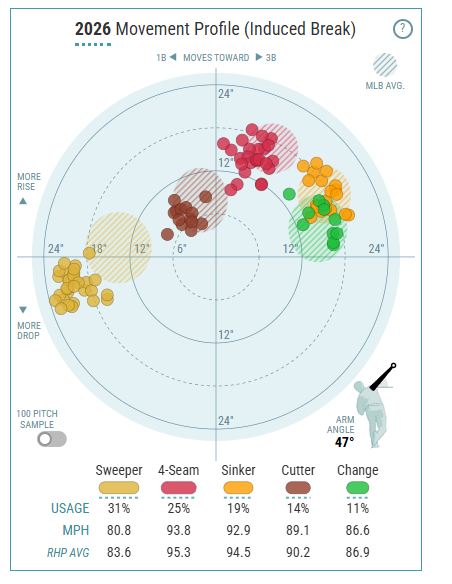
The pitch really deviates from the typical sweeper shape batters see, making it all the more difficult to read and square up. Wesneski’s sweeper has the movement and the underlying stats to suggest it’s capable of serving as a plus strikeout pitch. Wesneski only has a 19.5% strikeout rate so far this season, but he has a career 22.5% rate and I think he could reach that level again.
Wesneski’s next most used pitch is the four-seam fastball, which he has thrown 25% of the time. A 93.8 mph offering, Wesneski’s four-seamer is well below league average in terms of velocity. That hasn’t stopped the pitch from performing well, however, as batters are hitting just .200 with a .300 SLG and a .260 wOBA off Wesneski’s four-seamer this season.
The expected stats suggest that regression could be coming, as Wesneski has a .262 xBA, .454 xSLG, and a .339 xwOBA against his four-seam fastball. Batters are crushing this pitch for a 93.7 mph average exit velocity, 48% hard hit rate, and a 12% barrel rate. It’s a miracle that Wesneski has just a .208 BABIP against his four-seam fastball so far this season.
The four-seamer isn’t just soft, it also lacks significant movement or spin, and has thus proven to be quite hittable at times. Wesneski has only averaged a 2226 RPM spin rate, 13.7 inches of induced vertical break, and 5.5 inches of arm-side movement with his four-seam fastball this season. This fastball can’t be trusted or relied upon to consistently get outs, and it may prove to be a liability for Wesneski on the mound.
Wesneski also throws a 92.9 mph sinker 18.9% of the time, but the sinker has been hit even harder than the four-seamer. Batters have demolished Wesneski’s sinker for a .375 AVG, .750 SLG, and a .468 wOBA. The expected status do suggest that regression could be coming for Wesneski’s sinker, with a .277 xBA, .369 xSLG, and a .279 xwOBA.
The issue is, Wesneski has given up tons and tons of hard contact with his sinker. Batters have a 90.1 mph average exit velocity and an outrageous 62.5% hard hit rate against. He also has a 31.3% line drive rate with his sinker, so it’s no surprise that Wesneski has a .375 BABIP against his sinker.
The sinker has been much more effective at generating groundballs in past seasons, as Wesneski has a 54.1% groundball rate with his sinker all time, but just a 37.5% groundball rate this season. If Wesneski can find a way to reduce the hard contact allowed he could start seeing better results on his sinker, which would allow him to utilize the sinker more frequently over the four-seamer. Between the two fastballs, I think Wesneski’s sinker is the superior pitch.
Wesneski also uses a cutter and changeup, and the results against those have been on opposite sides ends of the spectrum. The changeup has been rather effective, with batters hitting just .167 with a .167 SLG and a .148 wOBA off Wesneski’s changeup.
An 86.6 mph offering, Wesneski’s changeup is relatively hard, with a low 1669 RPM spin rate. Wesneski has a 40.7% whiff rate with the changeup this season, so perhaps this pitch could be another strikeout weapon alongside the sweeper, especially against lefties.
The cutter, on the other hand, has been pulverized by opposing hitters. Batters have a .353 AVG, .588 SLG, and a .471 wOBA off Wesneski’s cutter this season. An 89.1 mph offering, Wesneski’s cutter is harder and sharper, with a relatively high 2449 RPM spin rate. Here’s an example of the pitch.
— Elliott Baas (@ElliottBaasBB) August 24, 2026
Looks like a good pitch there, and Wesneski does get decent movement with the pitch, averaging 5.3 inches of rise and 4.3 inches of glove side movement. Wesneski does have a 31% whiff rate with the pitch, which is very good for a cutter.
Wesneski’s overall 27.4% whiff rate suggests that more strikeout potential lurks beneath the surface. He’s never been able to maintain a plus strikeout rate over a long period, but Wesneski’s secondary stuff is certainly strong enough to consistently generate whiffs.
Unfortunately, his weak fastballs might prevent him from fully realizing that potential. Wesneski sort of feels like a right-handed Joey Cantillo. Bad fastball, intriguing secondaries, can he overcome his flaws and put everything together? This season, that might be a long shot. Wesneski is best viewed as a streamer rather than someone you start every time.
Verdict:
Finally back from Tommy John surgery, Wesneski’s stuff doesn’t seem diminished as he still has strong whiff rates with his sweeper, changeup, and cutter. There is the potential for more whiffs and strikeouts, but bad fastballs may ultimately limit Wesneski’s upside. He’s best used as a streamer against weak opponents (like the A’s), instead of someone to trust every single time.
Cody Bradford, Texas Rangers – 11% Rostered
2026 Stats (prior to this start): 15.1 IP, 2.93 ERA, 3.61 FIP, 9.2% K-BB%
08/22 vs. LAA: 5.1 IP, 7 H, 2 ER, 0 BB, 3 K
Bradford continued to pitch well in his return from the injured list, holding the Angels to just two runs in five and a third innings on Saturday. He was a tough luck loser, but Bradford now has a 3.05 ERA in four starts this season. Is Bradford going to be someone we can trust, or is he best left on waivers?
Originally a sixth-round pick by the Rangers in 2019, Bradford is a Texas boy through and through. He graduated from Aledo High School in Aledo, TX in 2016 and played his college ball at Baylor before being drafted by the Texas Rangers. Bradford works with a four-pitch mix consisting of a four-seam fastball, changeup, slider, and curveball.
Bradford may have four pitches at his disposal, but he relies heavily on two of them, the four-seam fastball and the changeup. He’s thrown the four-seamer 50% of the time in his four starts, which is actually slightly below his career four-seam usage rate.
An 88.5 mph offering, Bradford isn’t exact known for velocity. He ranks in the second percentile of fastball velocity in MLB, and his four-seam fastball is the second-softest among starting pitchers (min. 20 IP) behind just Bailey Ober.
The pitch has been roundly crushed by opponents as well, with batters hitting .353 with a .467 SLG and a .380 wOBA off Bradford’s four-seamer. The expected stats support these results, with a .315 xBA, .490 xSLG, and .368 xwOBA.
Bradford may be getting a little unlucky with his .410 BABIP against, but he’s also allowing a 93.2 mph average exit velocity, a 45% hard hit rate, and a 30.8% line drive rate, so he’s allowing tons of hard, hitter-friendly contact.
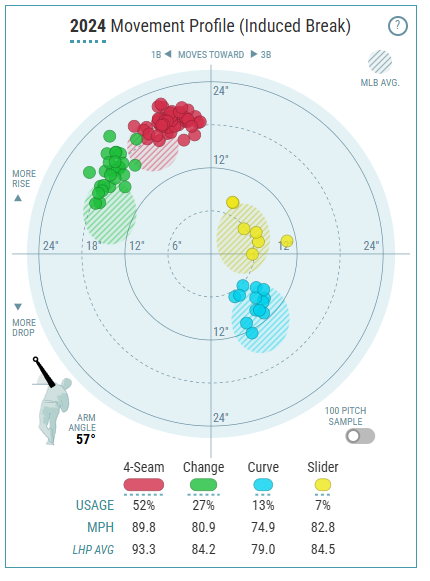
Interestingly, Bradford’s four-seamer performed much better in 2023 and 2024 prior to his internal brace surgery. In 2024 batters hit just .185 with a .249 wOBA against Bradford’s four-seam fastball. But, Bradford was getting much more movement on the pitch back then. Here’s a look at his pitch movement profile for 2024 (four-seamer in red).
And here’s 2026:
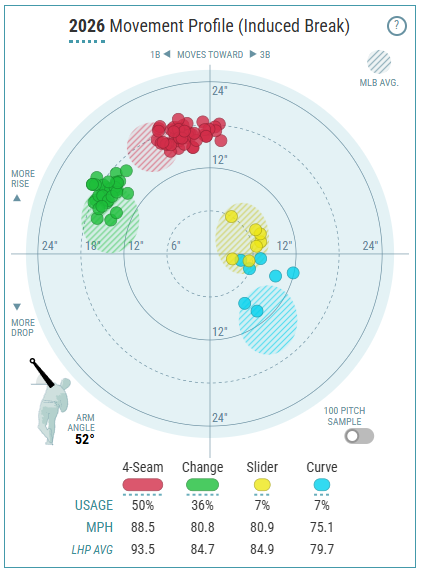
The shape has noticeably changed post-surgery. Bradford has lost 1.6 inches of induced vertical break since returning, going from 18.3 inches of IVB in 2024 to 16.7 inches this season. He’s also lost 2.3 inches of arm-side run, going from 6 inches in 2024 to 3.7 inches in 2026.
A guy throwing sub-90 mph is already walking a tightrope, and a loss in movement or change in shape could render the fastball less effective. It’s a very small sample size of just four games, but this is a worrying trend for Bradford, especially since he is so reliant on his four-seamer.
Bradford is also heavily reliant on his 80.8 mph changeup, a pitch he’s thrown 35.9% of the time this season. The changeup has been much more effective than the fastball, with opponents hitting just .200 off the pitch with a .240 SLG and a .230 wOBA.
The expected stats support these results as well, with a .183 xBA, .267 xSLG, and a .232 xwOBA. The changeup has also been Bradford’s best strikeout pitch, though that’s not saying much as he has just a 27.5% whiff rate with the change and a 14.9% strikeout rate overall, well below league average.
Bradford’s changeup is noteworthy for its 8.6 inches of rise and 14.3 inches of arm-side movement. Here’s an example from this start.
— Elliott Baas (@ElliottBaasBB) August 24, 2026
Gnarly change, with its low spin and late action. Bradford has also gotten better whiff rates with the pitch in previous seasons, usually around 33%. He got six of his 11 whiffs with the changeup in this start, and it would be nice to see that trend continue, as then Bradford could recreate the 21-22% K rates he had prior to internal brace surgery.
Bradford also throws a slider and a curveball, though he uses both less than 10% of the time. Both pitches have high batting averages against them, with .375 for the slider and .500 for the curveball, but even more concerning is the whiff rates.
Bradford has just a 10% whiff rate with his slider and a big old donut with his curveball. These are just secondary options for him, but it’s still discouraging to see such poor outcomes on these pitches. As it stands, I don’t know that we could expect a return to even a league average strikeout rate for Bradford.
All in all, I think there’s reason to be skeptical of Bradford’s strong performance since returning. He’s been aided by an 80.4% LOB rate and a 3.2% HR/FB ratio, giving him an uncharacteristically low 0.44 HR/9. That’s why his 3.05 ERA and 3.18 FIP look good, but his 4.82 xFIP and 4.90 SIERA tell a different story.
I don’t see how Bradford can sustain such a low home run rate given that he’s allowing the highest flyball rate of his career at 47% and has a 91.5 mph average exit velocity against. Hard flyballs tend to go over the fence, and I think Bradford could be more susceptible to home runs going forward.
If he’s more susceptible to home runs that means more runs will cross the plate, raising his ERA and his ugly 1.40 WHIP. It would be easier to stomach the ratio downside if Bradford offered any semblance of strikeout upside, but he does not. In standard 5x5 he doesn’t project to offer much help in any of the five pitching categories, and I think he is best left on the wire.
Verdict:
It’s been great to see Bradford back on a big league mound and performing well, but the underlying skills suggest that his 3.05 ERA is not sustainable. His already soft fastball has lost velocity and movement and Bradford is giving up tons of hard contact with it. He’s been lucky to have a 3.05 ERA, and I think he could creep closer to his 4.90 SIERA as the season goes on. He’s not someone I would prioritize adding.
Andrew Painter, Philadelphia Phillies – 15% Rostered
2026 Stats (prior to this start): 85.1 IP, 6.43 ERA, 5.38 FIP, 9.7% K-BB%
08/22 vs. STL: 7 IP, 5 H, 1 ER, 0 BB, 8 K
Painter had the best start of his young career on Saturday, holding the Cardinals to one run over seven innings while striking out eight and picking up his third career victory. It was a career high in strikeouts and innings pitched for Painter, and it was also just the second time he had a start with zero walks.
Painter has been pitching better since returning to the big leagues on July 31. In five starts since coming back Painter has a 3.62 ERA, 1.06 WHIP, 3.88 xFIP, and a 14.4% K-BB%, all marked improvements over his previous numbers. Is Painter ready to be the dominator or the ratio inflator?
Originally a first-round pick by Philadelphia in 2021, Painter was a huge pitching prospect in the early 2020s, and not just because he has an amazing name for a baseball pitcher. Painter was touted by scouts thanks to his big frame, big fastball, and bevvy of secondary options.
He seemed like a future frontline starter, but in 2023 Painter underwent Tommy John surgery and hasn’t been able to recapture past success. He works with a seven-pitch mix consisting of a four-seam fastball, slider, sweeper, splitter, sinker, curveball, and changeup, though Painter seems to have axed the splitter in favor of the changeup since his return to the majors.
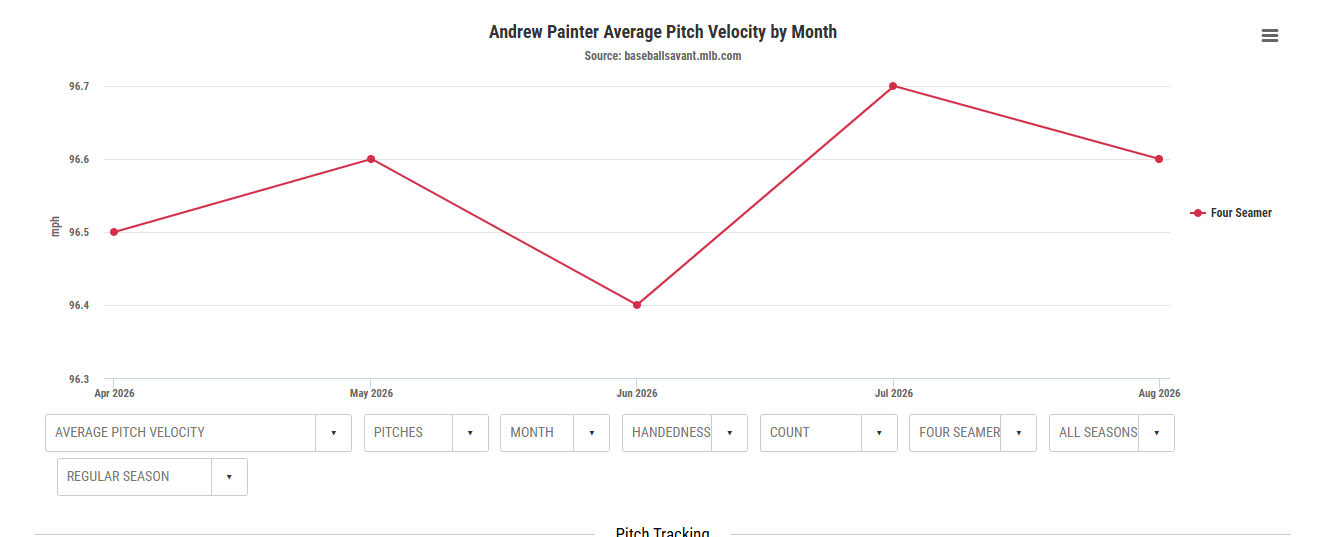
Painter throws a lot of different pitches, but the one he was probably most known for as a prospect was the fastball. A 96.6 mph offering, Painter was known for plus velocity, even sometimes touching triple digits. Painter was also known for plus movement and spin on his fastball too, though those metrics were diminished at the start of the season.
Here’s a look at Painter’s average fastball velocity by month this season.
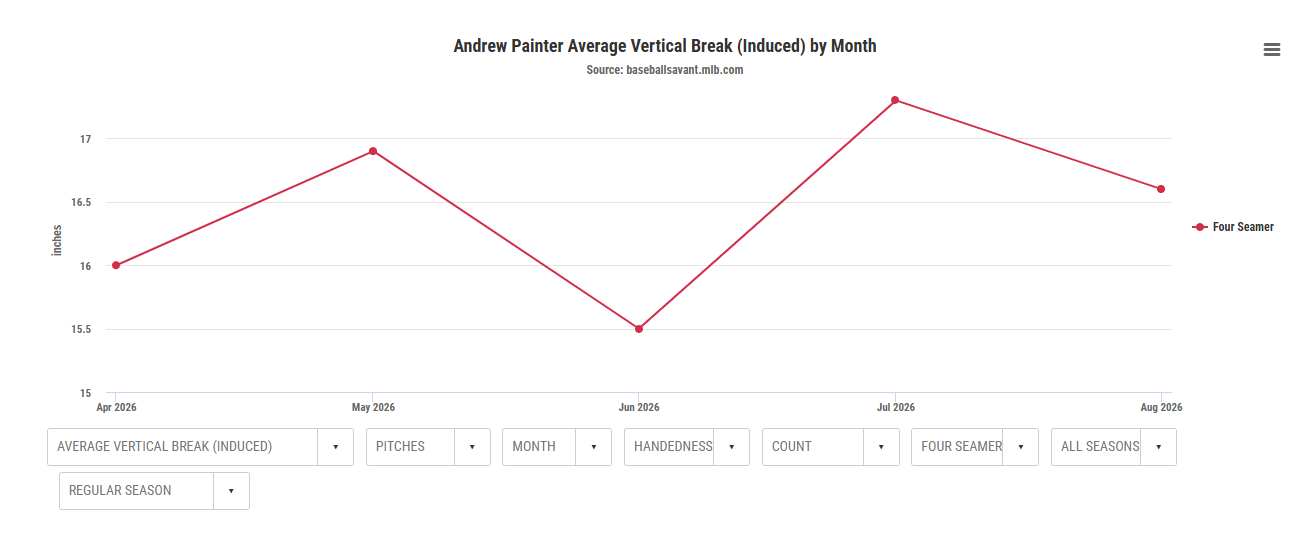
And induced vertical break.
And spin rate.
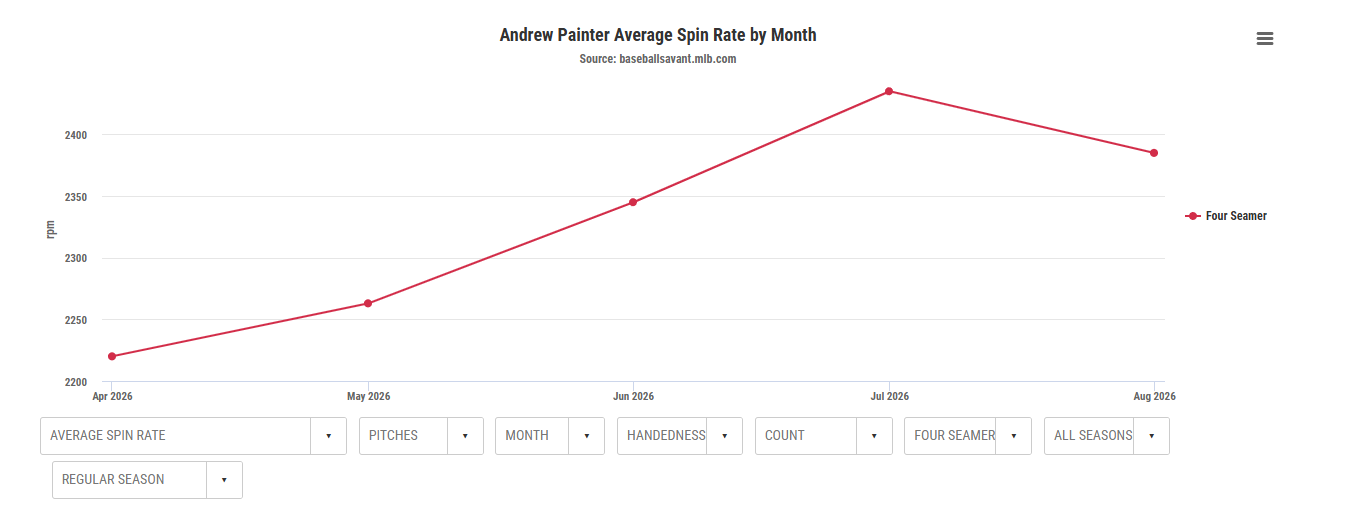
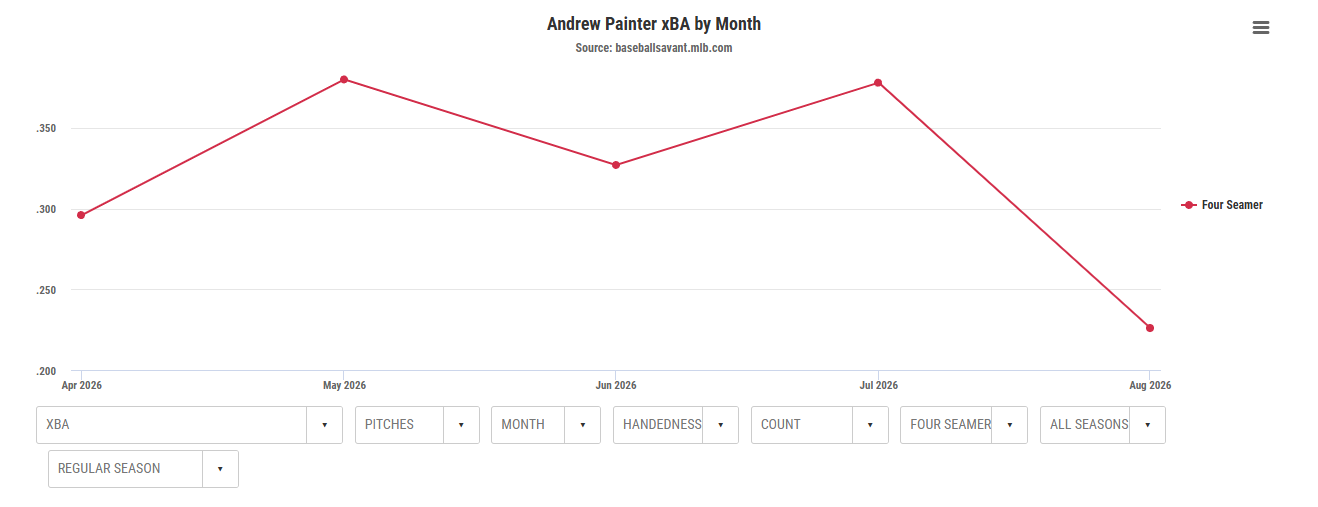
Painter is certainly trending in the right direction, and he averaged 18 inches of induced vertical break in his most recent start against St. Louis. His fastball has performed much better since his return as well. Here’s a look at the xBA.
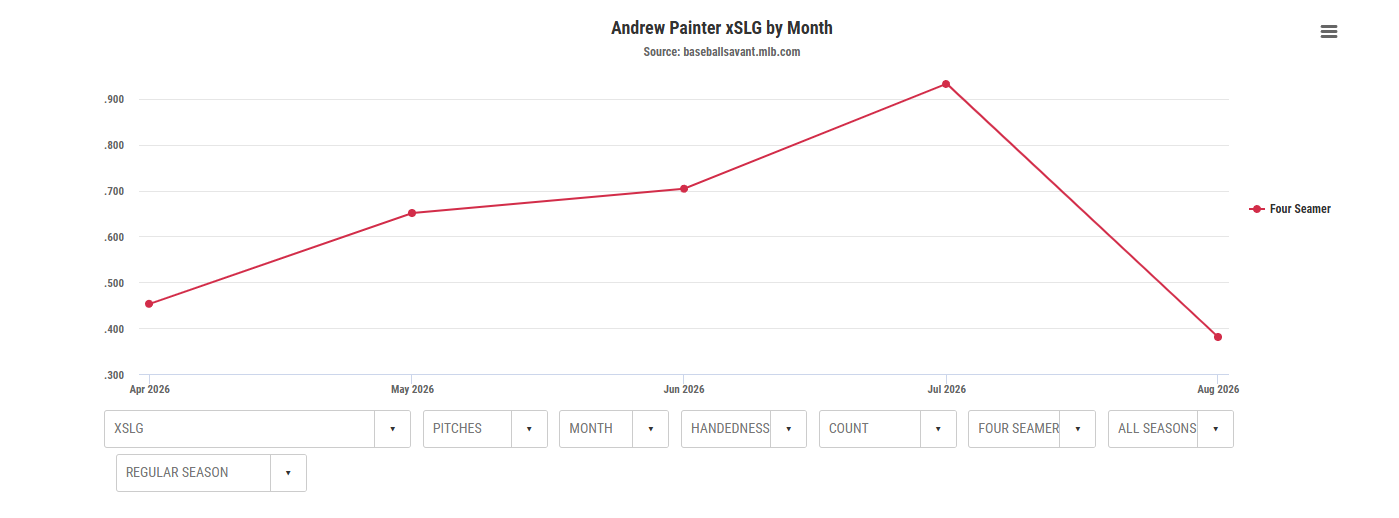
And xSLG.
And xwOBA.
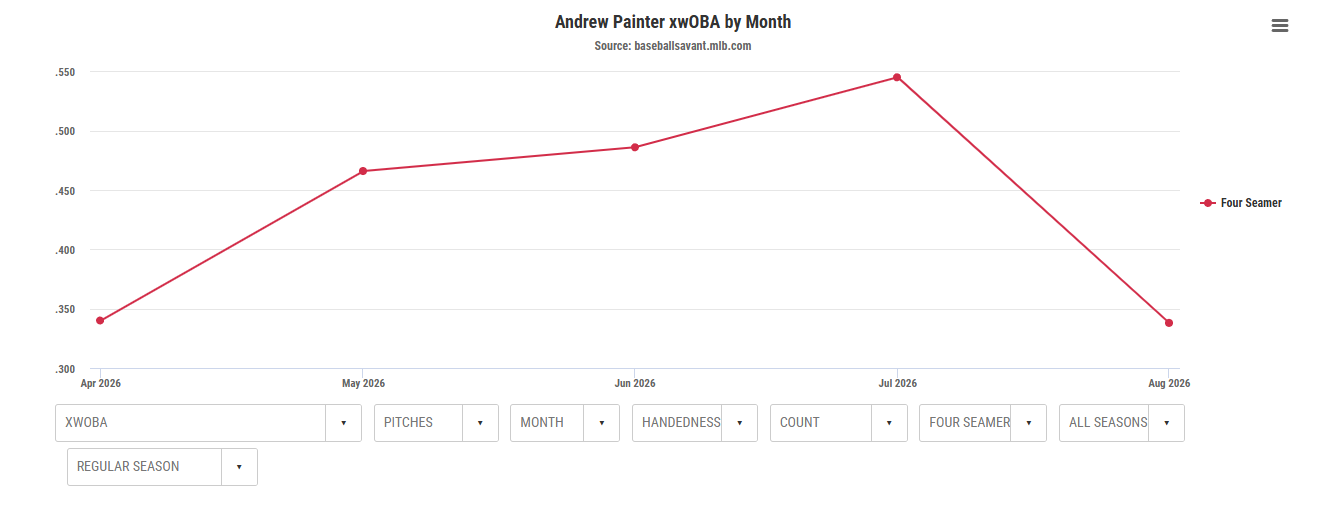
He only made one start in July so those numbers are skewed, but it appears that Painter had made some real progress here. Batters were hitting .355 with a .555 SLG off Painter’s four-seamer prior to 7/31, and are hitting .233 with a .467 SLG since that date. And, in case you aren’t sick of graphs yet, here’s a look at Painter’s fastball whiff rate by month this season.
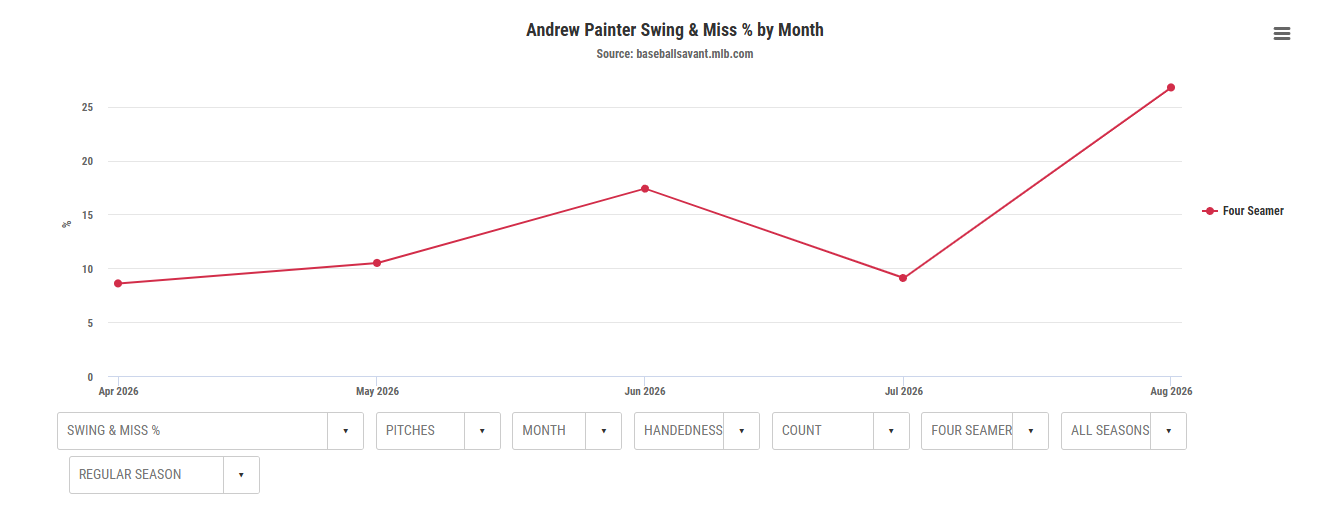
Big spike in August, coinciding with the improvements Painter has made with his fastball. The four-seamer has been a big liability for him on the mound this season, but if Painter is finding his old fastball shape he could be a dangerous pitcher.
Painter’s fastball isn’t the only pitch that’s helped him find success recently, as he’s also gotten great results with his sweeper and changeup since returning. We’ll start with the changeup, since that’s the new pitch for Painter.
A 90.6 mph offering, it’s a hard change with lots of horizontal movement, with 12.9 inches of arm-side action. The pitch is harder and has less drop than the splitter Painter axed. Here’s an example from this start.
— Elliott Baas (@ElliottBaasBB) August 24, 2026
Nasty stuff, and Painter does have a 31.1% whiff rate with the changeup, making it one of his best strikeout pitches.
Another great strikeout pitch for Painter has been the sweeper, which has also undergone a bit of a makeover this season. Since returning to the majors Painter is getting more horizontal movement and more spin with the pitch. Here’s a look at his spin rate by month.
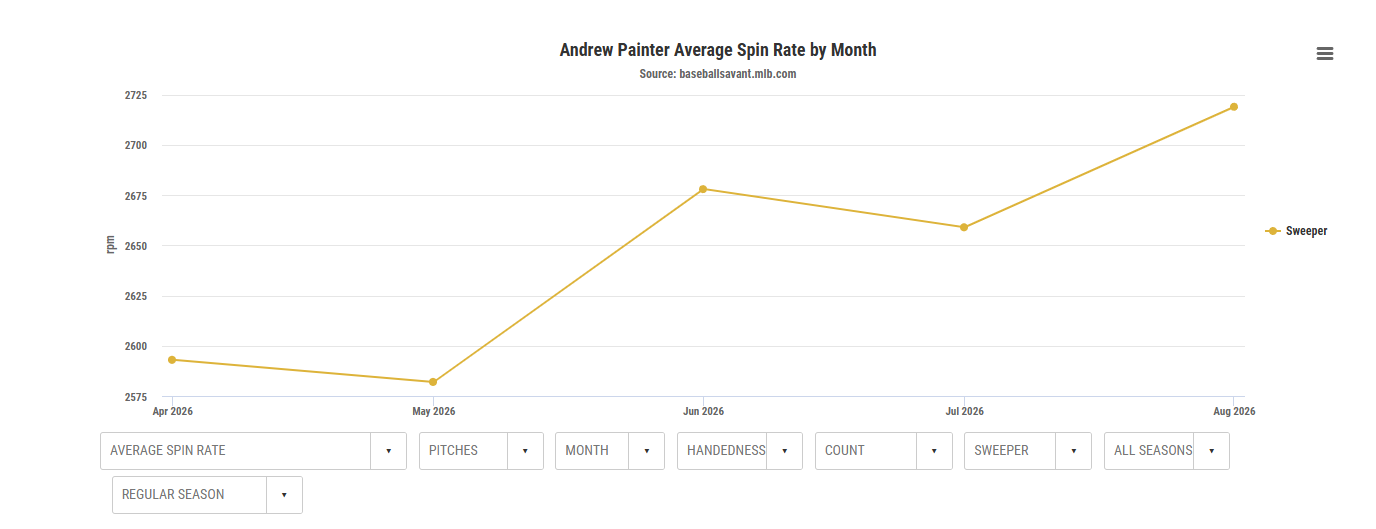
And here’s horizontal movement.
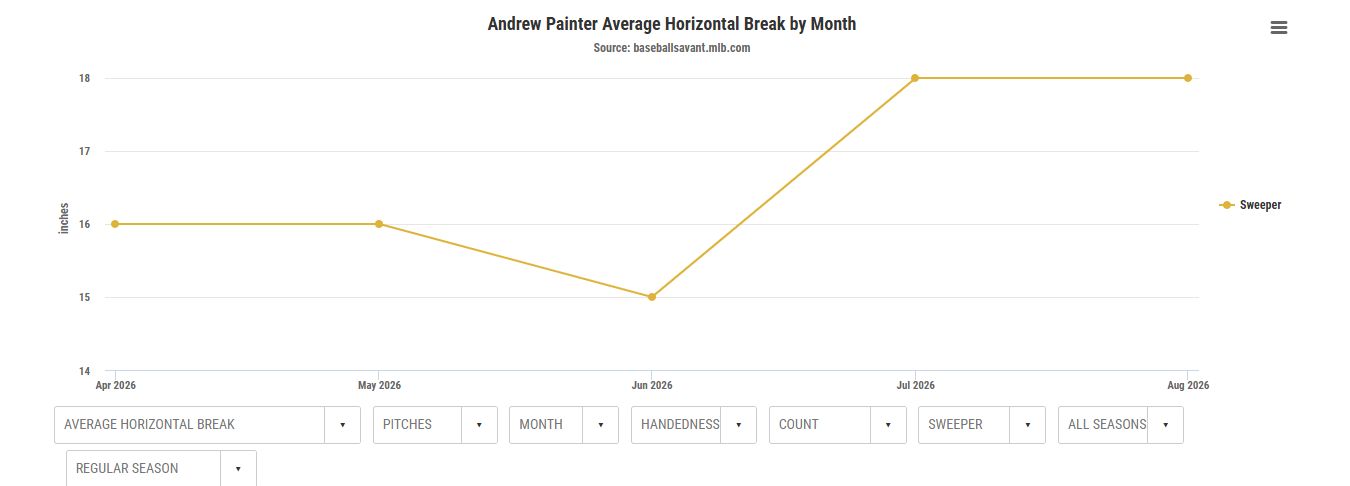
And here’s a look at the pitch itself.
— Elliott Baas (@ElliottBaasBB) August 24, 2026
It’s soft and loopy with lots of spin and lots of sweep, and between this pitch, the new changeup, and the improved fastball, I could envision a world where Painter develops beyond the 8.56 K/9 he’s had over his last five starts. He certainly has the ingredients to generate strikeouts, now let’s see if he can consistently cook the meal.
Painter’s recent run hasn’t been an earth-shattering “he’s arrived” moment, but there is plenty of reason to believe in and to be excited about Painter going forward. Not only did he lower his ERA, his strikeout rate, WHIP, K-BB%, FIP, xFIP, and groundball rate are all noticeably improved.
Even better, Painter has made improvements to his fastball spin and velocity, he’s reworked his splitter into a more traditional changeup to great results, and he’s revamped his primary strikeout pitch, the sweeper. The numbers aren’t just better, the pitches are better.
Painter is still available in lots of leagues as managers are still smarting from his early season struggles, but if you can look past the season-long stats there’s a very intriguing right-hander underneath.
Verdict:
Painter has revamped his approach following a demotion to the minors, and since returning we’ve seen improvements to his fastball and sweeper, and he’s replaced his splitter with a traditional changeup.
Numbers have been better across the board for Painter, and while calling him a league-winner would probably be a step too far, I do think Painter offers rare upside and intrigue for a waiver wire arm at this point in the season. He’s widely available in Yahoo leagues, and if you’re looking for a spark to finish strong, Painter could be that guy.
More Fantasy Baseball Advice
Download Our Free News & Alerts Mobile App
Like what you see? Download our updated fantasy baseball app for iPhone and Android with 24x7 player news, injury alerts, sleepers, prospects & more. All free!