RADIO









Elliott Baas looks at 3 second-half fantasy baseball busts from the 2026 season. Read his 2027 fantasy baseball outlooks for second-half underachievers such as Jose Ramirez, Jordan Walker, and Ozzie Albies
2026 is in the books, and as we gear up for 2027, it's important to look back at both the standout league-winning performances and the league-losing performances. In this article, we'll be examining the latter, because whether they're bona fide superstars, breakout players, or reliable fantasy mainstays, these players all disappointed with their performances in the second half.
In this article, I'll look at three fantasy stars who faded in the second half, leaving us with more questions than answers after the season ended. We will spotlight first-round pick Jose Ramirez of Cleveland, first-half breakout Jordan Walker of St. Louis, and longtime fantasy option Ozzie Albies of Atlanta.
These guys have question marks heading into 2027 thanks to their poor finishes, and I try to identify the possible causes of their struggles. Can these hitters rebound, or are their second-half woes signs of deeper problems?
Featured Promo: Save 50% off the regular price with discount code THANKS, for a limited time. Exclusive access to our Team Sync platform, DFS cheat sheets, Lineup Optimizers, betting/prop picks, and exclusive content from Nick Mariano and Eric Cross! GAIN ACCESS NOW
Jose Ramirez, Cleveland Guardians
NFBC ADP: 18.88
Ramirez is coming off his worst season as a full-time player, hitting .235 with just 12 home runs and 53 RBI in 544 PA. He did stay productive with 37 steals, but overall it was a down year for Ramirez at the plate. The biggest factor in his poor output was likely a fractured hamate bone in his left hand, which cost him five weeks and had Ramirez performing like a shell of himself upon returning.
After being activated from the IL on 7/22/26, Ramirez hit just .229 with a .598 OPS and a .073 ISO, hitting just two home runs in 230 PA. He still had 13 steals over this time, which salvaged his fantasy performance somewhat, but all in all, Ramirez managers were let down last season.
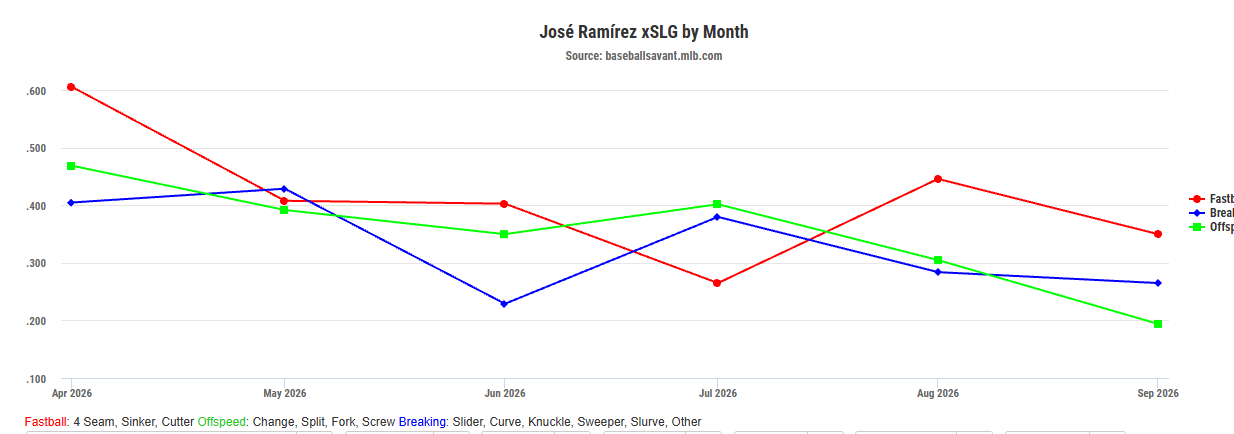
The obvious culprit was the hamate bone injury, which is known to sap power and can linger long after hitters return. This bears out in the numbers as well. Here’s a look at Ramirez’s xSLG month-by-month throughout last season.
And here’s a look at his hard hit rate month-by-month.
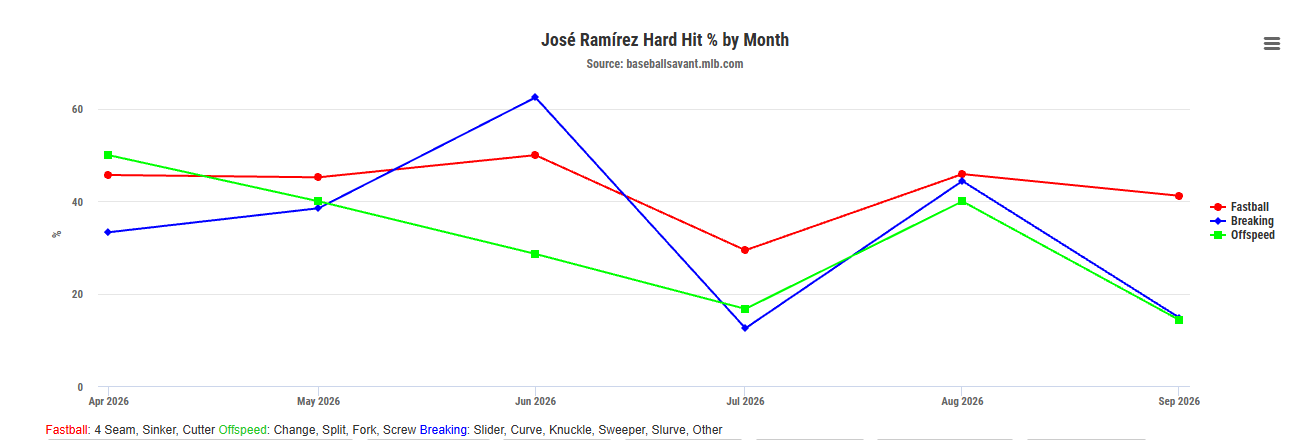
An obvious decline: Ramirez had a paltry 86.5 mph average exit velocity in the second half, compared to 90.3 mph in the first half. Can we just chalk these struggles up to the injury and consider Ramirez a safe pick for 2027?
It’s tough to overlook how poorly he performed, and Ramirez wasn’t hitting that well by his standards before the injury. He hit just .239 with a .757 OPS and a .179 ISO in the first half; though the hard-hit rate and plate discipline were still there for him, he was just hampered by an unusually low .249 BABIP and 9.3% HR/FB ratio, both well below his career marks.
The good news for Ramirez is that, despite being 34, he isn’t showing obvious signs of age-related decline at this juncture. He’s always been a great contact hitter, and his strikeout rate was an excellent 12.7% last season. His superb plate discipline is still there as well, with an 11% walk rate and a 45.4% swing rate last season.
Here’s a month-by-month look at his bat speed.
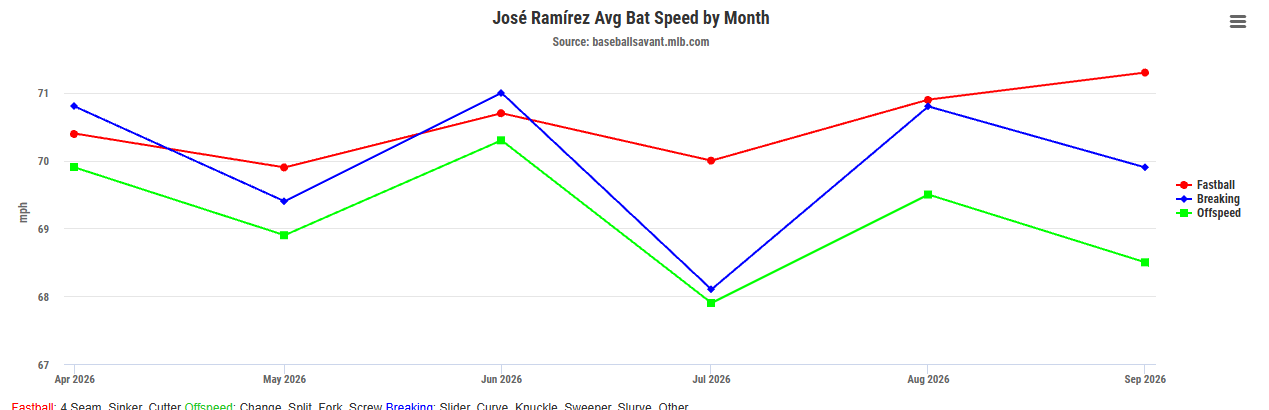
It dipped initially when he returned, but bounced back towards the end of the season. Ramirez is still hitting fastballs well too, with Ramirez putting up a .289 xBA and .440 xSLG against heaters in 2026. Those numbers are a little lower than previous years, but he was also dealing with injury.
He had only a 13.7% whiff rate, and these numbers show Ramirez isn’t being overpowered by heat, which often happens as players age.
Ramirez’s skill set is geared to age well, as players with a high-contact, patient approach tend to last longer than the free-swingers of the world. 34 is a scary age for a baseball player, because it’s often when big decline sets in or is on the precipice of setting in, but if healthy, Ramirez is positioned to age gracefully.
For 2027, Ramirez looks like a prime bounce-back candidate who could be a great value going around pick 18 in NFBC leagues. At his best, Ramirez has 30-40 potential, and even if the power dips, he could still hit over 20 homers in a full season. Plus, his stolen base ability gives him a solid floor even when he’s not hitting.
There is some risk with practically every player outside the top-12, and I think most of Ramirez’s 2026 struggles can be attributed to injury. He’s a fine second- or third-round option with the upside of a top-10 player.
Jordan Walker, St. Louis Cardinals
NFBC ADP: 34.44
The former top prospect enjoyed a breakout campaign in 2026, with Walker posting career highs in HR (29), SB (22), and wRC+ (119). This breakout was uneven, though, as Walker mashed in the first half of 2026 but fell off a cliff in the second half. In the first half, Walker hit .294 with 22 HRs and 13 SBs, good for an .887 OPS and a .238 ISO.
But in the second half Walker managed just a .234 AVG with seven home runs and nine steals, just a .660 OPS and a .139 ISO.
He went from All-Star production to below-replacement play, and many fantasy managers are rightfully questioning who the real Jordan Walker is. The Home Run Derby was perhaps the apex of Walker’s season, as he struggled to produce following that performance.
Walker is someone who has disappointed fantasy managers in the past as well, struggling in his first few years (71 wRC+ in 2024, 66 in 2025) despite being considered one of the best prospects in all of baseball.
On the positive side, Walker seems to have made legitimate improvements at the plate. He cut his strikeout rate from 31.8% in 2025 to 26.1% in 2026, despite an elevated 52.1% swing rate, up 3% from the year before. Walker also improved to 70% contact, still well below league average, but up 4% from the year before.
His CSW rate also fell from 32% in 2025 to 29.7% in 2026, thanks to both an improved whiff rate and an improved called strike rate, meaning he’s gotten better at recognizing pitch location. Walker’s biggest kryptonite has always been strikeouts and poor contact rates. His big, violent swing invites plenty of swing-and-miss, but when Walker does make contact, look out below.
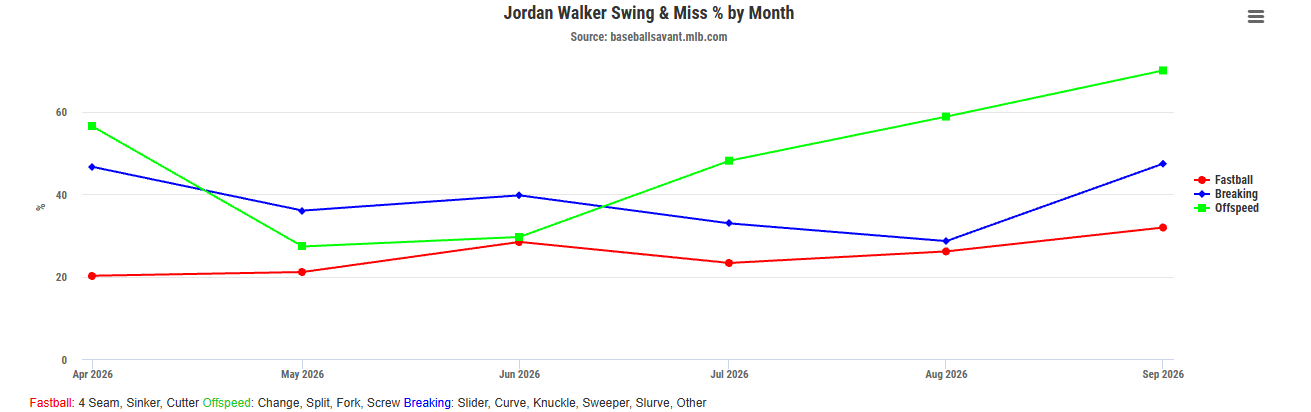
Perhaps most concerning for Walker in his second-half struggles would be the rise in strikeouts following the All-Star break. Walker struck out 24.8% of the time in the first half, which is manageable for someone with his batted ball skills, but that rose to 27.9% in the second half. Still an improvement over previous seasons, but obviously not the direction we want to see him heading.
Here’s a look at Walker’s month-by-month whiff rate for 2026.
Something that may’ve exacerbated this issue is the change in approach that opposing pitchers took against Walker in the second half. Walker saw 3% more sliders and 4% more sinkers in the second half than in the first. Walker had a mammoth 42.6% whiff rate against sliders last season, and although he hit .275 with a .324 wOBA off sliders, he had an ugly .196 xBA and .242 xwOBA against the pitch.
A big slugger being susceptible to sliders is nothing new, but it is still a problem for Walker, who saw 30.8% sliders in the second half, the highest rate of any one pitch.
The sinkers are another story, since sinkers aren’t really a strikeout pitch (Walker had a 20.5% whiff rate against sinkers last season), but Walker struggled to generate significant power against the pitch last season. In the second half, he actually hit .316 against sinkers, but he only had a .035 ISO, with two total extra-base hits off sinkers: a pair of doubles.
Walker also had just a four-degree average launch angle off sinkers last season, and his average exit velocity was only 91.1 mph, more than five mph lower than his average exit velocity against four-seam fastballs.
Walker annihilated four-seamers for a .477 SLG and 96.5 mph average exit velocity last season, so it makes sense that pitchers would want to shy away from four-seamers if possible and target him with pitches he struggles against.
Interestingly, Walker actually saw a 33% first-pitch slider rate versus right-handed pitchers in the second half last season, higher than both the four-seam fastball and sinker. If Walker wants to recapture his first-half success, he’ll have to work his way into better counts more frequently so he can see more favorable pitches to hit.
That’s any batter’s goal, but it’s extra important for a hitter who has such glaring weaknesses like Walker.
After the season ended, Cardinals president of baseball operations Chaim Bloom said Walker was dealing with lingering hip pain and other discomfort late in the season. This could certainly have contributed to Walker’s late-season struggles, as the hips are crucial for swing mechanics and generating power. If healthy, Walker could be more productive at the plate, and the Cardinals do not expect the injury to last into 2027.
For next year, I think Walker is a calculated risk at his current NFBC ADP of 34.91.
We know he has the raw tools and talent to be an impact player when healthy, but part of me is a little concerned about his inability to adapt midseason when pitchers changed their approach. I don’t know if he’ll ever overcome his breaking ball struggles, and if he can’t feast on four-seamers, he may struggle to put up the gaudy power numbers we’re hoping for.
On the bright side, if healthy, I think expecting a 30-20 season is totally reasonable for Walker, and I think he could hit between .260-.270 again so long as his strikeout rate doesn’t balloon. Walker looks like a low-end OF1 or a high-end OF2, going around guys like Jackson Merrill and Oneil Cruz. I think Walker and Merrill are quite close in value, and I’d actually rather have Walker over Cruz despite Cruz’s strong performance last season.
Cruz has a longer injury history and will likely see serious regression in batting average and HR/FB ratio.
If your first two picks are safe and Walker is sitting there in round three, he’s worth a stab at for his current value. Even though he’s been around for a few years, Walker will be just 24 years old on Opening Day. He could cement himself as a superstar if he stays healthy and adapts his approach to opposing pitchers.
Ozzie Albies, Atlanta Braves
NFBC ADP: 213.40
Albies isn’t an early-round player like the other two I’ve discussed, but he’s been a reliable producer at the keystone and a fantasy mainstay for nearly a decade. The first half started out well for Albies last season, as he hit .267 with 14 home runs and a .758 OPS before the All-Star break. Unfortunately, things fell apart for him in the second half, as Albies was practically unplayable with a .194 AVG, eight home runs, and a .575 OPS.
Even worse, unlike Ramirez and Walker, Albies did not make up for his poor plate performance with speed. He stole just four bases total in 2026 despite playing in all 162 games. Prior to last year, Albies had stolen at least 13 bases in every season where he played at least 100 games.
He was caught as many times as he was successful, and with his sprint speed in just the 41st percentile, the Braves may have given him a red light most of the time. Regardless of the reason, four stolen bases for a formerly speedy middle infielder is not ideal, and it made Albies a liability despite slugging 22 home runs, his most since 2023.
What concerns me most about Albies’ atrocious second half is the rise in strikeout rate. He had an 18.3% K rate in the second half last season, which is below league average, but very high by his standards. It was 5% higher in the second half, and Albies' whiff rate also rose in the second half.
Here’s a look at his whiff rate by month last season.
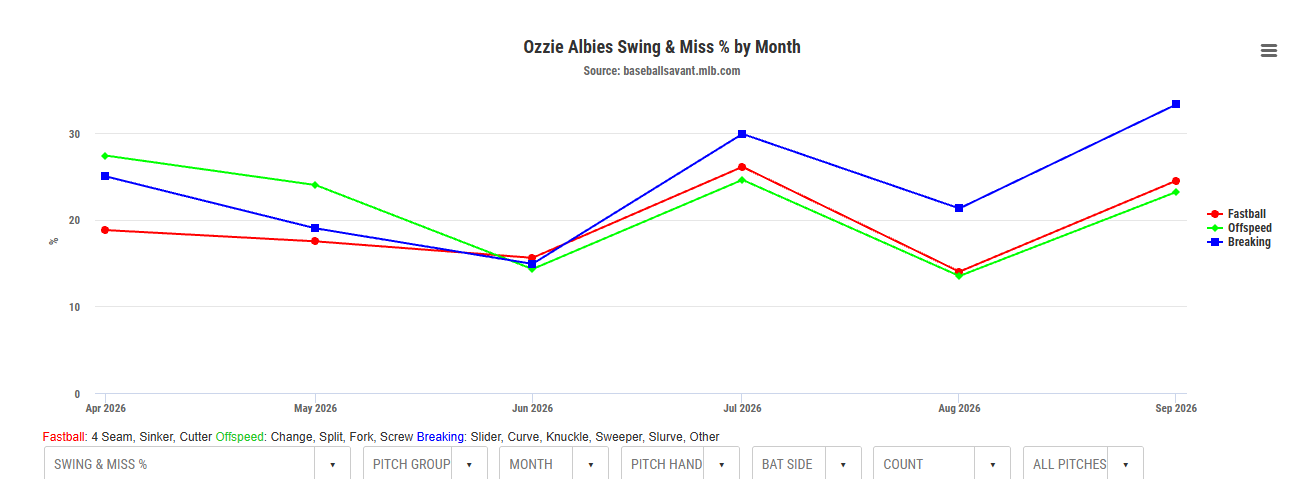
Not great, not great indeed. Albies has always found success through a high contact rate; it was his way of making up for poor batted-ball metrics, and if this is his new normal, fantasy managers should be trepidatious about drafting him, even at his relatively low cost.
Albies also saw a change in the way pitchers approached him in the second half, as he saw 6.4% more four-seam fastballs in the second half last season. Albies’ inability to hit fastballs has really been the crux of his downfall over the last few seasons, and it came to a head last year as Albies hit just .217 with a .306 wOBA off four-seamers. The high fastball absolutely kills him, and that’s basically all he saw in the second half.
Another concern for Albies is the diminished bat speed he showed in the second half. Here’s a look at his bat speed by month last season.
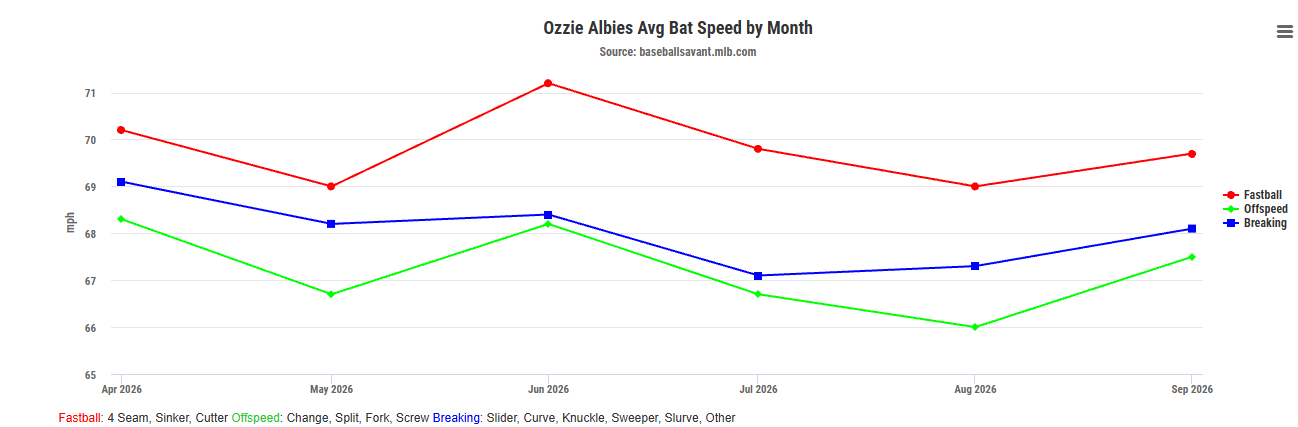
He’s obviously never been a Statcast stud, but that means he has a thinner margin of error than someone like a Jordan Walker who has high bat speed and hits the ball hard. Even a small drop-off for Albies could crush his output, and we saw that last season. Here’s a look at his Statcast percentiles last season.
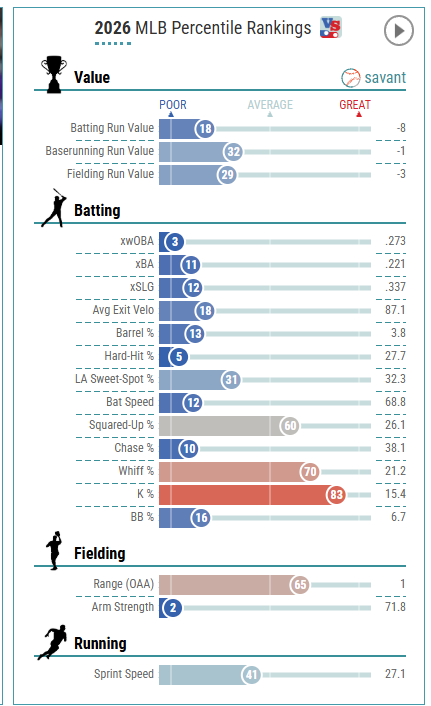
Bluer than the Boise State turf, and it’s a significant drop-off compared to even a few years ago. Here’s a look at his 2024 percentiles.
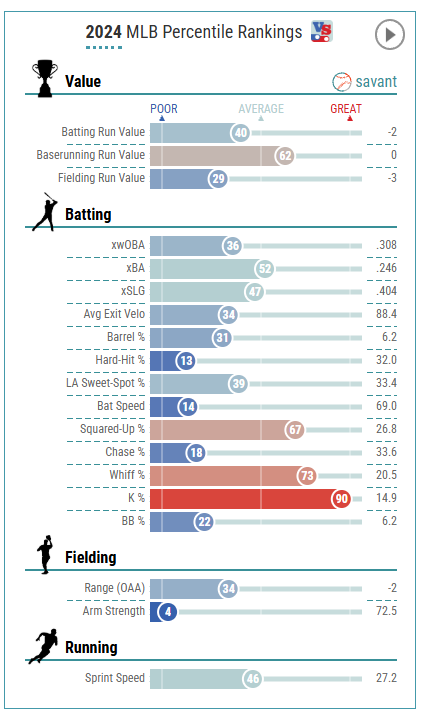
It’s not elite, but at least Albies wasn’t in the basement of basically every major Statcast category. He didn’t have room to experience a drop-off like this, and now that he has, he’ll likely struggle to both recapture past success and prove viable in a fantasy lineup.
Other middle infielders going around Albies include Corey Seager, Brooks Lee, Xavier Edwards, and Cooper Pratt. All of those guys have questions to some degree or another, but they seem to have a higher ceiling and floor than Albies right now.
He hasn’t hit better than .251 since 2023; he hasn’t had an ISO better than .154 since 2023, and if he’s not going to steal, he provides little value in his current form.
He may not be as bad as his .575 OPS in the second half, but he offers little upside and heavy downside, and he’ll be off my draft board in 2027.
More Fantasy Baseball Advice
Download Our Free News & Alerts Mobile App
Like what you see? Download our updated fantasy baseball app for iPhone and Android with 24x7 player news, injury alerts, sleepers, prospects & more. All free!