



 RADIO
RADIO






Brandon Murchison dives into historical fantasy football statistics to determine how much quarterback rushing attempts impacts a team's WR1 and their fantasy production ceiling.
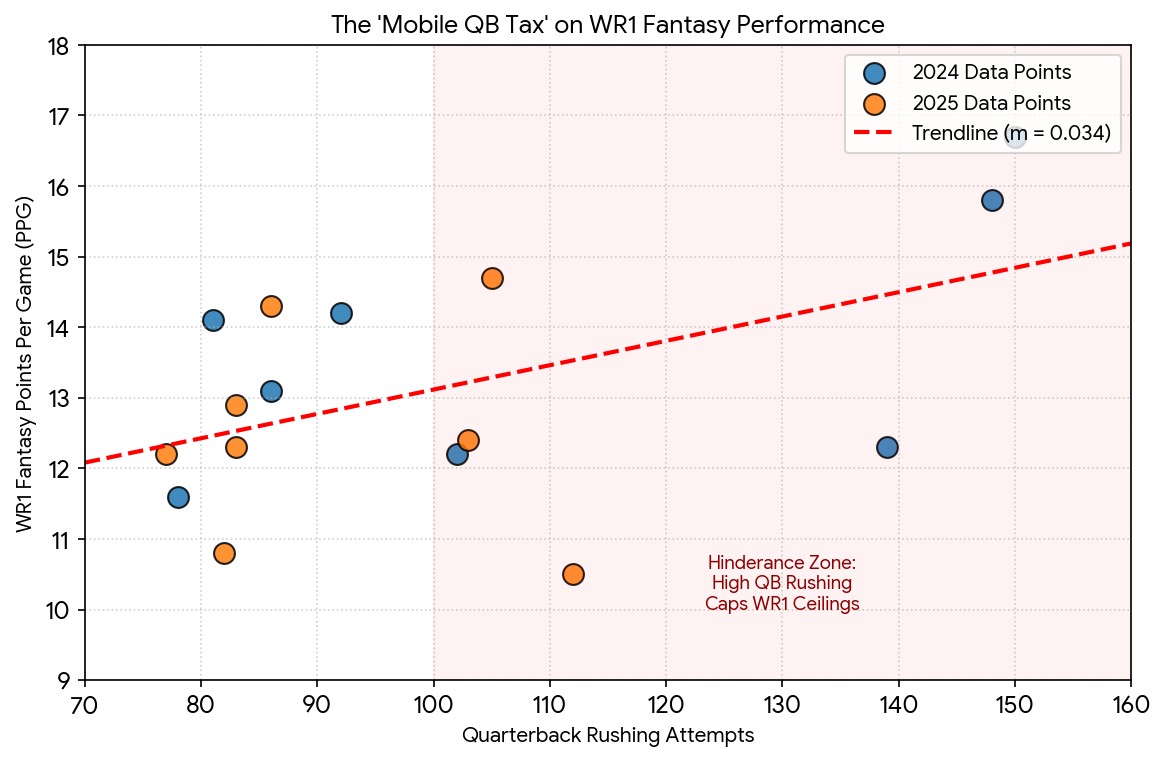
One trend that goes unnoticed when projecting wide receiver rankings is that when a quarterback starts tucking the ball and running more often, the ceiling for his top wideout takes a noticeable hit. It makes intuitive sense—more designed runs and scrambles mean fewer drop-backs, fewer pass attempts, and ultimately fewer opportunities for that WR1 to rack up the volume needed for elite production. Over the past several seasons, the data has backed this up in striking fashion. A deep dive into 75 quarterback seasons from 2020 through 2025 showed that signal-callers generating 25% or more of their total yardage on the ground supported minimal WR1-caliber fantasy finishes (in a 12-team PPR format). By contrast, pure pocket passers with 0-4% of their yards from rushing propped up 27 such WR1 seasons across just 25 campaigns, while the total fantasy value of their supporting casts ballooned to 94 "WR" slots compared to a meager eight for the heaviest runners.
Look no further than Lamar Jackson's Ravens for a clear illustration. In 2019, Jackson carried the ball a league-high 176 times for 1,206 yards while throwing just 401 passes; his top wide receiver, Marquise Brown, managed only 46 catches for 584 yards and seven scores—solid but nowhere near the 1,200-yard, double-digit-touchdown threshold that defines a true WR1 ceiling. Fast-forward to 2023, when Jackson still logged 148 rushes for 821 yards alongside 457 pass attempts: rookie Zay Flowers led the group with 108 targets, 77 receptions, 858 yards, and five touchdowns, finishing outside the top 25 in fantasy points per game. Even with improved efficiency under a new offensive coordinator, the volume simply wasn't there to push Flowers into elite territory. The same pattern shows up with high-rushers like Justin Fields in 2022, when he attempted just 318 passes (the fewest among full-time starters) while scrambling for 1,143 yards; the Bears' wideouts, led by a then-struggling Darnell Mooney, produced almost nothing usable in fantasy.
Of course, exceptions exist—Josh Allen has occasionally elevated Stefon Diggs to top-12 finishes, and Jalen Hurts has co-existed with productive seasons from A.J. Brown—but those outliers usually require Hall-of-Fame-caliber talent and still fall short of the absolute highest ceilings we see from pure passers. Across a broader 22-year sample of high-volume rushing quarterbacks (those averaging elevated rushing attempts per game), only 16% supported a top-12 wide receiver at any point, and none ever produced the overall WR1 in points per game. The numbers paint a consistent picture: every extra carry by the quarterback chips away at the pass volume that fuels WR1 upside, turning what should be a high-ceiling asset into more of a solid-but-limited WR2 or WR3. In the article ahead, I’ll provide you with a few wide receivers who are ranked highly in drafts according to current consensus ADP but may not live up to the billing due to quarterback rushing usage lowering their potential production ceiling.
Bookmark our updated and revamped fantasy football rankings portal for all league formats!PPR rankings | Half-PPR rankings | Standard rankings | Rookie rankings | Superflex rankings | Dynasty rankings | Who To Start? | Injuries | Matchup Ratings | Strength of Schedule
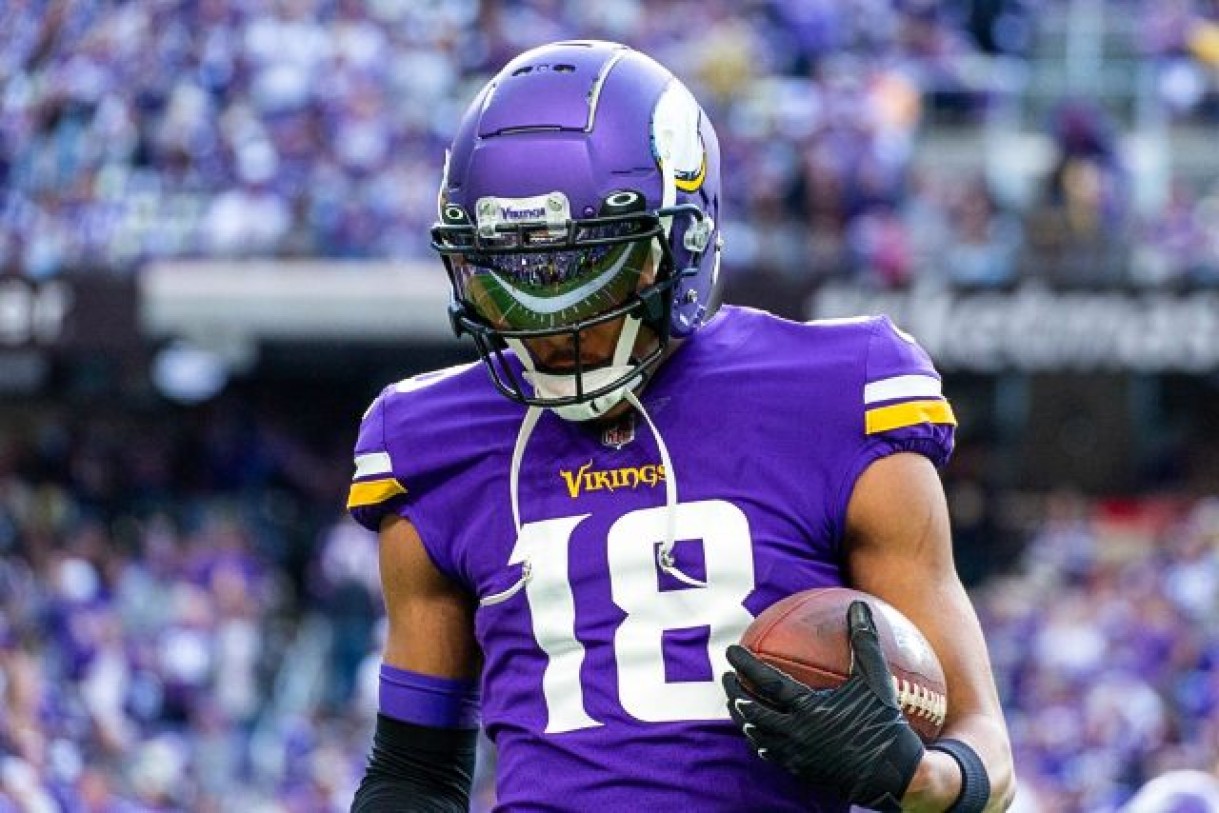
Justin Jefferson - WR, Minnesota Vikings
Position Rank: WR6, ADP: 10.7 (Average ADP via RotoBaller consensus ADP tool)
2026 QB: Kyler Murray (likely)
Jefferson is currently sitting as a late first-round pick in most fantasy drafts this year, but the addition of Murray as the likely Vikings starter introduces a real risk that he falls short of that ADP. Murray has carved out a career averaging 36.6 rushing yards per game across 87 starts, with 532 carries for over 3,100 yards and 32 touchdowns, and that dual-threat style naturally eats into overall pass volume.
His career mark of just 33.8 pass attempts per game already sits below what many pure pocket passers deliver, and when the designed runs and scrambles pile up, there are simply fewer opportunities for the wide receivers.
Even in Kevin O’Connell’s scheme, which has historically been pass-friendly, Murray’s legs have a history of capping the aerial attack in ways that could keep Jefferson from the 150-plus target seasons fantasy managers are banking on at his current cost.
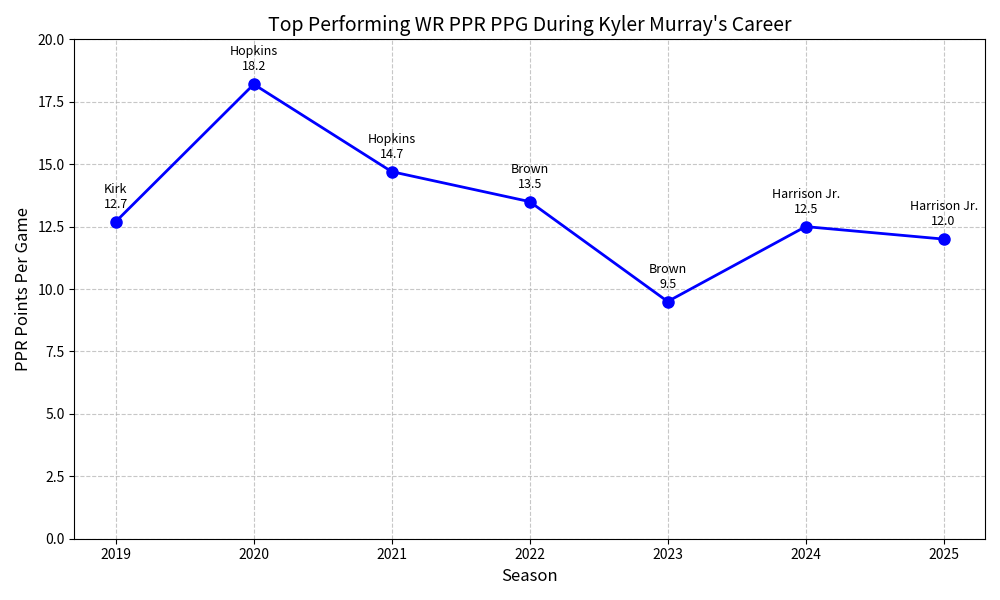
Looking at the receivers who have previously lined up with Murray only reinforces the caution. The top performer by far was DeAndre Hopkins in 2020, when he posted 115 catches for 1,407 yards and six scores, good for roughly 17.9 PPR points per game across a full 16-game slate.
That remains the high-water mark for any wideout sharing the field with Murray, and even then it came in an Air Raid system that pushed the ball around more freely than Minnesota is likely to.
Subsequent top options like Marvin Harrison Jr. hovered closer to 12 points per game, showing how the rushing emphasis can limit ceiling outcomes.
Jefferson’s elite talent gives him a higher floor than those names, but the combination of Murray’s consistent rushing usage and the modest historical production from his previous WR1s suggests managers taking him in the first round could easily end up with a solid WR2 rather than the difference-making WR1 his ADP demands.
A.J. Brown - WR, New England Patriots
Position Rank: WR8, ADP: 20.3
2026 QB: Drake Maye
Brown is coming off the board as a solid second-round pick in most 2026 fantasy drafts, but Maye’s rushing tendencies raise legitimate questions about whether he can fully deliver an ROI that his current ADP suggests. Maye has averaged 29 rushing yards per game over his first two seasons, totaling 871 yards and six scores on 157 carries, and that mobility often comes at the expense of pure passing volume.
His career mark of just 27.7 pass attempts per game already sits on the lower side for a starting quarterback, and when the scrambles and designed runs kick in, the overall target pool shrinks for everyone else.
Even in Josh McDaniels’ scheme, which has shown efficiency, Maye’s legs have a track record of limiting the kind of high-volume aerial attack Brown thrived in during his peak Eagles years, potentially capping the big-bodied receiver short of the consistent 140-target seasons managers are paying for.
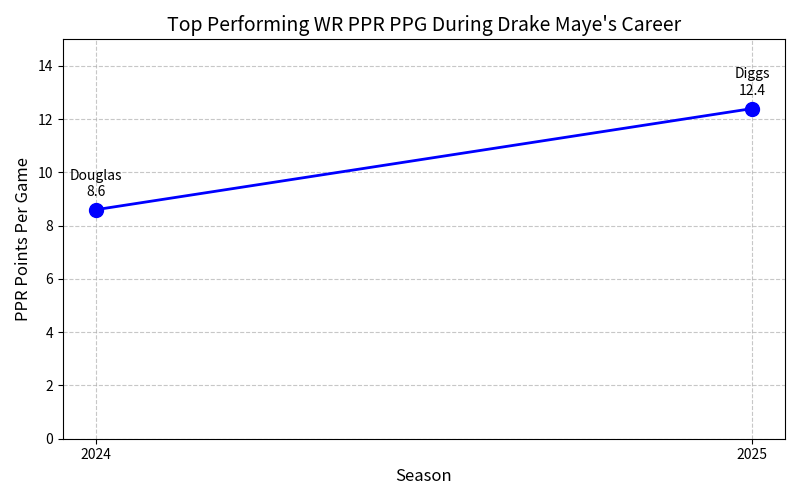
The receivers who have previously shared the field with Maye underscore the volume concerns. The clear top performer was Diggs last season, when he finished with 85 catches for 1,013 yards and four touchdowns—good for roughly 12.4 PPR points per game across a full 17-game slate.
That remains the high-water mark for any wideout working with Maye, and it came as the undisputed WR1 in an offense that still spread the ball around more than expected.
Secondary options lagged further behind, showing how the dual-threat style can suppress individual ceilings.
Brown’s proven talent and red-zone prowess give him a better shot than Diggs at turning limited opportunities into solid production, but the combination of Maye’s consistent rushing usage and the modest historical output from his previous lead receiver suggests managers selecting Brown in the second round risk settling for a high-end WR2 rather than the weekly difference-maker his current ADP implies.
DeVonta Smith - WR, Philadelphia Eagles
Position Rank: WR12, ADP: 27.4
2026 QB: Jalen Hurts
Smith is currently being drafted as an early third-round WR in most 2026 fantasy leagues, but the Eagles' heavy reliance on Hurts’ legs lowers the ceiling of what could be a player that threatens a top-5 WR ceiling.
Hurts has averaged 38.2 rushing yards per game across his career, amassing 3,554 yards and 63 touchdowns on 779 carries, and that dual-threat style consistently limits the overall pass volume available to the receivers.
His career average of roughly 25.7 pass attempts per game already ranks on the lower end for a full-time starter, and when the designed runs and goal-line tush-pushes pile up, there are simply fewer targets to go around.
Even with Smith now elevated to the clear WR1 role after Brown’s departure, the Eagles’ offense under Hurts has a long history of keeping the aerial attack in check, which could prevent Smith from reaching the 150-plus target threshold managers are banking on at his current cost.
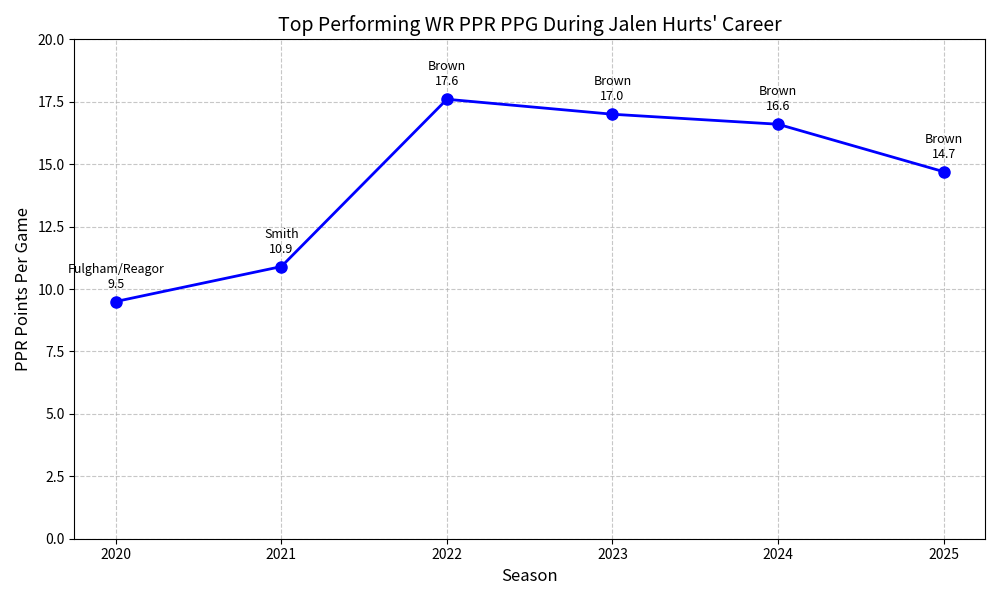
The receivers who have previously lined up with Hurts only reinforce the volume concerns. The top performer by a wide margin has been Brown, who averaged between 16.7 and 17.9 PPR points per game during his peak seasons alongside Hurts, including a 17.6 PPG mark in 2022 on 88 catches for 1,496 yards and 11 scores.
That remains the high-water mark for any wideout sharing the field with the dual-threat quarterback, and even then it required Brown’s physical dominance and a more balanced target distribution.
Secondary options like Smith himself have hovered closer to the low teens in points per game when competing for looks.
Smith’s route-running precision and chemistry with Hurts give him a solid floor, but the combination of Hurts’ consistent rushing usage and the modest historical ceilings for his previous lead receivers suggests managers taking Smith in the third round risk ending up with a steady but unspectacular high-end WR2 rather than the upside play his ADP currently demands.
Zay Flowers - WR, Baltimore Ravens
Position Rank: WR14, ADP: 33.7
2026 QB: Lamar Jackson
Flowers is currently landing in the mid-to-late third round of most 2026 fantasy drafts as a high-upside WR2, but Jackson’s relentless rushing usage presents a clear risk that he may not fully justify that ADP.
Jackson has averaged a remarkable 56.2 rushing yards per game over his career, totaling 6,522 yards and 35 scores on 1,081 carries across 116 games, and that dual-threat style has long kept the Ravens’ pass attempts on the modest side.
Even in seasons where Jackson pushes the ball downfield more, the overall volume rarely climbs high enough to support a true alpha receiver week after week, and Flowers’ limited red-zone role only compounds the concern.
Managers paying a premium for him are banking on another jump in targets and touchdowns, yet the historical pattern of Baltimore’s offense under Jackson suggests those opportunities will remain capped by the quarterback’s legs.
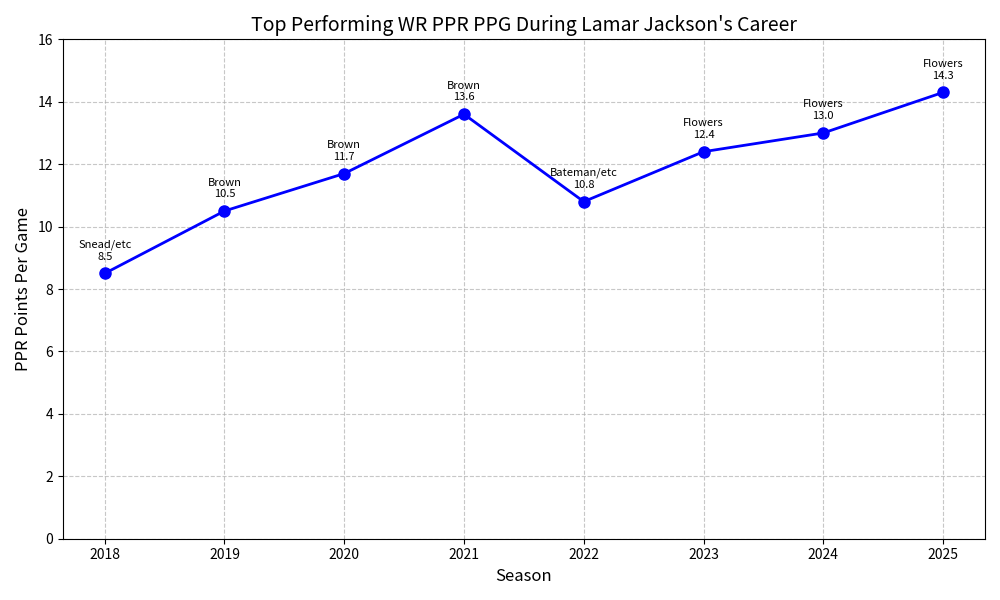
The wide receivers who have previously shared the field with Jackson further highlight the ceiling limitations. The top performer in recent years has been Flowers himself, who posted career-best numbers in 2025 with 86 catches for 1,211 yards and five touchdowns—good for roughly 14 PPR points per game—but even that mark required him to be the clear lead option in a run-heavy scheme.
Earlier standouts like “Hollywood” Brown rarely cracked consistent mid-teens scoring over full seasons, underscoring how Jackson’s mobility suppresses individual WR production.
Flowers’ speed and route-running give him a reliable floor, yet the combination of Jackson’s career-long rushing dominance and the modest historical peaks for his previous top wideouts makes it realistic that Flowers settles in as a solid but not elite WR2 rather than the fringe WR1 that many managers (and those in the industry) are hoping for.
Jaylen Waddle - WR, Denver Broncos
Position Rank: WR20, ADP: 42
2026 QB: Bo Nix
Waddle is being drafted consistently inside the fourth round of drafts as a potential WR2 (depending on the roster build) for 2026 fantasy leagues after his trade to Denver.
But Nix’s rushing prowess creates a real chance he underperforms that ADP. Nix has averaged 23.1 rushing yards per game across his first two NFL seasons, racking up 786 yards and nine touchdowns on 175 carries, and those designed runs plus scrambles inevitably cut into the overall pass volume available to the receivers.
Even though the Broncos ranked among the league’s higher pass-attempt teams last year, Nix still finishes a meaningful number of drives with his legs (assuming this to remain the case even after offseason ankle surgery), which has historically limited the ceiling for individual wideouts in Sean Payton’s system.
Managers selecting Waddle in the fourth round are counting on a big target share in a new offense, yet the dual-threat element of Nix’s game suggests those opportunities could be more shared—and less explosive—than the current draft cost implies.
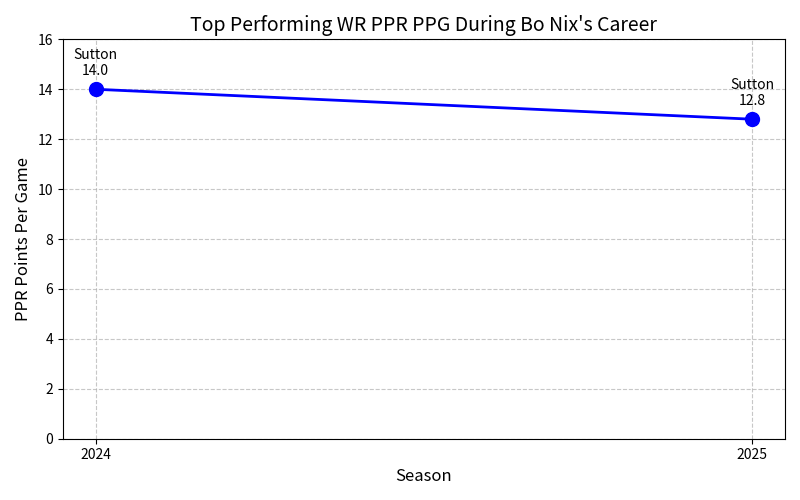
The receivers who have previously lined up with Nix only reinforce the volume concerns. The clear top performer has been Courtland Sutton, who posted back-to-back 1,000-yard seasons and averaged roughly 14.1 PPR points per game in his stronger campaign alongside the young quarterback, including a 74-catch, 1,017-yard, seven-touchdown line in 2025.
That remains the high-water mark for any wideout sharing the field with Nix, and it required Sutton to be the undisputed primary target. Secondary options have settled into lower teens or single-digit production, showing how the rushing usage keeps individual scoring in check.
Waddle’s speed and route precision give him a solid floor in Denver, but pairing him with a quarterback who still contributes nearly a full game’s worth of rushing yards each week makes it realistic that he lands as a reliable WR2 rather than the upside play his ADP currently prices in.
Who Should I Draft Fantasy Football Tool
Read more about the free Who Should I Draft tool here.
Compare up to four players and we'll tell you who to draft...

2026 Player Decisions. Today's focus is on specific players - Jaylen Waddle, DeVonta Smith, A.J. Brown, Zay Flowers, Justin Jefferson. These are some common searches for 2026 fantasy football drafts.
Using The Tool. This is a simple tool but very powerful. The first step is to enter the player names that you want to compare. In the first box, search for the first player's name. In the second box, search for the second player's name. Compare up to four NFL players at once, and then click the Who To Draft? button to see who the recommended draft picks are based on fantasy football rankings, projections, and more.
Improvements For Who Should I Draft? You may have noticed our Who Should I Draft? tool has gotten an overhaul. We've added lots of great features for you to give you as much information as possible to win your 2026 fantasy football drafts. You'll see NFL player tiles with headshots and bye weeks, stats and projections, ADPs, strength of schedule, enhanced search results with data to compare, and a slick interface. We hope you enjoy!
How It Works. Our RotoBaller staff puts together their preseason fantasy football rankings and projections based on their research and update them constantly throughout the preseason. That information is the core data that is powering the decision-making in this tool. When you search for player names, you will only see those players who are ranked.
Scoring Formats. Fantasy football managers play in various types of leagues, and this tool allows you to choose whether it's PPR scoring, Half-PPR scoring, or Standard (Non-PPR) scoring. The second thing you want to do is to select the scoring format. There are three small radio buttons (small circles), so click on the scoring format you prefer. The results may vary based on the scoring format you select.
Popular Draft Searches. Curious to see some tough draft decisions for 2026? Below you will find a list of some popular Who Should I Draft? searches that RotoBaller readers are looking at. Click any of the links to see the result and recommendation.
Popular Player Comparison Searches - Who To Draft
Below are some popular searches and comparisons from our Who To Draft tool for 2026 drafts for Jaylen Waddle, DeVonta Smith, A.J. Brown, Zay Flowers, Justin Jefferson:
More Fantasy Football Analysis
Download Our Free News & Alerts Mobile App
Like what you see? Download our updated fantasy football app for iPhone and Android with 24x7 player news, injury alerts, rankings, starts/sits & more. All free!