




 RADIO
RADIO










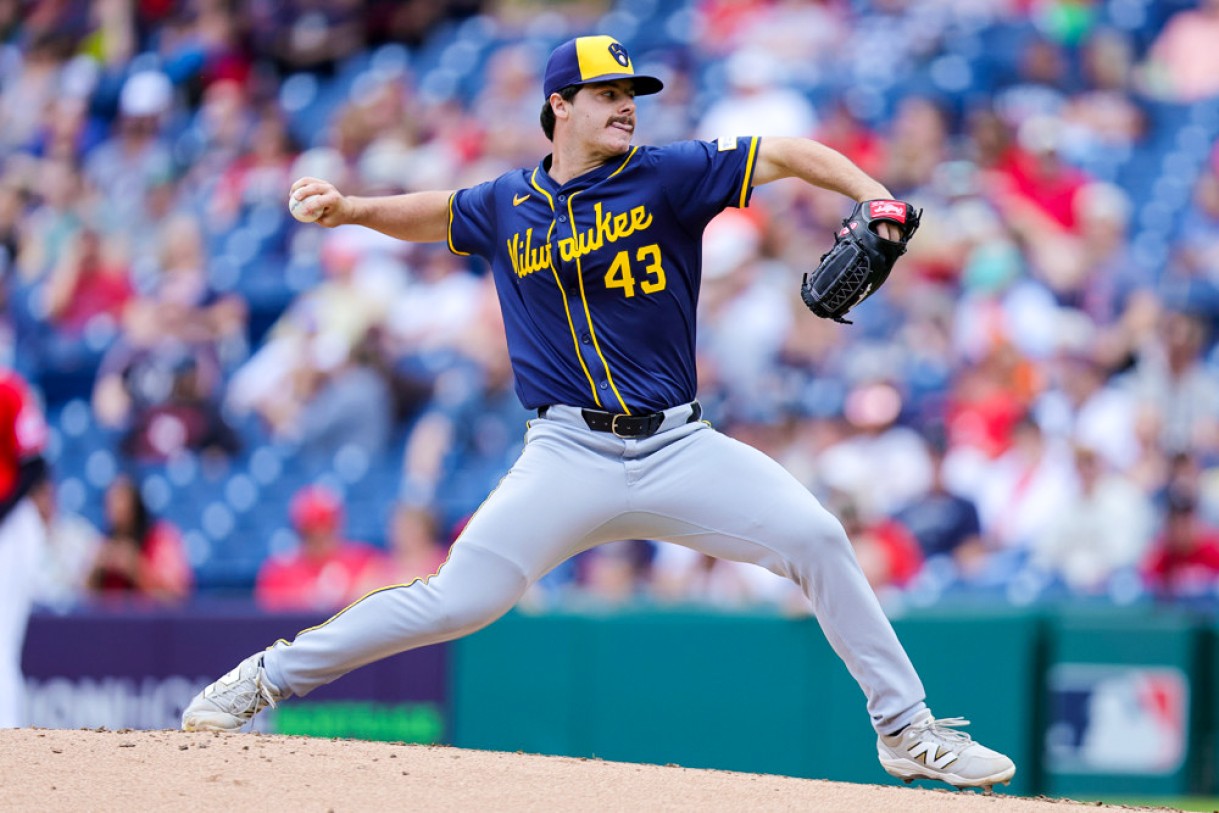
Elliott looks at pitchers with surprising starts recently. These SPs could emerge as fantasy baseball waiver wire targets for Week 8 in 2026, or just mirages.
Welcome back to the "Are You For Real?" series as we dive into Week 8 of the 2026 fantasy baseball season. For those unfamiliar, this is a weekly column where we examine starting pitchers who had surprisingly strong starts over the past week and put them under the microscope to determine whether they're legitimate or just smoke and mirrors.
It was rivalry weekend in MLB, and we saw tons of teams go toe to toe with their regional enemies. It gave us some interesting pitching performances, and this week, I am going to look at three young starters who are trying to carve out a permanent rotation spot for themselves on their respective teams. First, we'll deep dive into Logan Henderson's dominance against the Twins. Then, we'll look at Connor Prielipp, who pitched opposite Henderson in that same game. We'll finish it off by examining Trevor McDonald's recent hot start for the Giants.
Roster percentages are taken from Yahoo! and are accurate as of May 18.
Featured Promo: Save 50% off the regular price with discount code CHAMP, for a limited time. Exclusive access to our Team Sync platform, DFS cheat sheets, Lineup Optimizers, betting/prop picks, and exclusive content from Nick Mariano and Eric Cross! GAIN ACCESS NOW
Logan Henderson, Milwaukee Brewers – 42% Rostered
2026 Stats (prior to this start): 13 IP, 4.15 ERA, 2.10 FIP, 28.6% K-BB%
05/16 @ MIN: 5 IP, 6 H, 1 ER, 1 BB, 7 K
Henderson kept on rolling Saturday, holding the Twins to just one run over five innings for his first victory of the season. Henderson has truly been dominant since rejoining the Brewers’ rotation on May 3. He’s made three starts in May and has a 2.81 ERA, 11.3 K/9, 29% K-BB%, and 2.60 FIP.
It’s only been three starts, but Henderson appears to be picking up where he left off last season, when he pitched to a 1.78 ERA and 25.3% K-BB% in five starts. Is he a breakout candidate?
Originally a fourth-round pick by Milwaukee in 2021, Henderson was considered a decent prospect. Many saw him as a future back-end or mid-rotation starter. His strong command and plus changeup were his best attributes, while his middling fastball velocity was viewed as a negative. Henderson works with a four-pitch mix consisting of a four-seam fastball, changeup, cutter, and slider.
Henderson’s most used pitch this season has been the four-seam fastball, and that was true in this outing as well. He’s thrown the four-seamer 45% of the time against Minnesota on Saturday, which is about the same as his 44.2% usage on the year. A 93.2 mph offering, Henderson’s four-seamer is below average in terms of velocity, but tends to play above its velo thanks to strong movement and spin.
Henderson gets a ton of rise on his four-seamer, averaging 17.9 inches of induced vertical break thus far this season. He also averages 11.4 inches of horizontal arm-side movement, giving his fastball a unique shape that can be both difficult for hitters to read and square up. Here's a look at his pitch movement profile from this season (four-seamer in red).
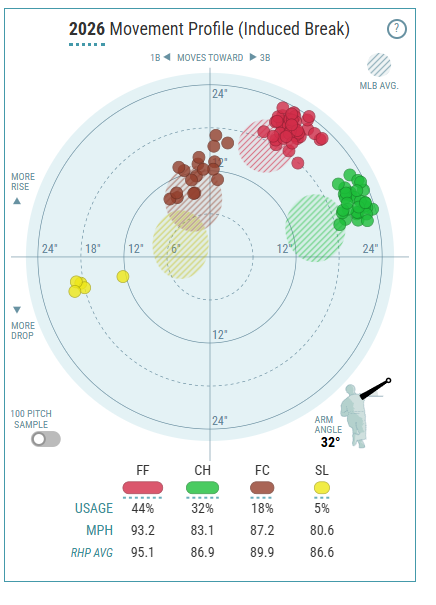
Henderson has also averaged 2367 RPM with the four-seamer. While that number doesn’t jump out as elite on its own, Henderson has 99% active spin with his heater, meaning practically all of that spin is contributing to the pitch’s movement.
It’s possible for some pitchers to get by or even thrive despite average or below-average fastball velocity, and I think Henderson is perfectly poised to be one of those pitchers. This fastball may not be thrown hard, but it’s proven very difficult to hit for opponents and has elite measurables.
This season, batters are hitting .154 with a .269 SLG and a .238 wOBA off Henderson’s four-seamer with a 27.5%. Last season, they hit .196 with a .392 SLG, .280 wOBA, and a 28.1% whiff rate. At Triple-A this year, batters have a .183 xBA, .274 xSLG, and a .283 xwOBA, along with a 45.6% whiff rate. This is all a total of just nine appearances, but it’s hard not to be impressed by Henderson’s fastball results.
The fastball has been great, but as I previously mentioned, Henderson’s changeup was his most revered pitch coming up as a prospect. An 83.1 mph offering, Henderson’s changeup is noteworthy for its high spin and unique movement. At 2556 RPM, Henderson has the highest spin rate of any changeup in MLB among qualified pitchers.
He’s also averaged 7.5 inches of induced vertical break and an unreal 20 inches of arm-side movement. Here’s another look at Henderson’s pitch movement profile (changeup in green).
That is an uncommon shape that can be quite difficult for hitters to read and make solid contact against. Here’s an example of the pitch from this season.
— Elliott Baas (@ElliottBaasBB) May 19, 2026
Nasty stuff, and batters have really struggled against this pitch. Opponents have hit just .200 off Henderson’s change, along with a .280 SLG and a .210 wOBA. The expected stats suggest that Henderson has earned these results, with a .201 xBA, .245 xSLG, and a .193 xwOBA. He also has a 30.4% whiff rate with the changeup, and earned eight of his 18 whiffs with the pitch on Saturday.
Even when batters make contact, they don’t strike the ball particularly well. Opponents have an 84.8 mph average exit velocity and a 29-degree average launch angle against Henderson’s changeup this season, leading to a 50% fly-ball rate. Flyballs are the least likely batted ball type to land for a hit, and as one could imagine, weak flyballs are especially likely to be outs.
Henderson has always displayed strong flyball tendencies even as a prospect, so I’m inclined to believe that he has the ability to consistently generate flyballs and weak flyballs on the mound.
The changeup and four-seamer are Henderson’s two best pitches, and batters see a healthy dose of both as he’s thrown the two a combined 76.5% of the time this season. That’s a lot for just two pitches, but Henderson has been making an effort to incorporate other offerings into his repertoire.
The biggest shift in his pitch mix has been an increase in cutter usage. He threw the cutter 7.8% of the time in the majors and 10% of the time in the minors last year. This season, he’s thrown the cutter 17.1% of the time in the minors and 18.2% of the time in the majors. He also threw the cutter exclusively to left-handed batters last season, but this year he’s thrown it to both lefties and righties.
An 87.2 mph offering, Henderson’s cutter has served mostly as a change of pace compared to his fastball and changeup. He’s mostly thrown the pitch when the batter is ahead, as a first pitch, or in even counts. It’s not a pitch he goes to often when ahead in the count or with two strikes.
Batters have handled the cutter well this season, hitting .417 with an .833 SLG and a .535 wOBA against, along with just a 16.7% whiff rate. The expected stats suggest that regression could be coming as Henderson has a .308 xBA, .496 xSLG, and .345 xwOBA against his cutter.
Those still aren’t great results, but much better than what we’ve seen. It’s been a very small sample size for Henderson’s cutter, and I have a hard time believing he’ll be saddled with a .444 BABIP and a 50% line drive rate against his cutter all season.
Still, this pitch did not perform well in the minors either, with a .312 xBA, .360 xSLG, and .337 xwOBA against. He also had just a 12.5% whiff rate in the minors with his cutter. This isn’t really a strikeout pitch, and Henderson doesn’t use it that way. At best, this pitch would be a nice complementary offering to his fastball-changeup combo, and at worst, it’s a liability on the mound.
Henderson also throws an 80.6 mph slider, though he’s only thrown 14 of them in the majors this season for a 5.2% usage rate. His slider usage has pretty much always been 10% or under, even in the minors, and it doesn’t appear to be a big part of Henderson’s game. He only threw one slider total in this start against Minnesota.
He does have a 33.3% whiff rate and has averaged 15.8 inches of glove-side movement with the pitch this season. Its soft velocity and big movement sort of give it a unique shape that can generate some swing and miss, but it’s such a small sample size that it’s hard to glean much from what we’ve seen.
I do think Henderson could use a pitch like this to neutralize right-handed batters better, and maybe he’d even benefit from developing the pitch, but for now, it’s sort of an afterthought in his game.
Verdict:
It’s getting hard to ignore just how good Henderson has been in the majors. Between 2025-26, he has a 2.49 ERA, 2.80 FIP, 26.5% K-BB%, and a raw 32.9% K rate. Those are ace-like numbers, and Henderson’s minor league track record suggests that he’s capable of consistently producing elite strikeout numbers and K:BB ratios.
His fastball is below average in terms of velocity at 93.2 mph, but it’s a plus offering thanks to Henderson’s strong spin and elite movement. It has proven incredibly difficult for major leaguers to hit, and Henderson can generate both whiffs and weak flyballs with the pitch.
His best offering is his changeup, which has the highest spin rate of any changeup in the majors this season, along with unreal movement. Scouts raved about Henderson’s changeup as he was coming up, and the pitch has been as advertised thus far. Between the four-seamer and changeup, I think Henderson can continue to produce an above-average strikeout rate.
The four-seamer and changeup are Henderson’s bread and butter, but he’s begun incorporating a cutter into his game more often this season. It’s had mixed results thus far, but I think it’s a good step for Henderson to be less reliant on his fastball and changeup.
Henderson has shown us strong control, strikeout abilities, and a complete major league arsenal. It’s been hard to gauge his usage because the Brewers treat their young pitchers a little unconventionally, and they’ve shown that they have zero qualms about sending a player who’s performing well to the minor leagues. Still, I don’t see how Henderson can be left on waivers in any format at this point. He’s a must add.
Connor Prielipp, Minnesota Twins – 16% Rostered
2026 Stats (prior to this start): 19 IP, 3.32 ERA, 4.36 FIP, 17.7% K-BB%
05/16 vs. MIL: 6 IP, 3 H, 2 R (1 ER), 2 BB, 8 K
Prielipp was a tough-luck loser opposite Henderson on Saturday, but the young left-hander was excellent on the mound nonetheless. It was the best start of Prielipp’s young career, with him notching a career-high eight strikeouts while also earning his first career quality start.
Prielipp now has a 2.88 ERA through his first five starts with Minnesota, and with several injuries to the Twins’ pitching staff, Prielipp certainly has the opportunity to carve out a permanent role for himself. But is there a role for him in fantasy?
Originally a second-round pick by Minnesota in 2022, Prielipp was considered one of their best pitching prospects, and scouts figured he’d make it as a mid-rotation starter. Prielipp works with a five-pitch mix consisting of a slider, four-seam fastball, curveball, changeup, and sinker.
Prielipp is a little unconventional in his pitch mix, seeing as his most used pitch this season has been the slider. He has thrown the slider 37.8% of the time this season, and threw it 40% of the time on Saturday. The slider was hailed as Prielipp’s best pitch and potentially an elite offering as a prospect, and it’s been exciting to see him lean into the pitch so much.
Batters have really struggled against this pitch as well, with opponents hitting just .154 with a .282 SLG and a .243 wOBA against Prielipp’s slider, along with a 32.1% whiff rate. The expected stats suggest that Prielipp has earned these results, with a .181 xBA, .314 xSLG, and a .263 xwOBA.
An 87.3 mph offering, Prielipp’s slider is a hard, sharp gyro slider with a high 2854 RPM spin rate. That is the sixth-highest slider spin rate in baseball among qualified pitchers, and the second-highest among pitchers who primarily work as starters.
Here's an example of the pitch from this season.
— Elliott Baas (@ElliottBaasBB) May 19, 2026
It might be tough for Prielipp to maintain such strong results against his slider all season, as there will likely be regression on the current .200 BABIP against the slider. Still, this looks like a plus offering that Prielipp can use to generate outs and whiffs on a consistent basis. Prielipp had some strong strikeout rates in the minor leagues, and we may see some of that translate thanks to his strong slider.
His next most used pitch has been the four-seam fastball, which Prielipp has thrown 31% of the time this season and 24% of the time against Milwaukee. A 95.2 mph offering, Prielipp has slightly above-average fastball velocity. Unfortunately for him, Prielipp’s fastball is rather ordinary in terms of spin and movement.
He’s averaged just 2232 RPM with the four-seamer and has gotten 15.7 inches of induced vertical break and 8.2 inches of arm-side movement with the pitch as well. That’s given his fastball a rather typical shape that doesn’t easily deceive hitters. Here’s a look at his pitch movement profile from this season (four-seamer in red).
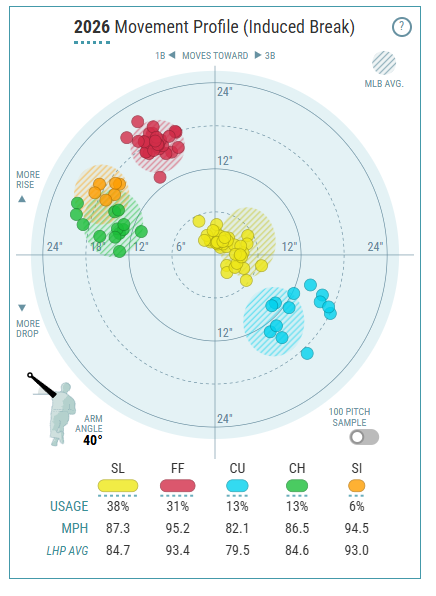
See all those red dots clustered around the “MLB AVG” circle? That’s not a good thing, as it means hitters can more easily read and pick up on Prielipp’s heater. The pitch has performed well with a .100 AVG, .250 SLG, and .267 wOBA against, but I am skeptical that Prielipp can sustain these results long term.
He has a comically low .059 BABIP against his four-seamer so far. Additionally, his .463 xSLG and .360 xwOBA against the four-seamer suggest that he’s due for some regression.
He has done a good job at generating flyballs with a 35-degree average launch angle and a 61.1% fly-ball rate against the four-seamer, but he’s shown a bigger tendency towards groundballs as a minor leaguer, plus the sample is too small to draw major conclusions. He will likely experience regression with some of these numbers, and over time, I think the fastball will perform worse.
Prielipp’s next most used pitch is also a new pitch for him, and that’s the curveball. An 82.1 mph offering, Prielipp’s curveball is soft and slow, with lots of horizontal movement. Prielipp has averaged 8.8 inches of drop with the curveball, which is fine if unremarkable, but he’s averaged a whopping 12.1 inches of glove-side movement as well. Here’s an example of the pitch from this season.
— Elliott Baas (@ElliottBaasBB) May 19, 2026
Nasty stuff, and one doesn’t often see curveballs with such pronounced horizontal movement. Like with his slider, Prielipp also gets a ton of spin on the curveball. He’s averaged 3206 RPM with the curveball so far, which is the second-highest spin rate in MLB among qualified pitchers, behind just Nolan McLean.
The pitch has performed well so far, with a .154 AVG, .231 SLG, and .168 wOBA against. What’s even more incredible is that the expected stats are somehow better for Prielipp. Batters have an .061 xBA, .080 xSLG, and a .059 xwOBA against his curveball so far. Prielipp only has a 20% whiff rate so far, but he had a 50% whiff rate with this pitch in the minors before being recalled.
Batters have simply been unable to make solid contact against Prielipp’s curveball. Opponents have a meager 81.5 mph average exit velocity off Prielipp’s curveball, along with a 25-degree average launch angle against. Like with his other pitches, I expect some regression on the outcomes, but for the curveball, I also wonder if bigger strikeout potential looms.
The measurables on this pitch are great; he throws hard and has another dominant breaking ball, and the pitch performed well in the minors. He’s only started using the curveball more often in his last three starts, and it’s been great for him so far. The curveball looks like a plus pitch, and I’d like to see Prielipp continue to make it a big part of his game.
Prielipp also throws an 86.5 mph changeup, a pitch he throws exclusively to right-handed hitters. The changeup wasn’t considered as strong as his slider or fastball, but it was necessary as a third pitch prior to Prielipp developing the curveball.
This is the one pitch that has not performed well for Prielipp, as batters have hit .333 with an .833 SLG and a .499 wOBA off the pitch. The expected stats aren’t much better, with a .320 xBA, .718 xSLG, and a .436 xwOBA against.
A big contributor to these poor results is likely the 96.1 mph average exit velocity batters have against this changeup. That EV will almost certainly drop over time, and I think Prielipp can get better results with his changeup than what we’ve seen thus far.
Still, the changeup doesn’t have exceptional spin or movement like the slider or curveball, and likely won’t be able to produce results as good as those two pitches. It’s a nice pitch to have in his back pocket, but not as dominant as some of his other offerings.
Verdict:
While most prospects come with immense hype—hype that’s only amplified by strong performances—Prielipp hasn’t garnered as much attention. He was considered a top-100 prospect by many outlets coming into the season, and normally, if a top-100 prospect was pitching to a 2.88 ERA, he’d be the talk of fantasy baseball.
He probably can’t maintain a sub-3 ERA all season, but I think a sub-4 ERA is possible for him, and he could land somewhere around his 3.42 SIERA or 3.84 xFIP.
Prielipp boasts a plus slider thanks to its sharp movement and elite spin rate. It has proven to be a bat-misser throughout Prielipp’s professional career, and I think it will continue to be a strong strikeout pitch for him. He also added a high-spin, high-break curveball that has looked and performed well so far.
His fastball has plus velocity at 95.2 mph, but its low spin and lack of significant movement make it easy to read for opponents, and he’ll almost certainly experience regression with the pitch going forward. His .190 overall BABIP is a big sign that Prielipp has overperformed so far.
Even if he has overperformed, there’s a lot to like about Prielipp’s talent and what he’s shown. He is still available in plenty of leagues, and I think he’s worth scooping up in all formats.
Trevor McDonald, San Francisco Giants – 17% Rostered
2026 Stats (prior to this start): 12.1 IP, 2.92 ERA, 3.99 FIP, 20% K-BB%
05/16 @ ATH: 6.2 IP, 5 H, 1 ER, 1 BB, 5 K
The good times continued to roll for McDonald, who now has a 2.37 ERA through three starts since being promoted in early May. McDonald was only called up to replace an injured Logan Webb, but with the Giants’ season teetering in the balance, McDonald could provide the spark they need to turn things around. Can he provide that spark for our fantasy teams, too?
Originally an 11th-round pick by the Giants in 2019, McDonald wasn’t a big prospect coming up like Henderson or Prielipp. He was viewed as more of a swingman type that could go between the rotation and bullpen and offer up some length. McDonald works with a four-pitch mix consisting of a sinker, slider, changeup, and cutter. It’s effectively been a three-pitch mix for him since being promoted to the majors, as he’s only thrown two total cutters in his first three starts.
McDonald’s most used pitch has been his sinker, which he’s thrown 57.4% of the time. His sinker usage was even higher in this game against the Athletics, as McDonald threw the pitch 62% of the time. A 94.2 mph offering, McDonald’s sinker is notable for its strong movement.
McDonald gets a ton of drop with this pitch, and it’s been great at generating groundballs. Here’s a look at his pitch movement profile from this season (sinker in orange).
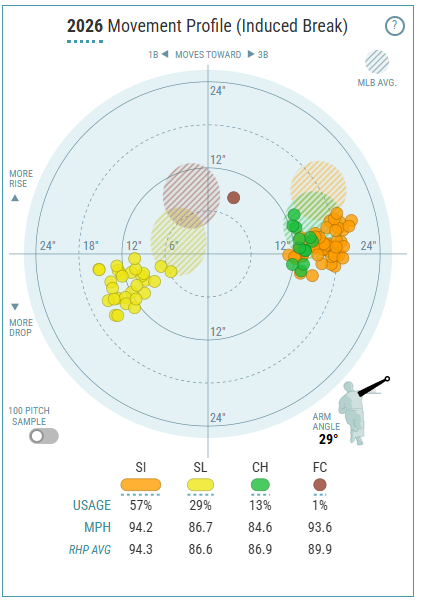
That pitch has a ton of drop for a sinker, and opponents have a -2-degree average launch angle and a 71.8% groundball rate against the sinker so far. Admittedly, this is still a small sample size, but McDonald has routinely posted plus groundball rates throughout his minor league career. He may not be able to sustain such a high groundball rate, but this is an area where McDonald could thrive.
His next most used pitch has been the slider, which McDonald has thrown 29.4% of the time. An 86.7 mph offering, McDonald’s slider is a high-spin pitch with lots of movement. He’s averaged 3.9 inches of drop and 10.8 inches of glove-side movement with the pitch so far, which is a lot for a slider. Let’s have a look at his pitch movement profile again (slider in yellow).
Here’s an example of the pitch itself.
— Elliott Baas (@ElliottBaasBB) May 19, 2026
That’s quite some shape, and it looks rather nasty in action. Batters have really struggled against this pitch as well, with a .111 AVG, .167 SLG, and a .154 wOBA off the slider so far. McDonald also has an incredible 42.1% whiff rate with the pitch, and got four of his 12 whiffs with it on Saturday. This pitch has also been very dominant in the minors, with whiff rates >45% in the last two seasons.
McDonald’s sinker-heavy approach might limit his overall strikeout upside, but this slider certainly has all the makings of a strikeout pitch. He might not be an elite strikeout pitcher long term, but this slider gives him a little extra oomph and gives him the potential to carve up an opponent in any given start, as we saw in his season debut with eight strikeouts against the Padres.
The sinker does its job by generating lots of groundballs and limiting hard contact and extra-base hits, while the slider is a high-spin, high-movement strikeout weapon. Those two pitches should allow McDonald to navigate right-handed hitters. But against lefties, he’s been relying on his 84.6 mph changeup, a pitch he’s thrown 12.5% of the time so far.
McDonald has allowed two home runs on the only two flyballs he’s surrendered with the changeup, which has skewed the numbers and expected stats. What does stick out is the 42.9% whiff rate and the 84.9 mph average exit velocity against.
If McDonald can generate whiffs and limit hard contact with his changeup, he’s doing it right. He had a 41.7% whiff rate and an unreal 0% hard hit rate against his changeup prior to promotion, and the numbers were similarly strong the year before.
Verdict:
McDonald’s repertoire is rather limited, and his long-term future might be as a reliever. His sinker and big slider would make him perfect as a groundball specialist, mostly facing right-handed hitters. Still, I like what we’ve seen from McDonald so far, and the few pitches he does throw all look to be above-average offerings.
He’s probably not a league winner, but there’s some talent in this right arm, and McDonald could be a back-end rotation piece in fantasy for this season. Logan Webb is due back soon, but given McDonald’s performance, I think he stays in the rotation anyway.
The Giants could easily remove an underperforming veteran like Adrian Houser or Tyler Mahle and see what they have in McDonald. I’m not going to call him a must-add like Henderson or Prielipp, but I think he’s worth considering in 12-team leagues or deeper, especially if you’re itching to drop that failed draft day sleeper or have an open roster spot due to injuries or streaming.
More Fantasy Baseball Advice
Download Our Free News & Alerts Mobile App
Like what you see? Download our updated fantasy baseball app for iPhone and Android with 24x7 player news, injury alerts, sleepers, prospects & more. All free!