



 RADIO
RADIO










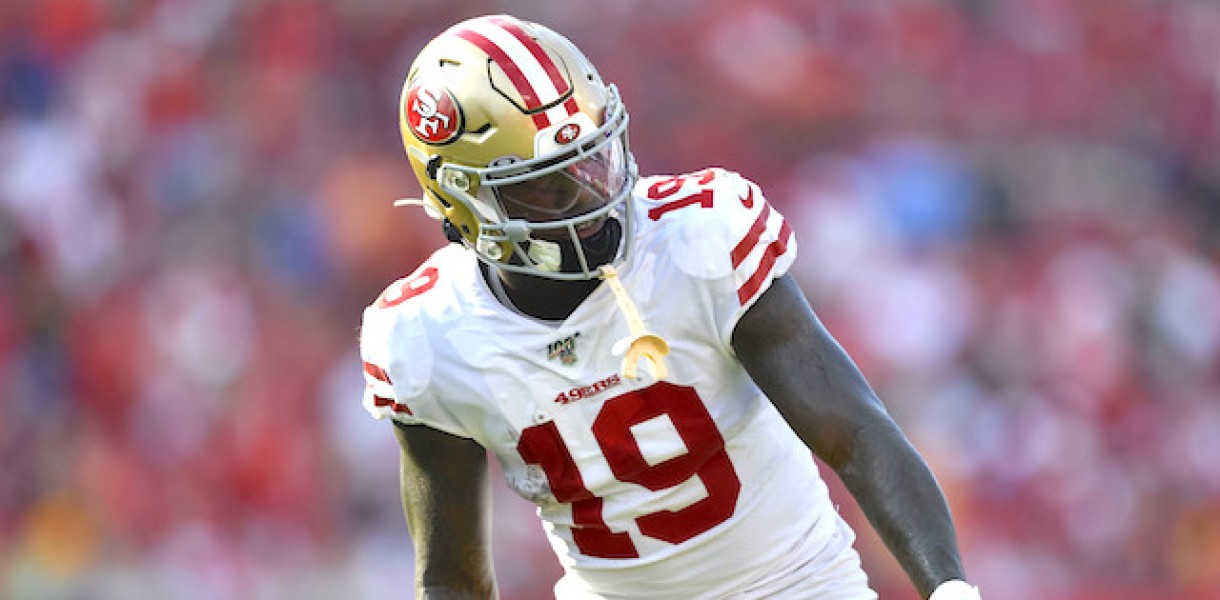
Antonio Losada provides key fantasy football takeaways from receivers data through five weeks in his weekly Next Gen stats series to help owners make the best lineup and waiver wire decisions.
We've talked about quarterback changes plenty this season, because the start of the year has been full of injuries and replacements taking the reigns as signal-caller. However, with five weeks of play in the books and things starting to settle a bit, we can flip the page and get back to studying some of the receivers around the league, both wideouts, and tight ends.
To gain the biggest edge in your fantasy football league, it's necessary to understand how to apply the advanced statistics being used in every sport nowadays. Back in the day, it was all about wins and losses, passing yards, and touchdowns scored. It is not that those stats are worthless, but they don't offer enough to the savvy analysts. While football is yet in its infancy in terms of analytics compared to baseball, the evolution the sport has seen lately in those terms is notable.
Each week, I'll be tackling NFL's Next Gen Stats, bringing you data from the just-completed week's games with notable takeaways you should consider when assessing fantasy players for the upcoming week. In case you're new to the series, or Next Gen Stats altogether, I recommend you read our preseason primer. Now, let's get to the data!
Bookmark our updated and revamped fantasy football rankings portal for all league formats!PPR rankings | Half-PPR rankings | Standard rankings | Rookie rankings | Superflex rankings | Dynasty rankings | Who To Start? | Injuries | Matchup Ratings | Strength of Schedule
Give Me Space or Else I'll Find It
After covering running back and receiver statistics during the first two weeks of the season, I took on the task of looking at quarterbacks for Weeks 3 and 4. By now, you know how it goes. It is all about Air Yards, over and under-performing players, and underlying numbers that tell more about the game than your old times' basic metrics.
The first time I studied receivers, I focused mostly on Average Targeted Air Yards (TAY), and %Share of Team's Air Yards (TAY%). TAY tells us how many air yards a receiver is thrown per target. TAY% measures the percentage of Air Yards a receiver was thrown to over the sum of his team's total Air Yards.
Two interesting metrics provided by the NFL are related to space: Average Cushion (CUSH) measured the distance between the WR/TE and the defender covering him at the time of the snap; Average Separation (SEP) measures the distance between the WR/TE and the nearest defender at the time of the catch/incompletion.
Before getting into individual cases, I found it interesting to try to find a relation between those metrics and the players' production on the field. That way we would be able to know if the CUSH and SEP statistics are just descriptors of how receivers are defended, or if those metrics could actually hold some predictive value to them by correlating with production. As we're discussing receivers, I deemed it worth comparing both CUSH and SEP to the receiver's yards gained through the air (from the LOS to the point of reception) and yards after catch (from the point of reception to the spot where the play ends). Here are the results:
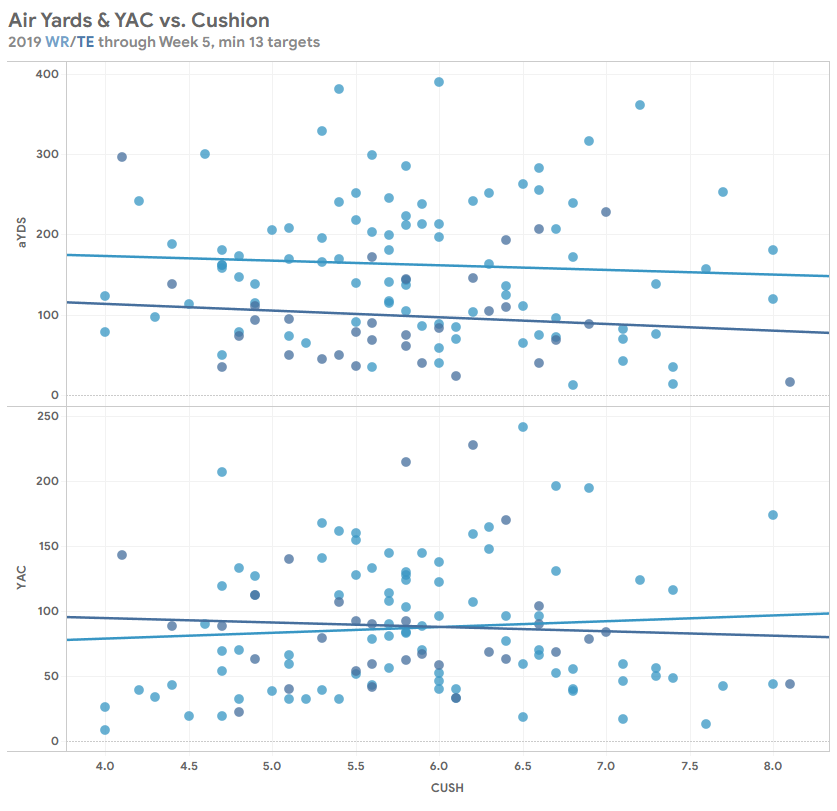

Those are quite a few points, yes. Actually, there are 120 players in each of the graphs, those who have been targeted at least 13 times combined through Week 5. There are 31 tight ends and 89 wide receivers, which virtually amounts to one tight end plus three wide receivers per team.
Back to the data regarding cushion and separation, we can come away with four conclusions from the combination of those two metrics with both the values from air yards and yards after catch each player has logged so far:
- CUSH vs. aYDS: There is virtually no correlation between both metrics. No matter if a receiver starts his route four or eight yards from his coverage-man, that won't change the yards he'll gain through the air. Only 12 tight ends are given more than six yards of cushion out of the 31 qualified.
- SEP vs. aYDS: There is, though, a moderate negative correlation (-0.14 R-Squared) between separation and air yards. The more separation at the point of the catch, the fewer air yards a player gets. Think about it. Of the qualified players, all are given around four yards of cushion. If they're thrown quick and short passes, they'll still maintain a high distance between them and the defender, but the air yards won't amount to much. That is why the bottom-right corner is full of tight ends.
- CUSH vs. YAC: Again, the cushion has almost no correlation with YAC. It is interesting to see how the WR/TE lines cross at the six-yard point, and again, how only eight tight ends of the 31 have reached more than 100 YAC so far this season.
- SEP vs. YAC: Although the chart might make it look different, the correlation between these two metrics is also virtually nonexistent with an R-Squared value of just 0.01. Only 27 players are getting 3.5 or more yards of separation on average, and only three of them have been able to gain more than 150 YAC.
All in all, there isn't seem to be much to find under both the CUSH and SEP metrics. They pass the eye test when reading a table containing names and numbers, but they don't tell us who we should be going after to fill our fantasy roster, or who's about to produce above his head just because of how he's been defended. Here is a quick look at receivers with at least 13 targets and 150 yards so far:
click on image to see full-size view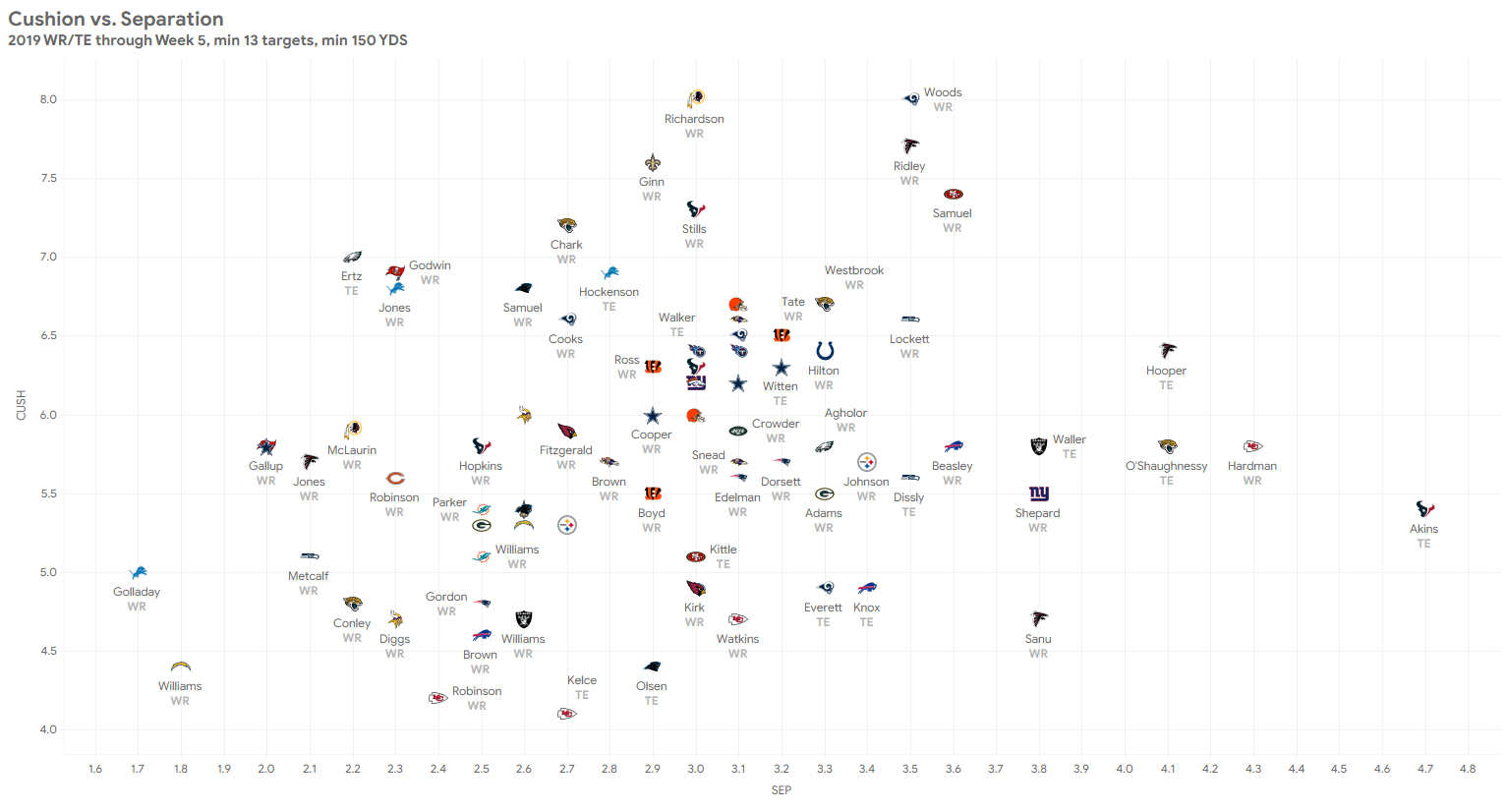
Here are some notes from the data:
- As expected, more cushion at the start of the route tends to end in more separation at the route's end. Robert Woods, Calvin Ridley, Deebo Samuel, and Austin Hooper are getting the most out of both distances. While three of them are known quantities, Deebo Samuel is having quite a rookie season after not carrying very high expectations entering 2019.
- Although Travis Kelce (bottom-left) usually gets off the LOS at four yards and doesn't reach three yards of separation on average, he has racked up 439 yards so far (most among tight ends). On the other side of the chart (mid-right), Darren Waller is given more space to start his routes and separates more from his coverage, yet he has the fourth-most tight end yards. As you see, the correlation is just not there between space and production.
Who Is Helping His Quarterback The Most?
I have already introduced how yards gained by a receiver can better be measured. It is as simple as separating yards gained through the air (Air Yards; aYDS; yards from the LOS to the point of catch) and yards gained on the ground (Yards After Catch; YAC; yards once the receiver catches the ball and runs with it).
This is very important to take into consideration when assessing both quarterback and receiver skill sets. A quarterback can have huge yardage numbers just tossing the ball to his running back and letting him rack up yards on the ground that would count as passing yards for the QB. At the same time, a fast/deep-threat receiver might put up big yardage numbers thanks to the arm of his quarterback throwing him long balls that he has just to catch and then walk a couple of yards until he crosses the goal line without having to break any tackle or get past any defender.
Here is a chart comparing all players' aYDS and YAC through Week 5:
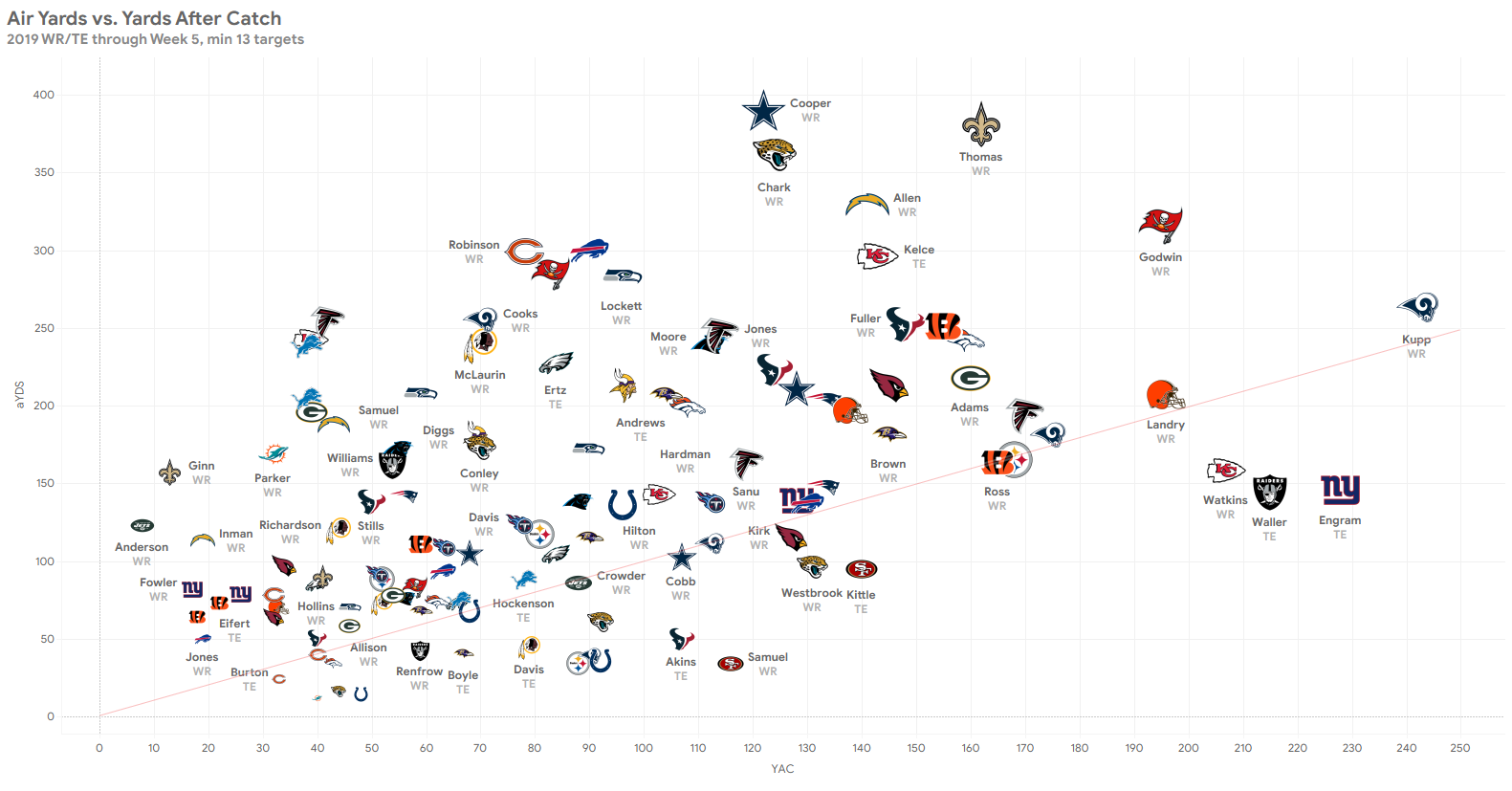
If you notice, I've added a red line breaking the graph into two parts. Everyone above it has gained more yards through the air than after the catch. Everyone below it has gained more yards on the ground than through the air. Here are some notes to highlight:
- Only 24 of 120 qualified receivers have more YAC than aYDS. In the top-10, there are three tight ends and seven wide receivers, which makes sense. The most unexpected thing, though, is the fact that our old friend Deebo Samuel--yes, a wide receiver--has the biggest difference between the two (+83 YAC). Unsurprisingly, he's followed closely by TE Evan Engram and TE Darren Waller. All this means is that even if you have doubts about how good Daniel Jones and Derek Carr are as quarterbacks, both Engram and Waller seem to not be entirely QB-dependant.
- Although Amari Cooper has been incredible in raw numbers (512 yards on 32 receptions), only 122 of those have come on his own merits. He's got the worst differential (-269 in favor of aYDS). D.J. Chark, Allen Robinson, and Michael Thomas are the only three other WRs with a differential lower than -215 yards in favor of the passing game instead of their production after the catch.
- Accounting for volume and normalizing the data--so everyone plays on the same leveled field, no matter the number of targets or receptions they've logged--we can look at the percentage of each type of yards players have accrued so far and put them in different categories.
- Do-It-Myself Receivers (>70% YAC): Deebo Samuel (78%), Parris Campbell (77), Jakeem Grant (76), Geoff Swaim (74), Vance McDonald (73), Jack Doyle (72).
- Split-The-Bill Receivers (50/50 split aYDS/YAC): Jamison Crowder (49%/51%), JuJu Smith-Schuster (50/50), Gerald Everett (50/50), Eric Ebron (50,50), Robert Woods (51/49), Jarvis Landry (51/49), Cooper Kupp (52/48), Sterling Shepard (52/48).
- Hand-It-On-A-Plate Receivers (>85% aYDS): Robby Anderson (94%), Ted Ginn (92), Marvin Jones (86), Demarcus Robinson (86), Calvin Ridley (86), Kenny Golladay (85).
Finally, How Does This Look From the Teams' Perspective?
So now you know a bunch about who is who in the league. You know who's all legs to go get the ball through the air, and who uses them to avoid being caught on the ground thus gaining extra yards. Alright, but how are teams performing as a whole?
I don't want to get too deep into quarterback data today as it's been two weeks covering it already, but we can look at things in a simple, combined way to get a sense of how teams (quarterbacks, better said) are performing in terms of passing yardage. Is Joe Flacco his usual self, throwing short passes and waiting for others to rack up yards for him? Has Matthew Stafford kept throwing bombs downfield helping his receivers get yards without having to move an inch after catching the ball? Are the wideouts from the rookie and sophomore-led teams putting up some YAC and making their QBs look better than they should?
Here is another chart, this time featuring teams instead of players and comparing both the percentage of aYDS and YAC through Week 5:

I didn't expect this to happen, but here we are! Four teams are near 50/50 splits, while San Francisco is just on another dimension. The reasonable thought to have prior to studying this data was to expect every team gaining more yards through the air than on having YAC. Turns out that is not the case in both Indianapolis and San Francisco, in the latter case by a mile.
We can take a better look at it by showing the delta (difference) between aYDS and YAC for each team in percentage terms:
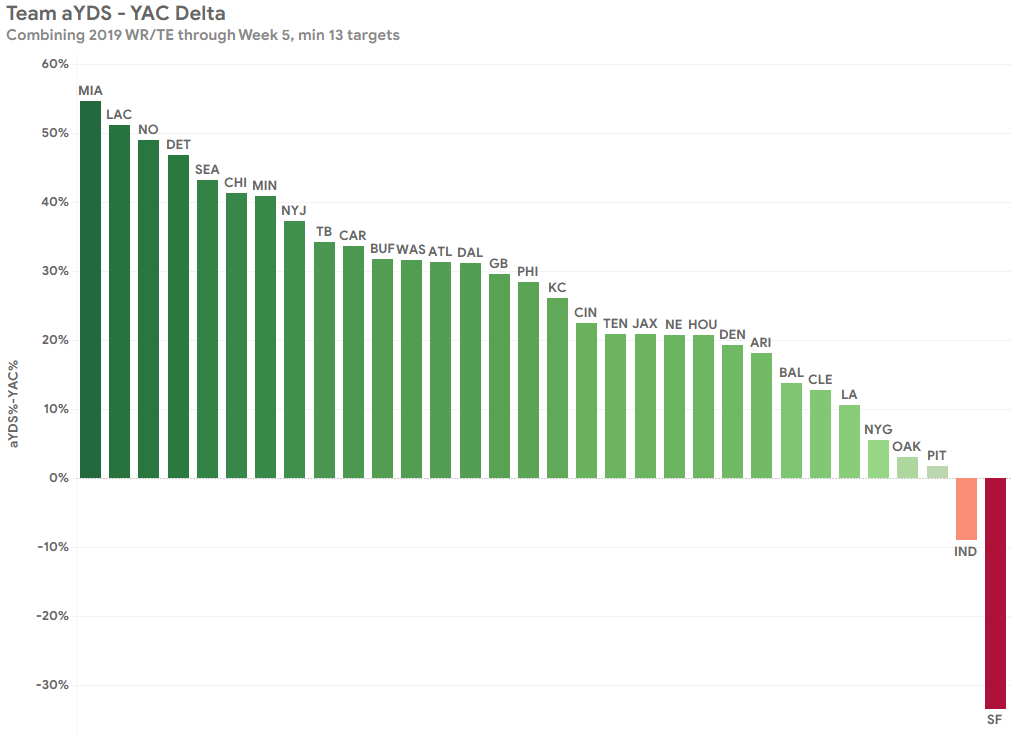
To say that's unique would be falling short. The 49ers are getting more passing yards from their receivers' efforts after the catch than what Garoppolo is actually doing with his arm. Not only that, but their delta is actually higher than that of the other 21 teams in the other direction! Fear not Niners fans, this essentially means you could put a street-QB at the helm and your receiving corps can still seemingly make something out of their targets.
Indianapolis, Pittsburgh, the Giants, and Arizona (all of them bottom-10 teams by delta) are at expected positions as they have backups, rookies or sophomores leading their teams, which normally means going the easy way and let the receivers do the heavy lifting. That is not the case in New Orleans, though, where Teddy Bridgewater seemed like he would go that way in his first few starts but has now reversed course and is throwing deeper passes with confidence.
That's it for today. The next time we meet I'll be looking at running backs and the rushing game, as it would have been already four weeks since I last did! Until then, don't get too mad at the bye weeks hitting strong for the first time with four teams out of the schedule, try to find the best free agents on your leagues' player pools, field the most productive teams you can and win the weekend in all of your leagues!