




 RADIO
RADIO










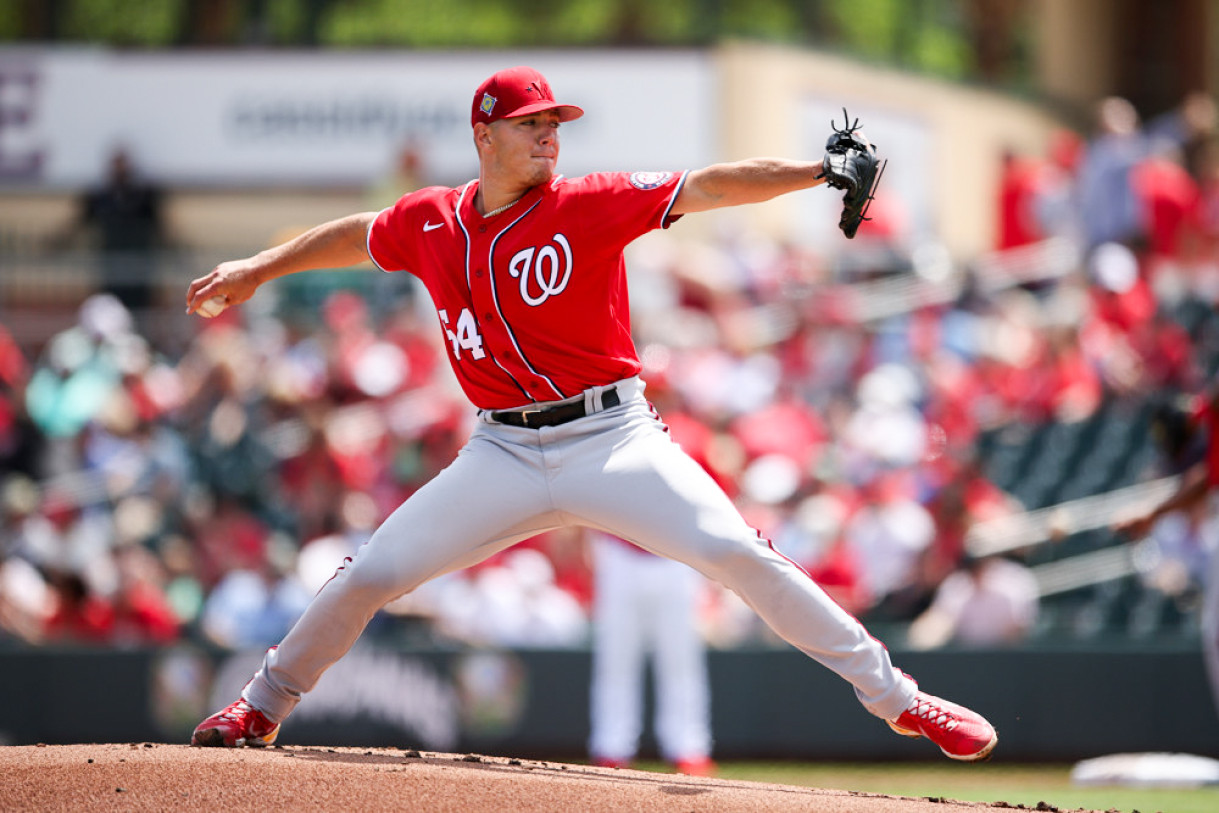
Elliott looks at pitchers with surprising starts recently. These SPs could emerge as fantasy baseball waiver wire targets for Week 7 in 2026, or just mirages.
Welcome back to the "Are You For Real?" series as we dive into Week 7 of the 2026 fantasy baseball season. For those unfamiliar, this is a weekly column where we examine starting pitchers who had surprisingly strong starts over the past week and put them under the microscope to determine whether they're legitimate or just smoke and mirrors.
The weekend was full of dominant and surprising pitching outings, and this week we'll zero in on three standout performances. First, we'll deep dive into Ryne Nelson's best start of the season on Friday. Then, we'll examine the fantasy outlook of Keider Montero following a strong outing against Kansas City. We'll finish it off with a breakdown of Cade Cavalli's recent hot streak.
Roster percentages are taken from Yahoo! and are accurate as of May 11.
Featured Promo: Save 50% off the regular price with discount code CHAMP, for a limited time. Exclusive access to our Team Sync platform, DFS cheat sheets, Lineup Optimizers, betting/prop picks, and exclusive content from Nick Mariano and Eric Cross! GAIN ACCESS NOW
Ryne Nelson, Arizona Diamondbacks – 48% Rostered
2026 Stats (prior to this start): 31.1 IP, 6.61 ERA, 5.48 FIP, 10.5% K-BB%
05/08 vs. NYM: 6.2 IP, 2 H, 1 ER, 1 BB, 7 K
It had been a rough start to the season for Nelson, who carried a 6.61 ERA heading into his start Friday night. Those numbers were certainly inflated by Nelson surrendering eight earned runs in one-third of an inning against the Blue Jays on April 19.
In fact, if we were to subtract that outing from Nelson’s overall numbers, he’d have a much more respectable 3.82 ERA. Even so, it’s been hard to trust Nelson in any given start this season. He had a career year in 2025, posting a 3.39 ERA in 154 innings. Was Friday’s start a sign that Nelson is ready to turn things around?
Originally drafted in the second round by Arizona in 2019, Nelson was viewed as a borderline top-100 prospect coming up and was seen as a future rotation piece for the Diamondbacks. He’s been rather volatile on the mound, and 2025 was the first time he was able to consistently string together success. Nelson works with a five-pitch mix consisting of a four-seam fastball, slider, curveball, cutter, and sinker.
Nelson may have a deep arsenal of pitches to choose from, but he tends to rely on a few of these pitches more than others. His most used pitch this season has been the four-seam fastball, and that shouldn’t be a surprise for anyone familiar with Nelson’s game.
He’s routinely been one of the heaviest four-seam users among starting pitchers in MLB since his debut in 2022, and he currently has the third-highest four-seam usage in the majors (min. 30 IP). He’s thrown the four-seamer 61.4% of the time this season, which is in line with last year's 61.9% usage rate.
A 96.2 mph offering, Nelson’s fastball boasts above-average velocity, but that’s not the only reason this pitch is so effective. Nelson pairs plus velocity with strong movement, giving the fastball a unique shape.
This season, he has averaged 18.9 inches of induced vertical break (IVB) and 2.3 inches of arm-side run with the four-seamer. Let’s have a look at Nelson’s pitch movement profile from this season (four-seamer in red).
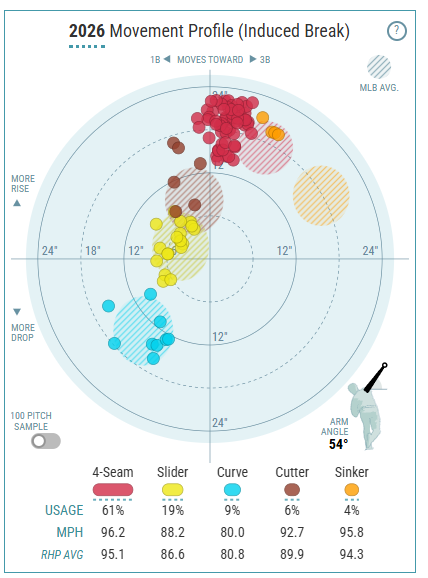
That is an elite level of fastball ride, and it means his four-seamers are incredibly tough to read, especially near the top of the zone. Fastballs with lots of IVB create a “rising effect”, where a thrown pitch doesn’t literally rise, but the spin and movement of the pitch make it so the ball doesn’t follow its expected trajectory.
This causes the batter to swing under the pitch and make weak contact, if they make contact at all. Nelson has a 21.9% whiff rate with his four-seamer this season, which is pretty good for a fastball. Batters are also hitting just .214 off the pitch, though they do have a .449 SLG, .538 xSLG, and .361 xwOBA against the four-seamer as well.
Nelson’s fastball is arguably his best pitch, and the pitch he’s going to use as the centerpiece of his repertoire. It’s certainly an above-average pitch, but I fear he overperformed with the fastball last season.
In 2025, he had a .207 AVG against the fastball despite a career .243 mark, he had a .360 SLG against, despite a .435 career SLG against the fastball, and he had an 11.7% HR/FB ratio despite a career 13.2%. These aren’t drastic differences, but his numbers this season align more with his career numbers. 2025 seems to be the outlier, and I don’t know if Nelson can recapture that success.
After the four-seamer, Nelson’s most used pitch is his slider, which he’s thrown 19.1% of the time this season. He’s thrown the four-seamer and slider a combined 80.5% of the time this season. He isn’t purely a two-pitch pitcher because Nelson has the curveball, cutter, and sinker that he mixes in, but the four-seamer and slider certainly make up the bulk of his pitch usage.
An 88.2 mph offering, Nelson’s slider is hard and sharp. It doesn’t have big, sweeping, wipeout movement like some other sliders we’ve seen. Nelson’s slider has average movement and spin, and the results haven’t been great so far. Batters are hitting .273 off the slider with a .545 SLG and .381 wOBA.
The expected stats support these results, as Nelson has a .293 xBA, .510 xSLG, and .373 xwOBA against his slider this season as well. His slider usage has been down over his last two appearances, which coincidentally happen to be his two best starts of the season. In the start, prior to this one, Nelson allowed just one run over 5.2 innings to the Cubs.
The slider has proven to be Nelson’s best strikeout pitch. He has a 32.8% whiff rate with it this season, and it was his best strikeout pitch in his last two starts despite decreased usage. He has a .368 BABIP and 22.2% HR/FB rate against this pitch so far, so I think it’s fair to say he will experience regression going forward.
These last two appearances look to be the start of a trend, though, and Nelson may benefit from incorporating more of his secondary pitches.
The pitch that saw the biggest increase in usage in this start was the cutter, which Nelson threw 17% of the time against the Mets. A 92.7 mph offering, Nelson’s cutter is hard and actually has a lot of movement for a cutter.
He’s averaged 10.8 inches of rise and 3.3 inches of glove-side movement with the cutter this season. It’s not a big strikeout pitch with a paltry 7.1% whiff rate this year, but batters have just a .200 AVG and a .256 wOBA against the cutter so far.
Batters are struggling to make solid contact against the pitch with an 87 mph average exit velocity against. This is a pitch that Nelson primarily throws to left-handed batters, and it could become a bigger part of his game. It’s tough to say after just one start, but maybe Nelson is looking to free himself from the fastball-slider combo he’s relied so heavily on this season.
Nelson also throws a 95.8 mph sinker and an 80 mph curveball. The sinker saw an uptick in usage in his start against the Cubs on May 2 at 21.4%, but thus far, he’s only thrown the sinker in two starts this season, his two most recent outings.
Nelson’s sinker is a new pitch for him, and it has some interesting movement. He averages 17.4 inches of IVB and 8.2 inches of arm-side movement with the pitch. Let’s have a peek at his pitch movement profile again (sinker in orange).
As we can see, the shape really deviates from the typical sinker and has the movement of a four-seamer, which is rare for a sinker. He’s only thrown 25 sinkers total this season, so it’s hard to draw significant conclusions from the results at this juncture, but it has performed well in limited usage.
Nelson seems to have begun throwing his curveball less often over these past few starts. He threw it 7.4% of the time against the Mets, which was his highest usage since the April 19 disaster start. An 80 mph offering, Nelson’s curve has average spin and movement for a curveball.
Batters are hitting .200 off the pitch this season, but have a .518 xSLG and .339 xSLG against as well. The curveball isn’t a big strikeout pitch with a 22.7% whiff rate this season, but it has performed well historically. Batters have a .226 AVG and a .661 OPS against Nelson’s curveball all-time. This is a fine complementary pitch, but it’s a rather ordinary offering.
Verdict:
Fantasy managers who are hoping Nelson recreates last year’s success may be kept waiting. Nelson thrived in 2025 thanks to a .252 BABIP and 9.7% HR/FB ratio, both big deviations from his career marks and league average numbers. Nelson may’ve had a 3.39 ERA last season, but he also had a 4.05 xFIP and 4.07 SIERA, both of which suggest he overperformed in terms of run prevention.
Nelson may be experiencing the opposite effect so far this season, as his 12.5% HR/FB ratio and comically low 48.9% LOB rate have inflated his numbers. Nelson will likely be able to bring his ERA to the 4-4.50 area, in line with his current 4.54 SIERA and career 4.44 SIERA. His fastball-heavy approach limits his overall upside, as the fastball cannot generate whiffs at the same rate as a good breaking ball.
Nelson’s best secondary pitch is the slider, but it has underperformed this season and has the measurables of a fairly mundane, typical slider.
He’s been mixing in more of his secondary offerings as of late, including increased cutter and sinker usage over his last two appearances. Time will tell how effective these pitches can be, but neither offering has the makings of a strikeout pitch.
Nelson will probably always be around the 20-22% range, which is league average. That would be fine if we could expect consistent results out of him, but he’s been incredibly volatile to start the season. I view Nelson as a low-upside streaming option. 2025 will probably go down as the best year of his career, and he’ll likely have an ERA starting with 4 going forward.
Keider Montero, Detroit Tigers – 13% Rostered
2026 Stats (prior to this start): 33.2 IP, 3.48 ERA, 3.41 FIP, 13.5% K-BB%
05/08 @ KC: 6 IP, 3 H, 1 ER, 1 BB, 4 K
Montero kept on rolling Friday night, holding the Royals to just one run over six innings for his second consecutive quality start. Montero hasn’t allowed more than four runs in any given start this season and has now lowered his ERA to 3.18.
With injuries to Tarik Skubal, Justin Verlander, Reese Olson, Casey Mize, and Troy Melton thinning out Detroit’s pitching depth, Montero certainly has the opportunity for an extended run in the rotation. Is he a fantasy asset?
Originally an international free agent out of Venezuela, Montero has been with the Detroit organization since 2016. He wasn’t considered a very big prospect coming up, and scouts viewed him as a potential swingman for Detroit in the future.
That’s sort of how it’s been for Montero since debuting in 2024. He’s made 46 appearances since then, starting 35 of them. Montero works with a five-pitch mix consisting of a four-seam fastball, sinker, slider, changeup, and knuckle curve.
Montero’s most used pitch this season has been the four-seam fastball, and that was no different on Friday against Kansas City. He threw the fastball 39% of the time in that start, with a 33.8% usage rate on the year.
A 94.1 mph offering, Montero’s four-seamer has perfectly average velocity. It has some decent movement, though not as much as someone like Nelson. Montero’s four-seamer has averaged 16.9 inches of IVB and 5.7 inches of arm-side movement this season. Let’s have a look at Montero’s pitch movement profile this season (four-seamer in red).
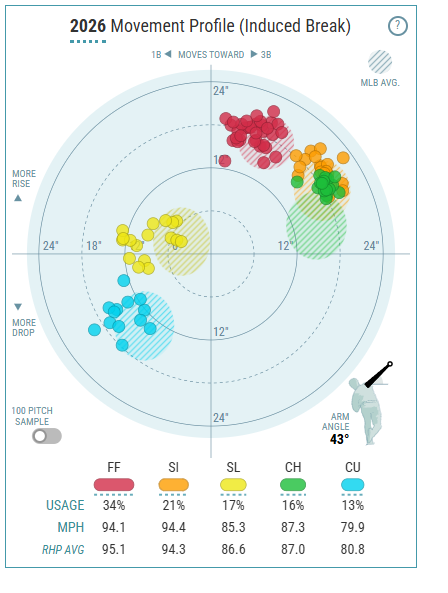
Montero’s fastball shape aligns closely with the typical MLB four-seamer, and this shape, along with league-average velocity and spin, means the pitch is relatively easy to read for MLB hitters. Batters are only hitting .222 against Montero’s four-seamer with a .671 OPS this season, but they hit .295 with a .786 OPS off it in 2025 and .272 with an .855 OPS against it in 2024.
Seeing as Montero also has a .448 xSLG and .320 xwOBA against his four-seamer, I think it’d be reasonable for us to have some doubts about the sustainability of his early-season success.
There has been a shift in the batted ball distribution against Montero’s four-seamer this season, which may explain some of the success. He has a 27-degree average launch angle against his four-seamer and has a 51.7% flyball rate. He was at 29% in 2024 and 35% in 2025, so this represents a big change.
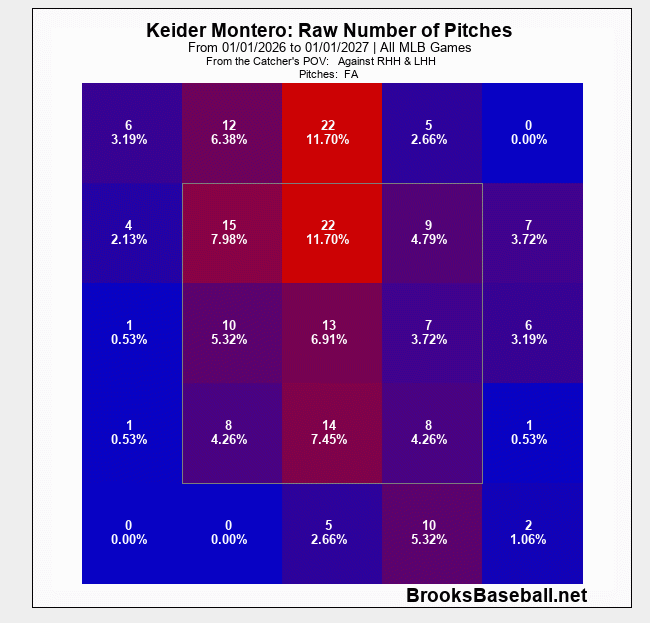
The sample size is too small to conclude whether this is the new normal for Montero, but there have been some other, subtle changes with his fastball locations. Let’s compare his 2026 four-seam heatmap to 2024-25.
2026:
2024-25:
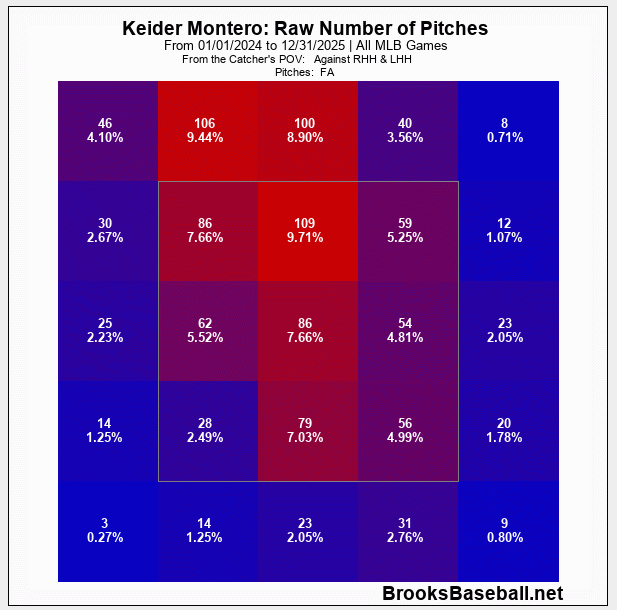
His pitches are more concentrated towards the center of the zone and above the zone, and his zone rate with the four-seamer is a career low 57.4%. His chase rate has also spiked to 30% with the fastball. While he’s not generating a lot of whiffs with the pitch overall (14.8% whiff rate), he is getting more and more hitters to swing at bad pitches and potentially make weak or unfavorable contact.
Again, I am skeptical of his results, and I think the BABIP against his fastball will rise over time, but perhaps this shift in batted ball outcomes could lead to better outcomes going forward. He probably can’t sustain the current .222 AVG and .237 BABIP against his four-seamer for an entire season, but he also probably won’t fall all the way back to his .295 AVG and .341 BABIP from a year ago.
Montero’s next most used pitch this season has been his sinker, which he’s thrown 21% of the time. He only threw the pitch 17% of the time against the Royals, making it one of his lowest sinker-usage games all year.
A 94.4 mph offering, Montero’s sinker is a little harder than his four-seamer and has quite a bit more movement. He’s averaged 11.9 inches of IVB and 15.1 inches of arm-side movement with the pitch so far, which represents plus movement for a sinker.
Montero’s sinker has performed well so far this season, with batters hitting a meager .176 with a .353 SLG and a .258 wOBA against the pitch. Montero has some heavy flyball tendencies, and the sinker is his best groundball pitch with a 10-degree average launch angle against. That has translated into a 46.9% groundball rate, which is good for Montero, but not particularly exceptional for a sinker.
Like with the four-seamer, I’m a little skeptical of Montero’s positive results with the pitch so far. He’s gotten by thanks to a .161 BABIP against the sinker, which is exactly half of what it was last season (.322).
Batters are still hitting this pitch relatively hard with a 90.7 mph average exit velocity against, and there’s really nothing in these results that would suggest a .161 BABIP is sustainable. It’s fair to say that Montero is overperforming with this pitch, and I would expect regression going forward.
His most used breaking ball has been an 85.3 mph slider, which Montero has thrown 16.5% of the time this season. His slider usage was uncharacteristically high during his May 2 start against the Rangers, but it was back down to 11.3% usage in this start against the Royals. Montero’s slider is kind of soft relative to his fastball velocity, but he does have strong movement with the pitch.
He’s averaged 8.5 inches of glove-side movement with the pitch thus far, and it’s been his best strikeout pitch with a 31.8% whiff rate. Here's an example of the pitch.
— Elliott Baas (@ElliottBaasBB) May 11, 2026
The slider might be Montero’s best strikeout pitch, but it’s proven inadequate in generating consistent strikeouts and whiffs for him. Montero hasn’t been a great strikeout pitcher since being promoted to the majors, with a career 18.6% strikeout rate. He also has a pitiful 22.9% chase rate, which puts him in the bottom fourth percentile in the major leagues.
His pitching style is fastball-heavy with mediocre secondary stuff, and it hasn’t translated into strikeouts at the major league level. This really caps Montero’s upside, as I think he’d struggle to even maintain a league-average strikeout rate. He will probably be a liability in this category throughout his career.
One pitch that has been working wonders for Montero is his changeup. An 87.3 mph offering, this pitch has confounded opposing hitters this season. Batters are hitting .083 with a .075 wOBA off this pitch.
It has a 29.7% whiff rate, which is hardly exceptional for a changeup, but this pitch has succeeded in inducing lots of weak contact. Montero has an 82.6 mph average exit velocity against his changeup, along with a 52.9% flyball rate, up 16% from last year.
Soft flyballs are generally going to be outs, so this is a very favorable outcome for Montero. It can be difficult to tell early on whether a pitcher can sustain weak contact against one of their pitches (pitchers don’t have a lot of control over a ball once a batter makes contact), but the .135 xBA, .190 xSLG, and .140 xwOBA against this pitch suggest there is a degree of sustainability.
The changeup isn’t going to transform Montero into an ace or anything, but his usage has crept up over the last few years, and it’s becoming a bigger part of his game. Again, don’t expect a lot of strikeouts, but maybe he can incorporate the pitch more often to get himself out of jams or tie up left-handed batters.
Verdict:
Montero is enjoying some of the most success he’s had in the major leagues, and a bevy of injuries to Detroit’s pitching staff should keep his rotation spot secure for the foreseeable future. He’s a solid MLB innings-eater type, but he’s not too exciting from a fantasy perspective.
Montero relies heavily on two fastballs that are of average velocity and have proven hittable at times. His secondary stuff leaves something to be desired, especially from a strikeouts perspective. He has a career 18.6% strikeout rate and an 18.7% strikeout rate this season. I don’t anticipate any drastic leaps forward in this regard.
It’s also worth noting that Montero is greatly overperforming at the moment. Yes, he has a 3.18 ERA and a 3.24 FIP, but it’s mostly been aided by a .235 BABIP against and a 4.6% HR/FB ratio, both of which are wholly unsustainable. He has a career 1.50 HR/9 but a 0.68 HR/9 this season.
Part of this is likely because Montero is allowing more flyballs this season (55.6% FB rate this season, 37.9% last season), but there’s no denying that he’s been fortunate. He’s currently rocking a 4.56 FIP and 4.46 SIERA, both of which are right around his career marks. At best, he’s a low upside streamer one can use in a pinch; at worst, he’ll tank your ratios with nary a strikeout or win to show for it.
Cade Cavalli, Washington Nationals – 18% Rostered
2026 Stats (prior to this start): 34.2 IP, 4.15 ERA, 3.09 FIP, 13.9% K-BB%
05/10 @ MIA: 5.2 IP, 4 H, 2 ER, 1 BB, 4 K
Cavalli bounced back on Sunday after allowing six runs (three earned) in his previous start against the Twins. The 27-year-old righty took a no-decision after allowing two runs over 5.2 innings in Miami.
Cavalli had been rolling prior to the start against the Twins; he even struck out ten batters in consecutive outings to close out April. The former top prospect has battled injuries throughout his major league journey, but is Cavalli finally ready to break out?
Originally a first-round pick in 2020 by the Nationals, Cavalli was a highly touted prospect thanks to his big fastball and solid arsenal of secondary pitches, though scouts were worried about his command. Cavalli works with a five-pitch mix consisting of a four-seam fastball, knuckle curve, sinker, sweeper, and changeup.
Cavalli has plenty of pitches to choose from, and he mixes them all in to some degree, with only the changeup having a usage rate below 10% this season. His most used pitch has been the four-seam fastball, which averages 96.3 mph on the gun. His four-seam velocity is down from 97.1 mph in 2025, but he still throws with plus velocity.
Cavalli may have plus velocity, but that hasn’t stopped opponents from teeing off against this pitch. Cavalli’s four-seamer has been crushed for a .397 AVG, .552 SLG, and .443 wOBA against. The expected stats suggest regression is coming, but they still aren’t pretty with a .304 xBA, .513 xSLG, and .398 xwOBA.
He’s definitely been a little unlucky with a .468 BABIP against his four-seamer, but he also has a ridiculously high 39.6% line drive rate against the four-seamer as well. Line drives are by far the most likely batted ball type to land for a hit, and a near 40% rate is astronomically high.
The problem for Cavalli is that, despite strong velocity, his fastball lacks significant movement and spin. He’s only averaged 15.3 inches of IVB this season, and his four-seam fastball has a rather typical shape that won’t often deceive hitters.
He has his velo to fall back on, but MLB hitters can handle 96-98 mph when it’s flat and straight. I doubt batters will hit nearly .400 off the pitch all season, but it might prove to be a liability for Cavalli nonetheless.
His next most used pitch has been the knuckle curve, and Cavalli has gotten some outstanding results with the pitch so far. Batters are hitting .216 off the curveball with a .243 SLG and .268 wOBA.
The expected stats are somehow even better with a .179 xBA, .208 xSLG, and .237 xwOBA against. An 84.6 mph offering, Cavalli has averaged 12.2 inches of drop and 8.4 inches of break with his curveball this season. Here’s an example of the pitch.
— Elliott Baas (@ElliottBaasBB) May 11, 2026
Nasty stuff, and hitters have really struggled to make contact against this pitch. Cavalli has an insane 46.2% whiff rate with his curveball this season, and got six of his 12 whiffs with the pitch on Sunday. Sunday was also his highest curveball usage all season at 36%, though his usage had been trending up during his recent hot streak.
Even when batters do make contact, the ball doesn’t go far. Cavalli has a 63.6% groundball rate with his curveball this season, along with an 84.1 mph average exit velocity against and a -6-degree average launch angle against. These are elite results, and while it remains to be seen whether Cavalli can maintain this, these are still encouraging outcomes.
His next most used pitch has been the sinker at 17%, although he only threw that pitch 9% of the time against Miami on Sunday. A 95.7 mph offering, Cavalli’s sinker is a pitch he typically uses against righties and when in even counts or behind in the count.
The pitch has been hit rather hard this season, with a .333 AVG, .394 SLG, and .375 wOBA against Cavalli’s sinker so far. He’s also allowing a blistering 94.2 mph average exit velocity against, so batters are just smoking the ball when they make contact.
Like with his four-seamer, the sinker seems like a hittable pitch despite the velocity. Also like his four-seamer, the sinker likely has inflated numbers against it at this point. He has a .407 BABIP against his sinker despite a 51.9% groundball rate.
Both the four-seamer and sinker could experience some BABIP regression going forward, leading to better results for Cavalli. The sinker isn’t a dominant pitch or anything, but it could perform better over time.
Cavalli also uses an 85.1 mph sweeper, another pitch that has seen increased usage over his past few starts. Batters have really struggled against this pitch, hitting just .158 with a .211 SLG and a .297 wOBA. He also has an 82.5 mph average exit velocity against the sweeper, along with a 30.2% whiff rate. He had four of his 12 whiffs with the sweeper on Sunday.
Cavalli’s sweeper is low spin, but it has exceptional movement. He’s averaged 8.2 inches of drop and 13.5 inches of break with the pitch this season. Let's have a look at Cavalli's pitch movement profile from this season.
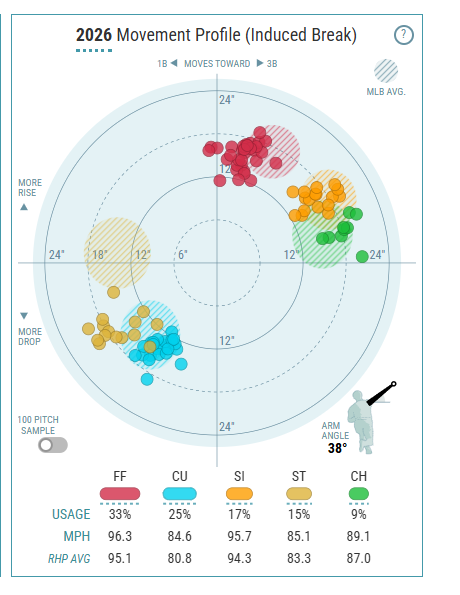
Here’s an example of the pitch.
— Elliott Baas (@ElliottBaasBB) May 11, 2026
It doesn’t quite have the sharp movement of a slider, but it has a ton of drop and thus has been difficult to square up for opponents. His 30.2% whiff rate is solid, but the low average exit velocity tells me that batters cannot make decent contact against this offering.
Cavalli barely threw his sweeper prior to this season, so it’s hard to say whether these results are sustainable, but the pitch looks great, has good measurables, and has performed well thus far. I think Cavalli could use this pitch alongside his hard fastballs and dominant curveball for a strong repertoire.
Verdict:
Cavalli has gotten off to a strange start this season. His 9.82 K/9 and 3.19 FIP suggest that he’s pitched very well, and it’s a .378 BABIP holding him back.
On the flip side, Cavalli has greatly benefited from a 2.3% HR/FB ratio; he’s allowed just one homer in nine starts this season after surrendering seven in 10 starts in 2025. He’s missed so much time with injury and pitched so sporadically over the past few seasons that it’s difficult to establish his baseline and what to expect going forward.
From what we’ve seen so far, Cavalli seems to possess two strong breaking balls and plus fastball velocity. His fastballs have been hit hard this season, but the numbers also suggest that he’s been unlucky with both pitches and could experience regression. His curveball has been downright elite with a .179 xBA and 46.2% whiff rate so far, and his new sweeper is right behind with a .158 AVG and a 30.2% whiff rate.
He’s a raw talent that may struggle with control at times, as evidenced by the fact that Cavalli has issued multiple walks in six of nine starts thus far. Still, it’s hard not to be intrigued by the potential Cavalli has shown us. He clearly has the juice to generate strikeouts, and he’s been pitching deeper into games as the season has progressed. I really like his talent, but I’m not sure 2026 is the year he puts it all together.
He still needs to find his footing after all the injuries and missed time, and he needs to rein in his control. Still, I like him enough that I think he’s worth an add in 12-team leagues or deeper, because I think he has breakout potential.
For now, he’s best deployed against weak lineups with a lot of swing-and-miss. I do think he could be a breakout candidate in the future, maybe even this season if he can figure out his control. The talent is certainly there.
More Fantasy Baseball Advice
Download Our Free News & Alerts Mobile App
Like what you see? Download our updated fantasy baseball app for iPhone and Android with 24x7 player news, injury alerts, sleepers, prospects & more. All free!