



 RADIO
RADIO









Kyle identifies fantasy baseball sleepers, breakouts using K-Score data for 2026 drafts. These pitchers and hitters are good draft values at ther current ADPs.
Welcome, RotoBallers! I'm one of the resident daily fantasy experts here at RotoBaller, but I have a lot of experience doing analysis and playing season-long fantasy sports as well. This is my return to the fold with an article for the upcoming fantasy baseball season, and while we only have two weekends left to get drafts in before the season starts up on Wednesday, March 25th, there's still plenty of time to get your last-minute research and ranking adjustments in order.
If you've read any of my NBA DFS articles or follow me on Twitter/X @RING_DFS, you're likely familiar with the "K-Grade" metric that I use as a starting point for my analysis. This "grade" is simply a weighted metric that incorporates what I deem most important for predicting fantasy success. In the NBA, this includes implied game and team totals, projected pace of play, and offensive and defensive efficiency metrics.
The MLB is a much, much different beast - arguably as unpredictable as any major sport - but I have found a combination of metrics that I believe will correlate strongly with fantasy success in the upcoming season. The objective is to find players who pop in the custom metric I'm calling a "K-Score," which could signal who to draft above ADP and who could profile as fantasy baseball sleepers in 2026.
Featured Promo: Save 50% off the regular price with discount code CHAMP, for a limited time. Exclusive access to our Team Sync platform, DFS cheat sheets, Lineup Optimizers, betting/prop picks, and exclusive content from Nick Mariano and Eric Cross! GAIN ACCESS NOW
What Is K-Score | Why Is It Important?
The starting point was to pull basic stats and advanced metrics using 2025 FanGraphs data, so this notably won't include rookies or players who didn't qualify due to injury or other reasons. The next step was to normalize the metrics using "z-scores," which essentially uses the dataset's average and standard deviation to create metrics that won't skew the analysis due to outliers. The last step was to create "buckets" of related metrics - making sure not to include duplicative stats - and then weight those buckets as I saw fit.
This is by no means a "perfect" way to analyze, and in fact, it's my first attempt at compiling stats to come up with one predictive score for fantasy baseball. It should also be noted that the Hitter K-Score doesn't account for stolen bases or run speed, focusing solely on hitting production. However, I believe it is a combination of stats that has a high likelihood of predicting future fantasy success, so we're going to roll with it and see what comes out!
Starting Pitcher K-Score Metrics:
Minimum 100 IP (127 qualified SPs)
- Strikeout Skill (30%): K-BB%, Swinging Strike %
- Ability to rack up strikeouts while limiting walks.
- Command / Plate Discipline (15%): O Swing %, BB%, Zone %
- Ability to control the zone, draw chase swings, and limit free passes.
- Contact Damage (15%): Barrel %, Average Exit Velocity, Hard Hit %
- Quality of contact allowed when hitters put the ball in play.
- Contact Ability (10%): O Contact %, Z Contact %
- How often hitters make contact when they swing.
- Run Prevention Models (15%): xFIP, SIERA
- Advanced estimators that strip out defense and luck to better measure true pitching skill.
- Pitch Quality / Stuff (10%): Pitching+, Fastball Velocity
- Overall effectiveness and raw quality of a pitcher’s arsenal.
- Batted Ball Profile (3%): Groundball %, Launch Angle
- Limiting dangerous contact by keeping the ball on the ground.
- Regression Signal (2%): HR/FB%
- Unusually high or low home run luck.
Hitter K-Score Metrics:
Minimum 500 PAs (145 qualified hitters)
- Plate Discipline (30%): K%, BB%, Swords
- How well a hitter controls the strike zone by limiting strikeouts and drawing walks.
- Quality of Contact (35%): Barrel %, Average Exit Velocity, Sweet Spot %
- How consistently a hitter makes hard, well-struck contact.
- Expected Production (25%): xwOBA, xISO
- Estimate what a hitter’s production should look like based on contact quality.
- Bat Speed (10%): Average Swing Speed, Fast Swing Rate
- Raw swing power and a hitter’s ability to generate bat speed.
Top 25 Starting Pitchers by K-Score
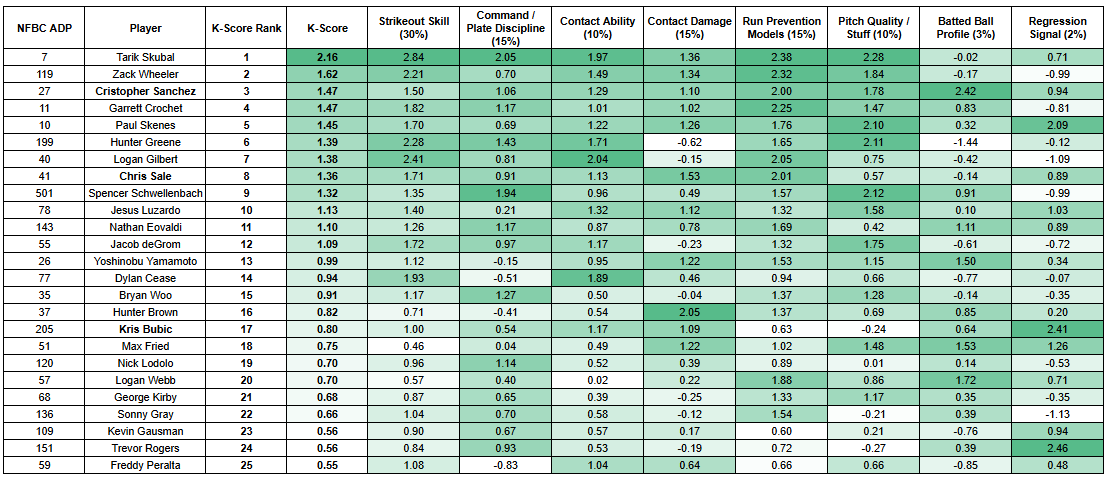
First off, it's a very encouraging sign that Tarik Skubal is the runaway winner of the K-Score metric for pitchers. Skubal was the most dominant arm in the sport, finishing the year with a sparkling 2.21 ERA, 0.89 WHIP, 32% K%, and advanced metrics that make the rest of the league look silly. Seeing other dominant arms like Cristopher Sanchez, Garrett Crochet, and Paul Skenes in the top 5 also provides the K-Score metric with initial validation.
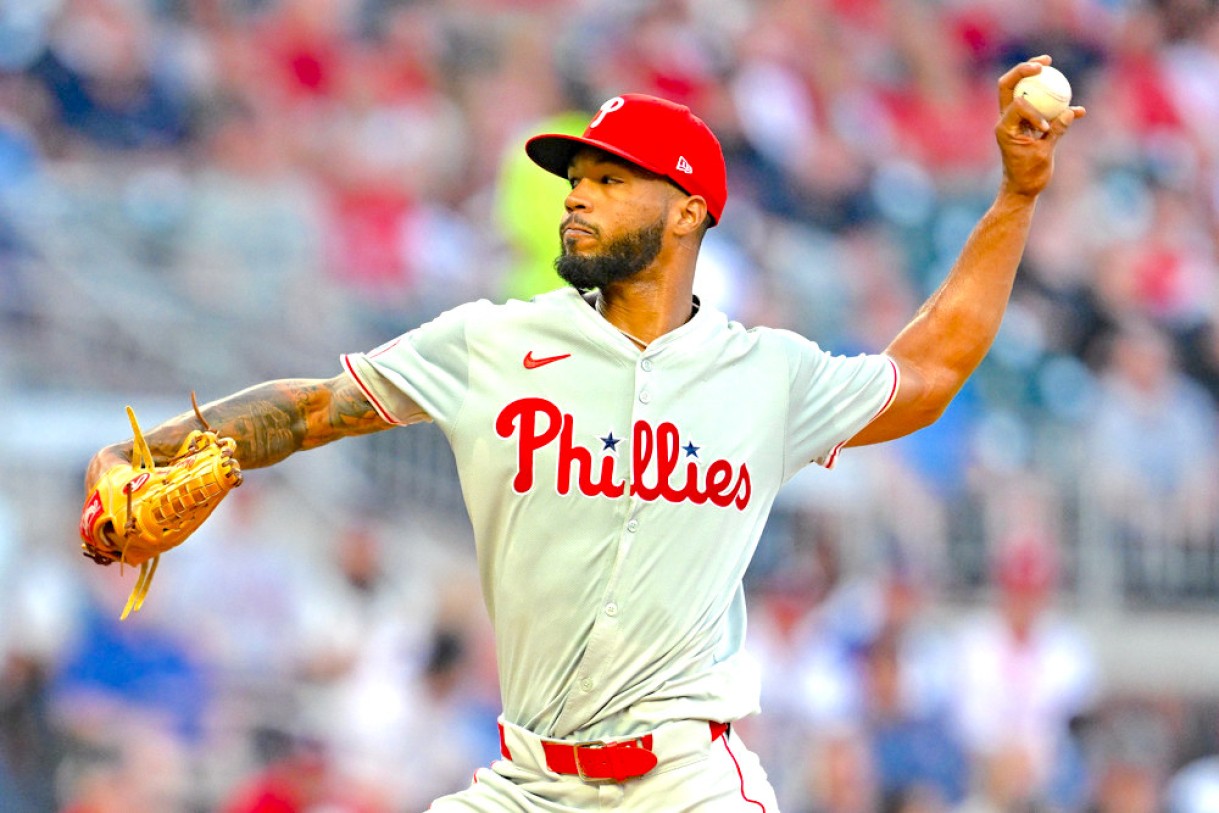
Cristopher Sanchez, SP, Philadelphia Phillies
Sanchez enjoyed a breakout season in 2025, finishing with a sparkling 2.50 ERA and great advanced metrics across the board over 32 starts. The run prevention models (xFIP, SIERA) and his elite batted ball profile are the metrics vaulting him to the top in K-Score, and those are great categories to excel in, as they should have a high likelihood of carrying over into the 2026 season. He's still being slept on a bit as the 29-year-old lefty has only had one truly elite season, but I'd rather be ahead of the curve here than on the skeptical side of things.
Only one starting pitcher (min 50 IP) had a whiff rate above 30% and a groundball rate above 50% in 2025...
Cristopher Sánchez#RingTheBellpic.twitter.com/aPqIbJ9jEm
— Eric Cross (@EricCrossMLB) February 21, 2026
Final Verdict:
I'm willing to fully trust the K-Score on this one. Sanchez broke out in a major way last year, and the metrics suggest his surge was anything but a fluke. This is the type of arm you can, and should, reach for in drafts this season.
Chris Sale, SP, Boston Red Sox
The 36-year-old southpaw for Atlanta comes in at #8 in K-Score, which did not surprise me in the slightest. Sale has always had nasty stuff, posting a 3.01 ERA and 32.4% K% over his 10-year career with the White Sox, Red Sox, and Braves. He hasn't slowed down in the twilight of his career, recording a 2.77 xERA and 32.1% K% in a Cy-Young winning 2024 and a 2.87 xERA and 32.4% K% in 2025. He only made 20 starts last season due to a fractured rib cage, but his K-Score shows that his strikeout skill, contact ability, contact damage, and run prevention remain up there with the best arms in the league.
Final Verdict:
Sale is currently being drafted as the ninth starting pitcher off the board, behind guys like Bryan Woo, Hunter Brown, and Logan Gilbert. I like Brown and Gilbert as targets this season, but Sale's significant edge in limiting hard contact has me ranking the wily veteran higher in my personal sheet.
Kris Bubic, SP, Kansas City Royals
Bubic is a bit of a tricky one because he has only had one season with usable fantasy production over his six-year career with the Royals. Fortunately, that season came just last year, where he finished with a 2.55 ERA over 20 starts before suffering a rotator cuff injury that shelved him for the rest of the season. He's not going to win with velocity, but he can excel with his ability to limit contact and hard contact while racking up enough strikeouts to be viable.
It was nice to see Kansas City Royals starting pitcher Kris Bubic on the mound. Bubic had his four-seamers up in the zone, with sliders and changeups low in the zone.
-Changeups were effective against RHH (44.4% SwK)
-Solid four-seam IVB (17-18 inches)
-Main concern is health,… pic.twitter.com/TlRwykwDoJ— Corbin (@corbin_young21) March 2, 2026
Final Verdict:
Bubic has durability concerns due to his injury history, but he appears fully healthy coming into this season and is being drafted way too low for his upside in the Royals' rotation. He's a sleeper who I'm going to be heavily targeting in all formats this season.
Other Notes
Zack Wheeler, Logan Gilbert, Chris Sale, and Nathan Eovaldi all rank in the top-11 in K-Score, and they're all pitchers I'm highly interested in at cost this season. Dylan Cease, Hunter Brown, Logan Webb, and George Kirby are my other top targets that popped in this metric.
Top-200 Starting Pitchers with Poor K-Scores
Zac Gallen (-0.32), Sandy Alcantara (-0.16), Gavin Williams (-0.08), Robbie Ray (-0.01), Merrill Kelly (0.05)
Top 25 Hitters by K-Score
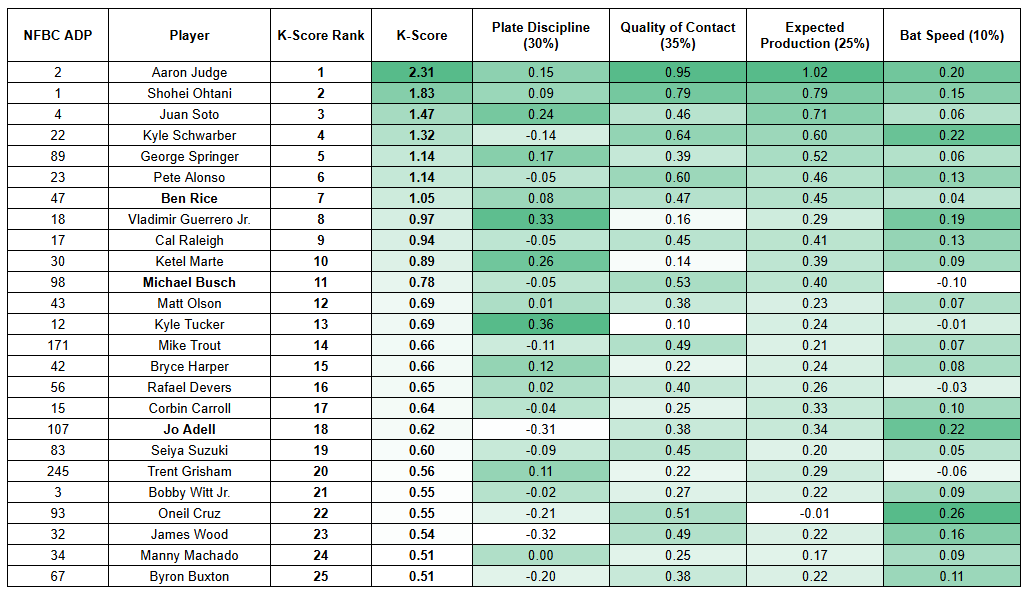
Much like the starting pitcher K-Score, it's a beautiful sign that we have established superstars at the top of the board in Aaron Judge, Shohei Ohtani, and Juan Soto. Kyle Schwarber and Pete Alonso also feel like they belong in this group, but we already know what they're all about. Let's highlight a few surprises emerging in this metric.
Ben Rice, New York Yankees, 1B/C
Rice's K-Score is up there with the best in the league due to his high marks in plate discipline, contact quality, and expected production. He was above-average across the board in 2025, compiling 26 homers, .499 SLG, and .836 OPS with incredible advanced metrics to back it all up. Encouragingly, the former 12th-round pick seemed to take his production to the next level after the All-Star break, posting an elite .894 OPS over his final 203 at-bats of the season.
Final Verdict:
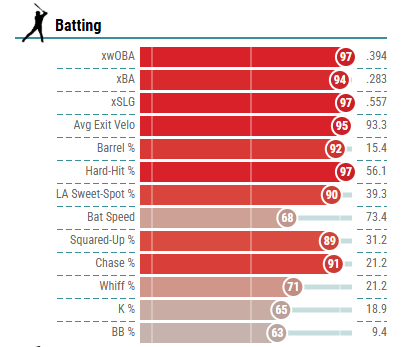
Rice's profile is too juicy to pass up at his low ADP. Drafting a 1B/C early can feel a bit wrong when you can get 20+ homers at the position late in the draft, but there aren't many players who can match Rice's combination of counting and peripheral stats and a Statcast slider board that looks like his. Batting behind Trent Grisham, Judge, and Cody Bellinger only gives his prospects a boost, as does playing in the hitter-friendly Yankee Stadium (Park Factor: #11 overall for LHHs, #5 HR for LHHs).
Michael Busch, Chicago Cubs, 1B
Busch had a superb year in 2025, racking up 34 home runs, 90 RBI, and 78 runs scored with a .523 SLG and .866 OPS. His .378 xwOBA, .286 xISO, 17.1% barrel rate, and 41.1% sweet spot rate all ranked among the best in the MLB, which is what vaulted the fourth-year slugger up the K-Score rankings. There isn't anything in his profile that suggests last year was a fluke, and if anything, he can propel himself to new heights if he can increase his bat speed (16th percentile) and cut down on his strikeouts (38th percentile).
Who is your favorite infield target in ADP 101-200?
Our staff picks (Part 1)@EricCrossMLB: Michael Busch@ThunderDanDFS: Jac Caglianone@ElliottBaasBB: Luke Keaschall@JRRupp5: Ivan Herrera@Baseball_Jimbo: Brandon Lowe@heistjm: Jonathan Aranda pic.twitter.com/m2CVbQuj9h
— RotoBaller MLB (@RotoBallerMLB) March 6, 2026
Final Verdict:
Busch is a tremendous value in fantasy drafts this season. He's going right around 100th overall, but the K-Score leaderboard indicates that he belongs in the same tier as established stars like Matt Olson and Bryce Harper. Reaching at least a round early for Busch makes all the sense in the world.
Jo Adell, Los Angeles Angels, OF
Full transparency: I had to triple-check the formula accuracy when Adell popped up 18th in K-Score. It just didn't seem right, and I questioned the validity of my entire process with this new metric. After digging into it a bit, though, it does make sense. Adell smacked an eye-popping 37 homers while posting elite marks in xwOBA (.365), xISO (.289), barrel rate (17.3%), and bat speed (77.6 MPH) in 2025. He struggled with plate discipline, as reflected in his K-Score, but everything else suggests he will have another productive year at the plate in Los Angeles.
Final Verdict:
Adell appears to be a sneaky sleeper going outside the top-100 in fantasy baseball this season. He's not going to hit for average, but he has every opportunity to excel thanks to the hitter-friendly Angel Stadium (Park Factor: #4 overall for RHHs, #4 HR for RHHs) and what should be an improved lineup around him. He's an outfield target I'm fully willing to reach for, but I'm making sure to pair him up with a high-average contact hitter like Luis Arraez, Yandy Diaz, or Chandler Simpson.
Other Notes
George Springer ranking fifth in K-Score surprised me. He bounced back with an incredible .959 OPS and 32 homers in 2025, but part of me wonders if it's a bit of a mirage. He had down years in 2023 and 2024, and he's now 36, entering his 13th MLB season. Ketel Marte, Matt Olson, Kyle Tucker, Mike Trout, Bryce Harper, Corbin Carroll, Grisham, Bobby Witt Jr., and Oneil Cruz are my favorite targets at cost from the rest of this top-25 K-Score list.
Top-200 Hitters with Poor K-Scores
Xavier Edwards (-0.93), Jacob Wilson (-0.90), Jose Altuve (-0.70), Steven Kwan (-0.61), Ozzie Albies (-0.59), Brenton Doyle (-0.54), Ceddanne Rafaela (-0.51), Nico Hoerner (-0.51), Trevor Story (-0.48), CJ Abrams (-0.46), Michael Harris II (-0.40)
Conclusion
This is a starting point for a brand-new, all-encompassing metric, so I'm taking everything we're seeing here with a grain of salt. This hasn't been tested or proven out in any way, but it will be fascinating to see if the guys I highlighted vastly outperform their ADPs.
I expect to continue making small tweaks and iterations to these K-Score metrics, and the next step will be to bring in three years of data to get a more complete picture and expand the pool of qualified starting pitchers and hitters.
Good luck with drafting, and make sure you stay locked in on RotoBaller.com as we're ramping up our fantasy baseball content with the season drawing near!
More Fantasy Baseball Advice
Download Our Free News & Alerts Mobile App
Like what you see? Download our updated fantasy baseball app for iPhone and Android with 24x7 player news, injury alerts, sleepers, prospects & more. All free!