




 RADIO
RADIO










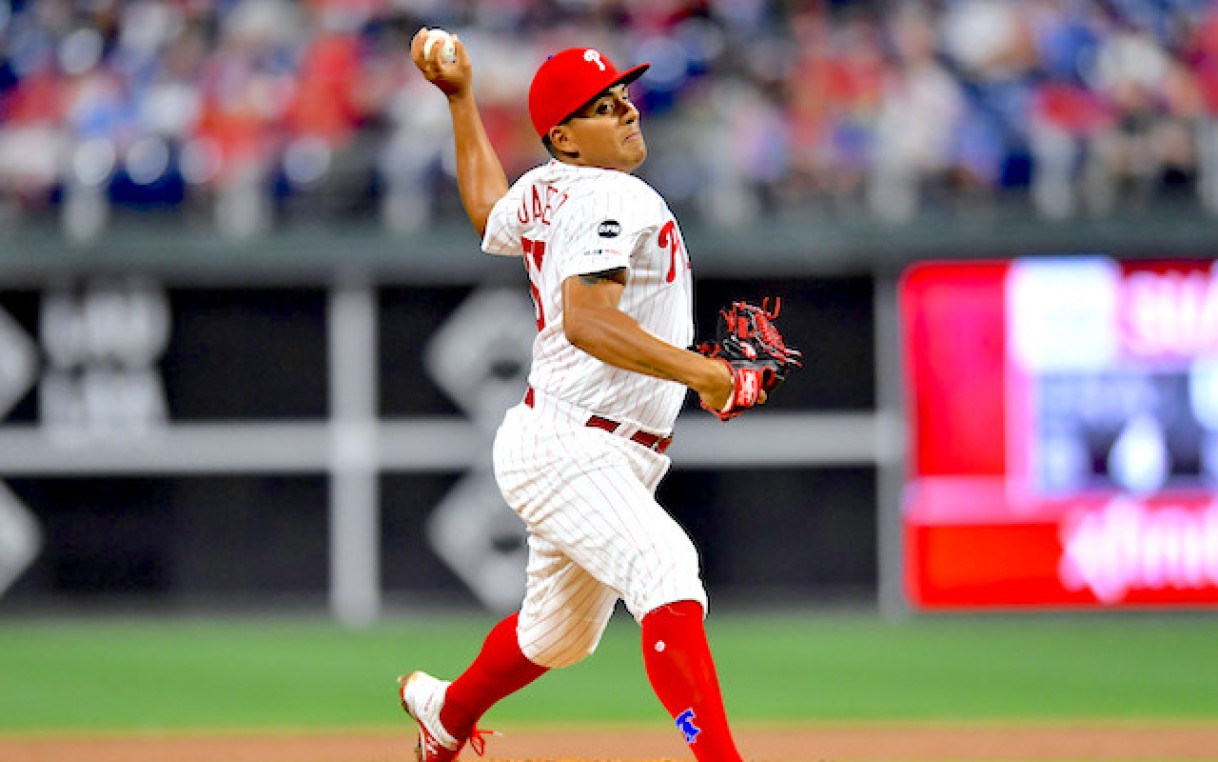
Nicklaus Gaut takes a deep look at Ranger Suárez as a 2022 fantasy baseball starting pitcher breakout candidate, draft target and undervalued sleeper.
He was a starter throughout his minor league career but Philadelphia's Ranger Suárez had only seen action from the bullpen in the big leagues before 2021 and again started this past year as a reliever. Suárez dominated from the jump, posting a 1.12 ERA (3.32 FIP) over 40.1 IP, starting as a multi-inning fireman role and ending as the Phillies de facto closer for his final weeks in the bullpen, collecting four saves before the Phillies abruptly transferred him to their ailing rotation.
Suárez rewarded the move, going 3-2 over 12 starts, with a 1.51 ERA (2.35 FIP), 1.08 WHIP, and 25.0% K% over 65.2 IP. Granted, he did get helped by winning the wheel of fortune for opponents; his final six starts were against the Orioles, Cubs, Rockies (in Philadelphia), Pirates, and Marlins (twice). But you can't control who you pitch against and Suárez dominated everyone put in front of him, ending the year with two scoreless outings, including a complete-game shutout in his penultimate start.
Regardless of quality, it's hard to bet too strongly on a reliever-turned-starter with just 12 starts under his belt. But the way that Suárez achieved his results in 2021 - and the pitch mix that he did it with - make me believe that we're seeing the beginning of a successful starter's story.
Featured Promo: Save 50% off the regular price with discount code CHAMP, for a limited time. Exclusive access to our Team Sync platform, DFS cheat sheets, Lineup Optimizers, betting/prop picks, and exclusive content from Nick Mariano and Eric Cross! GAIN ACCESS NOW
Steady As He Throws
The overall surface stats were good, independent of role, and not a ton changed about how Suárez attacked batters by handedness either, with his usage splits staying mostly the same whether in the bullpen or as a starter.
The biggest change vs LHH - who managed just a .152 wOBA/.235 xwOBA vs Suárez as a reliever and a .151 wOBA/.190 xwOBA as a starter - was swapping increasing his four-seamer usage from 7.9% to 14.2%:
| Pitch Type | RP n | SP n | Use% RP | Use% SP | wOBA RP | wOBA SP | xwOBA RP | xwOBA SP |
| 4-Seam | 15 | 31 | 7.9 | 14.2 | .277 | .000 | .423 | .153 |
| Changeup | 30 | 30 | 15.8 | 13.8 | .221 | .138 | .271 | .173 |
| Sinker | 125 | 135 | 65.8 | 61.9 | .118 | .179 | .205 | .189 |
| Slider | 20 | 22 | 10.5 | 10.1 | .000 | .000 | .044 | .381 |
There also weren't many changes vs RHH - who had a .251 wOBA/.263 xwOBA as a reliever and a .274 wOBA/.265 xwOBA but Suárez did drop his changeup usage by nine points, spreading out the drop nearly equally among the rest of his mix:
| Pitch Type | RP n | SP n | Use% RP | Use% SP | wOBA RP | wOBA SP | xwOBA RP | xwOBA SP |
| 4-Seam | 101 | 216 | 24.8 | 27.0 | .293 | .212 | .303 | .232 |
| Changeup | 136 | 195 | 33.4 | 24.4 | .239 | .300 | .253 | .283 |
| Sinker | 154 | 320 | 37.8 | 40.1 | .214 | .320 | .222 | .298 |
| Slider | 16 | 68 | 3.9 | 8.5 | .481 | .144 | .506 | .139 |
The (almost) 27-year-old left-hander attacks batters on both sides with a strong four-pitch repertoire but it's the fast ones that form the base of his powers and are why I'll be betting on a continued ascension in 2022. But while the two fastballs are forming the base of his powers - and the base of my optimism - let's check in on the slow stuff first.
Slide Up, Change Down
Suárez kept his slider usage vs LHH steady from the bullpen to a starter but did double his use vs RHH, though still only up to 8.5%. The results were the same, regardless of role; Suárez threw his slider to LHH 42 times in 2021, allowing zero hits. And while it might look like righties hammered the slider out of the bullpen (.481 wOBA/.506 xwOBA), that's just small-sample shenanigans (n=16). Suárez allowed zero hits on those 14 pitches but did have two hit-by-pitches. Of the other 12, seven were strikes of some sort, five were balls, and one grounder was hit into play. AKA the high wOBA doesn't mean much.
While the sample of sliders to RHH still wasn't large after moving to the rotation (n= 68), the results against it were impressive. The aforementioned lefties did absolutely zero against it and righties posted just a .144 wOBA and .139 xwOBA, collecting just two singles in total. And the slider got a lot more strikes as a starter, of both the swinging and called variety. It finished with a 31.8% CSW% and 14.3% SwStr% for the season but had a 36.7% CSW% and 15.6% SwStr% as starter.
Even though the slider was lightly used, its performance says perhaps it should be utilized more in 2022, particularly as a fourth option when facing RHH. It generates poor contact, can get strikes, and attacks batters down and to his glove side.
This makes it an excellent complement to his changeup, which fades down to his arm side.
His changeup went the other way on usage, though, dropping two points vs LHH as a starter compared to a reliever and nine points vs RHH. Despite the drop in usage, it did have better results as a starter, at least to lefthanders. But as a starter, RHH put up a .300 wOBA and .283 xwOBA, compared to a .239 wOBA and .253 xwOBA as a reliever.
Even though it got worse once he left the bullpen, the numbers against still weren't bad, particularly given the improvements only came from righties. What's important is that the changeup is another quality offering that allows Suárez to give RHH more looks to deal with and with which to get himself deeper into games.
However, while the slider and changeup are perfectly fine weapons, it's the fastballs that get me all hot and bothered for some Ranger in 2022.
Sinking to New Highs
The biggest difference in the Suárez we saw in 2021 (whether as a reliever or starter) was the ascension of his sinker to a primary offering, with the increased usage running parallel with his newfound success.
Here is Suárez's pitch mix during his limited time in the majors, with 2021 also being split into SP/RP:
| IP | Sinker | 4-Seam | Changeup | Slider | |
| 2018 | 15 | 23% | 37% | 20% | 17% |
| 2019 | 48.2 | 29% | 24% | 27% | 20% |
| 2020 | 4 | 35% | 26% | 19% | 20% |
| 2021 | 106 | 46% | 23% | 24% | 8% |
| SP | 65.2 | 45% | 24% | 22% | 9% |
| RP | 40.1 | 47% | 19% | 28% | 6% |
While the usage was new, the quality of his sinker wasn't. Especially in regards to its primo worm-burnery, eliciting a 71.4% GB% against in 2019 and a 66.7% GB% in 2021 - the seventh-highest among starting pitchers (min 300 sinkers thrown).
Hitting bowling balls is hard, isn't it, Mike Freeman:
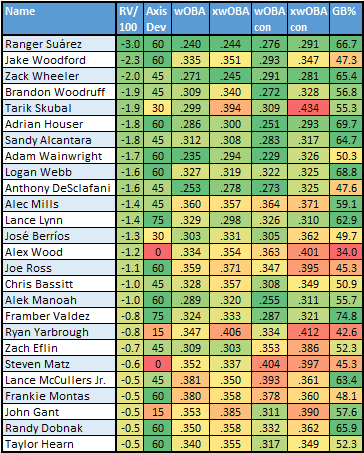
But groundball rates alone fall short in giving voice to just how little batters could do against Suárez's sinker. They managed just a .240 wOBA (2nd-lowest) and .244 xwOBA (1st), not faring much better when making contact. Suárez's sinker had a .276 wOBAcon that was the sixth-lowest and a .281 xwOBAcon that was second only to Zach Wheeler's.
And looking at StatCast's Run Value (which takes into account the value of every event in every ball-strike/base-out situation), Suárez's sinker again rises to the top. And not just for all sinkers but all fastballs.
Here were the top-30 fastballs (four-seam, sinker, cutter) thrown by starters in 2021 (min 300 pitches) according to RV (per 100 pitches):
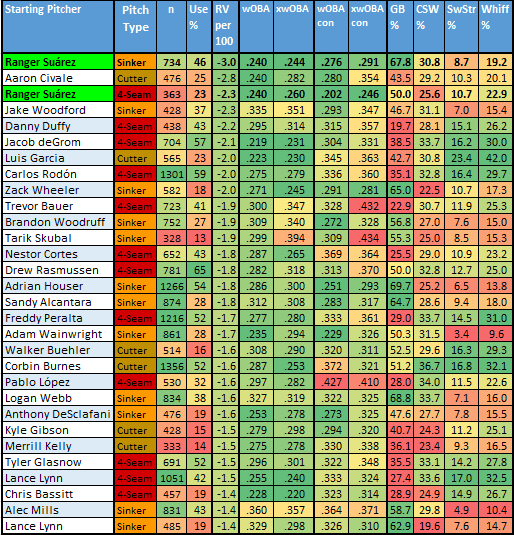
Run Value isn't some all-encompassing metric that perfectly speaks to a pitch's quality (see: Woodford, Jake), nor is it necessarily predictive. But it does a good job of telling the story of a pitch's overall results. And while one good pitch does not a great starter make, having one on the leaderboard is a good start. Having two out of the top three is even better.
The sinker was good in 2019 (and keep in mind that he only threw 224 of them) but a -1.9 RV/100, .318 xwOBA, and .330 xwOBAcon isn't quite on the same level as what batters managed in 2021. While a small velocity boost was nice (91.9 mph in 2019, 92.9 mph in 2021), it didn't suddenly gain more spin or movement, with his average spin dropping from 1955 rpm to 1843 rpm.
But while he's technically getting less sink, dropping from 25.6 inches (2.6 inches above average) in 2019 to 23.9 inches (2.3 inches above average) in 2021, remember that some of this will come from the natural consequences of more velocity. Looking at sinkers thrown at similar velocity/extension, Suárez got 11% more than average compared to 12% in 2019.
It may be getting less vertical movement at the higher velocity but what it gets still makes for some premium sink. And Suárez's sinker picked up a half-inch of horizontal movement, increasing from 15.2 inches to 15.8 inches, which isn't on the same level as the vertical movement but is still just below.
Secondary Fastball, Primary Results
The sinker got more horizontal movement but Suárez's four-seamer also got more wiggle, increasing from 5.9 inches to 7.4 inches. This may have only brought it up to the league average but that was a giant improvement considering how straight it was in 2019, getting 23% less break compared to the league average of similarly-thrown pitches.
Here is the horizontal movement of his pitch mix from 2018-2021. Keep in mind that he only threw 15 IP in 2018 and 4 IP in 2019.

And here is his total movement profile (again, courtesy of baseballsavant.com):
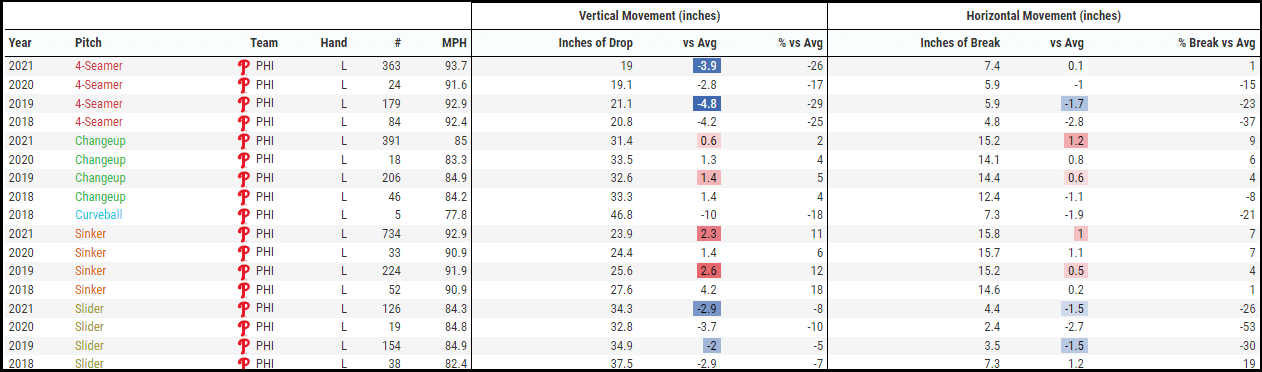
Even with the increased movement, nothing about the four-seamer's movement profile screams elite, even as a -2.3 RV/100 (-3.1 RV/100 as a starter) does. As does a .240 wOBA (3rd-lowest),.260 xwOBA (5th), .202 wOBAcon (1st), and .246 xwOBA (1st). So, how did a fastball that can get a little straight end up with superlative numbers against it?
Well, this brings us back to the sinker, which, in addition to being a premium pitch on its own, pairs especially wells with the rest of his mix, with his sinker and four-seamer tunneling together before tailing to opposite sides of the plate, consequently making both more difficult for batters to square up.
Here are Suárez's 3D pitch tracks from 2021, focusing on what right-handed hitters are seeing:
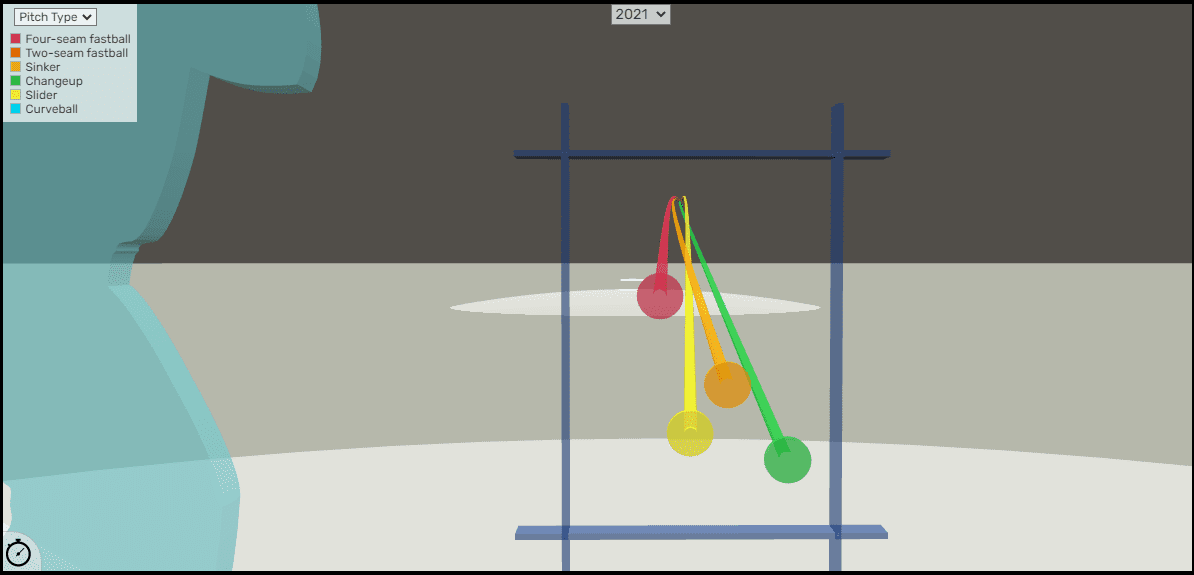
Thinking like the batter, we can see how the four-seamer and sinker could be difficult to handle if not identified early, as well as how the changeup and sinker pair well together as they work away from righties. But staying with the fastballs, that aforementioned identification is harder when they're still living in the same tunnel near the decision point.
Here are Suárez's pitch tracks from overhead, with the purple dots representing the commit point and the white dots representing the recognition point:

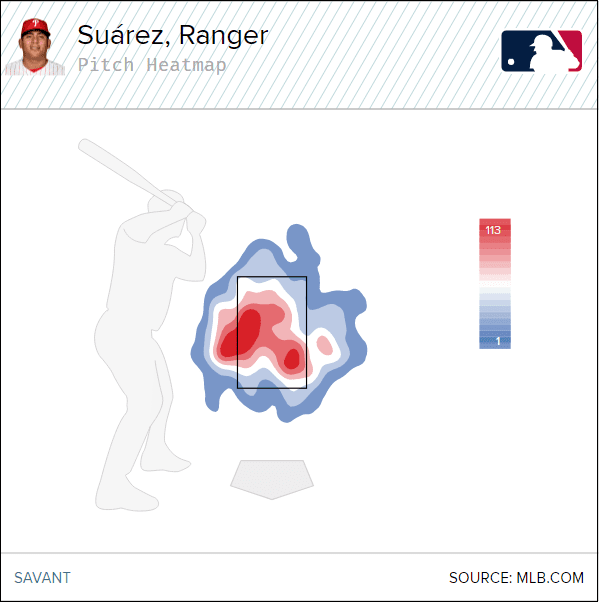
When all is going right, both pitches should be hard to identify, as the four-seamer works in to RHH, with the sinker heading down and away. And looking at all of the four-seamers and sinkers that Suárez threw to right-handers in 2021, this plan seems to have been mostly executed:
Okay, so all of the above is great and combines to add to my general bullishness on Suárez. But this non-Texas Ranger has one more trick in his saddlebag that could amplify that continued success ever further...Deviations, and side force, and seam shifts, oh my!
Hawk-Eye Flips More Than Houses
It also flipped around conventional knowledge of how a baseball moves through space. You see, a long, long time ago - all the way up until 2020 - Statcast was powered by radar-based systems of tracking the baseball; Trackman for batted balls, and Pitchf/x for pitching. Things were switched over to the Hawk-Eye system in 2020, which uses optical cameras operating at 100 frames per second putting high-res eyes on everything. In other words, now we can finally see.
And what we now see is that side forces, caused by the location of a ball's seams while in motion, inform movement via a "seam-shifted wake". Early research from Tom Tango (as well as Smith, Driveline, and others) points towards the effectiveness of sinkers and cutters being most tied to their SSW, with four-seamers also seeing benefits. But SSW effects can happen on any pitch, whether they increase effectiveness, or not.
Going back to Suárez's sinker in 2021, it averaged a spin direction of 10:45 using spin-based movement but was measured at 9:45 using observed movement, giving it a 60-minute deviation. And while having a deviation between your observed and inferred axis is no guarantee for sinker success, many of the recent best ones have had a little.
Did much of the above make sense to you? If so, great! You're probably as excited as I am because the Hawkeye camera system now utilized by Baseball Savant is allowing us access to data that's opening up all-new horizons in both what we understand about pitch movement and how it can make for better (and more purposeful) pitch design. SSW discussion should continue to be pervasive, making it an exciting time for those who want to better understand pitching voodoo.
But if all this has sounded like a bunch of seam-shifted gobbledygook, don't sweat it! While the concepts are becoming widespread (and written about), we're still talking about cutting-edge stuff that isn't yet commonly discussed and certainly isn't even completely understood yet. So before we get back to Ranger, let's have a quick breakdown of what seam-shifted wake is and how it might be helping make pitches better.
Seam-Shifted Cliff Notes
Under the old system, a pitched baseball's movement could be tracked but because Statcast didn't have "eyes", the axis that the baseball was spinning on couldn't be actually known (seen), so it was instead inferred by the path the ball took. This was possible because the generally accepted notion was that the only force affecting a baseball's motion was the downward forces of gravity and Magnus (the force applied to a spinning object). Working under that assumption, Statcast could then work backward from the path the baseball took and calculate what axis it needed to be spinning around in order for that path to have happened. In other words; if the ball moved like this, it must have been spinning around like this and in this direction.
But Hawk-Eye has changed everything and now we have proof of what baseball brain trusts like Barton Smith and Driveline Academy had already been positing from their own research; the directions that Hawk-Eye could now see were often different than what the previously used method had inferred. Vis-à-vis, there were other forces at play than just Magnus and these mysterious "side forces" could (and were) affecting a ball's movement in a way not previously understood.
To sum it up as I've done previously:
Hawkeye’s cameras, however, are able to observe what the spin axis actually is after leaving the pitcher’s hand. When comparing the two measurements (inferred and observed) the deviation between the two can tell whether more forces than the downward one of Magnus are at play. The work of Smith and at Driveline has centered around how the seam orientation of the pitched baseball in flight is informing those “side forces” and how best pitchers can attempt to keep their seams in the place most conducive for their desired movement. Sounds difficult but it’s certainly possible and pitchers have been doing it unknowingly as long as baseball has been played, playing with and cycling through grips in search of the elusive nirvana that is “I just found one that works”.
Side Force Wakes Ranger Up, Up
And now his sinker go-goes, helping treat batters just like a yo-yo. Because in addition to the premium sink, increased velocity, and more horizontal movement, it seems his sinker is also getting an extra boost from SSW.
Using the Savant illustrator, here is a side-by-side of Suárez's sinker (in orange), which is inferred to be moving at 10:45 but is observed to be moving at 9:45. The deviation between the two is what is telling us that aerodynamic (SSW) forces are at play. The crude markups are my own, with the arrow showing the direction of movement due to spin and the straight line showing the approximate axis the sinker is spinning on.
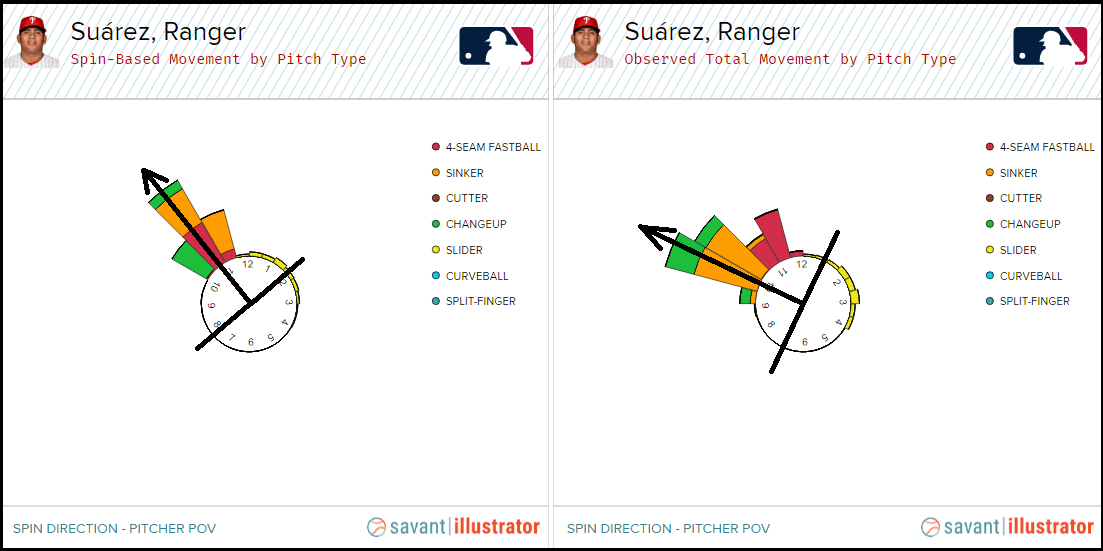
From a practical standpoint, the picture on the left shows the direction of movement a batter might be expecting given its spin, and on the right is the movement that actually happens. Or bluntly, the batter thinks it's going to move here but it actually moves there. And when it comes to helping Suárez's sinker, we can send it back to Tango:
Here we see that the story of the Sinker is all about the SSW (or more technically the non-Magnus force, which we are presuming is the SSW). The sinkers that are getting the most SSW are by far the most effective.
Also notice his four-seamer's direction of movement in the above illustration, which only has a small deviation in its spin-based and observed movement (10:30 vs 10:45). But while the sinker has a 60-minute deviation and the four-seamer's is 15 minutes, it is important that it is a negative number. In other words, the seam-shifted "pushes" are happening in different directions, making a total gap of 75 minutes between the sinker and four-seamer.
Let's look again at the pitch tracks Suárez's pitch mix with the added context of how the SSW effects of his fastballs might be making things more difficult on batters.
As we already discussed, the sinker and four-seamer already tunnel together as they approach the decision point but the SSW amplifies their movement, making for a more distinct split beyond the point of commitment. This, ideally, leads to less squaring up, worse contact, and more groundballs. Sound like anyone's sinker/four-seamer you know?
Fantasy Star Rising
With a 163 ADP (min 97, max 291) in the first 49 NFBC drafts, Suárez's draft cost is relatively inexpensive. There is the worry of betting on someone with so little time in the rotation but with the groundball-heavy sinker leading the charge, 160-170 IP seems fairly reasonable.
If he reaches that mark, I believe Suárez will give you above-average strikeouts with excellent ratios and return a solid ROI even around his floor. But if the innings go over and the Phillies bullpen continues to improve, Suárez's ceiling could reach into the top-20 of fantasy starters.
Download Our Free News & Alerts Mobile App
Like what you see? Download our updated fantasy baseball app for iPhone and Android with 24x7 player news, injury alerts, sleepers, prospects & more. All free!

More Fantasy Baseball Advice