RADIO










Rob breaks down the fantasy football tight end landscape in 2026 by looking at snaps played, routes run, and targets earned to provide you with in-depth information about who to trust in Week 9.
Every year, without fail, at least one player who wasn't ranked in the top 20 finds their way into the top 10. That is true for most positions, but at running back, it's often due to an injury that couldn't have been predicted. The tight end position has always been and will always be a bit more unpredictable.
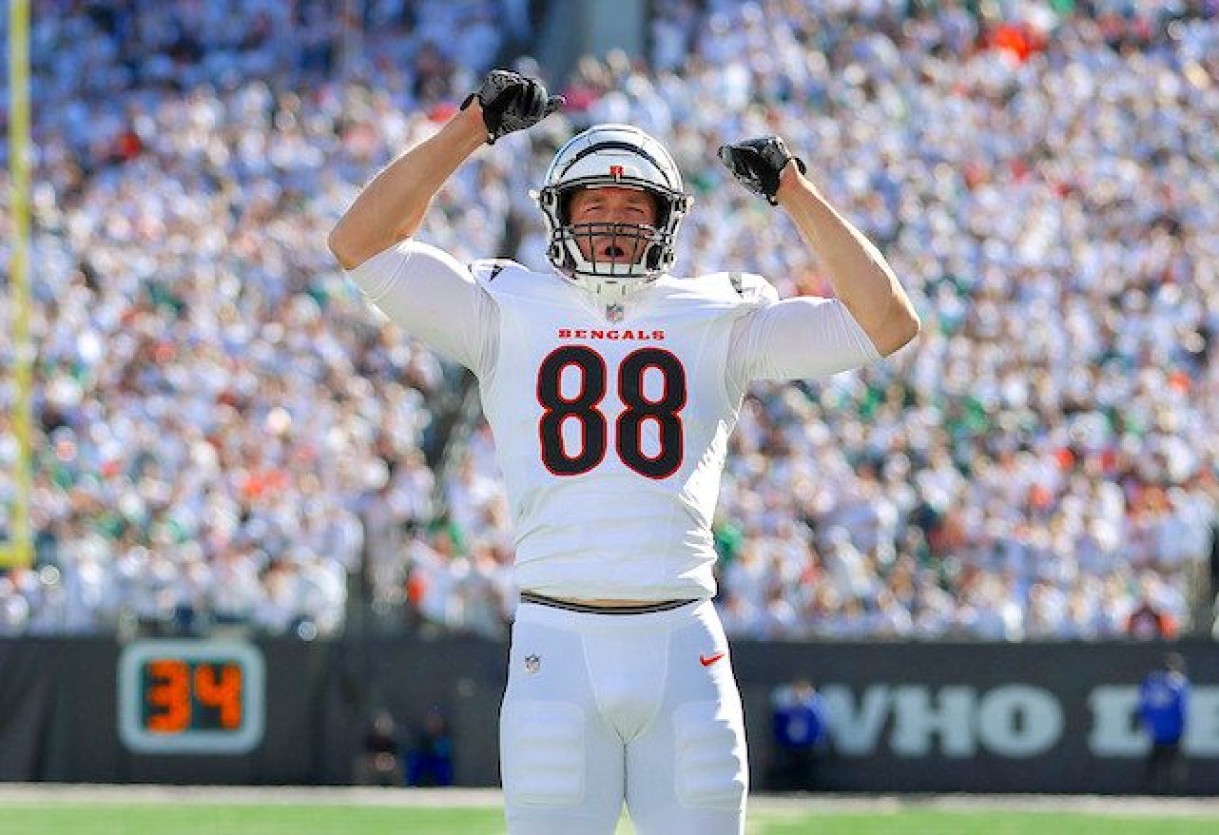
That's because players in the 6-12 range rarely have more than 800 yards, so someone can crack the top 10 almost entirely on a high touchdown rate. This year, that's Mike Gesicki, who has now scored a touchdown in five consecutive games. Will that rate continue? No, but his role is increasing, so it may not have to.
In this week's edition, we'll be breaking down a few of the surprises at the tight end position - both good and bad - to determine what fantasy managers can expect from some of these players for the rest of the season. Let's get started.
Bookmark our updated and revamped fantasy football rankings portal for all league formats!PPR rankings | Half-PPR rankings | Standard rankings | Rookie rankings | Superflex rankings | Dynasty rankings | Who To Start? | Injuries | Matchup Ratings | Strength of Schedule
Mike Gesicki, Cincinnati Bengals
Gesicki has scored in every game this season but one, but his usage didn't look like something fantasy managers could trust. From Weeks 1-5, Gesicki's route share was 51.5%, ranking 33rd among tight ends this season. That's a gigantic red flag. However, over the last three weeks, that rate has climbed to 62.4%.
5th straight game with a TD for Mike Gesicki! Bengals retake the lead.
TENvsCIN on CBS/Paramount+
Stream on @NFLPlus https://t.co/XWMIU61Bfn— NFL (@NFL) November 1, 2026
In fact, in Cincinnati's last game, Gesicki had a 71.7% route share. On one hand, it's reasonable to assume that a guy who can't stop scoring touchdowns would start finding the field more. Unfortunately, that hadn't happened. In fact, in Week 7, Gesicki's route share was 46.9%.
Those drastic changes keep Gesicki extremely unpredictable and impossible to trust. At the same time, given his fantasy production, he simply needs to be rostered because, at any point, Gesicki's role could become more permanent and secure, giving him significant upside.
Gesicki has four end zone targets, the sixth-most among tight ends, tied with George Kittle. If we back up, however, and look at red zone targets, Gesicki has only five, which is 16th among tight ends. Still, his role and involvement near the end zone is incredibly strong.
Now, he's caught three of his four end zone targets, a rate that may not continue. Fantasy managers should still be skeptical about starting Gesicki. While his route share in Week 8 was strong and could make him a top-12 tight end moving forward, it was below 50% two weeks ago.
So, while some analysts and fantasy managers will point to his Week 8 role and say, "Look, it's growing!" Maybe, but I'd pump the brakes. The week before, he had one of his lowest route shares of the season. Growth isn't always linear, but we rarely see two extremes like that in back-to-back samples. My recommendation: roster and hold.
Travis Kelce, Kansas City Chiefs
Kelce and Gesicki could not be more different. While Kelce is the TE7 with an 11.7 half-PPR PPG average, he's getting almost zero work inside the red zone and near the end zone. Fantasy managers can choose to interpret that in one of two ways.
The first is that, given his target volume, it's only a matter of time before his red-zone and end-zone volume starts to tick up. The second is that Kelce's ceiling is clearly capped if he's not going to get many opportunities to find the end zone. It's also worth noting that he's the TE7 despite almost no work near the end zone, but a top-five ceiling is unlikely without an uptick in this area.
Kelce ranks 29th in red-zone targets among tight ends, with three. He's 22nd in end zone targets with just two. Those are major red flags when judging his ceiling and upside case. Another scenario is the Chiefs' interest in a wide receiver at the trade deadline.
Given his lack of scoring, he needs volume to maintain his fantasy scoring. Right now, he's 10th in targets and eighth in receptions per game. What happens if they add someone like Josh Downs or Brian Thomas Jr., who could potentially shrink his volume?
It's also important to remember that Rashee Rice missed a few games due to a hamstring injury, so his return also negatively impacts the piece of the pie that he's getting. Given Kelce's utilization, he's overperforming.
His 11.7 half-PPR PPG average is higher than his expected 10.3 PPG, an increase of +1.39 PPG and the seventh-highest rate among tight ends with at least 100 routes. Based on his utilization, Kelce's rest-of-season outlook is TE6-TE12, and he's largely operating near his ceiling right now without a significant change in usage.
Harold Fannin Jr., Cleveland Browns
Fannin would benefit greatly from a Jerry Jeudy trade, which has been rumored, but seems unlikely given Cleveland's record and push for a playoff spot. However, adding Denzel Boston and KC Concepcion Jr. alongside Jeudy has significantly impacted Fannin's volume.
Among 65 tight ends with 50 routes this season, Fannin is 25th in target rate at 20%. He does, however, have a 19.1% target share, which is sixth among this sample. He's also averaging 6.0 targets per game, which ranks ninth. A Jeudy trade would only increase his volume upside.
Fannin's role is strong in Cleveland. He's sixth in routes per game and has the seventh-highest route share. He's eighth in receptions per game (4.4) and eighth in yards per game (51.4). This week, the Browns are looking at likely starting Shedeur Sanders after Deshaun Watson entered concussion protocol.
Just a reminder Harold Fannin Jr averaged 14.6 fantasy PPG with Shedeur Sanders last season - that was 9.9 PPG with any other QB
— Michael F. Florio (@MichaelFFlorio) November 4, 2026
Fannin got off to a slow start to the season, but has been heating up. In the past two weeks, Fannin has totaled 91 yards and 154 yards. He's had 21 targets and 16 receptions in the past two weeks. Fannin's utilization aligns almost perfectly with his production.
He's the TE8 with an 11.5 half-PPR PPG average. He's also sixth in target share, ninth in targets per game, and eighth in receptions and yards per game. Fannin's rest-of-season outlook sits between TE5 and TE12. If Jeudy is traded, Fannin could have top-five potential with increased volume.
Juwan Johnson, New Orleans Saints
Johnson is a major red flag. Jordyn Tyson is likely to return this week or next. Travis Etienne Jr. could also return soon. That increased talent and volume competition is a major concern on its own, but we've seen a concerning trend in Johnson's usage over the past few weeks.
In the first four weeks of the season, Johnson's route share was at 69.7%, a healthy number. In the past three games, however, Johnson's route share has decreased to 59.6%. We've seen his routes per game go from 34.5 down to 19.7. Now, again, add Tyson and Etienne. It won't get better!
The Saints have begun using Noah Fant and Oscar Delp more on offense, which has minimized Johnson's role. Johnson averaged 6.5 targets per game in the first four weeks of the season, but in the last three games, Johnson has only averaged 2.3 targets per game.
Johnson was a surprise top-10 finisher last year, and he looked poised to repeat that early in the season; however, things have changed sharply. Johnson no longer needs to be rostered. He's gone from a rest-of-the-season outlook of TE6-TE12 early in the season to someone who will struggle to produce like a top-20 tight end. Johnson has almost fallen out of the "streamer" group.
You can safely drop and ignore him until something changes.
Tucker Kraft, Green Bay Packers
Kraft has been up and down this season, but things are starting to click. In the first five games, he averaged 7.5 half-PPR PPG, despite an expected 9.2 PPG. Given his utilization, he was a clear buy-low candidate.
Since then, Kraft has made those who bought low on him look very smart. Over the past three weeks, Kraft has averaged 11.1 half-PPR PPG and has started to look more like the player that we saw last season.
Tucker Kraft
Weeks 1-3: 6.5 fantasy PPG
Weeks 4-8: 13.8 fantasy PPG
Ramp up period after the knee injury, but he's looking like himself lately
— Michael F. Florio (@MichaelFFlorio) October 30, 2026
We've seen his route share increase from 64.8% to 71.8% from Weeks 1-5 compared to Weeks 6-8. In this same sample, Kraft has also increased his targets per game from 5.8 to 6.7. Kraft has benefited from touchdowns recently. He has two touchdowns in the last three games, compared to just one in the first five weeks.
His expected half-PPR PPG from Weeks 6-8 is 10.4 half-PPR PPG, so we have seen this go up from the first five weeks of the season when it was 9.2. Interestingly, last year, from Weeks 1-8 (before Week 9, when he suffered his torn ACL), Kraft averaged 5.4 targets per game and had a 10.6 expected half-PPR PPG.
However, he averaged 16.2 half-PPR PPG last season. Kraft always looked like a regression candidate, and we're seeing some of that this season. The good thing for Kraft is that the Packers are passing the ball at a much higher rate than they did last year.
Despite competing for targets with two borderline alpha receivers, Christian Watson and Matthew Golden, Kraft is still averaging 6.1 targets per game, up from 5.4 last year when Watson and Reed were hurt. Kraft still has top-five potential, and I expect Kraft to continue to regain some of that elite efficiency that we saw last year.
Buy and Stash Terrance Ferguson
Ferguson has really only played two games this season. He was injured in Week 3 and hasn't played since. In Week 1, Davante Adams and Puka Nacua were both on the field. In Week 2, Nacua was out. In Week 1, Ferguson's route share was at 41.4%. In Week 2, with no Nacua, that number rose to 66.7%.
Without Nacua on the field, Ferguson had nine targets and finished with a 29% target share. In Week 1, he only had one target and a 3.6% target share. With Adams likely out for the rest of the regular season, Ferguson has significant upside for fantasy football. Los Angeles' No. 2 receiver is Konata Mumpfield. They also have Tutu Atwell and Jordan Whittington.
Rumors have circulated that they're interested in adding a receiver, and they should be, but until they do, Ferguson will likely become the team's No. 2 receiver. Don't be surprised if Ferguson operates as the team's No. 2 receiver once he returns. Tyler Higbee and Colby Parkinson will likely stay in more traditional tight end roles, while the team uses Ferguson more creatively.
Analysis: Terrance Ferguson will practice in limited capacity on Wednesday
https://t.co/wDhcRQLzbC— RotoBaller NFL (@RotoBallerNFL) November 4, 2026
He's big, fast, and athletic, with real receiver traits. He put some of his upside and potential on full display in Week 2 when Nacua was out. He finished with nine targets, six catches, 54 yards, and one touchdown for 14.4 half-PPR fantasy points. He has the potential to be a top-10 tight end and should be a priority add if he's available.
Week 9 Rankings
- Brock Bowers
- George Kittle
- Trey McBride
- Sam LaPorta
- Colston Loveland
- Tucker Kraft
- Harold Fannin Jr.
- Kyle Pitts
- Isaiah Likely
- Travis Kelce
- Tyler Warren
- Dalton Kincaid
- Brenton Strange
- T.J. Hockenson
- Greg Dulcich
- Chig Okonkwo
- Mike Gesicki
- Dallas Goedert
- Michael Mayer
- Tyler Higbee
- Eli Raridon
- Mason Taylor
- Juwan Johnson
- A.J. Barner
- Dalton Schultz
More Fantasy Football Analysis
Download Our Free News & Alerts Mobile App
Like what you see? Download our updated fantasy football app for iPhone and Android with 24x7 player news, injury alerts, rankings, starts/sits & more. All free!