




 RADIO
RADIO







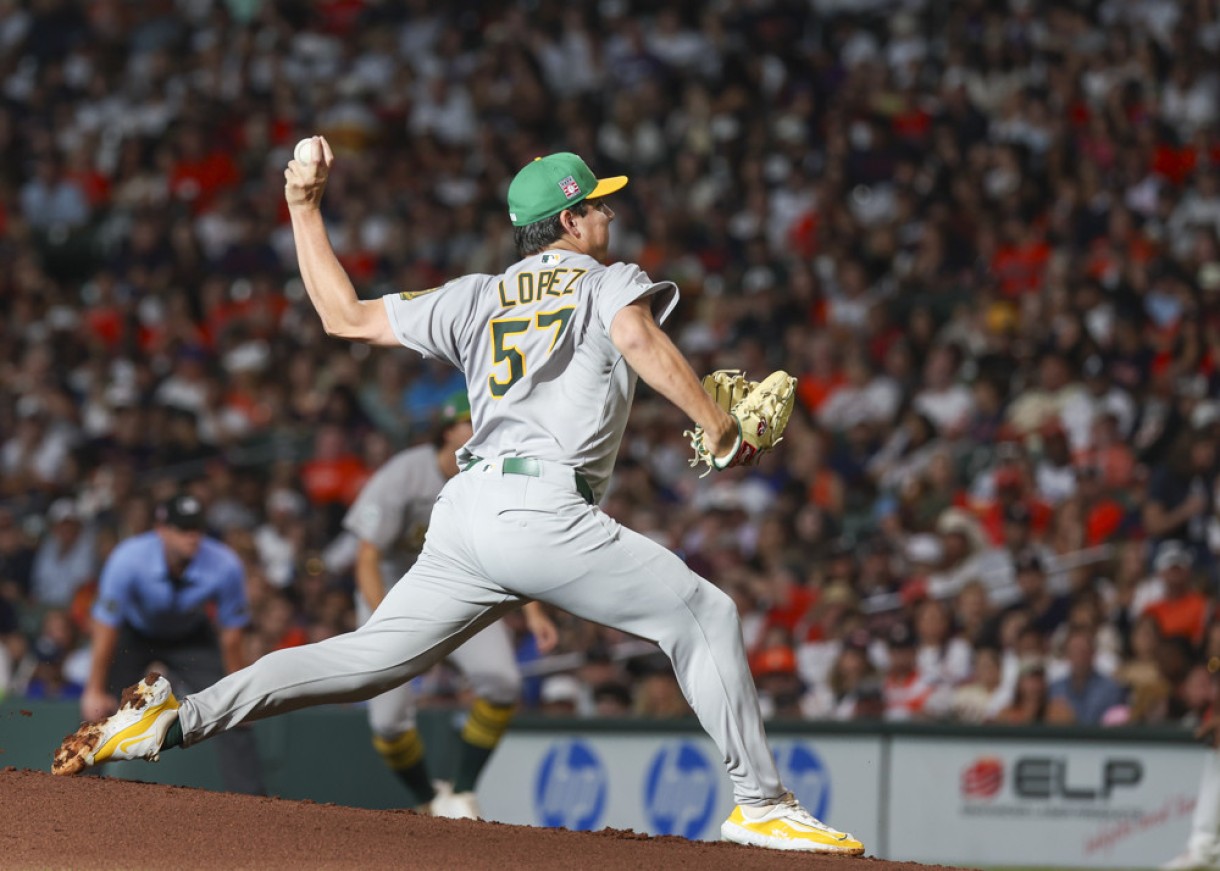
Elliott looks at pitchers with surprising starts recently. These SPs could emerge as fantasy baseball waiver wire targets for Week 21 in 2026, or just mirages.
Welcome to the "Are You For Real?" series as we dive into Week 21 of the 2026 fantasy baseball season. For those unfamiliar, this is a weekly column where we examine starting pitchers who had surprisingly strong starts over the past week and put them under the microscope to determine whether they're legitimate or just smoke and mirrors.
It was another exciting week of baseball action, and, as always, I've got three surprising starters to break down. First, we'll deep dive into Aaron Nola's Field of Dreams performance last Thursday. Then, we'll analyze Brandon Pfaadt's incredible run in the desert. We'll finish it off by examining Jacob Lopez's strong return for the Athletics.
Roster percentages are taken from Yahoo! and are accurate as of August 17.
Aaron Nola, Philadelphia Phillies – 47% Rostered
2026 Stats (prior to this start): 125 IP, 5.47 ERA, 5.09 FIP, 15.8% K-BB%
08/13 @ MIN: 5 IP, 5 H, 1 ER, 3 BB, 9 K
They built it, and Nola certainly came to play in the Field of Dreams game last week. The veteran righty fanned nine Twins while picking up his first victory since May 26. It’s been a rough season for Nola, who is 4-9 with a 5.33 ERA following this game. He does have a 2.91 ERA and 28.3% K rate over his last four starts, so could Nola be recapturing past success?
Originally a first-round pick all the way back in 2014, Nola was considered a premier pitcher in the late 2010s and early 2020s, but he’s experienced a deep decline over the past two seasons, as evidenced by his 5.62 ERA and 1.93 HR/9 since Opening Day 2025. Nola works with a six-pitch mix consisting of a curveball, four-seam fastball, sinker, changeup, cutter, and slider.
Nola’s most-used pitch in this game and this season is his famous knuckle curve. A 78.3 mph offering, Nola’s curveball was his signature pitch during his prime, and it’s still proven to be quite effective in 2026. Batters are hitting .183 with a .349 SLG and a .254 wOBA.
The expected stats support these results as well, with a .178 xBA, .294 xSLG, and a .231 xwOBA. Nola also has an impressive 42.3% whiff rate with the curveball, as well as an 82.7 mph average exit velocity and a 1-degree average launch angle against. Here’s an example of the pitch from this start.
— Elliott Baas (@ElliottBaasBB) August 17, 2026
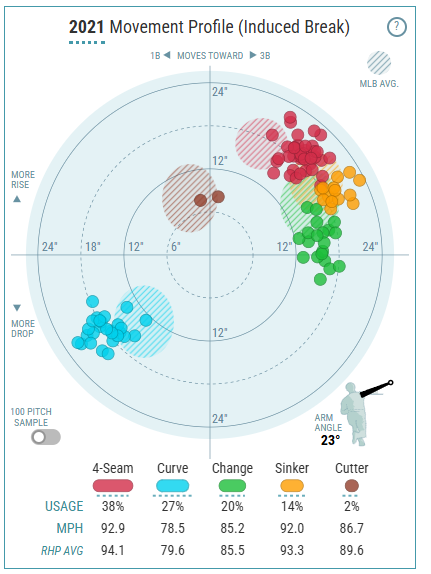
Still got it. Nola hasn’t lost movement or spin with the curveball either. Here’s a comparison of his 2021 pitch movement profile to his 2026 pitch movement profile (curveball in blue).
2021:
2026:
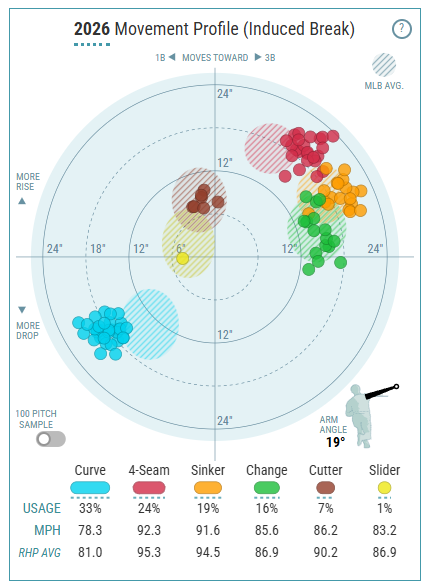
The curveball shape hasn’t changed much since 2021, and based on the results, I think it’s fair to say that Nola’s curveball is still a plus, quality breaking ball that can generate whiffs, weak contact, and groundballs.
The curveball still looks great, but the curveball is hardly what’s given Nola trouble over these past few seasons. The real trouble begins with the fastballs, because both the four-seamer and sinker have been annihilated by opposing hitters this season.
We’ll start with the four-seamer, which has been crushed for a .352 AVG, .722 SLG, and .473 wOBA against. A 92.3 mph offering, Nola doesn’t throw hard, but he never threw all that hard.
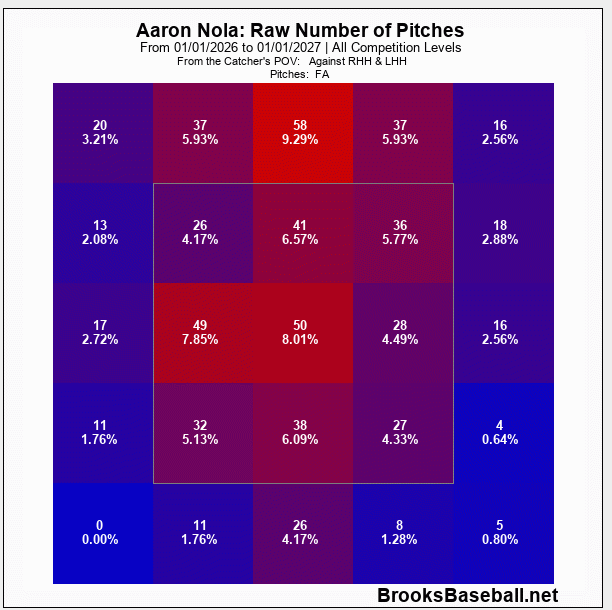
His highest average four-seam velocity was 93.1 mph in 2019, and he is usually around 92 mph, so it’s not like he had some precipitous velocity drop-off. I think a bigger issue for Nola is fastball location. Let’s look at his fastball heatmaps from this season, and then let’s compare it to pre-2025 Nola.
2026:
2015-2024:
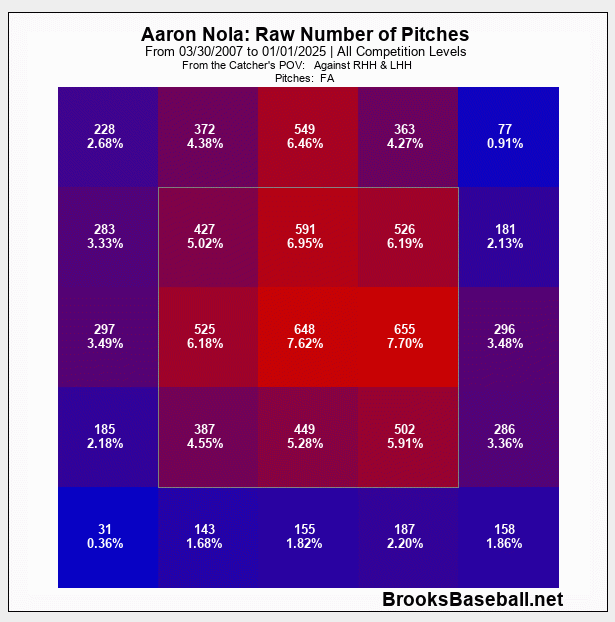
There are fewer pitches in the zone, and that is evident in the numbers too, as Nola’s 52.9% zone rate this season is the lowest of his career and well below his 58% career mark. I think this is more than just poor command, however.
Nola’s 8.1% walk rate is his highest since 2019, but the bigger issue may be lack of confidence. Nola’s fastball has been crushed for almost two years now, and, as a human being capable of pattern recognition, Nola may simply be unwilling to challenge hitters directly with his heat.
I could buy that some regression is due on the four-seam fastball. Nola probably isn’t quite this bad with his four-seamer, as batters hit .230 off the pitch last season, though they had a .529 SLG.
Nola will almost certainly see regression on his .364 BABIP against the four-seamer, though maybe not all the way down to his career .267 BABIP with the fastball. He still has a 93 mph average exit velocity, 29.9% line drive rate, and 14.8% barrel rate. Those are the ingredients of a high BABIP, and the entrée being served up is meatballs, extra spicy.
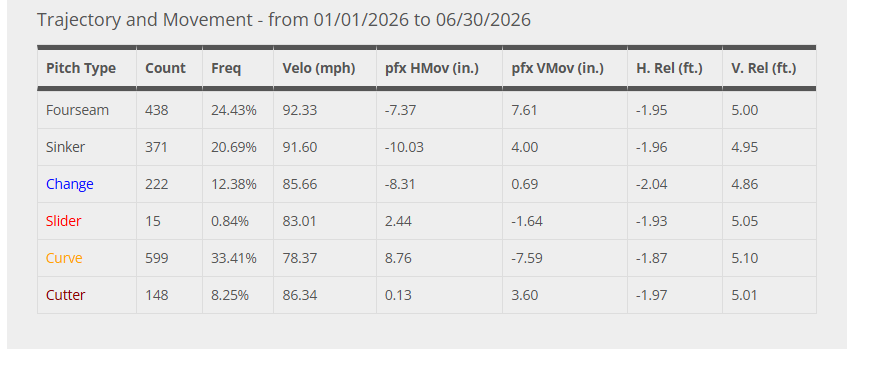
Nola has made a drastic change to his pitch mix throughout the season, and it really began towards the start of July. Let’s have a look at his pitch selection prior to July 1 and after July 1.
Pre-July:
Post-July:
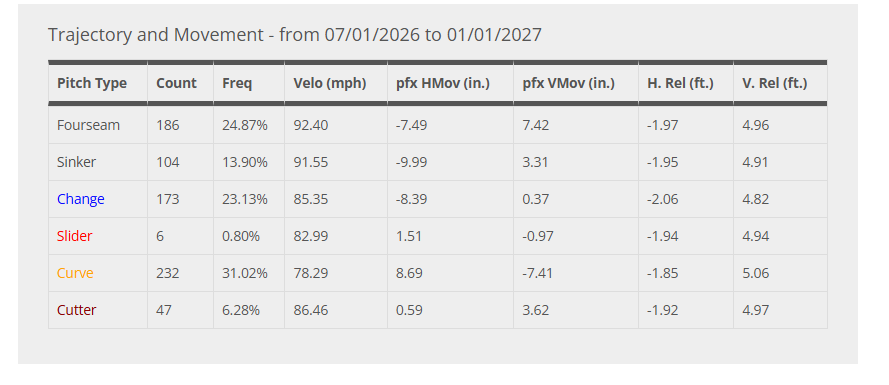
That is nearly an 11% increase in changeup usage and nearly a 7% drop in sinker usage. Unlike the four-seamer, Nola’s sinker has been getting crushed for the past few seasons and has proven to be more of a liability than an asset on the mound. Decreased sinker usage should be a good thing for Nola, especially if it means relying more on off-speed pitches.
The changeup has performed well for Nola, with opponents hitting .219 with a .288 SLG and a .267 wOBA against the pitch. Interestingly, the results on Nola’s changeup were much better prior to July 1 than after it, when his usage ramped up. Here’s a look at the changeup’s xwOBA against month-by-month.
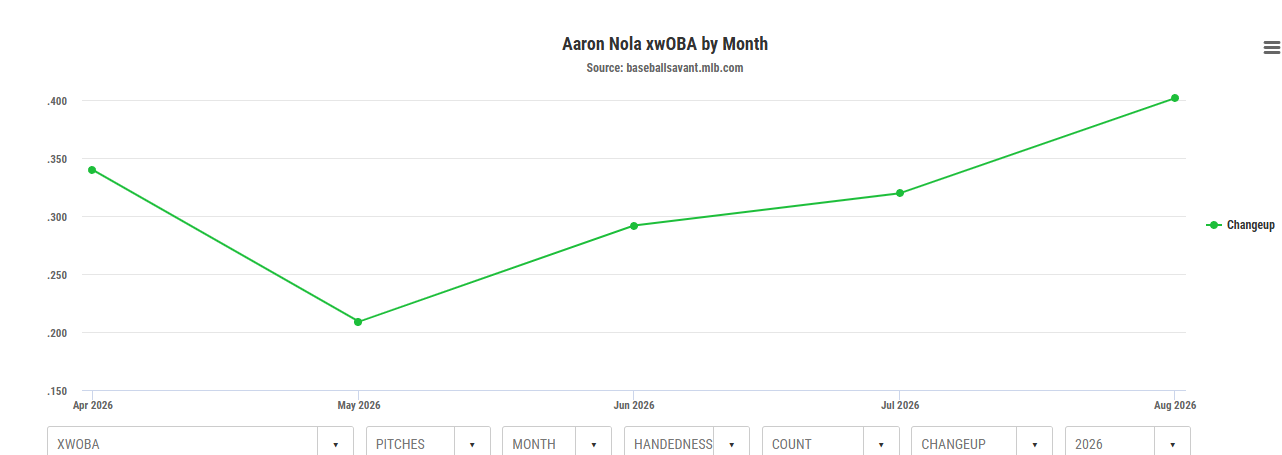
That’s not good, and the rest of the results are similar. Batters hit .178 with an .089 ISO off the changeup prior to July 1, and are hitting .270 with a .108 ISO since that date. Overall, Nola isn’t performing all that great during this stretch too.
Sure, his 4.00 ERA and 1.38 WHIP since July 1 are technically an improvement, but it still comes with a 2.20 HR/9 and 5.13 FIP. It also took a 90.1% LOB rate to achieve, an outrageously high number considering how many home runs Nola surrenders.
The one interesting nugget in all this is Nola’s dominant strikeout numbers over this time. He has a 26.8% K rate and a 17.9% K-BB% since July 1 as well. The changeup has played a big part in this performance. Here’s a look at Nola’s changeup whiff rate month-by-month this season.
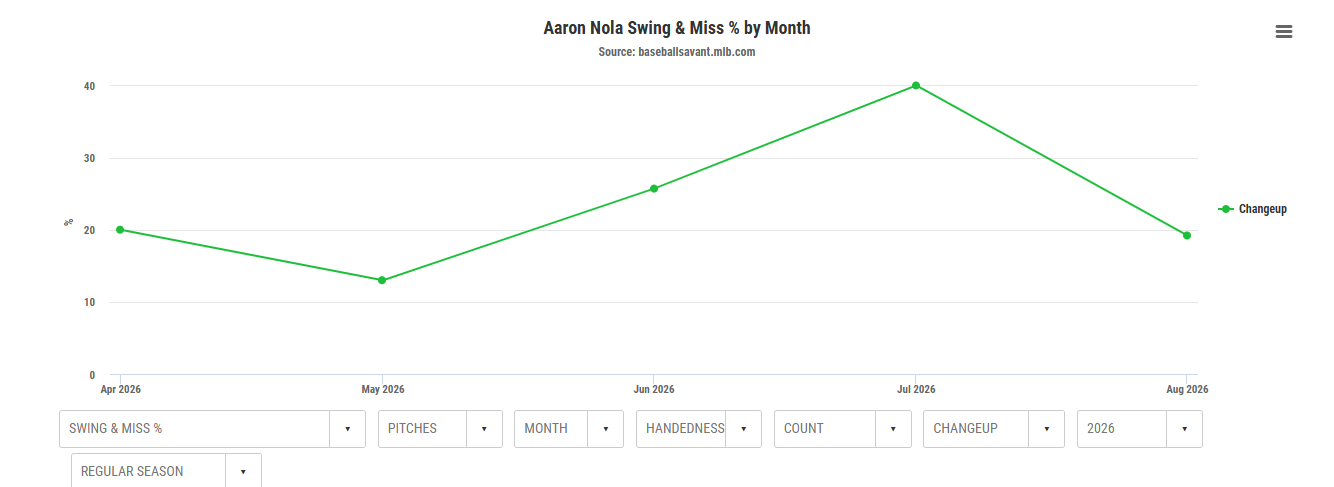
It really spiked in July, but we’re seeing a much better whiff rate from Nola’s changeup since his usage increased. Is this going to bring back the Nola of old?
Probably not, but it could give him an interesting second act if Nola can improve his command and find some way to manage his Gopheritis. I’m fearful he can’t fix the second one, because the home run issue has only gotten worse and worse for Nola over time, to the point where he’s allowing 2.08 HR/9 this season, far and away the highest mark of any qualified pitcher.
Surely there’s room for his 19.2% HR/FB ratio to drop, but this number has also been climbing over the past few years, and it’s hard to envision home run regression when Nola is giving up tons of hard contact, tons of barrels, and has the highest fly-ball rate of his career. The numbers don’t lie, and they spell disaster for Nola at Sacrifice—I mean, on the mound.
Verdict:
If you’re expecting Nola’s recent hot streak to catapult him back into a frontline starter, or even a reliable veteran, you may be disappointed. Instead, I think Nola’s attempting to enter a new phase of his career, one where he increases focus on his secondary stuff and further reduces fastball usage.
Given how the fastballs have performed this season, that can only be a good thing. For fantasy purposes, I think Nola works best as a high-variance streaming option, best used when the manager needs to throw a Hail Mary and is maybe willing to sacrifice ratio stability for strikeout upside. But, truthfully, he’s a little over-rostered at this point, and he’s not someone I’d prioritize seeking out.
Brandon Pfaadt, Arizona Diamondbacks – 45% Rostered
2026 Stats (prior to this start): 85.2 IP, 3.36 ERA, 4.01 FIP, 8.4% K-BB%
08/14 @ ATL: 7 IP, 2 H, 0 ER, 0 BB, 7 K
It was lucky number seven for Pfaadt last Friday, as the righty picked up his seventh win after tossing seven scoreless innings with seven strikeouts. It was Pfaadt’s fourth straight game without allowing a run, and he now has a 1.15 ERA in nine starts since rejoining the rotation on June 30. Are we witnessing a breakout, or will Pfaadt’s output eventually slim down?
Originally a fifth-round pick by Arizona back in 2020, Pfaadt was a big prospect for the Diamondbacks and was expected to be a rotation mainstay for them. He has been for the most part since debuting in 2023, but prior to this season, the results were shaky. Pfaadt had a 5.13 ERA, 1.31 WHIP, and 1.43 HR/9 coming into 2026. Pfaadt works with a six-pitch mix, consisting of a four-seam fastball, sinker, changeup, curveball, sweeper, and cutter.
Like Nola, Pfaadt has gone through some pitch mix changes this season. The first notable change is the variety Pfaadt is employing this season. He’s thrown all six pitches at least 11.8% of the time, when in past seasons he was usually throwing just four pitches in double digits.
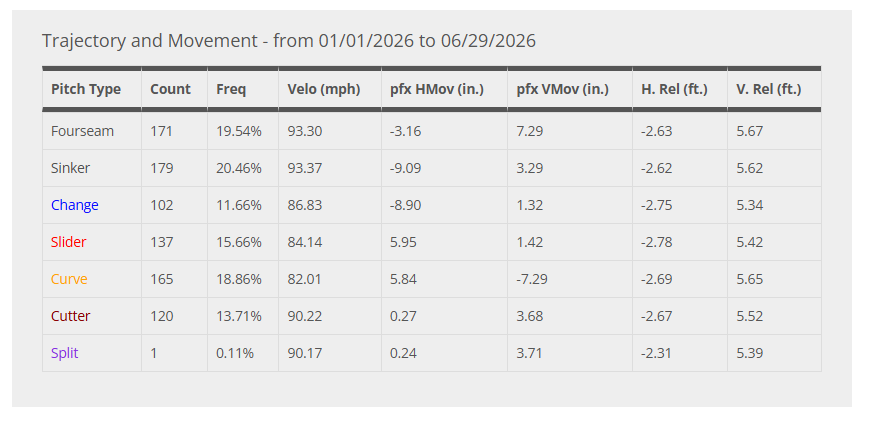
He’s also changed his pitch mix throughout the season, and the differences are stark if we use his June 30 return to the rotation as a dividing point. Here’s a look at his pitch mix before June 30.
Here’s after returning to the rotation.
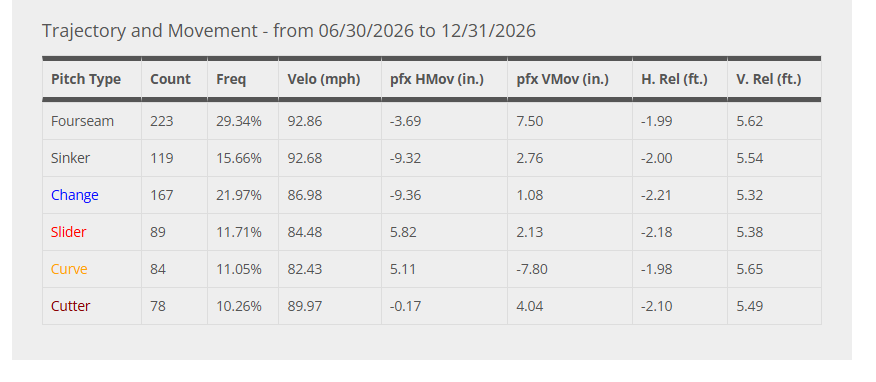
The most glaring differences are the increased four-seam and changeup usage, as well as a decrease in sinker usage and other secondary pitches.
As a prospect, Pfaadt was more known for his sweeper and curveball, but he seems to have transitioned towards his changeup. Not only did the changeup usage shoot up, but Pfaadt more than doubled his changeup usage against right-handed pitching, electing to throw changeups more often than sweepers.
Just how good can this changeup be? Overall, the performance has been iffy, with opponents sporting a .273 AVG, .473 SLG, and .326 wOBA off the pitch this season.
It has performed much better since Pfaadt rejoined Arizona’s rotation, but that’s true for all but the sinker and cutter. Batters are hitting .174 with zero extra base hits off the changeup since June 30, and batters are hitting .200 or under against four of Pfaadt’s pitches during this time frame, with only the sinker and cutter lagging behind.
Now, Pfaadt is certainly overperforming with the changeup over his last nine starts, and there’s simply no way he maintains a .233 BABIP or .000 ISO with his changeup over a full season. But one thing that’s encouraging for me is that Pfaadt seems to have displayed better command during this hot streak. Here’s a look at his changeup heatmaps before June 30 and since June 30.
Pre-June 30
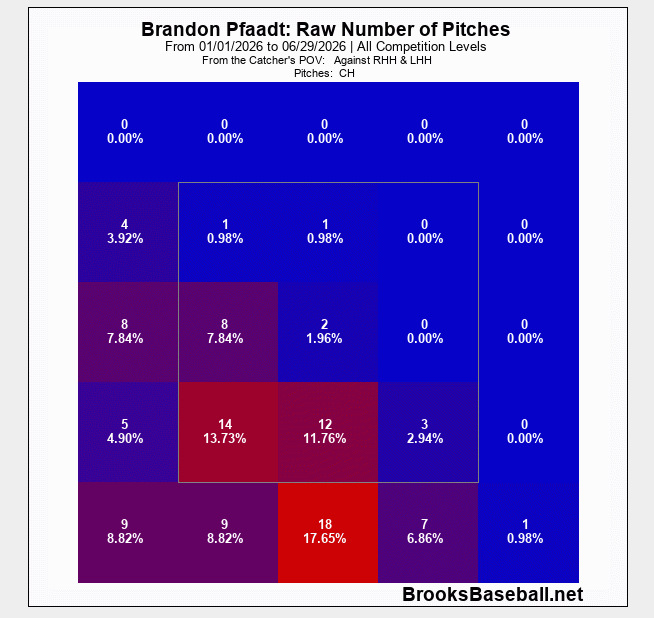
Post-June 30
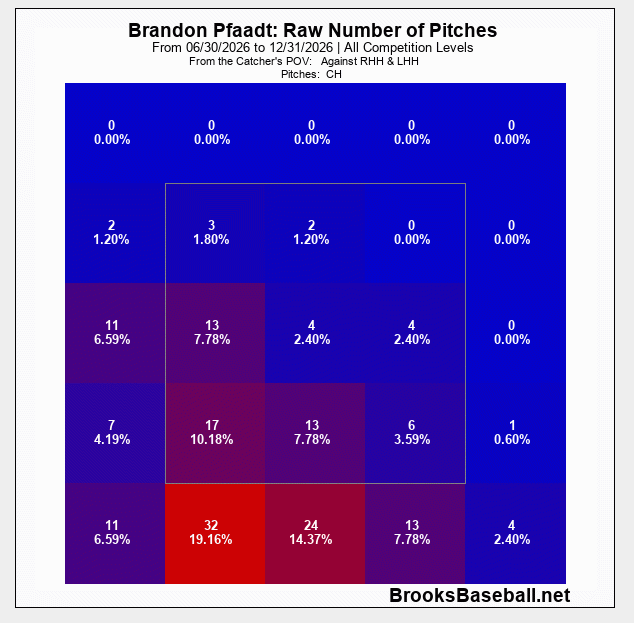
It’s not a drastic difference, but you may notice that Pfaadt is more consistently hitting that down-and-away corner against lefties, which is oh so important for a changeup.
All in all, Pfaadt’s command has been on point during this hot streak, as he has a microscopic 1.15 BB/9 in his last nine starts. But are the increased changeup usage and command gains translating to more whiffs? Here’s a look at Pfaadt’s changeup whiff rate by month this season.
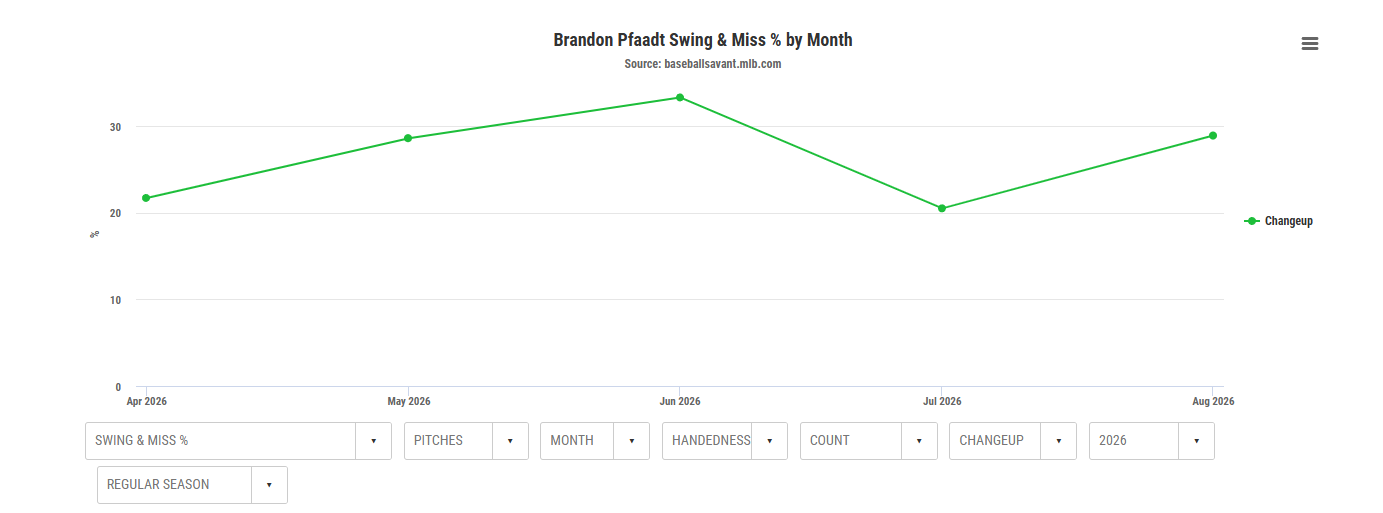
Not quite, and despite his strong ratios, Pfaadt has been rather underwhelming in the strikeout department. His current 16.1% strikeout rate is by far a career low and well below league average, and he has just a 14.4% strikeout rate during his nine-start hot streak.
He notched seven strikeouts in this start, and that was Pfaadt’s highest strikeout total since September 17, 2025, almost a full calendar year. In this start, it was the curveball that was working to earn Pfaadt the strikeouts. Pfaadt had five of his 13 whiffs with the curveball, good for a 56% whiff rate.
Despite his strikeout shortcomings, the curveball has proven to be effective at generating whiffs this season. Batters are hitting just .186 off Pfaadt’s curveball, along with a .279 SLG, .228 wOBA, and 35.3% whiff rate, all very strong numbers. Pfaadt’s curveball usage has fallen to just 11% over his last nine starts, but he’s still retained the ability to get whiffs when needed with the pitch. Here's an example of the curveball from this season.
— Elliott Baas (@ElliottBaasBB) August 17, 2026
A harder, sharper, low-spin curve at 82 mph and 2494 RPM, Pfaadt has been able to use this and the changeup as an answer to his lefty struggles. Pfaadt usually has massive platoon splits, and lefties had a .962 OPS against him pre-June 30, but since June 30, lefties are hitting just .203 with a .494 OPS off Pfaadt.
I think the end result for Pfaadt against lefties will be somewhere in the middle of these two splits, but it seems like Pfaadt may finally have an answer for a problem that has plagued him since he was a rookie.
Another issue that has long plagued Pfaadt is his fastball effectiveness. His four-seamer and sinker have routinely been crushed by opponents, and though the sinker continues to be knocked around, Pfaadt has seen much better results on his four-seamer this year as well.
Pfaadt increased his four-seam usage to 29% since rejoining the rotation, and the pitch has been quite effective. Batters are hitting .207 against the pitch with a .283 SLG and a .260 wOBA. That’s much better than the .271 AVG and .483 SLG against the pitch all time, and the current .221 xBA, .343 xSLG, and .287 xwOBA suggest that Pfaadt can sustain these results.
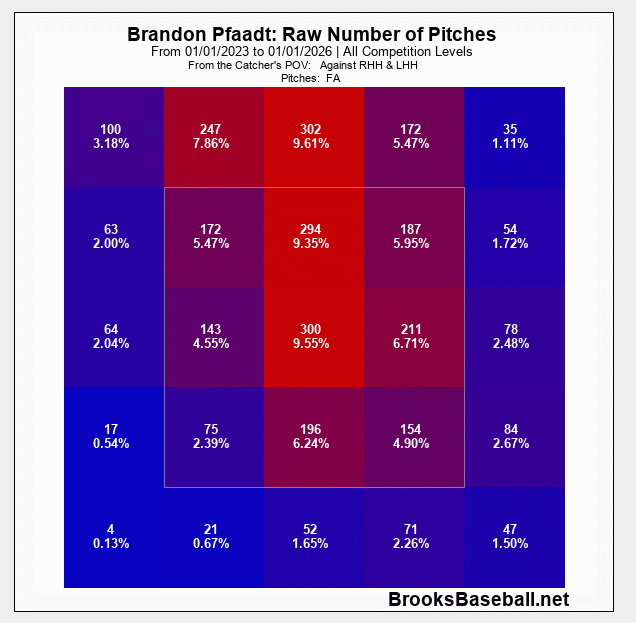
What changed? Again, it comes back to command for Pfaadt. Let’s have a look at his four-seam heatmap prior to this season, and then for 2026.
Pre-2026:
2026:
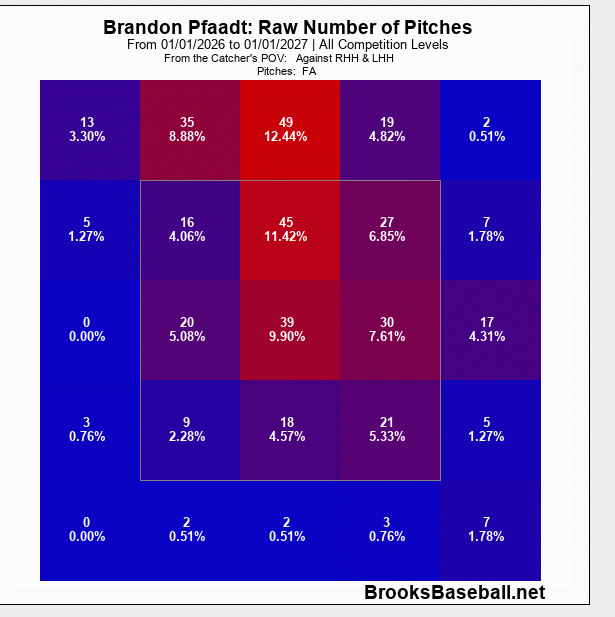
Much more focused, intentional. Pfaadt isn’t going to blow his 93.2 mph heater with 14.5 inches of induced vertical break by anyone, at least not with any consistency. But this is his best approach, which is to hammer the heater in high and make hitters try and catch up with it.
Now, Pfaadt is certainly going to have regression on the current .234 BABIP against his four-seamer, but he’s also made legitimate improvements that shouldn’t be overlooked.
It would be easy to sit here and tell you that Pfaadt is going to regress, because, well, he is. I hate to break it to the Pfaadt fanatics out there, but there’s simply no way he can maintain a 1.15 ERA, 0.88 WHIP, 0.16 HR/9. .237 BABIP, 1.6% HR/FB ratio, or 86.1% LOB rate over a full season, or even for the rest of the year.
Many of these numbers are unusually fortunate for Pfaadt, and he will regress. But he doesn’t have to regress all the way back to the ~5.00 ERA guy we knew from prior seasons.
He’s made real improvements in command and tangible changes to his pitch mix, and I think he can exist as a low-dominance, innings-eater, command-wizard type. It’s not the way most envisioned a successful Pfaadt, but this profile can certainly last in a major league rotation and have fantasy value. Plus, he’s been so good lately it’s become impossible to ignore. Pfaadt should be rostered in 12-team leagues or deeper.
Verdict:
A combination of improved control, pitch mix changes, and luck from the baseball Gods has resulted in a dominant stretch from Pfaadt. While his performance isn’t sustainable to this degree, there is enough growth here for me to buy into Pfaadt’s transformation.
This is exceptional command, and he still has good secondary pitches despite a fastball that is weak on paper. If Pfaadt is still out there in your league, he could be worth an add, as he provides rare stability from a waiver wire arm, even if the strikeout upside is limited.
Jacob Lopez, Athletics – 22% Rostered
2026 Stats (prior to this start): 82 IP, 5.38 ERA, 5.19 FIP, 8.3% K-BB%
08/16 vs. TEX: 6 IP, 5 H, 2 ER, 2 BB, 6 K
Lopez continued his tear on Sunday, holding Texas to just two runs over six innings in a no-decision. Lopez has allowed two runs or fewer in each of his last seven starts and has a 2.36 ERA over that stretch. After a rough start to the season, has Lopez turned things around and become a viable fantasy option?
Originally a 26th-round pick by San Francisco in 2018, it’s safe to say that the twice-traded Lopez was not considered a big pitching prospect. With his late-round draft status, unconventional path, and funky throwing motion, Lopez feels like a throwback to the Moneyball era of the Athletics.
He would fit perfectly alongside Chad Bradford and Scott Hatteberg. Lopez works with a five-pitch mix consisting of a four-seam fastball, slider, cutter, changeup, and sinker.
Lopez’s most used pitch this season has been the four-seam fastball, which he has thrown 34.1% of the time. A 90.5 mph offering, Lopez ranks in just the fifth percentile of fastball velocity in MLB and has the third-softest fastball among starting pitchers (min. 80 IP).
Despite its soft velocity, Lopez’s four-seamer has actually been quite good from a results perspective. Batters are hitting .225 with a .414 SLG and .318 wOBA, and he has a .191 xBA, .312 xSLG, and .267 xwOBA with the pitch.
What makes the 90 mph heater so effective? One is the exceptional movement Lopez gets with the pitch. His 12.6 inches of induced vertical break may seem pedestrian, but Lopez gets a whopping 13.6 inches of arm-side action with his fastball.
That makes the pitch both difficult to read and difficult to square up, and Lopez has a surprisingly high 20.3% whiff rate with his four-seamer this season. Here's an example of the pitch from this year.
— Elliott Baas (@ElliottBaasBB) August 17, 2026
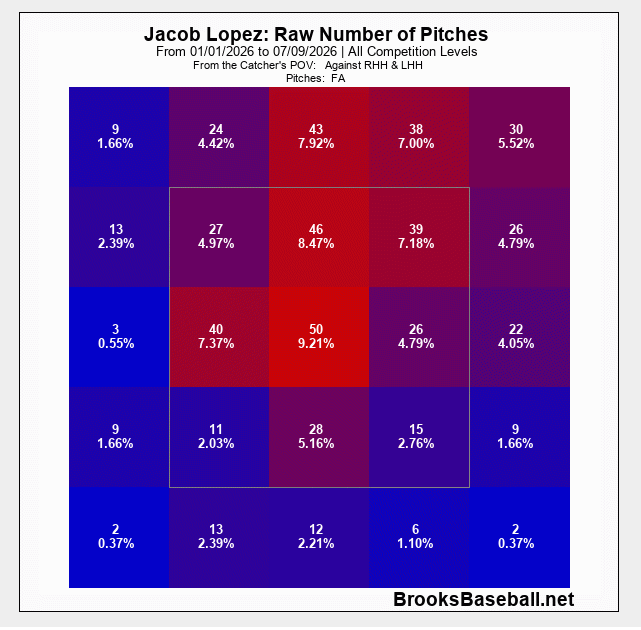
Another contributor to the fastball’s success has been improved command from Lopez throughout the year. Here’s a look at his fastball heatmap from prior to rejoining the rotation on July 10.
Here is since July 10.
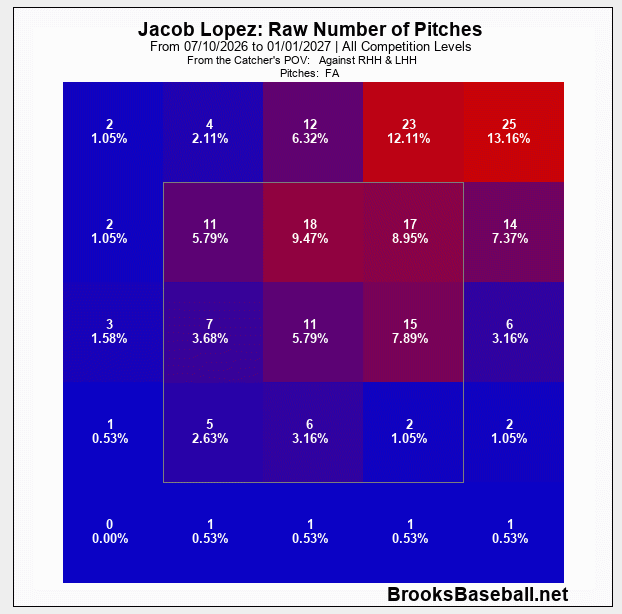
It’s much more controlled, up and away to righties, which is exactly where Lopez wants to be given his delivery and unique fastball shape. It’s tough to make it in this league with a 90 mph fastball, but Lopez is better positioned than most to not only make it work, but make it a weapon.
Lopez’s next most used pitch has been the slider, which he’s thrown 33% of the time this season, and 37.7% of the time since rejoining the rotation.
A 76.6 mph offering, Lopez’s slider is the third-softest among qualified pitchers and the softest among pitchers who work primarily as starters. It’s soft and has a big loop, but also has sharp glove-side movement that just sort of rainbows its way to the plate. Here’s an example from this season.
— Elliott Baas (@ElliottBaasBB) August 17, 2026
Deceptively tough to read and hit, and batters have been flailing more and more at this pitch. Here’s a look at Lopez’s slider whiff rate by month this season.
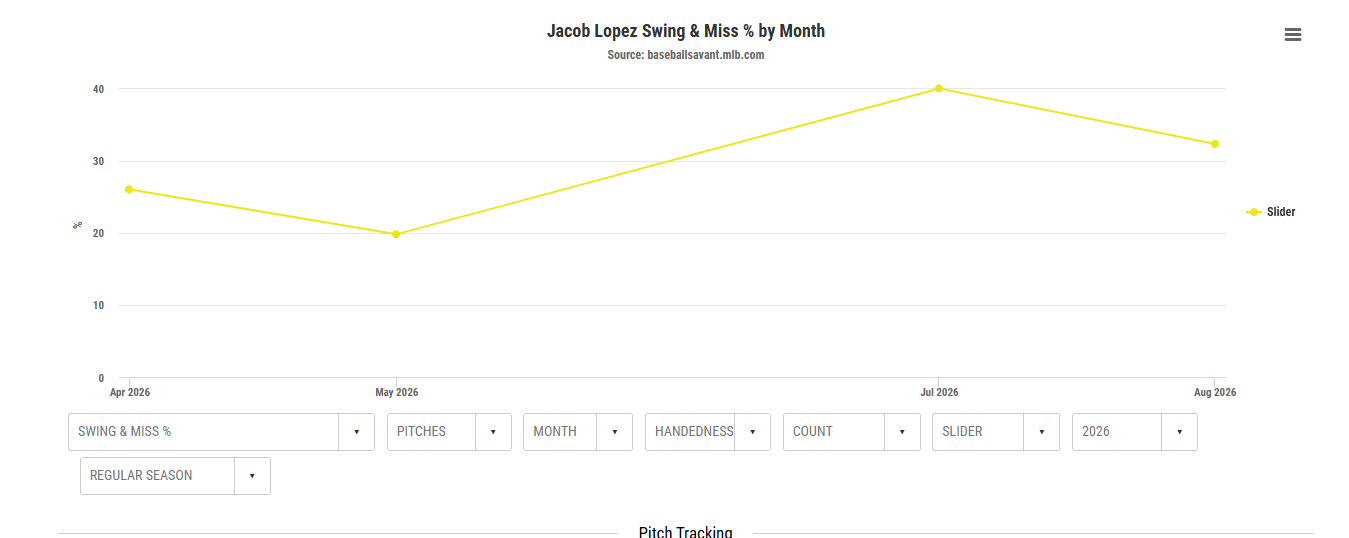
He had a big spike when returning to the rotation, and has been able to sustain a high whiff rate with the slider. Overall, batters are hitting .212 with a .339 SLG and a .296 wOBA off Lopez’s slider, but the expected stats are even better with a .163 xBA, .245 xSLG, and a .242 xwOBA.
Opponents have a comically low 76.4 mph average exit velocity off the slider, along with a 23.8% hard hit rate and a 53.1% fly-ball rate. Flyballs are the least likely batted ball type to land for a hit, and weak flyballs are practically guaranteed outs. Lopez was able to consistently generate weak contact and whiffs with his slider last season, and I think he can continue to do so in 2026.
His third-most used pitch has been the cutter, which Lopez has thrown 20.4% of the time this season. An 86.4 mph offering, Lopez’s cutter has quite a bit of movement and sort of acts as the perfect hybrid between his funky fastball and loopy slider. Here’s an example from this season.
— Elliott Baas (@ElliottBaasBB) August 17, 2026
Hard (for him) and sharp, this pitch has a 25.3% whiff rate this year, which is quite high for a cutter. Batters have hit .299 with a .448 SLG and .378 wOBA off the pitch, but Lopez also has a .231 xBA, .350 xSLG, and .320 xwOBA, suggesting that Lopez may’ve been unlucky with the results so far.
Lopez does have a .346 BABIP against his cutter this season, which seems rather high given that the pitch has just an 85 mph average exit velocity against and a 53.7% fly-ball rate.
Lopez had similar numbers and expected stats with his cutter last season, so I don’t think we can just assume it will automatically perform better. Still, this cutter has plenty of movement, is relatively hard, and fits nicely in Lopez’s repertoire as a third option, especially against righties.
It’s been a tale of two seasons for Lopez, who had a 7.04 ERA in his first 13 appearances and a 2.36 ERA in his last seven. He’s been a different pitcher since returning to the majors, and while maintaining the sub-3 ERA would be a stretch, I do think there’s enough in this profile to believe in Lopez.
Since returning, he’s changed his pitch mix, shown improved command, and has elevated whiff rates. Yes, he’s also getting lucky with a .246 BABIP and 86.8% LOB rate, but there are real improvements underneath the hood.
Lopez had a 28.3% strikeout rate last season and has a 28.1% strikeout rate since returning to the rotation. Strikeouts can be hard to find on waivers this time of year, and Lopez has shown he has the ability and the stuff to generate whiffs.
He will regress, but even if he regresses to his 3.63 FIP with a 28% strikeout rate, he’d be well worth a roster spot. Like with Pfaadt, I think Lopez has been too good to ignore and deserves to be rostered in 12-team leagues or deeper. I think he’s a sneaky add as we approach the home stretch.
Verdict:
Lopez was a disaster in his first 13 games, and an ace in his last seven. Between a new pitch selection, better command, and elevated whiff rates, I think there’s enough here to believe in Lopez as a sneaky second-half breakout candidate.
He is still risky at this juncture as he’s shown to have quite a low floor, but the recent strikeouts and ratios are tough to leave on the wire. Lopez is worth the add in 12-team leagues or deeper, and I think he could be an impact second-half player off the wire.
More Fantasy Baseball Advice
Download Our Free News & Alerts Mobile App
Like what you see? Download our updated fantasy baseball app for iPhone and Android with 24x7 player news, injury alerts, sleepers, prospects & more. All free!