RADIO
RADIO










Fantasy football lineup targets and sleepers for Week 3 of 2024. Josh looks at high-powered offenses to target, and the top fantasy lineup picks from each.
Hello, RotoBallers, and welcome to Week 3 of the High-Powered Offenses column. Week 2 was a little more normal for the superstar fantasy players we trust. However, injuries hit hard, especially in the running back position. There were also several upsets, including the Raiders over the Ravens, the Saints over the Cowboys, the Vikings over the 49ers, and the Buccaneers over the Lions. We'll take the new information we have from injuries and what we believe about teams into consideration this week. Remember, this article will identify offenses that are set up for a huge week and which players among them are great targets. The teams and players highlighted will change weekly based on the data trends, their current matchup, situational factors, and key injuries. The goal will be not to repeat offenses on a week-to-week basis, selecting new teams for you to target.
The foundation for determining which offenses to target will be based on a data-driven methodology focused on NFL scoring. You can find more details on that in the methodology section. On top of the number of points scored, we’ll also be incorporating player-level information within the offense and analyzing the opposing defense to generate a list of the players you want to rely on each week. A shoutout to Stathead, Next Gen Stats, Fantasy Points, and DraftKings for the information required to write this article.
Below, you’ll find a recap of the last week's offenses to target, a sneak peek of the offenses to target, a breakdown of the methodology, a snapshot of each metric in a data table, a few key takeaways, and the list of offenses and players to target in Week 3. Let’s dig in!
Bookmark our updated and revamped fantasy football rankings portal for all league formats!PPR rankings | Half-PPR rankings | Standard rankings | Rookie rankings | Superflex rankings | Dynasty rankings | Who To Start? | Injuries | Matchup Ratings | Strength of Schedule
Week 2 Offenses Recap
- Los Angeles Chargers - 26 points scored (tied for fifth most)
- Baltimore Ravens - 23 points scored (tied for ninth most)
- Philadelphia Eagles - 21 points scored (tied for 13th most)
- Dallas Cowboys - 19 points scored (tied for 17th most)
- San Francisco 49ers - 17 points scored (tied for 21st most)
It was a decent week again in Week 2. Dallas and San Francisco were major disappointments, but it was nice to see Los Angeles score high, which could've been higher. Once again, there were three defensive or special teams touchdowns, none of which came from these five teams.
Week 3 Offenses to Target
- New Orleans Saints
- Arizona Cardinals
- Tampa Bay Buccaneers
- Buffalo Bills
- Cincinnati Bengals
Methodology
In terms of how it works, each week we’ll analyze four different metrics and their impact on the average number of points teams scored, including location (home, away), pace -- offensive plays per game (above average, average, below average), offensive touchdowns per game (above average, average, below average), and offensive yards per game (above average, average, below average).
We’ll calculate the average number of points scored for all 11 categories, identifying trends and patterns that can provide further insight into scoring output. We’ll track the cumulative average points scored as the season progresses, creating a larger sample size with more accurate data.
Below, you’ll find a breakdown of each of the four metrics, explaining what they are and how the subcategories were created.
Metric No. 1 - Location
NFL teams travel across the country and abroad, battling one another every year. However, every team is allotted eight home games one year and nine the next, playing their remaining games on the road.
This metric is divided into two categories: home and road. Occasionally, teams play on a neutral site outside America, including England, Mexico, Brazil, and Germany. In those situations, whoever the NFL identifies as the host team will be considered the home team, while the visiting team will be viewed as the road team.
The home team expects to have the advantage and score more points because they do not need to travel and have the comfort of their normal amenities and routine, along with the familiarity of their stadium and the crowd support.
Metric No. 2 - Pace (Offensive Plays Per Game)
The pace of play represents how fast a team runs its offense. It’s a statistic that can be measured in several ways, but for this article, we will focus on the number of offensive plays per game a team runs, which includes passing attempts, rushing attempts, and sacks taken.
This metric is divided into three categories: above average, average, and below average. To find the average, we went back three seasons, including 2023, 2022, and 2021, to find the average number of plays for all 32 teams each year, creating a total of 96 team seasons. The average number of plays from that sample is 63.14.
We then expanded that number to create a range of 61 to 65 offensive plays per game, which we defined as the range for “average.” Thus, anything greater than 65.0 would be “above average,” and anything less than 61.0 would be “below average.”
Every week, each team's average offensive plays per game will be placed in one of the three ranges to identify the average points per game in that range for NFL teams that week.
Their plays per game will be recalculated based on their cumulative total for the season each week to provide a cumulative average number of points scored for the three categories. The further into the season we get, the more accurate this will be because the sample size will be larger.
Sometimes a team has a large lead and is attempting to run out the clock, causing it to play slower, but in general, the expectation is that teams that run more offensive plays will have more scoring opportunities and thus score more points.
Metric No. 3 - Offensive Touchdowns Per Game
Touchdowns are one of the statistics with the highest variance at a player level, team level, and throughout a season for a particular franchise. However, as a league, the number is very consistent, especially when focusing on offensive touchdowns, which include passing and rushing.
This would exclude any touchdowns scored by a team’s defense or during special teams plays, such as kicking and punting. We've excluded these scoring plays because they are harder to predict and occur less frequently than offensive touchdowns.
This metric is also divided into three categories: above average, average, and below average.
To find the average, we went back three seasons, including 2023 where teams scored an average of 2.3 touchdowns per game, 2022 where teams scored an average of 2.3 touchdowns per game, and 2021 where teams scored an average of 2.4 touchdowns per game. We then took the average of those three seasons, which was 2.3.
Finally, we expanded that number to create a range of 2.2 to 2.4, which we defined as the “average.” Anything greater than 2.4 is defined as “above average,” and less than 2.2 would be “below average.”
Every week, each team's offensive touchdowns per game will be placed in one of the three ranges to identify the average points per game in that range for NFL teams that week.
Their offensive touchdowns per game will be recalculated based on their cumulative total for the season each week to provide a cumulative average number of points scored for the three categories. The further into the season we get, the more accurate this will be because the sample size will be larger.
The expectation is that teams who score more offensive touchdowns will score more points. We’ll be particularly curious about the gap in points scored between the three subcategories, not just a higher number.
Metric No. 4 - Offensive Yards Per Game
In addition to touchdowns, yards are another key measurement of offensive output. Because the range of numbers for yards is much wider, this statistic is more consistent among players and teams than touchdowns. Fortunately, it's consistent for the NFL as a whole as well. Similar to touchdowns, we’ll be incorporating only offensive output for the same reasons outlined above.
Once again, this metric is divided into three categories: above average, average, and below average.
As with the previous two metrics, we went back three seasons, including 2023 where teams had an average of 331.6 yards per game, 2022 where teams had an average of 340.1 yards per game, and 2021 where teams had an average of 333.6 yards per game. We then took the average of those three seasons, which is 335.1.
Finally, we expanded that number to create a range of 320 to 350, which we defined as the “average,” with anything greater than 350 defined as “above average,” and less than 320 would be “below average.”
Every week, each team's offensive yards per game will be used to place them in one of the three ranges to identify the average points per game in that range for NFL teams on that week.
Their offensive yards per game will be recalculated based on their cumulative total for the season each week to provide a cumulative average number of points scored for the three categories. The further into the season we get, the more accurate this will be because the sample size will be larger.
Sometimes, a team will begin a drive with a great field position because of its defense or special teams unit, which decreases the number of yards required to score a touchdown or kick a field goal. But, in general, the expectation is that teams who produce more yards on offense will score more points.
Additional Measures
These four metrics above will set the foundation for identifying offenses to target based on the different thresholds.
We’ll incorporate additional inputs such as the team’s record (wins, losses, and ties), which teams are favored to win by the betting market, metrics like pre-snap motion rate and pass rate over expectation, and changes in personnel or coaching staff to help hone in on the high-powered offenses to target.
We’ll also go beyond the offensive perspective to factor in the opposing defense and other variables that could impact the offensive output, such as weather.
Data Tables
Data Table No. 1 - Location
| Location | Average Points Scored |
| Home | 20.78 |
| Road | 20.19 |
Data Table No. 2 - Pace (Offensive Plays Per Game)
| Offensive Plays Per Game | Average Points Scored |
| Above Average (above 65.0) | 20.00 |
| Average (61.0-65.0) | 21.67 |
| Below Average (under 61.0) | 20.18 |
Data Table No. 3 - Offensive Touchdowns Per Game
| Offensive Touchdowns Per Game | Average Points Scored |
| Above Average (over 2.4) | 26.83 |
| Average (2.2-2.4) | N/A |
| Below Average (under 2.2) | 16.68 |
Note: Because touchdowns are a whole number, there won't be any teams in the "average" range yet. With two games played, a team would have to have 4.4 to 4.8 total touchdowns on the season, which isn't possible. This category should be populated next week, assuming a team has seven total touchdowns.
Data Table No. 4 - Offensive Yards Per Game
| Offensive Yards Per Game | Average Points Scored |
| Above Average (over 350) | 26.04 |
| Average (320-250) | 19.67 |
| Below Average (under 320) | 17.18 |
Data Takeaways
Our data set has doubled with two weeks of information to assess now. Having about four weeks of data is ideal, but we are starting to see some definitive trends.
Much like last week, the two categories with the most points scored came from the "above average" range in both offensive yards per game and offensive touchdowns per game at 26.04 and 26.83 points per game, respectively. These two metrics are the most correlated with points scored, making them important when choosing which team to target.
Similarly, the lowest points scored came from the inverse, "below average," in offensive touchdowns and offensive yards. There's about a 10-point gap between the "above average" and "below average" in each metric, highlighting the disparity.
The road teams responded to close the gap in Week 2, thanks to big wins from the Bills, Chargers, Saints, and Raiders. The Bengals also performed well in Arrowhead despite losing on a last-minute field goal. Overall, home-field advantage exists, but the combination of a good offense in the stadium is the ideal pairing.
The pace of play remains a mixed bag, partially because teams like New Orleans, Buffalo, and Tampa Bay rank first, third, and fourth in points scored, respectively, but have run fewer plays thanks to lopsided victories. Meanwhile, offenses like the Dolphins and Browns have run plenty of plays but with minimal offensive output. This may be a metric where we need a larger sample size before any trends unfold.
Week 3 Offenses and Players to Target
Offense No. 1 - New Orleans Saints
It's fair to state that the Saints offense has been the biggest surprise through two weeks. We knew the change in offensive coordinator to Klint Kubiak would be a positive move, but few, if any, would've predicted such a stark contrast. The Saints are a perfect 15-of-15 on finishing drives with points, including 11 offensive touchdowns.
Additionally, they're averaging 405.5 offensive yards per game and 45.5 points per game, making them second in offensive yards, first in points, and first in offensive touchdowns.
One of the keys to the new scheme is the massive increase in pre-snap motion and play action. There's plenty of research to suggest that these two play designs result in higher offensive output, which New Orleans is executing at an extremely high level.
Fresh off a statement win on the road against Dallas, the Saints will return to the Superdome to host the Eagles, whose defense has allowed 51 points through two weeks. While the numbers are unsustainable, this offense deserves to be targeted. Furthermore, what's great about this offense for fantasy is the concentration of volume.
The obvious: Alvin Kamara turned back the clock to score a combined four touchdowns last week, looking unstoppable. Chris Olave had a much better outing in Week 2 and possesses too much upside to pivot away from given his talent and the way this offense is clicking.
Players to target:
Player No. 1 - Rashid Shaheed has outscored Olave in both weeks, finding the end zone each outing. He's averaging a ridiculous 24.14 yards per reception and leads the NFL in yards per route run at 5.28. He's also commanding a 17% target share on limited volume, representing a significant step forward from last year. He deserves to be considered among the top 36 wideouts with a week-winning upside.
Player No. 2 - Derek Carr leads the NFL in passing touchdowns and has scored the second-most fantasy points thus far. It's in part due to his absurd 12.2% touchdown rate, but he's certainly earned a spot in the top 12, if not the top 10.
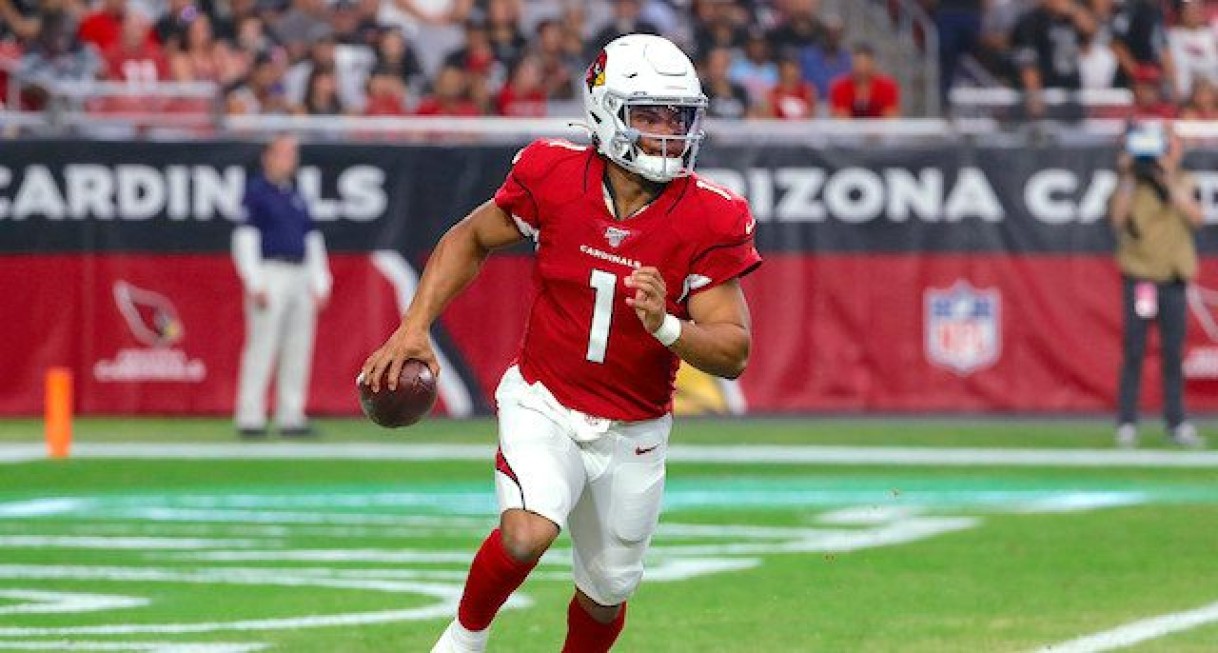
Offense No. 2 - Arizona Cardinals
Arizona was hyped up all offseason. Kyler Murray is healthy and it added Marvin Harrison Jr. The stars appeared to align perfectly.
Week 1 started with a bang before a slow second half against the Bills. However, the Cardinals boat-raced the Los Angeles Rams on Sunday, scoring 21 points in the first 16.5 minutes. It was over at halftime. If not for their huge lead, they probably would've finished with more than 41 points.
When discussing the top offenses in points per game above, the team missing from the top four was the Cardinals. They've scored 69 points across their first two contests, behind only New Orleans. They've also averaged 379.5 offensive yards and three offensive touchdowns per game while running 122 total offensive plays (61 per game).
Not only did they decimate the Rams, but they made sure to get Harrison rolling, who had back-to-back touchdown grabs on their first two drives. With Murray looking elite again and the Lions' susceptible defense coming to town, they're a great selection this week.
The obvious: Marvin Harrison Jr. was discussed above. James Conner hasn't missed a beat, finding the end zone in back-to-back games with 177 rushing yards and 35 receiving yards. He almost had a third score, which he fumbled and Trey McBride scooped up. McBride capitalized on the opportunity, adding to his six receptions for 67 yards. This trio is locked in your lineup.
Players to target:
Player No. 1 - Not far behind that trifecta is Kyler Murray, who has a long history of producing in fantasy football. On top of being a capable passer, he's an athletic runner. He's run the ball 10 times for 116 yards. That's the equivalent of adding 290 passing yards for fantasy, which is why he's so valuable. He's a must-start this week against Detroit.
Offense No. 3 - Tampa Bay Buccaneers
There was a lot of concern about the Buccaneers losing offensive coordinator Dave Canales to the Panthers this offseason. Many wondered whether the team could build upon a successful 2023-2024 campaign, which included a division crown and a playoff victory.
After two weeks, the Bucs look as good, if not better than last year. They're sitting fourth in points per game at 28.5 and tied for third in offensive touchdowns. The yardage has been lower because they've been so efficient, averaging 304 per game. Similarly, they've run 54 plays per game.
After thumping the Commanders in Week 1, they proved they're more than a one-hit wonder with a road win at Ford Field over Detroit. Next up for them is a home game against the lowly Broncos, whose defense has kept their games close, but their offense has kicked five field goals and scored one touchdown through two weeks, totaling 22 offensive points.
The obvious: Mike Evans exploded in Week 1 with five grabs for 61 yards and two scores. He was quieter in Week 2, but that was because Chris Godwin stole the show with seven receptions for 117 yards and a trip to the end zone. Both are viable, especially the way this offense is playing.
Rachaad White got banged up in Week 2, causing him to miss snaps. He also struggled to earn targets, seeming to be a focal point of the defense. The Broncos are better at covering wide receivers, which should open more room for White to operate out of the backfield.
Players to target:
Player No. 1 - Baker Mayfield has earned weekly starter status with six total touchdowns. He's also completed 73.5% of his passes for 474 yards. Denver's pass defense is better than the Lions or Commanders, but Mayfield will get plenty of chances to carve it up, given its inability to possess the ball and sustain drives.
Player No. 2 - Neither White nor Bucky Irving could get much going against the Lions on the ground, which has been the case for multiple seasons. The Broncos present a better matchup, allowing the 12th-most fantasy points to the position and the 10th-most rushing yards.
White still has a stranglehold on the receiving role, but Irving continues to eat into his workload on the ground, averaging eight carries per week. He has flex potential in this matchup in a positive game script.
Offense No. 4 - Buffalo Bills
Buffalo has Miami's number, which has been the case for several years. We knew last week would be no contest. Unfortunately, Tua Tagovailoa suffered a scary concussion, removing any need for the Bills to keep pressing. While they're currently five-point favorites at home against the Jaguars, it should be more competitive.
They've scored over 30 points in both contests, averaging nearly 300 yards and 3.5 touchdowns. Like the other successful squads, their plays per game are lower at 51.5 because they're running the ball in the fourth quarter to bleed the clock. OC Joe Brady seems content with pounding the rock and controlling the ball.
The obvious: Josh Allen's numbers were subpar in Week 2, but that was because James Cook was dominating the Dolphins. The rushing attack was too strong. Both players are no-brainers for Week 3.
Players to target:
Player No. 1 - After vanishing in Week 1, the team made a concerted effort to get Dalton Kincaid involved early. Unfortunately, he got kicked in the head, sidelining him temporarily. He had two more receptions later in the game, but after that, there was no need to air it out. As mentioned above, they expect to pass more, creating more opportunities for Kincaid to produce.
Player No. 2 - There have been many injuries this season, including some big-name receivers. Khalil Shakir isn't going to offer the same output, but he's capable of finding the end zone and earning enough volume to be considered a flex option.
Offense No. 5 - Cincinnati Bengals
The streak of selecting home teams will stay alive with the Bengals. You may recall we had them in this very spot in Week 1 before we knew Tee Higgins was injured, Ja'Marr Chase would be limited, and Joe Burrow's wrist was still bothering him.
The stats haven't been there yet. 17.5 points per game, 272 offensive yards per game, and 1.5 offensive touchdowns per game on 51.5 plays per game isn't ideal. However, they nearly upset the Chiefs in Arrowhead and started to look more like themselves.
There's no better team for your passing attack to rebound against than the Washington Commanders, who have allowed the most fantasy points to both quarterbacks and wide receivers.
The obvious: Ja'Marr Chase is a popular buy-low candidate for the reasons referenced. His frustration on Sunday resulted in an unnecessary roughness penalty that cost Cincy a field goal. You can anticipate him and the offense finding their way.
Players to target:
Player No. 1 - Joe Burrow outplayed Patrick Mahomes, but the Chiefs defense scored a touchdown and they executed a game-winning field-goal drive. He hasn't been what fantasy managers hoped, but his 258 yards and two touchdowns in Week 2 were good enough for a top-12 performance. He's inside the top 12 against the Commanders.
Player No. 2 - Zack Moss has established himself as the lead back thus far. He has a 75% RB rush share and a 7.7% target share. He's also tied for second in the NFL in carries inside the 10-yard line with five. He's positioned to have a big day as a top-24 back.
Player No. 3 - The absence of Tee Higgins benefited Andrei Iosivas in Week 1, allowing him to find the end zone twice. However, in Week 2, it was the Mike Gesicki show. He led the team in targets (nine), receptions (seven), and receiving yards (91). This may be a one-off performance, but tight ends have been abysmal through two weeks, making him a decent streamer if Higgins is out again.
UPDATE: Higgins is good to go for Monday's game, which lowers the volume for Gesicki, making him a risky streamer. However, Higgins becomes a solid top-36 wideout against the Commanders.
Hopefully, you found this article helpful as you prepare for Week 3. Thanks for reading. We’ll be back next week with more offenses and players to target.
Download Our Free News & Alerts Mobile App
Like what you see? Download our updated fantasy football app for iPhone and Android with 24x7 player news, injury alerts, rankings, starts/sits & more. All free!

More Fantasy Football Analysis
Check out all of RotoBaller's fantasy football rankings. Staff rankings are updated regularly for all positions and include standard formats, PPR scoring, tiered rankings and dynasty leagues.