




 RADIO
RADIO








Ariel Cohen dives into his ATC projections for 2021 fantasy baseball by looking at volatility among high draft picks.
One year ago, I penned my very first article on RotoBaller. I am truly honored that the Fantasy Sports Writers Association (FSWA) awarded the piece as the 2020 Baseball Article of the Year. “Finding Combo-Player Values Using Z-Scores and ATC Projections” provided a new perspective on how to find helpful multi-category players to fill out your fantasy rosters throughout the draft.
For 2021, I will once again go through the same exercise. In addition, I will enhance the analysis by including all new ATC inter-projection volatility metrics. While having the best set of expected statistics for each player is primary, projection volatility helps paint a more vivid picture of a player’s associated risk.
Let’s start out with a quick review of how the ATC Projections are generated.
Featured Promo: Save 50% off the regular price with discount code CHAMP, for a limited time. Exclusive access to our Team Sync platform, DFS cheat sheets, Lineup Optimizers, betting/prop picks, and exclusive content from Nick Mariano and Eric Cross! GAIN ACCESS NOW
The ATC Projections
The Average Total Cost projection system (ATC) gets its name from the fact that it “averages” many other projection systems together. ATC also happens to be my initials.
While many others who attempt to aggregate projections typically apply equal weight to all data sources, ATC assigns weights based on the careful study of historical performance. ATC is a “smart” aggregation model.
The methodology behind ATC is similar to what Nate Silver does with his presidential election forecasting at www.fivethirtyeight.com. Nate collects lots of polling data. He assigns credibility weights to each firm in order to know how to combine them.
Silver does this on a state-by-state level. Rasmussen polling may garner 22% of the weight for Delaware polls, while YouGov may only get a 7% share. In New York, those weights might be totally different – perhaps YouGov has 18%, with Rasmussen only receiving 6% of the total aggregation.
Similarly, ATC calculates different weights for each statistic. System A might receive 15% of the weight for batter home runs, but only 5% for pitcher strikeouts. System B may receive 10% for HR, but 20% for K, etc. The ATC system incorporates many freely available projections, plus prior MLB statistics over the past three seasons.
Nate Silver does little or no polling of his own … yet his forecasting model is the best in the industry. ATC operates in a similar manner, but for baseball. By studying the strengths of systems and by combining multiple sources of data, ATC is highly predictive. For the second straight year, FantasyPros has crowned the ATC projections as the most accurate fantasy baseball projections.
Using ATC as your base rankings source will give you a leg up on your competition for 2021!
Projections Volatility
ATC looks at many individual underlying projection sets. For some players, projections are largely in agreement with one another. For others, projections are highly divergent.
As projection sets differ, we can observe the intrinsic variance between them. Measuring the range of differing projections, allows us to quantify part of each player’s parameter risk. Parameter risk is the term for the uncertainty of the true expectation.
Aside for simply knowing the magnitude of the divergence, it is important to know which way projections differ. For some players, there may be one or two outlying projections above or below the ATC average. For some players, projections are equally just as high as they are low.
This year, ATC has unveiled two risk metrics that in tandem will help paint the picture of how projections sit around the ATC average. The formal definitions of the two are as follows:
Inter-Projection Standard Deviation (InterSD) – The standard deviation of the underlying projections surrounding the ATC average auction value. InterSD describes how much the projections disagree about the value of a player. The larger the InterSD, the more projections differ.
Inter-Projection Skewness (InterSK) – The skewness of the underlying projections surrounding the ATC average auction value. InterSK describes the symmetry of the underlying projections. A positive InterSK means that a player’s mean is being pulled to the upside; the majority of projections are lower than the ATC average. A negative InterSK means that a player’s mean is being pulled to the downside; the majority of projections are higher than the ATC average.
For hitters, my research has shown that inter-projection standard deviation (InterSD) is negatively correlated with expected rotisserie earnings. The higher the variance in-between projections, the lower the expected returned end of season values for most value ranges.

In terms of skewness (InterSK), negative values are superior to positive ones. Players with high positive skewness are at risk for a lower returned end of season value, while players who demonstrate a large negative skew have shown the tendency to out earn their ATC projected statistics.

For more background and research, see the full introductory ATC projections volatility article.
Z-Scores
Z-Scores, often referred to as standard scores, are the kernel of a widely popular auction valuation method for fantasy. For offense, Z-Scores help us equate the five standard rotisserie scoring categories (R, RBI, HR, SB, BA) and aggregate them into one simplified metric in order to rank players.
The general idea is to convert each categorical statistic to the same basis. The heart of the Z-Score engine calculates the following value for each player, by scoring statistic.
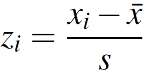
Where: Z[i] = Player i’s Z-Score; X[i] = Player i’s Category Stat; X-Bar = Average Stat for the category; S = Standard Deviation for that category.
For all rate stats (beyond the scope of this article), we must first convert them into a counting stat. Using hits as an example (zxH), we calculate the total number of a player’s hits above the pool’s mean batting average.
A Z-Score of exactly zero indicates that a player has exactly the average category stat of the player pool. A +1.00 indicates that a player is one standard deviation over the mean, and a -1.00 indicates that a player is one standard deviation under the mean.
Multi-Category Offensive Players
By most people’s standards, a “combo” player (or a multi-category player) is defined as a player who will hit a considerable number of home runs, while at the same time steal a large number of bases. I prefer to define multi-category players with the use of Z-Scores. Further, I do not simply utilize power and speed alone, but extend the concept to all of the five scoring categories. After all - runs, batting average and RBI equate to 60% of your offensive score; we would be foolish to ignore the majority of a player’s production.
I have previously demonstrated that rostering “combo” players are worthwhile fantasy baseball investment. Finding such players throughout the player pool is an exercise worth undertaking each season. Using the Z-Score framework, we can now look for multi-category players using standard scores. Perhaps, one might define a “combo” player as having four categories with a Z-Score of at least +0.75. Or perhaps, one might choose to define combo as any 3 categories which have at least a +0.50 Z-Score.
Rather than set a hard definition for the number of categories requiring a particular target, we will use Z-Scores as a means to filter for multi-category players. We can use standard scores to scope out the players who are:
- Excellent in every category
- Great in every category
- Good in every category
- Excellent in most categories
- Great in most categories
- Good in most categories
- Excellent in some categories
- Etc.
Today’s article will focus solely on offensive players. By filtering on various Z-Score thresholds, we can find all of the “combo” players both atop the draft and lower down. We may find some cheaper valued players by the market who will be able to quickly balance out your rotisserie team’s categories late in drafts.
Let’s start with the elite.
5 Categories with Z-Scores over +1.00

At the very top of our multi-category player list, we can find Fernando Tatis Jr. and Mookie Betts. The tandem is typically being drafted in NFBC leagues within the first four or five picks.
Tatis and Betts are the only players who are projected to achieve a Z-Score value in each and every category of at least +1.00. In other words, Tatis & Betts are superior 5-category players – residing a standard deviation above the player pool average in every single category. Drafting either of the duo will set an incredibly strong broad base of production for their lucky fantasy owners.
There is some debate as to who the number one overall (offensive) player should be in 2021 drafts. Along with Tatis and Betts, Ronald Acuna and Juan Soto are squarely in the middle of that contest. From a pure multi-category argument, this analysis would suggest sticking with one of the players covered in this section.
Upon looking at the ATC volatility metrics – Betts’s underlying projections are tighter than those of Tatis (InterSD of 2.87 vs. 3.48). On the other hand, Fernando Tatis’s projections are displaying more potential upside than Betts (InterSK of -1.38 vs. +0.20).
For first-round players, I tend to favor the tightness over the upside. For me, the choice for the number one overall player should be Mookie Betts. Betts also qualifies at the outfield position, a shallower position in 2021 than Tatis’ shortstop spot. Additionally, Mookie Betts has the greater runs and batting average projection by a wide margin - which are harder to find later on in drafts.
5 Categories with Z-Scores over +0.75

Next up, let’s add in five more players who have Z-Scores in each category of at least +0.75.
Ronald Acuna just missed the prior list by a few decimal points of batting average. Juan Soto missed the prior list by just one stolen base. Consider both of these players as strong candidates at the very top of drafts.
What surprised me here was seeing Christian Yelich’s superior projection after a down season. Yelich’s volatility metrics are stable (InterSD of 3.42) and contains upside (InterSK of -1.65). These risk measures give me confidence to draft Yelich late in the first round this year.
Rounding out this pack of players is both Jose Ramirez and Trevor Story. Ramirez’s largest deficiency is his batting average, and Story’s weakness is his RBI component. These are mere quibbles; a +0.82 BA Z-Score projection for Ramirez and a +0.94 RBI projection for Story are still superior figures. Both players are correctly being drafted among the first-rounders of 2021.
5 Categories with Z-Scores over +0.50

When we lower the filter of a 5-category player to include those with over a +0.50 in all categories, two additional players emerge – Cody Bellinger and Xander Bogaerts. Both players just missed the previous list by a handful of stolen bases.
For Cody Bellinger, he is displaying a high level of parameter risk. With a 6.4 InterSD, projections disagree as to whether he should be drafted at the beginning of the second round. At pick 16, consider skipping over Bellinger in favor of a pitcher, for example.
The surprising name on this list is Xander Bogaerts. He is currently being selected in the third round of 2021 drafts. However, Bogaerts is just the kind of multi-category player that will help you start your drafts with a healthy base of production in all five categories … plus, he has a low inter-projection standard deviation (InterSD of 2.46). The strongest part of his profile is his run production metrics (R & RBI). Bogaerts is projected to eclipse the 90 mark in each.
Next up are the 4-category combo players:
4 Categories with Z-Scores over +1.00
Article note: Even though all 5-category players belong on the 4-category lists, I will not repeat any names we have seen thus far. Only new members to each group will be listed.

You will now notice a few Z-Score values colored in red. A red shade signifies players/categories which have a below-average Z-Score. For each of the players in this tier, the category below the +1.00 threshold is typically the stolen base component.
The one player in this pack with an above-average stolen base projection is Bryce Harper. Harper is pegged for a large +1.34 SB Z-Score. To add more to Harper’s appeal, Bryce is still above average in every single scoring category; his lowest component is his batting average with a Z-Score of +0.08. At an ADP of 17, and with an exceptionally low InterSD – Harper is an intriguing draft selection in 2021.
Just a little later on, Rafael Devers provides a superior 4-category statistical base at pick 41. Devers will not swipe very many bags in the coming year, but he is a strong third/fourth-round value play. He is projected to both knock in and score nearly 100 runs. Both Devers and Bogaerts (from the last section) are strong combo/players valued similarly by the market.
4 Categories with Z-Scores over +0.75

Dropping the Z-Score threshold to +0.75 yields four more players – Manny Machado, Corey Seager, Marcell Ozuna, and last year’s AL MVP – Jose Abreu.
Akin to Harper above, Manny Machado is above average in each and every offensive scoring category. In fact, Machado is fairly close to five-category consideration. Adding in his low inter-projection volatility into the equation, makes Machado is a solid second-round option in 2021.
The player to watch here is Marcell Ozuna. Marcell can be found at pick 41, yet he maintains nearly a +1.0 Z-Score in four of the offensive categories. Ozuna also has an incredibly low inter-projection standard deviation (InterSD of 1.85). If you focus on pitching and speed in the first few rounds, Ozuna is a player who can cement your categorical balance heading into the early/mid rounds.
4 Categories with Z-Scores over +0.50

For this tier, we now relax the 4-category requirement of Z-Scores to +0.50.
Rather than going though all of the above players, a few notes:
- Amazingly, the first five members of this group are high-stolen base threats. Albies has over a +1.0 Z-Score in stolen bases. The others are all above +1.5!
- With so many solid 4-category contributors in the 35-40 ADP range, there is a clear hitter hotspot in the 3rd round of drafts. As a bonus, these players all have low InterSDs.
- Kyle Tucker and Luis Robert are the two players with a deficient batting average. I would personally shy away from these two in drafts, and especially from Tucker.
- J.D. Martinez can be found at about pick 94, which is undervalued as compared to the market. His Z-Score profile resembles a few other players who are being selected nearly 45 players ahead of him. Martinez is riskier than others in this grouping, but has the chance to turn a nice rotisserie profit at his expected production.
Next up are the 3-category combo players:
3 Categories with Z-Scores over +1.00
We now have arrived at the more limited “combo” environment. At this stage, high values in any 3 categories will do.

Some quick notes on these batters:
- Trea Turner can be found in this grouping (3-categories over +1.00) for the second straight season, and is firmly a first-round player. He is above average in all five scoring categories, and enjoys a low 1.68 InterSD.
- Tim Anderson is nearly above average in all five scoring categories, with RBIs as the lone holdout (a -0.10 Z-Score). Anderson also has some projections upside with a -1.0 InterSK.
- Whit Merrifield has one of the lowest InterSD values at 1.10. However, more projections are found below the ATC average.
- Nick Castellanos is available at pick 82. For elite power and run production, he’s a great option for the price.
3 Categories with Z-Scores over +0.75

- Starling Marte is the lone player on this list with an above average Z-Score for stolen bases - and a large one at that (+2.64). Other than power, Marte is above average in all of the other scoring categories, and he won’t cost you a top 50 selection this year.
- Pete Alonso has the lowest InterSD and most negative InterSK of this grouping. According to my research, Alonso has an excellent chance of exceeding his expected production. Depending upon your team's construct in the first few rounds (high BA, base of steals), Alonso may be an excellent complimentary choice at an ADP of 55.
- The two players in this group found after ADP 70 are Michael Conforto and Yordan Alvarez. Conforto is nearly a five-category positive Z-Score contributor. His statistical makeup should fit just about any categorical team profile.
3 Categories with Z-Scores over +0.50

- The bulk of these players can be found in the 90-110 ADP range. Eddie Rosario has the highest difference between projected (ATC) value and market value for this group.
- Like Conforto, Javier Baez and Lourdes Gurriel are also nearly 5-category positive Z-Score players. Baez can be found at an ADP of 73, but Gurriel is more undervalued at pick 85.
- Lower valued players in this tier include Joey Gallo, Rhys Hoskins and Miguel Sano – all found after pick 157. At pick 194, Miguel Sano is a very late source of power and run production.
- Matt Chapman and Paul Goldschmidt are the least risky of the bunch according to InterSD. Javier Baez and Joey Gallo have some upside indicators according to InterSK.
Finally, let’s look at the players who are very strong in just 2 categories. These aren’t necessarily the best examples of “combo” players, but it is helpful to know the players who can provide a strong boost to particular scoring categories.
2 Categories with Z-Scores over +1.00

- D.J. LeMahieu is expensive and does not provide enough of a stats base in most categories to warrant an ADP of 27. ATC is not a fan of LeMahieu.
- Trent Grisham is an undervalued steals source in the early/mid rounds. Raimel Tapia is an undervalued steals source in the late rounds.
- Mike Moustakas and Franmil Reyes are large bargains according to ATC. They assist in both power and run production, and are not detrimental to your team’s batting average.
- Nick Madrigal is the riskiest player in this group according to InterSD.
2 Categories with Z-Scores over +0.75
Here is one final listing of players who are “very good” at 2 categories:

- Jose Altuve has a unique profile. He is one of just three players available after pick 75 with an above-average Z-Score in Runs, BA and SB. He is quite strong in his two best categories. Caution though, Altuve does have an element of risk associated with him (InterSD of 6.51), but has a hint of projections upside (InterSK of -0.52).
- Jorge Soler and Josh Bell have somewhat similar Z-Score profiles and can be found at around pick 145. Consider the 10th round of 15-team drafts to be a power/RBI hotspot.
- Anthony Santander is close to being a four-category positive Z-Score contributor. Aside from stolen bases, he will provide his owners with a strong base of stats late in drafts.
- Nelson Cruz is still incredible!
Conclusion
Just as last year, by mapping out all of the potential multi-category contributors via Z-Scores, we are able to find a number of potentially helpful players for the 2021 draft season. Knowing the multi-category hotspots of the player pool in advance is a prudent planning exercise.
For 2021, with the ATC projections volatility metrics, there is an extra dimension added to smart aggregation. While InterSD and InterSK are not perfect quantifications of risk by any means, they help us paint a far better picture of the parameter risk present for each player. Consider inter-projection volatility as one other point of reference as you navigate your 2021 drafts.
Download Our Free News & Alerts Mobile App
Like what you see? Download our updated fantasy baseball app for iPhone and Android with 24x7 player news, injury alerts, sleepers, prospects & more. All free!

More Fantasy Baseball Advice