



 RADIO
RADIO









Corbin analyzes fantasy football WR/CB matchups to find sleepers, targets, avoids for Week 2 of 2026. His WRs to upgrade based on cornerback matchups data.
Welcome back to our WR/CB Matchups for Week 2 of the 2026 fantasy football season. Wide receiver injuries headlined Week 1, so several updates will occur throughout the week as injury reports come in. For those unfamiliar, this weekly series looks at fantasy football matchups for wide receivers versus the cornerbacks who are projected to cover them.
The data we access for offensive and defensive players continues to skyrocket. Though we mainly focus on offensive players, the defensive matchups and coverages sometimes take a backseat. However, the goal of this weekly column is to cover the potential wide receiver upgrades and downgrades based on the weekly WR/CB matchups for fantasy football.
Most teams mix in defensive backs all over the field, with very few cornerbacks shadowing an opposing top receiver. The main takeaway involves not overreacting to a weaker matchup if the receiver is a high-end to near-elite target earner and producer in their respective offense. Based on the weekly matchups, we'll use various tools to find several matchup upgrades and downgrades for the opposing receivers.
Bookmark our updated and revamped fantasy football rankings portal for all league formats!PPR rankings | Half-PPR rankings | Standard rankings | Rookie rankings | Superflex rankings | Dynasty rankings | Who To Start? | Injuries | Matchup Ratings | Strength of Schedule
WR vs. CB Chart Details
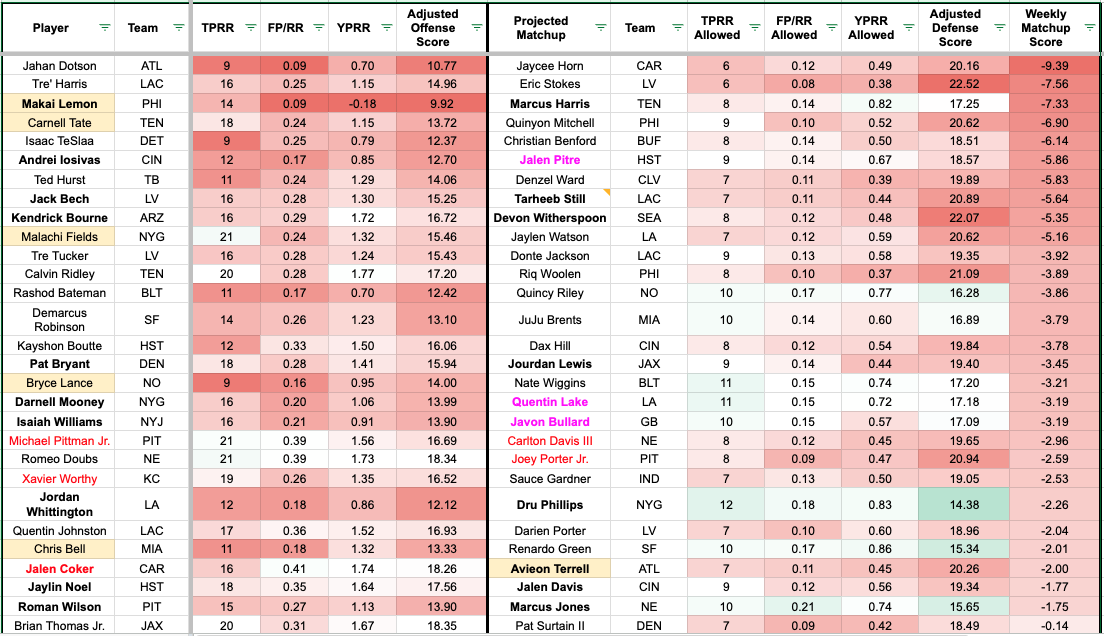
The WR/CB Matchup Chart is back again for 2026! You can find it below! We'll have the most favorable and unfavorable matchups based on several metrics. We used weighted averages to create an adjusted offensive and defensive score. Some inputs include yards per route run, fantasy points per route run, and targets per route run.
We'll have a weekly matchup score, calculated by adjusting the scores by subtracting the defensive number from the offensive one. The caveat would be the limited data due to injuries among offensive and defensive players, which may skew the matchups to be more or less favorable.
Since this is a relatively new process, there may be some minor adjustments along the way. With more data from the 2026 season, we'll learn what matchups to target and which ones to temper expectations for.
Players can underperform and outperform in a given matchup based on luck and skill factors. There are multiple layers to consider in these matchups, especially since team defenses tend to shift their coverages based on the opposing offenses.
How to Use The WR/CB Chart
One way to use this chart is to identify weaker or tougher projected matchups in the given week. Another purpose is identifying which team-level matchups to target. For instance, if multiple receivers have a positive or green matchup score on the same team, that indicates the opposing secondary could be a favorable matchup.
The flip side is also true. Finally, when a receiver has a positive or negative matchup score, it shouldn’t be used as a start or sit tool. However, it’s more helpful to utilize the matchup score to adjust expectations for that wide receiver. We also know there can be a wide range of outcomes where a receiver thrives or posts a dud, regardless of the matchup and projected game script.
Key Terms and Abbreviations
- TPRR = targets per route run
- YPRR = yards per route run
- FPRR = fantasy points per route run
WR/CB Matchups Chart: Alphabetical
Below, we'll see the WR/CB matchups for Week 2 sorted alphabetically. We also have players marked differently to indicate a new player (red-shaded cell), an injured player (red text), and slot coverage (bold text) to monitor. Rookies will have a yellow-shaded cell.
I also noted the magenta colored text as players who the teams list as safeties, but they tend to cover receivers in the slot. That seems to be a recent trend: safeties have been covering the slot if teams don't prefer another corner, whether it be based on size or coverage skills.
We added additional team-level metrics to the formula to account for team context. The red numbers indicate a more challenging matchup for the receiver, and the green numbers indicate a favorable matchup (or the defender allows a high rate on the given metric). These charts will be updated throughout the week after injury news.
The visual below shows offenses from the Arizona Cardinals to the Cleveland Browns.
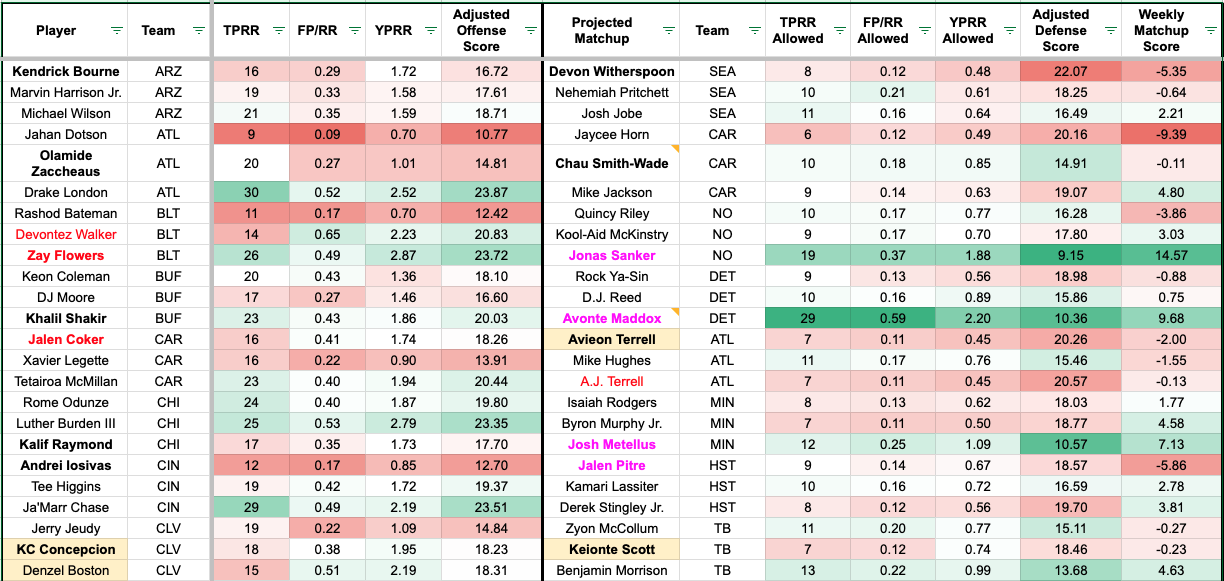
The visual below shows offenses from the Dallas Cowboys to the Kansas City Chiefs.
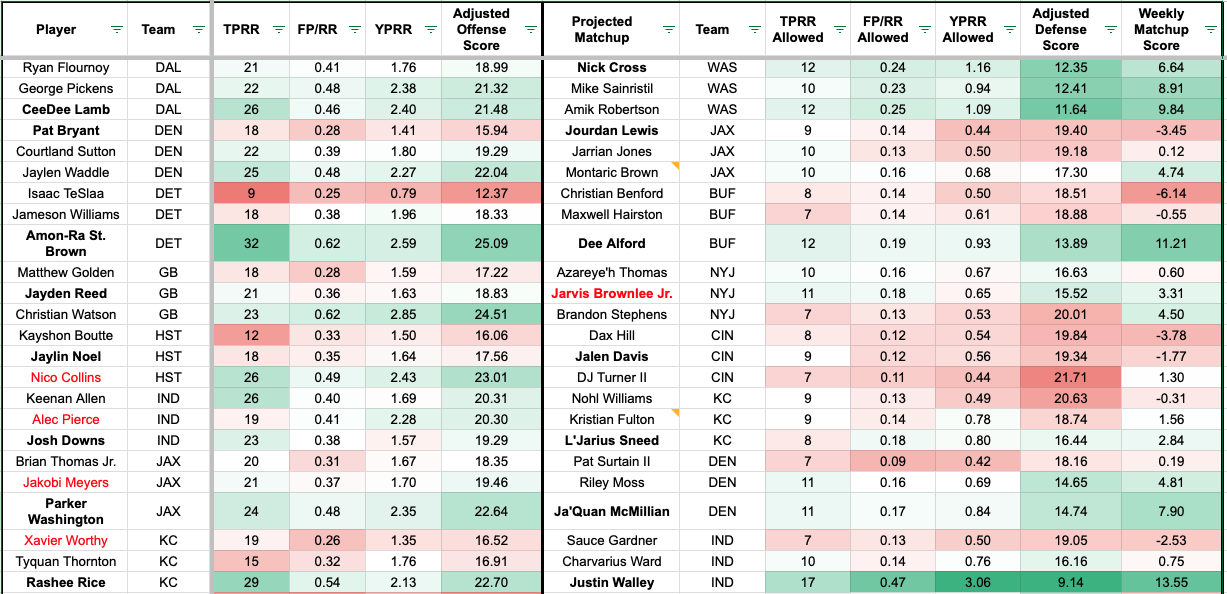
The visual below shows offenses from the Los Angeles Rams to the New York Giants.
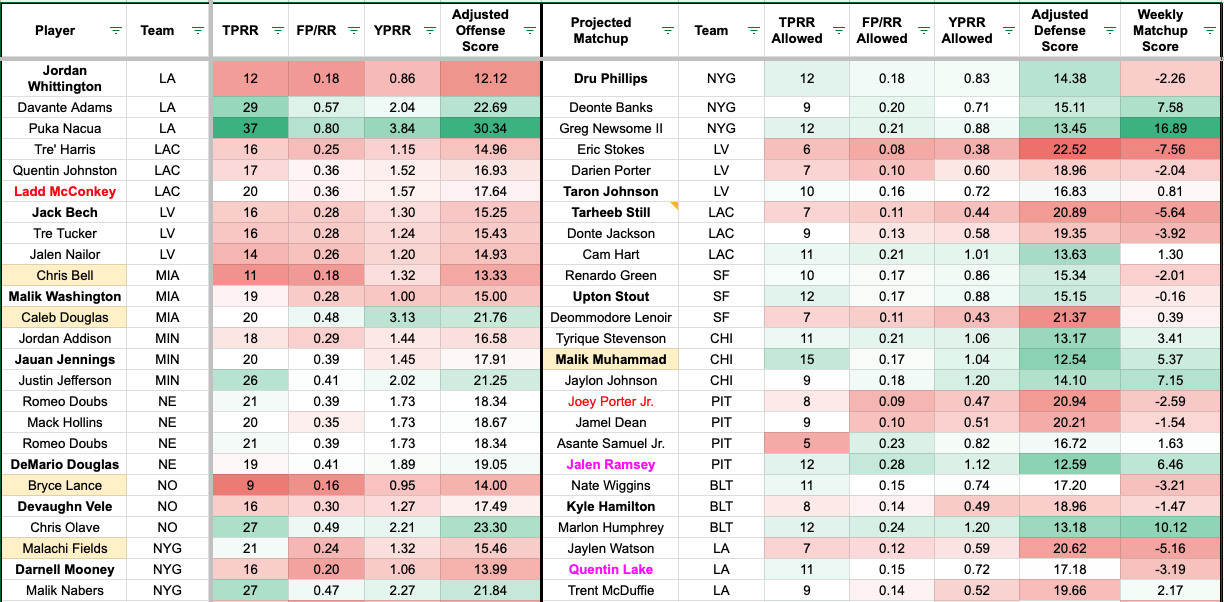
The visual below shows offenses from the New York Jets to the Washington Commanders.
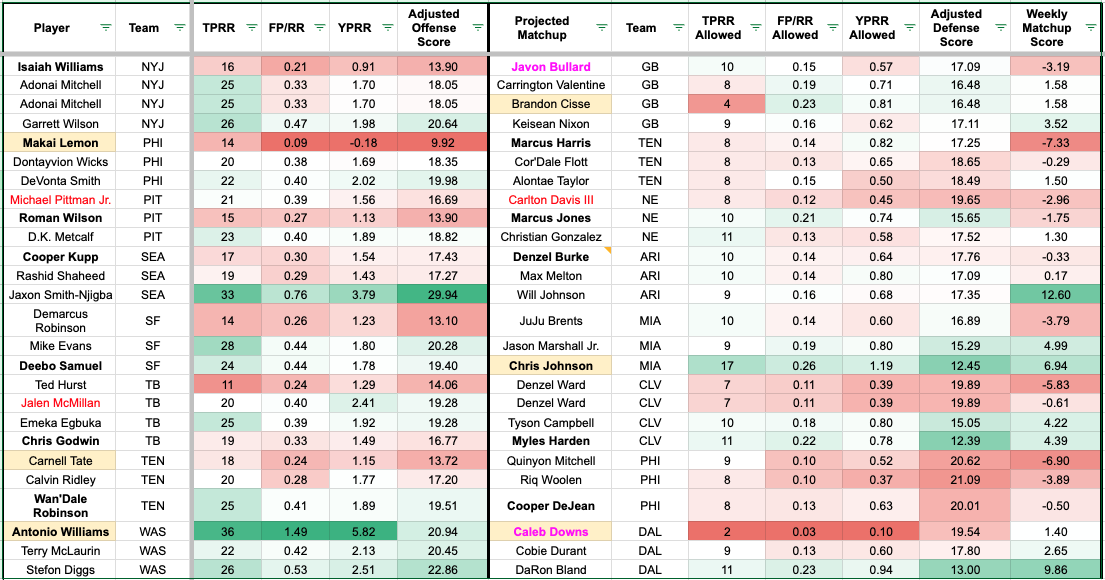
Best Projected Week 2 WR/CB Matchups
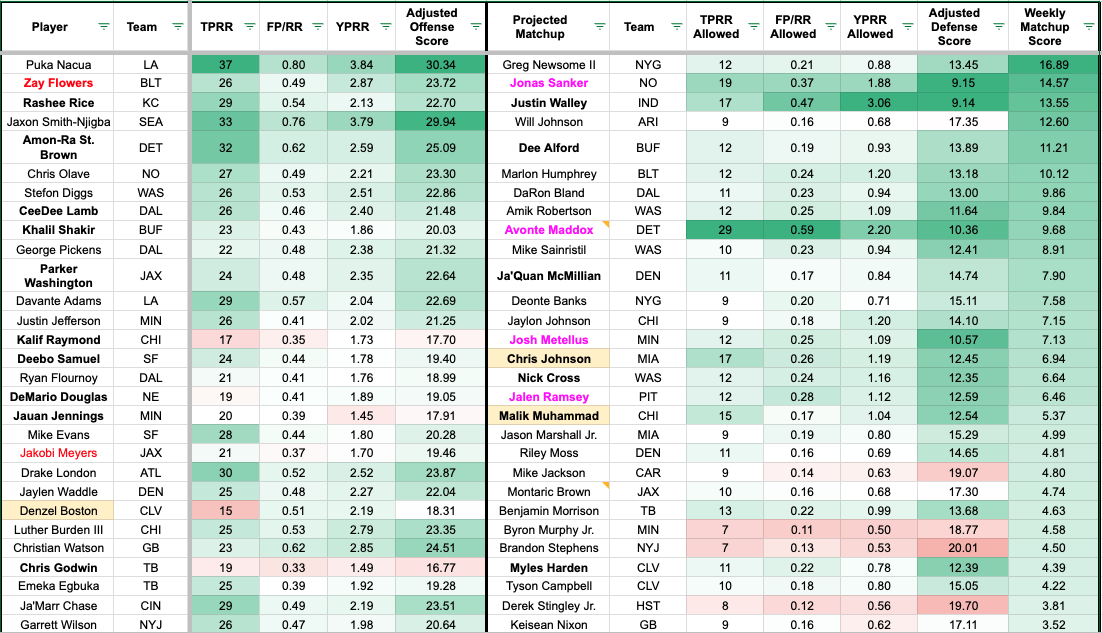
Worst Projected Week 2 WR/CB Matchups
Week 2 WR/CB Matchup Upgrades
Chris Olave vs. Marlon Humphrey
Olave was carving up the Lions defense in Week 1. He led the team with a 29.3% first-read target share and 3.57 yards per route run. Olave had 32.8 expected fantasy points per game, four points more than the actual output. Tyler Shough was targeting Olave downfield with a 50.1% air yard share in Week 1.
Olave had elite usage in Week 1 and last season, with the 5th-highest expected fantasy points per game. In Jesse Minter's first game as the Ravens head coach, they used two-high looks at the 4th-highest rate in Week 1. They deployed zone coverage 76.5% of the time (No. 18) and Cover 4 at the 7th-highest rate.
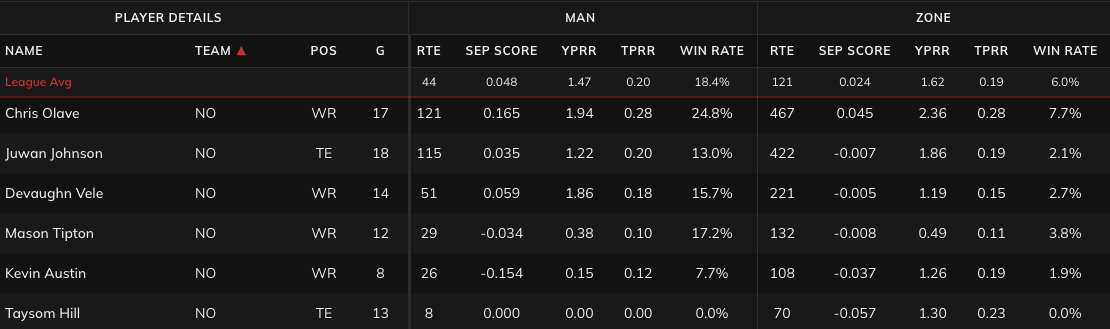
That's similar to how the Chargers defense operated under Minter. For context, the Ravens used two-high looks at the 31st-highest rate and Cover 4 at the No. 31 last season. Olave has been better against zone coverage (2.36) than man (1.94), though he can win versus both over the past two seasons, as seen in the visual below.
He projects to face Marlon Humphrey, who allowed a team-worst 0.24 fantasy points per route and 1.20 yards per route run among their primary defensive backs. Furthermore, Humphrey allowed 0.480 EPA per target over the past two seasons, which was a team low. Humphrey often allowed opposing receivers to be within a step in coverage.
That indicates Humphrey was within a step of separation at the catch point on 68.9% of his charted targets in coverage. Olave ranks in the 80th percentile in Average Separation Score over the past two seasons, suggesting it's a strength against Humphrey's weakness and a matchup to target.
The Saints have been pass-heavy, ranking 4th in pass rate in neutral game scripts. When talent aligns with a juicy matchup, it leads to spike weeks. Olave should have another one in Week 2.
Deebo Samuel Sr. vs. Chris Johnson
Samuel finished third on the team in route percentage in Week 1 at 44.4%, behind Mike Evans (63.9%) and Demarcus Robinson (52.8%). However, Samuel earned a target on 44% of his routes while generating 3.00 yards per route run on a low 2.57 aDOT.
The 49ers deployed Samuel out wide (43.8%) and in the slot (50%) in Week 1, which should continue as they'll need to funnel the passing offense through Evans, Samuel, George Kittle, and Christian McCaffrey. The Dolphins defense used single-high looks at the 3rd-highest rate and allowed the 7th-most fantasy points per dropback in Week 1.
That's significantly different from the Dolphins defense last season, ranking 26th in single-high coverages under Anthony Weaver as defensive coordinator. Interestingly, Dolphins Head Coach Jeff Hafley was the defensive coordinator with the Packers, who often used two-high looks (No. 10), so those trends might shift for the Dolphins defense.

The Dolphins have used zone coverage at the 16th-highest rate over the past two seasons, which might better represent their defensive tendencies over a larger sample. Samuel has a similar target rate against man (26%) and zone (24%) coverages. Interestingly, Samuel had a better yards-per-route run against man coverage (2.29) than zone (1.70) across the past two seasons.
Samuel projects to face rookie cornerback Chris Johnson, who was targeted 11 times and allowed two receiving scores in Week 1 against the Raiders. Johnson allowed a team-worst 2.21 fantasy points per target, among Dolphins defensive backs with over 10 coverage snaps. Expect Kyle Shanahan and the 49ers offense to target Johnson in the secondary in Week 2.
The game script could be a concern, since the 49ers project as 13.5-point favorites against the Dolphins. However, Samuel should be efficient in the 49ers offense, as a WR3 with touchdown upside.
Jordan Addison vs. Tyrique Stevenson
Like the Lions defense, the Bears look like one to target for opposing offenses. Though Addison didn't produce in Week 1, he was their downfield option, garnering a 14-yard aDOT across the past two seasons. This is more about the matchup and Addison's talent, though he plays alongside one of the league's best receivers, Justin Jefferson.
The Bears deployed man coverage at the 8th-highest rate and allowed the 12th-most fantasy points per dropback over the past two seasons. Addison garners a 16% target rate and 0.92 yards per route run against man coverage over the past two seasons. However, we could argue that J.J. McCarthy and Carson Wentz impacted Addison's production.
That's evident in Addison's 21.3% route win rate (65th percentile), 1.34 yards per route run (67th percentile), and a 0.131 Average Separation Score (87th percentile) against man coverage in 2024 with Sam Darnold as quarterback. Furthermore, the Bears defense loves using Cover 1 (No. 10) and Cover 2 (No. 3) in 2025 and Week 1 of 2026.
Addison leads the team in EPA per target (0.116), with a low 0.78 yards per route run and a 15% target rate against Cover 1 and Cover 2 in 2025 and Week 1 of 2026. He has significantly underperformed (0.15) his expected fantasy points per route run (0.22) against Cover 1 and 2, hinting at potential regression.
The visual below shows the team defenses sorted by the teams allowing the highest percentage of explosive pass rates in 2025 and Week 1 of 2026.
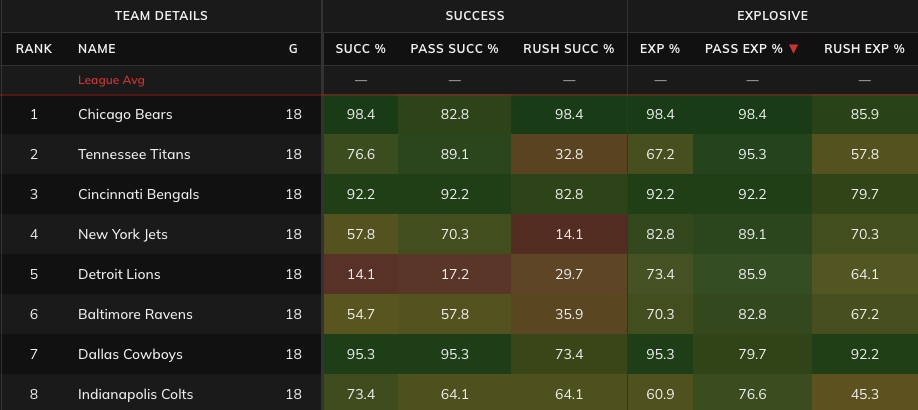
As the Vikings' downfield option, Addison should thrive against the Bears' defense. Over the past two seasons, the Bears allowed the highest percentage of passing explosive plays (12%). That means the Bears' defense led the league in the percentage of 20+ yard pass plays while allowing the 5th-highest passing success rate on 20+ yard passes.
Addison is a high-risk, high-reward option, with the potential for more passing as a 5.5-point underdog in Week 2.
Week 2 WR/CB Matchup Downgrades
Carnell Tate vs. Quinyon Mitchell
In Tate's rookie debut, he had an 18% target rate and 1.15 yards per route run. Tate garnered a team-high 31.6% first-read target share with 7.6 expected fantasy points per game in Week 1. Over the past two seasons, the Eagles ranked 13th in man coverage rate and allowed the 11th-lowest fantasy points per dropback.
As a prospect, Tate produced 3.12 yards per route run against man and 2.72 against zone coverage. In Week 1, Tate had a 13% target rate and 0.00 yards per route run against man coverage. Meanwhile, Tate had a 23% target rate and 1.73 yards per route run against zone coverage in Week 1.
Over the past two seasons, the Eagles allowed the 9th-fewest receiving fantasy points and the 3rd-lowest fantasy points per opportunity to outside receivers. That's where Tate lines up, as he projects to face Quinyon Mitchell. He blankets opposing receivers 44.6% of the time (95th percentile), meaning the coverage will be tight.
Furthermore, Mitchell allows a low 0.10 fantasy points per route run and 0.52 yards per route run. Vic Fangio will make it tough for Cam Ward, with Mitchell blanketing Tate, landing him on the WR/CB downgrade list.
Tre Tucker vs. Donte Jackson
Though Tucker was a sleeper in the Raiders offense, it looks much different without Brock Bowers. In Tucker's first game with Klint Kubiak, he had a 17% target rate, 1.00 yards per route run, and a 16.7% first-read target share. The Chargers deploy the 7th-highest rate of zone coverage and give up the 3rd-fewest fantasy points per dropback.
Tucker had a 15% target rate and 1.14 yards per route run against man. Meanwhile, Tucker had a similar target rate (17%) and yards per route run (1.34) against zone coverage. Specifically, the Chargers like using two-high looks (No. 2) while deploying Cover 3 and 4.
The visual below shows the Raiders' pass catchers (WR/TE) against two-high looks in 2025 and Week 1 of 2026.
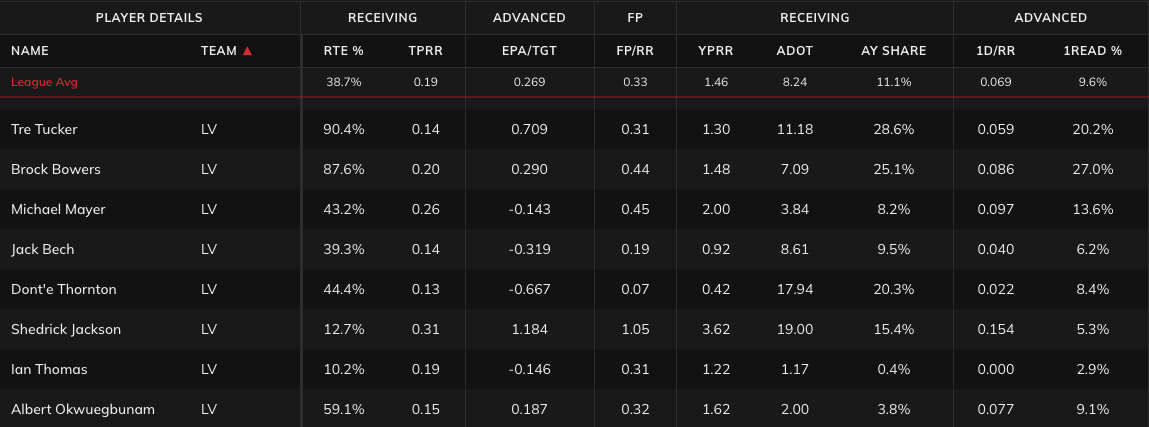
Given Tucker's 11.2 aDOT against two-high looks, he struggled with 1.30 yards per route run and a 14% target rate. That said, this matchup against the Chargers favors the tight ends. Bowers had a 20% target rate and 1.48 yards per route run against two-high looks. However, Michael Mayer led the team in target rate (26%) and yards per route run (2.00) among Raiders pass catchers with a route rate of 40% or higher against two-high coverages.
Tucker projects to face Donte Jackson, who allowed a -0.424 EPA per target (93rd percentile) and 1.48 fantasy per target (69th percentile). As a team, the Chargers allowed the 8th-lowest fantasy points per game and the 6th-lowest fantasy points per opportunity to opposing receivers.
Hopefully, fantasy managers aren't compelled to start Tucker in deeper leagues, because it looks like a tougher Week 2 matchup.
Michael Pittman Jr. vs. Carlton Davis III
In Pittman's first game as a Steeler, he had an 8% target rate and 1.42 yards per route run. For context, DK Metcalf (27%), Roman Wilson (25%), Pat Freiermuth (15%), and Darnell Washington (10%) had a target rate of 10% or higher in Week 1. That's significantly different usage for Pittman, given his 22% target rate, 23.8% first-read target share, and 1.57 yards per route run in 2025.
The Patriots often used man coverage (No. 12), though they allowed the 9th-most fantasy points per dropback over the past two seasons. Specifically, the Patriots deployed Cover 1 at the 7th-highest rate and single-high looks at the 14th-highest percentage.
Pittman had an 18% target rate and generated 1.17 yards per route run against man coverage. However, Pittman flashed a 0.099 Average Separation Score (77th percentile) and a 20.6% route win rate (97th percentile) against man coverage. For context, Pittman was slightly better against zone coverage, with a 21% target rate and 1.74 yards per route run.
In man-heavy coverage, this favors Roman Wilson (2.11) and Metcalf (1.49), though it doesn't inspire plenty of confidence in the Steelers' pass catchers. Pittman projects to Carlton Davis III, who blankets opposing receivers 35.7% of the time (89th percentile). Furthermore, Davis allowed 1.54 fantasy points per target, 0.12 fantasy points per route, and 0.45 yards per route.
Be cautious when starting Pittman in Week 2.
More Fantasy Football Analysis
Download Our Free News & Alerts Mobile App
Like what you see? Download our updated fantasy football app for iPhone and Android with 24x7 player news, injury alerts, rankings, starts/sits & more. All free!