




 RADIO
RADIO







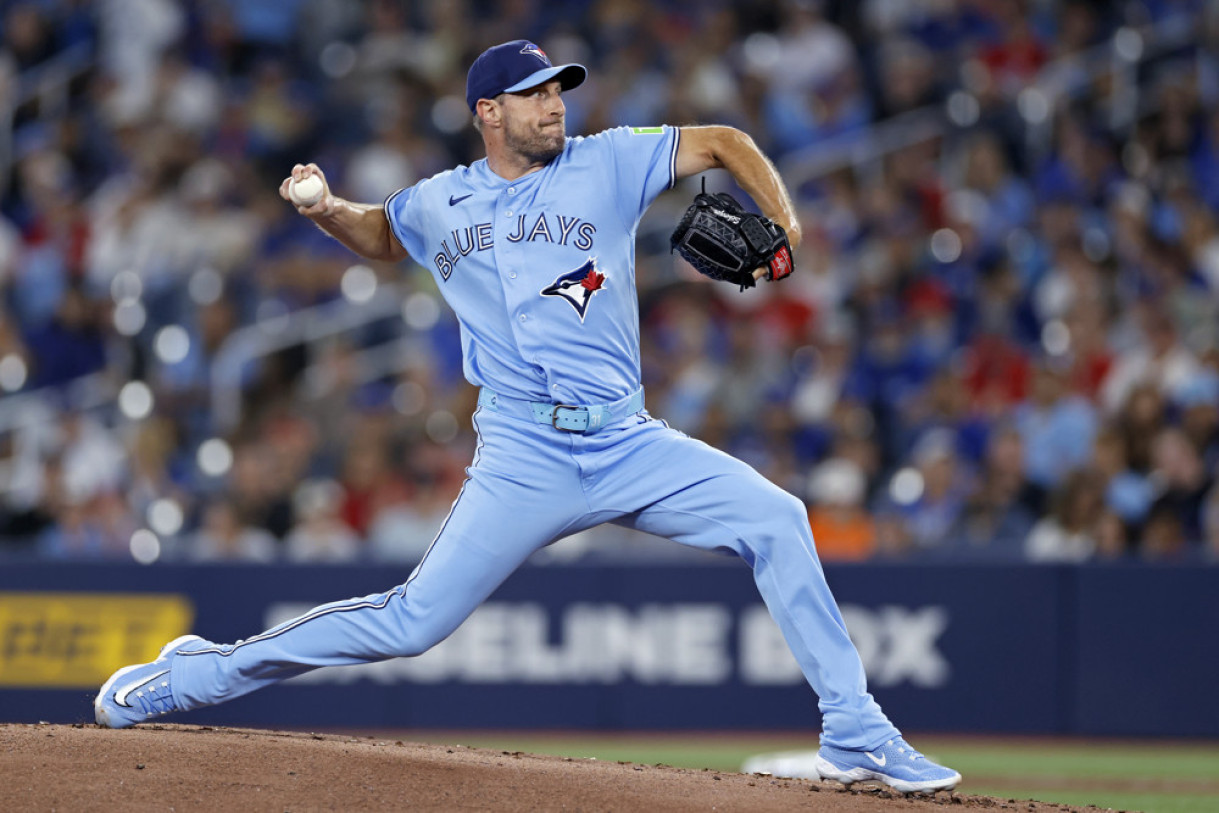
Elliott looks at pitchers with surprising starts recently. These SPs could emerge as fantasy baseball waiver wire targets for Week 23 in 2026, or just mirages.
Welcome to the "Are You For Real?" series as we dive into Week 23 of the 2026 fantasy baseball season. For those unfamiliar, this is a weekly column where we examine starting pitchers who had surprisingly strong starts over the past week and put them under the microscope to determine whether they're legitimate or just smoke and mirrors.
The final month is upon 0n, and the fantasy playoffs begin this week in many leagues. Even if you're still in the regular season, it's crunch time, and every start matters as we fight for championships. This week I'm breaking down a pair of southpaws in Patrick Sandoval and Jackson Kent, and I kick the tires on Max Scherzer to see if there's anything left in the tank.
Roster percentages are taken from Yahoo! and are accurate as of August 31.
Featured Promo: Save 50% off the regular price with discount code CHAMP, for a limited time. Exclusive access to our Team Sync platform, DFS cheat sheets, Lineup Optimizers, betting/prop picks, and exclusive content from Nick Mariano and Eric Cross! GAIN ACCESS NOW
Patrick Sandoval, Boston Red Sox – 7% Rostered
2026 Stats (prior to this start): 39.2 IP, 4.54 ERA, 4.09 FIP, 12.5% K-BB%
08/28 @ NYY: 5.1 IP, 3 H, 1 ER, 4 BB, 7 K
Sandoval had one of his best starts all season on Friday, holding the Yankees to just one run over 5.1 innings while striking out seven. He lower his ERA to 4.20 in the process, and appears to have a firm grip on a rotation spot in Boston; until Garrett Crochet returns, at least. Could Sandoval be a difference maker for us as we gear up for the fantasy playoffs, or is he best left on the wire?
Originally an 11th-round pick by Houston in 2015, Sandoval first cracked the big leagues in 2019 with the Angels. He had some success in Los Angeles as well, most notably his 2.91 ERA in 27 starts in 2022.
He underwent Tommy John surgery in 2024 and missed all of 2025 as a result, so it’s fair to say the 29-year-old southpaw is still getting his bearings back in the majors. Sandoval works with a six-pitch mix consisting of a slider, changeup, sinker, four-seam fastball, sweeper, and curveball.
Sandoval may have six pitches at his disposal, but his game is centered around four of them: the slider, changeup, sinker, and four-seamer. Sandoval throws each of those pitches over 20% of the time, while throwing both his sweeper and curveball under 5% of the time.
His most used pitch this season has been the slider at 24.7%. An 86.9 mph offering, Sandoval’s slider is characterized by high spin and heavy horizontal movement. Here’s an example of the pitch from this season.
— Elliott Baas (@ElliottBaasBB) August 31, 2026
It’s loopy with a lot of glove side action. Batters have actually handled the pitch well this season, hitting .341 with a .488 SLG and a .381 wOBA. The expected stats do suggest bad luck could be a factor in the results, as Sandoval has a .284 xBA, .451 xSLG, and .342 xwOBA. Those still aren’t great numbers, and Sandoval also has just a 27.2% whiff rate with this pitch, which is rather low for a slider.
Sandoval’s slider has lost some effectiveness since his return from Tommy John surgery, and it’s also lost movement. Let’s compare his pitch movement profile from his peak year in 2022 to this season (slider in yellow).
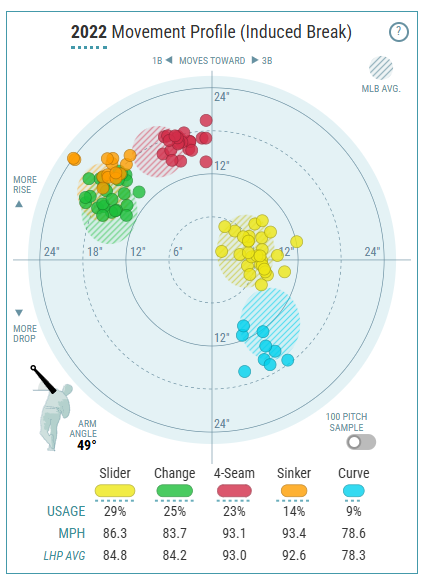
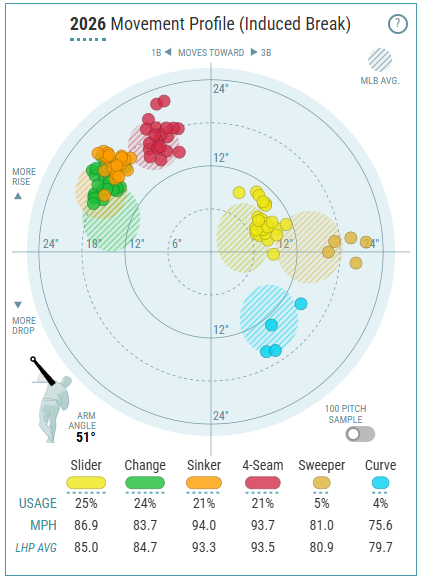
The slider shape has changed, and it hasn’t been as good of a pitch for Sandoval compared to pre-surgery. The slider wasn’t even a big part of this start against the Yankees, as Sandoval only got one of his seven whiffs with the pitch.
Sandoval’s next most used pitch has been the changeup, an 83.7 mph offering which he has thrown 24.5% of the time. The changeup has been far more effective than the slider, as batters are hitting just .160 with a .160 SLG and a .168 wOBA against Sandoval’s change. It’s been a dominant strikeout pitch too, as Sandoval has a 40.9% whiff rate and a 32.2% chase rate with it as well.
Sandoval’s changeup has lots of movement too. Let’s take another peek at that pitch movement profile (changeup in green).
And here’s an example of the pitch.
— Elliott Baas (@ElliottBaasBB) August 31, 2026
That late movement is tricky, and while Sandoval has lost some drop with the changeup as well, this pitch has still been effective and should help him generate whiffs, outs, and strikeouts, especially against right-handed batters.
The changeup helps Sandoval neutralize righties, but Sandoval has really struggled against left-handed batters this season. Lefties are hitting .375 with a .431 wOBA against Sandoval this season, which is a big deviation from his career norm, as prior to this season Sandoval has handled lefties better.
A big reason behind Sandoval’s struggles versus lefties is his sinker quality. A 94 mph offering, Sandoval’s sinker has been rocked for a .389 AVG, .611 SLG, and .485 wOBA. And if that wasn’t bad enough, he has a .402 xBA, .689 xSLG, and .511 xwOBA, suggesting he’s earned those poor outcomes.
A big problem for Sandoval with his sinker is the lack of groundballs. He only has a 37.9% groundball rate with the sinker this season, compared to a 31% line drive rate. He also has a 43.3% hard hit rate and a 13.3% barrel rate against, which are contributing to his struggles with the pitch.
He hasn’t been consistently hitting his spots with the pitch and has career high 61.7% zone rate. Here’s a heatmap comparison of his sinker usage in 2026 to his sinker usage prior to 2026.
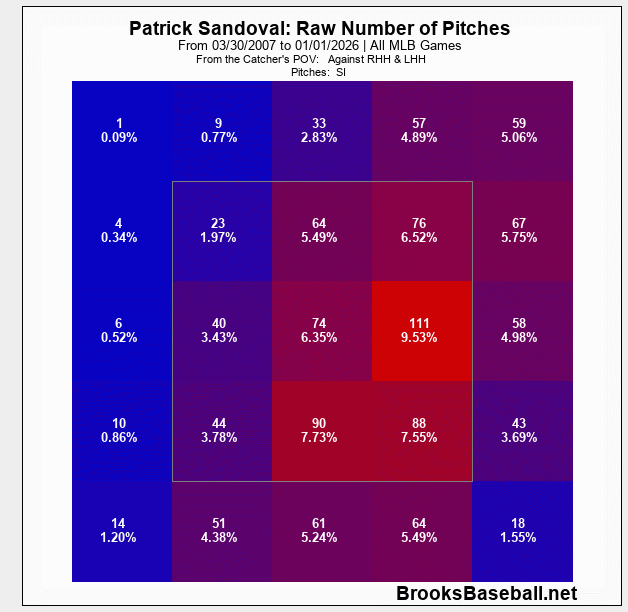
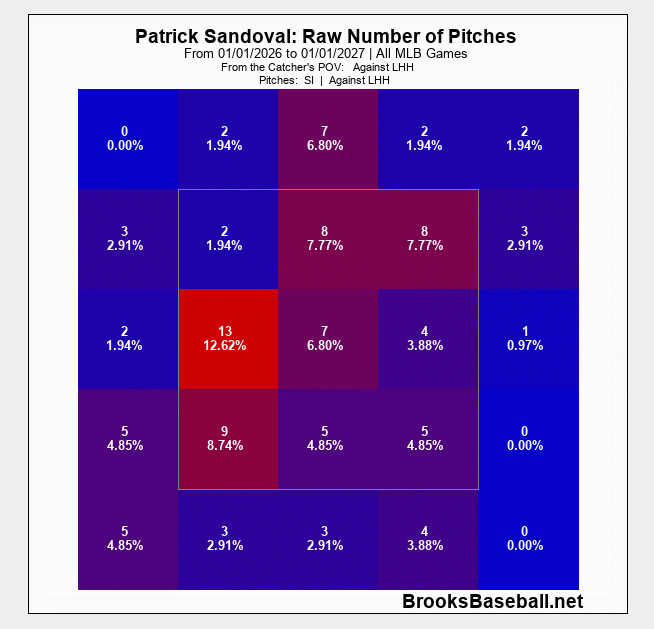
He’s throwing it most often to lefties, and he’s been focused mostly on throwing it down and away. Or trying to, at least. Overall, I think the sinker could be a liability for Sandoval this season. He may not perform quite this bad with the pitch going forward, but his expected stats align with the bad outcomes he’s gotten thus far.
Hand in hand with the sinker struggles for Sandoval are poor four-seam results. Batters are crushing Sandoval’s four-seamer for a .375 AVG, .675 SLG, and a .485 wOBA. The expected stats are a little better, but not pretty at a .304 xBA, .547 xSLG, and a .411 xwOBA.
Sandoval hasn’t lost velocity with his four-seamer as he’s still throwing 93.7 mph, but his four-seam shape has changed since returning from injury. He’s lost nearly an inch of induced vertical break, averaging just 15.8 inches this season. He’s also gained about three inches of horizontal glove side movement.
Sandoval’s four-seamer was never his strong suit, as he has below average velocity, movement, and spin with the pitch, and having such poor results against it is not a rare occurrence. Batters are hitting .334 against Sandoval’s four-seamer all time and 2021 was the only season where opponents hit under .300 off this pitch.
Sandoval’s four-seamer struggling isn’t a result of his Tommy John surgery, it’s just how this pitch has performed in the major leagues. The numbers might be a little inflated, but even if there’s regression the stats will probably still be ugly.
Overall, I think Sandoval may be too flawed at this moment to be a meaningful fantasy contributor. Command was never a strength, and he’s been unable to hit spots and has a 10.6% walk rate this season. Sandoval is likely to drive up your WHIP and maybe ERA too, plus he doesn’t pitch all that deep into games.
He’s only completed six innings once this season, meaning it’ll be tough for him to get wins and quality starts. I do think he could be good contributor for strikeouts, but I also think the bad outweighs the good and Sandoval is only worth using in deeper leagues.
Verdict:
Sandoval has been up and down since returning from Tommy John surgery. When he’s at his best it’ll look like it did Friday, with lots of strikeouts, but a short leash and inefficiencies. Walks will be a probably, as will his poor performing fastballs, both of which have been crushed for over a .375 AVG.
Sandoval won’t be reliable for wins, quality starts, ERA, or WHIP, and for that reason I think he has limited value as a streamer. He’s best used as a desperation streamer, since he could give you decent strikeouts in any given outing, but that's about all you can hope for.
Jackson Kent, Washington Nationals – 1% Rostered
2026 Stats (prior to this start): 12.1 IP, 8.03 ERA, 4.54 FIP, 4.9% K-BB%
08/28 vs. MIA: 7 IP, 3 H, 1 ER, 4 BB, 3 K
Kent had the best start of his young career on Friday, holding Miami to just one run over seven innings while picking up his first career victory. Kent was called up about three weeks ago by Washington to join their rotation, and Friday was Kent’s best showing by far. Could he make waves down the stretch?
Originally a fourth-round pick by Washington in 2024, Kent was the Nationals’ 9th ranked prospect by MLB pipeline, and most scouting reports peg him as a future mid- or back-end rotation starter. Kent works with a five-pitch mix consisting of a four-seam fastball, changeup, slider, curveball, and sinker.
Kent mixes in all of his pitches with some degree of regularity, throwing each pitch at least 12% of the time. His most used pitch has been the four-seam fastball, which Kent has thrown 35.2% of the time. A 93.1 mph offering, Kent’s four-seamer has been crushed by opponents for a .341 AVG, .423 SLG, and .422 wOBA. The expected stats align with the actual results too, as Kent has a .303 xBA, .457 xSLG, and a .414 xwOBA against his four-seamer.
Kent’s fastball is limited by his below average velocity, but it also suffers from a lack of movement. He averages 15.6 inches of induced vertical break and 5.8 inches of arm-side run, both of which are around league average for a four-seamer. Here’s a look at Kent’s pitch movement profile (four-seamer in red).
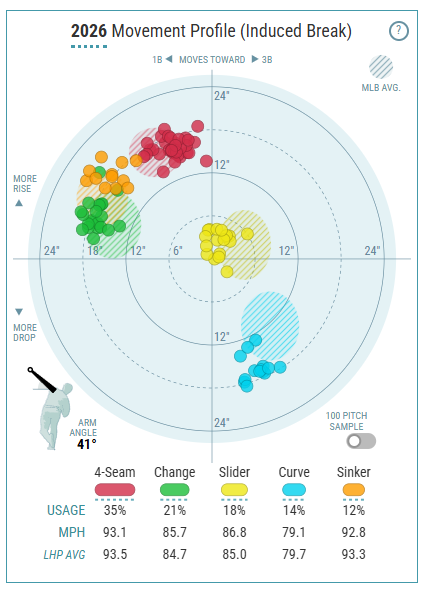
It’s got a little tail, but its league average rise makes the pitch easier to see and square up for opponents. There’s a reason why opposing batters have a blistering 91.5 mph average exit velocity and a 52.4% hard hit rate off Kent’s four-seamer thus far.
Kent’s four-seamer has been a liability, but Kent emphasized his other fastball, the sinker, in this outing. The sinker was his most used pitch against the Marlins, throwing it 34% of the time. The sinker has performed much better than the four-seamer, as batters have yet to secure a single hit off the sinker in the major leagues. Kent also has a 62.5% groundball rate and a 5-degree average launch angle against the sinker.
Kent’s sinker has 12.2 inches of rise, which is quite a bit for that type of pitch. He also averages 14.2 inches of arm-side run, giving the pitch late action that can be tough to make solid contact against. Here’s an example of the pitch from this start.
— Elliott Baas (@ElliottBaasBB) September 1, 2026
Kent only averages 92.8 mph with the sinker, but he gets seven feet of extension, raising the pitch’s perceived velocity. Kent is 6’3” with long arms and a smooth, classic delivery, giving him this exceptional extension.
It will be interesting to see whether Kent leans into the sinker more, seeing as he barely threw the pitch at all in the minors. The sinker has much stronger movement than the four-seamer, and I think the sinker could be the more effective pitch, though time will tell.
Another pitch Kent emphasized in this start was his curveball, throwing it 23% of the time compared to just 9.5% usage at Triple-A. A 79.1 mph offering, Kent’s curveball is soft and loopy, with 14.9 inches of drop and 5.8 inches of glove-side movement. Here’s an example of the pitch from this start.
The curveball has been quite effective too, with batters hitting .125 with a .125 SLG and a .111 wOBA off the pitch so far. The pitch was excellent in the minors too, as Kent had a .149 xBA, .170 xSLG, and a 139 xwOBA with the curve along with a 41.9% whiff rate before his promotion.
Kent wasn’t necessarily known for his curveball or his sinker as a prospect, but he begun emphasizing them in this start, and both pitches have strong movement and have induced favorable batted balls thus far.
Kent’s most noteworthy pitch as a prospect has been the changeup, which he has thrown 21.2% of the time since being called up. An 85.7 mph offering, Kent’s changeup is low spin with strong horizontal movement. He’s averaged an 1825 RPM spin rate along with 16.2 inches of arm-side movement with the change so far. Here’s an example of the pitch from this season.
— Elliott Baas (@ElliottBaasBB) August 31, 2026
Gnarly stuff, and Kent does have a 32.4% whiff rate with the changeup so far, his best of any pitch. Kent was a strikeout machine in the minors, putting up a 27.2% K rate at Triple-A prior to promotion.
I’m not sure if he can replicate that in the majors, but between the changeup and the curveball I could buy into a better strikeout rate for Kent going forward. He’s only had a 19.3% strikeout rate so far, but that could climb as Kent finds his bearings.
One major issue for Kent thus far has been walks, as Kent has an ugly 17% walk rate in four starts so far. He handed out four free passes in this start, and has issued at least three walks in each of his starts thus far.
His 42.2% zone rate is quite low and he only has a 30% chase rate, meaning batters just aren’t going after his stuff off the plate, and he’s either not confident enough or doesn’t have enough control to consistently throw strikes.
Control and command have never been Kent’s biggest strengths, but he was usually able to keep his walk rate between 7-8% in the minors. He needs to cut this 17% walk rate in half at least, if he has any hope of hanging onto a rotation spot.
His current walk rate is simply untenable for a major league starter, and if he doesn’t find a way to lower it he will take more lumps on the mound and might find himself back in Triple-A before the season ends.
Verdict:
Kent’s best start of the season came with a shift in pitch mix, as he relied more on his sinker and curveball in this start. Is that enough for Kent to break through and be a meaningful fantasy contributor this season? Probably not, as he’s showcased both poor control and a lack of strikeout upside in his four starts.
I think Kent has the potential to earn more whiffs, but he’s got to get his command figured out before that happens. As it stands, Kent is just walking too many people and has too thin of a track record to trust at this juncture. It's crunch time, and I wouldn’t be willing to trust a wild rookie like Kent in my lineup with the stakes so high.
Max Scherzer, Toronto Blue Jays – 9% Rostered
2026 Stats (prior to this start): 50 IP, 7.02 ERA, 6.32 FIP, 4.9% K-BB%
08/30 vs. SEA: 7 IP, 1 H, 0 ER, 1 BB, 10 K
We got a vintage performance from Mad Max on Sunday, as the 42-year-old righty mowed down the Mariners for seven innings of shutout ball, striking out 10. Scherzer has been pitching better as of late; he owns a 3.62 ERA over his last six starts along with a 1.05 WHIP and 12.2% K-BB%. Is this a sign that Scherzer is emerging from his funk to provide value down the stretch?
Originally a first round pick in the Bush years (2006), Scherzer needs little introduction. He’s a three-time Cy Young winner, eight-time All-Star, and future Hall of Famer. Things have taken a turn south for Mad Max in his 40s, as he has a 5.58 ERA and 5.25 FIP since the beginning of 2025. Scherzer works with a five-pitch mix consisting of a four-seam fastball, slider, changeup, curveball, and cutter.
Scherzer’s most used pitch this season has been the four-seam fastball at 46.6%. A 93.2 mph offering, Scherzer has lost some velocity from his 94.9 mph peak in 2019, but he hasn’t lost all that much velo considering he’s a baseball senior citizen.
Despite his overall struggles, Scherzer’s four-seamer has performed quite well relatively speaking. Batters have hit .220 off the pitch with a .354 SLG and a .328 wOBA. He also has a solid 16.3% whiff rate and got eight of his 17 whiffs with the heater in this start.
Scherzer’s fastball shape has changed as he’s aged, gaining a little bit of rise but losing quite a bit of horizontal movement. Here’s a comparison of his pitch movement profile from 2022 (his last elite year) and 2026.
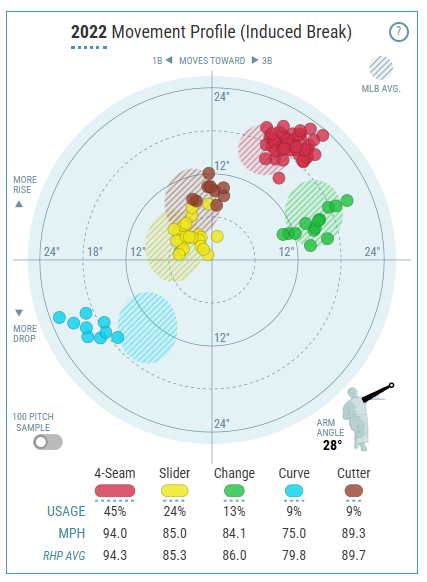
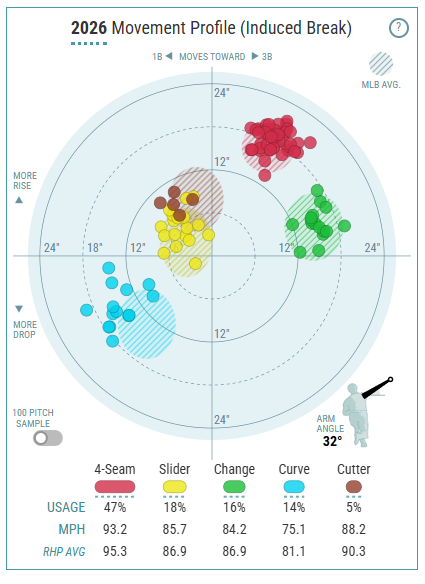
He’s clearly lost a few inches of tail, but the fastball has remained effective. I am skeptical that Scherzer can sustain the .227 BABIP against his four-seamer, and I know he can’t maintain the .132 BABIP against his four-seamer since August 1 when his hot streak began. Still, there is one shift Scherzer made with the pitch that’s worth pointing out. Let’s compare his four-seam heatmap from prior to August 1 and after August 1.
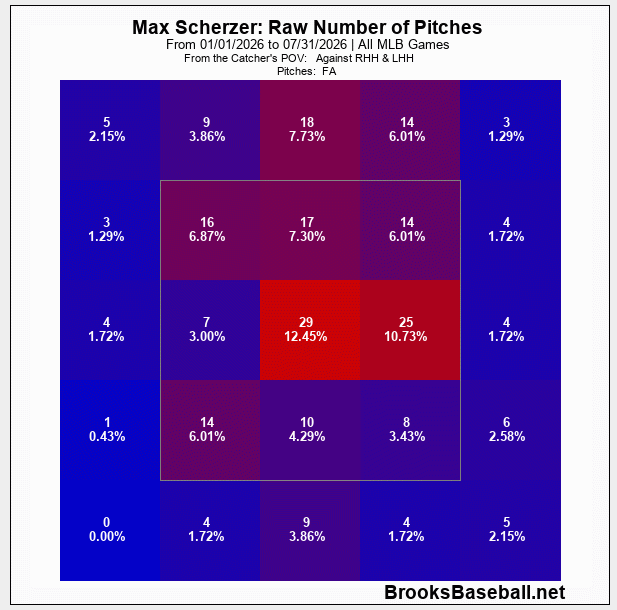
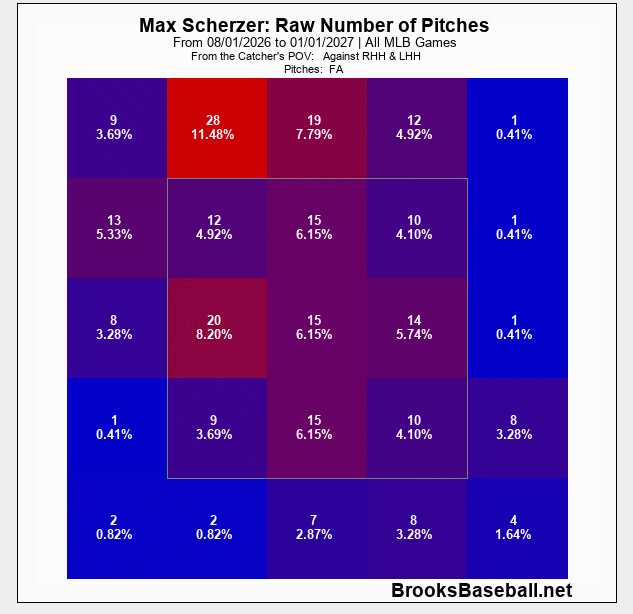
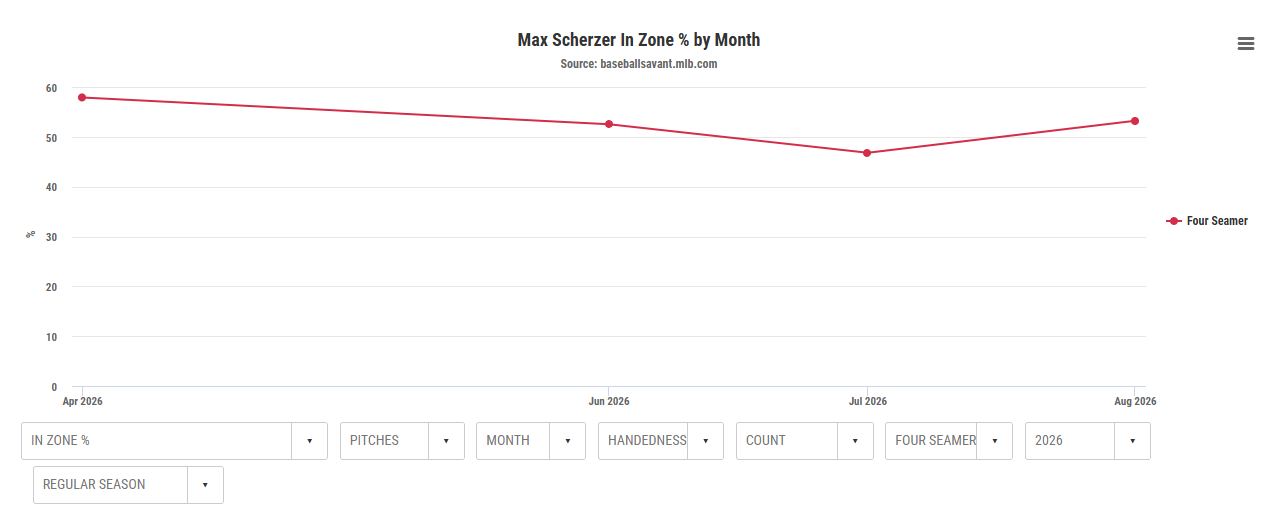
He’s made a more concentrated effort to throw the pitch up and out of the zone. Here’s a look at his four-seam zone rate by month.
And his four-seam in-zone swing rate by month.
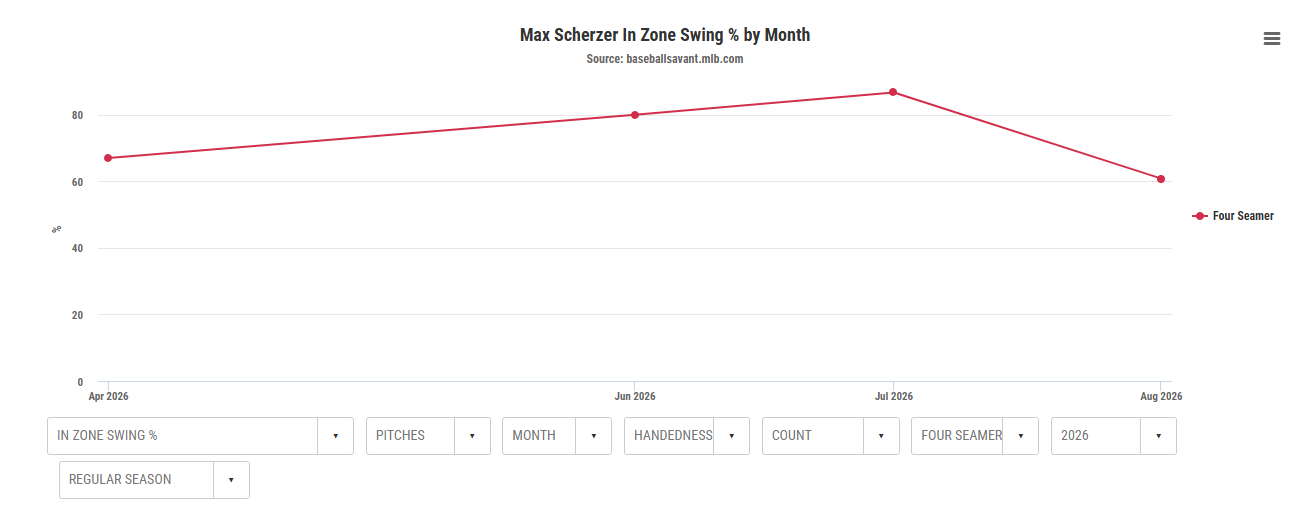
Both are going down, and I think Scherzer is learning how to get by with a diminished fastball. He can no longer go right at the hitters, and he still has the command to put it where he wants, so why not dance around the edges? I’m not saying this approach will give us the old Max Scherzer, but it may breathe new life into a player fighting against father time.
Scherzer’s next most pitch this season has been the slider, which he’s thrown 18.4% of the time. Scherzer’s slider was once one of the most feared pitches in baseball, but the pitch has lost effectiveness. Batters are hitting .271 off the slider, which is the highest batting average against this pitch in 17 years.
Opponents also have a .661 SLG and a .416 wOBA off Scherzer’s slider, and he has a paltry 24.5% whiff rate. Let’s compare Scherzer’s pitch movement profile from 2022 to 2026 again, this time focusing on the slider (in yellow).
It doesn’t have as much break, and even an inch or two lost of horizontal movement can turn a strikeout pitch into a meatball. He does have a 31.9% whiff rate and a .179 AVG against the pitch in August, so perhaps like the fastball there is something of a renaissance here.
That would be welcomed, as Scherzer’s whiff rate, chase rate, and zone rate are all well below his career marks this season, and the contact rate is the highest ever at 76.5%. Scherzer does have an improved 21.4% strikeout rate since August 1, and I think he could creep back towards league average with this approach.
One pitch that Scherzer has begun throwing more often recently is the cutter. He threw seven total cutters before August, but has a 9% cutter usage rate since August 1. He primarily throws it to left-handers, and batters have just a .125 AVG and .256 wOBA off the pitch all season, though they have a .500 SLG.
A hard, sharp cutter at 88.2 mph, Scherzer has a 22.6% whiff rate with the pitch, good for a cutter. Overall, I think Scherzer still has the capacity to perform better than his current 18.5% strikeout rate. Not only does he have more Ks in his recent outings, he’s also made changes to his approach, locations, and pitch mix.
Not everything is sunshine and rainbows for Scherzer, however. Home runs have remained a problem, as he has a brutal 1.89 HR/9 this season. He’s only had an 0.84 HR/9 since August 1, but his 6.7% HR/FB ratio during that stretch is not sustainable, and I’d expect him to regress back to over 10% like it has been for most of his career. He still has an elevated 9.2% BB rate during August as well, still quite high, especially for Scherzer.
He’s also been prone to blow up outings this season, having allowed five or more earned runs in four of his 13 starts. Even during this hot streak Scherzer got shelled for seven earned runs over four innings in Tampa Bay.
Even so, of the three pitchers covered in this week’s piece, I think Scherzer could have the most value in redraft. He can pitch deep into games, he plays for a (somewhat) competitive team, and I think he possesses a level—like we saw on Sunday—above what the other two are capable of.
Should you run out, blow your remaining FAAB, and stick Scherzer directly into your lineup? Probably not unless you’re in a deep league. Instead, I like Scherzer as a situational streamer. He’s best used against weak, righty-heavy lineups and in pitcher-friendly ballparks.
Verdict:
Scherzer was dominant on Sunday, an exclamation point to a strong August where he pitched to a 3.62 ERA. Scherzer has made changes to his fastball and slider approach, and has begun incorporating more cutters as of late. I think he’s better than his ugly 6.16 ERA and 1.39 WHIP suggest, and I think he’s gone from “don’t touch” to “situational streamer”. This final month may be Scherzer’s last ride, and I think there’s still a little gas left in the tank for Mad Max.
More Fantasy Baseball Advice
Download Our Free News & Alerts Mobile App
Like what you see? Download our updated fantasy baseball app for iPhone and Android with 24x7 player news, injury alerts, sleepers, prospects & more. All free!