



 RADIO
RADIO









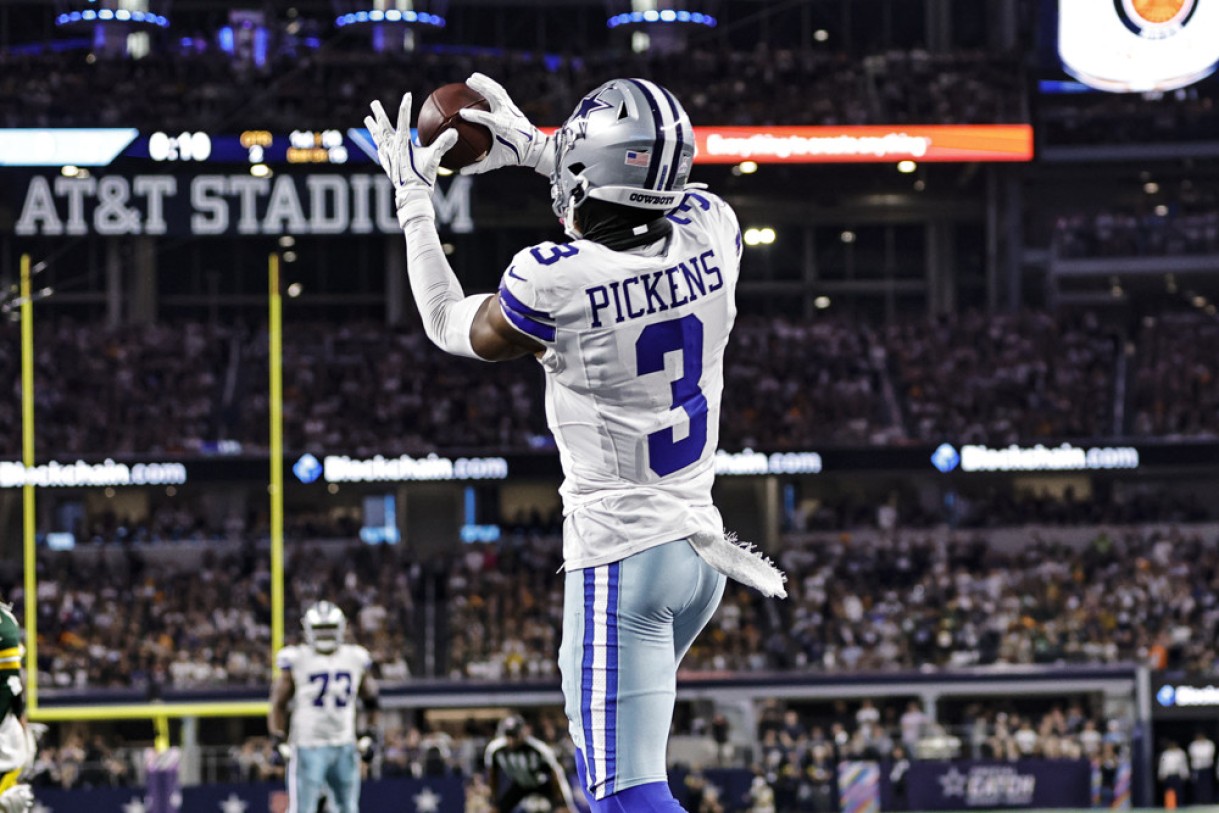
Matt Donnelly's overvalued players for 2026 fantasy football leagues. His fantasy football draft avoids and potential busts, including Travis Etienne Jr., George Pickens, and more.
With the 2026 NFL season just a couple of weeks away from kicking off, fantasy enthusiasts have been heading to their computers and getting as many drafts in as is humanly possible.
Remember, draft responsibly. Before you hit that draft button, be sure to weigh all the pros and cons of each selection. Not every draft pick is created equal. There are real dangers out there: players who are rotten apples, who carry far too much risk.
Here are five players being drafted far too high with a high likelihood of being busts when all is said and done.
Bookmark our updated and revamped fantasy football rankings portal for all league formats!PPR rankings | Half-PPR rankings | Non-PPR (Standard) rankings | Rookie rankings | Superflex rankings | Best Ball rankings | Underdog rankings | Dynasty rankings | IDP rankings | Injuries
Travis Etienne Jr.: The Numbers Say Buyer Beware
Last year, Travis Etienne Jr. finished RB13 in fantasy points per game. Etienne recorded 260 carries and 13 touchdowns — exactly the type of production that makes fantasy managers want to draft him. But let's look underneath the box score.
Among qualifying running backs, Etienne ranked:
- 37th in explosive run rate
- 31st in missed tackle rate
- 34th in yards after contact per attempt
Those aren't the numbers I want to see from a running back I'm drafting as an RB2 in the fourth round. Neither is the recent trend we’ve witnessed in his yards-per-carry metrics, as they’ve declined in each of the last three seasons, from 3.78 to 3.72 to 3.66.
Then there's the biggest issue: Alvin Kamara. Kamara is still in New Orleans. While he isn't the same player he was at his peak, he's still by far the better receiving back of the two.
That's important because if Kamara takes a significant portion of the passing-down work and red-zone opportunities, Etienne's workload suddenly becomes much less attractive. It's also worth noting that Kamara suffered a knee injury (MCL) on August 18th, but by all accounts, it was nothing serious.
That's also why Etienne's 13-touchdown season is dangerous to use as a projection for 2026.
A hat trick for Travis Etienne!
NYJvsJAX on CBS/Paramount+https://t.co/HkKw7uXVnt pic.twitter.com/bjm8wMhn8l
— NFL (@NFL) December 14, 2025
13 touchdowns are great, but can he repeat it? Six of those touchdowns came off of 36 receptions; that receiving volume won’t be there this season, and it certainly can not be counted upon.
For me, it comes down to price and what you are willing to pay. Considering Etienne is currently going around RB18, and some, including myself, view him closer to RB25, it’s hard to get behind. That's a meaningful difference.
I don't hate Etienne. I hate paying a fourth-round price for him. If his ADP drops into the lower-end RB2 range, I may become interested. But at his current cost? That’s a hard no.
Alec Pierce: Health Questions Too Big To Ignore
Last season, Alec Pierce finished WR23 in fantasy points per game. Producing 1,003 receiving yards and six touchdowns, Pierce accomplished that level of production despite a 17.4% target share. In reality, his 19.4-yard average depth of target tells you exactly what Pierce brings to the table. He's a field stretcher — a big-play threat who can change a fantasy matchup with one reception.
When that works, it works beautifully. Among 109 qualifying wide receivers last season, Pierce finished 12th in receiving yards per game and 16th in yards per route run. Those are pretty solid efficiency numbers, so why is Pierce poised to be a bust? Health.
Pierce's ankle is something I can’t look past. In March of this year, Pierce underwent surgery on that left ankle. This was after having a PRP injection on that same ankle in January. Fast forward to August, and Pierce has had an additional injection on that ankle. We're dealing with a player who has had a difficult recovery, and I don't think we should assume he'll walk into Week 1 at 100%.
For a player whose fantasy value is heavily tied to his explosiveness, that's a major concern. In all likelihood, Pierce could stumble out of the gate and not fully recover. If that wasn’t bad enough, it’s not just his health that’s a concern; we have Daniel Jones returning after a ruptured Achilles cut his 2025 season short.
Pierce relies on the deep ball to produce. If Jones’ mobility is limited in any fashion, those deep shots may not be there, so he may choose to dump the ball off to preserve his health rather than risk holding on too long to let something develop down the field. A quicker passing game favors short to intermediate targets, something we could have hoped for before the Colts signed Keenan Allen.
While more targets are available with Michael Pittman Jr. now in Pittsburgh, a large portion of those will likely be spread around to the likes of Allen, Tyler Warren, and Josh Downs, leaving Pierce once again relegated to the deep shot specialist.
For Pierce, the talent is there, the efficiency is there, and so too is the big red flag when it comes to that left ankle. This all raises questions about his ability to achieve the higher target share amid uncertainty surrounding his injury and his quarterback's recovery. Too much uncertainty, it’s another hard pass when it comes to Pierce.
The Curious Case of Breece Hall
According to ADP, Breece Hall had been coming off the board somewhere between pick 27 and 32, basically in the third round of fantasy drafts as the RB14. That was before that groin strain hit him, and now we are looking at a two-to-three-week recovery, putting Week 1 in jeopardy.
Groin injuries and calf strains aren’t to be messed with; for running backs of Hall’s skill set, we are looking at a high risk of re-injury or a limited workload (not a doctor).
After averaging 5.6 targets per game early in his career, Hall's target volume fell dramatically last season to just 3.0 targets per game. Hall finished with only 48 targets and 36 receptions in 16 games, which is a major concern in PPR leagues.
That's especially important because Hall's early-career fantasy profile was built around elite receiving volume. He previously posted back-to-back seasons with 200-plus carries and 75-plus targets. Those targets fell off a cliff in 2025.
When you're drafting Hall as an early-round running back, losing that receiving production creates a much lower fantasy floor.
Hall's overall fantasy production has also trended downward. Last season, he averaged just 11.9 fantasy points per game, a significant decline from the production we expected from him coming into the year.
Breece Hall goes 42 yards!
📺: #BUFvsNYJ on ESPN/ABC
📱: Stream on #NFLPlus pic.twitter.com/1WSizWkvzS— NFL (@NFL) October 15, 2024
We've also seen stretches where his explosiveness hasn't been quite as consistent, with fewer long runs and declining yards-per-touch and yards-per-carry numbers compared to the early promise he showed in his career.
The talent isn't really the question. The problem is a combination of average offensive-line play, an offensive scheme, and inconsistent big-play production. Hall can still make explosive plays, but we're no longer seeing them with the consistency that made him such an appealing fantasy asset early in his career.
Then there's Braelon Allen. Allen has consistently taken away goal-line and short-yardage opportunities, and that becomes an even bigger concern if Hall's workload continues to decline. The more first-team reps Allen gets, the more appealing a committee-type approach may become for Jets decision-makers.
If that continues, there's a real possibility this backfield becomes more than a temporary split. It could become a permanent committee, which is a major problem for Hall's touchdown upside. Even if Hall continues to dominate the overall workload, losing valuable goal-line touches to Allen could significantly limit his scoring potential.
Finally, we have to talk about the Jets offense. The Jets have historically struggled to find the end zone, and that creates a difficult environment for an early-round running back. New York has consistently ranked poorly in scoring and red-zone production, while negative game scripts often force the Jets into more passing situations.
Hall can still rack up yardage. He posted a career-high 1,065 rushing yards in 2025, along with his receiving production; however, yardage alone isn't enough to justify an early-round fantasy price.
If the Jets struggle to sustain drives and consistently create red-zone opportunities, Hall's touchdown ceiling becomes limited.
Yes, Geno Smith represents an upgrade at quarterback compared with some of the options the Jets have used recently, and the team has made additions along the offensive line and elsewhere on the roster. But I still have concerns about the overall offensive scheme and supporting cast.
If the Jets continue playing from behind, that could mean more passing and fewer opportunities for Hall to pile up rushing attempts. That's a dangerous combination for a running back you're expecting to produce as an early-round fantasy pick.
Jameson Williams: Boom-Bust Risk Is Too High
Jameson Williams is fast, explosive, and I completely understand the appeal. He's a big-play machine with an ADP of 58 and coming off the board as WR29. Last season, Williams ranked fifth in yards per target and fifth in yards per reception, while finishing eighth in the NFL in receiving yards with 1,117 yards on just 65 catches.
Those numbers are impressive. But don't let them fool you. Williams is one of the more boom-or-bust options in fantasy football.
Williams' production lives and dies on the big play. Despite running the fifth-most routes in the league, he ranked just 44th in target share and 72nd in target rate. Williams’s red-zone involvement was almost nonexistent.
Williams finished with just nine red-zone targets, which ranked 50th among receivers, along with a 10.2% red-zone target share, which ranked 77th. That's a problem. Williams can win you a fantasy matchup with one or two explosive plays; however, he can also disappear completely. That's the definition of a boom-or-bust player.
Over the course of a 17-game fantasy season, that's difficult to trust every single week. At his current ADP, you don't want to put yourself in that position.
Williams is never going to be a target hog. He’s not. In fact, he’s already competing for targets with Amon-Ra St. Brown, Jahmyr Gibbs, Sam LaPorta, and second-year receiver Issac TeSlaa. That's a lot of mouths to feed.
Williams can absolutely have huge games in this offense, but I don't see a realistic path for him to become a true target hog. That's what makes his current price uncomfortable. Investing a fourth-round pick in a player whose production is so heavily dependent on explosive plays feels too risky for me.
I am also very concerned with LaPorta. Many may forget just how good LaPorta was when healthy. When LaPorta was inactive last season, Williams averaged:
- 7 targets per game
- 79.4 receiving yards per game
- 15.1 fantasy points per game
When LaPorta was active?
- 4.8 targets per game
- 52.7 receiving yards per game
- 10.9 fantasy points per game
That's significant. Williams' production clearly benefited when LaPorta wasn't on the field. Bottom line, there are better options available in this range. We are looking at Christian Watson, Rome Odunze, and even Carnell Tate.
George Pickens Regression in 2026
George Pickens broke out massively in 2025, finishing as the WR5 with 137 targets, 93 receptions, 1,429 receiving yards, and nine touchdowns. After being traded to Dallas following three seasons in Pittsburgh, the move looked like a perfect match.
GEORGE PICKENS. WOW.
PHIvsDAL on FOX/FOX Onehttps://t.co/HkKw7uXVnt pic.twitter.com/ZcmA7vSMIH
— NFL (@NFL) November 24, 2025
Pickens thrives on exactly what Dak Prescott likes to do — push the ball down the field.
The numbers backed it up. Pickens ranked:
- Seventh in air yards
- Third in red-zone targets
- Fifth in fantasy points per game at 17.2
- 2.40 yards per route run
- Ninth in first downs per route run
So why am I fading him?
The biggest reason is CeeDee Lamb. When looking at the two, there isn’t much separating them in terms of their ADP. Pickens is coming off the board as WR9 and Lamb a few spots ahead of him. As good as the Cowboys offense is, it’s hard to envision two top-10 fantasy receivers if both were to remain healthy for all 17 games.
Pickens benefited significantly from Lamb missing three games and playing through a high-ankle sprain for much of the season. Lamb finished with just three touchdowns, a career low.
That's unlikely to happen again. Lamb enters 2026 fully healthy, motivated, and still the clear alpha in this Cowboys offense. That's a problem when you're drafting Pickens as a top-10 wide receiver.
Pickens ranked just 25th in target share, 30th in target rate, 93rd in designed target share, and 73rd in separation. There's another number that really stands out. Pickens finished fifth in fantasy points per game, but just ninth in expected fantasy points per game.
That tells me his 2025 production was ahead of what his underlying opportunity would normally suggest. Coming off career highs in both targets and touchdowns, it's going to be extremely difficult for Pickens to replicate that production with Lamb healthy.
That's before considering what you're paying for him. Pickens is being drafted as a top-10 wide receiver, ahead of or right around players like A.J. Brown, Rashee Rice, DeVonta Smith, and Chris Olave. Those players are the undisputed alphas in their respective offenses. They're not fighting for targets with another superstar receiver.
That's the difference for me.
More Fantasy Football Analysis
Download Our Free News & Alerts Mobile App
Like what you see? Download our updated fantasy football app for iPhone and Android with 24x7 player news, injury alerts, rankings, starts/sits & more. All free!