RADIO
RADIO






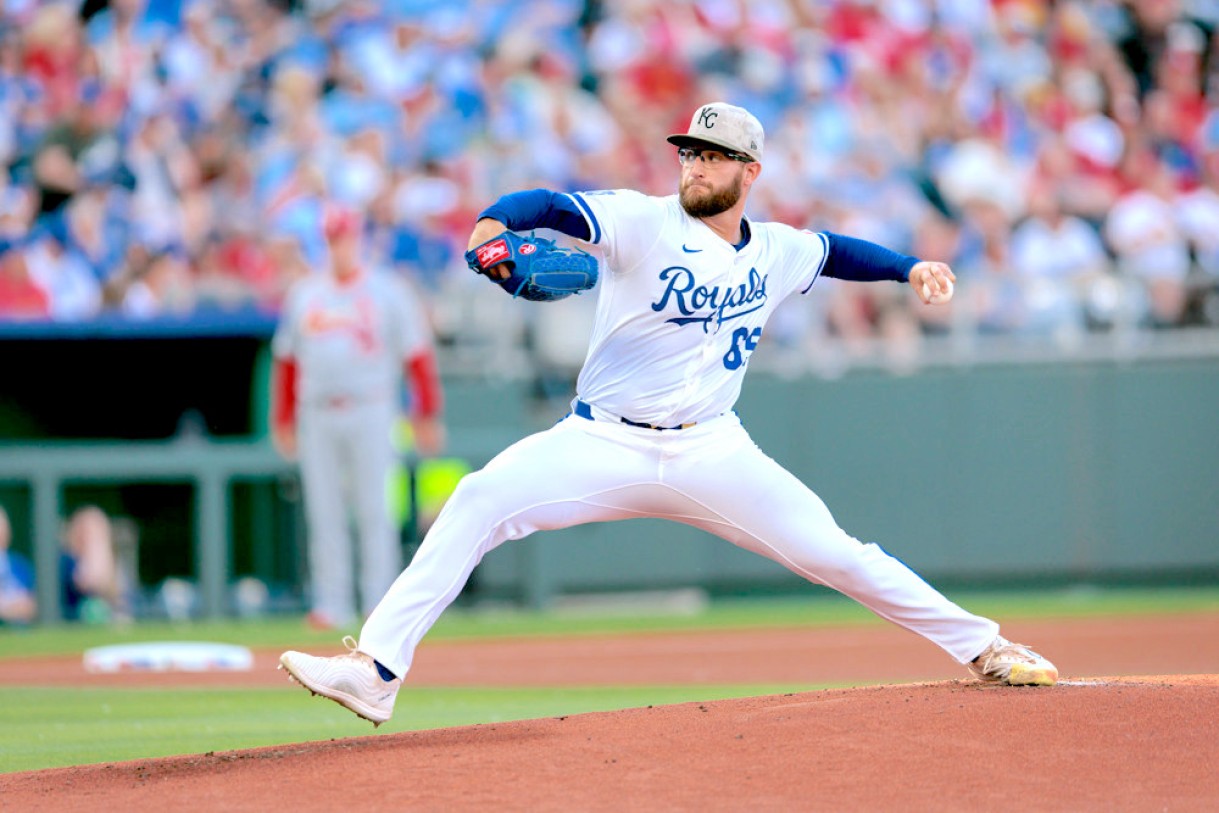
Thunder Dan's starting pitcher fantasy baseball busts, avoids, fades based on SIERA for 2026 drafts. These are SP overachievers who could see negative ERA regression.
It's that time again - time to dig into the advanced stats and see what we can find that will help us make the right decisions in our upcoming fantasy baseball drafts.
Every year, I like to analyze the SIERA of starter pitchers to identify those who likely overperformed in terms of their ERA. SIERA is my go-to ERA estimator. Some may prefer FIP, xFIP, or even xERA, and I am not opposed to using multiple estimators, as they all have different inputs.
The first year that I ever wrote this piece, I correctly identified Alek Manoah as a major regression candidate, and he hasn't been a good pitcher since. We got out in front of Tony Gonsolin's downfall the following season. The goal here is to avoid pitchers who may look appealing based on their surface stats but are ticking time bombs just waiting to implode.
Featured Promo: Save 50% off the regular price with discount code CHAMP, for a limited time. Exclusive access to our Team Sync platform, DFS cheat sheets, Lineup Optimizers, betting/prop picks, and exclusive content from Nick Mariano and Eric Cross! GAIN ACCESS NOW
Largest ERA Overachievers From Last Year
All starting pitchers (minimum of 50 IP) who had a SIERA at least 1.0 run higher than their ERA in 2025.
| Pitcher | IP | ERA | SIERA | Difference |
| Tyler Mahle | 86.2 | 2.18 | 4.62 | 2.44 |
| Luis Gil | 57 | 3.32 | 5.74 | 2.42 |
| Trevor Rogers | 109.2 | 1.81 | 3.75 | 1.94 |
| Randy Vasquez | 129 | 3.7 | 5.54 | 1.84 |
| Cade Horton | 114 | 2.53 | 4.33 | 1.8 |
| Kodai Senga | 113.1 | 3.02 | 4.52 | 1.5 |
| Nathan Eovaldi | 130 | 1.73 | 3.17 | 1.44 |
| Corbin Burnes | 64.1 | 2.66 | 4.05 | 1.39 |
| Noah Cameron | 138.1 | 2.99 | 4.33 | 1.34 |
| Andrew Abbott | 166.1 | 2.87 | 4.2 | 1.33 |
| Kris Bubic | 116.1 | 2.55 | 3.85 | 1.3 |
| Blake Snell | 61.1 | 2.35 | 3.64 | 1.29 |
| Gavin Williams | 167.2 | 3.06 | 4.35 | 1.29 |
| Martin Perez | 52.2 | 3.59 | 4.86 | 1.27 |
| Brayan Bello | 161.2 | 3.34 | 4.58 | 1.24 |
| Lucas Giolito | 145 | 3.41 | 4.65 | 1.24 |
| Adrian Houser | 125 | 3.31 | 4.46 | 1.15 |
| Drew Rasmussen | 150 | 2.76 | 3.9 | 1.14 |
| Paul Skenes | 187.2 | 1.97 | 3.1 | 1.13 |
| Pablo Lopez | 75.2 | 2.74 | 3.87 | 1.13 |
| Ryne Nelson | 128 | 3.16 | 4.26 | 1.1 |
| Jose Quintana | 131.2 | 3.96 | 5.04 | 1.08 |
| Clayton Kershaw | 111.2 | 3.39 | 4.46 | 1.07 |
| Clarke Schmidt | 78.2 | 3.32 | 4.37 | 1.05 |
| Joey Cantillo | 67 | 2.96 | 4.01 | 1.05 |
| Bailey Falter | 121.1 | 4.15 | 5.2 | 1.05 |
| Reese Olson | 68.2 | 3.15 | 4.15 | 1 |
Let's eliminate Clayton Kershaw, who retired, as well as Reese Olson and Pablo Lopez, who are both out for the year with arm surgeries.
Let's also remove those starters who finished with a SIERA under 4.00 (because we are less concerned about them), our list shrinks to 18 pitchers. Then I applied another filter to further shrink our group. The following six pitchers had a SIERA over 4.00, but an xERA under 4.00.
| Pitcher | IP | ERA | SIERA | Difference | xERA |
| Cade Horton | 114 | 2.53 | 4.33 | 1.8 | 3.91 |
| Kodai Senga | 113.1 | 3.02 | 4.52 | 1.5 | 3.96 |
| Corbin Burnes | 64.1 | 2.66 | 4.05 | 1.39 | 3.86 |
| Andrew Abbott | 166.1 | 2.87 | 4.2 | 1.33 | 3.55 |
| Clarke Schmidt | 78.2 | 3.32 | 4.37 | 1.05 | 3.02 |
| Joey Cantillo | 67 | 2.96 | 4.01 | 1.05 | 3.51 |
If you want to ding pitchers like Rogers, Bubic, or Snell a bit in your rankings, have at it. But I think they'll probably pitch well this year and don't really qualify as bust candidates for me.
By using xERA, we can differentiate these pitchers from the rest of the group based on their ability to suppress hard contact. SIERA and xERA are both very useful stats, as long as you know what they're measuring, and pitchers can have a big disparity between the two metrics. Clark Schmidt, for example, had a SIERA of 4.37 but an elite xERA of 3.02, suggesting that his 3.32 ERA really wasn't that inflated given the quality of contact he allowed.
I'm not actively looking to draft Horton, Senga, or Abbott, but I'm also not as worried about them as I am about some of the others. Burnes is out to start the year, as is Schmidt. Cantillo is actually an intriguing value pick, and with an xERA a full half run lower than his SIERA, he has some batted ball data working in his favor.
So here is who we are left with from the original group after applying our filters. I added the BABIP, strand rate (LOB%), and HR/FB here, as these are among the first places I look (I call them my "red flag stats") when trying to reconcile the big difference between ERA and SIERA.
As for those red flag stats, the five-year averages are as follows.
- BABIP (Batting Average on Balls in Play) - .295
- LOB% (Strand Rate) - 72.5%
- HR/FB (Percent of Fly Balls that become Home Runs) - 12.5%
| Pitcher | IP | ERA | SIERA | Difference | xERA | BABIP | LOB% | HR/FB |
| Tyler Mahle | 86.2 | 2.18 | 4.62 | 2.44 | 4.23 | 0.26 | 84.60% | 4.90% |
| Luis Gil | 57 | 3.32 | 5.74 | 2.42 | 4.94 | 0.256 | 78.40% | 6.30% |
| Randy Vásquez | 129 | 3.7 | 5.54 | 1.84 | 5.45 | 0.255 | 78.90% | 8.40% |
| Noah Cameron | 138.1 | 2.99 | 4.33 | 1.34 | 4.08 | 0.241 | 84.00% | 12.40% |
| Gavin Williams | 167.2 | 3.06 | 4.35 | 1.29 | 4.29 | 0.254 | 83.80% | 14.40% |
| Martín Pérez | 52.2 | 3.59 | 4.86 | 1.27 | 5.38 | 0.214 | 73.10% | 8.20% |
| Brayan Bello | 161.2 | 3.34 | 4.58 | 1.24 | 4.56 | 0.274 | 75.30% | 9.80% |
| Lucas Giolito | 145 | 3.41 | 4.65 | 1.24 | 5.01 | 0.273 | 76.70% | 9.30% |
| Adrian Houser | 125 | 3.31 | 4.46 | 1.15 | 4.04 | 0.303 | 77.30% | 8.10% |
| Ryne Nelson | 128 | 3.16 | 4.26 | 1.1 | 4 | 0.249 | 76.70% | 9.90% |
| Jose Quintana | 131.2 | 3.96 | 5.04 | 1.08 | 5.19 | 0.259 | 73.40% | 11.20% |
| Bailey Falter | 121.1 | 4.15 | 5.2 | 1.05 | 4.89 | 0.245 | 71.50% | 11.70% |
There are certainly plenty of names from this list we can ignore for fantasy, but there are some interesting names worth discussing here, too. Let's break down some of these potential draft targets. Who are we targeting or avoiding?
Potential Draft Targets: Are We Fading?
Gavin Williams, Cleveland Guardians
(NFBC ADP: 148)
I think I spent more time analyzing Williams 2025 data than any other pitcher that I'll discuss in this piece. I think it has to do with conflicting data from Williams and a pretty big split in his results between the first and second halves of the season. Williams posted just a 9% K-BB% and 1.40 WHIP in the first half, but then a very respectable 18% K-BB% and 1.05 WHIP after the All-Star break.
Is he truly ready to be the ace of this staff in Cleveland after failing to meet expectations up to this point in his career? He clearly has a ton of potential, with a high velocity fastball and multiple plus breaking pitches. But the command has been a real issue, as those walks really hurt our WHIP. But it's not just the walks, it's the fact that he's far too inconsistent with his fastball location, too.
His Location+ on the four-seamer last year was just 95, ranking in the bottom third of all starters.
It's a bit of a red flag when a pitcher's worst pitch is their fastball, and that's pretty much the case here with Williams. I am working on another article in which I ranked the best (and worst) fastballs thrown by starting pitchers last season, and Williams ended up with a 0.47 rating, meaning he fell just below average (.50) compared to about 200 other MLB starters.
That's not the end of the world, but also not what we want to see from a high-end starter.
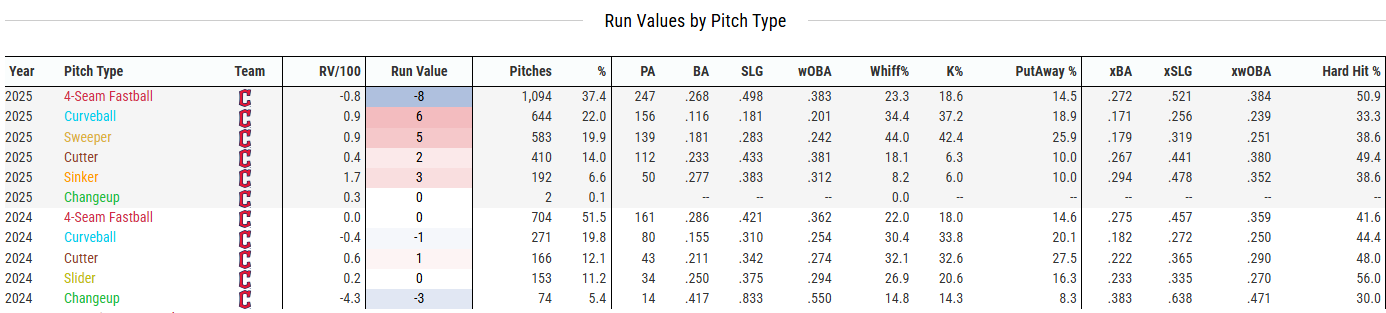
This Baseball Savant data helps emphasize how bad the fastball was in terms of its run value and batted ball data. An xSLG of .521 and a hard-hit rate of 50.9% is concerning, even if his offspeed stuff was really good.
I want to believe in his late-season improvement, but it looks like he started throwing his sinker and slider far more often, de-emphasizing the fastball. While throwing your worst pitch less often is generally a good idea, it's probably not a sustainable strategy either.
Williams' BABIP and LOB% both suggest some potential ERA regression, too. As I said earlier, it's a mixed bag of results here, and it's always tough with younger pitchers who are still coming into their own. But we are now 63 starts into Williams' career, so the sample size isn't all that small either.
Final Verdict: There's definitely some strikeout upside to like here from Williams, but plenty of risk, too, as there's a distinct possibility that he's more of a 4.00 ERA pitcher than a 3.00 ERA pitcher. The walks are rough on the WHIP, and the fastball has to be better, even if he's dropping the usage. I think I am OUT on him at his current ADP because he's far from a polished starter at this point, and you can take some risks on pitchers with similar upside much later in the draft.
Ryne Nelson, Arizona Diamondbacks
(NFBC ADP: 261)
I wish we could merge Ryne Nelson and Williams into one pitcher. Nelson features a very effective heater with 19.2 inches of iVB, so while he tops out around 96 mph, the pitch plays up to hitters. Nelson's fastball is a lot like Ryan Pepiot's in that way, as he also has an over-the-top release point, and he can live up in the zone without having to throw 98 like Paul Skenes or Tarik Skubal.
However, Nelson lacks great secondary pitches. He throws a cutter, a slider, and a curveball; however, the shape and velocity of his cutter and slider are too similar. His curveball also has below-average vertical movement, which is somewhat odd coming from a high arm slot.
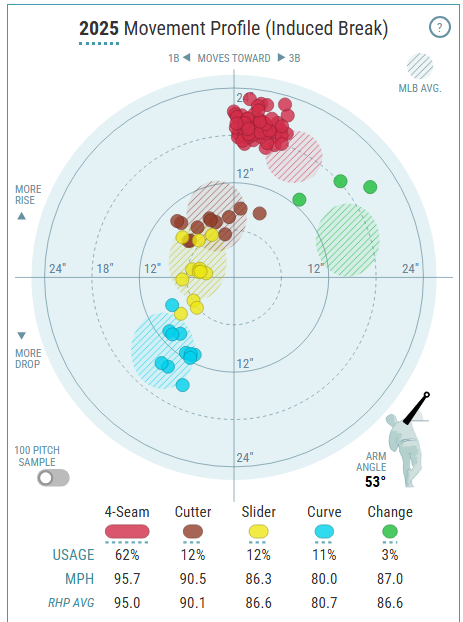
The cutter got hit hard (.502 xSLG), while the slider posted just a 33% Whiff% (which is fine, but consider we're usually looking for 35% or better on sliders). No single pitch had a Putaway% above 20%, which helps explain the relatively low overall K% for Nelson (20.5%).
Nelson relied on the fastball a bit too much for my liking, even if he was getting good results with it. He had a 19% whiff rate on it last season, which was 1.5% below the league average, so he's relying a lot on inducing weak contact with it. I am fairly sure his .249 BABIP is sustainable, either, which is likely what helped to prop him up last year.
I think he will eat some innings and stands a fairly decent chance of posting decent ratios, but I don't see much strikeout upside. There's more room for negative regression here than improvement based on his profile.
Final Verdict: Nelson is a much more reasonable pick here in this ADP range, but I have some concerns with his lack of strikeouts and fastball-heavy pitch mix. He lacks a true "out pitch" in his secondary offerings, which will likely prevent him from evolving into a high-end starter in this league.
Anything can happen with pitchers and new pitches or changes in approach, but from what we've seen with Nelson in his career, this is pretty much who he is at this point. He's a low-risk, low-reward option when he's being drafted.
Noah Cameron, Kansas City Royals
(NFBC ADP: 262)
Cameron and Nelson are being drafted in the same range right now, much later than Williams. But does either offer the type of upside we are looking for?
I always try to look for both the good and the bad with these profiles before drawing any conclusions, and Cameron's 2025 rookie campaign certainly had plenty of both.
Let's start with the good! Cameron made 24 starts for Kansas City and averaged 5.75 innings per start while winning nine decisions and finishing with a 2.99 ERA. He showed very good control (7.7% BB%) and posted a decent SwStr% of 11.5%. His 1.10 WHIP was a boon to ratios, and he held opposing hitters to a .214 batting average.
Now here's the bad, and unfortunately, (if you are a Cameron fan), there are more of those data points.
Cameron's walk rate outperformed his Ball% of 37.4%. His pedestrian strikeout rate of 20.5% was significantly lower than what we had seen from him in the minor leagues. His .241 BABIP is one of the lowest in our group of overachievers in the chart, and it's 50 points below the league average. And his 84% strand rate is far too high for a guy who doesn't get strikeouts.
He absolutely got lucky on batted balls, and in stranding runners last season, there's no way around it.
I do like that he has a balanced arsenal of pitches, throwing no pitch more than 26% of the time. However, he has a very weak fastball, so he had to rely a lot on his cutter and breaking pitches. That would be fine if he had some really dynamic breaking balls, but that's not really the case.
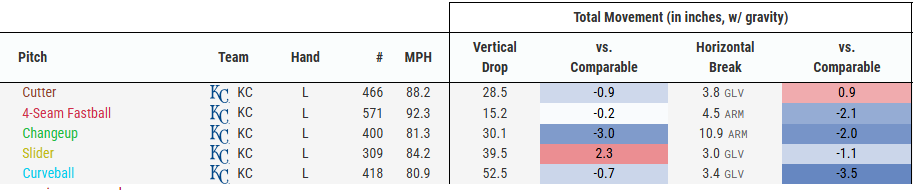
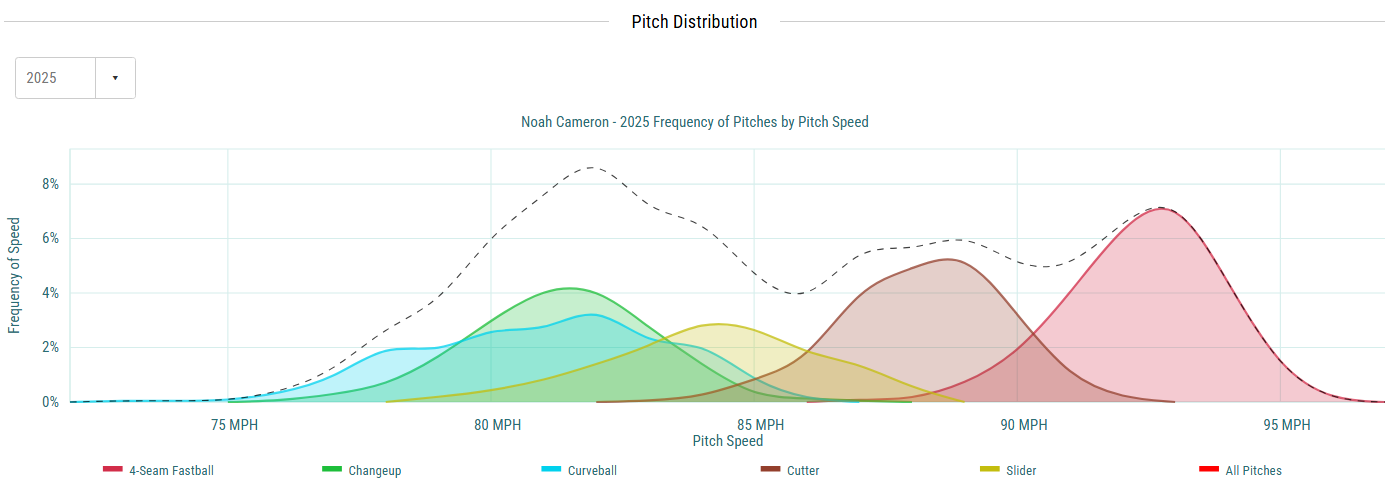
Despite the below-average movement, his changeup did elicit a 20% SwStr%, but the curveball and slider don't miss bats nearly as often. Since he tops out around 92 mph on his four-seamer, there's only around a 10-11 mph difference in his fastest and slowest pitches. I think the more exposure MLB hitters have to Cameron, the more they'll be able to sit back and wait on his offspeed stuff, as he doesn't have the velocity to keep them honest with his heater.
When it comes to left-handers, they seem to have a better chance of outperforming their underlying numbers. We hear the term "crafty lefty" thrown around, implying that left-handers with average or slightly below-average stuff can still be effective if they can sequence their pitches, hit their spots, and stay out of the middle of the strike zone.
Cameron may qualify for that designation, and could be immune to the regression that we've called for in the past from guys like Andrew Abbott, who has a super-similar profile.
I almost forgot to mention that Kansas City also moved its fences in this offseason, creating a more neutral, less pitcher-friendly home venue for Cameron and the rest of the Royals' hurlers.
Final Verdict: Cameron can be a promising young pitcher AND at the same time be someone whom I am avoiding in drafts because his stats point towards a more likely outcome of regression than sustainability. He could continue to outperform his underlying stats, but it's not a risk I am willing to take.
I don't think he's a total bust, but it wouldn't surprise me at all if his ratios were both worse in 2026 than they were last season. Let someone else buy into the hype of his surface stats.
Later-Round Fades
- Brayan Bello, Boston Red Sox (NFBC ADP: 312)
- Tyler Mahle, San Francisco Giants (NFBC ADP: 353)
- Luis Gil, New York Yankees (NFBC ADP: 359)
These pitchers won't get such a dedicated analysis, but I have no interest in taking a shot on them this year, even this late in drafts.
Bello isn't a terrible pitcher; he'll eat some innings, but he saw his K% drop to just 17% last season (9.2% SwStr%) and is far too reliant on groundballs as a sinker-heavy pitcher. He's still getting hit very hard by lefties, too.
There's some talk of a new curveball in the works for this year, but we are already in year five for Bello, and I am not sure one new pitch (if it's even effective) is going to vault him up into the next tier of pitchers. Of the guys on this list, he had the most sustainable red flag stats and a decent xERA. There are just others in this range with far more upside (new article coming soon!)
Mahle gets a fresh start out in San Francisco, but his profile is littered with red flags. The BABIP, LOB%, and HR/FB (4.9%) all scream major regression, and we even saw it happen in real time when he gave up eight runs on 15 hits in his last two starts in June before missing most of the season with an injury.
I know the Giants have a reputation for fixing middle-aged pitchers, but Mahle overperformed in Texas in a major way, and I'm simply not betting on him to get that lucky again this year.
And finally, we have Luis Gil, who has a chance to open the season in the rotation for the Yankees, while Carlos Rodon, Schmidt, and Gerrit Cole are out. But we saw more of the same control issues from Gil last year as his BB% ballooned to 13.5%. Meanwhile, his strikeouts disappeared as he whiffed just 17% of hitters - nearly 10% fewer than he did in the two years prior.
He has an uninspiring three-pitch arsenal of fastball-slider-changeup, with only the slider having good batted ball results (but also a below-average 31% whiff rate). Gil's xERA was 4.94, so it wasn't just the lack of strikeouts (and all the walks) that were the issue. He got hit hard. I don't think he's a very good pitcher and is likely a placeholder, at best.
I hope this analysis helps you avoid some landmines this season, and make sure you stop back for my next piece on starting pitchers, which will likely be just around the corner!
More Fantasy Baseball Advice
Download Our Free News & Alerts Mobile App
Like what you see? Download our updated fantasy baseball app for iPhone and Android with 24x7 player news, injury alerts, sleepers, prospects & more. All free!