




 RADIO
RADIO









Eric Samulski continues evaluating starting pitchers who have developed new pitches for 2021 to determine if these additions to their pitch mix will increase fantasy baseball value and make them breakout performers.
Throughout all Spring Training, we hear about pitching adding new pitches, or making major changes to their pitch usage. We even get to see those new pitches in action and dream about their potential impact. However, when the regular season starts, those changes can be abandoned and pitchers go back to what they do/know best. So it's important to continue to track these new pitch or pitch mix developments into the regular season to see what is here to stay and what is just a passing fad.
So far, I have covered some of those potential changes over the course of four articles already. Check them out here: Part 1, Part 2, Part 3, and Part 4.
As with the other versions, the working premise of this article is simply that a pitcher throwing a pitch more isn't always a good thing. If it's similar to a pitch the pitcher already throws or is used to target the same area of the plate then it doesn't always add anything to the arsenal and may even take away from the effectiveness of a pitch he already throws. So instead of blindly celebrating that some pitchers are throwing a certain pitch more, we need to look at whether or not it makes the pitcher any more effective. From there I tried to give you a simple verdict as to whether we should care about this new development or not.
Featured Promo: Save 50% off the regular price with discount code CHAMP, for a limited time. Exclusive access to our Team Sync platform, DFS cheat sheets, Lineup Optimizers, betting/prop picks, and exclusive content from Nick Mariano and Eric Cross! GAIN ACCESS NOW
Joe Musgrove, San Diego Padres
Cutter
There have been few pitchers that have been as impressive in the early part of the season as Joe Musgrove. Through 26 innings, he's compiled a 1.04 ERA, 0.54 WHIP, .124 batting average against, and 36.6% K-BB ratio. Since K-BB% is one of the earliest metrics to stabilize, it's one of my favorites to look at early in the season to see if results are valid, and Musgrove's most certainly seem to be.
A big key for Musgrove has been the increased reliance on his cutter and, to a lesser extent, his slider. Musgrove threw his cutter only 6.4% of the time in 2020 and 8.4% in 2019 but is already up to 24.8% in 2021. It's his second most used pitch behind the slider, which he is now throwing 27% of the time. This is a strong change for him and continues a trend we've seen of him relying less on his four-seam, which was his most-used pitch in 2020 and was a pitch he actually threw almost 38% of the time in 2019.
The cutter itself has been solid for Musgrove this year, with a 13.2% swinging-strike rate (SwStr) and 38.5% CSW, to go along with a 3.22 deserved ERA (dERA). The cutter also pairs well with the slider since it has 10 inches more vertical drop than the four-seam fastball. The fact that the cutter has more overlap in movement with the slider means that it takes batters longer to figure out what pitch they are seeing. This has made Musgrove's slider even more dynamic, registering a ridiculous 34.3% SwStr and 53.5% CSW. It's a filthy pitch and the fact that Musgrove's reliance on the cutter makes it even stronger is a clear reason to get excited.
However, as the video below explains, there are some minor reasons for caution.
In addition to Musgrove's reliance on the cutter potentially being linked to his facing an exceedingly high number of lefties so far, the pitch itself is also over-performing. It currently registers a .318 expected batting average (xBA) and .526 expected slugging (xSLG). It has also allowed a 12.5% barrel rate (8.2% deserved barrel rate) and 13.3% deserved hard-hit rate. While e don't want to rely too much on x-stats and it's clearly still a solid pitch, I would expect it to get hit a bit harder as Musgrove sees better competition, since he has had one of the easiest schedules of any starter to open the season, as mentioned in the video.
VERDICT:
Meaningful impact. I love Musgrove using the cutter as a primary fastball offering instead of the four-seam, so I hope that this continues. Even if the pitch regresses a little, it will likely still make the slider better, which means Musgrove can remain a solid strikeout pitcher. Keep an eye on his usage as he begins to face more righties, but this could be a good indicator of Musgrove gaining more consistency.
Dane Dunning, Texas Rangers
Sinker
After battling injuries during his minor league career, Dane Dunning enjoyed a solid rookie campaign with the White Sox last year, pitching to a 3.97 ERA and 1.12 WHIP with a 4.33 SIERA and 24.6 strikeout rate. In the offseason, Dunning was traded to the Texas Rangers, and he has come out this year with a clear pitch mix change, upping his sinker usage from 39.4% last year to 65.3% this year.
Dunning also completely dropped his four-seam fastball and is now essentially a two-pitch pitcher with a sinker and slider combo making up 84.7% of his pitch mix. I took a look at how that has been working for him in the video below:
Dunning is never going to be a big swing-and-miss guy. He has a 10.2% SwStr rate so far this season and a 29.2% CSW, both of which are below league average. His slider has a 23.8% SwStr and can absolutely miss bats by itself, but I'd like to see him incorporate the changeup more. Now that he is more reliant on the sinker, I believe the changeup can be more effective because of the way it approaches the hitter on a similar trajectory to the sinker.

You can see in the Observed Movement image on the right that the hitter observes the sinker and changeup from similar points on the clock; yet, the changeup has less deviation. Dunning is throwing the changeup slower this year, which I think will create more separation with the sinker and could give him a third pitch to rely on more and potentially earn more whiffs when hitters are expecting the sinker.
Even though Dunning isn't going to consistently miss bats, he can still be a useful fantasy starter. He is inducing 47.5% groundballs and pitches in a good pitcher's park, which means his chances of getting blown up are relatively low (even though we saw it happen on Friday).
VERDICT:
Moderately impactful. The sinker is a strong pitch for Dunning and one that I think will help him to remain effective in the zone. I think it will, over the long haul, reduce Dunning's strikeout upside, but it turn him into a more consistent ratio-helper for your fantasy staff.
David Peterson, New York Mets
Sinker
With the injuries to Noah Syndergaard and Carlos Carrasco, David Peterson has found himself in the Mets rotation but the results have been a mixed bag. On one hand, he has a 6.75 ERA and 1.35 WHIP across 13.1 innings in three starts. On the other hand, he has a 2.68 xFIP and 2.96 SIERA, with a 12.3% SwStr and 33.6% CSW. So what do we make of that?
For one, Peterson has made a drastic pitch change this year.

Peterson has very clearly ditched his four-seam fastball for a sinker. The change is interesting on the surface. Since a sinker and a slider would move in opposite directions, using those two pitches as his main offerings would conceivably lead to more deception and allow Peterson to attack both inside and outside corners against righties and lefties. He can then also sprinkle in the changeup as a solid third offering.
But here is where we run into an issue. As I explain in the video below, Peterson doesn't really use his sinker on both sides of the plate. He also doesn't throw the sinker up in the zone, which means he doesn't really attack that part of the strike zone:
Since Peterson's sinker doesn't have a lot of movement, it doesn't really break in an opposite direction from the slider. It was also a far worse pitch for him in 2020 than the four-seamer. The four-seam registered a .164 batting average against and .213 xBA, while the sinker had a .368 batting average against and .425 xBA. They both had almost identical SwStr and CSW rates, which means there is no real indicator that the sinker is a better pitch for Peterson.
If you also look at spin direction, they both pair equally well with the slider and changeup:

A key difference is that the sinker has more deviation, thanks to 16.7 inches of horizontal movement away from a right-handed hitter. Meanwhile, he gets 10.9 inches of movement, which is above league-average, towards right-handed hitters on the four-seamer. He also uses the four-seamer almost exclusively up in the zone. To me, that means the four-seamer doesn't need to be abandoned in favor of the sinker as it is potentially a better pitch and also fills a need for Peterson up in the strike zone.
VERDICT:
Potentially negatively impactful. Even though Peterson's swing-and-miss rates have improved this year, I'm not actually sure he's pitching better. His slider is a really good pitch, so I understand the desire to use the sinker more as a partner for it. However, I think Peterson should close the gap between the sinker and four-seam, which would allow him to attack more areas of the plate while still featuring his slider. In short, don't give up on Peterson yet. He's been pitching better than his numbers, and I think there is still more room for growth.
Griffin Canning, Los Angeles Angels
Slider
In his two professional seasons, Canning has flashed intriguing potential while also showcasing a lack of consistent health. This season, there was some hesitation on buying into Canning due to those health concerns and the Angels stating that they would be using a six-man rotation. The 24-year-old has also gotten off to a slow start with a 5.68 ERA and a below-average 28.6% CSW.
However, I see some signs of optimism for Canning. For starters, his 15.8% SwStr rate is impressive and shows that his CSW numbers are impacted by his called strike rates. Secondly, Canning's predictive metrics (3.41 SIERA, 3.64 xFIP) actually show that he has been pitching better than the results.
Another major reason that I have some confidence in Canning going forward is the growing reliance on his slider, which has been one of his best pitches.
| 2020 Slider | 2021 Slider | |
| Batting Average | 0.185 | 0.231 |
| xBA | 0.145 | 0.228 |
| Slugging | 0.296 | 0.462 |
| xSLG | 0.248 | 0.429 |
| SwStr | 12.30% | 25.30% |
| CSW | 30.30% | 38.50% |
The fastball-slider pairing is a good one for Canning, and an important consequence is that the uptick in slider usage has meant less cutter usage as Canning has only thrown two all year. Since the cutter wasn't a good pitch for Canning, it's a little bit of addition by subtraction. By focusing primarily on fastball-slider-change, Canning is able to attack all areas of the strike zone

Given Canning's proven swing-and-miss ability on the slider and removal of a poor pitch, I think this can be the foundation of a strong arsenal for him.
VERDICT:
Moderately impactful. Canning is another arm we shouldn't give up on yet. While he hasn't been great to start the season, I think a lot of it has to do with a small sample size and poor HR/FB luck. The increased use of the slider is a strong choice, and I think it has the potential to pay off in the long run. If you have deeper benches or are in a deep league, I would throw Canning on your bench and watch to see if he can sort things out.
Danny Duffy, Kansas City Royals
Four-Seam and Slider
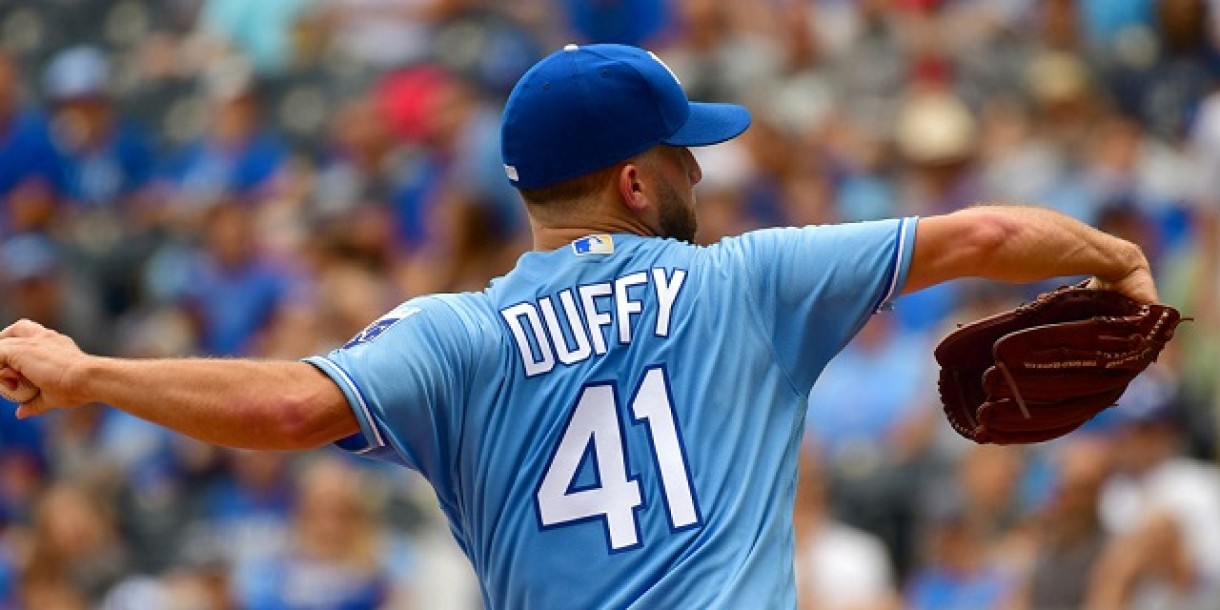
Veteran Danny Duffy is off to a strong start to 2021, notching a 0.50 ERA, 1.11 WHIP, and 26% strikeout rate over 18 innings. The two most noticeable changes for Duffy, which we can see thanks to Mike Kurland's awesome pitch mix chart, is a velocity bump as well as an increase in four-seam and slider usage.

We'll talk about the velocity later, but Duffy's increase in four-seam and slider usage is of interest to me. The slider has been Duffy's best swing-and-miss pitch over his career, with a 15% SwStr over his career. Over the years, the fastball has recorded a lower barrel rate than his slider and has recorded a batting average over .250 only twice since 2013.
However, Duffy gradually lessened his fastball use from 2013 to 2017, dropping it from 63.6% use to 24.7% use. He has slowly been increasing the usage since then and has had only one season where his fastball was not a good pitch for him. It so happens that that came in the only season where Duffy's fastball velocity dipped below 93 MPH on average. This year, Duffy's velocity is up to 93.8 MPH, which would be the highest velocity he's registered since 2016. In the video below, I looked at why that could be impactful.
Duffy has a history of success with higher velocity, so his results this year, shouldn't be written off too quickly. Using his two best pitches more is a good thing; however, the swinging strike rate on his slider this year is 17.9% with a 29.9% CSW. Those are improvements from his career rates, but only marginal ones. Obviously, improvements are good, but we need to understand that this isn't a brand new Danny Duffy; it's just a good version of Danny Duffy.
VERDICT:
Minimally impactful. The pitch mix change isn't what's fueling Duffy's success. I also think the only reason we're seeing a rise in four-seam usage is that he has the velocity going for him now, but we may see the usage drop if the velocity begins to drop. However, as long as he is throwing 94 mph, Duffy should be a useful fantasy pitcher. He's still below league-average CSW rates, so don't expect big strikeout numbers or dominant outings, but he'll be useful for you and could put up strong outings in the right matchups. When/if the velocity starts to go, be ready to find another option.
Download Our Free News & Alerts Mobile App
Like what you see? Download our updated fantasy baseball app for iPhone and Android with 24x7 player news, injury alerts, sleepers, prospects & more. All free!

More Fantasy Baseball Advice