




 RADIO
RADIO










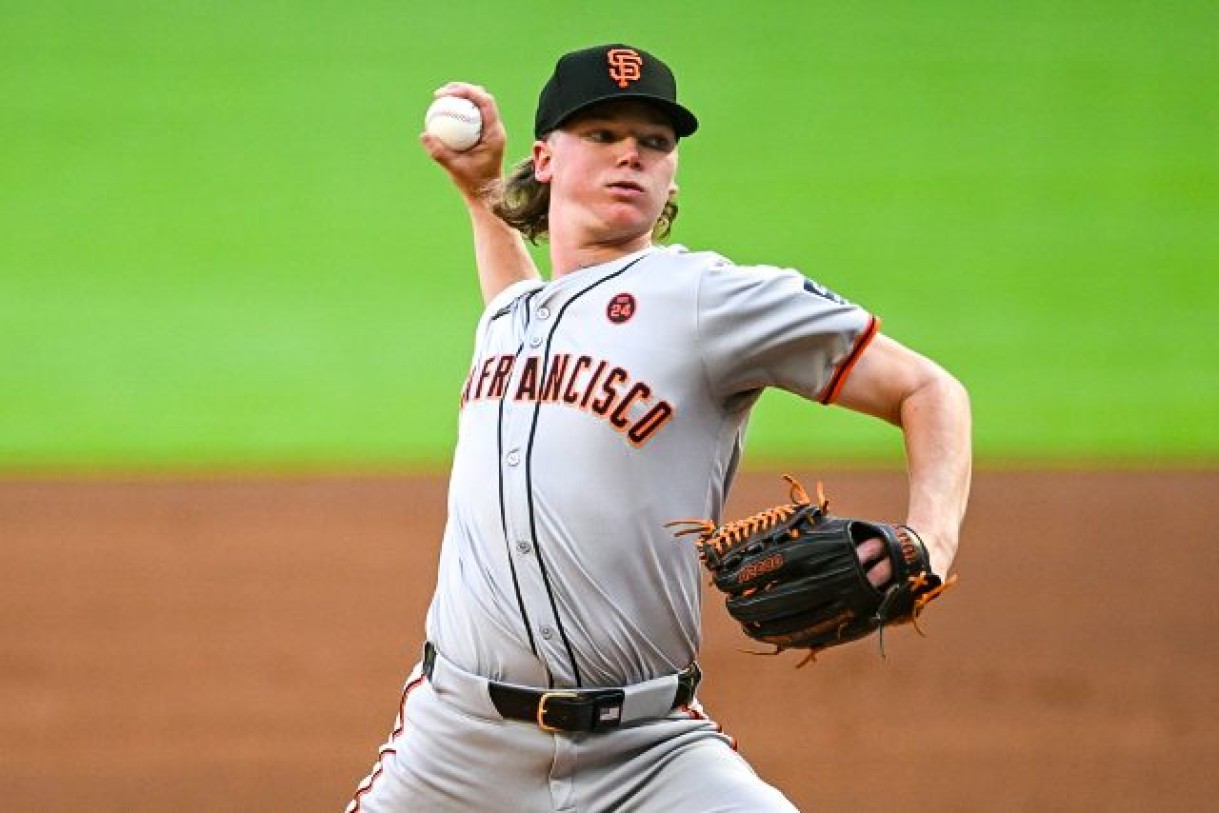
Elliott looks at pitchers with surprising starts recently. These SPs could emerge as fantasy baseball waiver wire targets for Week 10 in 2025, or just mirages.
Welcome back to the "Are You For Real?" series as we dive into Week 10 of the 2025 fantasy baseball season. For those who are not familiar, this is a weekly column where we take a look at starting pitchers who had surprisingly good starts over the past week and put them under the microscope to determine whether they're legitimate or just smoke and mirrors.
This week we've got three interesting arms to look at, two youngsters in San Francisco and a veteran in the Bronx. First, we'll deep dive into Kyle Harrison's strong start Friday against Miami. Then, we'll look at Hayden Birdsong dominating those same Marlins on Sunday. We'll finish out with a breakdown of Ryan Yarbrough's recent success in New York.
Roster percentages are taken from Yahoo! and are accurate as of June 2.
Featured Promo: Save 50% off the regular price with discount code CHAMP, for a limited time. Exclusive access to our Team Sync platform, DFS cheat sheets, Lineup Optimizers, betting/prop picks, and exclusive content from Nick Mariano and Eric Cross! GAIN ACCESS NOW
Kyle Harrison, San Francisco Giants – 9% Rostered
2025 Stats (prior to this start): 9.1 IP, 3.86 ERA, 4.47 FIP, 21.1% K-BB%
05/30 at MIA: 5 IP, 1 H, 0 ER, 3 BB, 5 K
Harrison has primarily worked out of the bullpen this season, but he made his second start on Friday, holding the Marlins to just one hit over five innings while picking up his first victory of the season. Harrison figures to have a spot in the rotation for at least until Justin Verlander returns. Is there any fantasy value to be had here, or should Harrison be kept on the wire?
Originally a third-round pick by the Giants back in 2020, Harrison was a huge prospect coming up through San Francisco’s system. He was ranked as high as the No. 18 prospect by MLB Pipeline in 2023, and some even called Harrison the best pitching prospect in baseball. Harrison has floundered as a starter, posting a 4.34 ERA, 4.54 FIP, and 14.8% K-BB% in 33 career starts.
He wasn’t getting his teeth kicked in necessarily, but those are hardly the numbers we’d expect from a top prospect. Harrison quickly went from hyped to forgotten, and 2025 is the first real sign of life we’ve seen from him.
Harrison works with a three-pitch mix consisting of a four-seam fastball, slurve, and changeup. He leaned heavily on the four-seamer and slurve in this start, throwing the two pitches a combined 91% of the time. The fish flailed at the ball, as Harrison racked up 12 of his 14 whiffs with those two pitches as well.
Harrison really relied on his fastball in this start, throwing that pitch 63% of the time. He averaged 95.3 mph with the pitch in this start, which is slightly down about half a mph compared to his bullpen velocity.
He averaged 94.7 mph with his heater in his previous start, so it’s nice to see that number trending upwards. Something else that was nice to see was the whiffs Harrison earned with his fastball in this start. He got 10 whiffs with his fastball alone against Miami, good for a 33% whiff rate.
That’s an impressive number for a fastball that was used so heavily. Harrison’s fastball is notable for its extreme horizontal break compared to average. Have a look at his four-seam fastball shape (red).
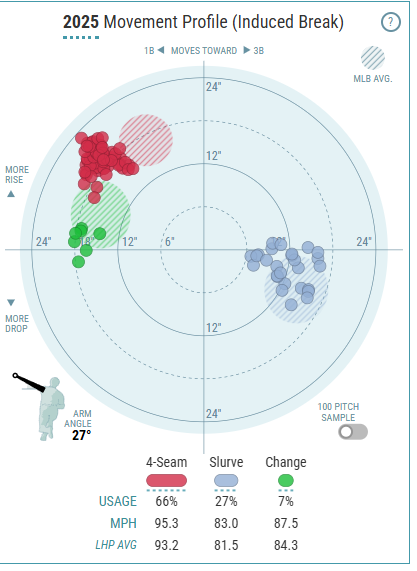
That makes the pitch especially deceptive and hard to square up. Batters have managed just a .105 AVG, .184 SLG, and .179 wOBA off Harrison’s four-seamer this season, and that’s despite a 96 mph average exit velocity against. It’s only been 14 1/3 innings, so don’t expect the microscopic numbers against the fastball to last.
He has a .136 BABIP against his fastball right now, and also has a .190 xBA, .372 xSLG, and .280 xwOBA against it. Still good numbers, but regression is coming.
Harrison’s most-used secondary pitch is the slurve, which he threw 28% of the time against Miami. An 83 mph offering, Harrison’s slurve doesn’t spin as much as a traditional curveball. Its movement profile puts it, as the name suggests, somewhere between a curveball and a slider.
The pitch looks filthy there, and it has acted as Harrison’s best strikeout pitch in the big leagues. He has a strong 36.4% whiff rate with the pitch this season, but he only had a 27.7% whiff rate with it last year over a much larger sample. Overall, I’m skeptical of Harrison’s spike in strikeouts this season.
He had a 22.2% K rate in 124 1/3 innings last season, but has a 28.6% strikeout rate this season in 14 1/3 innings.
It’s worth noting that Harrison is throwing much harder this season at 95.3 mph (he was at 92.5 mph last year), so perhaps this velocity spike is allowing him to blow his fastball and secondary stuff by hitters. As previously mentioned, he got a whopping 10 whiffs on his fastball in this one, 14 whiffs overall.
Increased velocity could lead to better deception for Harrison and allow him to slip the slurve past opponents more frequently this season, but he’s also allowed his fair share of hard contact with the pitch. Opponents have a 94.2 mph average exit velocity against Harrison’s slurve, along with a .300 AVG, .700 SLG, and .449 wOBA.
It’s a really small sample size here, but the expected stats are worrisome at .444 xBA, .821 xSLG, and .546 xwOBA. It’s not often that I see a pitch with a .700 SLG against and has a higher xSLG. Truly a rare feat from Harrison, but not a good one. Again, small sample size, but trending in the wrong direction.
Harrison rounds out his repertoire with an 87.5 mph changeup, a pitch he hasn’t thrown much this season. He’s only used the changeup 6.5% of the time, barely throwing it at all when he was a reliever. But it’s reentered his pitch mix with the move to the rotation, and he threw it 10% of the time against Miami.
Harrison’s changeup is characterized by high spin (for a changeup) at 2030 RPM and plus horizontal movement.
He has a 40% whiff rate with the pitch thus far, although opponents are hitting .500 against it as well. The changeup is a fine pitch to use against opposite-handed hitters, but it’s clearly the third option for Harrison and won’t be a major source of production except against heavy right-handed lineups.
Verdict:
Harrison’s recent success coincides with a big spike in velocity, going from 92.5 mph in 2024 to 95.3 mph in 2025. He’s been able to sustain those velocity gains as a starter thus far, so we shall see if he can continue to throw this hard. Harrison has a rather limited arsenal with just three pitches, and it shrinks a little bit more knowing that he only throws his changeup to righties.
It’s such a small sample size that it’s hard to put a ton of weight into these numbers, but there are some worrying metrics for Harrison.
He allows a ton of hard contact with an average exit velocity of 94.6 mph against, and has a .475 xSLG against overall. His home ballpark should help alleviate some of the power concerns, but I don’t think that elevates Harrison beyond a streamer. His time in the rotation may be limited, as Verlander’s eventual return could send him back to the bullpen.
Hayden Birdsong, San Francisco Giants – 39% Rostered
2025 Stats (prior to this start): 32.2 IP, 2.48 ERA, 3.81 FIP, 16.4% K-BB%
06/01 at MIA: 5.1 IP, 5 H, 1 ER, 0 BB, 5 K
Harrison wasn’t the only Giants pitcher to take advantage of a matchup with the Marlins, as Birdsong got in on the fun for 5 1/3 innings of one-run ball en route to his third victory of the season. Birdsong has now made three starts since joining the rotation and is sporting an impressive 2.37 ERA in 38 innings this season, mostly as a reliever.
Can Birdsong make the leap to starter, or will this tune go stale?
Originally a sixth-round pick by the Giants in 2022, Birdsong wasn’t as big a prospect as Harrison coming up, but he does have some strong minor league numbers. Most notable would be his 13.1 K/9 rate across all minor league levels. Birdsong works with a four-pitch mix consisting of a four-seam fastball, slider, changeup, and curveball.
Birdsong has four pitches at his disposal, and he uses all of them on a somewhat frequent basis. He’s thrown each pitch at least 12.9% of the time this season and threw each pitch at least 16% of the time in this start. His most-used pitch is the four-seam fastball, which Birdsong has thrown 39.7% of the time this season.
A 96 mph offering, Birdsong boasts plus velocity with his heater. He also boasts a plus spin at 2418 RPM and a plus vertical break.
Batters have really struggled against Birdsong’s four-seamer this season, managing just a .193 AVG, .421 SLG, and .309 wOBA against it. What stands out is Birdsong’s extreme flyball tendencies with the pitch. He has a 26-degree average launch angle against his four-seamer this season, along with a 55.3% fly-ball rate and a 19.2% infield fly-ball rate.
Infield flyballs are practically guaranteed outs, so it’s a desirable batted-ball type to induce.
Flyballs may be the most likely batted-ball type to produce power, but they’re also the most likely batted-ball type to produce an out. Batters have the lowest BA on flyballs compared to grounders and line drives, and Birdsong has done a great job inducing them.
He’s also managed to reduce the average exit velocity against his four-seamer from 92.4 mph in 2024 to 88.7 mph in 2025, which also caused his xSLG to drop 66 points compared to last season.
The measurables on Birdsong’s fastball are strong, and he’s getting good results with the pitch thus far. The good results are supported by favorable batted-ball metrics, and Birdsong should be able to wield his four-seamer to success at the major league level.
His most-used secondary pitch is the slider, which Birdsong threw 28% of the time against Miami. An 88.7 mph offering, Birdsong’s slider has gotten mixed results this season. He has a 15.6% swinging-strike rate with the pitch, but batters are hitting .333 with a .500 SLG off the slider as well.
The expected stats suggest that regression is coming, with a .279 xBA, .438 xSLG, and .328 xwOBA. Birdsong has a .370 BABIP against his slider despite an 85 mph average exit velocity off the pitch, so it seems fair to say that the batting average will normalize over time.
When it comes to Birdsong’s best pitch, that honor may belong to the changeup, which he’s thrown 19.3% of the time this season. Opponents have struggled against this pitch, hitting just .189 with a .216 SLG and a .192 wOBA. The expected stats suggest that Birdsong has earned these numbers as well, with a .200 xBA, .252 xSLG, and .209 xwOBA.
The changeup has been an exceptional strikeout pitch for Birdsong this season, with a 42.1% whiff rate and a 34.1% chase rate on the year. Birdsong’s changeup is relatively hard at 89 mph and has a low 1369 RPM spin rate. The changeup is also noteworthy for its exceptional vertical movement. Birdsong averages 5.8 inches of vertical above the league average.
Have a look at the movement profile (changeup in green).
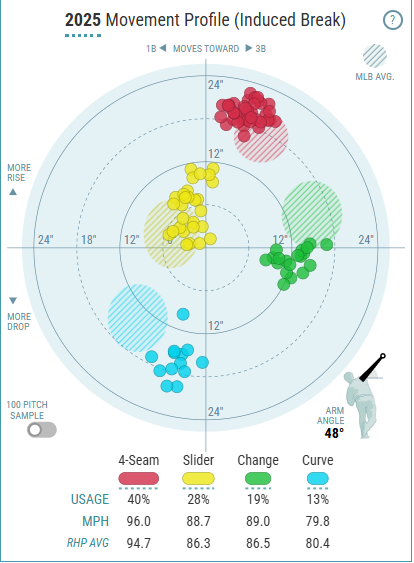
That’s some drop, and batters have had a hard time squaring up the ball as a result. Opponents have a 0-degree average launch angle against the pitch this season, along with a 61.9% ground-ball rate. Birdsong mostly throws the pitch to left-handed batters, but has mixed it in with righties at times too this season.
There’s a lot to like about Birdsong’s changeup, but the only hope is that he incorporates the pitch more into his pitch sequencing.
Birdsong rounds out his repertoire with a curveball, and batters have pulverized it this season. Opponents have a .357 AVG, .500 SLG, and .414 wOBA against Birdsong’s curveball this year. Batters have scorched the pitch for a 95.9 mph average exit velocity and a 16-degree average launch angle.
With a 50% line drive off Birdsong’s curveball this season, it’s no wonder that he has a .625 BABIP with the pitch.
Line drives are the most likely batted-ball type to land for a hit by a good margin, so Birdsong must be giving up hits left and right with the pitch. What’s strange is that the pitch was quite effective for him in 2024, with batters hitting just .145 off the curveball last season. He’s lost about three inches of vertical drop with the pitch.
His location is a lot more concentrated this year compared to last season. Perhaps Birdsong doesn’t have the same command or feel for the pitch this season, but one thing is for sure: we can’t rely on the curveball as an out or strikeout pitch going forward.
Birdsong has been relying on his other pitches more frequently this year and has been getting better results with those other pitches.
Verdict:
Birdsong has a deep arsenal full of above-average pitches, including a plus fastball velocity at 96 mph. Birdsong has carried his velocity into the rotation thus far and has mixed in his secondary stuff frequently. He’s been getting varied results with the pitches this season, including excellent results on the changeup, so-so results on the slider, and bad results on the curveball.
The changeup looks to be the best strikeout pitch, with a 42.1% whiff rate on the year.
Birdsong has put up some prodigious strikeout numbers in the minors and even last year, but the underlying numbers in his individual pitches do not suggest that there’s much room for improvement on his current 24.8% K rate. Do not expect a big bump going forward, even though he had an 11.0 K/9 last season.
Birdsong is in competition with Harrison to keep a rotation spot when Verlander returns, and I prefer Birdsong. His stuff looks better, and he’s got a deeper arsenal. Birdsong is worth a speculative add in anything deeper than standard, and he may be worth an add in standard if you need pitching help immediately.
The ride might be a little bumpy as he's still a work in progress, but Birdsong looks like a major league starter.
Ryan Yarbrough, New York Yankees – 32% Rostered
2025 Stats (prior to this start): 35.1 IP, 3.06 ERA, 4.32 FIP, 17% K-BB%
06/01 at LAD: 6 IP, 4 H, 1 ER, 0 BB, 5 K
Yarbrough was outstanding on Sunday night, allowing just one run over six innings while picking up his third victory of the season. It was the third straight start where Yarbrough allowed exactly one run, and he has a 2.08 ERA in five starts since joining the Yankees’ rotation. Is Yarbrough the savior the Yankees and our fantasy teams need?
Originally a fourth-round pick by Seattle in 2014, Yarbrough had zero prospect hype coming up. In fact, he was viewed more as a specialist reliever than as someone who could start games in the big leagues. Then, he became one of the faces of the new “opener” phenomenon in baseball, starting games but only pitching one or two innings at a time.
He’s bounced between the rotation and bullpen for his whole career, but he’s stretched out now and working as a starter.
Yarbrough works with a five-pitch mix consisting of a cutter, sinker, sweeper, changeup, and four-seam fastball. It’s actually rather impressive how Yarbrough incorporates each pitch so frequently into his pitch sequencing, as he throws his cutter, sinker, slider, and changeup all more than 20% of the time.
We don’t often see pitchers with such an even mix of usage among their offerings, but that’s how Yarbrough approaches things on the mound. When you only average 88.3 mph with your heater, you’ve got to be unusual, and that’s exactly what Yarbrough is.
Let’s start with the cutter, because that’s served as Yarbrough’s primary pitch against right-handed hitters. He’s also used the cutter 30.8% of the time as a starter, the most of any pitch. An 83.3 mph offering, Yarbrough’s cutter is low spin and has roughly average vertical drop, along with slightly below average horizontal break.
Where this pitch really shines is in producing weak contact, as opponents have an 84.7 mph average exit velocity against it. He also has an 18-degree average launch angle and a 42.9% fly-ball rate with the pitch.
Flyball pitchers in Yankee Stadium can be scary, but Yarbrough mostly allows weak contact, which should help keep the ball in the yard. He does have a career 1.20 HR/9 as a starter, so long balls could continue to be an issue for Yarbrough, who has allowed 1.52 HR/9 this season and has allowed a home run in four straight games.
Overall, Yarbrough is walking a tight rope with this as his primary pitch, but he’s managed to do so successfully thus far.
Something we’ve seen from Yarbrough during this recent hot stretch that we haven’t always seen is strikeouts. He’s never been a big strikeout guy thanks to his poor velocity, but that’s changed over his last few starts. Yarbrough has a 10.6 K/9 over his last three outings. He’s gotten it done primarily with a combination of sweepers and changeups.
He got a monster 17 whiffs in this start against the Dodgers, including seven alone from his sweeper for a 70% whiff rate with the pitch. An incredible 71.4 mph pitch, Yarbrough’s sweeper confounds hitters with its atypical movement. Have a look at Yarbrough’s movement profile (sweeper in gold).
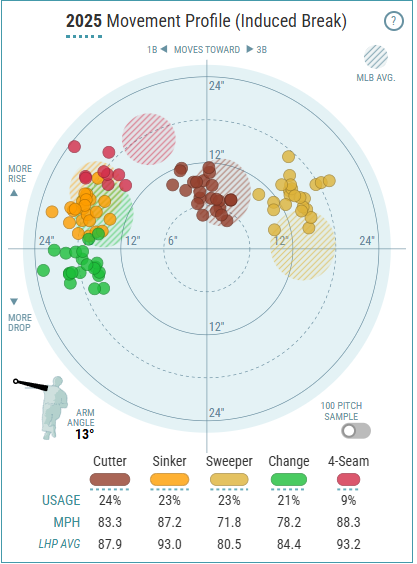
Like the cutter, the pitch has been incredibly difficult for batters to square up this season. Opponents have a 75 mph average exit velocity off Yarbrough’s sweeper. 75 mph! Batters are hitting .219 off the pitch, but have a .188 xBA and a .191 xwOBA.
On top of that, Yarbrough has a 41.7% whiff rate with the pitch. Incredible results, and while I have doubts that Yarbrough can sustain the strikeout and whiff numbers, the soft contact is legit. Yarbrough has been a soft contact machine throughout his career. Have a look at his savant landing page.

The page is red and red when it comes to average exit velocity and hard hit rate. The dude has an exceptional skill, and it’s easier to appreciate with a visual. That’s why it would be so interesting if Yarbrough could maintain these whiff and strikeout numbers; he would be incredibly tough to hit and could really help our fantasy teams.
The sweeper isn’t even his only strikeout pitch to emerge during this hot stretch either, as Yarbrough has been fanning hitters with his changeup too. Batters are hitting .167 off Yarbrough’s changeup with a .226 xwOBA and a 46.6% whiff rate.
That whiff rate is especially impressive, as it’s rare to see a whiff rate for an individual pitch get too high above 40%. Yarbrough has exceptional movement with this pitch, with 3.1 inches of drop above league average. Take another look at his movement profile, this time focusing on the changeup (green).
That makes the pitch incredibly deceptive, which is a significant reason why Yarbrough has a monster 19% swinging-strike rate with the pitch. He only has a 14% swinging-strike rate with it for his career, so we could see some regression here, but overall, the changeup looks like a bona fide strikeout pitch that should rack up whiffs, even at a reduced rate going forward.
All the secondary stuff looks good, but what about the fastball? Yarbrough doesn’t exactly bring the heat, averaging just 88.3 mph with his four-seamer, the third slowest in the majors (min. 40 IP). He’s only used his four-seamer 9.3% of the time, instead relying on a sinker 23% of the time. The sinker is just 87.2 mph and has slightly above average vertical and horizontal movement.
Yarbrough is a flyball pitcher through and through, but the sinker has proven to be an effective groundball pitch, with Yarbrough posting a 50% ground-ball rate with his sinker this season. Opponents are hitting just .237 off the sinker, but they have a .321 xBA, .446 xSLG, and .365 xwOBA against it as well.
It will be difficult for Yarbrough to maintain the current .250 BABIP with his sinker, even with his plus ground-ball rate. When it comes to fastballs, Yarbrough is succeeding in spite of them, not because of them.
Verdict:
Yarbrough is doing a lot of things well right now, and the underlying metrics suggest that he could sustain this success to a degree going forward. He’s getting excellent results with his bevy of secondary pitches, including some nutty whiff numbers on the sweeper and changeup. The whiff rate on his changeup more than doubled from 2024 to 2025, and while I wouldn’t expect all of the gains to last, Yarbrough could be a better source of strikeouts than he has been in years past.
He’s worked around his weak fastball velocity by throwing his cutter often, and mixing in a lot of different pitches at different times. Junk baller feels like an insult, but it describes what Yarbrough is doing. He’s like an elevated junk baller, mixing in tons of effective off-speed offerings, but his fastball is lacking.
There’s a lot to like about what Yarbrough is doing, but he’s definitely pitching over his head at the moment. His .223 BABIP and 90.1% LOB rate will both normalize over time, causing his ratios to rise. He won’t sustain these levels of success, but I do think he’s worth an add in standard leagues.
If nothing else, fantasy managers can take advantage of a hot streak until he cools down, or they can stream him against weak opponents. The way he's pitching right now, you can start him against almost anyone, as we saw in his dismantling of the mighty Dodgers on Sunday.
More Fantasy Baseball Advice
Download Our Free News & Alerts Mobile App
Like what you see? Download our updated fantasy baseball app for iPhone and Android with 24x7 player news, injury alerts, sleepers, prospects & more. All free!