RADIO
RADIO






Elliott Baas looks at starting pitchers who turned in surprising starts recently. These SPs could emerge as waiver wire targets and sleepers, or simply mirages.
Welcome back to "Are You For Real?" Each week, we look at lower-owned starting pitchers who have performed unexpectedly well in their last outing(s).
This time out, we'll look at something old (Jake Odorizzi) and something new (Brandon Woodruff and Spencer Turnbull) to determine who is truly worthy of being on your fantasy roster.
Ownership is based on Yahoo leagues and is accurate as of 05/7/2019. The goal of this article is to look at pitchers widely available that could be useful in fantasy, whether they have been recently added by a ton of teams or are still sitting on waivers.
Featured Promo: Save 50% off the regular price with discount code CHAMP, for a limited time. Exclusive access to our Team Sync platform, DFS cheat sheets, Lineup Optimizers, betting/prop picks, and exclusive content from Nick Mariano and Eric Cross! GAIN ACCESS NOW
Brandon Woodruff, Milwaukee Brewers
26% Owned
2018 Stats: 42.1 IP, 3.61 ERA, 3.26 SIERA, 18.7% K-BB%
4/27 @ NYM: 5 IP, 6 H, 1 ER, 1 BB, 6 K
5/3 vs. NYM: 5 IP, 6 H, 1 ER, 2 BB, 7 K
Between his 2018 numbers and prospect pedigree, one might not consider a start like this one surprising, but Woodruff got hammered in his first five starts for a 6.33 ERA before putting up two solid (and nearly identical) starts against the Mets. Other than his 4.71 ERA, Woodruff’s underlying numbers make him look like a breakout. His 11.15 K/9 is top-10 among qualified starters, and his 3.31 FIP and 11.4% SwStr are above average as well. Woodruff gets it done primarily with four pitches, a 95.5 MPH four-seamer, a 95 MPH two-seamer, an 88.8 MPH slider, and an 86.5 MPH changeup. He does throw the occasional curve, but it’s mainly about the other four pitches for Woodruff.
The fastball has been a key piece to Woodruff’s success over his last two starts. He got nine of his 25 swinging strikes between these two starts with his fastball, and the pitch had increased movement over these two starts. Fastballs aren’t typically seen as strikeout pitches, but in Woodruff’s case, he might be able to pull decent strikeout numbers with his four-seamer.
Woodruff’s fastball has a few things going for it. First, of course, is the velocity. Woodruff is the 14th hardest throwing starting pitcher (13th if we don’t count Ryne Stanek, who’s an opener) out of the 190 to start an MLB game this season. He’s also thrown the pitch with more movement over his last two starts, which has helped increase Woodruff’s swinging strike rate with the pitch. Woodruff has also thrown the pitch high in the strike zone, which can result in an above average strikeout rate for fastballs, especially those with above-average velocity.
The high fastball is deceptive, because to a hitter the pitch looks like it’s coming in low and fat, but by the time a hitter realizes it’s staying up it’s nigh impossible to readjust in time. As a pale basement-dweller I haven’t experienced this in an actual baseball game, but I can attest to the high fastball’s deceptiveness based on my experience in MLB the Show. Boy, is it hard to catch up to the high heat.
To illustrate the effectiveness of the high fastball I have pulled heatmaps (via brooksbaseball.net) of fastball location and whiff rate for three pitchers. Here are the 2019 heatmaps for Brandon Woodruff (location on the left, whiff rate on the right).


And here they are for Jon Gray.

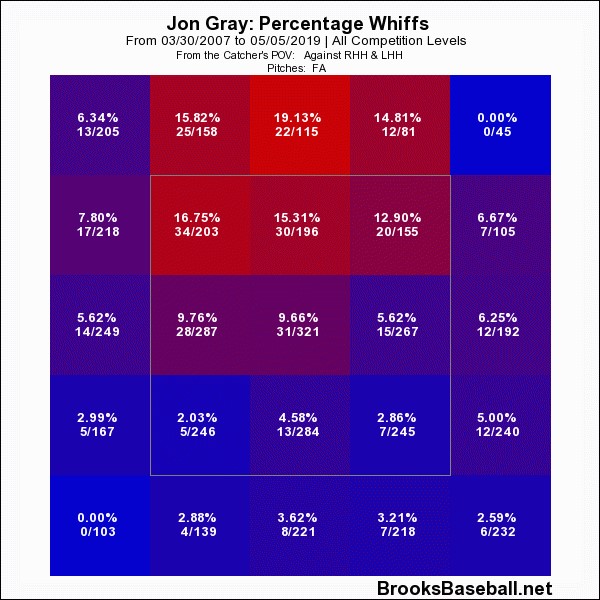
Why Jon Gray? Because he throws nearly as hard as Woodruff and yet struggles to get whiffs with his fastball. His poor command could be a reason why that’s the case.
And here are the 2019 heatmaps for Jake Odorizzi.
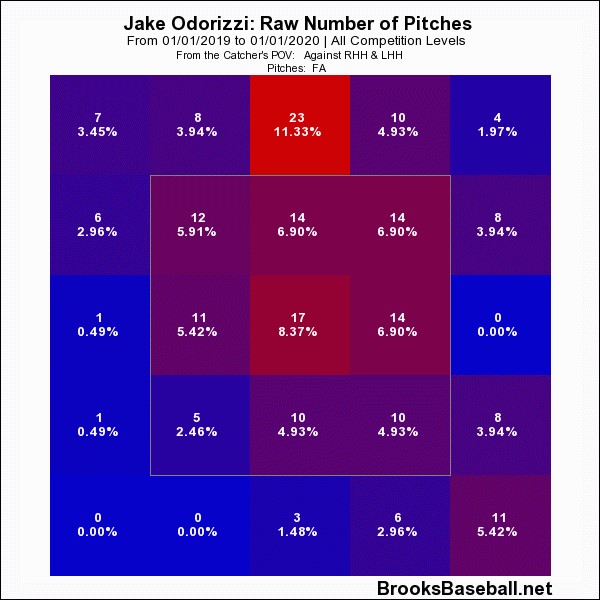

Odorizzi is doing quite a few interesting things this season, and one of them is his fastball whiff rate. Odorizzi has the second-highest fastball whiff rate among starters (min. 200 pitches), and he does it with average velocity thanks to his excellent location.
If Woodruff can maintain good command of his fastball, he should be able to produce whiffs at an above average rate with the pitch. The high fastball pairs nicely with Woodruff’s primary breaking ball, his 88.8 MPH slider. Woodruff throws the eighth-hardest slider in the majors, and unlike many pitchers that throw a slider, Woodruff isn’t afraid to throw it to opposite-handed hitters. He uses his slider 29% of the time against lefties when ahead in the count, and 24% of the time when behind in the count.
His changeup has gotten a solid whiff rate over his career, better than his slider in fact, so it’s odd that he uses his slider so much against lefties. It’s proven to be more effective from a results perspective, as lefties are hitting .111 with an .056 ISO against Woodruff’s slider this season. Conversely, lefties are hitting .333 with an .083 ISO against his changeup.
Woodruff’s slider isn’t really a strikeout pitch, in fact, it’s in the 45th percentile of whiff rate among starting pitchers this season. It’s most effective trait has been inducing poor contact, chiefly infield flyballs. Batters have a 21-degree average launch angle against Woodruff’s slider along with a 45% infield flyball rate this season. It’s hard to buy into the pitch as a pop-up producer with such a small sample size, but it helps explain Woodruff’s success with the offering.
While he’s not succeeding in the traditional manner that we expect from high impact, hard-throwing rookies, Woodruff’s current skill set is indicative of legitimate success, and his positive results are repeatable over time. If his fastball command falters, Woodruff could be in trouble since his breaking pitches haven’t proven capable of racking up big strikeout numbers. For now, he’s someone worth taking a shot on, because the numbers are here and there’s reasoning behind them.
Verdict:
Woodruff’s exceptional fastball location has allowed him to rack up great strikeout numbers, and as long as he keeps the ball up, there’s no reason to think he can’t maintain this strikeout rate with the pitch. His secondary arsenal leaves something to be desired, but his slider has been effective enough from a result and contact perspective that we can overlook a poor whiff rate for now. Woodruff’s ownership hasn’t spiked yet, which means it’s time to jump on this train, because one more good start means that his ownership rate will skyrocket.
Jake Odorizzi, Minnesota Twins
41% Owned
2018 Stats: 164.1 IP, 4.49 ERA, 4.55 SIERA, 12.9% K-BB%
4/29 vs. HOU: 7 IP, 4 H, 0 ER, 1 BB, 7 K
5/4 @ NYY: 6 IP, 2 H, 0 ER, 4 BB, 8 K
Odorizzi was used as an example in the Brandon Woodruff analysis, but the 29-year-old right-hander deserves a section of his own with the way he’s pitched this year. Odorizzi has a 2.78 ERA and 26.6% K rate through his first seven starts, and is coming off back-to-back scoreless outings. Odorizzi was once considered a reliable middle-of-the-rotation type, but he took the launch angle revolution on the chin. Odorizzi has always had flyball tendencies, but his flyball rate, hard hit rate, and home run rate all spiked in 2016, giving Odorizzi a few tough seasons. He has more than returned to form this season, and the current version of Odorizzi may be the best we’ve ever seen.
When it comes to pitch mix, Odorizzi isn’t doing too much differently this season compared to years past. He is using his curveball 14% of the time this season, which is 9% more than his career usage rate, but that doesn’t account for his success. Odorizzi’s curveball is a subpar offering, and batters have feasted on the pitch for a .412 AVG and .401 wOBA this season. It also has below average spin and a meager 6.3% SwStr rate, so the curveball can safely be ruled out as the reason for Odorizzi’s success. Pitch usage hasn’t been the key to Odorizzi’s performance anyway, it’s been pitch location.
As previously mentioned in this piece, Odorizzi has the second-highest swinging strike rate on his fastball (min. 200 pitches) behind just Gerrit Cole. Well, a high swinging strike rate makes sense for Cole; he averages 96.7 MPH with his four-seamer with 2500 RPM and is in the 93rd percentile for movement. Odorizzi’s fastball, on the other hand, looks average at best on paper. At 92.2 MPH his fastball clocks in slightly below league average for a starter, and his 2225 RPM is also just under the league average. He’s made up for it with great location, as Odorizzi keeps the ball up in the zone and above, where hitters struggle to make solid contact with it. Not only do high fastballs induce more whiffs, they serve as a good counter to the loft-focused, uppercut swings that have become more common in today’s game.
While uppercut swings are great for hitting low and mid zone pitches for power, they aren’t as effective against high heat. An uppercut swing against a high fastball can often result in an infield flyball, and that’s been true for Odorizzi thus far, who has a 46.2% IFFB rate on his four-seam fastball this season. Batters have also made weaker contact on his fastball, which an 83.9 MPH average exit velocity this season compared to an 88.9 MPH average exit velocity in 2018. It’s still a small sample size for Odorizzi, especially with batted ball data like this, but these are encouraging signs that indicate legitimate improvement.
Other than small sample size, there are a few things that should make owners hesitant of buying into Odorizzi. First, is that his current pitching is extremely dependent on command, and based on his recent track record I’m not sure I’d bet my ratios on Jake Odorizzi’s ability to command a fastball. He has a 9.3% walk rate and 3.6 BB/9 since 2016, and he’s also allowed 1.5 HR/9 over that stretch. The poor walk rate is indicative of bad control, and the poor home run rate indicates bad command along with easily hittable stuff. He’s only allowed 0.5 HR/9 this season, but he’s gotten by on a 4.9% HR/FB ratio. Odorizzi’s performance will get worse as that number inevitably creeps towards league average, and owners can look no further than his 4.49 xFIP to get a glimpse in the future.
There’s reason to believe Odorizzi could start to curb his home run rate. In a year when average flyball distance is going up Odorizzi reduced his to 191 feet, which is 15 feet lower than last season. He also cut his hard-hit rate against to 27%, an 11% drop from last year. Even with those factors, it’s hard not to worry about regression with Odorizzi. He’ll be better than the pitcher he was between 2017-2018, but he’s still got flaws.
Verdict:
Odorizzi has managed to turn his fastball into one of the league’s most effective heaters for strikeouts. Whether he can maintain this newfound success hinges on his command, and based on past seasons that’s a tough bet to make on Jake Odorizzi. He’s an improved pitcher, but don’t expect that 2.78 ERA or 0.5 HR/9 to hold very long.
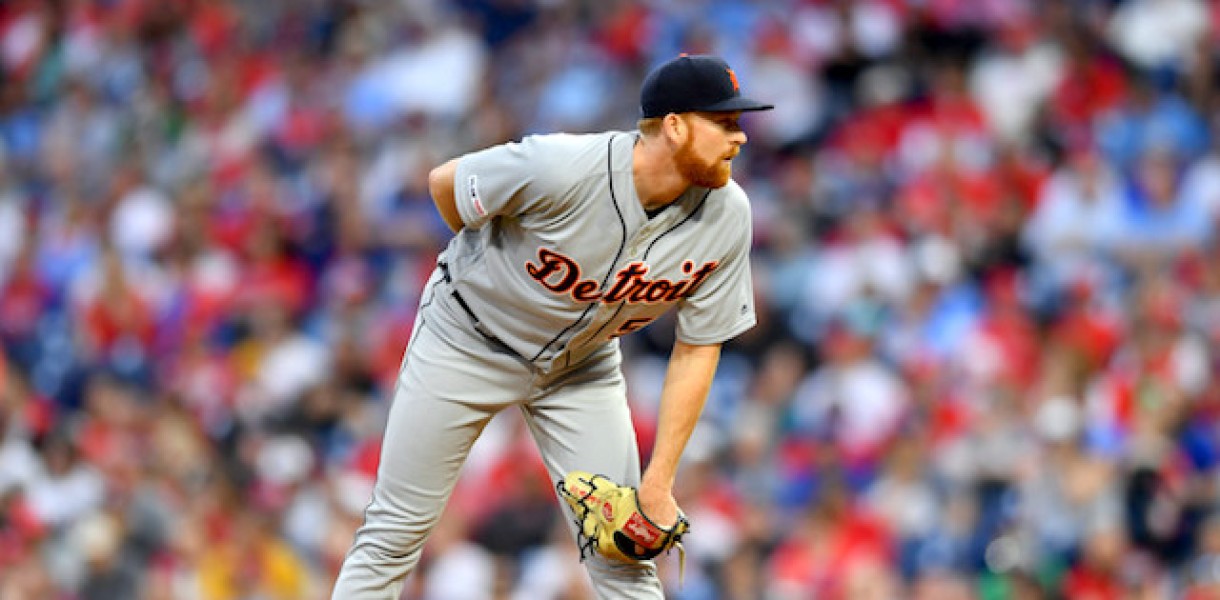
Spencer Turnbull, Detroit Tigers
37% Owned
2018 Stats: 16.1 IP, 6.06 ERA, 3.76 SIERA, 15.9% K-BB%
5/5 vs. KC: 7 IP, 6 H, 1 ER, 1 BB, 7 K
Turnbull has impressed in seven starts this season, posting a 2.31 ERA and 3.33 FIP in 39 innings so far. A relative unknown, Turnbull got his chance with a rebuilding Detroit squad, and much like with Matthew Boyd, the Tigers may have stumbled upon something valuable during an otherwise bleak season. Turnbull has a deep arsenal, throwing both a four-seam and two-seam fastball, a slider, a curveball, and the occasional changeup. While Turnbull is above average on the radar gun, averaging between 93-94 MPH with his fastball, the key(s) to his success have been breaking balls. Both his slider and curveball have been extremely effective for Turnbull, and both pitches have a wrinkle to them that make each offering deceptive and hard to square up.
Turnbull’s cutter has been his best pitch this season by a significant margin. Batters are hitting .094 with just one extra-base hit and an 18.7% SwStr rate this season. The pitch operates as more of a slutter (slider-cutter hybrid) because of how hard Turnbull throws it, and the type of movement the pitch gets. Turnbull’s slider won’t sweep across the plate like Corey Kluber’s, nor will it dive into the dirt like Chris Sale’s, rather the pitch comes in hot and tails off with subtle movement. He’ll never generate Corey Kluber or Chris Sale-like strikeouts with the pitch, but it’s an effective swing-and-miss offering nonetheless. When batters make contact, it usually turns out poorly, as opposing hitters have a zero-degree average launch angle and 69% groundball rate against the pitch. Turnbull has done an excellent job locating the pitch down-and-away from right-handers, making it hard for hitters to make any kind of solid contact. With just a 39% zone rate and 27% o-contact rate, it’s easy to see how hitters have been so futile against the pitch.
Turnbull’s curveball has also been an effective offering for him. His curve clocks in at 80 MPH with average spin rate. What makes the pitch interesting is its side-to-side movement. Turnbull’s curveball is in the 80th percentile of horizontal movement among starters, and that type of movement allows him to generate whiffs and maintain a 58% groundball rate with the curveball. Throughout his minor league career Turnbull has limited home runs allowed and inducing groundballs at an above average rate, and it’s easy to see how with his curveball and slider combination. His 4.28 xFIP may scare owners away, but based on stuff and track record there’s no reason to think his 5.9% HR/FB ratio will drastically spike upwards. Unlike Jake Odorizzi, Turnbull’s home run suppression is believable.
The weakest part of Turnbull’s game is his fastball. While he throws with decent velocity, batters have hit the pitch well, with a .310 BA and .308 xBA against. Opposing hitters also have a 36% line drive rate against the pitch, and that’s a result of poor location for Turnbull. He has a 59% zone rate with his fastball, and while Turnbull’s history of walk issues might lead him to pound the zone more often than necessary. Some pitchers, such as Tyler Glasnow, have corrected their walk issues by living in the zone, but Turnbull doesn’t have the stuff to hang in the zone like Glasnow can.
Batters have only mustered an 85.9 MPH average exit velocity against Turnbull’s four-seamer, which helps to limit power, but he’ll be giving up plenty of hits with his current approach. He has good enough command of his secondary arsenal that Turnbull could probably afford to back off a bit with his heater, but he’s been so successful this year that a change in approach seems unlikely and unwelcome at this time. He can do well pitching this way, but he won’t maintain a 2.31 ERA or even an ERA under 3.50 with his current approach. He’s still worth adding, but expect regression.
Verdict:
Two above-average breaking balls is great to see, but an ineffective fastball caps his upside to back-end starter status. Turnbull should be added in most leagues, but he’s not the league winner his current 2.31 ERA might suggest.
More 2019 Fantasy Baseball Advice