




 RADIO
RADIO











Brandon's fantasy football winners and losers for rookie drafts after the 2026 NFL Scouting Combine. His analysis of who increased and decreased their draft stock.
The 2026 NFL Scouting Combine just wrapped in Indianapolis, and it felt like the ultimate reality check for the next wave of pro hopefuls. One minute, a guy is flying through the 40-yard dash like he’s got rocket boosters; the next, another prospect is staring at the turf after a shaky change-of-direction drill. Over three wild days, we saw bodies, bursts, and pure football instincts on full display—and yeah, a few dreams got a serious boost while others quietly took a hit.
That’s the beauty (and the brutality) of the Combine: a single explosive performance can rewrite a player’s entire story. A 4.3 forty or a record-setting broad jump doesn’t just turn heads in the war room—it can vault a mid-round prospect into first-round money and instantly juice their fantasy upside. Suddenly, that wide receiver who was “maybe a WR3” is getting talked about as a potential league-winner, and dynasty managers are already refreshing their trade calculators.
Of course, the other side of the coin is just as real. A disappointing vertical or a clunky three-cone can send a player’s draft stock sliding, forcing teams to second-guess the tape and fantasy owners to pump the brakes on their projections. In the paragraphs ahead, we’ll spotlight the clear winners who just cashed in big, the guys who might need to regroup, and exactly how these numbers will ripple through draft boards and your 2026 fantasy rankings. Buckle up—it’s going to be a fun ride. Be sure to also check out our free NFL Mock Draft Simulator tool and create unlimited mock drafts for the 2026 NFL Draft.
Bookmark our updated and revamped fantasy football rankings portal for all league formats!PPR rankings | Half-PPR rankings | Standard rankings | Rookie rankings | Superflex rankings | Dynasty rankings | Who To Start? | Injuries | Matchup Ratings | Strength of Schedule
WINNERS
Grant Nussmeier - QB, LSU
Garrett Nussmeier, the former LSU quarterback with NFL bloodlines—his dad Doug is the Saints' offensive coordinator—entered the 2026 Combine needing to remind scouts what he looked like when healthy. After battling a nagging abdominal injury that tanked his final college season and led to a benching, his draft stock had slipped from early first-round buzz into Day 2 territory, around the third round in most mocks. But Indy gave him a fresh stage to prove the arm talent and pocket poise that once made him a top prospect.
He skipped the athletic testing (measuring 6'2", 203 pounds with 30 3/8" arms and 9 1/8" hands), but his throwing session stole the show. After shaking off some early jitters, Nussmeier settled in with crisp mechanics, sharp timing on intermediate routes, and confident downfield lasers that showed he was fully recovered and ready to rip it.
I am going to hand out a grade of an A- for looking healthy, leading receivers well, and flashing the reliability that could make him QB3 in this class for most analysts, while I have him neck-and-neck with Ty Simpson for QB2.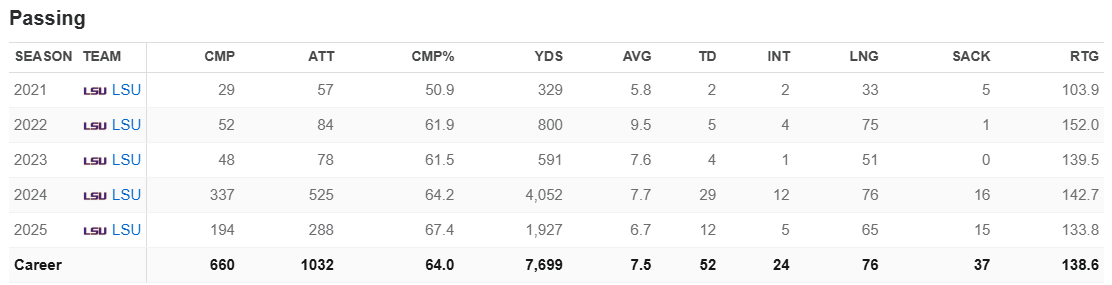
That strong performance steadied his momentum from a good Senior Bowl, pushing him firmly into late Day 2 conversations as a likely third-round pick with backup-to-starter upside.
For fantasy football, it’s a nice boost too: in dynasty leagues, he’s now a more intriguing late-round flier or waiver-wire stash, especially if he lands with a creative coordinator who can scheme around his quick release and gunslinger mentality.
The injury cloud is lifting, and suddenly, Nussmeier feels like a quarterback worth monitoring as the draft unfolds.
Drew Allar - QB, Penn State
Drew Allar, the towering Penn State quarterback standing 6'5" and 228 pounds, came into the 2026 Combine with his stock somewhat battered after a disappointing senior year capped by a season-ending ankle injury. Once viewed as a potential early-round talent with elite size and a cannon for an arm, his draft projection had slipped toward Day 3, making Indy a critical chance to remind teams why he was so highly regarded out of high school.
He skipped the athletic testing to protect that surgically repaired ankle, but his throwing session became the talk of the event.
Allar started somewhat rattled, with errant throws and inconsistent footwork, early on, but he quickly found his rhythm, finishing strong with zippy intermediate routes, effortless deep balls, and clean mechanics that showed no lingering effects from the injury.
His throwing session was excellent and garnered an A from me for winning his group and looking increasingly comfortable, while other analysts commended him for rallying impressively on go balls, comebacks, and fades.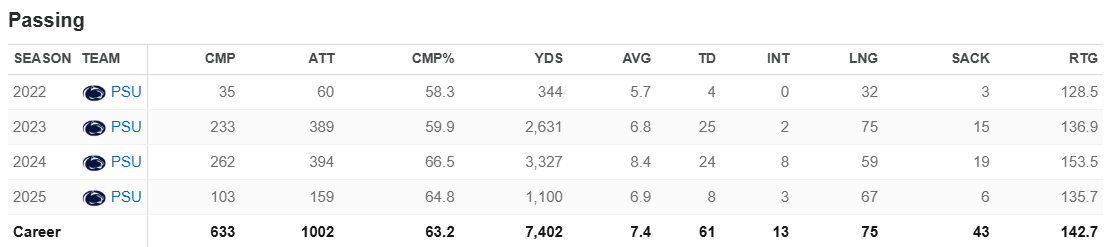
The performance highlighted his live arm and prototypical build, pushing him back into serious Day 2 conversations as a possible late second- or third-round pick with starter upside.
For fantasy football, it's a meaningful bump in dynasty leagues: Allar's combine showing quiets some injury and inconsistency concerns, making him a more appealing mid-to-late rookie draft target or stash with big-play potential if he lands in a system that unleashes that rocket arm.
The arm talent was always there, but now scouts and owners see proof he can still deliver when it counts.
Mike Washington Jr. - RB, Arkansas
Mike Washington Jr., the powerful Arkansas running back out of Utica, New York, arrived at the 2026 Combine as a solid but somewhat under-the-radar prospect after bouncing between Buffalo, New Mexico State, and finally the Razorbacks, where he broke out with over 1,000 rushing yards in his senior year.
Standing 6'1" and a sturdy 223 pounds, he already had the size-speed combo scouts love, but his pre-combine draft stock hovered in the Day 3 range—think late rounds or priority undrafted—with questions about elite burst and first-man elusiveness lingering from his journeyman college path.
The drumbeat that I started months ago will now only get louder after his explosion in Indianapolis: Washington blazed a 4.33-second 40-yard dash—the fastest among all running backs in what was already the quickest RB group in combine history—while posting a lightning-quick 1.51 10-yard split, a 39.5-inch vertical, and a 10'8" broad jump that earned him a perfect 10.0 RAS score, topping every RB tester historically in athleticism metrics.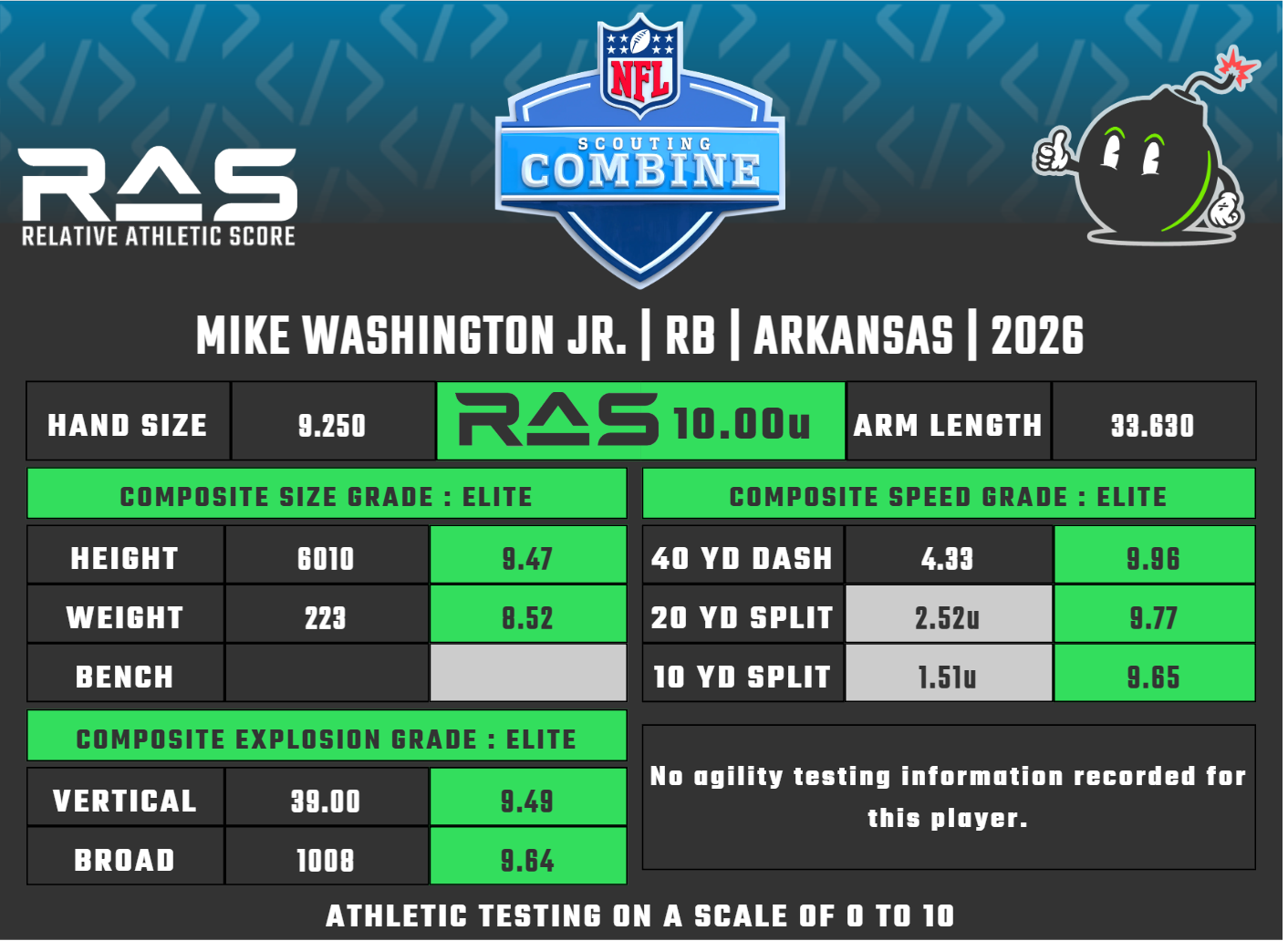
The emotional moment when he saw the time and broke down in tears went viral, but the numbers spoke even louder, turning heads and vaulting him into serious Day 2 discussions, potentially as high as the late second or third round with rotational or even co-starter upside.
For fantasy football, this is a massive glow-up in dynasty formats—Washington jumps from a late-round dart throw to a legit early-round rookie target, especially if he lands in a run-heavy scheme that can unleash his downhill power and sudden home-run ability.
The combine didn't just confirm his traits; it proved he can dominate in testing at big weight, making him one of the clearest winners and a back worth prioritizing in drafts as teams chase that explosive RB spark.
Seth McGowan - RB, Kentucky
Seth McGowan, the Kentucky running back with a winding college path—from Oklahoma (where off-field issues cut things short) to JUCO stints, New Mexico State, and finally a solid 2025 breakout with 725 yards and 12 touchdowns—rolled into the 2026 Combine as a Day 3 hopeful at best, often pegged as a late-round or priority UDFA type due to questions about elite burst, consistency, and his journeyman background.
At 6'1" and around 223 pounds, he brought the physical downhill style scouts liked, but pre-Indy projections had him firmly outside the top 150-200 prospects.
The Combine changed the conversation in a big way: McGowan posted a strong 4.49-second 40-yard dash, then absolutely stole the show with a 42.5-inch vertical (second-highest ever by an RB in modern Combine history) and a 10'11" broad jump that ranked among the best in recent years, earning him a sky-high 9.63 Relative Athletic Score and putting him in elite company for explosiveness at his size.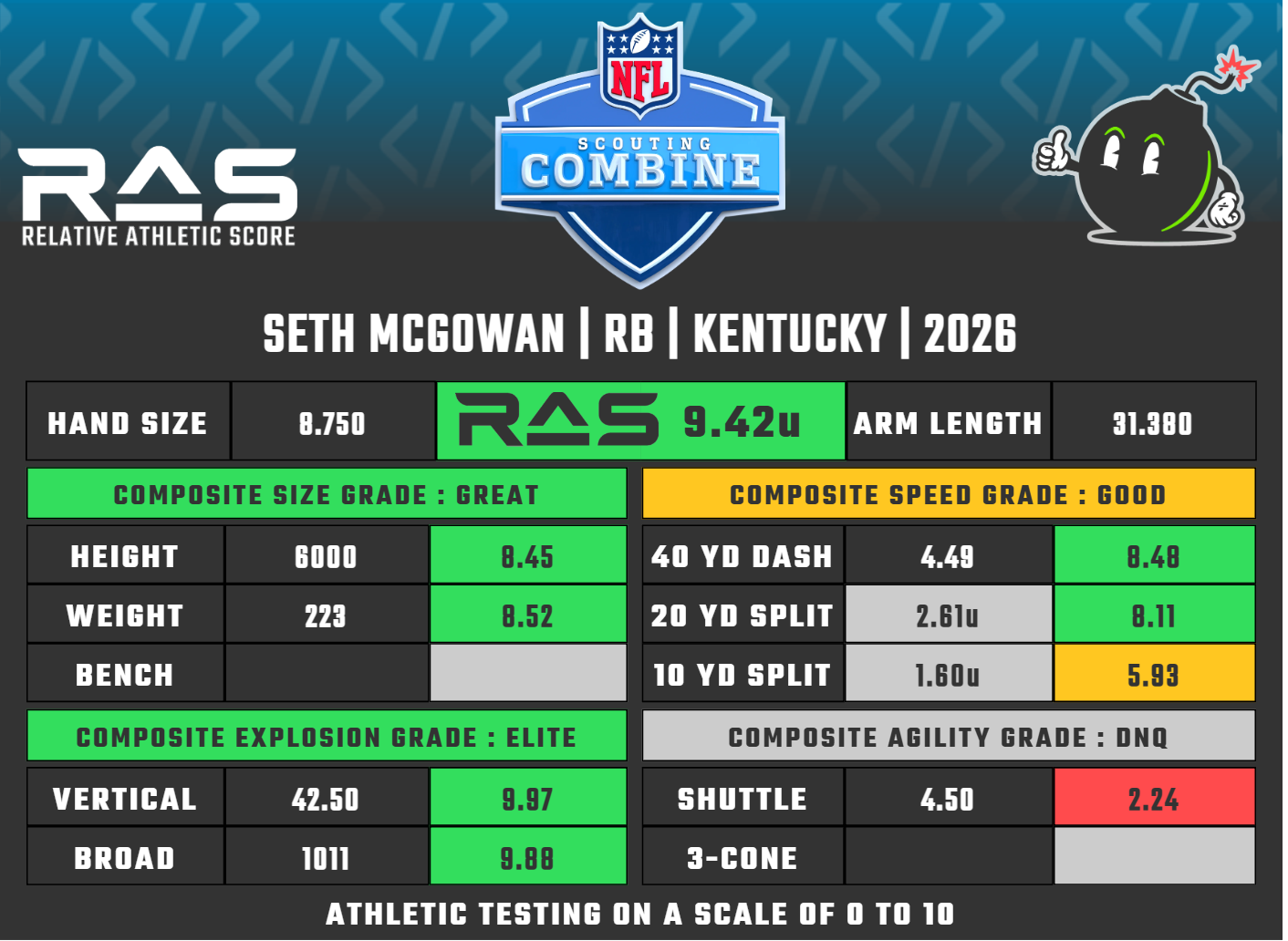
Those jaw-dropping jumps highlighted rare lower-body power and bounce, quieting doubts about his athletic ceiling and turning heads across draft rooms.
Suddenly, McGowan's stock has climbed into solid Day 3 territory—likely a fourth- or fifth-round pick—with teams seeing him as a potential rotational piece or even a committee back who can handle early-down work and pop for chunk plays.
In fantasy football, especially dynasty leagues, this is a serious upgrade: he's gone from a late-round flier or waiver priority to a more intriguing mid-round rookie draft target, particularly if he lands in a physical, run-heavy offense that values his violent style and newfound testing proof.
The tape (which I need to go back and watch more of) still needs to match the traits, but Indy gave him the athletic stamp that makes him worth monitoring as one of the Combine's underrated risers.
Ted Hurst - WR, Georgia State
Ted Hurst, the Georgia State wide receiver who transferred in after starting at Valdosta State, entered the 2026 Combine as a small-school sleeper with solid production—over 1,000 yards in his final college season—but questions about his long speed kept his draft stock mostly in the late rounds or as a priority UDFA.
At 6'4" and 206 pounds, he already checked the big-bodied, vertical-threat box, yet scouts wanted proof he could separate against NFL-level coverage after dominating lesser competition.
Indy delivered in a big way: Hurst clocked a smooth 4.42-second 40-yard dash (faster than many expected for his frame), crushed a top-of-the-class 11'3" broad jump (tied for the best among WRs), and showed off excellent body control and ball-tracking during the on-field drills, including crazy mid-air adjustments that went viral.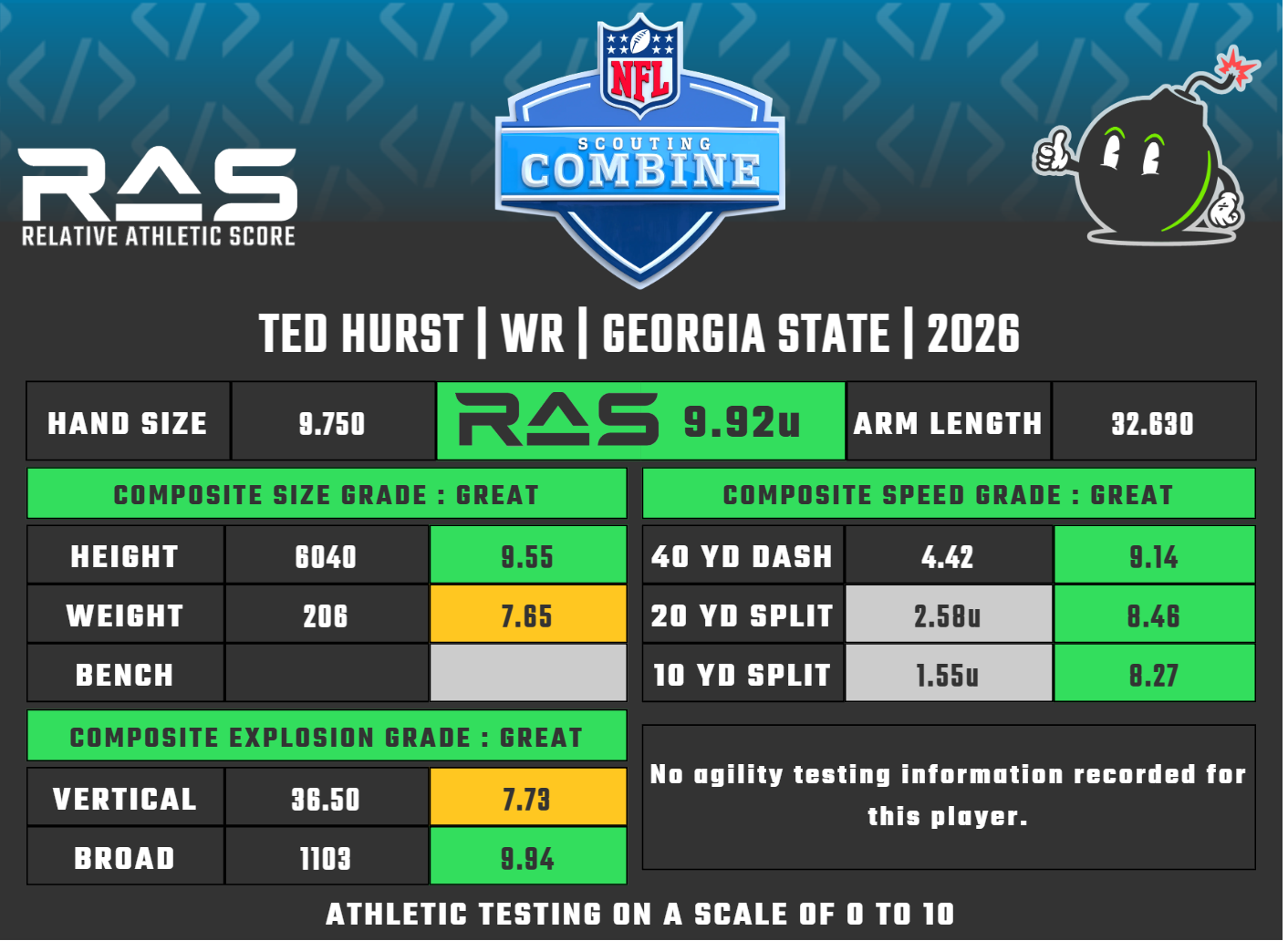
His explosiveness, hip sink for route breaks, and upside beyond just being a deep threat put him in a category as one of my top bets to make post-Combine.
That performance flipped the script, boosting him into mid-to-late Day 2 range—think third or fourth round—with teams seeing starter potential as a field-stretcher who can win contested catches and add YAC juice.
For fantasy football, especially in dynasty leagues, he's a huge riser: Hurst jumps from a late-round dart throw or undrafted afterthought to a worthwhile mid-round rookie pick, particularly if he lands with a quarterback who loves pushing the ball downfield.
The traits were always intriguing on tape, but the Combine gave him the elite testing confirmation that makes him one of this class's clearest winners.
Deion Burks - WR, Oklahoma
Deion Burks, the speedy Oklahoma wide receiver who transferred from Purdue, came into the 2026 Combine as a intriguing but somewhat limited prospect—his 5'10", 180-pound frame and solid-but-not-elite college production (like 57 catches for 620 yards in 2025) had him pegged mostly as a Day 3 pick, perhaps fourth or fifth round, with questions about whether he could truly stretch the field at the next level.
Then Indy happened, and Burks turned into one of the event's biggest fireworks: he blazed a 4.30-second 40-yard dash (third-fastest among WRs and historic when paired with his 26 bench press reps), led the position group with a 42.5-inch vertical jump (best among receivers and elite all-time), and added a 10'11" broad jump that ranked top-five at the spot, posting ridiculous athletic scores that screamed explosive playmaker despite his smaller build.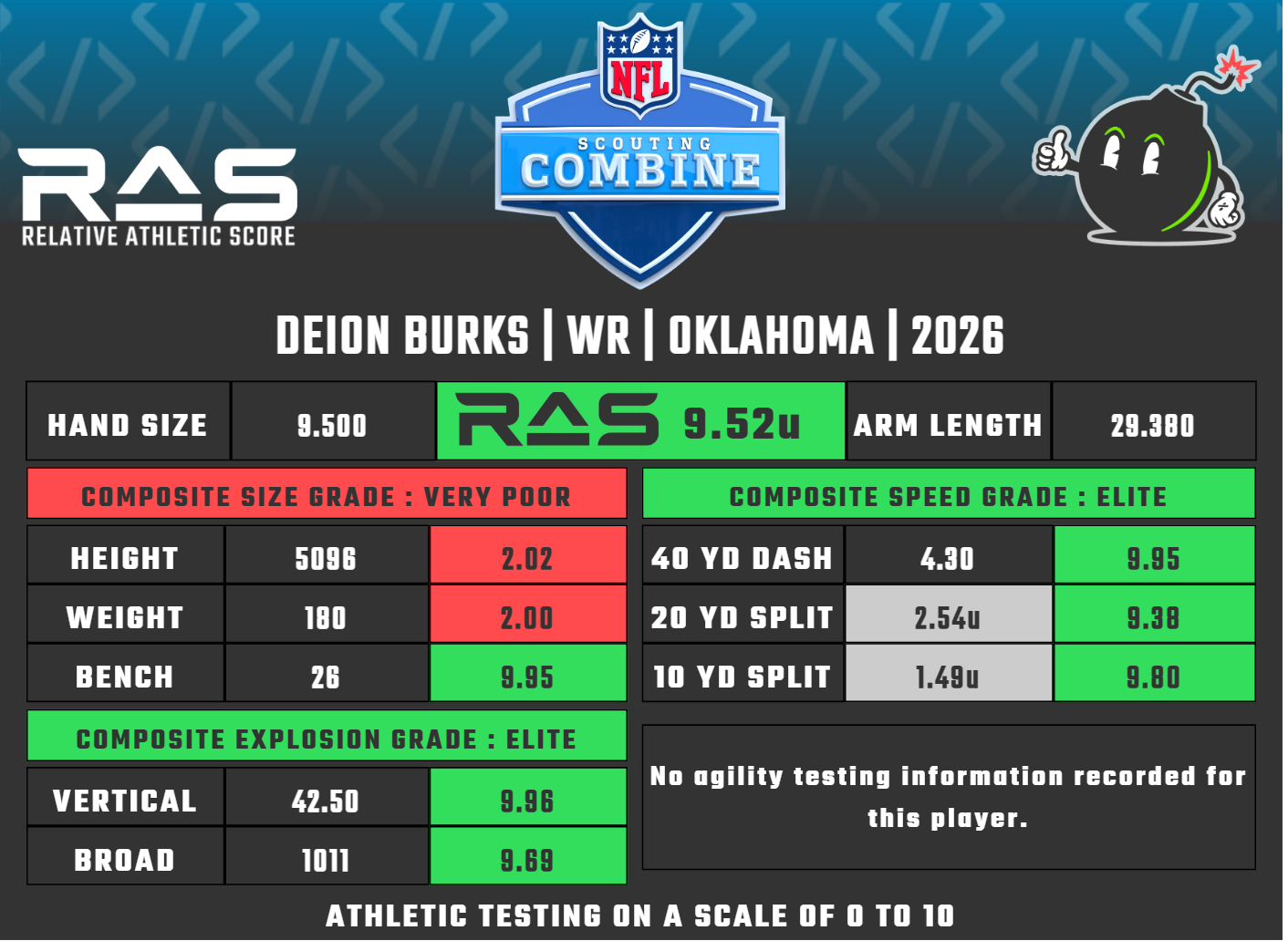
Scouts and analysts lit up over the workout warrior display—his straight-line burner speed, rare lower-body pop, and surprising strength quieted size concerns and highlighted big-play upside as a deep threat or slot gadget guy.
The performance has clearly lifted his draft stock into late Day 2 territory, with many now seeing him as a late third-round possibility or high fourth-rounder with starter potential in the right system.
For fantasy football, particularly dynasty leagues, this is a serious spotlight: Burks jumps from a late-round flier or undrafted stash to a more exciting mid-to-late rookie draft target, especially if he lands with a creative offense that can scheme him open for chunk plays and YAC opportunities.
His tape was a fun but inconsistent watch, but the Combine proved he's got the elite burst to turn heads and produce fantasy-relevant flashes right away.
Eli Stowers - TE, Vanderbilt
Eli Stowers, the Vanderbilt tight end who switched from quarterback at Texas A&M and became a dominant pass-catcher—racking up over 1,400 yards and Mackey Award honors in his Commodores tenure—entered the 2026 Combine as a strong Day 2 prospect, often mocked in the late second or early third round thanks to his receiving polish and athletic frame at 6'4" and 239 pounds.
Pre-Indy buzz had him as TE2 or TE3 (my TE1 going into the Combine) in the class, with some wondering if his lighter build and conversion background might cap him as a specialist rather than a full-time starter.
But the Combine turned him into one of the event's absolute stars: Stowers shattered the tight end vertical jump record with a mind-blowing 45.5 inches (the best at the position since 2003 and third-highest overall in modern history), set another TE record in the broad jump at 11'3", and ran a smooth 4.51-second 40-yard dash that ranked elite for his size, earning A+ grades from myself for the week.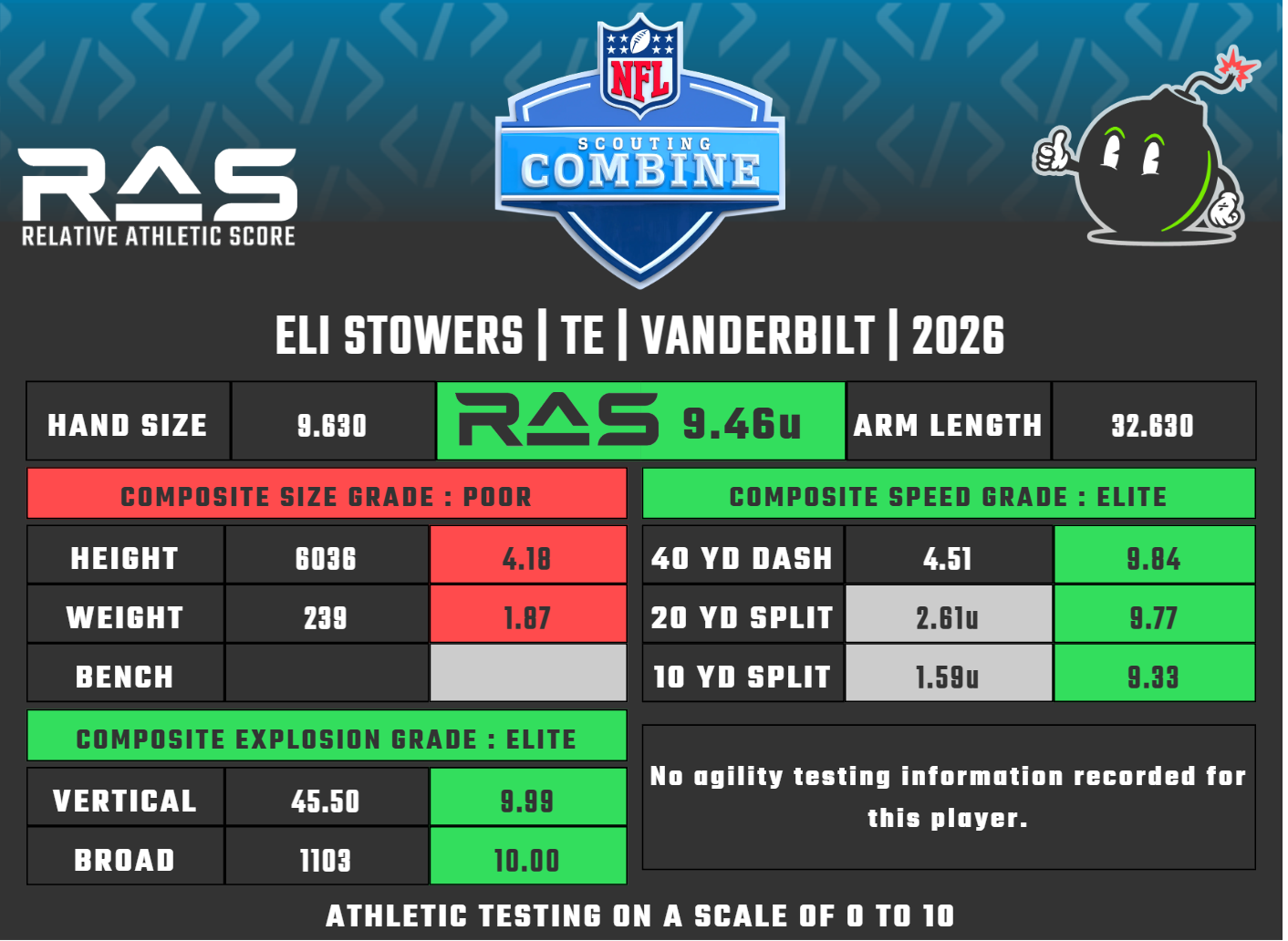
Those explosive numbers erased any lingering doubts about his athletic ceiling, showcasing rare burst and playmaking traits that make him a nightmare mismatch in the seam and red zone.
The performance has locked him in as a probable second-round pick—potentially even climbing higher—with teams viewing him as a high-upside receiving weapon who could start early in the right offense.
In dynasty fantasy football, it's a massive win: Stowers rockets up rookie boards from a solid mid-round target to a premium TE pick, often TE1 or TE2 in the class, worth grabbing in the late first or early second round of rookie drafts, especially in PPR formats where his YAC ability and route-running could deliver immediate TE-relevant production.
The traits were evident on tape, but Indy proved he's got the freakish athleticism to back it up and become a fantasy difference-maker.
Sam Roush - TE, Stanford
Sam Roush, the massive Stanford tight end standing 6'6" and 267 pounds, rolled into the 2026 Combine as a reliable but somewhat one-dimensional prospect—known more for his in-line blocking prowess and high-character makeup than explosive receiving upside after a solid senior year with 49 catches for 545 yards and two touchdowns.
Pre-Indy mocks had him firmly in the Day 3 range, often as a late fourth- to sixth-round pick or priority UDFA, with scouts viewing him as a classic "Y" tight end who could contribute early as a run-game specialist but needed to prove he wasn't just a blocker at the next level.
The Combine flipped that narrative hard: despite his heavyweight frame, Roush ran a respectable 4.70-second 40-yard dash (impressive for his size), posted a 38.5-inch vertical (top-three among TEs), cleared 10'6" in the broad jump, and crushed a 7.08-second 3-cone drill that ranked elite for big-bodied tight ends, earning him sky-high athleticism grades (third among TEs in many metrics) and SPORQ percentiles in the 90s.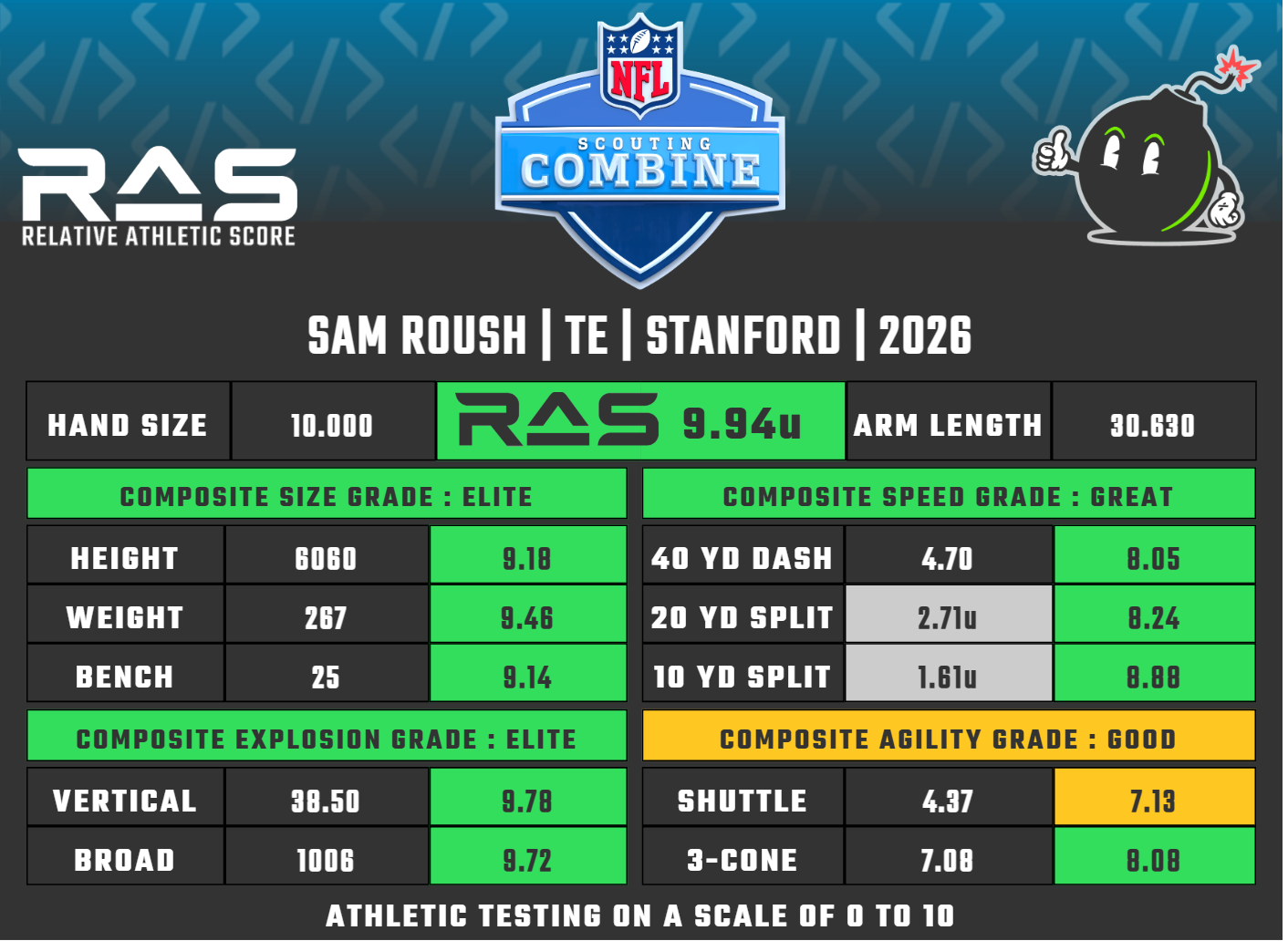
He showcased rare agility and burst for someone so heavy, quieting concerns about limited athletic traits and highlighting his potential as a multi-role contributor who can block, catch seams, and even win in the red zone.
That performance has boosted his draft stock into solid Day 2 conversations—likely a fourth-round selection—with teams now seeing him as an immediate TE2 with starter upside in balanced offenses that value his blend of power and surprising movement skills.
In dynasty, it's a meaningful standout: Roush moves from an afterthought to an intriguing late rookie draft target, especially in formats that reward versatile TEs who can rack up yards and occasional scores if they land in a pass-friendly system.
The tape showed that there were tools in the shed to work with, but Indy proved he's got the freakish athleticism at ridiculous size to become a legit fantasy-relevant piece down the line.
LOSERS
Cade Klubnik - QB, Clemson
Cade Klubnik, the Clemson quarterback who once carried first-round hype after a stellar 2024 campaign, headed into the 2026 Combine with his stock already cooled by a bumpy senior season—lower production, more inconsistency, and a slide into Day 3 projections as teams questioned his processing and arm strength at the next level.
At 6'2" and 207 pounds with solid but not elite measurables (9¼-inch hands, 31⅛-inch arms), he was viewed as a developmental dual-threat type who needed to flash the athleticism that made him special in college to climb back up boards.
The big miss came when Klubnik opted out of all athletic testing, including the 40-yard dash—surprising for a mobile QB known for quickness and RPO playmaking—leaving scouts without fresh proof of his burst or escapability that could have countered the tape concerns from 2025.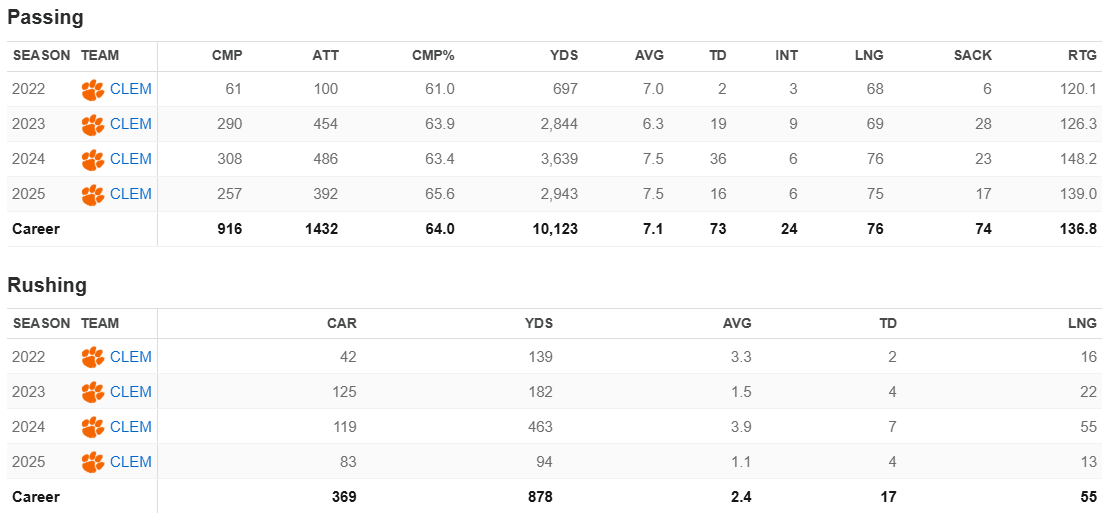
His throwing session was mostly positive with adequate accuracy, nice touch on deep and intermediate balls, and steady footwork, but it didn't wow like some peers who combined strong workouts with blazing testing numbers.
That decision to skip the runs and jumps kept his momentum flat rather than providing the jolt needed to reclaim higher-round buzz, leaving him likely stuck in the late Day 2 to early Day 3 range—perhaps a fourth- or fifth-round pick—as a backup prospect with spot-start upside in the right scheme.
For fantasy football in dynasty leagues, it's a slight drag: Klubnik stays a late-round rookie dart throw or deep stash rather than a more exciting mid-round target, with his ceiling capped unless he lands in an offense that schemes around his mobility and touch—managers will want to see him prove the athletic traits on the field before pushing up rookie drafts.
The arm showed up fine, but passing on the testing left just enough doubt to hinder what could have been a bigger rebound story.
Emmett Johnson - RB, Nebraska
Emmett Johnson, the Nebraska running back who exploded for over 1,400 rushing yards and 15 total touchdowns in 2025, entered the 2026 Combine as a rising Day 2 prospect—often mocked in the late second to early third round—with scouts loving his vision, contact balance, receiving skills, and three-down potential at 5'10" and 202 pounds.
He was viewed as a possible RB2 (My RB2 before the Combine) or RB3 in the class, with his efficient, jitterbug style making him a fit for modern offenses that value pass-catching backs.
The testing session in Indy didn't deliver the boost he needed: Johnson posted a 4.56-second 40-yard dash—the slowest among the RBs who ran—along with a middling 35.5-inch vertical and 10-foot broad jump that ranked toward the bottom of the group, resulting in a low Relative Athletic Score (around 6.16, dead last among testers this year in some metrics) and subpar speed/explosiveness percentiles.
While his short-area quickness shone in drills like a strong 4.29-second shuttle, and on-field work showed good hands and downhill burst, the lack of elite burst or top-end speed raised fresh questions about his home-run ability against NFL defenses.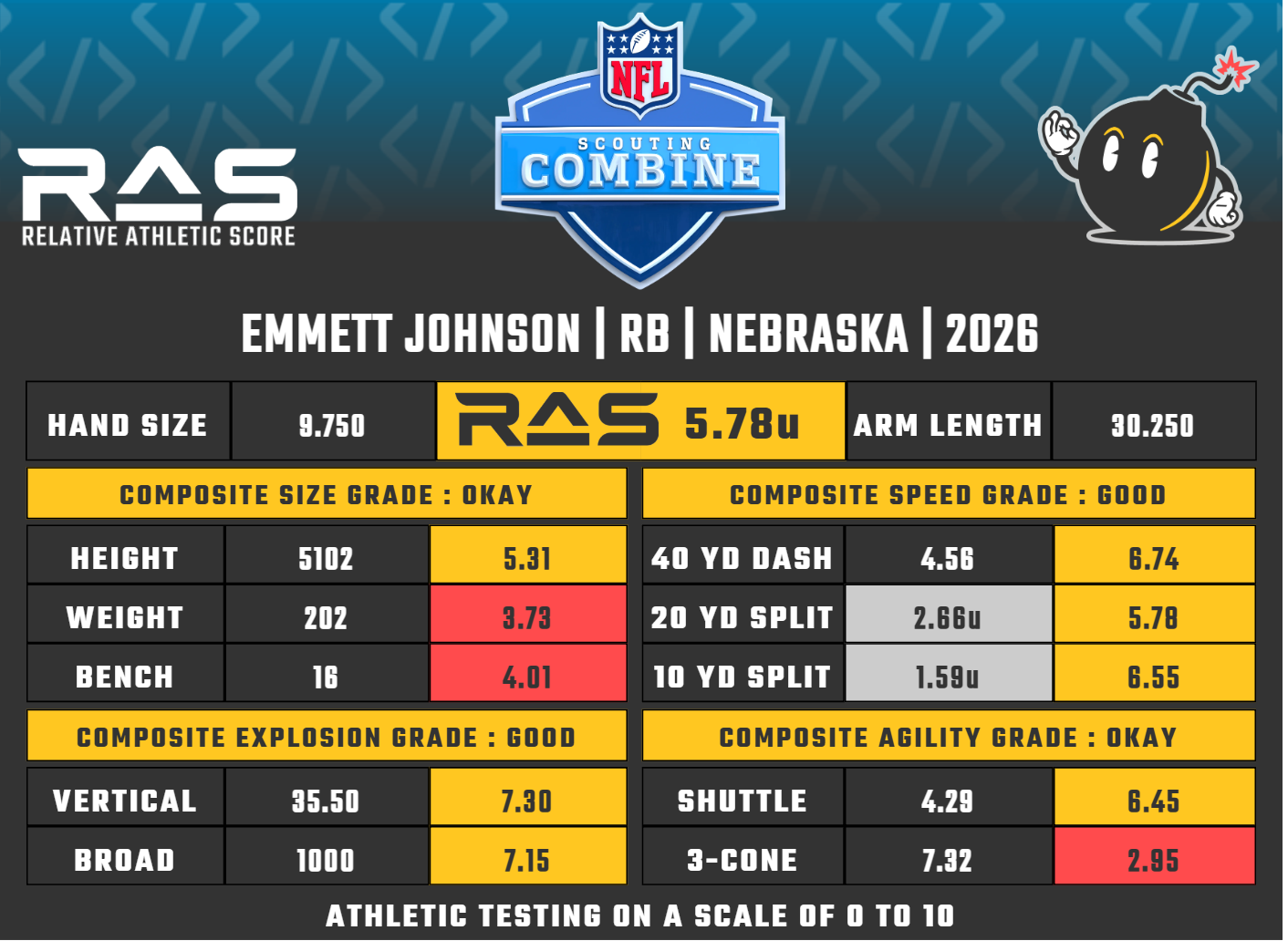
That underwhelming athletic showing has cooled his momentum, likely dropping him out of firm Day 2 consideration and into the mid-to-late Day 3 range—think fourth or fifth round—as teams weigh his high-floor traits against the testing concerns in a loaded RB class full of faster risers.
For fantasy football in dynasty leagues, it's a noticeable hit: Johnson slides from a potential early rookie draft pick with RB2 upside to more of a mid to late-round target, where his receiving chops and efficiency could still yield value in PPR formats, but the limited explosiveness caps his ceiling as a true every-down fantasy starter unless he lands in a perfect scheme.
The tape remains strong, but Indy left some doubt that he'll need to erase at his pro day or in camp.
J'Mari Taylor - RB, Virginia
J'Mari Taylor, the compact Virginia running back who transferred from North Carolina Central and delivered a strong 2025 season with 1,062 rushing yards and 14 touchdowns on 4.8 yards per carry, entered the 2026 Combine as a Day 3 prospect with mid-round buzz thanks to his contact balance, vision, and three-down potential at 5'10" and 199 pounds.
Scouts saw him as a potential zone-scheme contributor or change-of-pace back, but hoped for testing numbers that could push him into firmer third- or fourth-round territory in a deep RB class.
Instead, his athletic workout fell flat: Taylor recorded a modest 34.5-inch vertical (middling for the group) and a disappointing 9'7" broad jump that ranked near the bottom among tested RBs, with no 40-yard dash time posted and several drills skipped or not standout.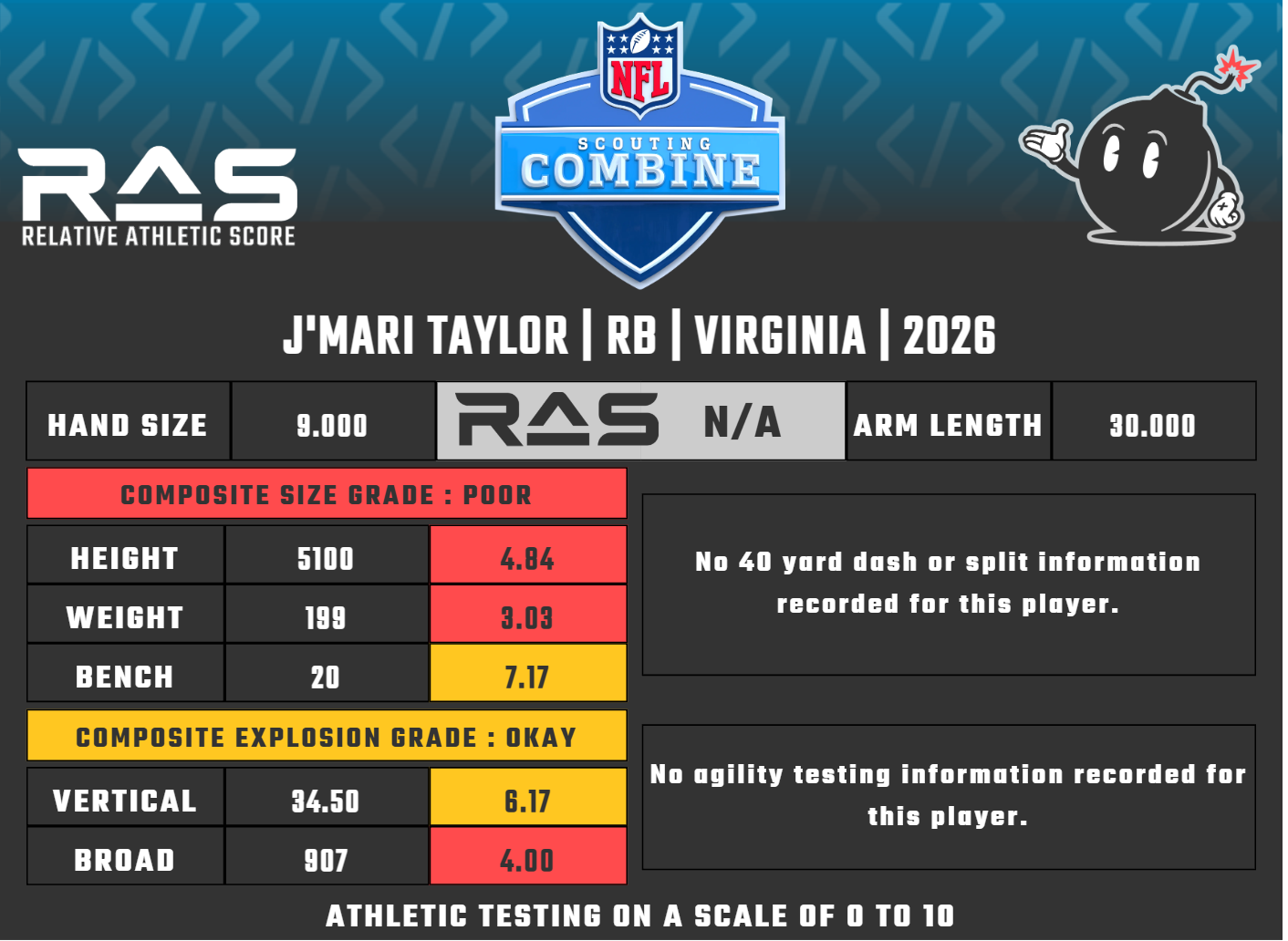
Those lackluster explosiveness and lower-body power metrics—especially the poor broad jump—did little to counter concerns about his limited long speed and elite burst, leaving evaluators wanting more proof he could create consistent big plays against NFL fronts.
The underwhelming showing has likely kept his draft stock stagnant or slightly cooled, cementing him in the late Day 3 range—probably a fifth- or sixth-round pick or priority UDFA—with teams viewing him more as a rotational or special-teams piece rather than an immediate impact back.
For fantasy football in dynasty leagues, it's a minor setback: Taylor drops from a potential mid-to-late rookie draft target with committee upside to more of a late-round flier or waiver-wire stash, where his receiving skills and efficiency could still produce PPR value if he lands in a favorable system—but the testing didn't provide the athletic pop to elevate his ceiling as a fantasy-relevant starter.
The tape shows a tough, productive runner, but Indy highlighted traits that might limit his role at the next level.
Denzel Boston - WR, Washington
Denzel Boston, the Washington Huskies wide receiver who stepped up as a primary target after the departures of stars like Rome Odunze, entered the 2026 Combine with legitimate late-first-round buzz—thanks to his 6'4", 212-pound frame, elite contested-catch ability (winning most of his battles last season), and reliable hands that made him a red-zone nightmare.
Pre-Indy mocks often slotted him in the back half of Round 1 as a big-bodied X-receiver with Mike Evans-like traits, though scouts already had quiet concerns about his top-end speed and ability to separate against press coverage.
The workout didn't help those doubts: Boston skipped the 40-yard dash entirely (a bold choice that left no fresh proof of his straight-line burst), posted a middling 35-inch vertical that ranked around average for WRs, and turned in a shaky on-field session—starting with drops in the gauntlet before rebounding somewhat with solid hip sink and route finishes, but never truly exploding in cuts or showing suddenness that could silence speed questions.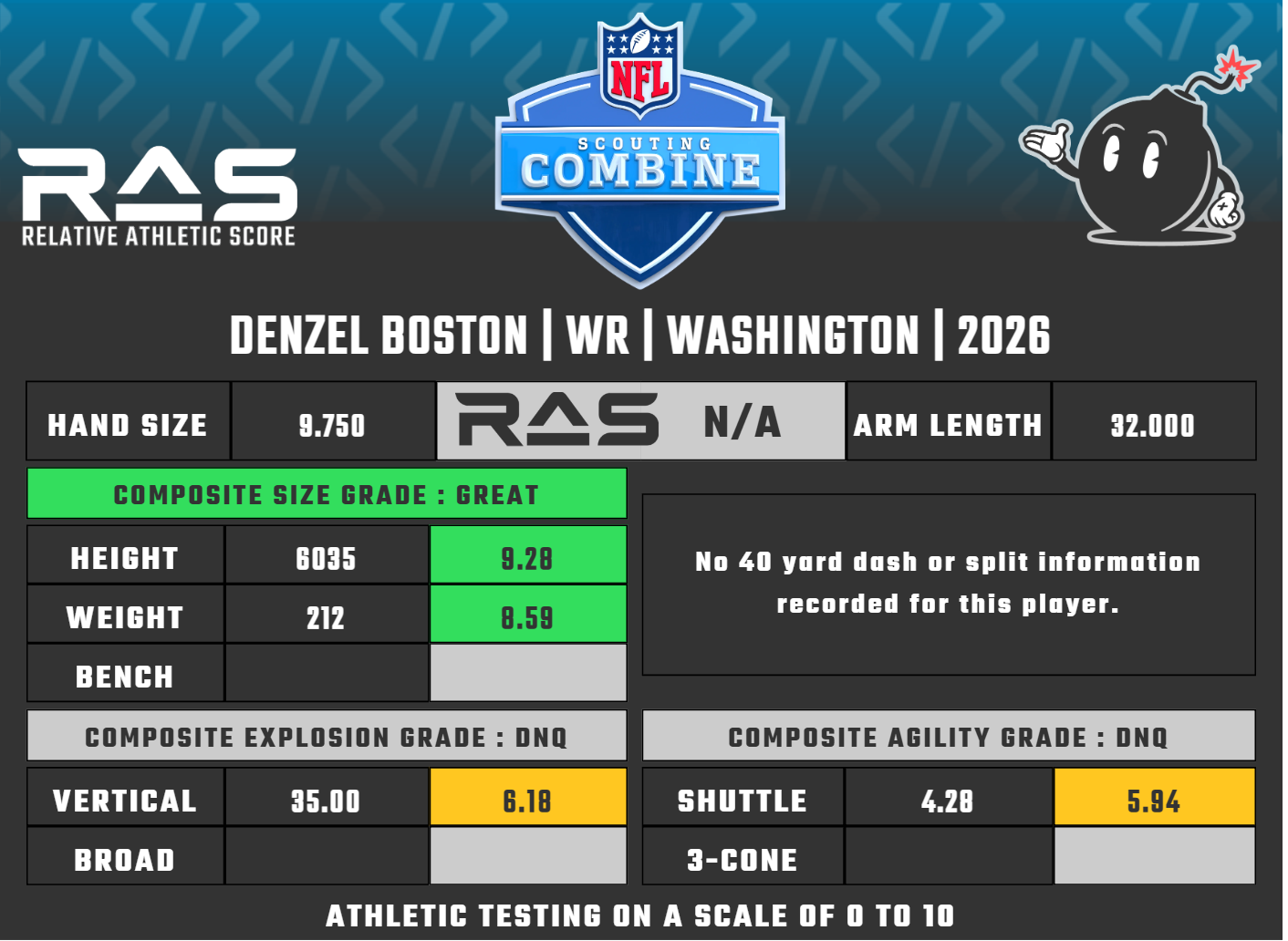
It was a very meh performance that garners a grade of C+ from me, and his athletic score landed low among the group despite strong production metrics.
That underwhelming performance has dinged his momentum in a stacked WR class, likely pushing him out of firm first-round consideration and into early second-round range as teams weigh his high-floor ball skills and toughness against the testing red flags that reinforce separation limitations.
For fantasy football in dynasty leagues, it's a noticeable step back: Boston slips from a potential high-end rookie pick (WR2 upside early in his career) to more of a late first or early-second target, where his ceiling as a volume-dependent possession guy feels capped unless he lands with an accurate deep-ball QB who can scheme him open.
The tape still screams starter potential, but Indy highlighted traits that could limit his explosiveness and immediate fantasy pop.
Malachi Fields - WR, Notre Dame
Malachi Fields, the Notre Dame wide receiver who transferred from Virginia and became a reliable big-bodied target—averaging over 17 yards per catch with a tiny drop rate in his final season—entered the 2026 Combine riding momentum from a strong Senior Bowl that had him flirting with late-first-round buzz as a 6'4½", 218-pound X-receiver with contested-catch prowess and physicality.
Pre-Indy mocks often pegged him in the back end of Round 1 or early Day 2, with scouts excited about his catch-point dominance but already whispering about potential speed limitations for a guy who thrived on go routes and fades.
The testing session in Indianapolis didn't deliver the needed reassurance: Fields ran a sluggish 4.61-second 40-yard dash (one of the slower times among WRs, ranking near the bottom of his group and drawing comparisons to underwhelming big receivers), paired it with a respectable but not elite 38-inch vertical and 10'4" broad jump, and turned in a middling 6.98-second 3-cone that left his overall athletic profile looking average rather than explosive.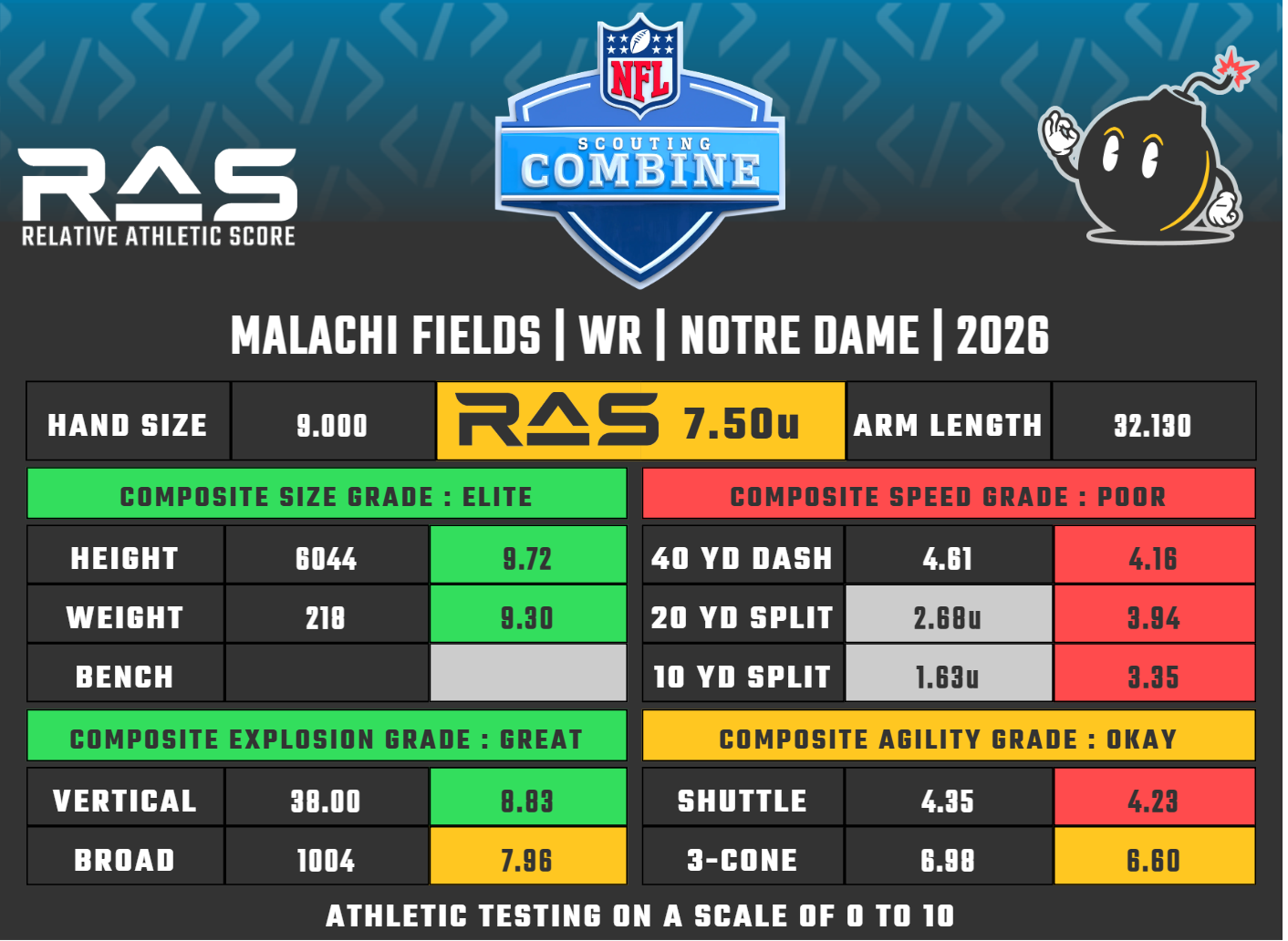
While he showed good play speed in the gauntlet (hitting over 19 MPH in some routes) and recovered somewhat with solid route finishes, the slow-timed speed reinforced long-standing separation concerns in a deep WR class full of burners.
That disappointing athletic showing has taken a bite out of his draft capital, likely sliding him out of first-round contention and into the mid-to-late Day 2 range—think second or third round—as teams now view him more as a high-floor possession guy who'll need scheme help to win consistently rather than an immediate alpha.
For fantasy football in dynasty leagues, it's a clear setback: Fields drops from a potential late-first or early-second rookie draft target (with WR2 upside in the right offense) to more of a mid-to-late second or early-third pick, where his ceiling feels capped as a volume-dependent red-zone threat unless he lands with a quarterback who can throw him open and maximize his catch radius.
The tape still highlights a tough, reliable producer, but Indy highlighted enough athletic red flags to make fantasy owners pump the brakes on early hype.
More Fantasy Football Analysis
Download Our Free News & Alerts Mobile App
Like what you see? Download our updated fantasy football app for iPhone and Android with 24x7 player news, injury alerts, rankings, starts/sits & more. All free!