



 RADIO
RADIO









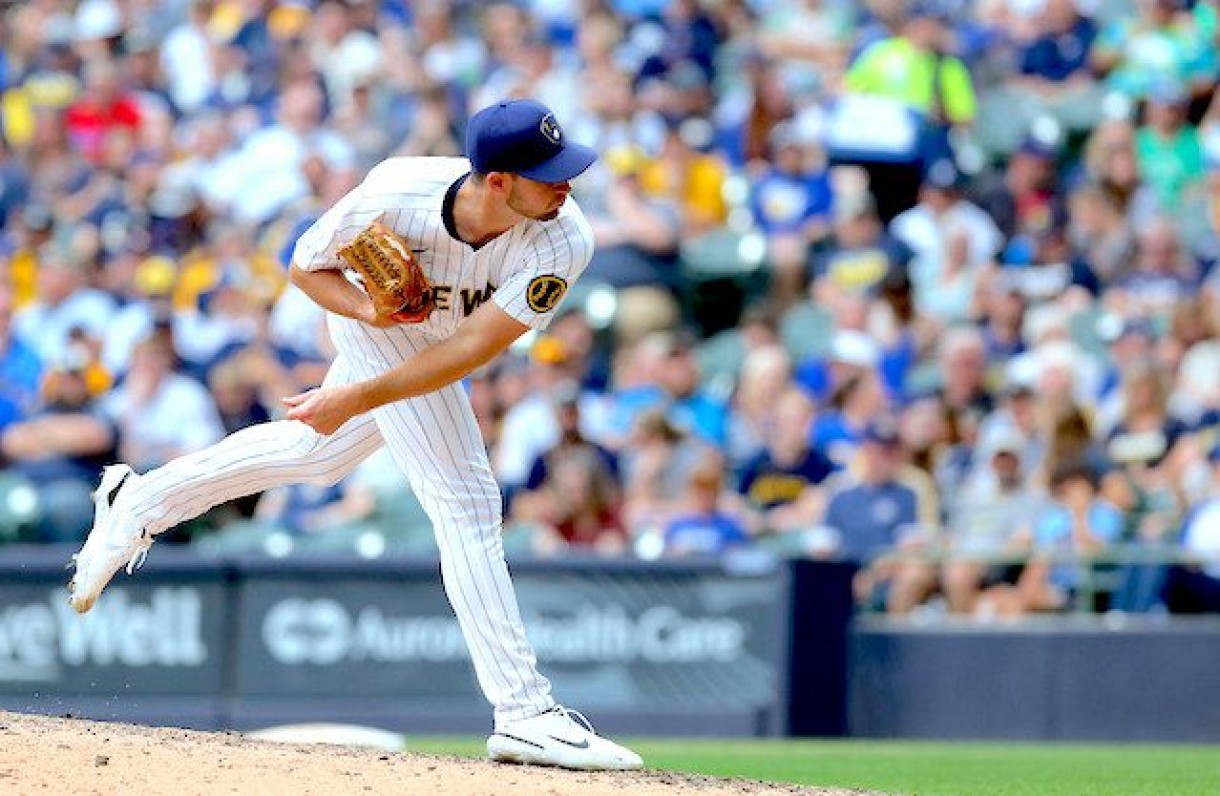
Nick explains how to win 2026 fantasy baseball leagues using relief pitchers to build pitching aces. He uses JB’s FrankenAces bullpen method to identify draft sleepers.
Six years ago, our beloved JB Branson published an article breaking down his favorite successful fantasy baseball strategy. The Bullpen Method is a lifestyle that reflects the importance of balance on a fantasy team. That turned into an annual Bullpen Method article, with the 2023 version nominated for the FSWA's Baseball Article Of The Year award, and this is my third season writing it up.
You need a steady and consistent approach, which means zigging from the traditional over-reliance on starting pitcher zag. One winds up relying on pure volume for wins and strikeouts while often yielding ERA and WHIP, unless you go SP-SP early and struggle offensively. There are a precious few SPs beyond the first five rounds to trust with one's ERA and WHIP, and most are clamoring for their services.
The opportunity cost of a roster spot on RPs is worth it, especially when most of these picks come late! We encourage you to give the bullpen method a shot before your 2026 fantasy baseball draft. This year, I am going to spend our time with an introduction for newcomers, an example of two vying FrankenAcing managers from one of my 2025 leagues, overall saves and bullpen trends over the last five years, and then our 2026 targets.
Featured Promo: Save 50% off the regular price with discount code CHAMP, for a limited time. Exclusive access to our Team Sync platform, DFS cheat sheets, Lineup Optimizers, betting/prop picks, and exclusive content from Nick Mariano and Eric Cross! GAIN ACCESS NOW
Breaking Down JB's Bullpen Method
In a standard league, one typically rosters 11-13 pitchers. Of those, five or six will be starters. This leaves seven or eight relief pitchers, and one shouldn’t care if they are preseason “closers.” Notable FrankenAce alumni are Devin Williams in 2020, Jonathan Loaisiga (2021), Jhoan Duran (2022), Bryan Abreu (2023), Cade Smith (2024), and Adrian Morejon (2025).
This is the bullpen mentality, realizing that most starting pitchers are heavily overrated in fantasy and, subsequently, relief pitchers (especially setup men) are heavily underrated. Once you come to this epiphany, you can immediately take advantage of this blind spot and zoom ahead.
*Disclaimer - Please do not attempt this method in Points Leagues. Points leagues are made for heavy-volume starters and elite closers. This method crushes Roto leagues, where balance is king, and in H2H leagues, where you can easily beat your opponent in three of the five pitching categories (all five if you are a talented SP streamer).
Building FrankenAce Relievers
The first question most people ask when they see the outline is, "How can you win without drafting aces?" Well, there are two answers. First, draft the sleepers that become aces. Easy, right? The second and most important answer is that YOU BUILD THEM WITH RELIEVERS.
Like Frankenstein, you can put together a stud ace with unwanted scraps from the waiver wire or later in the draft. This is the heart of the Bullpen Method. (Aaron Bummer and Drew Pomeranz will always have a place in our hearts and on the FrankenAce logo.)

Past FrankenAces
The 2021 FrankenAce Award saw Chad Green and Tyler Rogers combine for 17 W, 19 SV, 154 K, 2.68 ERA, and a 0.97 WHIP. The first SP off the boards, Gerrit Cole, finished with 16 W, 0 SV, 243 K, 3.23 ERA, and a 1.06 WHIP. In 2022, a late combo of Ryan Helsley and Clay Holmes delivered 16 W, 39 SV, 159 K, 1.90 ERA, and a 0.88 WHIP. The AL Cy Young Award winner, Justin Verlander, had a similar 18 W, 0 SV, 185 K, 1.75 ERA, and a 0.83 WHIP.
In 2024, we saw Mason Miller (ADP: ~250) and a waiver-add Cade Smith vault teams with 140 1/3 IP, 8 W, 29 SV, 207 Ks, 2.18 ERA, 0.89 WHIP. Tarik Skubal had 228 Ks with a 2.39 ERA and 0.92 WHIP in 52 more innings, getting 10 more wins in the process. But at what cost? A heck of a lot more, that's for sure!
Come 2025, Adrian Morejon and Ronny Henriquez gave us this: 146 2/3 IP, 20 W, 10 SV, 168 Ks, 2.15 ERA, 1.03 WHIP. I won't even "cheat" with Smith, despite his ADP of roughly pick 300. Max Fried, the SP11 per Yahoo's 5x5 scoring, got you 19 wins with a 2.86 ERA, 1.10 WHIP, and 189 Ks in 195 1/3 IP. So again, about 50 innings to flex with a good ratio base and counting stats sprinkled on to match an SP1.
We are not only making FrankenAces out of late-round picks/free-agent pickups, but building an incredible offense that no one else can touch as they spend early picks on pitching. That is the soul of the Bullpen Method and how it is so effective. Cement your offensive categories and then win/catch up on pitching categories on the back end with an undervalued resource pool.
Bullpen Method Drafting Strategy
As we've said, and will probably say a few more times, this is not a black-and-white strategy. You can't say, "I drafted Edwin Uceta because JB and Nick said relievers were better than starters, and he stunk, so I lost." That's why it is more of a state of mind, where names don't matter.
All you care about is numbers. If one guy isn't getting it done, move on, even if he is getting saves. It can feel counterintuitive to deprioritize saves when looking at RPs, but I'll take this strategy over stubbornly holding Jordan Romano, Luke Jackson, Camilo Doval, etc.
Originally, it seemed that when you took your pitchers didn't much matter, but this past year solidified my stance that in the current landscape, you need to be patient with fleshing out the rotation. Names may not matter to us as you pursue those 5-6 arms to get you IP, W, and K to keep you afloat in those categories, while your bullpen does the rest. But lately, the pool of bats that I trust as a bedrock feels shallow.
Typically, I'd insert a mock draft here, but I don't feel that this is the best use of our time and energy. At least, not when I have a real example from last season to use (later). It boils down to the first half of the draft focusing on the bats before turning to the arms.
Here are the earlier arms I'm hoping slide as my SP1: Chris Sale, Logan Gilbert, Hunter Greene, and Cole Ragans. I'd love to have Eury Perez as my SP2, but I'll bet his ADP continues to rise. Fortunately, most of my buddies still prefer Yahoo, where his ADP of 125 on Feb. 5 lags most other platforms by over a full round.
Anywho, if you've followed the blueprint, then most site projections are going to hate you due to lower pitching "volume," aka innings/starters alone. Breathe, you're okay. The offense is competing for the top spot in all categories because of the number of early bats, while the RPs and selective starters should have you comfortable in Saves, ERA, and WHIP.
Some successful SP streaming throughout the season can vastly improve the K totals for some extra first-place padding, especially in daily-roster move leagues. Wins will take care of themselves, as all great RP tend to beat conservative win projections.
Okay, let's get down to business. First, we are going to analyze a redraft league I played in last season, where I ran into another FrankenAcer. Then, we'll check in on how reliever and save trends are rolling with 2025 in the bank. Eager beavers can scroll all the way down to the picks, of course.
FrankenAcing Among Friends (When Two Teams Simultaneously Use This Strategy, Do’s & Don’t’s)
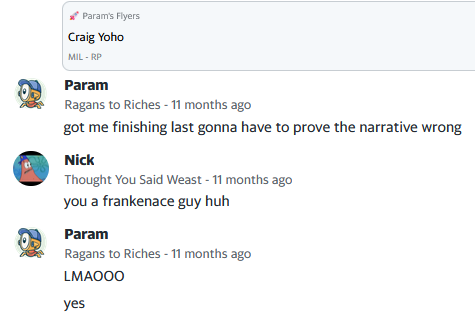
I’d joined a Yahoo baseball league off the private prize league forum with a buddy of mine and wound up competing for resources with a fellow FrankenAce enjoyer in the draft. I was aware of a similar build going on, and then he said Yahoo’s projections hated him (a staple) and took Craig Yoho. The jig was up!
It was a roto league with corner and middle infielders, five outfielders, two Util slots, three starting pitchers, three relievers, three “P” spots, and seven bench spots. Relevant to our interests, there was a 1,400-inning maximum.
Spoilers, but I handily won the league, and figured I might use this to examine things further. Especially because I did not “crush” the draft, it just set the table so well. For starters, I had the No. 2 pick and fell into Shohei Ohtani after Bobby Witt Jr. kicked off the party.
There’s no getting around how much that helps! But I did wind up trading for Emmanuel Clase about a month before the suspension dropped, so c'mon, it wasn't all luck.
I took players who were either going to give me a strong power base relative to the field at their position (Ketel Marte, Junior Caminero) or fill out both power and speed without sacrificing my average. Marte, Caminero, Jazz Chisholm Jr., and Teoscar Hernandez joined Ohtani to set the table.
The guilty pick was going with Chris Sale in the fourth round, earlier than usual, but I had him far higher on my board, before taking Jeff Hoffman as my “big” closer in the eighth round. Other key picks wound up being Pete Crow-Armstrong in the 11th and Trevor Story in the 22nd. By then, I could keep targeting HR+SB profiles because I trusted my AVG base.
To once again illustrate the power of the process, Hoffman was joined by the likes of Justin Martinez, Griffin Jax, Jason Adam, and Uceta. The late reliever picks were joined by fliers in Cam Smith and Jacob Wilson. By the 24th round, I only had Sale, Spencer Schwellenbach, and Carlos Rodon as SPs.
You'll note that the RP core wasn't even that good in the end, but the mentality meant I was locked in and got the Henriquez/Morejon combo, as well as Andrew Kittredge, Jose A. Ferrer, and so on.
Where I believe our pal picking ninth went wrong, beyond some poor injury luck, is stacking risky young bats, not building a healthy enough speed foundation early, biting on the early RP, and giving in too quickly to the SP pivot. Many steps just felt slightly off.
He took Cole Ragans in the third, Miller in the fifth, and then ripped off Hunter Brown (10th), Bryan Woo (12th), Kodai Senga (13th), and Lucas Erceg (14th). I waited until the 14th for my SP3 and the 16th round for my RP2. Relying on Oneil Cruz, Brenton Doyle, and Mark Vientos early was exceptionally volatile.
He made great picks such as Zach Neto in the 16th and Byron Buxton in the 19th, when risk is easily worth it, before getting a FrankenAce superstar (Cade Smith) in the 21st. We each wound up with 100 or more strikeouts than innings. This left me competitive in the Ks category with those who invested more into pitchers, despite my relatively light SP investment.
Player takes will rule the day, but structurally, you must read the room. I think he did far more correctly than incorrectly, but you come at the King, you best not miss!
Saves Landscape Going Into 2026
It’s natural to look around these days and feel as though the bona fide closer is dying off, with committees and firemen coming to take your precious RP1 security blankets like the bogeyman. Let us first set the stage regarding how saves, and even “solds” (saves + holds), are trending these days.
That means raw volume, as a rate stat, and year-to-year repetition. Let's first look at raw save threshold markers reached in each of the last five seasons, with the number of those repeating the mark under that.
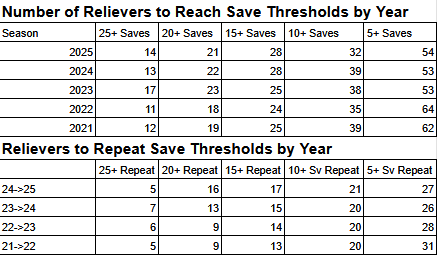
We’ll naturally focus on last year, with 2025 continuing a slight upward trend in the number of RPs to reach 15+ saves. What fell off was the next step down, as only 32 reached double digits, compared to 35-39 in each of the four previous seasons. And finally, the number of relievers to hit even five remained below 55 for a third straight year after higher totals in '21 and '22.
While the raw volume seemed steady, it’s worth noting that the higher end of the totem pole showed more stability than we’re used to. The number of RPs who reached 20-plus, 15-plus, and 10-plus saves in ‘25 after also doing so in ‘24 was the highest in four years. Seeing 21 RPs repeat the 10-plus mark while the overall number dropped meant that fewer new options emerged.
Don’t overreact to one season, but it’s important to put last year into the context of this modern era of bullpen management. Health, the prospect pool, trades, parity, and more will contribute to the variance, and we must respect the nature of the beast.
Let’s safeguard against some degree of injury and look at those who recorded a save in a certain percentage of their appearances. We’ll set the cutoff to those who played in at least 20 games.
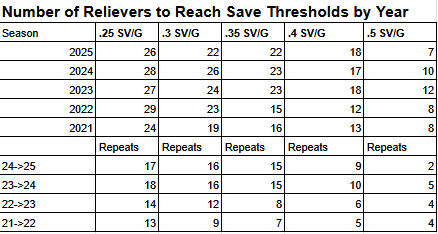
You’ll note that 2025 was quite stable compared to ‘24 and ‘23 in particular, except for a drop in those who snagged a save in at least 50% of appearances. The same is true for the tally of RPs who repeated the mark. Going from 2024 to ‘25 nearly mirrored ‘23 into ‘24, except only two repeated the 50% rate.
And guess what? Neither is a closer at this time. Emmanuel Clase is reaping the ill-thrown sliders that he sowed, and Robert Suarez is setting up Raisel Iglesias. We can never get too comfortable.
What does this mean for 2026? Nothing finite. But I believe this hammers home the importance of being open-minded and flexible during your draft and throughout the year on the waiver wire.
We've enjoyed good health and more solidified save shares lately, so getting the Morejon-esque stats in the bank while others drown chasing ugly saves can be a differentiator. But you could also say that we've seen good fortune in the higher repeat rates compared to 2022 and '23. Keep the light on and let's see who emerges.
2026 Relief Pitcher Draft Targets
We must acknowledge and recognize that ADP is a loose orientation point in non-standard drafts, as key studs such as Abreu will get pushed up with most in the know. However, most rooms are still anchored by default ADP, leaving us with buying opportunities.
This won't be exhaustive, but I'll try to stick to RPs I feel are underdiscussed or whose 2025 stats may undersell their appeal in '26. This season, once I reach the second half of the draft and start filling those pitcher slots, these are some late-round relievers I'm targeting to build some FrankenAces:
Griffin Jax / Garrett Cleavinger, TB - ADP: 218 / 413
Pete Fairbanks is off to Miami, which reopens the door to everyone with a strong reputation in Tampa’s bullpen. Don't overlook the effects of going back to Tropicana Field from George M. Steinbrenner Field for pitchers.
As I noted in my Top 150 Saves+Holds piece, you can widen the lens and include Bryan Baker and get four TB RPs who had a SIERA under 2.85 last year, which is four within the top 21 of 191 RPs (min. 40 IP).
Jax frustrated fantasy managers in Minnesota by sprinkling meltdowns in between the usual shutdown frames, including 10 earned runs in his first nine games. He had a .484 BABIP in April, as well as a .421 mark in June. The Rays saw him push through some troubles in August after acquiring him, as he allowed seven runs (three homers) in 10 IP.
Then his sweeper usage fell by 15 percentage points in September, which corresponded with a rise in fastballs and cutters. Lo and behold, Jax was phenomenal on the month, posting a 12:4 K:BB with one run allowed (zero HRs). The skills remain superb, though the ADP is now rising.
Cleavinger had two saves and 21 holds last year as the ranking southpaw, reaching new sabermetric heights after struggling with control in 2024. His walk rate went from 11.7% in ‘24 to 7.4%, the barrel rate allowed was nearly halved, and his strikeout rate rose by seven points. He featured the slider/sinker more, with a selective four-seamer/sweeper combo seeing a sharp rise in whiffs.
Shawn Armstrong, CLE - ADP: 448
I'd had Armstrong in the additional target bullet points, but he deserves a full slot. Hunter Gaddis had mild forearm tightness crop up in early March, and though it came back clean, that's a fright. And Cleveland needs Armstrong with or without Gaddis! Did you know he came up with Cleveland back in 2015-17?
He's grown a lot since then, returning to the shutdown form he found in Tampa (fancy that) back in 2023 after an unlucky 2024 campaign. This came over a career-high 74 IP with a 2.31 ERA/0.81 WHIP.
Now, the Guardians have to replace Emmanuel Clase's robust workload. Cade Smith takes the ninth, and then only Gaddis and Jakob Junis topped 60 IP out of the 'pen for them (Junis is now in Texas). Cleveland had five pitchers above 65 IP in '24, as well as four in '23. This can go quite far if Armstrong lives up to his name and stays healthy.
Kirby Yates, LAA / Drew Pomeranz, LAA - ADP: 330 / 680
Yates was a legend in '24 for Texas, but the hamstring and back issues tanked his 2025 for the Dodgers. That said, he had a 2.95 ERA, 1.09 WHIP, and a robust 31:5 K:BB in 18 1/3 IP. That 41.3% K rate was second in MLB, so he could wind up being a steal for drafters if health holds up.
And then Pomeranz didn’t miss a beat in his first MLB action since 2021, posting a 2.17 ERA/1.07 WHIP with a 28% K rate and career-low 7.4% walk rate for the Cubs. Working in his favor for us, beyond being an OG FrankenAce name, is that he’s the only high-leverage lefty. This could afford him 6-8 save opportunities if the team keeps an open mind.
Clayton Beeter, WAS - ADP: 381
Beeter enters his age-27 season as a potential frontrunner for saves in a barren Washington bullpen, but we don’t need him to own the ninth. Yes, the 4.26 ERA had a FIP, xFIP, and SIERA all 4.00 or higher behind it, and the 17.3% walk rate is more bloated than yours truly after Thanksgiving dinner, so what’s the intrigue?
Well, he gave up six runs over 3 2/3 IP as a Yankee in July, when he was throwing 70% fastballs, so let’s throw that out. He joined the Nats and then posted a 57/43 fastball/slider split in August, which flipped to 57% sliders in September.
Out of 123 RPs with 10 or more innings in September, Beeter’s 45% strikeout rate was fourth-best. We’d like to see him grow with a weapon for left-handed bats, but someone capable of this dominance in an ambiguous ‘pen deserves underlining.
There will be days his control fades, and you must determine your WHIP safety, yet he only issued a walk in eight of his 24 games for Washington. It can get ugly when it’s off, but don’t go thinking it is a daily issue.
Jordan Leasure, CHW - 349 ADP / Grant Taylor, CHW - ADP: 384
If you were locked in down the stretch, then perhaps you benefited from (or at least recall) Leasure’s incredible 38% K rate in the last two months. Hitters had a .256/.359/.504 triple slash against him in the first half, but only mustered a .144/.212/.327 line in the second. He could easily force a committee or overtake Seranthony Dominguez if that form prevails.
Taylor is the posterchild for elite raw talent that demands refinement. As a rookie, Taylor racked up six saves and nine holds with 54 Ks in 36 2/3 IP, but the 4.91 ERA and 1.42 WHIP dampened the appeal. His 1.42 FIP, 2.34 xFIP, and 2.65 SIERA are stellar, but a gaudy .420 BABIP and 61.5% strand rate weighed him down.
Only 5-of-37 hits allowed went for extra bases (all doubles). If he can enjoy better luck, avoid the errant mistake that gets poked at, and meet his sabers alongside the big whiffs, then we have a fantasy force.
Lucas Erceg, KC - ADP: 510
This one’s a bit more of a gamble, but the cost reflects that. Erceg went 8-4 with two saves and 22 holds last year, posting a lovely 2.64 ERA/1.17 WHIP. But the 3.78 SIERA points to the dropoff in Ks, as he went from a 28.5% clip in ‘24 to 19.3% in ‘25. Perhaps the right shoulder impingement did more to affect him than we’d thought.
Either way, it’s a low-cost pick to see if he regains the 27-29% K form shown in 2023-24. The bigger piece to the puzzle lies in Carlos Estevez’s regression after enjoying a 2.45 ERA with a 4.95 xFIP and 4.43 SIERA.
The Ks are tumbling, the walk rate is not elite, and the new Kauffman Stadium wall dimensions should be trouble (he allowed one HR in 36 ⅓ IP at home) as a fly-ball pitcher (51.6% in ‘25). Erceg (and Matt Strahm) could be neat.
Matt Brash, SEA - ADP: 435
Matt Brash missed 2024 due to Tommy John surgery and returned with fewer Ks but steady command. He came back throwing more sliders, introducing a changeup, and nearly abandoning the four-seamer.
After finding his stride, Brash was one of 30 RPs with a 31% or better K rate in the second half (min. 20 IP). That's the guy we want. Andres Munoz is one of the established closers pitching in the World Baseball Classic, which presents an early chance for injury to strike.
Slider, slider and another slider!
Matt Brash strikes out Aaron Judge in a big spot 😤 pic.twitter.com/kXx3iGYBjw
— MLB (@MLB) May 14, 2025
Brad Keller, PHI - ADP: 428
Not every pitcher has to show promise behind a wavering closer, of course. Yes, Duran is very good and worthy of such a high draft pick! But Keller isn’t getting his proper magnitude of flowers for such a successful RP conversion.
His age-29 season was the first as a dedicated bullpen option, and he cruised to a 2.07 ERA/0.96 WHIP with 75 Ks, three saves, and 25 holds over 69 ⅔ IP for the Cubs. That overall 27.2% K rate belies the comfort zone found out of the ‘pen down the stretch, as it jumped to 35.4% in the second half, next to just one run allowed (0.33 ERA).
Alex Vesia, LAD - ADP: 377
Vesia was outstanding in 2024 (1.76 ERA, 0.99 WHIP, 33.1% K rate), but the peripherals didn’t quite back it up. In 2025, his 3.02 ERA gave back some of the luck, though he brought down the walks, induced more whiffs, and gave us a 2.84 SIERA.
He’s no “surprise,” though perhaps he is forgotten about with Edwin Diaz headlining things and Tanner Scott still presumed to be the top lefty. No one flexes its bullpen like the Dodgers, so don’t lose sight of him as a cheap path to ratios, wins, Ks, and the wayward save.
Josh White, MIA - ADP: 745
I know they just made moves for Pete Fairbanks and have some trusted veterans, but White could easily surpass them if given a shot. The prospect ravaged Double- and Triple-A in 2025, owning a 10-1 record with a 1.86 ERA (1.65 FIP), 0.92 WHIP, and 40.8% K rate with a healthy 8.8% walk rate.
That K rate was the second best in the minors, sitting between Trey Yesavage and Jonah Tong. No one had a better K-BB rate (Chase Burns was second). Those others are obviously starters and occupy a different lane, but White's the only RP in this stratosphere. I want that rarified air.
Aaron Ashby, MIL - ADP: 530
Much attention is (deservedly) going to Abner Uribe as folks ponder whether Trevor Megill will be Milwaukee’s closer, or a Brewer at all, come Opening Day. But don’t overlook this rising southpaw, who showed several highs and lows as a starter in 2022 before getting hurt.
He wound up with a healthy five wins, three saves, and five holds over 66 2/3 IP, posting a 28.1% K rate with a beautiful 62% ground-ball rate that stood in the top five of all RPs. And he's not afraid to attack the best in the game.
Yes, Kyle Tucker should've crushed that 3-1 fastball middle-middle in the 6th.
BUT! Aaron Ashby throwing back-to-back four-seamers in that AB was electric. He'd thrown that pitch <10 times to lefties this year, just 2%.
Befuddled Tuck in the biggest AB of the season. Hat tip. pic.twitter.com/AXS97krQsx
— Lance Brozdowski (@LanceBroz) October 12, 2025
And for those who want more volume from their FrankenAce pieces, Ashby went more than one inning in 27 of his 43 appearances. This helps one trusted with high leverage to catch victories as well.
(Since we’re talking Milwaukee, power prospect Yoho is not to be forgotten about!)
Drey Jameson, ARI - ADP: 650
The flamethrower is back in action and flirted with triple digits at the Arizona Fall League. There are a lot of moving parts in this D-Backs bullpen, with both Martinez and A.J. Puk rehabbing from elbow surgery. I wish Jameson did better at the AFL (4:4 K:BB, 4 ER in 5 2/3 IP), but health is the bottom line this early.
Maybe Kevin Ginkel or Ryan Thompson can put their foot down as the high-leverage man, but none inspire me to make the click after last year. Andrew Saalfrank doesn’t rack up Ks, and that 4.61 xFIP/4.54 SIERA catches my eye far more than the 1.24 ERA. He’s shown control issues throughout his career and does not represent the skill set that we’re after.
Some Injury Stashes:
Edwin Uceta, TB - ADP: 320
Edwin Uceta is dealing with a shoulder issue and is unlikely to be ready for Opening Day. But he has played catch a few times and is "feeling good," per the Tampa Bay Times Marc Topkin, so perhaps it won't be a long absence.
He couldn’t replicate his pristine 2024 ratios, though he compensated with 103 Ks and a 10-3 record over 76 IP. And he was a new man after the All-Star break, posting a 1.78 ERA, 28.4% K-BB rate, and .547 OPS against. We'll see which side of him emerges from the IL.
Yimi Garcia, TOR - ADP: 660
I’m not terribly attached to any one of Garcia, Rogers, or Louis Varland, but I understand those who want to hedge against Hoffman. For now, Garcia will open the year on the injured list, but he's been throwing and "all the reports are good," per John Schneider. The time for getting back on a mound remains to be determined, according to Sportsnet's Ben Nicholson-Smith.
If Garcia’s elbow holds up once he returns, then he can boast the best K rate and has been the one to elevate into the closer’s role when needed. Excitement around Varland does tick up as a result of this.
Andrew Kittredge, BAL - ADP: 512 - Update: Kittredge is dealing with shoulder inflammation and is unlikely for Opening Day. It sounds more precautionary, but still bad!)
Kittredge just had his best season since the All-Star 2021 campaign, posting a 3.06 ERA/0.98 WHIP with 64 strikeouts, five saves, and 15 holds over 53 total innings. He rejoins Baltimore after being flipped by the O’s to the Cubs at last year’s deadline, where he really found another gear.
In 21 2/3 IP, Kittredge posted a dazzling 32:3 K:BB for the North Siders. The resulting 35.4% K-BB rate trailed only Miller (42.2%) and Smith (36.3%) of RPs with 10 or more innings from August 1 on. The 1.48 SIERA was only edged by Duran (1.46).
He was no slouch in Baltimore, but his velocity rose nearly a full tick in Chicago. Let’s see if some new mechanics can lead to sustained gains back in Charm City, where Helsley must prove the 2025 woes that led to a 1.54 WHIP were truly temporary and fixable.
Others I'm Targeting:
Graham Ashcraft, CIN - ADP: 700
Fernando Cruz, NYY - ADP: 530
Mark Leiter Jr., ATH - ADP: 570
Phil Maton, CHC / Hunter Harvey, CHC - ADP: 470 / 550
Matt Svanson, STL - ADP: 405
More Fantasy Baseball Advice
Download Our Free News & Alerts Mobile App
Like what you see? Download our updated fantasy baseball app for iPhone and Android with 24x7 player news, injury alerts, sleepers, prospects & more. All free!