RADIO
RADIO





Ariel Cohen reflects on his league-winning strategy for the Tout Wars expert fantasy baseball league in 2020.
I am extremely fortunate to be able to write an article entitled, “How I Won Tout Wars.”
It is truly a humbling experience, and I am both excited and proud to pen today’s words.
Including all of the draft preparation that I describe in my aforementioned articles, here a few of the reasons that (I think) I won in 2020.
Featured Promo: Save 50% off the regular price with discount code CHAMP, for a limited time. Exclusive access to our Team Sync platform, DFS cheat sheets, Lineup Optimizers, betting/prop picks, and exclusive content from Nick Mariano and Eric Cross! GAIN ACCESS NOW
Humble Beginnings
Before I had ever written a single baseball article, and before the ATC projections were released – I followed and greatly respected Tout Wars. Formed in 1998, Tout Wars features the best and brightest experts in the fantasy baseball industry competing against each other. I learned about the league while attending Baseball HQ’s First Pitch regional forums, hosted by Ron Shandler. I had attended one of their conferences each and every year since 2011.
Below is a photograph of the title page of the very first Baseball Forecaster book that I had purchased, which Ron Shandler autographed for me.

Earlier this year I was honored when Baseball HQ asked me to present at their First Pitch Florida conference. Ron was among the attendees for my 45-minute talk on advanced auction strategies.
I became even more interested in Tout Wars after reading Sam Walker’s book, Fantasyland which portrays his 2004 AL Only Tout Wars league experience. I also watched the subsequent video documentary, Fantasyland, which follows amateur player Jed Latkin’s 2008 fantasy experience. Latkin earned a one-time chance to compete in Tout Wars for the movie.
I had not come into the fantasy industry until recently. I never thought for a moment that I would ever get to compete in Tout Wars, much less win a contest. I was content just playing in my own home leagues, and participating in NFBC tournaments.
Then, one day in January of 2019, I received a message from Jeff Erickson inviting me to compete with the other Touts. My jaw dropped to the floor that minute, and it stayed there for quite some time. I played in the inaugural season of the Tout Wars Draft & Hold league, winning 2nd place honors. This year, I was invited to compete in the live Head to Head auction league.
This was an opportunity that I could not waste. I fully prepared for the affair. I heavily documented the steps that I took prior to the March 15 auction, and wrote the following two full articles:
Tout Wars Head to Head Points League – 2020 Recap – Part I
Tout Wars Head to Head Points League – 2020 Recap – Part II
If you have not done so yet, I urge you to read the above articles. They are not of the typical draft recap style. Rather, I embarked on a journey depicting my heavy preparation for the event – to help the reader learn how to tackle the game. Some of the topics include:
- Deciding on a Hitter/Pitcher pricing split
- Generating a market curve
- Generating auction values
- Replacement level values
- Projection adjustments
- Streaming mid-season
- Reconnaissance of Opponents
- Observing Nominations
- etc.
Six and a half months later, I find myself as the 2020 Tout Wars Head to Head League Champion.
The ATC Projections
I am the author of the ATC projections, which can be found on FanGraphs. The ATC projections are a smart aggregation of other projections. ATC does not do well by producing an outsized projection for any single player, rather, its strength lies in the law of large numbers. It gets projections more right than wrong – and it does so better than anyone else.
In 2019, the ATC projections were crowned as the most accurate baseball projections of 2019. I was also crowned by FantasyPros as the #1 most accurate fantasy baseball expert of 2019. Having accurate projections heading into any league auction gives any user an advantage at the very start.
I have found that in the NFBC leagues that I play in (high stakes leagues), more and more players are using (or at the very least looking at) the ATC projections prior to their drafts. In all of my home leagues, I know that many of my friends examine them.
But in leagues such as Tout Wars – each expert has his or her own set of projections, a plan, and their unique methodology. I cannot be certain, but I would venture to say that my competitors likely did not pay that much attention to ATC.
What surprised me most of all, is that ATC worked well in the short 60 game season. I knew that using ATC is highly accretive for the 162-game affair, but with more variability in only 60 games – ATC was further tested. It passed the test.
Proper Valuation
It is important for one to perform individual player analysis in preparation for a league. Knowing the draftable player set well is essential to success.
However, I believe it is more important to understand your league’s format, and to properly valuate what a player is worth. You could have the best underlying projections at hand, but if you do not understand which categories and positions are the most and least valuable, you will not win the league.
As described in my pre-season recap article, the Head-to-Head Points format was not one that I was overly familiar with. To make matters worse, I was the newcomer to the league this year – which gave me a disadvantage from the get-go.
When applying the math – I realized that stolen bases were not valuable in this format. Quality starts, and pitchers who threw deep into games were immensely valuable. Starting pitchers with RP eligibility were given a huge replacement level bump, etc. Even if I had not used the ATC projections, the math of converting stats into points and then into auction values was where I believe that I gained a distinct advantage.
At the conclusion of the league’s auction, I calculated the following projected season point totals for each tout [starting players only]:

I projected that I had an 11% advantage over the league’s average position, edging Ian Kahn out by about 200 points. To compare, below are the final league standings.
Note that the original projected points were based on a 162-game season, and a standard play 1 opponent each week format. Final standings were for the 60-game short season, and a special play-all format.
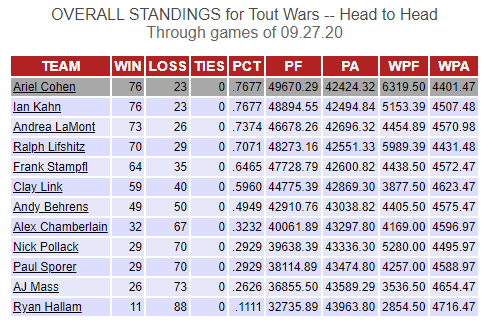
Indeed, my projections and valuation were largely accurate. The touts with the 5 highest projected point totals ended up finishing in the top five.
Scouting
In great detail, I portrayed the scouting that I undertook in preparation for Tout Wars in Part II of my auction recap . I surveyed prior league draft results for each tout. I looked into each player’s likely targets. I even personally attended five hours’ worth of a different live 2020 auction of one of the touts – just to get any edge and information that I could.
As I have described many times in the past, your own valuation of players is not enough to win a league. Determining that Player A is worth $9, is not enough information on its own. In the quest to assemble the most value in the aggregate, subject to the $260 auction budget - one needs to ascertain if there is a market for Player A. Are others willing to spend $12? Will they spend just $6?
Consider the following simple example:
| Shortstop | Your Value | Market Value |
| Player X | $12 | $7 |
| Player Y | $14 | $12 |
Which player would you rather target during an auction?
Sure, Player Y will provide more value to your team than Player X ($14 to $12). However, I would rather be on the lookout to acquire Player X. The potential profit that one can derive from Player X exceeds that of Player Y by an estimated $3.
The task for the fantasy owner is to assemble the most value on your roster for the least amount of fantasy draft capital. Without having a good sense of what the market would pay for a player, you may not be able to maximize your roster’s value despite having excellent valuations. For instance, if you did not have an awareness that Player X’s market value was low – you may pay the $12 for Player Y, thinking that you would earn a $2 draft profit for the shortstop position. You might be leaving an additional $3 of profit on the table … and worse … one of your opponents will profit instead.
Draft Strategy & Tactics
Many people often confuse the difference between strategies and tactics. They are in fact two distinct elements of playing a game.
Strategies are the pre-planned moves that you execute. Strategy comes to fruition when the game (any game) is merely a blank canvas; it emerges during the part of the action when you have the most freedom to operate. Perhaps, you come to the draft deciding that you will target two high priced first basemen. Perhaps you plan to nominate high priced closers early on, etc.
A tactic is implemented in response to the way that a game unfolds. Tactics are needed where the action is the greatest. One draws upon his or her knowledge of the game on just how to react. In poker, a bluff is a tactic carried out in order to induce an opponent to fold his or her cards. One does not come into a poker room planning to buff a particular hand. Rather, one looks at their cards, reads the faces around the table, and in response - decides to aggressively bet on a weaker hand.
For Tout Wars, I prepared a detailed strategy. I estimated the likely pockets of players who would be available at bargain prices. For hitters, the ranges were clearer. For starting pitchers, I developed two plans of attack. The first, was a hotspot of 1A type pitchers. I planned to use my auction nominations early on largely to determine which pockets of players that I would play in.
I responded well in the midst of the auction to the hands that I was dealt. I ended up defaulting to my alternate plan, which included pouncing on mid-level pitchers such as Max Fried, German Marquez and Eduardo Rodriguez. As an additional example, I did not intend to purchase Alex Bregman, but I took advantage of the opportunity of a depressed cost.
I also employed more subtle in-game tactics such as bidding up Alex Chamberlain on players that I knew he would try to outbid the room. Successfully siphoning an extra $3-4 from an opponent’s auction budget is often just as important to the auction’s endgame - as saving cash on players that you yourself purchase. Every little bit counts.
Deciding on just how much to bid on mid-season FAAB is an important tactic to master. For Tout Wars - I periodically studied the player needs of other teams, and looked at their personal FAAB bidding history. I even got a hold of last year's Tout Wars HTH FAAB bidding by week to help me make informed decisions on just how much to bid. I made sure that my FAAB bids were somewhat random, so that no one else could track what I was doing.
Each of these tactics contributed to my overall success.
Adapting to the League
Consider the following exaggerated scenarios in a rotisserie format:
- All other teams each spend a total of $240 on hitting, and only $20 on pitching.
- All other teams do not draft a single closer. They all draft 9 starting pitchers.
- All other teams spend only $1-2 on every catcher that they purchase.
None of the three above scenarios are strategies that I would employ at the outset of a league draft. I wouldn’t go into an auction with an intended 92%/8% hitter/pitcher split of auction funds. I wouldn’t punt saves from the get-go. I wouldn’t only want to spend $2 on JT Realmuto or Yasmani Grandal, etc.
Those three strategies seem quite strange to the naked eye, because … they are. I did say that they were exaggerated.
However:
- If all of your opponents spend $240 on hitting, then if you only spend only $180 on hitting – you will likely finish dead last in almost all five offensive categories. Yes, you may finish with the most pitching points – but that still will leave you with an average overall score when combined with the hitting.
- If all of your opponents do not draft closers, spending the usual ~$25 worth of funds will render your pitching spend as highly inefficient. You will also have a hard time winning the other pitching counting stat categories.
- If all of your opponents barely pay for catchers, buying JT Realmuto at $15 is an overspend. You could have purchased for the next best catcher at a fraction of the cost. Realmuto isn’t 5 times better than the next backstop.
The point here is that playing the game without context can lead to an inefficient use of fantasy capital. Operating in a vacuum literally sucks value out of your roster. You need to be aware of the league norms, and adapt your strategies accordingly. The norms won’t be as ridiculous in the above examples, but adjusting to them will make a profound difference.
This rule does not only apply for the league draft; the in-season adaptation is also essential. If waiver wire pitchers are cheaply acquired in the league, there is no need to spend heavy there. If hitters are constantly churned each week, why not think more short-term? And so on ...
In Tout Wars, despite the fact that I was green to the league in 2020, I felt that I was able to quickly adapt to the league. For adjusting mid-auction - I had a lot of prior experience in doing so (even for new leagues). For me - the harder part was adapting to the week-to-week play.
How did I adjust quickly? I looked at what last year’s winner, Ian Kahn and runner-up Clay Link did for their teams. I looked at how they set their lineups, at the types (and quantities) of players they purchased each week, and what they had paid for them. I recognized the types of trades that were profitable in the format. I observed just how patient they were with underperforming players, etc.
In case a fellow league mate (or US General) reads this, I don’t want to give away all of the specific tidbits of information that I had acquired - but I do want to convey to you the importance of learning. Observing the two touts allowed me to catch up as fast as I could with the right strategy for this league’s dynamic. Just “doing your usual thing” is not how you win leagues. One needs to use his or her own bag of magic tricks, but must figure out what works for your particular audience. Each league is different, and one needs to adapt quickly.
Play the Matchups
Down the stretch of the season, as it became clear that I was going to contend for the league title, I shifted my focus on free agent pickups from long term to short term. I could no longer sift through the waiver wire for rest-of-season targets; I needed to put up as many points as I could each and every week. Playing from behind, I took each week as a single must-win contest.
As such, I spent a lot of time looking at matchups. For both hitters and pitchers, I looked at who they would face in the coming week, the ballparks they would play in – and most importantly, at the playoff status for their real-life teams. Some teams needed to fight towards the end, and some had already clinched their postseason berth. This made a large difference in both my free-agent acquisition targets, as well as how I set my team’s active lineup.
But not only did I look at the coming week’s schedule – I also looked ahead a week further into the future. I sometimes purchased “future two-start” pitchers (as I typically call them) a week in advance. Purchasing these types of pitchers allowed me to spend far fewer resources on them, as most teams were not looking to acquire them a week early. Had I waited the week to roster the future two-start pitchers, I would have to pay ten times the auction price [or more] to do so! That would not be an efficient use of fantasy capital. Sometimes, a player riding on your bench for a week can lead to a more optimal use of funds.
Luck
I could not have won Tout Wars without an element of luck. This is the truest statement that I have made thus far.
I got lucky.
I won’t say that I was extremely lucky; I believe that all of the elements described above played a large role in my winning. However, the difference between my 1st place finish and what could have been a 5th place finish required the fates to be on my side. Had a few pitchers pulled a muscle in the last week, I would not be writing this article. Had Andrea LaMont made one or two different decisions during the course of the season, she might be writing this article in my stead.
Of course, not everything broke right for me during the season either. I too had my fair share of injuries and poor play. I traded away Randal Grichuk to Ryan Hallam in the middle of the season, which proved to be a bad decision on my part. Eduardo Rodriguez never played a game in 2020, yet I had spent $10 on him in the auction.
The margin of error in a league full of experts is razor-thin. I was blessed in 2020 that I had just enough luck to go along with my gameplay. The combination of both earned me my very first experts league title.
Conclusion
I could have spent time today talking about the specific players who provided me the most and least value for my Tout Wars team this season. Sure, Marcell Ozuna was a fantastic $16 selection, who earned $31 of value in the format. But simply discussing players will not provide much help to you in the future. It won’t help me for 2021 either.
You see, it is not about the results – it is about the process.
Hopefully, I have given you some insight into my successful season in Tout Wars, and at the same time provided you with a few strategies and tactics for your fantasy leagues next year. I am surely hoping that the 2021 season will go on without interruption, and I hope to be writing this article again at its conclusion.
Download Our Free News & Alerts Mobile App
Like what you see? Download our updated fantasy baseball app for iPhone and Android with 24x7 player news, injury alerts, sleepers, prospects & more. All free!

More 2020 Fantasy Baseball Advice