




 RADIO
RADIO










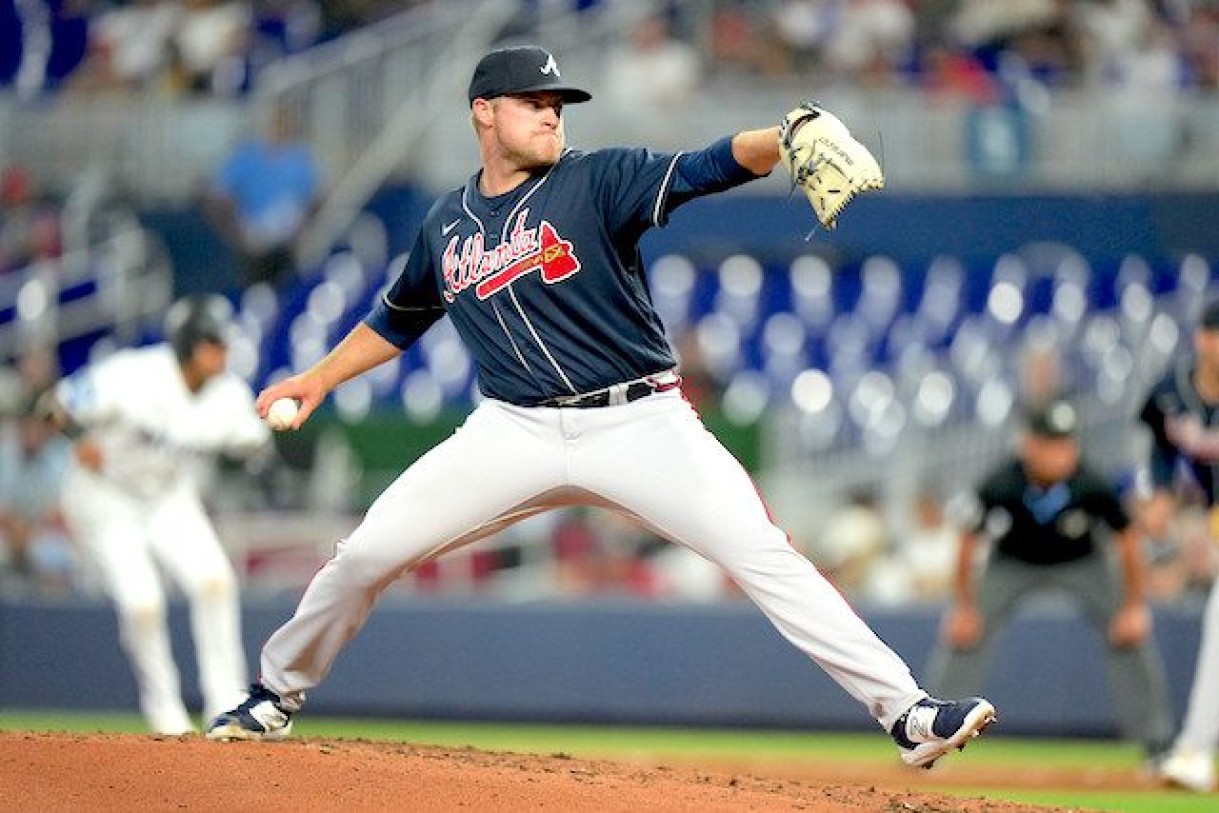
Elliott looks at pitchers with surprising starts recently. These SPs could emerge as fantasy baseball waiver wire targets for Week 2 in 2026, or just mirages.
Welcome back to the "Are You For Real?" series as we dive into Week 2 of the 2026 fantasy baseball season. For those unfamiliar, this is a weekly column where we examine starting pitchers who had surprisingly strong starts over the past week and put them under the microscope to determine whether they're legitimate or just smoke and mirrors.
The 2026 season is officially rolling, and we've got a ton of interesting early-season starters to choose from. This week, I'm focused on three right-handers who dominated the competition in their last starts. First, we'll be looking at Taj Bradley's strong start against the Royals. Then, we'll deep dive into Bryce Elder's hot start in the desert. We'll finish it off by taking a look at Michael Soroka shutting down the Braves.
Roster percentages are taken from Yahoo! and are accurate as of April 6.
Featured Promo: Save 50% off the regular price with discount code CHAMP, for a limited time. Exclusive access to our Team Sync platform, DFS cheat sheets, Lineup Optimizers, betting/prop picks, and exclusive content from Nick Mariano and Eric Cross! GAIN ACCESS NOW
Taj Bradley, Minnesota Twins – 31% Rostered
2025 Stats: 142.2 IP, 5.05 ERA, 4.35 FIP, 11.7% K-BB%
04/02 @ KC: 6 IP, 5 H, 0 ER, 1 BB, 3 K
Bradley is off to a hot start this season, blanking the Royals over six innings in his second start. This was an excellent follow-up to his first outing, where he fanned nine Orioles in 4.1 innings. Bradley is now sporting a 0.87 ERA and 10.45 K/9 through his first two starts, and he has a lot of fantasy managers wondering if the former top prospect is ready to turn a corner. Is Bradley one of the best early-season adds, or is this just fool’s gold?
Originally a fifth-round pick by Tampa Bay back in 2018, Bradley quickly became a top prospect thanks to his outstanding minor league performances. Scouts loved his high fastball velocity, strong command, and deep arsenal of breaking balls. He had some moments in a Rays uniform, but ultimately was shipped to Minnesota at the 2025 trade deadline in exchange for reliever Griffin Jax.
Bradley works with a four-pitch repertoire consisting of a four-seam fastball, cutter, splitter, and curveball. He threw a sinker 8.9% of the time last year, but we haven’t seen him throw it yet this season.
Bradley’s most used pitch thus far this season has been the four-seam fastball. That’s no surprise from him, as the pitch has consistently been his most thrown offering throughout his major league career. However, Bradley has thrown it even more through his first two starts compared to previous seasons. He has a 47.9% four-seam usage rate through his first two starts, and used it 55% of the time against Kansas City on Thursday.
He’s also throwing it a little harder this season, averaging 97.3 mph on the gun thus far. He’d been around 96 mph in previous years, so this is a notable improvement. It could just be small sample size fluctuations, but this is exactly what we like to see in a potential breakout pitcher.
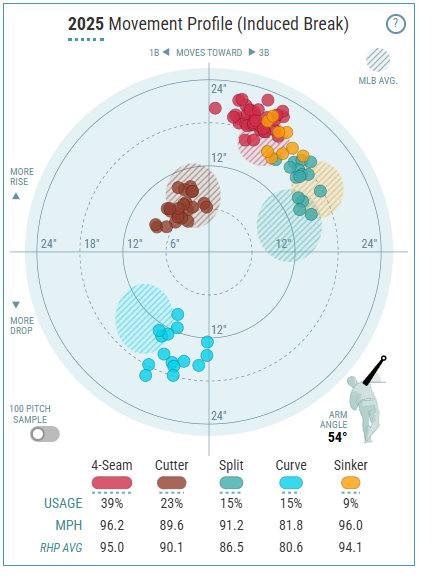
It’s not just an increase in velocity for Bradley either, as he’s also gained nearly an inch of rise on the fastball as well. He averaged 18.5 inches of induced vertical break (IVB) last season, but is averaging 19.3 inches this season. That has him teetering towards elite territory in terms of fastball IVB, and that movement, coupled with his improved velocity, could make for a nasty pitch. Let’s compare his 2026 pitch movement profile to his 2025 movement profile (four-seamer in red).
2025:
2026:
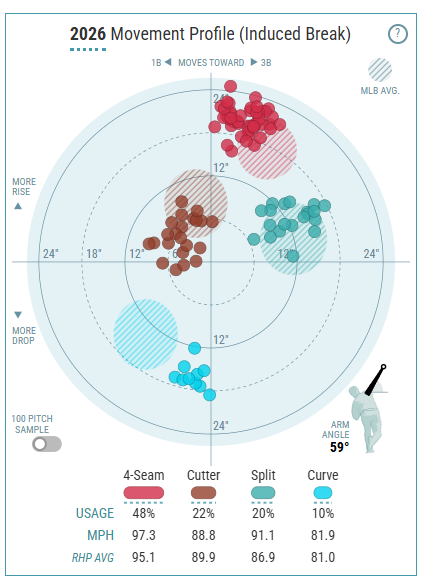
Note the shift in movement for the four-seamer. Interestingly, the four-seamer hasn’t been the source of Bradley’s success. Batters have a 95.6 mph average exit velocity off the pitch, along with a .341 xBA and .498 xSLG, and just a 13.5% whiff rate. Again, it’s only been two games, but one would hope for better results with the four-seamer given these improvements and how Bradley began the year. Still, it’s easy to like what we’re seeing from Bradley’s fastball so far, even if the quality of contact against it has been good for opponents.
Bradley’s next most used pitch this season has been the cutter, which he’s thrown 21.9% of the time so far. That’s in line with his career usage rate of 23.2%. The cutter has performed well for him so far, with a .188 xBA, .282 xSLG, and .263 xwOBA against so far, along with a 33.3% whiff rate. Even amid his struggles last season, the cutter has been a consistent strikeout weapon and performed well for Bradley. He should be able to continue wielding this pitch to great effect in 2026.
Bradley’s next most used pitch this season has been the splitter, which has often been seen as his number one strikeout weapon. That has certainly been the case thus far in 2026, as Bradley has a 52.9% whiff rate with it so far. Batters have yet to secure a hit off this pitch this season, and Bradley has a .158 xBA, .216 xSLG, and a .159 xwOBA against the splitter. A 91.1 mph offering, Bradley’s splitter is of the split-change variety, with its low spin rate and strong arm-side movement. Here’s an example from this season.
— Elliott Baas (@ElliottBaasBB) April 7, 2026
Nasty stuff, and Bradley actually had seven swinging strikes with the splitter against Baltimore in his first start this season. Bradley is throwing his splitter more often so far this season at 19.8% usage, and that’s a trend I would like to see continue. It’s an excellent offering that should net him plenty of whiffs and strikeouts, and maybe Bradley can recapture some of that big strikeout upside we saw prior to 2025, when his strikeout rate dipped to a career-low 21%.
Bradley rounds out his arsenal with an 81.9 mph curveball, a pitch he’s thrown just 10.4% of the time so far this season. This is down from his 14.7% usage last year, and he only threw six curveballs in his start against the Royals on Thursday. Still, he has a 33.3% whiff rate with the pitch thus far, and has a .132 xBA and .153 xSLG against as well.
He had a 37.6% whiff rate along with an .082 AVG, .137 SLG, and .109 wOBA against the curveball last season as well. Even when he struggled, the curveball was still effective. The curveball has exceptional movement with 16 inches of drop and 2.9 inches of glove-side movement. Here’s a look at Bradley’s pitch movement profile again for this season (curveball in blue).
Notice how much it deviates from the league average. That’s what makes the curveball special, and while it’s not one of Bradley’s most heavily featured pitches, it is a strong offering that should yield good results going forward.
Verdict:
The stuff has always looked great for Bradley, and he’s coming out of the gate hot with increased velocity and some big whiff numbers on the secondary pitches, especially the splitter. He seems to have scrapped the sinker in favor of increased four-seam and splitter usage, and I am here for it.
Bradley has teased fantasy managers over the past few seasons with glimpses of greatness only to turn back into a pumpkin, but I am ready to risk getting hurt again. Bradley is a must-add in 12-team leagues or deeper. This could finally be the breakout, and this could be the last chance to add him before everyone else catches on.
Bryce Elder, Atlanta Braves – 35% Rostered
2025 Stats: 156.1 IP, 5.30 ERA, 4.55 FIP, 11.8% K-BB%
04/04 @ ARI: 7 IP, 4 H, 2 R (0 ER), 1 BB, 8 K
Elder was a tough-luck loser on Saturday, going seven innings and allowing just two unearned runs in the loss to Arizona. Elder has yet to give up an earned run this season and is now looking like a fixture in Atlanta’s rotation after they suffered a few significant injuries to other pitchers. Elder has really struggled over the past two seasons, posting a 5.59 ERA and 4.55 FIP in 206 innings. If it weren’t for injuries, he may not have even earned a rotation spot to begin the year. But he’s in the rotation and pitching well for Atlanta. Is Bryce Elder finally breaking out?
Originally a fifth-round pick in 2020 by Atlanta, Elder wasn’t viewed as a big prospect coming up, but he was seen as a potential back-end starter or innings-eater type for the Braves' rotation. Elder works with a five-pitch mix consisting of a slider, sinker, four-seamer, changeup, and cutter. He’s thrown each pitch at least 10.5% of the time so far this season, though he’s changed up his pitch mix a bit in 2026.
The biggest change Elder has made has been a reduction in sinker usage. He was usually around 40% usage in prior seasons, but this year he’s only thrown the sinker 26.7% of the time. That might be a good thing for Elder, as batters are hitting .284 with a .792 OPS against his sinker all-time. A 91 mph offering, Elder has rather weak velocity, especially for a young right-hander. The sinker doesn’t have much heat, and doesn’t have exceptional movement either.
The one good thing about this pitch is that it has consistently generated strong groundball rates for Elder over the years. Elder has a 55.3% ground-ball rate with his sinker all-time and has a 2-degree average launch angle against the sinker this season. Elder has been a strong groundball guy even amidst his struggles on the mound, and this sinker is a big reason why. Still, Elder seems to have deliberately deemphasized the pitch in 2026, and given how poorly it has performed in past seasons, that could be a positive step.
The sinker isn’t even Elder’s most used pitch anymore; that distinction goes to the slider, which he has thrown 37.2% of the time this season. He threw the pitch 35.1% of the time last year, so this isn’t a huge jump, but it does allow Elder to feature a more effective pitch. Batters have hit just .059 off the slider so far with an .085 xBA, .099 xSLG, and .116 xwOBA. He also has a 32.4% whiff rate with the pitch so far, which is solid for a breaking ball. It’s a slow slider at 83.3 mph, but Elder does get 3.2 inches of drop with the pitch. Here’s an example from this start.
— Elliott Baas (@ElliottBaasBB) April 7, 2026
Not the craziest slider I’ve ever seen, but it’s slow, loopy, and has a strong drop. That could be enough to make it a plus strikeout pitch. Even if it is, Elder probably doesn't have the juice with the rest of his pitches to sustain an above-average strikeout rate.
Elder’s next most used pitch has been the four-seam fastball, which has always taken a backseat to his sinker, as the sinker is his primary fastball. The four-seamer is a little harder at 92.6 mph, but with just 15 inches of IVB and 4.2 inches of arm-side run, the movement on the four-seamer is painfully average.
Like with the sinker, the four-seamer has proven quite hittable for major leaguers, and Elder has a .272 AVG and .795 OPS against his four-seamer all time. Even in his first two starts, opponents have a .264 xBA, .341 xSLG, and a 96.4 average exit velocity against this pitch. Neither of Elder’s fastballs impresses me, and they could act as detriments to his long-term viability as a starter.
Elder has also thrown his changeup 12.2% of the time this season. Batters have yet to get a hit off this pitch, but he has just a 20% whiff rate with the change as well. The changeup also does not have exceptional movement and has ultimately proven to be a rather mediocre pitch over the course of Elder’s career.
He’s never had a whiff rate higher than 26% with the pitch, and that was back in his rookie year in 2022. He had just a 17.3% whiff rate with it last season, and it seems like this pitch is only used against lefties when Elder doesn’t want to throw a slider. It’s another unexciting offering from Elder.
One change that Elder has made for 2026 is the addition of a cutter, which he’d never thrown before this season. He’s only used the pitch 10.5% of the time so far, and it has a .283 xBA, .367 xSLG, and .284 xwOBA against, along with a 10% whiff rate. Cutters aren’t necessarily known for racking up whiffs and strikeouts, but 10% is just pitiful. It’s another weapon for Elder against lefties, but I doubt this pitch will transform him into a new pitcher.
Verdict:
Elder has made some changes to his approach and pitch mix for 2026, deemphasizing his sinker while adding a cutter to the mix. Even with these changes, the arsenal is still rather underwhelming altogether. He throws very softly at just 91-92 mph, and his fastballs have been hit hard over repeated seasons. His slider is his best pitch, and it’s nice to see him throwing it even more at 37.2% usage.
However, even with this increase, the rest of Elder’s repertoire leaves much to be desired. His fastballs are soft with poor movement, his changeup has long struggled to generate whiffs, and his new cutter hasn’t performed all that well in limited usage. It’s been a nice start to the season for Elder, and maybe he could post a sub-5 ERA this season, but I don’t see much breakout potential here. Leave him on the wire and add Bradley instead.
Michael Soroka, Arizona Diamondbacks – 45% Rostered
2025 Stats: 89.2 IP, 4.52 ERA, 4.23 FIP, 17.4% K-BB%
04/04 vs. ATL: 5 IP, 4 H, 1 ER, 3 BB, 3 K
On the other side of Elder’s start on Saturday was Michael Soroka, who put up a second straight win with five innings of one-run ball against the Braves. Soroka now has a 0.90 ERA and 11.7 K/9 through his first two starts, and it’s looking like the former rookie-of-the-year runner-up may be on the path to resurgence. Is Soroka back, or should we leave him on the wire?
Originally a first-round pick by the Braves back in 2015 out of Canada, Soroka burst onto the scene with a 2.68 ERA in 174.2 innings his rookie year in 2019, but unfortunately, it’s been nothing but injuries and struggles for Soroka since, with brief glimpses into the pitcher he once was. Soroka works with a five-pitch mix consisting of a slurve, four-seam fastball, changeup, sinker, and cutter.
Soroka’s most used pitch this season has been the slurve, and that’s probably a good thing for him. An 81.4 mph offering, the slurve is a soft, loopy hybrid between a slider and a curveball. He gets exceptional spin with the pitch at 2850 RPM, and he also has excellent movement at 6.7 inches of drop and 9.7 inches of glove-side movement. Here’s an example of the pitch from this season.
— Elliott Baas (@ElliottBaasBB) April 7, 2026
Nasty stuff there, and Soroka has a 32.3% whiff rate with the pitch so far. He had a 38.3% whiff rate with it last season, so perhaps there’s even room for more strikeouts and whiffs with the slurve for him. It was a big point of emphasis for him in his first start against Detroit, when Soroka threw the slurve 48% of the time, and it helped earn him 10 strikeouts in that start. Batters hit just .118 with a .245 SLG and a .213 wOBA against the pitch last season, and are hitting .071 with zero extra-base hits and a .065 wOBA off the pitch so far in 2026.
The slurve is a bona fide strikeout weapon for Soroka, and it would be interesting to see if this increased usage holds. It was heavily influenced by his first game (he threw it 26% of the time against Atlanta), but it was also extremely successful for him. Why not do what works, after all?
Soroka’s next most used pitch has been the four-seam fastball, which averages 94.3 mph on the gun. Unfortunately for Soroka, the pitch has middling velocity and poor movement. He has averaged just 13.7 inches of IVB thus far, and the pitch has a very traditional fastball shape.
It’s been hit hard so far, with a .385 AVG, .462 SLG, and .439 wOBA against so far, along with a 97.1 mph average exit velocity. It’s a very small sample size, but batters did hit .281 with a .527 SLG off Soroka’s heater last season. The pitch doesn’t have very strong measurables and could be a liability for Soroka this season. He may be able to fan hitters with the slurve, but the four-seamer leaves much to be desired.
Perhaps Soroka could overcome his four-seamer deficiencies with increased sinker usage. He’s thrown the sinker 11.7% of the time so far, and batters have yet to notch a hit off of it this season. He is allowing a .281 AVG and .749 OPS with the pitch all time, but he also has a 57.2% ground-ball rate with the pitch all time as well. That’s at least something positive, which is more than we can say about Soroka’s four-seamer.
He was a big sinker guy during his strong 2019 campaign, and maybe increased sinker usage could be what he needs to recapture past success. The slurve has been an excellent groundball pitch as well, and with these two weapons, Soroka could be a groundball machine. He upped his sinker usage to 14% against Atlanta, and it would be nice to see that number continue to rise.
He’s also mixed in an 86.5 mph changeup 11.7% of the time this season. The changeup has been effective so far, with a .167 AVG against and a 33.3% whiff rate, though the whiff rate is quite elevated compared to previous seasons. He got three whiffs with the pitch against Atlanta, but I’m not sure he can sustain a whiff rate above 30% with this pitch.
It’s never been a big strikeout pitch for him, and there are no significant changes in velocity, usage, or movement that would suggest more strikeouts are coming. Rather, this is a pitch that Soroka can wield against lefties to help neutralize opposite-handed hitters, but it won’t be a big strikeout weapon for him.
Soroka has also added a cutter this season, which seems like the hot thing to do for major league starters at the moment. Soroka’s cutter is 89.2 mph and has perfectly average vertical and horizontal movement. It’s been hit for a 1.000 AVG against (though he’s only thrown 13 cutters) and has a 25% whiff rate.
It’s too early to tell how effective this pitch can be, but it doesn’t really have the makings of a plus strikeout offering. Perhaps Soroka could begin using it more often and favoring it over his four-seamer, but that’s something we’ll have to monitor. For now, consider it more of a show-me pitch or a tertiary offering for Soroka.
Verdict:
Soroka has come out of the gate swinging, and increased slurve usage could have his strikeout rates rising. Soroka’s slurve has all the makings of a plus strikeout offering, and as his best pitch, it would be nice to see him continue to focus on using it often. His fastballs leave something to be desired, with poor movement and average velocity; they’ve proven very hittable over Soroka’s career, especially the four-seamer.
It would be interesting to see Soroka use his sinker more often, because at least the sinker can generate groundballs. He’s added a cutter to his repertoire, and while it’s awfully early to judge it, it doesn’t seem like the pitch that’s going to transform him into a breakout starter. All in all, Soroka is a flawed pitcher with a strong slurve that could pop for some good starts here and there, though I struggle to view him as a breakout given his poor fastballs. His next start is scheduled for Friday in Philadelphia, and I’d try to avoid him there.
More Fantasy Baseball Advice
Download Our Free News & Alerts Mobile App
Like what you see? Download our updated fantasy baseball app for iPhone and Android with 24x7 player news, injury alerts, sleepers, prospects & more. All free!