




 RADIO
RADIO










Antonio Losada reviews the 2019 fantasy football season by analyzing volatility and consistency at QB, RB, WR, and TE. These statistics could guide fantasy owners during draft day in the 2020 offseason.
When it comes to handling a fantasy football team there isn't a single approach to win the weekend or the season. In fact, much of it depends on your personality and how able or willing you are to deal with risks. You can be a completely risk-averse player, opting for the safest plays every time, knowing they usually come with lower upside. Or you can be a risk-taker who always tries to chase the "boom" play.
No matter which side of the scale you fall on, what is clear is that we need some sort of way to asses how volatile players are and how much risk they carry with them. That is what I'm here for today.
Now that the 2019 season is over, I'm going to analyze league-wide statistics from Weeks 1-16 to present a methodology to asses volatility and produce groups of player names that could be labeled as the most and least-volatile players of the year. Let's get to it!
Bookmark our updated and revamped fantasy football rankings portal for all league formats!PPR rankings | Half-PPR rankings | Standard rankings | Rookie rankings | Superflex rankings | Dynasty rankings | Who To Start? | Injuries | Matchup Ratings | Strength of Schedule
How to Measure Player Volatility in Fantasy Football
As I said in the introduction you can have an extremely risk-averse mindset, an extreme risk-taking profile, or fall in the middle of the pack. Whatever the case, you need as much information as you can get weekly to make your lineup decisions and to build your roster. Volatility, defined as how regularly a player generates weekly production, is something to take very seriously when playing fantasy sports.
First of all, you shouldn't misunderstand volatility as ability. A highly-volatile player doesn't have to mean a player is good or bad, the same as a non-volatile or "safe" player doesn't mean that either. A volatile player is one whose fantasy points vary wildly from week to week during the season (think of constant peaks and valleys), while a safe player is one whose fantasy points remain most often than not within some known and tight boundaries. Just so you see the difference, here are two players' fantasy outcomes from the 2019 season -- Amari Cooper and D.J. Moore:

Both Cooper and Moore finished the season averaging 15.5 FP/G, although they did so in different ways. Cooper had a volatility (standard deviation of weekly fantasy points) of 11.6 points while Moore had one of just 5.8 points. To not overcomplicate things, we can say that Cooper was the boom/bust player while Moore was the safe bet.
A simple approach to know the range of outcomes a player can produce is to simply take the volatility of the player and add/subtract it to/from his average. In the example above, Cooper would be a weekly play with a range of outcomes between 3.9 and 27.1 on average (with a true-floor of 0.0 and a true-ceiling of 39.6), while Moore would be a weekly play with a range between 9.7 and 21.3 (true-floor of 1.1 and true-ceiling of 31.4).
As you see, both Cooper and Moore are virtually the same players in terms of their ability, but they offered their owners very different profiles. Always remember that volatility doesn't mean ability.
An Objective Approach to Volatility Assesment
Calculating the standard deviation of fantasy points from a player during the season, as done in the section above, is a good way to know who the most and least-volatile players are. Another way of doing it from a completely objective perspective that levels the field and doesn't fall in false results is to split a player's season in two halves and see how much they varied. A simple way of doing this is to take the games each player played in odd weeks and those he played in even weeks. That is a random enough way to split seasons that yield the desired results over the whole league population:
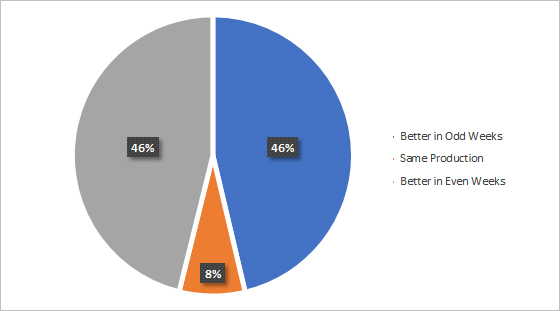
As incredible as it looks, it is correct. There have been 542 players to log at least a fantasy score in both an even and an odd week in 2019. Of those, 46% performed better in odd weeks (251 players), another 46% did so in even weeks (250 players), and only 8% averaged the same fantasy points in both splits (51 players). Obviously, we shouldn't expect anyone to perform the same in both splits and most of those 51 players had 0.0 points on average during the whole season -- in fact, only five players had a FP/G mark over 0.0 and finished the season averaging the same points in even and odd weeks.
All in all, the differences are notable and they range from most-even-week-favorable at a difference of 11.9 FP/G (Rico Gafford) to most-odd-week-favorable at a difference of 18.5 FP/G (DeSean Jackson). If we take those two players out because they played two and three games respectively and focus on players with at least 10 games played, those values move a bit to 9.7 FP/G (James Conner better on even weeks) and 14.1 FP/G (Marvin Jones better on odd weeks).
Here is how the whole league looked like in 2019 (the color of the dots represents the absolute difference between odd-weeks and even-weeks performance, and those values can be read under some of the players' names; the circle radius represents the FP/G of the player on the season): click on images to view full-sized

2019 Volatility Player Clusters
With all of this information at hand, the final step is to break down the chart that finished the section above into different groups to better know who was who in 2019 and put different players in different groups depending on how volatile they were during the year.
Group 1: 0-2 FP/G Difference
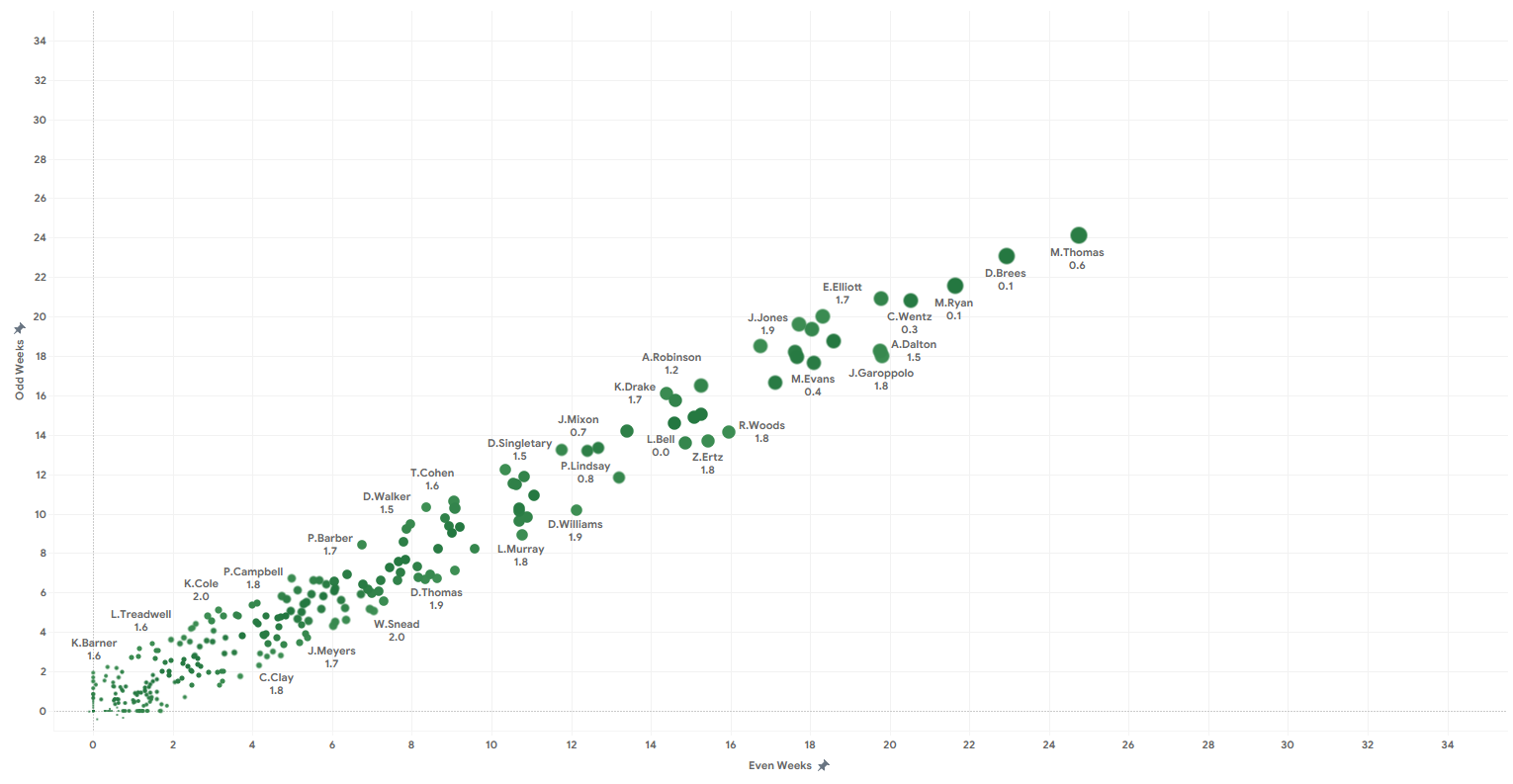
This is the most populated group of players (305 in total), which makes sense considering it contains a lot of players with a small number of games played (109 players with eight or fewer games).
Most of the steadier performers during the whole year were so because they never amounted to overly-high fantasy points weekly. Of the 305 players that are part of this group, only 25 averaged 14-plus fantasy points on the year, and only 21 of them played more than 12 games. Here are some quick notes about this group and its members:
- Michael Thomas and Drew Brees top the FP/G leaderboard among members of this group. With both being Saints, this was the safest and most reliable QB/WR stack of the 2019 fantasy season.
- Even as a rookie, Kyler Murray averaged more than 20 FP/G while having a variance of just 1.1 FP/G, making him a very reliable play.
- Often-criticized players in real life such as Andy Dalton, Derek Carr, Philip Rivers, Le'Veon Bell, and Joe Mixon were all pretty consistent during the whole year. Their average outcomes varied between them (from Dalton's 19 FP/G to Mixon's 13 FP/G) but at least they were consistent in the performances they were putting together.
Group 2: 2-4 FP/G Difference
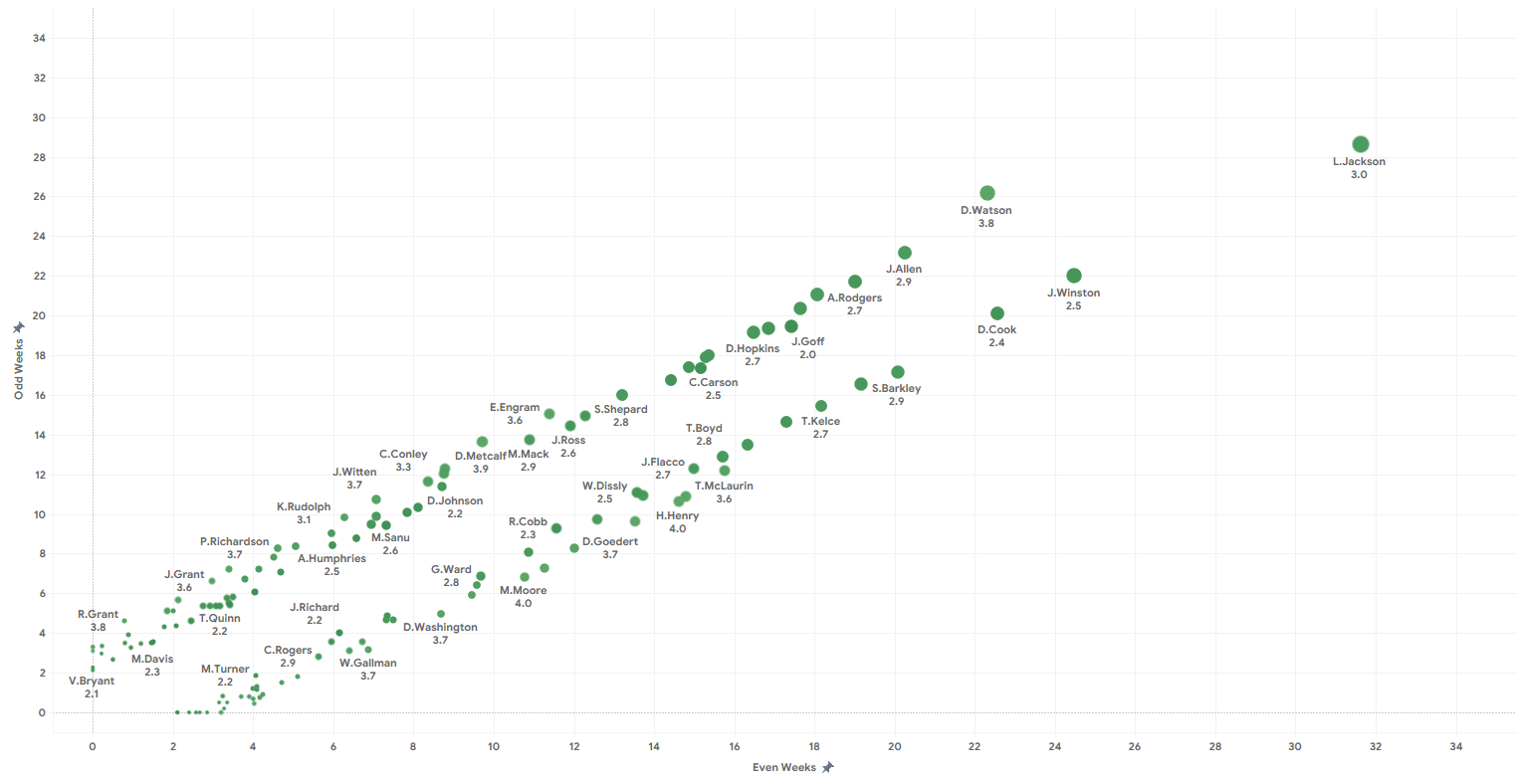
The group of the King. Lamar Jackson belongs to the second-tier in terms of volatility but he does so with a staggering average of 30 FP/G through Week 16. As the plot makes clear, he's so ahead of the field (the difference with second-best Deshaun Watson is of 5.4 FP/G, and Jackson was also less volatile with a 3.0 FP/G difference between his odd and even week performances compared to Watson's 3.8).
There are 130 players in this group, and the top performers (those averaging 14-plus FP/G on the season) are virtually equal in number (23) to those in the first group (25). Truth be told, this is the group where most superstars sit at and should be expected to be found in. Consider Group 1 as that of the "unexpected league-winners", "one-season wonders", or "elite performers on a year for the ages", and Group 2 as that of the "yearly reliable top players". Let's say this is the bunch that will give you mostly good points with some super peaks due to their talent and a valley-game here are there just because anybody can have a bad day. Here are some quick notes about this group and its members:
- You can point out Jameis Winston's woes all you want, but he's a fantasy machine. He always finds a way to make up for his errors and his offensive repertoire is so great he can rack up numbers effortlessly on a weekly basis.
- Austin Ekeler's production was lowered once Melvin Gordon came back from his holdout, and that was probably the main reason he fell into Group 2. Had Gordon's holdout lasted longer or gone for the full season, then Ekeler might have found his way to Group 1 as a true unexpected outlier with a massive single-season set of outings.
- Kareem Hunt has been one of the best and safest late-season performers. He has only played in seven fantasy-relevant games this year, but he's done so averaging 13.4 FP/G with a variance of just 2.7 FP/G between his even and odd week games. His role will probably stay the same with Nick Chubb as the leading Browns rusher, but if you want some good and easy-to-get points weekly, he's one of the most reliable bets out there to come at a discount given his usage.
- Odell Beckham Jr. has definitely had a rough year, although he's been very consistent in what he's done with a variance of just 2.8 FP/G over his 15 games played. As you see and I told you earlier, being "steady" or non-volatile doesn't mean playing great, but rather always playing to a similar level.
Group 3: 4-6 FP/G Difference
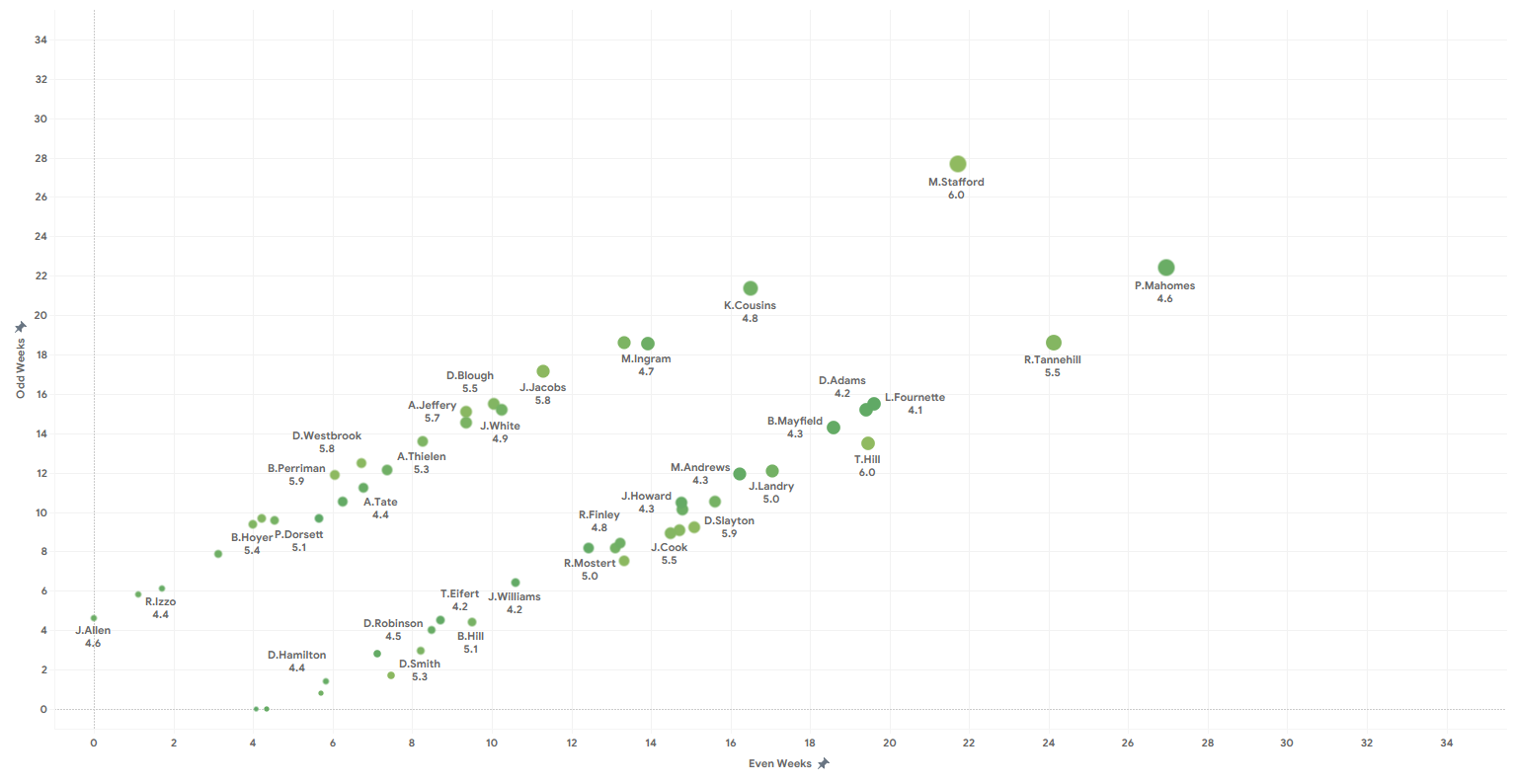
Starting with this group, the field of players to be part of each cluster starts to shrink progressively. Here we find some of the players talented enough to average good FP/G all year long, but who also carry the typical boom/bust profile that makes them riskier propositions. That is why there are only 13 players with averages of 14-plus fantasy points in this group compared to 23-plus in Groups 1 and 2.
It is hard to consider any of the top players of this group to be a bad player, but all of them pass the eye test if we bring the low-floor, high-ceiling conversation to the table. The Fournettes, Staffords, Cousins, etc. of the league all fall in this group, as do some mid-average performers who happened to had one or two booming games through the season. Here are some quick notes about this group and its members:
- Matthew Stafford is one of the poster-boys of this group. His profile is similar to that of Winston, although Stafford's average points per game are higher but also come with a higher risk/volatility attached to them as he's more prone to have either poor or great performances and no middle-ground games.
- Patrick Mahomes is on this group mostly because of a poor/floor game in an odd week (8 FP) and a great/ceiling one in an even week (34.3 FP). Even with that, though, we can consider him a great player with the ability to rack up massively high fantasy numbers if the Chiefs offense clicks and drops a bit if it doesn't. That's mostly due to him carrying an incredible talent but his receivers not being that good as to elevate him, but rather the other way around.
- Kirk Cousins' season has been one of two tales. He was heavily criticized to start the year, then had a great run of performances and finally, he had some duds late in the season. Good on average, but with some wild swings during the year.
- Josh Jacobs and Leonard Fournette have both been great, but also risky bets. Jacobs has played incredibly good for a rookie rusher, but his weekly variance made him a real boom/bust play for his owners in virtually every game. Fournette's bad luck on the scoring column made him overly-dependant on his production on the ground and receiving, and when either of those things didn't work in a middling Jaguars offense he didn't get as many points as he let us know he could get in other games.
Group 4: 6-8 FP/G Difference

Only 34 players in this group, with 11 of them averaging 14-plus fantasy points per game. Reading the names belonging to this group I'd say that those who are part of it could mostly be labeled as "great players with bad seasons still able to shine here and there."
That has been the case with the likes of Alvin Kamara, Keenan Allen, and Amari Cooper. All of them are very talented and put on true shows here and there, but their lows have been so ground-level that their volatility went through the roof while still able to maintain a high FP/G average on the season. Here are some quick notes about this group and its members:
- Aaron Jones is very suited to this group. As part of a multi-back offense in Green Bay, he's lost a lot of chances to Jamaal Williams during the season and that has hurt his "weekly safety". That (his incredible talent combined with the loss of opportunities in other games) is why Jones has had two 40-plus FP performances (he even reached 49.2 FP in Week 5) while he's also logged two 3-point ones in Weeks 9 and 12 when he couldn't get going.
- Alvin Kamara was drafted as a top-five player entering this season, and his talent has always been there: he's averaged 17.8 FP/G through Week 16. The problem is that the separation between his ceiling and his floor has been so great he's turned into a very risky weekly bet and someone to think about twice before putting in any lineup.
- The aforementioned Amari Cooper, Keenan Allen, and also Nick Chubb, fit that same profile. They are all pretty good players but they've all gone through more than one and two bumps in their roads that have killed their "safe" tags through the season.
Group 5: 8-10 FP/G Difference

You can consider this the "safest" of the riskiest groups. What I mean is that if we compare Groups 5 and 6 you'll see quite a notable difference in the names that belong to each of them and their talent level. There are 13 players in this group, but all of them averaged 8-plus fantasy points through Week 16 and up to nine finished with an average of 14-plus points.
Virtually every player in this group (excluding Drew Lock and perhaps Chase Edmonds) should be considered a great talent, full stop. All of them have high variances in his outings but that is mostly due to the incredibly high ceilings they can have over a full season, which stretch their range of results and bump up both their season average and their volatility values. Here are some quick notes about this group and its members:
- Christian McCaffrey has arguably been the best fantasy player of the season (other than Lamar Jackson). His 8.5 FP/G volatility is really high, but he's only had one bad game (7.3 FP in Week 2) all year long. The problem is that his ceiling was so high at times (42.9 FP in Week 1, 47.7 in Week 5) that his average numbers felt low while still being great at around 25 FP/G weekly.
- Chris Godwin exploded as a true league-winner this season, but he suffered playing along with another monster wide receiver in Mike Evans. It was either one of the other overperforming each week in Tampa's offense, and that is what made him (and Evans, for that matter) a rather volatile weekly play.
- Something similar happened to Stefon Diggs, even more, aggravated by the presence/absence of Adam Thielen due to injury through the middle of the season. Sometimes it was one, others the other one, and finally when Thielen went down injured and Diggs had the chance to play alone he still fluctuated in his outings.
Group 6: 10-plus FP/G Difference
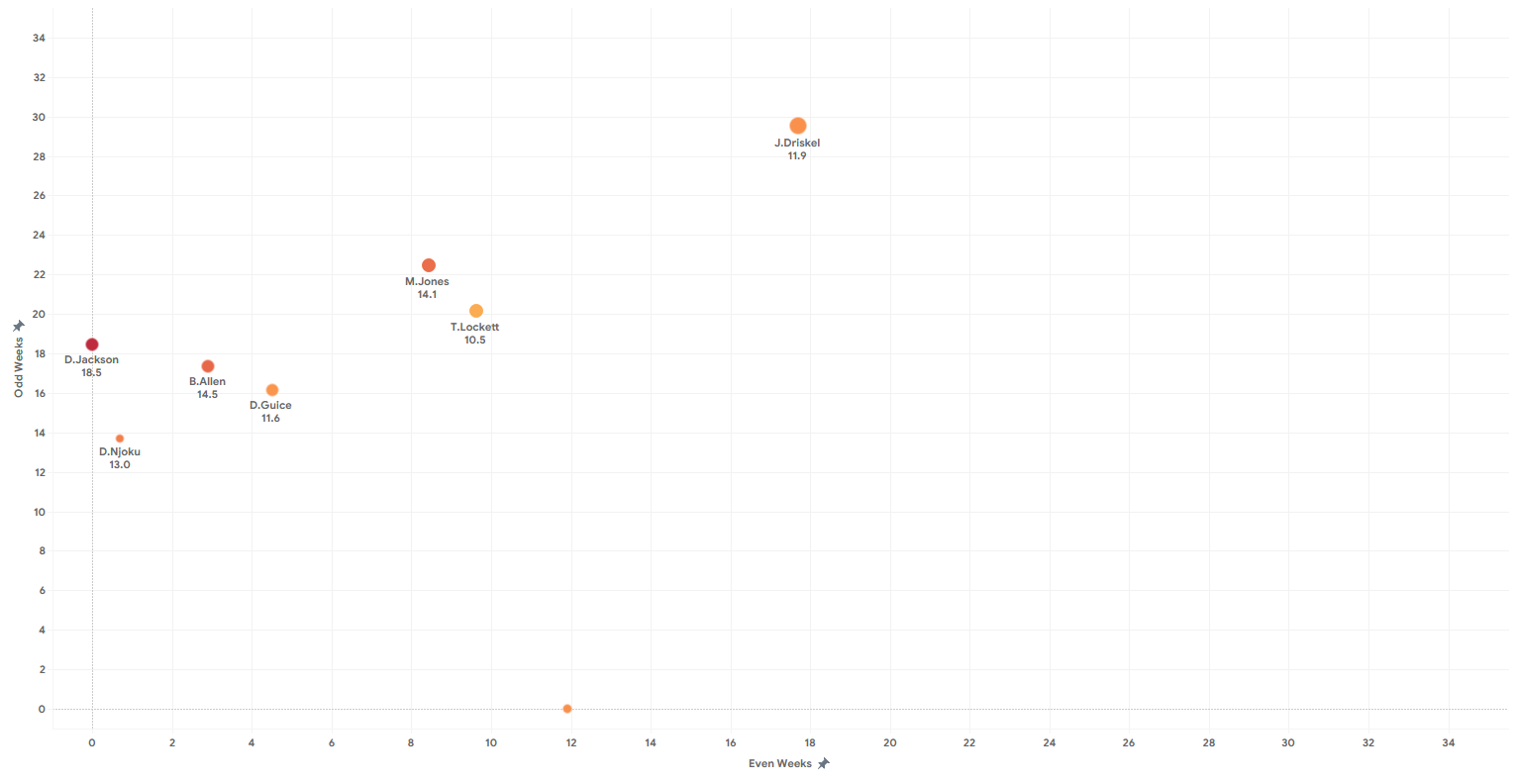
The ultimate "play at your own risk" sign carriers are all here. This group is obviously minuscule as those players are all outliers and if we're serious, only two of them would truly qualify for a season-long weekly risky-play consideration: Marvin Jones (13 games) and Tyler Lockett (15 games). The rest of the players in this group played five or fewer games and missed the rest due to injury or having a bench/reserve-role in their teams. Here are some quick notes about this group and its members:
- Marvin Jones has been one of the most polarizing players of the season by far. He's been as good as to reach 43.3 FP in Week 7 (10 receptions, 93 yards, 4 TD) and as bad as to finish Week 6 with 3.7 FP (2 receptions, 17 yards). He closed his season in Week 14 but his 13 games played were enough to paint him as a true risky bet weekly. If you needed huge points to win your week, he could definitely give you them... or sink your chances to the lowest of points.
- Tyler Lockett was impressive last season with an incredibly effective year playing under Russell Wilson. And he started the year nicely, even reaching 32.4 FP in Week 3. Other than that, though, he's been pretty much an afterthought in all but two great games in which he scored himself 40.2 and 26 fantasy points (Week 9 and Week 15 respectively). In between he was almost completely nullified, making his owners go through headaches while deciding if playing him for the potentially huge reward or benching him fearing the ultimate dud.
- We don't have a big enough sample of Derrius Guice games yet, but so far so risky for the Washington rusher. Is he a 5 FP player, or a 28 FP one? Can he turn into a steady 100-plus yards runner, or will he remain an underperformer? Had I to choose, I'd completely pass on such a volatile young man.
More Fantasy Football Analysis