




 RADIO
RADIO






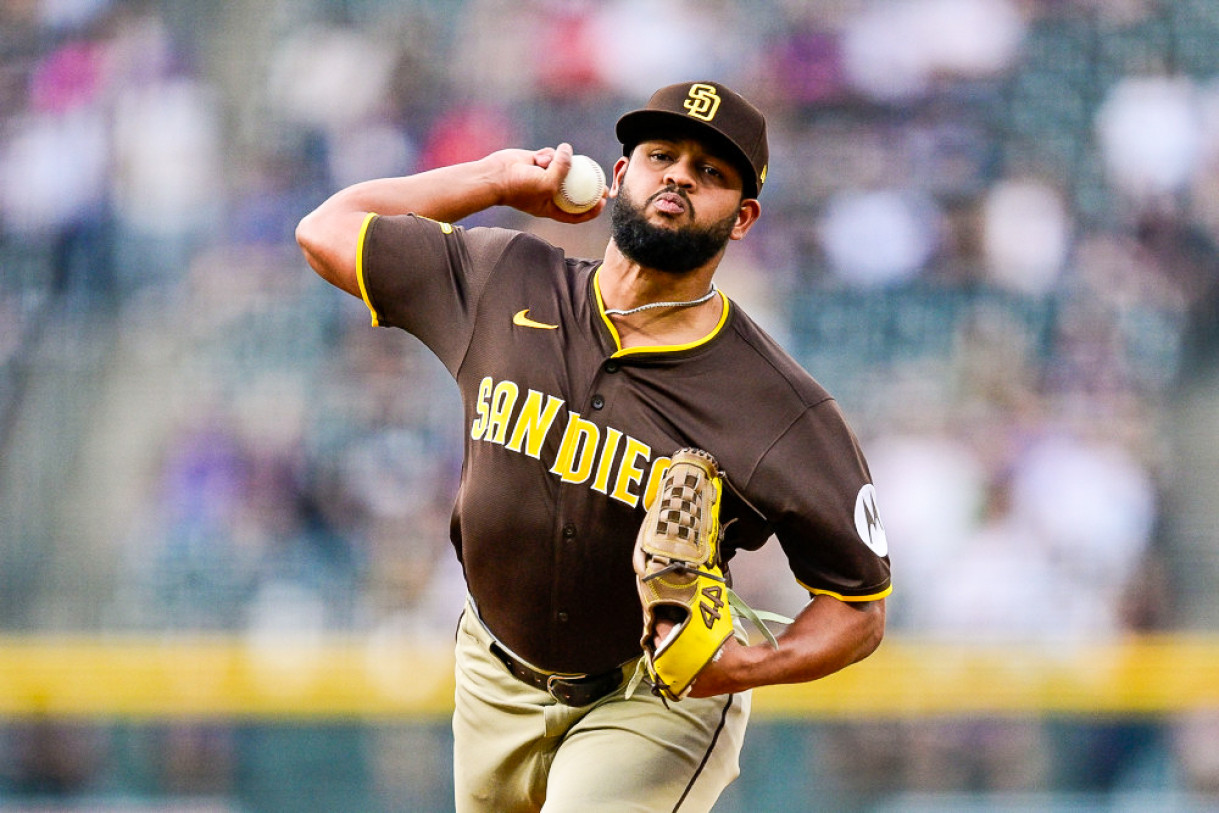
Corbin's deep dive into starting pitcher fantasy baseball breakouts, waiver wire adds, for Week 3 of 2026. Are these unlikely aces potential league winners?
Welcome to the third edition of our Unlikely Aces series in 2026. We're into the third full week of the 2026 fantasy baseball season. It's fun to stream starting pitchers and find success. However, sometimes streaming pitchers can destroy the ratios. We should have a process for any waiver wire move, start/sit decision, or player examination.
Some pitchers possess high-end skills but don't perform well. There are instances where the data and research indicate this pitcher shouldn't perform well, but the outcomes look good. After a quality outcome, fantasy managers need to decide whether it's sustainable. Throughout the season, we'll highlight starting pitchers who have been performing well and examine whether we should buy, sell, or hold.
Are these unlikely aces for real, or is it safe to leave them out on the waiver wire, with negative regression surely coming? Let's take a deeper look!
Featured Promo: Save 50% off the regular price with discount code CHAMP, for a limited time. Exclusive access to our Team Sync platform, DFS cheat sheets, Lineup Optimizers, betting/prop picks, and exclusive content from Nick Mariano and Eric Cross! GAIN ACCESS NOW
MacKenzie Gore, SP, Texas Rangers
92% Rostered
Gore was a breakout starting pitcher candidate in the offseason before being traded to the Rangers, but that added to the intrigue. He maintained his control (38% ball rate) and swinging-strike rate (13.5%) in 2026 compared to his career averages. However, we've seen Gore's K-BB% balloon to 39%, which should regress to something between 2026 and the career norm (16.3%).
In 2025, Gore's slider (19.5%), changeup (20.4%), and cutter (18.8%) led his arsenal from a swinging-strike standpoint. However, Gore's curveball has been leading his arsenal early in 2026, with a 17.2% swinging-strike rate, up from a career average of 14.8%.
The breaking balls were Gore's calling card. It's worth noting that Gore's curveball and slider lost a couple of inches of downward movement in 2026, though we could see those regress back. Furthermore, Gore's changeup lost three inches of downward movement, while maintaining a similar velocity.
Gore's changeup has been effective against right-handed hitters in 2026, allowing a .152 wOBA (.141 xwOBA). That's significantly better than Gore's changeup results in 2025 against righties (.358 wOBA, .285 xwOBA). So, what changed with the changeup?
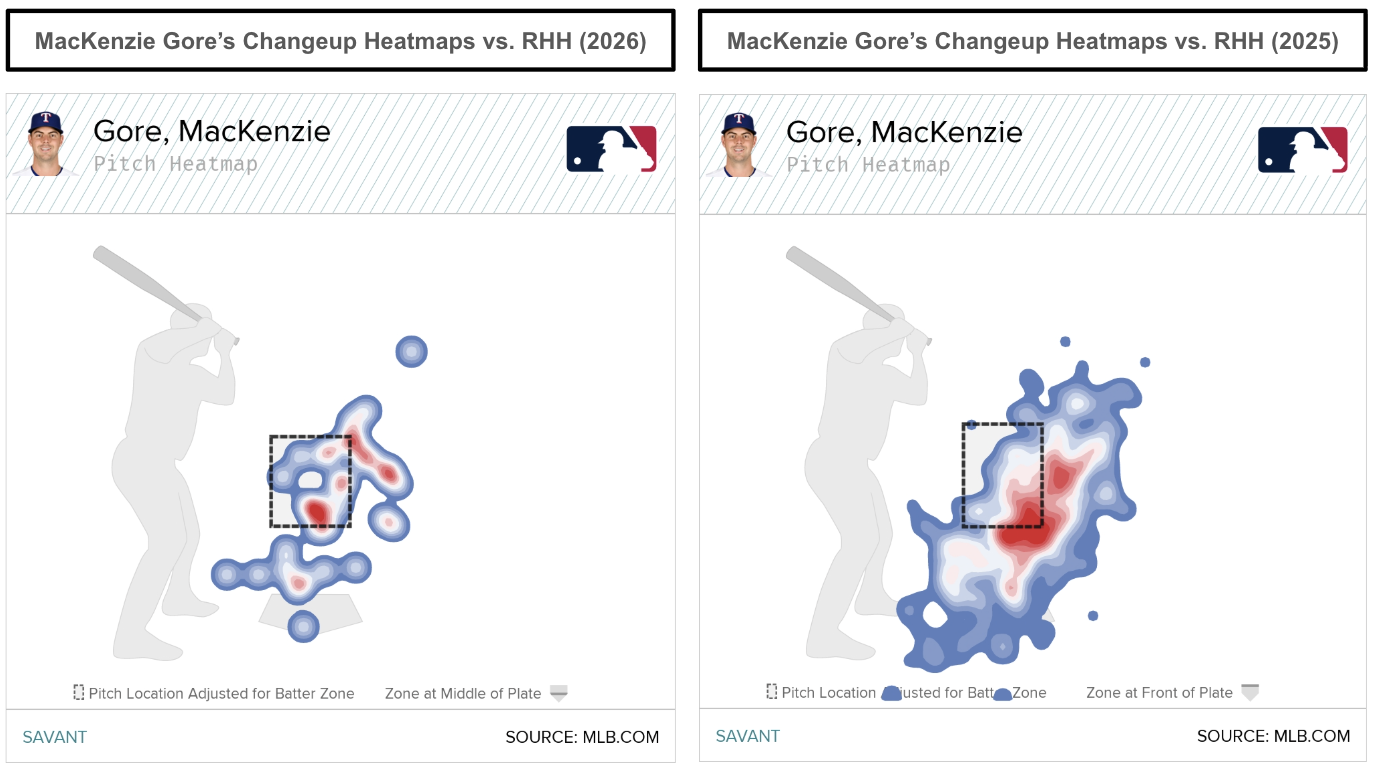
First, Gore has been throwing the changeup in the zone more often (42.4%), compared to 28.4% in 2025 and 38.6% in 2024. The changeup locations have been thrown over three inches higher in 2026 than in 2024 and 2025. There's a chance that opposing right-handed hitters knew Gore would throw changeups outside the zone, so they looked to crush them when in the zone.
Overall, it looks like Gore's attempt to trade whiffs for weak contact via the changeup. It's minor, but Gore threw changeups 3-4 percentage points more often against right-handed hitters, as he traded fewer four-seamers for more changeups and cutters (four percentage points more).
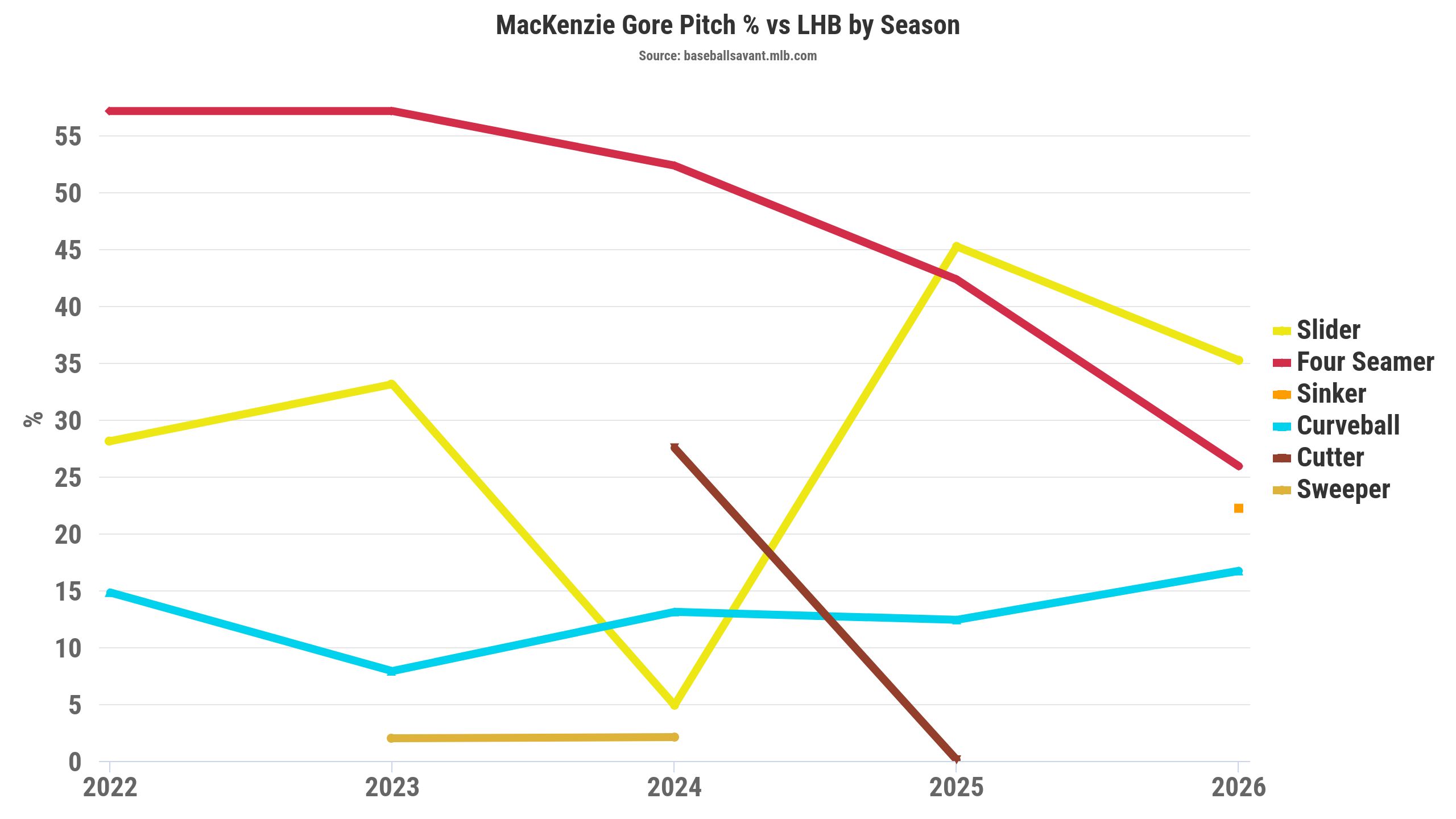
Besides Gore's changeup location changes, let's highlight his new sinker against left-handed hitters. In 2025, Gore was throwing sliders (45.2%) and four-seamers (42.3%) most often against left-handed hitters. However, Gore dropped the four-seam (25.9%) and slider (35.2%) usage against lefties, while throwing a sinker (22.2%).
We're examining 12 sinkers, so it's a tiny sample. At first glance, it appears that Gore could be manipulating the four-seamer to be classified as a sinker. Gore's sinker has 2-3 inches less of induced vertical break with nearly nine inches of arm-side movement compared to the four-seamer.
The early results haven't been great via the sinker, so it might be something Gore experiments with throughout the season. We'll want to keep tabs on the sinker usage and locations for Gore.
Gore has a WHIP under 1.00, something we thought would never happen. A better team context, plus limiting hits (28%) and stranding runners, will help Gore improve his WHIP while generating whiffs at an above-average rate. We were already buying into Gore before the season, and these early season adjustments and results further solidify those takes.
Ryan Weathers, SP, New York Yankees
27% Rostered
Weathers was a velocity riser in spring training, but he had a bumpy start to the 2026 season before he threw eight innings with one earned run and seven strikeouts against the Athletics. From a skill standpoint, Weathers looks similar to the career averages, evidenced by a 34% ball rate and 11.3% swinging-strike rate.
It's slightly better control than his career ball rate (37%), though a two-point dip in swinging-strike rate from 2025 (13.6%). Weathers started throwing more sinkers (18.4%) to right-handed hitters in 2026 after primarily throwing four-seam (45.3%), changeups (32%), and sweepers (16.5%) over 90% of the time in 2025.
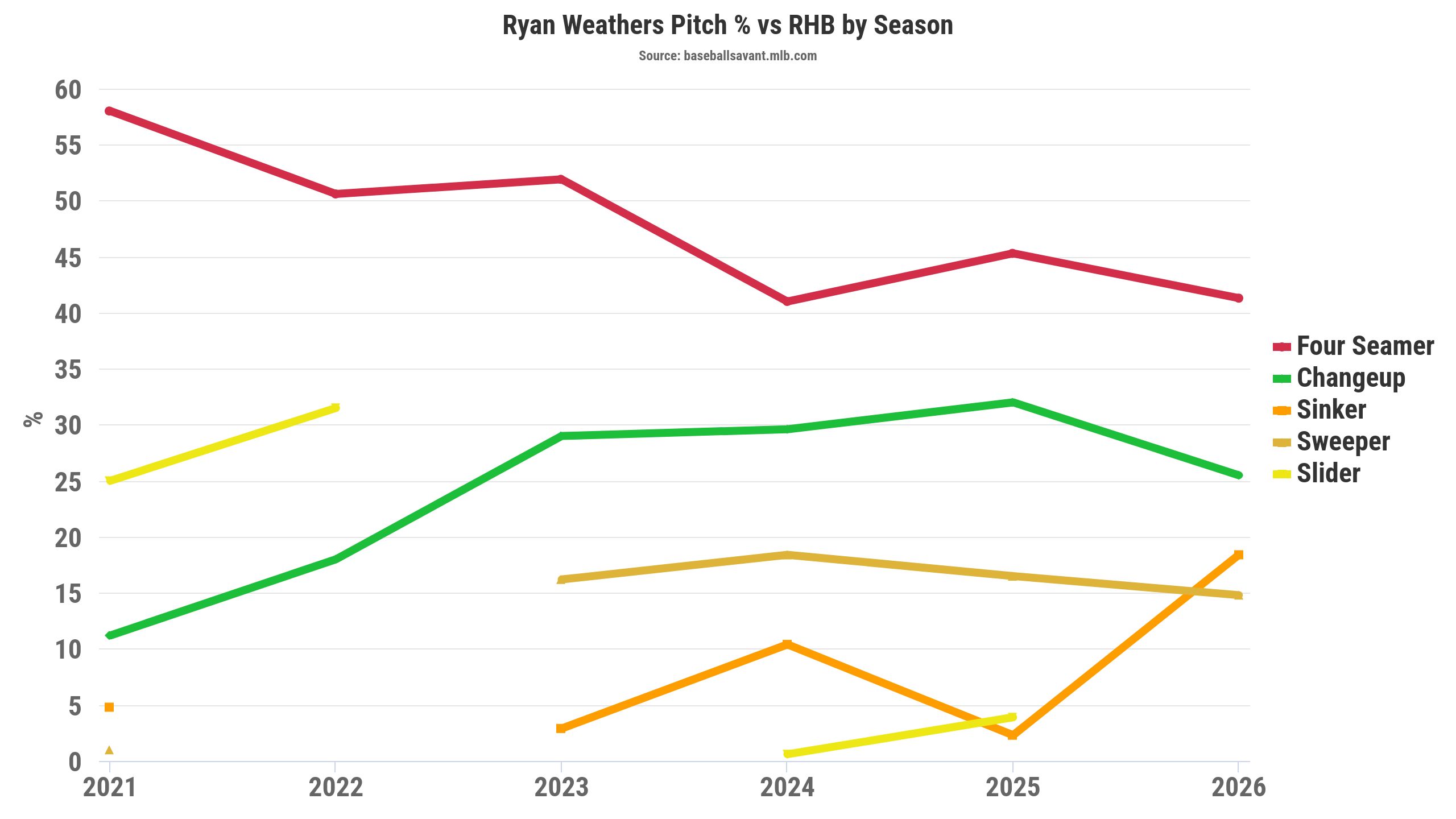
Weathers' sinker possesses an elite amount of arm-side fade (18-19 inches), as his only pitch moving horizontally that much. He has been throwing sinkers low and away from right-handed hitters, though it hasn't quite led to weak contact (.409 wOBA, .479 xwOBA) yet.
Speaking of sinkers, that pitch leads Weathers' arsenal against left-handed hitters, throwing them 44.9% of the time in 2026. That's notable because Weathers typically leaned on his four-seamer against lefties, tossing them 45.2% (2025) and 31.7% (2024) of the time in recent seasons.
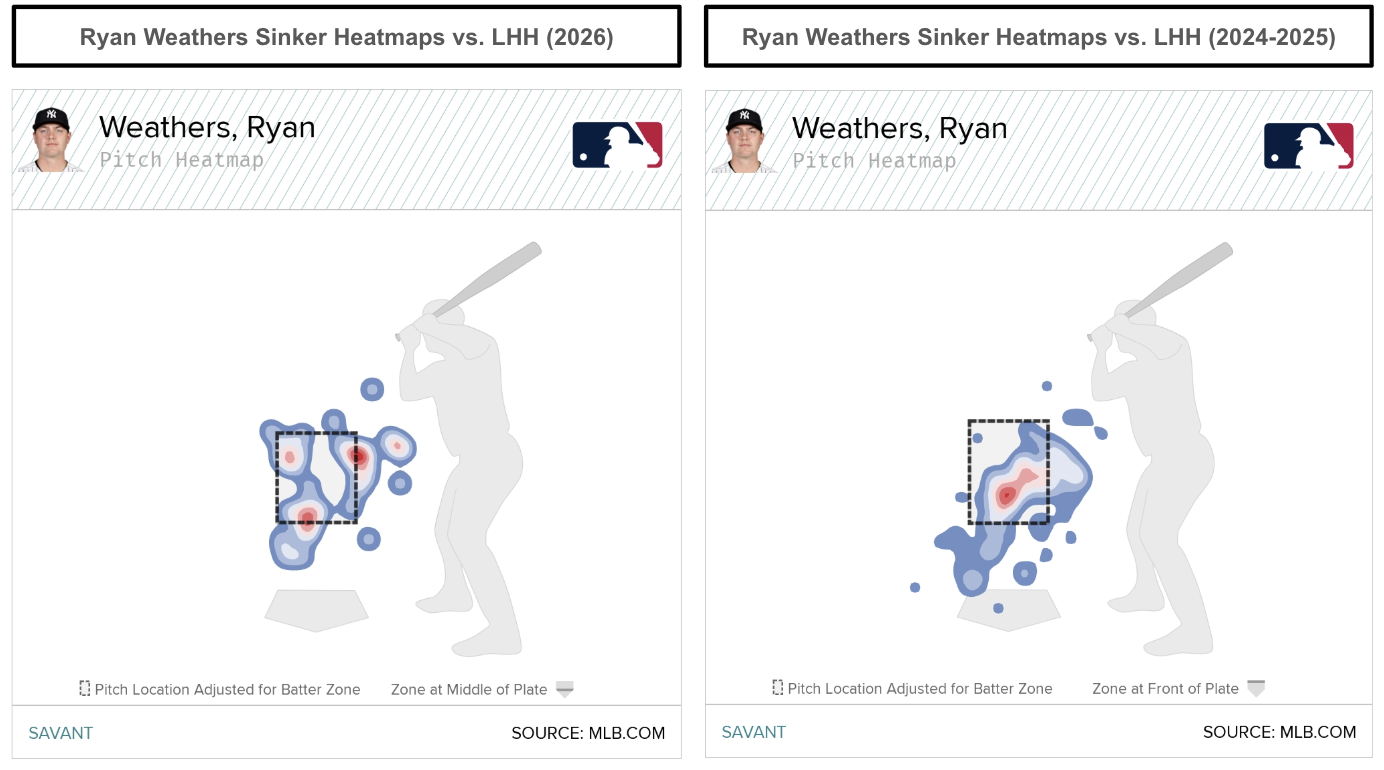
It could be noisy, but Weathers has been throwing the sinker high and inside to lefties, while also peppering them low and away in 2026. The Yankees love throwing sinkers, logging the second-highest percentage behind the Phillies, suggesting these are actionable changes for Weathers in New York.
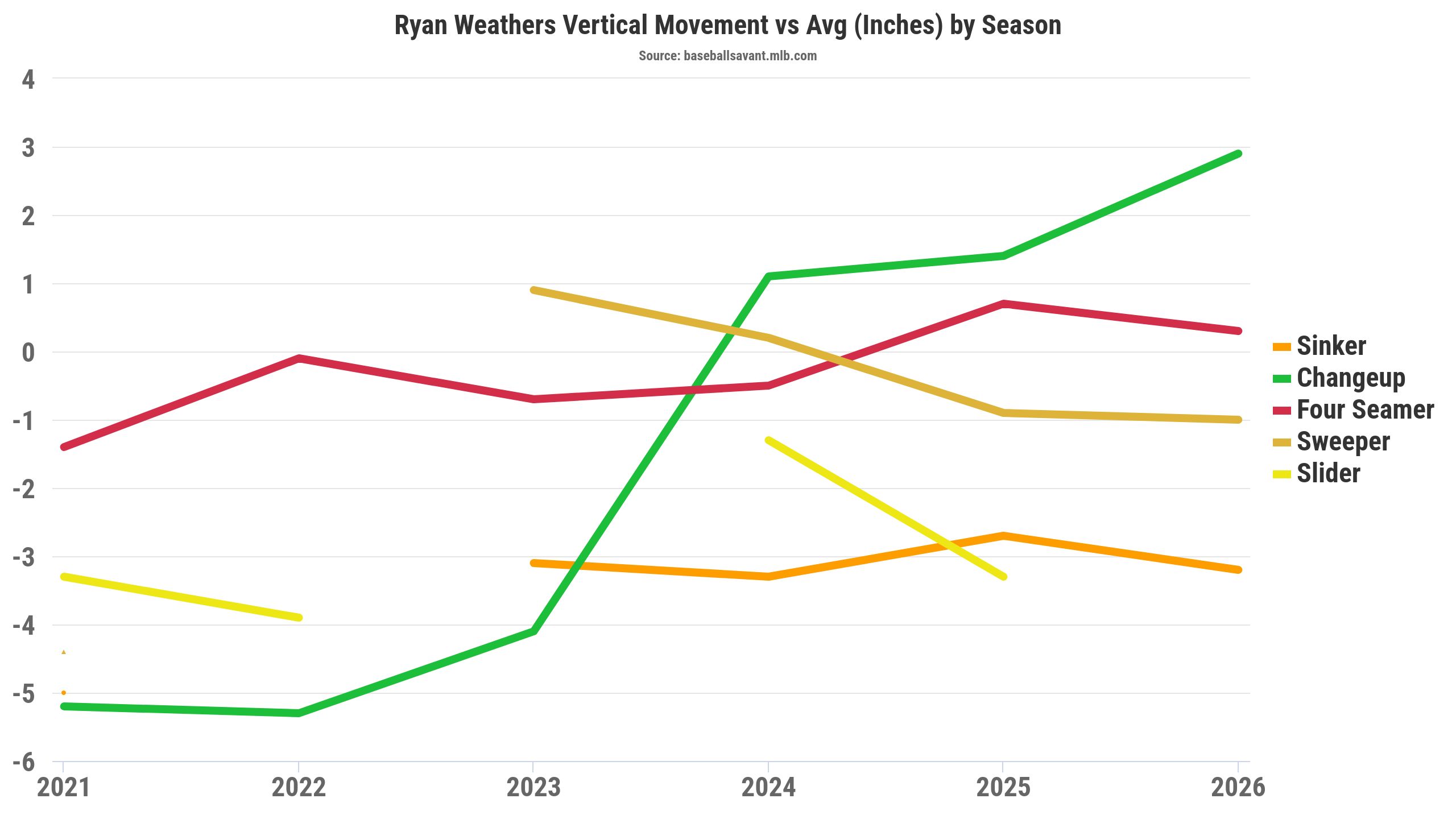
Weathers' changeup typically led his arsenal from a swinging strike standpoint, eliciting a 19-20% swinging-strike rate in 2024 and 2025. In the early 2026 sample, Weathers' changeup generates a 14.8% swinging-strike rate, though it added four inches of downward movement. Theoretically, Weathers' changeup should elicit more whiffs.
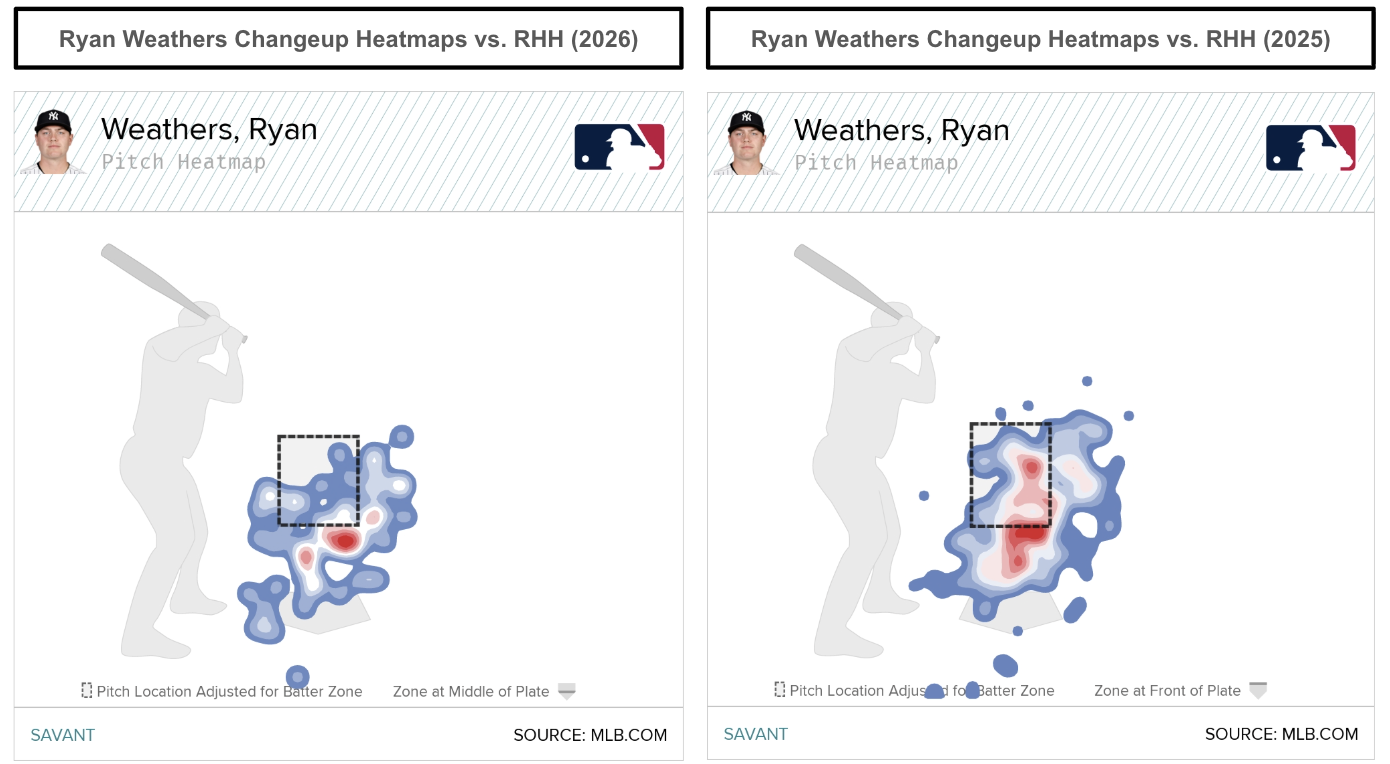
It could be fluky, but the changeup locations have been tighter in 2026. The changeup has been located over 1.5 inches closer toward the middle of the plate in 2026 compared ot 2025. Furthermore, Weathers' changeup was thrown nearly four inches higher (3.8) than in 2025. That could indicate better command of the changeup in 2026.
As expected, Weathers continues to evolve with the Yankees, who already worked with lefty Max Fried to make pitch-level adjustments in 2025. Weathers remains another starting pitcher to buy into, even if the initial results haven't been consistent yet.
Randy Vasquez, SP, San Diego Padres
49% Rostered
Throw out your previous biases with Randy Vasquez because there's a different pitcher under the hood. Throughout Vasquez's career, he had a 35% ball rate and a single-digit swinging-strike rate (7.9%). Early in 2026, Vasquez boasted a 32% ball rate and 14.3% swinging-strike rate.
He was a spring training velocity riser who had seen his sinker and four-seam velocity increase by 1.5 mph in 2026. Vasquez's arm angle dropped by three degrees in 2026, though his horizontal and vertical release points shifted within an inch. So, what's different for Vasquez?
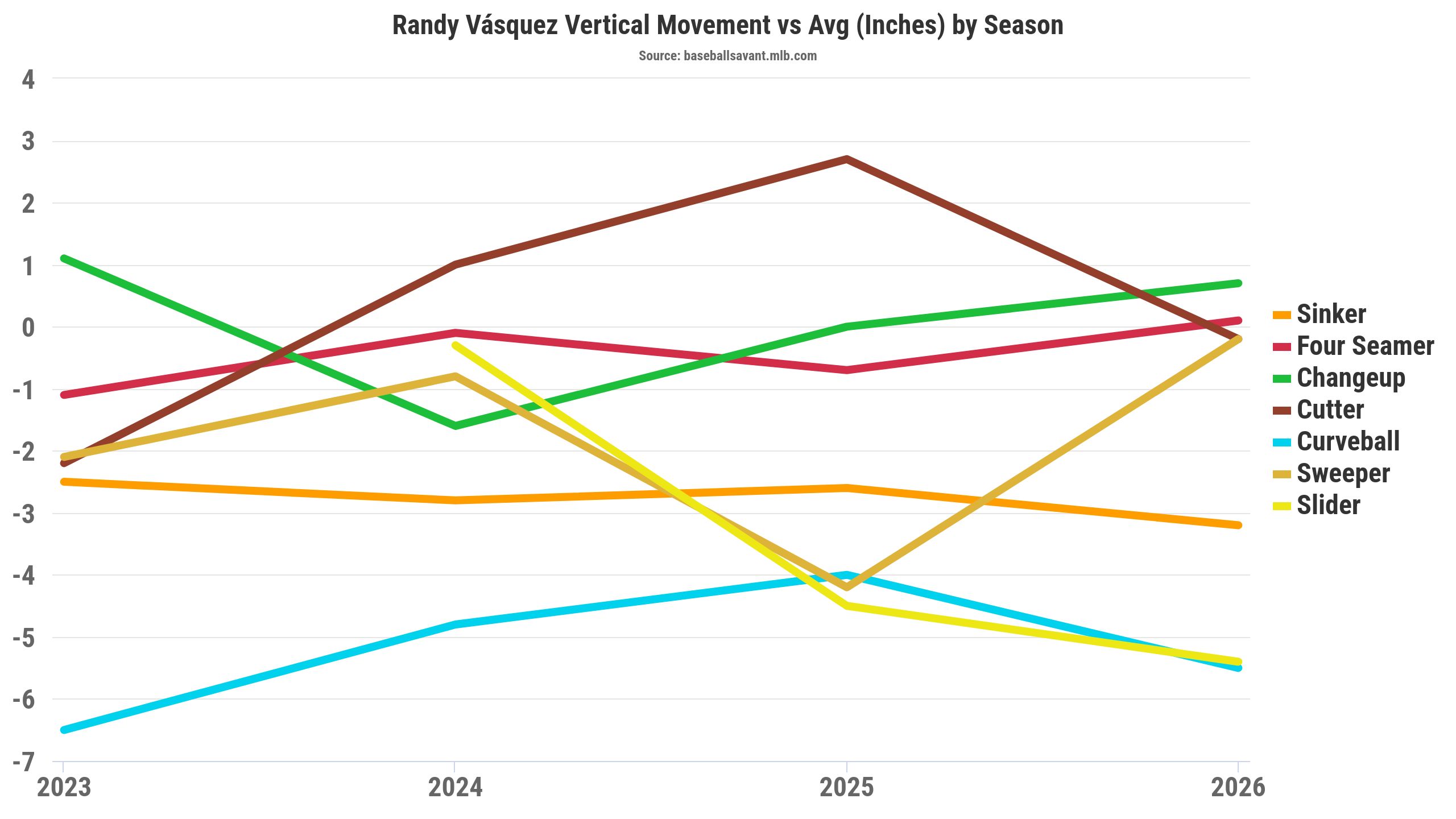
Vasquez's four-seamer added an inch of induced vertical break with an additional inch of arm-side fade. Like Vasquez's four-seam, his changeup added an inch or so of downward and horizontal movement. That aligns with Vasquez's changeup, eliciting an arsenal-best 21.9% swinging-strike rate, over triple the career average (6.8%).
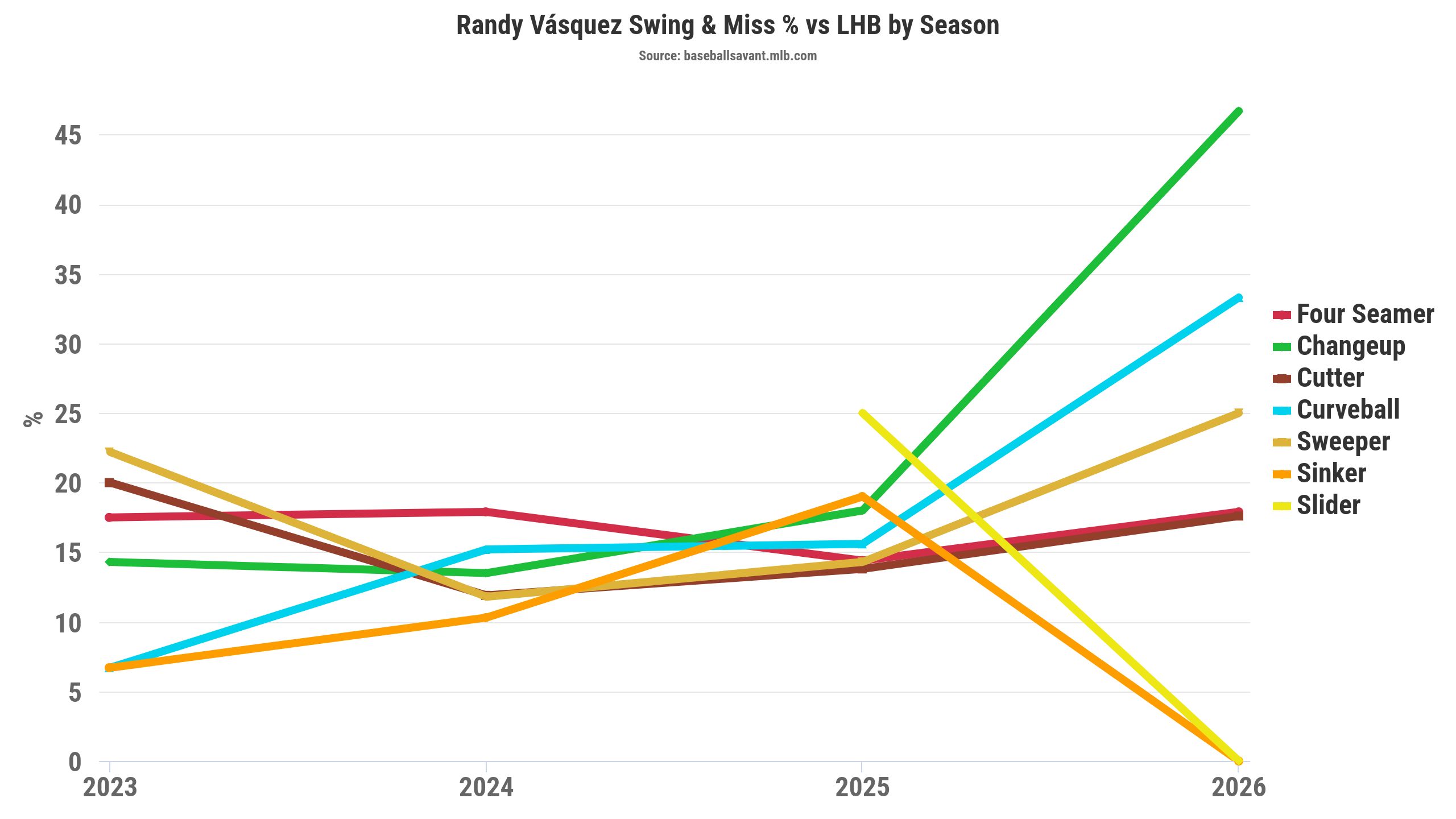
Specifically, Vasquez's changeup has been limiting weak contact against left-handed hitters. That's evidenced by Vasquez's changeup, allowing a .114 wOBA (.204 xwOBA). Furthermore, Vasquez's curveball added over 2.5 mph of velocity and lost over four inches of downward movement while maintaining above-average glove-side sweep.
Like the changeup and four-seamer, Vasquez's curveball saw a swinging-strike rate jump to 16% in 2026, compared to a career average of 8.9%. That provides Vasquez with three pitches that generate whiffs against left-handed hitters after lacking an arsenal to miss bats.
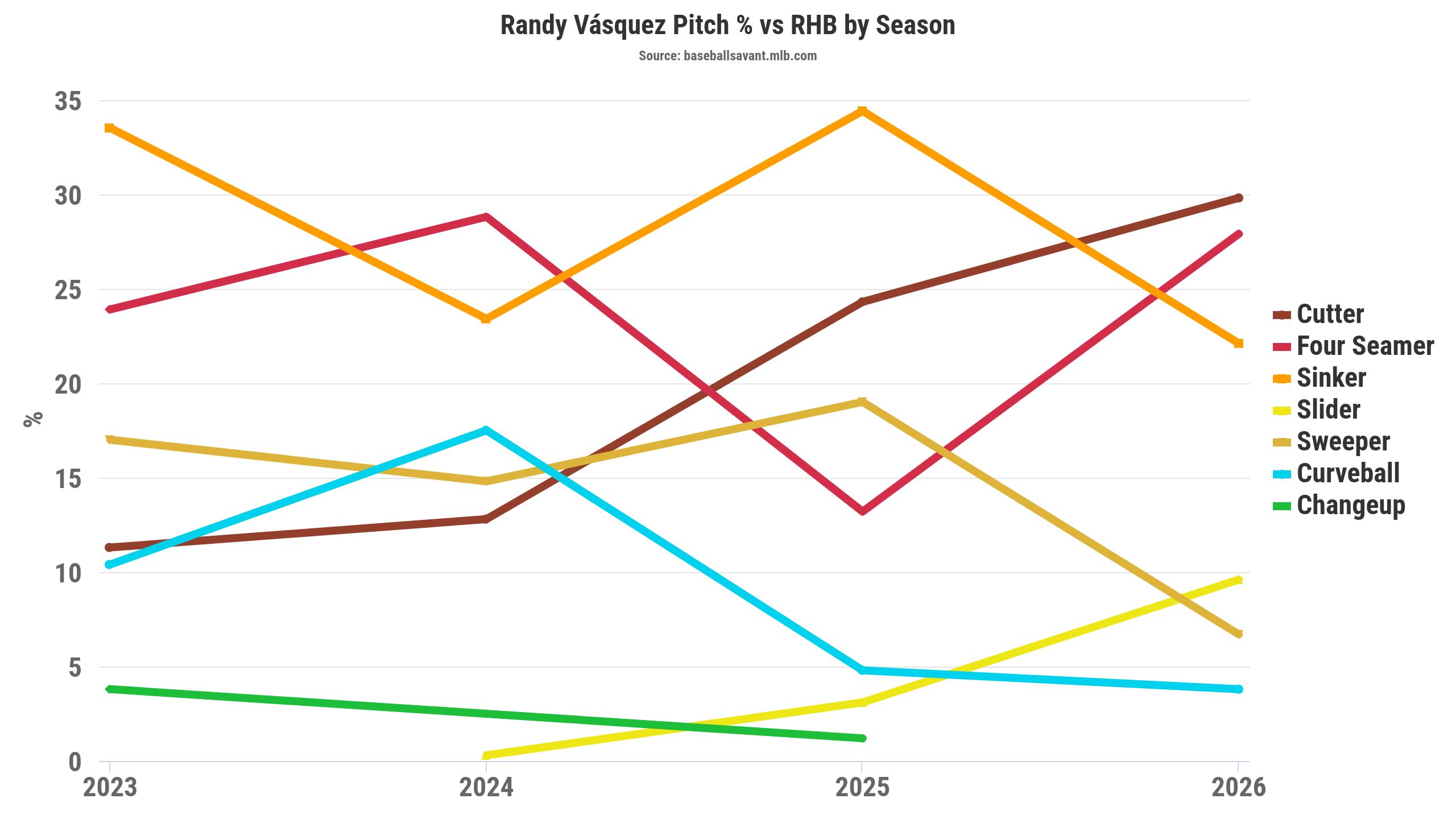
Vasquez throws cutters 29.8% of the time to right-handed hitters. The cutter added over three inches of downward movement while gaining two inches of glove-side movement. Unfortunately, Vasquez's cutter has been destroyed against right-handed hitters (.555 wOBA, .685 xwOBA).
That's significantly worse than Vasquez's cutter outcomes (.276 wOBA, .302 xwOBA) in 2025, which he threw 24.3% of the time. However, it's worth noting that Vasquez's cutter had an above-average vertical movement profile in 2025, unlike in 2026.
There's a chance Vasquez can manipulate the cutter and slider, with those gyro-like shapes, seen via the induced movement profiles below. Focus on the tighter pitch plot between the sliders and cutters in 2026 compared to 2025.
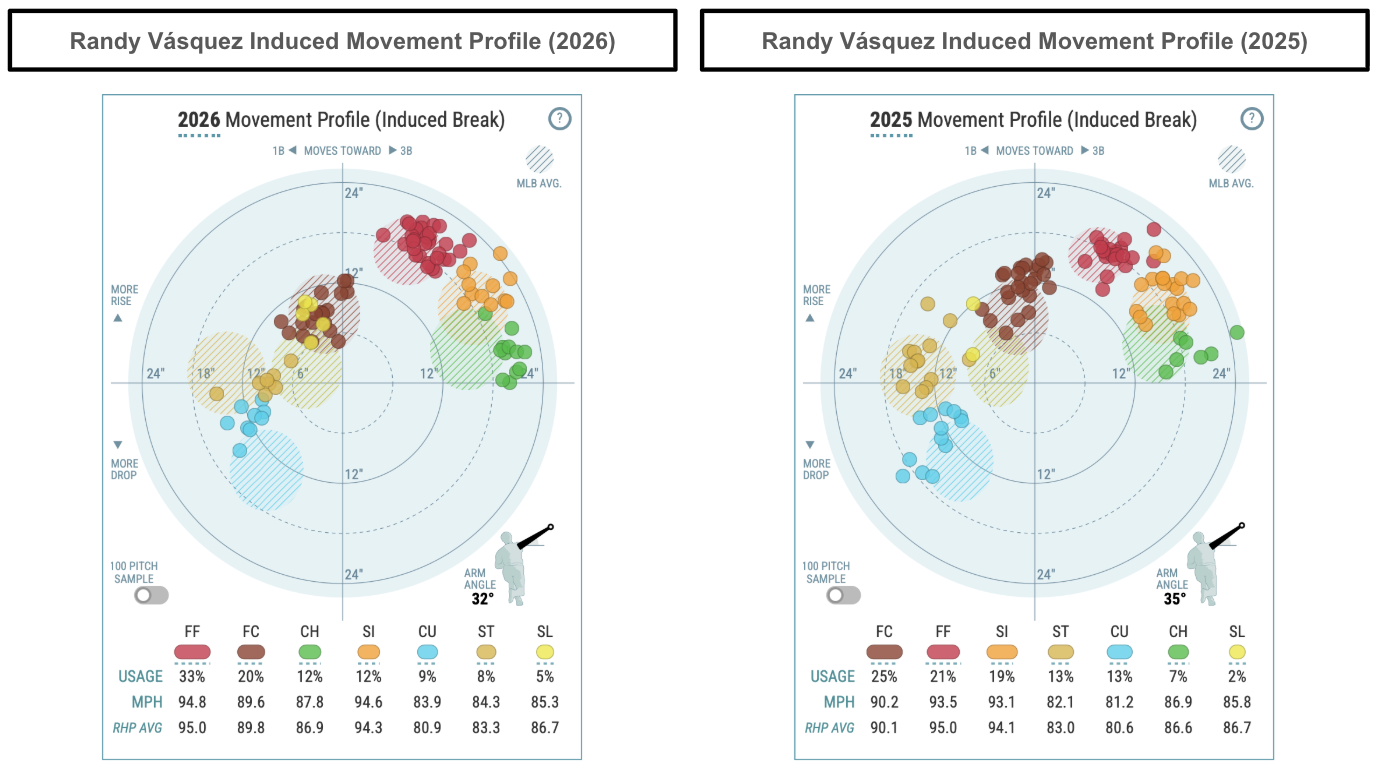
That could explain Vasquez's slider eliciting an 18.2% swinging-strike rate in 2026 compared to a career average at 10.9%. Furthermore, Vasquez's cutter generated a 14.5% swinging-strike rate in 2026, three percentage points above the league norm, and significantly higher than Vasquez's career average.
Vasquez's cutter (107) and slider (115) have career bests in Location+ in 2026, as we circle back to the tighter slider and cutter pitch plot, plus the potential for better command. For context, Vasquez's cutter had a career Location+ of 93 with the slider at 99, showing significant improvements in command.
I've been searching for offseason articles to see if Vasquez went to Driveline, Tread Athletics, or another player development facility, but I haven't seen one yet. Regardless, Vasquez has evolved as a starting pitcher beyond velocity with the pitch movement profiles, usage rates, and pitch command across the board.
This is a legitimate breakout, given several supporting factors, though it's understandable to be skeptical based on the historical numbers.
Trevor Rogers, SP, Baltimore Orioles
92% Rostered
Rogers was cooking last season with the Orioles, with high expectations heading into 2026. Like in 2025, Rogers has been fortunate with a .268 BABIP and 81% strand rate, leading to a 4.09 SIERA, suggesting regression for him in 2026.
Meanwhile, Rogers' skills remained similar to 2025 (31% ball rate and 12.7% swinging-strike rate), with a 34% ball rate and 12.5% swinging-strike rate in 2026.
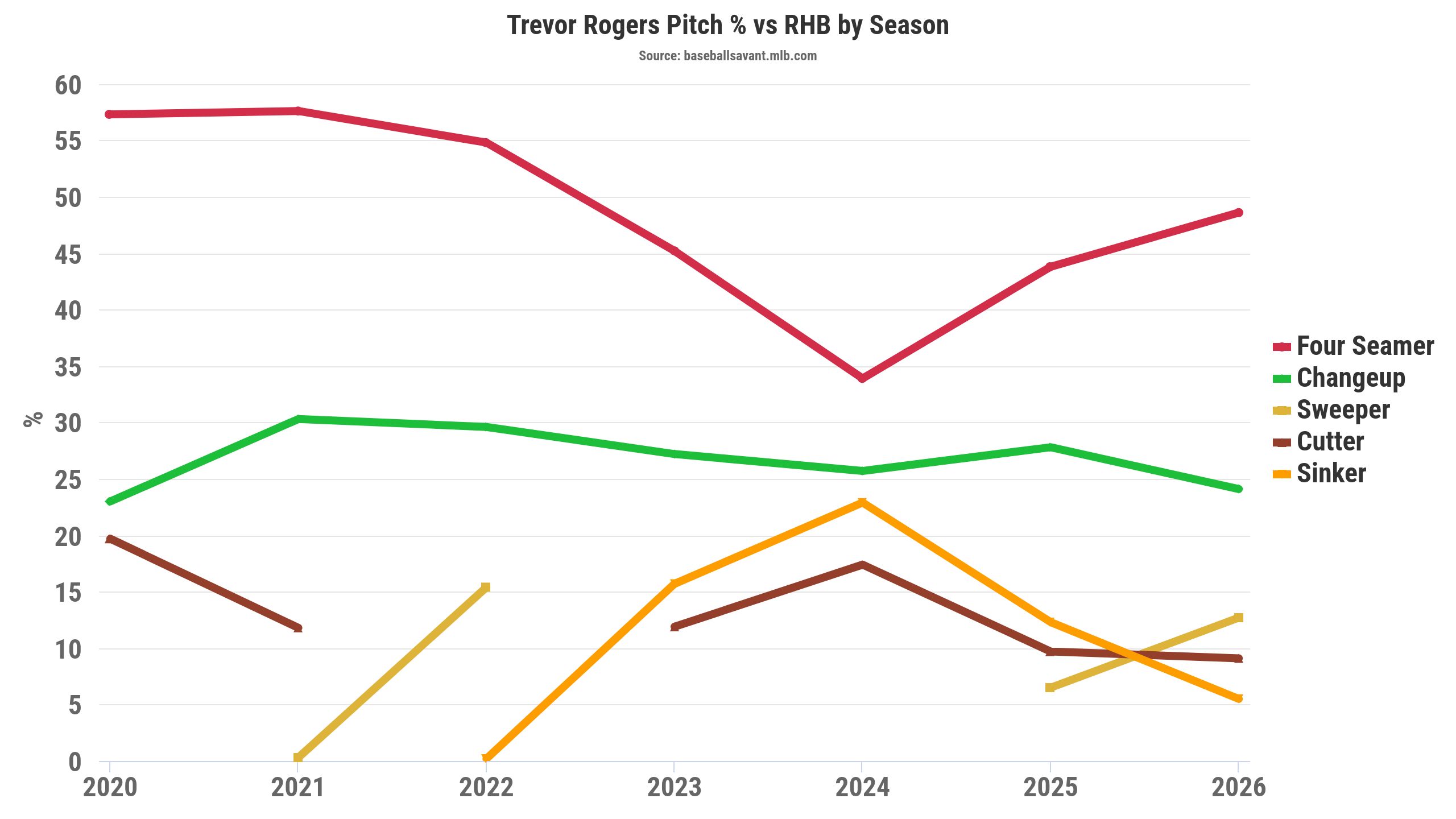
Against right-handed hitters, Rogers continued to throw four-seamers (48.6%) and changeups (24.1%). However, Rogers threw sweepers 12.7% of the time against right-handed hitters in 2026. Rogers hasn't thrown sweepers at a double-digit rate since 2022 (15.4%). He typically threw sinkers and cutters to round out his arsenal.
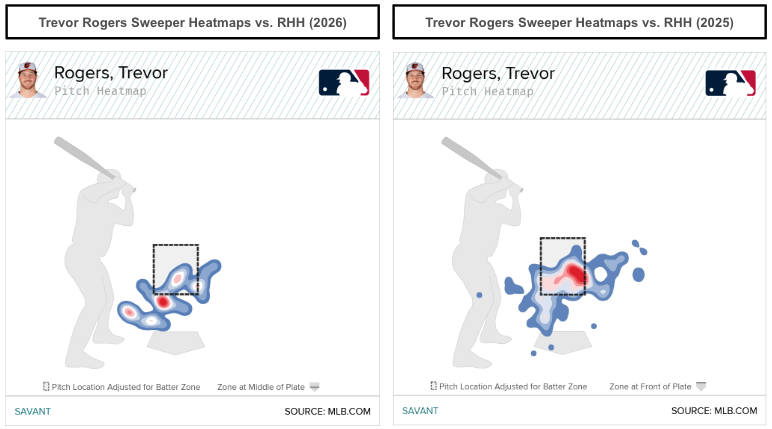
The sweeper added over 4.5 inches of downward movement and more than two inches of glove-side sweep in 2026 compared to 2025. Early in 2026, Rogers' sweeper generates a whopping 24.2% swinging-strike rate, leading his arsenal. When the movement profile and whiffs align, that's actionable.
With the sweeper's movement profile change and usage difference, Rogers locates the sweeper low and inside to right-handed hitters in 2026. That's different than the sweeper locations in 2025, as seen in the visual below.
The pitch-level sample against left-handed hitters is small in 2026 and throughout his career, since opposing teams tend to stack right-handed hitters against him. Although we didn't highlight Rogers' changeup, it typically led his arsenal, with a 15.2% swinging-strike rate in his career, but it's down to 8.3% early in 2026.
Rogers' changeup movement profile looks similar in 2026, within one inch of downward and horizontal movement, compared to previous seasons. He has been locating the changeup two inches lower in 2026 than in 2025 against right-handed hitters, though he tends to command them well.
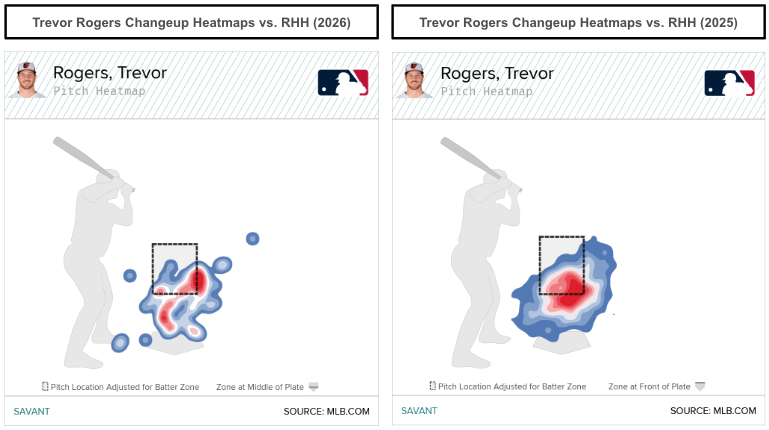
That's evident by Rogers' changeup having a 111 Location+ in 2026 and a 107 Location+ in 2025, so the outcomes should regress in his favor. An ERA under 2.00 might not be sustainable, or he could be a pitcher with the tendency to outpitch his underlying metrics. Rogers has shown us he can produce ace-like outcomes while possessing above-average skills, supporting the results.
More Fantasy Baseball Advice
Download Our Free News & Alerts Mobile App
Like what you see? Download our updated fantasy baseball app for iPhone and Android with 24x7 player news, injury alerts, sleepers, prospects & more. All free!