



 RADIO
RADIO










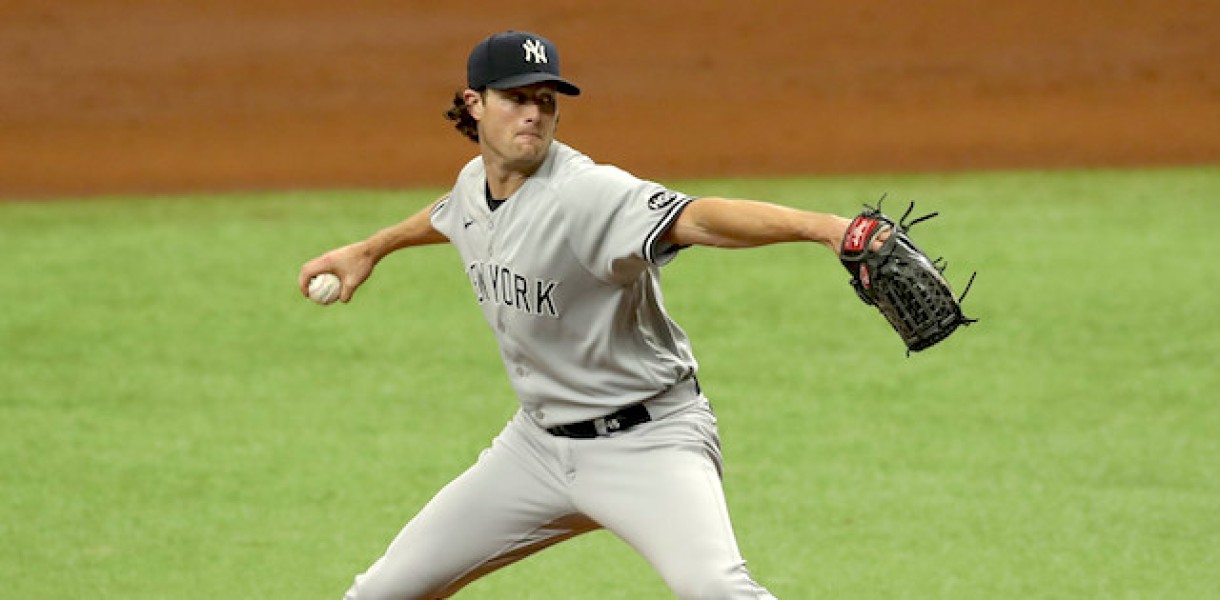
Jon Anderson outlines his process for selecting which pitchers to use in MLB DFS on FanDuel and DraftKings with some data-driven insights from prior seasons.
Welcome back to RotoBaller, where we are taking you through some advanced DFS strategy and advice to prepare you for a full-length MLB season in 2021.
Last spring, while baseball was not being played and I did not know what to do with myself, I wrote a big old script to go back and collect every MLB box score since 2014 while merging in each player's DraftKings salary for that day. This provided me with an enormously useful dataset to explore and learn from. Learning from the past is the best way to get better at predicting the future, which is the name of the game in fantasy sports.
In this post, I will take you through some of the data and offer some of the best tips I have for MLB DFS players about how to choose pitchers on FanDuel and DraftKings for your DFS contests. And if you're looking for other MLB DFS strategy content, check out my most recent article on how to stack hitters here.
Featured Promo! Save 50% on any PGA Premium Pass using discount code MASTERS, this week only! Win more with our DFS and Betting Packages, get expert tools and advice from proven winners including the Lineup Optimizer, Research Station, betting/props cheat sheet and more. GAIN FULL ACCESS HERE
DraftKings Scoring Analysis
You can't win a game if you don't know the rules. Here is how DraftKings scoring breaks down for pitchers:
| Category | Points |
| IP | 2.25 |
| W | 4 |
| BB | -0.6 |
| H | -0.6 |
| ER | -2 |
| SO | 2 |
| CG | 2.5 |
| CGSO | 2.5 |
| NH | 5 |
From my data source, I combined all pitcher data from 2019 and 2020 to see how the total points scored distribution breaks down. Different pitchers accrue their points in different ways, of course, but taking the league as a whole here is the breakdown:
From 2019 to 2020, MLB pitchers scored 156,985 DraftKings points. Here is how the scoring has broken down:

Innings pitched leads the way, as 84% of the total points scored has come from that 2.25 per inning pitched multiplier. However, directly factoring into that are the negatives from hits, walks, and earned runs. The more innings you pitch, the more of those negatives you give up, making innings not always the best thing to shoot for. The league average WHIP over this data sample is 1.33. That means an average inning from a DraftKings perspective would break down like this:
+2.25 points from the inning pitched, -.8 points from the 1.33 walks + hits, for a total of 1.45 DraftKings points per inning. That's for an average pitcher though, and typically we are playing pitchers in DFS that are much above average. If you take a pitcher with a strong 1.10 WHIP, they would lose .67 points per innings from giving up walks and hits, giving them an average of 1.58 points per innings when not factoring in strikeouts.
All of that math is to say that strikeouts are king. To offer further evidence, here are the top-ten DraftKings scorers by DK points scored per inning pitched along with their K/9 values.
| Player | DKPts/IP | K/9 |
| Liam Hendriks | 4.5 | 13.1 |
| Gerrit Cole | 4.5 | 13.2 |
| Justin Verlander | 4.3 | 12.1 |
| Tyler Glasnow | 4.2 | 12.7 |
| Jacob deGrom | 4.0 | 11.9 |
| Shane Bieber | 4.0 | 11.8 |
| Max Scherzer | 3.9 | 12.6 |
| Dinelson Lamet | 3.9 | 12.5 |
| Mike Clevinger | 3.9 | 11.2 |
Here are the average DraftKings points scored by strikeout total:

The 17 strikeout game has only happened once in the last two seasons (Chris Sale on 5/14/2019), so that explains the sudden dip at the end. Other than that, this is almost a perfectly linear relationship.
When we look at DraftKings points vs. innings pitched, it's less linear:

You can see that between two and five innings, there isn't much of a difference in how many points you should expect. You can see the big jump you get from reaching that "complete game" bonus there, but those are so rare in today's game that it is futile in trying to predict it.
What About Wins?
As a whole, only 9% of total DraftKings points scored have come from the win bonus. Starters earned a win in 29% of their starts. Only ten starters (minimum 20 starts over the last two seasons) have even broken 50% (Domingo German, Justin Verlander, Gerrit Cole, Max Fried, Clayton Kershaw, Eduardo Rodriguez, Mike Clevinger, Stephen Strasburg, Marco Gonzales, and Shane Bieber). So even if you're playing one of the guys most likely to get a win, your expected value would only be two added points (4 points * a 0.5 chance of getting it). Since you're typically hoping for 20+ points from your starting pitcher, we're talking about less than 10% of those points coming from a win.
FanDuel Scoring Analysis
| Category | Points |
| IP | 3 |
| W | 6 |
| QS | 4 |
| SO | 3 |
| ER | -3 |
It's a slightly different story on FanDuel in terms of pitcher scoring. On DraftKings, we saw that 74% of points came through the strikeout. On FanDuel that number is only 56%. Wins account for 7% of total points and quality starts for 6%. On DraftKings, the win bonus (4 points) is worth the same as two strikeouts. On FanDuel, it's the same (six points for a win, three points for a strikeout), but the quality start bonus comes in and skews things. This is because quality starts and wins are highly correlated. When a pitcher earns a quality start, he earns a win 57% of the time. When he fails to record the quality start, that number plummets to 14%.
That essentially means the win and quality start bonuses go hand-in-hand, if you get one, you're pretty likely to get the other. Getting both of those bonuses is 10 points, which is worth 3.33 strikeouts, making strikeouts mean less on FanDuel. It's still true that the biggest scores still all have big strikeout totals alongside them. In fact, the top 80 FanDuel scores of the last two years all came from 10+ strikeout games (that number is a similar 91 on DraftKings).
While the rest of this post will be centered around DraftKings data (as those are the salaries and scores I used when building out my dataset), most of the following can be applied to FanDuel as well.
What's Cooked Into Salary?
When it comes down to it, salary is the most important part of DFS. All of your decisions should be centered around those salaries. It turns out that DraftKings and FanDuel are factoring in most of the statistics that we like to look at when generating player prices. That means that spotting a good match-up for a pitcher might not actually do you any good, because the pitcher's price will likely have already been adjusted to it.
To test how sharp these algorithms are, I took every start of the last two seasons, rounded each pitcher salary (using DraftKings data again) to the nearest $500 mark, and looked at how each salary "bin" performed. If we would see a perfectly linear relationship between salary and performance (meaning that points scored go up steadily with every extra $500 in salary), that would show us that the pricing algorithm is doing a very good job.

Here are those salaries and fantasy scores in line graph form:

You can see that the algorithm is pretty darn good as a whole. As the price you're paying increases, so do your chances of getting the win bonus, as do your expected points. The one thing to notice in that chart is the numbers cluster a bit in the middle. On average over the last two seasons, you have gotten 12.24 points from a $7,000 starter (since I rounded to the nearest $500 these are all pitchers priced between $6,800 and $7,200). Spending $2,000 more adds 2.85 points to your expectation. If you take a $9,000 pitcher, you get 15.32 points, but adding $2,000 onto that gets you 21.48 points, a much bigger increase of 6.16 expected points.
What this means is that, if the pricing algorithm continues to work in the way it has the last two years, it would be profitable to, in general terms, fade pitchers priced around $9,000 in favor of pitchers at $7,000 or at $10,500 or above. The algorithm is really great at picking up the best and worst starters, but it's not quite as good in the middle. You can get about the same expectation from a guy at $7,200 compared to someone at $8,500, and the vast majority of the huge tournament-winning scores are going to come from the guys above $10,000.
How Much Does Opponent Matter?
The matchup is going to be built into the salary as well, making the opponent thing matter a bit less. Over the last two seasons, the average starting pitcher salary against the Marlins has been $8,500, while that drops the whole way to $7,000 against the Astros. That does have something to do with the pitchers most commonly facing those teams, but when you sort the teams by the average salary of opposing pitchers, you see the best offenses in the league (Astros, Yankees, Red Sox, Nationals, Dodgers, Twins) all seeing the least expensive pitchers on average.
Since the pricing algorithm already factors in the matchup, it is really not that useful to pick pitchers based on who they're facing, because you're already being forced to pay more for the boost in expected points in a good matchup and vice versa.
That said, there are some exceptions to the rule. Over the last two seasons, the Houston Astros have allowed starters to score just 1.86 DraftKings points per inning pitched, while on the other end of the spectrum is the Tigers who have given up 3.19. That's a massive difference, and it's probable that the algorithm is not always aggressive enough to catch up to those huge disparities. You would have needed a really huge discount to justify playing a pitcher against the Astros the past two seasons given how stingy they have been at allowing SP points.
Now in terms of the teams in the middle, again, it's not a huge difference. Number five on the list of points given up to opposing starters is the Blue Jays, who have had 2.87 points per inning scored against them, equating to 14.3 points every five innings. If you go down 15 spots in the ranks you find the Angels at #25, and their numbers are 2.31 per inning and 11.6 per five innings. So while over the last two years DFS players have viewed those matchups wildly differently (the 5th best team vs. the 5th worst is how a lot of people would frame this), the result is only an expected difference of less than three fantasy points on average.
I'm not making any recommendations about teams to target or avoid for 2021, since the lineups and lots of other stuff will be different, but my point is that you really should not worry too much about matchup except at the extremes.
So What Should We Look For?
Since the pricing algorithm cooks in most of the metrics you'll be looking at when choosing your lineup, there's not much profitability to be squeezed out of sweating over strikeout rates and other statistics. You might find that a pitcher is facing the highest strikeout rate team they have faced all season and want to jump on, but chances are that the advantage is already taken away by an increase in price. So the smart move is to try to beat the algorithm. How do we do that?
1) Look for Price Disparities
One thing you can do that can be advantageous is to target pitchers at their lower price points. It is true that the pricing algorithm weighs in recent point totals into the price. If a player has had a few bad games in a row, they will often become cheaper. I tested this with a bunch of different starters and they mostly all show the same pattern, as shown here with Aaron Nola:

On the x-axis, there are his average DraftKings points from his three most recent starts. You can see that line trends upwards. At one point in the last two years, Nola had averaged just 11 points in his last three starts, and his price bottomed out to $7,100 because of it. In that game he went six innings and struck out 12, racking up 33 DraftKings points. That's just one anecdote that doesn't prove anything, so I ran a correlation test to see how predictive the average of the last three games was on the next score, and the answer came out to be a correlation coefficient of 0.49, which shows a pretty weak relationship.
Taking another anecdote, here is Jacob deGrom's DraftKings points outputs by price point over the last two seasons:

His best game was, indeed, at his highest price point, but everything in the middle jumps up and down. He's done just as well between $10,500 and $11,000 as he has between $11,500 and $12,000. This proves to be true for all pitchers when you look at the middle of the plots.
The moral of the story here is that pitchers' recent performance is not a great predictor of what they will do next, so you really should not care what the last few games have looked like for a guy. The exploitation is that the pricing algorithm often does, so you can profit over time by jumping on those small price decreases.
2) Look for changes happening after prices are released
Prices are released the night before the day of the slate. Anything that happens after the prices are released cannot affect the price tags. That means that if a big name in the opposing lineup isn't in the lineup for that night, there is an advantage to be had. The pitcher's price was made assuming he would be facing a better lineup than he actually is. These are small advantages to capitalize on.
The same is true for weather developments. The algorithm won't often factor in weather, so there can be price inefficiencies in cases where, say, there is heavy winds blowing in from the outfield, or if a dome roof is closed after it was planned on being opened. Little stuff like that is what you need to keep your ear to the ground for.
Summary
All of this can be boiled down to a few bullet points. Here is my general advice for picking pitchers in DFS.
- Focus less on the statistics and more on the salaries. You can study the box scores and stats all day long, but you're not getting yourself ahead at all if everything you're exploring is already cooked into the pitcher salary, which most of the time it is.
- Recent performance does not matter in most cases. Provided a player isn't playing hurt, his last several games have no predictive power over the very next game. Sometimes the pricing algorithm does weigh that recent good or bad production too heavily into the salary, which provides an opportunity and makes it profitable to roster a pitcher coming off of a couple of bad starts that has seen his price drop a few hundred dollars from where it was prior.
- Don't overreact to match-ups. Unless a pitcher is facing an opponent that is at the complete extreme of match-up favorability, the opponent does not have nearly as significant an effect on expected points as you might think.
- Be vigilant of lineups when they come out. Salaries come out the night before the slate and they assume the "normal" lineups, so any abnormal lineups will not be weighed into the salary. A major bat being out of the opposing lineup may end up making a pitcher a little bit too cheap, which you can exploit.
Download Our Free News & Alerts Mobile App
Like what you see? Download our updated fantasy baseball app for iPhone and Android with 24x7 player news, injury alerts, sleepers, prospects & more. All free!