RADIO
RADIO







Elliott Baas looks at starting pitchers who turned in surprising starts recently. These SPs could emerge as waiver wire targets and sleepers, or simply mirages.
Welcome to our Surprising Starts series, where every week we look at lower-owned starting pitchers who have performed unexpectedly well in their last outing(s).
This week we're hitting all points of the surprising starts spectrum. We're looking at a veteran castoff in Homer Bailey, an under-the-radar pitching style change in Jordan Lyles, and a young breakout candidate in Matt Strahm.
Ownership is based on Yahoo leagues and is accurate as of 04/22/2019. The goal of this article is to look at pitchers widely available that could be useful in fantasy, whether they have been recently added by a ton of teams or are still sitting on waivers.
Featured Promo: Save 50% off the regular price with discount code CHAMP, for a limited time. Exclusive access to our Team Sync platform, DFS cheat sheets, Lineup Optimizers, betting/prop picks, and exclusive content from Nick Mariano and Eric Cross! GAIN ACCESS NOW
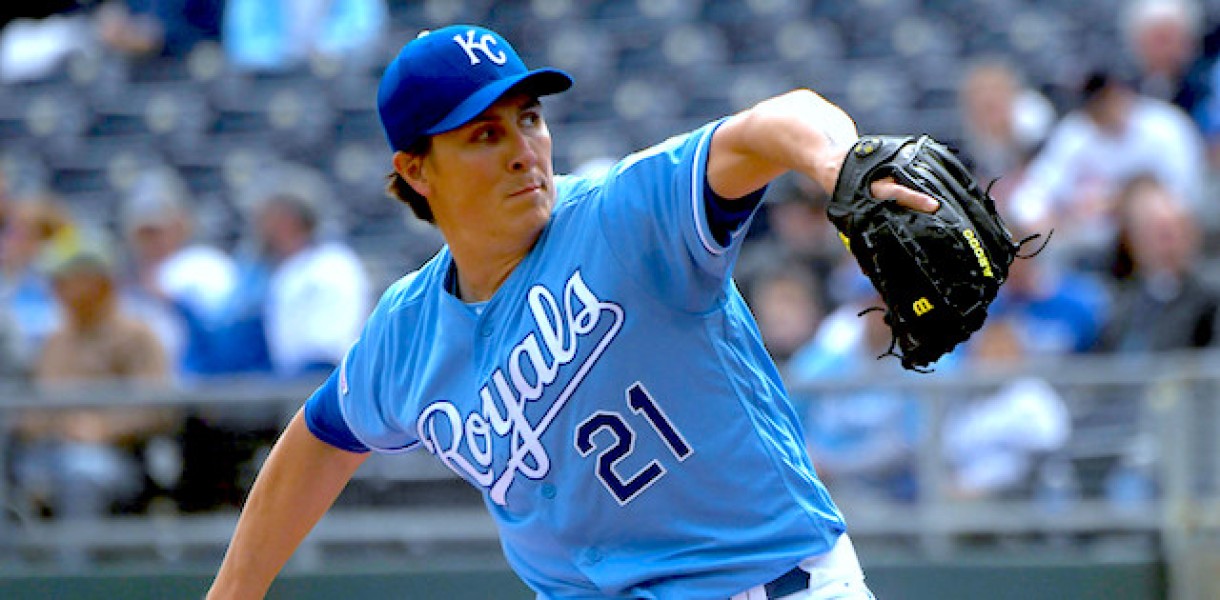
Homer Bailey, Kansas City Royals
3% Owned
2018 Stats: 106.1 IP, 6.09 ERA, 4.82 SIERA, 8.5% K-BB%
04/13 vs. CLE: 7 IP, 2 H, 0 ER, 2 BB, 6 K
04/18 @ NYY: 6 IP, 3 H, 1 ER, 1 BB, 6 K
If there’s one pitcher no one ever expects to be successful, it’s Homer Bailey. Between 2015-2018 Bailey had a 6.25 ERA, 8% K-BB%, and allowed 1.5 HR/9 in 231.2 innings. He’d become nothing more than a laughing stock, his contract an albatross on the Cincinnati organization. So Bailey, like many other once-good starting pitchers, packed his bags and went to the one place where any washed-up former top prospect is welcome, the AL Central. Things went as expected initially, as he allowed 10 earned runs through his first two starts, but Bailey has shut down the Indians and Yankees over his last two games.
He mainly throws four pitches these days, a four-seam fastball, a slider, a curveball, and a split-change. The split-change has been the key to success for Bailey thus far. Batters are hitting just .074 against the pitch with a 63.6% groundball rate and 25.5% SwStr rate. It’s still early, but the splitter has been performing better for Bailey this season than it ever had in the past, even at his peak. Here are a few examples from his previous two starts.
Pretty nasty stuff, right? And Homey Bailey threw those. Homer Bailey. Arguably the worst starting pitcher in baseball over the last three seasons is dealing absolute filth right now. The splitter doesn’t just look better either, he’s throwing it with better movement. Bailey’s gained two inches of drop on his splitter this season along with an inch and a half of horizontal movement. He’s also shaved 1000 RPM off the pitch (lower spin rates are better for offspeed pitches; it helps with deception). He’s only 96 splitters so far, so we’re still looking at a small sample size for pitch movement numbers, but this splitter looks like a legit put-away pitch for Bailey.
So, the splitter’s good, that means we can ride David Dewitt Bailey Jr. for the next five months to a fantasy championship, right? There’s one small problem with that, and by small, I mean huge. It’s a huge problem that Homer Bailey’s fastball is probably the worst fastball any Major League pitcher has ever thrown and ever will throw. Hyperbole? The numbers don’t think so, as batters have absolutely teed off on Bailey’s fastball for a .361 BA and .667 SLG. Even worse, it has a .390 xBA and .767 xSLG against, meaning batters could have done even better against the pitch. Hitters also send it back faster than Bailey fires it in, as Bailey’s fastball has an average velocity of 92.9 MPH and an average exit velocity against of 94.2 MPH.
Like with his splitter, it’s still a relatively small sample size to judge Statcast numbers on Bailey’s fastball, except in this case his poor fastball performance isn’t isolated to just this season. Since 2015, which is when Homer Bailey’s career unraveled, batters are hitting .350 with a .214 ISO against his fastball. The pitch has -40 pVAL since 2015 and a -1.66 pVAL/C (per 100 pitches) over that stretch, which is the second worst in baseball behind just Jered Weaver. His splitter has been impressive, but his fastball is so bad that Bailey could implode at any moment against any team in any matchup. It’s not worth the risk in mixed leagues.
Verdict:
There’s playing with fire, and then there’s playing with fire in the middle of a Redwood forest over a puddle of gasoline with a leaky lighter in one hand and a can of hairspray in the other. The splitter looks good, and Bailey deserves credit for that, but he’s not worth the risk in standard mixed leagues. There will probably be a few more good starts from him this year, and probably be quite a few bad ones as well. In deeper leagues, he’s a desperation streamer at best. Hopefully, you never get that desperate.
Jordan Lyles, Pittsburgh Pirates
31% Owned
2018 Stats (starter and reliever): 87.2 IP, 4.11 ERA, 3.88 SIERA, 10.2% K-BB%
04/19 vs. SF: 6 IP, 4 H, 0 ER, 1 BB, 6 K
Lyles pitched six shutout innings against the Giants on Friday before departing with a hand contusion, but he is expected to make his next start, which is great news for the Pirates and his fantasy owners considering how dominant Lyles has been this season. He has allowed just one run in his first three starts, and has 18 strikeouts to just five walks in 17 innings.
Prior to 2018 Lyles was a below average starting pitcher in pretty much every category. His ERA was consistently over five, his strikeout rate was usually below 16%, and his walk rate was typically over 7%. There wasn’t anything to like about his profile, but things changed in 2018. Lyles transitioned from a subpar sinkerballer to a curveball pitcher, and found various success both as a starter and a reliever last year. His 2018 stats weren’t eye-popping, so when he won a rotation spot with Pittsburgh few were interested, but Lyles may have a little more appeal than was initially thought.
As previously mentioned, Lyles ditched his sinkerball approach and increased his curveball usage, which was a great move, because the curveball is by far Lyles’ best pitch. Since 2018, Lyles has thrown his curveball 29% of the time and batters are hitting .212 against it with a .117 ISO. The pitch also has above average spin at 2481 RPM and is about two inches above league average in vertical movement. It’s not a big swing-and-miss pitch, curveballs rarely are relative to other secondary pitches, but it’s got a 61.5% groundball rate all time. One shouldn’t expect Lyles to maintain his current 29% strikeout rate with this as his primary breaking ball, but he should be able to have a strikeout rate around 20-23% with a good groundball rate.
Lyles' curveball is good, that’s true, but it’s also worth pointing out just how lucky he’s been through his first three starts. When it comes to luck, some blame their problems on it, others debate its existence, and I personally look at three basic pitching metrics to determine how fortunate or misfortunate a pitcher has been on the mound. Funny how life philosophy can vary from person to person, isn’t it? The three metrics I look at when giving a pitcher a cursory look are: BABIP against, HR/FB rate, and strand rate. If home runs, walks, and strikeouts are the three true outcomes, then the three aforementioned metrics represent their inverse, at least from a pitching perspective.
Now, there can be valid reasons for a pitcher to routinely excel in either BABIP against, or HR/FB rate, but generally these metrics normalize to about league average for everyone. And Lyles couldn’t have been more fortunate through his first three starts. He has a 100% strand rate, .237 BABIP against, and 5.9% HR/FB rate this season. It’s only been three starts, but these numbers are sure to normalize.
For Lyles, one could buy an above average HR/FB rate; he excels at inducing groundballs with his curveball and pitches in Pittsburgh, but the other two could present problems for the right-hander. No one expects him to maintain a 0.53 ERA this season, but owners should anticipate regression in practically every category from Lyles. His curveball is good, but it’s not good enough to overcome an otherwise below average arsenal. If Lyles delivers another good start and proves he’s healthy, it’ll be time to sell. He could be a decent matchup play, but he’s just not all that exciting.
Verdict:
A transition from sinkerballer to curveball specialist rescued Lyles’ career, but that doesn’t mean he’ll maintain anywhere close to his current production. He’s a good sell-high player since there is plenty of regression coming here. He won’t be unusable, but he’s not on the precipice of a breakout either. He’s a decent streamer in the right matchup.
Matt Strahm, San Diego Padres
40% Owned
2018 Stats (bullpen): 61.1 IP, 2.04 ERA, 3.36 SIERA, 19.6% K-BB%
04/19 vs. CIN: 8 IP, 2 H, 1 ER, 0 BB, 5 K
Strahm was a hot name on sleeper lists coming into the season due to his dominance as a reliever and his deep four-pitch repertoire. He fit the blueprint for successful reliever turned starter because he had multiple secondary pitches to lean on rather than relying on velocity to blow hitters away. His first start went poorly; he allowed five runs in 2.2 innings against the Diamondbacks, and that caused owners to bail quickly. He’s only allowed two earned runs over his last three starts combined, and after twirling an eight-inning gem against the Reds those owners have to be wondering whether they cut Strahm loose prematurely.
Strahm excelled out of the bullpen by inducing whiffs at an above average rate with his fastball, slider, and changeup. He had three pitches he could rely on for strikeouts, with his slider being the best of the bunch. Unfortunately, the slider hasn’t been nearly as effective a swing-and-miss pitch this season compared to last. Reduced velocity and strikeout rate is to be expected when a pitcher moves from the bullpen to the rotation, but the switch has been more drastic than anticipated. Sure, he notched eight of his 11 swinging strikes with the pitch in this last start, but the season-long swinging strike rate has fallen to 15.2%, an 8% drop from last season. He also lost 2.5 MPH of velocity, 1500 RPM, and over an inch of drop with his slider as a starter. The pitch went from dominant to average when he moved to the rotation.
The slider wasn’t the only pitch to lose effectiveness in Strahm’s move to the rotation. His fastball is getting absolutely hammered by opposing hitters. Batters have a .333 AVG, .700 SLG, and 94.5 MPH average exit velocity against the pitch in 2019. He lost about two MPH on the pitch, along with a half inch of movement, and batters are feasting on it. He lost two inches of drop and 2000 RPM of spin on his curveball, and so far batters are hitting .500 against it with a 1.000 SLG and 92.2 MPH average exit velocity against.
We knew his pitches would lose a little edge moving from the bullpen to the rotation as a result of longer outings, but right now they’ve diminished so much that it’s hard to believe Strahm can continue to be effective. He’s surviving off a .266 BABIP and 6.9% HR/FB ratio but the peripherals don’t back his 3.05 ERA. He has a 5.11 SIERA, 5.66 K/9, and 9.8% SwStr rate. Those aren’t the numbers of an effective starting pitcher. He’s also gone beyond five innings just once, and that was in this start against Cincinnati. However, he lasted so long because he threw just 87 pitches, not because San Diego trusts him to go deep into games or get his pitch count up with regularity. His hot start and preseason sleeper status might stir up a little trade interest on Strahm, and it’s probably worth cashing this chip in early.
Verdict:
We were excited for Strahm to become a starter during draft season, and now he’s doing well, so what’s the problem? His stuff has diminished beyond the point of effectiveness, and he’s surviving on BABIP luck right now. He could maybe be trusted in a good matchup, but the upside is low on a per-start basis. Might be worth shopping him around, try and see if anyone buys the breakout based on preseason hype.
More 2019 Fantasy Baseball Advice