



 RADIO
RADIO









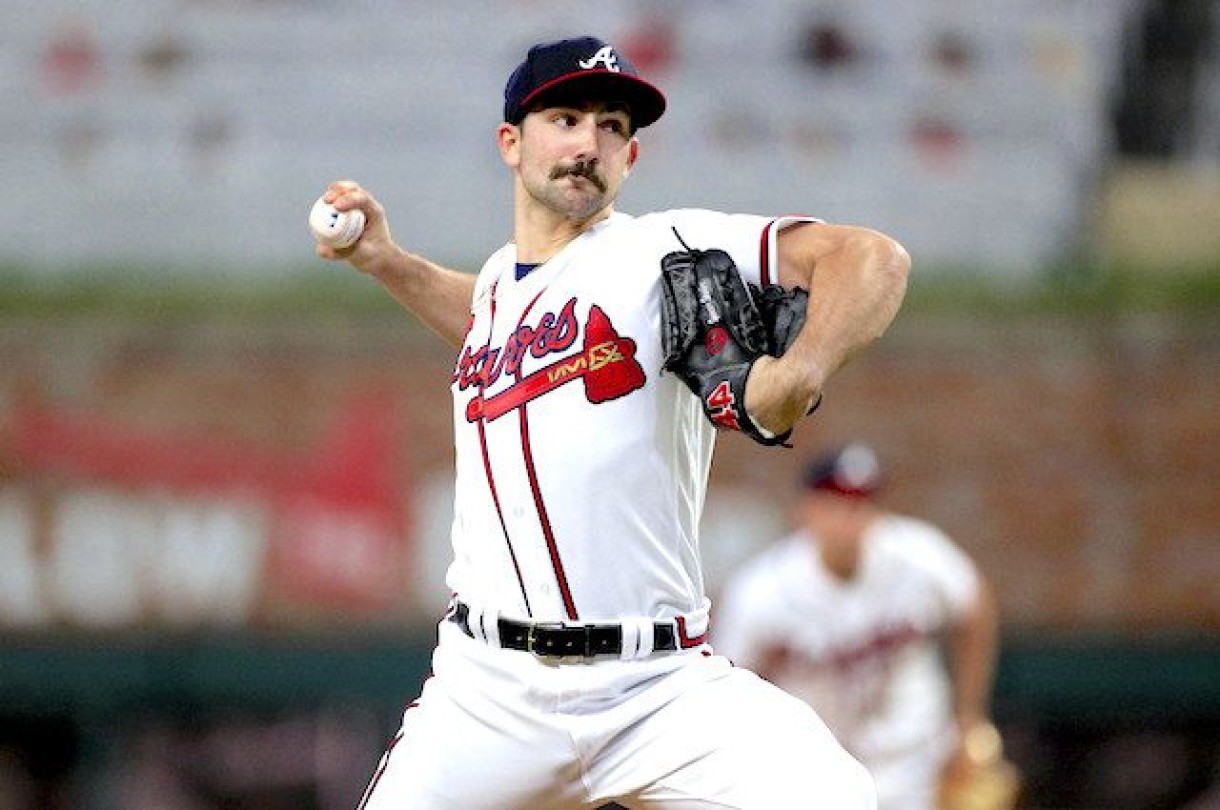
Corbin Young's 10 fantasy baseball bold predictions for the 2026 MLB season, including predictions for Luis Robert, Spencer Strider, Colson Montgomery, more.
Throughout my examination of team- and player-level analysis, we often consider the wide range of outcomes via skills, luck, and situations. Whenever considering bold predictions, we're highlighting results that are far-fetched but somewhat reasonable.
After hours and weeks of research, these bold predictions have been based on data. Some fantasy baseball drafters stick to projections, others go by feel, and many use both. We have biases and players we love, and sometimes the data will lead us to love or hate them more.
We have several RotoBaller writers giving us their bold predictions. In the education world, we love operationalizing definitions. What does a bold prediction look and sound like? It's like how I want my spicy foods, medium spice. We're lucky to hit on one or two of my 10 bold predictions for 2026.
Featured Promo: Save 50% off the regular price with discount code SUMMER, for a limited time. Exclusive access to our Team Sync platform, DFS cheat sheets, Lineup Optimizers, betting/prop picks, and exclusive content from Nick Mariano and Eric Cross! GAIN ACCESS NOW
Nolan Schanuel Hits 20 Home Runs
Let's kick it off with a lukewarm one. Schanuel hit 12-13 home runs over the past two seasons. The last time Schanuel surpassed that mark was in college when he hit 16 home runs in 2022 and 19 in 2023 at Florida Atlantic University. He increased his bat speed by 2 mph to a cold 67.5 mph in 2025. Schanuel pulled the ball 40-41% of the time over the past two seasons.
He hit 17 of his career 26 home runs on pulled batted balls over the past two seasons, translating into an 81 percent home run to barrel rate. That suggests Schanuel has been efficient in hitting pulled barrels for home runs, and we could see more of that in 2026. If Schanuel pulls the ball more or takes another slight step forward in bat speed, we could see him sniff at 20 home runs.
Luis Robert Jr. Earns Close to First Round Value ($25 or More)
When we posted optimistic things about Luis Robert Jr., most of the comments expected Robert to be a bust in 2026. There's no denying Robert's healthy concerns with 60 days on the injured list in 2024 and 1.5 months in 2025. Those injuries were hip and hamstring-related, as he continues to deal with lower-body issues.
The visual below shows Robert's bat speed distributions by season compared to the league average.
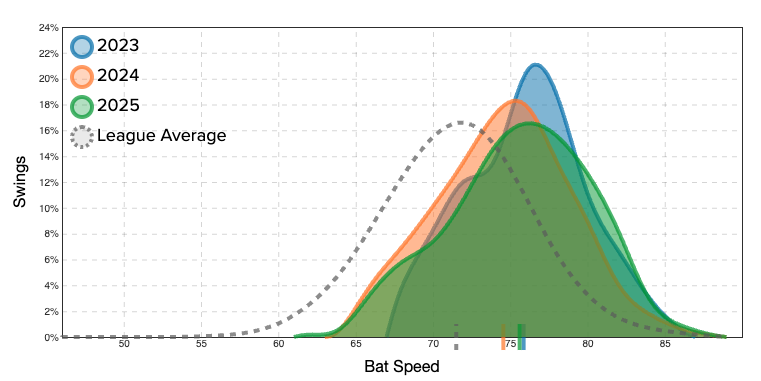
Robert's stolen base opportunity rate was 34 percent in 2024 and 41 percent in 2025 after stealing 22 (2024) and 33 (2025) bases. He possesses near-elite bat speed (75.6 mph) with a fast swing percentage at 57.4 percent in 2025. Robert goes from the White Sox home park, which ranks 18th (96) for right-handed hitters, to the Mets' home park, which ranked seventh (109) in home run park factors.
There's a 25-30 home run, 30+ stolen base season within Robert's range of outcomes, while joining a much better team. That's the type of production we see from Fernando Tatis Jr.
The Athletics Will Have Four Hitters Who Hit 40 Home Runs
The Athletics played in a home park that ranked sixth in a one-year sample of home run park factors in 2025. Several of the Athletics' hitters have strong power skills, evidenced by the team being tied for 8th in Exit Velocity 90 (EV90), 15th in barrel rate, and 9th in bat speed. Last season, the Athletics had three hitters with 30 or more home runs, including Nick Kurtz (36), Shea Langeliers (31), and Brent Rooker (30). Tyler Soderstrom (25) and Lawrence Butler (21) were close behind.
According to ATC Projections, Kurtz's home run projection is 38, Rooker is at 33, with Langeliers (29), Soderstrom (24), and Butler (21) at 20 or more. Kurtz, Rooker, and Langeliers have the best chances of sniffing 40 home runs. If Butler wasn't dealing with a knee issue heading into the season, we might have had more confidence in him with a career 9.9 percent barrel rate, 74 mph bat speed, and 41.2 percent fast-swing rate throughout his career.
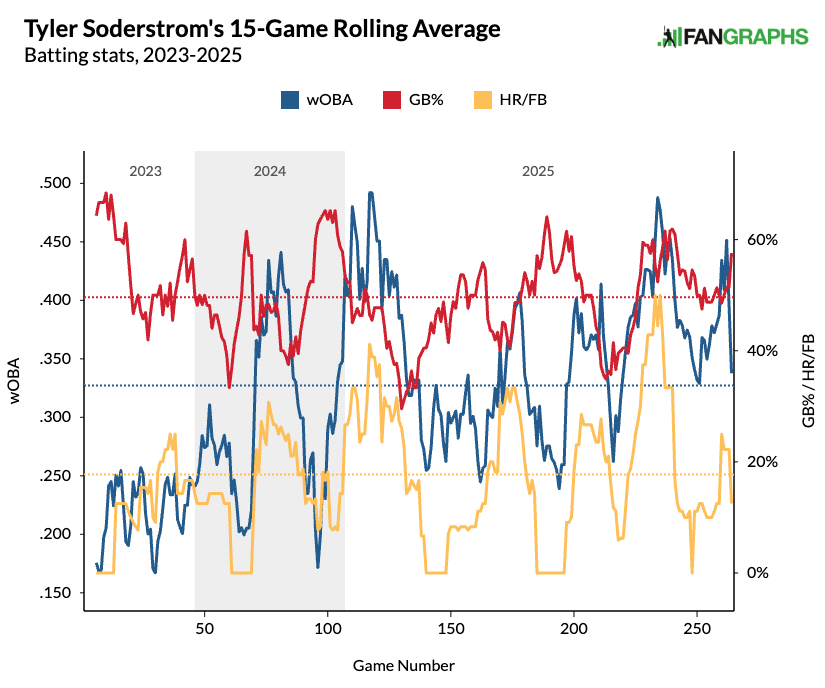
Soderstrom boasts a rare power-hitter profile, with above-average contact rates and high-end bat speed. The biggest concern about Soderstrom reaching 30 or more involves his 48-49 percent groundball rate. Regardless, Soderstrom does damage when elevating the ball, ranking 44th in average exit velocity on flyballs and line drives (95.7 mph), tying him with Vladimir Guerrero Jr. and Dansby Swanson.
Colson Montgomery Hits 35 Home Runs
I wrote about Montgomery as a later-round hitter sleeper for home runs because of his bat speed and power. The market seems to be torn on whether Montgomery was lucky or not after hitting 21 home runs in 284 plate appearances, especially considering his 25.9 percent home run per flyball rate (HR/F).
However, Montgomery possesses legitimate power while pulling the ball into the air. That's evident by Montgomery's 46.8 percent flyball rate, 51.4 percent pull rate, and 27.2 percent pulled air rate on Statcast. That, paired with Montgomery's 77 mph average bat speed and a 71.7 percent fast swing rate, shows his near-elite power skills.
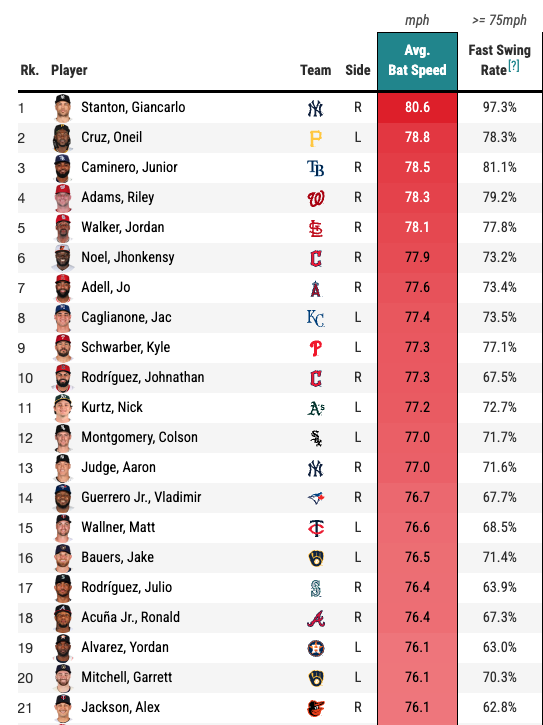
Montgomery ranked 12th in bat speed and 11th in fast swing rate in 2025 among hitters with 100 swings. Hitters with similar elite bat speed metrics include Aaron Judge, Kurtz, and Jac Caglianone.
Brice Turang Posts a 25/30 Season
After single-digit home run totals in 2023 and 2024, Turang hit 18 home runs in 2025. He focused on increasing his bat speed, making a four mph increase to 70.7 mph (2025) from 66.2 mph (2024). That made Turang's power go from non-existent to average, which was further evident in his 5.3 percent barrel per plate appearance rate, right above the league norm.
The visual below shows Turang's bat speed distribution by season.
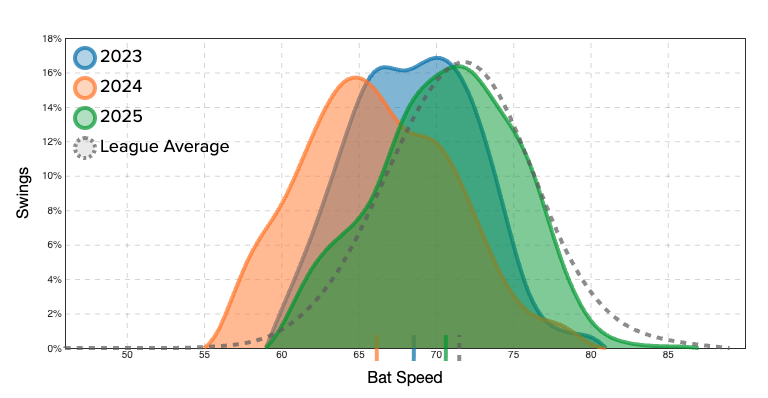
Most projections expect Turang to regress in home runs to 2023 and 2024. However, we could argue that Turang could push for 20+ home runs in 2026, especially if there's another slight increase in bat speed. Speed is another part of Turang's profile, but we saw his 50 steals in 2024 drop to 24 in 2025.
Interestingly, Turang's stolen base attempt rate was at 27 percent (2023), spiking to 35 percent (2024), then down to 17 percent (2025). Assuming the stolen base attempt rate regresses somewhere around the career average (26 percent), 25 stolen bases with the potential for 30 should be within reason.
Turang's draft price isn't low, going as a top-50 pick. He should be worth it with a 25/30 ceiling.
Emmet Sheehan Will Be the Best Dodgers' Starting Pitcher
After having concerns about Yoshinobu Yamamoto's injuries heading into 2025, he shoved it in our face and led the Dodgers' rotation into the playoffs. Blake Snell expects to start the season on the injured list with a shoulder injury. Tyler Glasnow pitches well on a per-inning basis, but struggles with health at times. Roki Sasaki has volume and role concerns, with Shohei Ohtani already the best fantasy asset.
Many love Sheehan, and he is one of my breakout pitchers. Across a 73-inning sample, Sheehan boasted a 23 percent K-BB% and 15.6 percent swinging-strike rate. Sheehan has the makings of a high-end starting pitcher, including a nasty slider (23.3 percent swinging-strike rate), 6.7 feet of extension (74th percentile), and nearly 18 inches of induced vertical break (17.9) via the four-seamer.
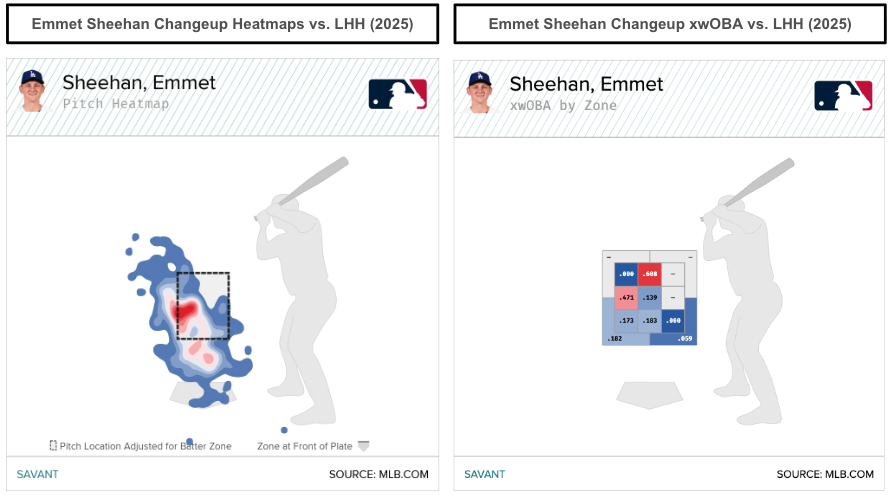
Furthermore, Sheehan threw a different changeup, over three mph harder, which led to it losing arm-side fade (over four inches). He locates the changeup well, low and away from right-handed hitters, allowing a .155 wOBA (.201 xwOBA). That's further supported by his 101 changeup Location+.
Theoretically, Sheehan's changeup should be his best pitch, giving him three above-average offerings. That's the formula to chase from a starting pitcher. Sheehan could be the Dodgers' best starting pitcher in 2026.
Spencer Strider Finishes as a Top-50 Player in 2026
Strider's fastball velocity concerns have been a main talking point in Spring Training. His four-seam velocity fell one mph in Spring Training (94.5 mph) from 95.5 mph in 2025. That's nearly another one mph lower than Strider's four-seamer in 2024 (96.3 mph). Looking at the percentage of pitches in different velocity bands is another way to examine these changes.
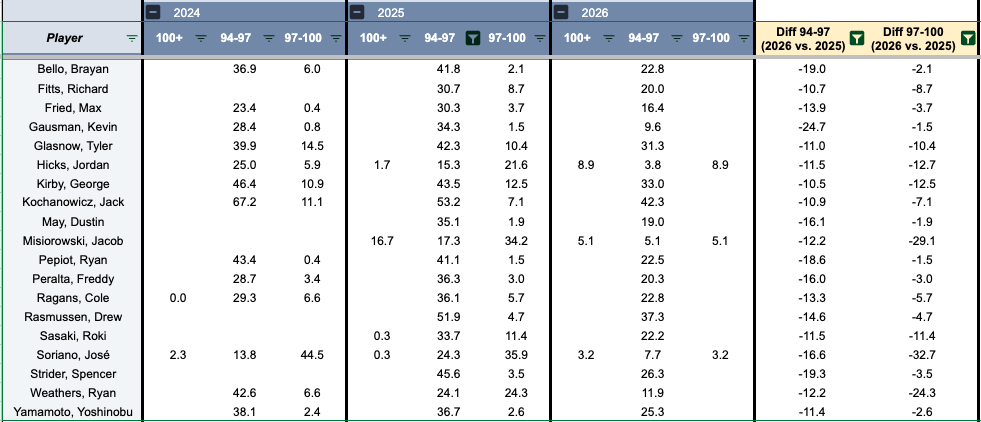
Among pitchers with 15 percent or more of their pitches within 94-97 mph in 2025, Strider was one of the pitchers with a 10 percentage point decline in this velocity band during Spring Training (2026). The other filter involved which players had their percentage of pitches with 97 to 100 mph decrease by one percentage point or more in Spring Training.
We have several notable pitchers on this list, including Richard Fitts, Max Fried, Kevin Gausman, Glasnow, George Kirby, Dustin May, Jacob Misiorowski, Ryan Pepiot, and many more fantasy viable options. Last season, there were talks about Jacob deGrom backing off on his velocity, which raised alarm from some fantasy managers.
deGrom saw his average fastball velocity drop by 1.5 mph in 2025, compared to his peak of around 99 mph. He threw the most innings (over 172) in 2025 since the 2019 season. It might not be directly correlated, but there's a chance deGrom remained healthy by not pitching close to his maximum velocity often throughout the season. That could be the case for Strider in 2026.
The visual below shows Strider's four-seam pitch metrics throughout the past few seasons, including Spring Training in 2026.
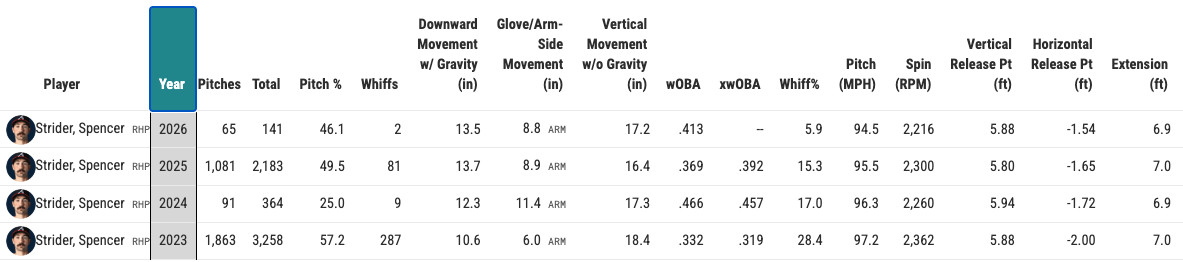
At Strider's lower four-seam velocity, we've seen him gain nearly an inch of induced vertical break on the four-seamer (17.2 inches) in Spring Training. It might not be at the elite levels from 2023 (18.4 inches), but Strider's four-seam could still be effective at a slightly lower velocity. Meanwhile, Strider's slider lost one inch of downward movement and arm-side fade in Spring Training.
We could be dreaming when we consider that Strider had a career-low Stuff+ (96) and Location+ (93) in 2025, compared to a 112 Stuff+ and 96 Location+ throughout his career. I'm betting on Strider evolving in 2026, with him going from just outside the top 100 picks to being a top-50 player.
MacKenzie Gore Finally Delivers a Breakout Season
I wrote about Gore over one month ago as a National League breakout starting pitcher. That article was written before Gore was traded to the Rangers. Gore's improved team context led to his rising draft cost. He had three pitches with a swinging-strike rate above 18 percent, including the slider (19.5 percent), changeup (20.4 percent), and cutter (18.8 percent).
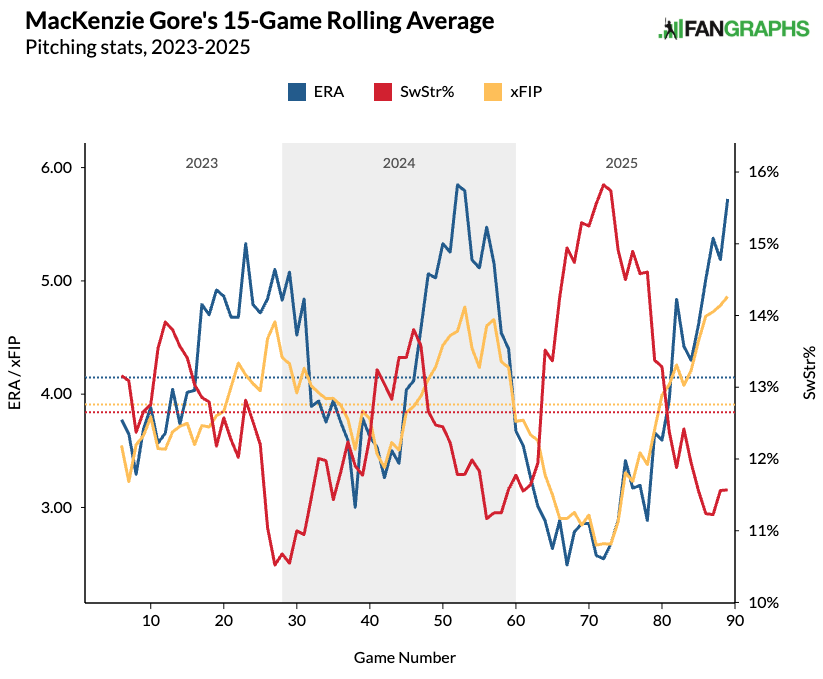
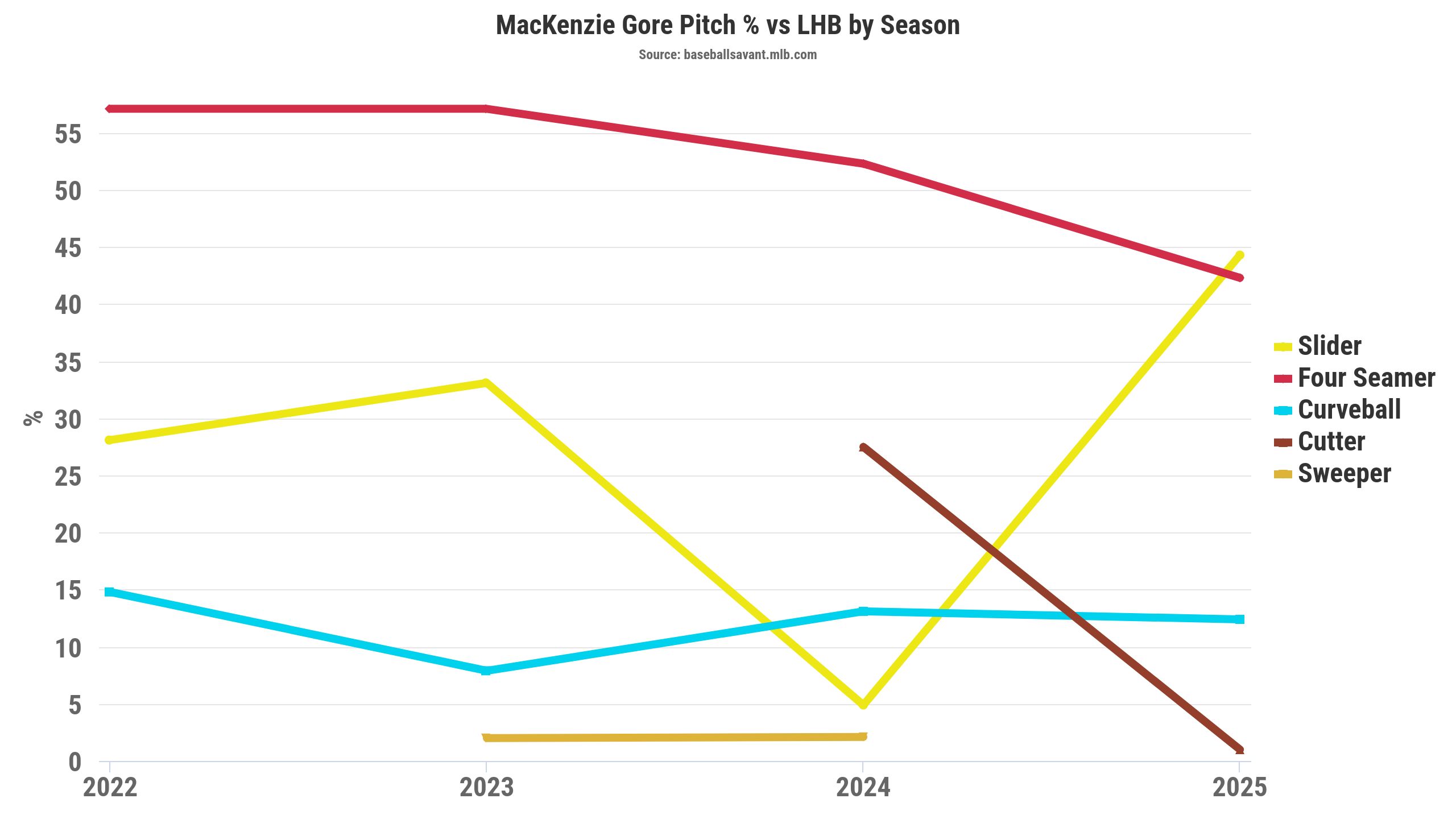
The slider and changeup were 4-5 percentage points above the league norm, with the cutter being over 7 points higher than the league average in swinging-strike rate. Gore made a significant pitch mix change against left-handed hitters by throwing more sliders in 2025 (44.3 percent) after only 4.9 percent in 2024. He lowered his four-seam usage to 42.3 percent (2025) from 52.3 percent (2024).
The issue has been WHIP for Gore, with a 1.40 WHIP throughout his career. He often had higher hit rates or batting average on balls in play (BABIP). Gore played with a Nationals' defense that ranked 27th in defensive runs saved and 29th in outs above average. Although the Rangers lost Marcus Semien and Adolis Garcia, they ranked first in defensive runs saved and sixth in outs above average in 2025.
A better defense should help Gore's BABIP improve, leading to a better WHIP, with his high-end strikeout skills. Gore's draft cost continues to rise within the top 150 picks, and fantasy managers better jump on board the breakout train.
Braxton Garrett is the Second-Best Marlins SP
This might not be that bold, but some fantasy managers may have forgotten about Garrett after missing the 2025 season due to UCL revision surgery late in 2024. It's been a small sample of under 100 pitches for Garrett, but we've seen his velocity increase to 88.9 mph in Spring Training, up from 86.4 mph in 2023 and 2024.
That's mainly because Garrett's four-seam increased to 92.5 mph in Spring Training, up nearly two mph (1.8) compared to 2023 and 2024. Besides Garrett's four-seamers, the changeup added nearly two mph of velocity at 88.1 mph in Spring Training versus 86.3 mph in 2024 and 87.5 mph in 2023.
Garrett has a diverse arsenal of three to five pitches against both sides of the plate, including his changeup and slider with above-average movement to generate whiffs and weak contact. The volume might not be in Garrett's favor, but the slider's 19.6 percent career swinging-strike rate should help pair well with the changeup swinging-strike rate from 2024 (17.8 percent).
Besides Eury Perez, the quality from Sandy Alcantara, Chris Paddack, and Max Meyer might be more volatile than Garrett's. The velocity gains and potential skill improvements for Garrett in Spring Training reminded us of his previous sleeper appeal. Don't sleep on Garrett, especially in deeper leagues.
Payton Tolle Will Be a Streamer With Upside
For some reason, Tolle's draft price tends to be outside the top 400 picks. Meanwhile, Connelly Early's average draft position is around 250. Although Tolle doesn't project as a starter in the Red Sox rotation, there might be more to like in his stuff compared to Early. Both pitchers threw under 20 innings in their MLB sample, so we're dealing with very little data.
Tolle had a 36 percent ball rate and 15.5 percent swinging-strike rate across 19 innings in 2025. Interestingly, Early had a similar ball rate (35 percent) and a better swinging-strike rate (16.7 percent) in his 19-inning sample.
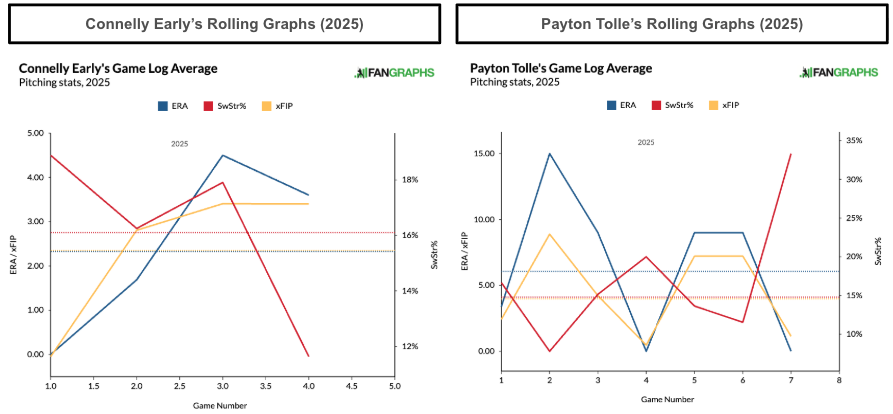
For context, Tolle had a 32.7 percent ball rate and a 17.9 percent swinging-strike rate throughout the minors in 2025. Early posted a 35.5 percent ball rate and a 14.3 percent swinging-strike rate across Double-A and Triple-A in 2025 throughout the minors. Early showed four pitches to either side of the plate, with Tolle consolidating to two pitches against right-handed hitters (four-seam, cutter) and lefties (four-seam, slider) in 2025.
The visual below shows the starting pitcher leaders in Stuff+ for the Red Sox in 2025.
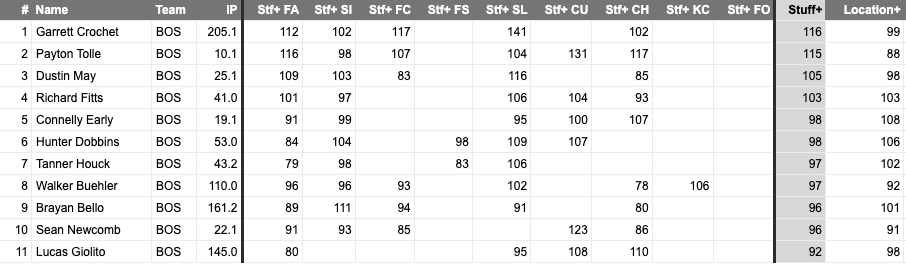
Early has better command with a 108 Location+. Meanwhile, Tolle is a Stuff+ monster (119). There's a chance Tolle becomes a high-leverage reliever, with Early being a more reliable starting pitcher throughout their careers. Tolle should be a streaming pitcher with tons of strikeout upside, as a low-risk, high-upside pitcher, and a significantly later draft cost. In shallower leagues, keep Tolle on the watch list.
More Fantasy Baseball Advice
Download Our Free News & Alerts Mobile App
Like what you see? Download our updated fantasy baseball app for iPhone and Android with 24x7 player news, injury alerts, sleepers, prospects & more. All free!