




 RADIO
RADIO







Corbin identifies potential breakout power hitters as fantasy baseball risers looking at exit velocity (EV50) data. He analyzes Ben Rice, Brice Turang, and more.
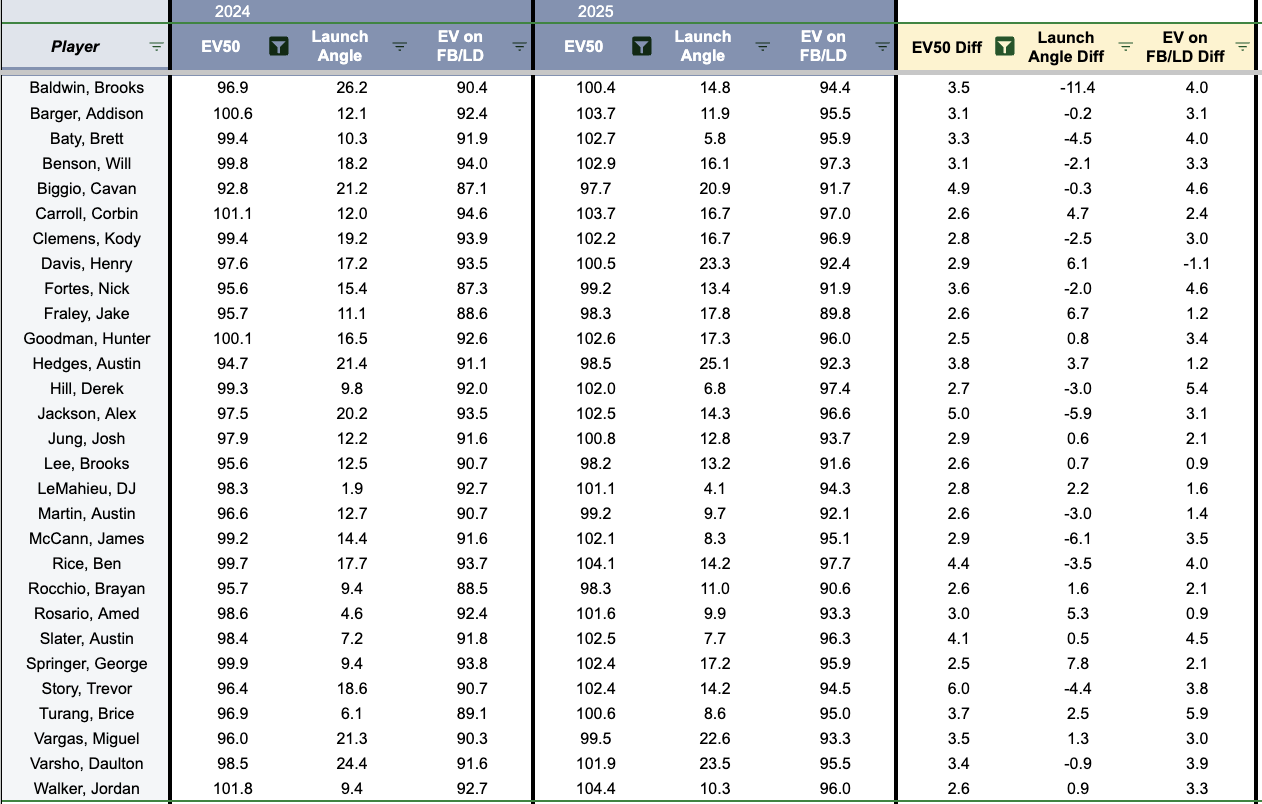
We have so many advanced stats available on Baseball Savant, allowing us to dive deeper beyond average exit velocity. We're using Exit Velocity 50 (EV50), which Baseball Savant defines as the average of the hardest 50 percent of a player's batted balls, giving us a somewhat reliable metric for averaging exit velocity on flyballs and line drives (EV on FB/LD).
EV50 correlates well with barrels (0.524) and barrels per plate appearance (0.641). That's unsurprising since barrels involve batted balls with an exit velocity of 98 mph at an optimal launch angle (26-30 degrees). The hitters in this article improved their EV50 by 3 mph or more in 2025 compared to 2024.
We'll examine five exit velocity standpoints that might be worth prioritizing in fantasy baseball drafts. Are these power hitters legitimate, or are they noisy ones to fade?
Featured Promo: Save 50% off the regular price with discount code CHAMP, for a limited time. Exclusive access to our Team Sync platform, DFS cheat sheets, Lineup Optimizers, betting/prop picks, and exclusive content from Nick Mariano and Eric Cross! GAIN ACCESS NOW
Exit Velocity Standouts - Power Hitters on the Rise
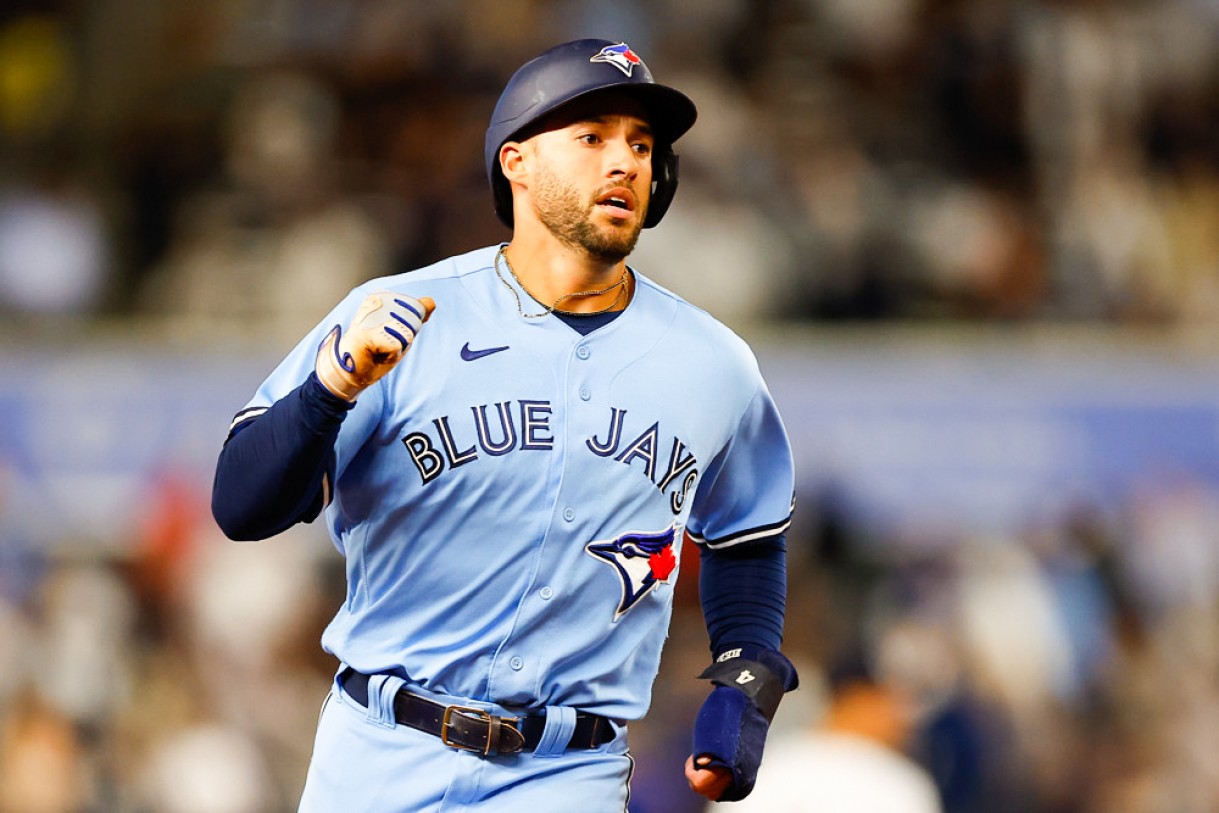
George Springer, OF, Toronto Blue Jays
- EV50: 102.4 mph
- EV on FB/LD: 95.9 mph
Just when we thought Spring was falling off, he silenced any doubters in 2025 by hitting 32 home runs and swiping 18 stolen bases. That, paired with a .308 batting average, led to $31 of earned value, meaning he was probably a league winner by earning first-round value. Springer increased his EV50 by 2.5 mph and his average exit velocity on flyballs and line drives (EV on FB/LD) by over 2.0 mph in 2025.
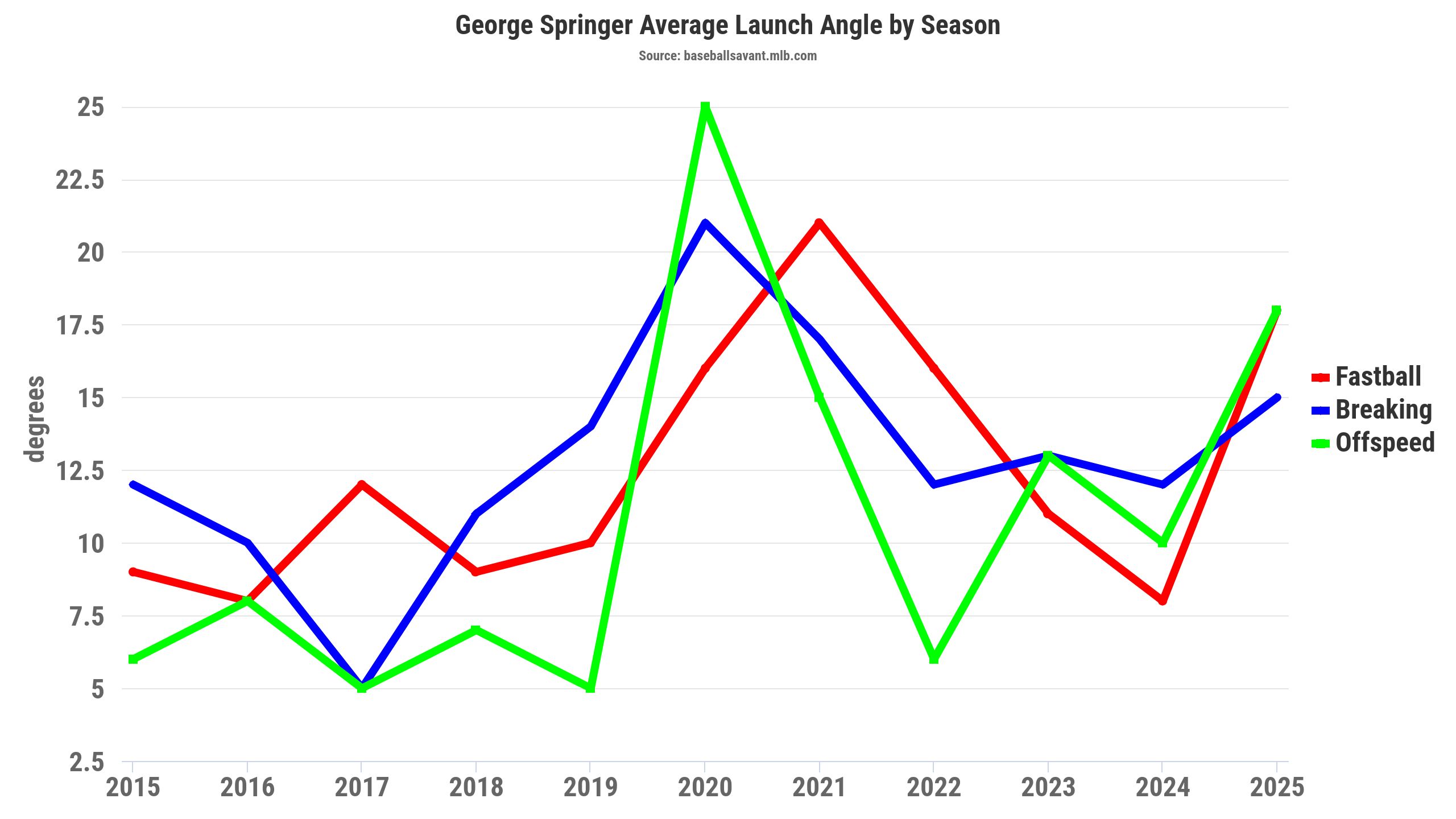
He also significantly improved his launch angle, which had been trending down over the past few seasons. That's evident in Springer's launch angles of 13.9 degrees in 2022, 12 degrees in 2023, 9.4 degrees in 2024, and 17.2 degrees in 2025. Springer made a concerted effort to pull the ball in the air (18.7 percent) in 2025 after being around 15-16 percent (2023-2024).
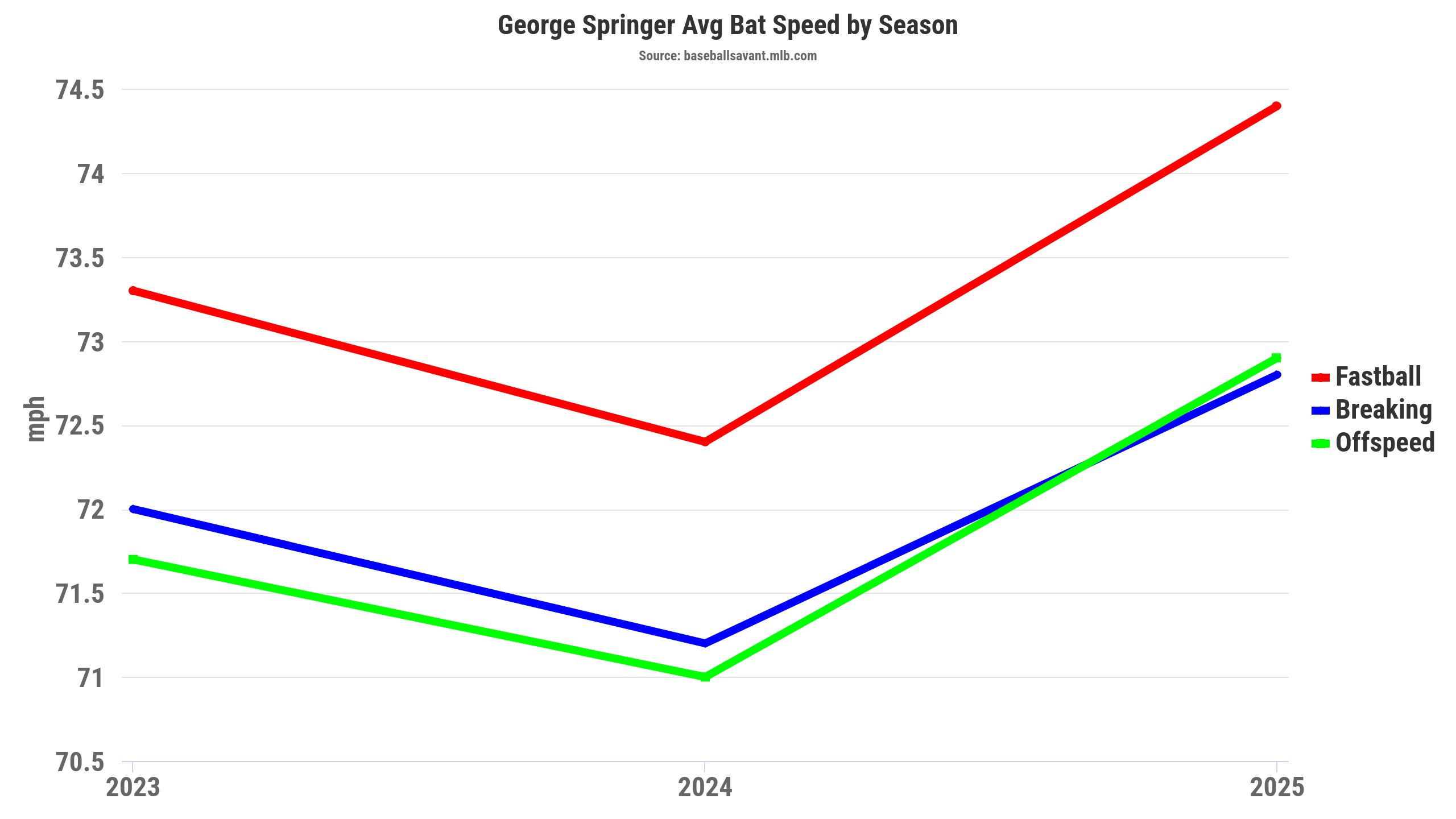
Furthermore, Springer's bat tracking data supported the increased power skills. He had an above-average bat speed (73.7 mph) with a 40.3 percent fast-swing rate, meaning over 40 percent of his swings were 75 mph or higher. That's nearly double his fast-swing rate in 2024 (22.4 percent).
If we regress Springer's home run output based on age, 22-25 home runs feels like a fair expectation. Assuming Springer maintains those power skill gains in 2026, he should be a value at cost, around pick 100 in the current NFBC ADP.
Trevor Story, SS, Boston Red Sox
- EV50: 102.4 mph
- EV on FB/LD: 94.5 mph
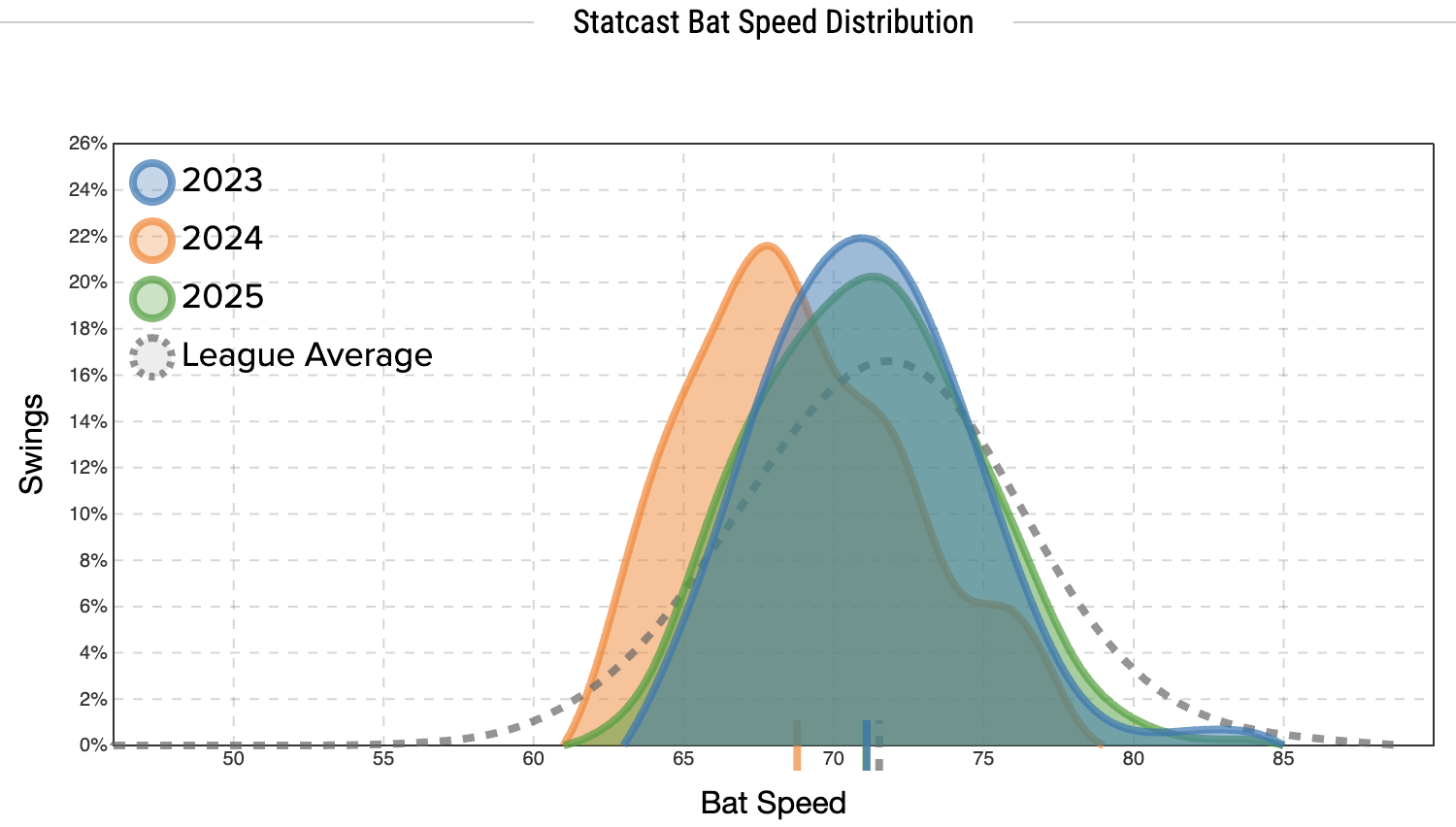
After lengthy absences in 2023 and 2024, Story was a monster with 25 home runs and 31 stolen bases in 2025. Story had the largest increase in EV50 (6 mph) in 2025, with a 3.8 mph jump in his average EV on FB/LD. He had mediocre bat speed (71.1 mph) and a fast swing rate (14.2 percent) in 2025.
He might've been fortunate in the home run category, or the 2025 total will regress slightly in 2026. However, Story posting another 20/20 season feels like a reasonable floor with enough upside. The plate discipline could come back to bite him, with a career-high chase (35.2 percent) and swing rate (54.4 percent), about seven percentage points above his career norm.
Story still makes enough contact while hitting the ball hard, though the plate discipline is something to monitor. He continues to run often, with a stolen base opportunity rate of 22 percent. Interestingly, Story converted 96 percent of his stolen base attempts in 2025, significantly higher than his career average (81 percent).
Story might be the end of the startable tier for shortstops for power and speed around pick 100 in NFBC drafts. There's the potential for another season of earned value as a top 50-60 pick in 2026 based on the power skill gains and speed.
Ben Rice, C/1B, New York Yankees
- EV50: 104.1 mph
- EV on FB/LD: 97.7 mph
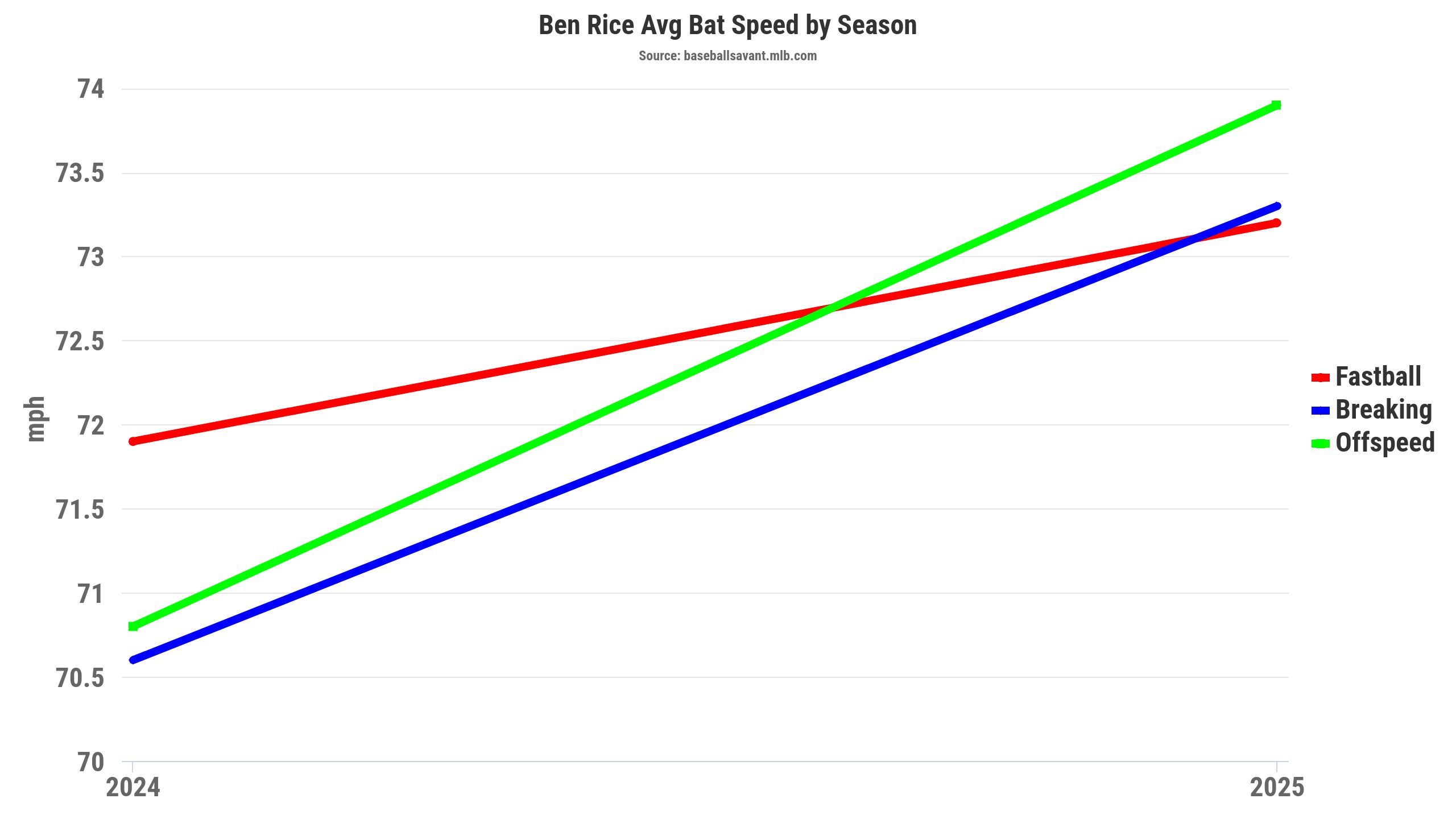
The draft market loves Rice as a top 50 pick. That's partly because Rice projects to play mostly at first base with catcher eligibility. Meanwhile, Rice possesses the power tools to dream upon. That's evident by Rice's 104.1 mph EV50 and 97.7 mph EV on FB/LD, both of which were four mph higher in 2025 than in 2024.
Rice barrels up the ball regularly, with a 10.5 percent barrel rate per plate appearance, over double the league average. He boasts solid plate discipline with an 89 percent zone contact rate, nearly four percentage points above the league norm. Meanwhile, Rice shows a patient approach and doesn't chase, with a 21.2 percent chase rate that's almost seven points below the league average.
There's a chance that Rice platoons, given that Paul Goldschmidt re-signed with the team in February. However, Rice was serviceable against left-handed pitchers, with a 104 wRC+ across a small sample of 119 plate appearances in 2025. Theoretically, Rice should play regularly and avoid platoons, especially since he crushes right-handed pitching (141 wRC+).
Rice checks the boxes of a strong power hitter, with the bonus of catcher eligibility. The platoon risk remains the biggest concern, though logical coaching would suggest Rice needs to play regularly.
Brice Turang, 2B, Milwaukee Brewers
- EV50: 100.6 mph
- EV on FB/LD: 95 mph
Heading into 2025, most wouldn't have expected Turang to be on the power skill riser. Turang went from below-average power to above-average. He had a significant increase in EV50 (100.6 mph) and EV on FB/LD (95 mph), rising by 3-6 percentage points in 2025, compared to 2024. The launch angles improved, but they can still be an issue. However, Turang crushed the ball when he elevated it, with 35 barrels in 2025, compared to 20 in 2023 and 2024.
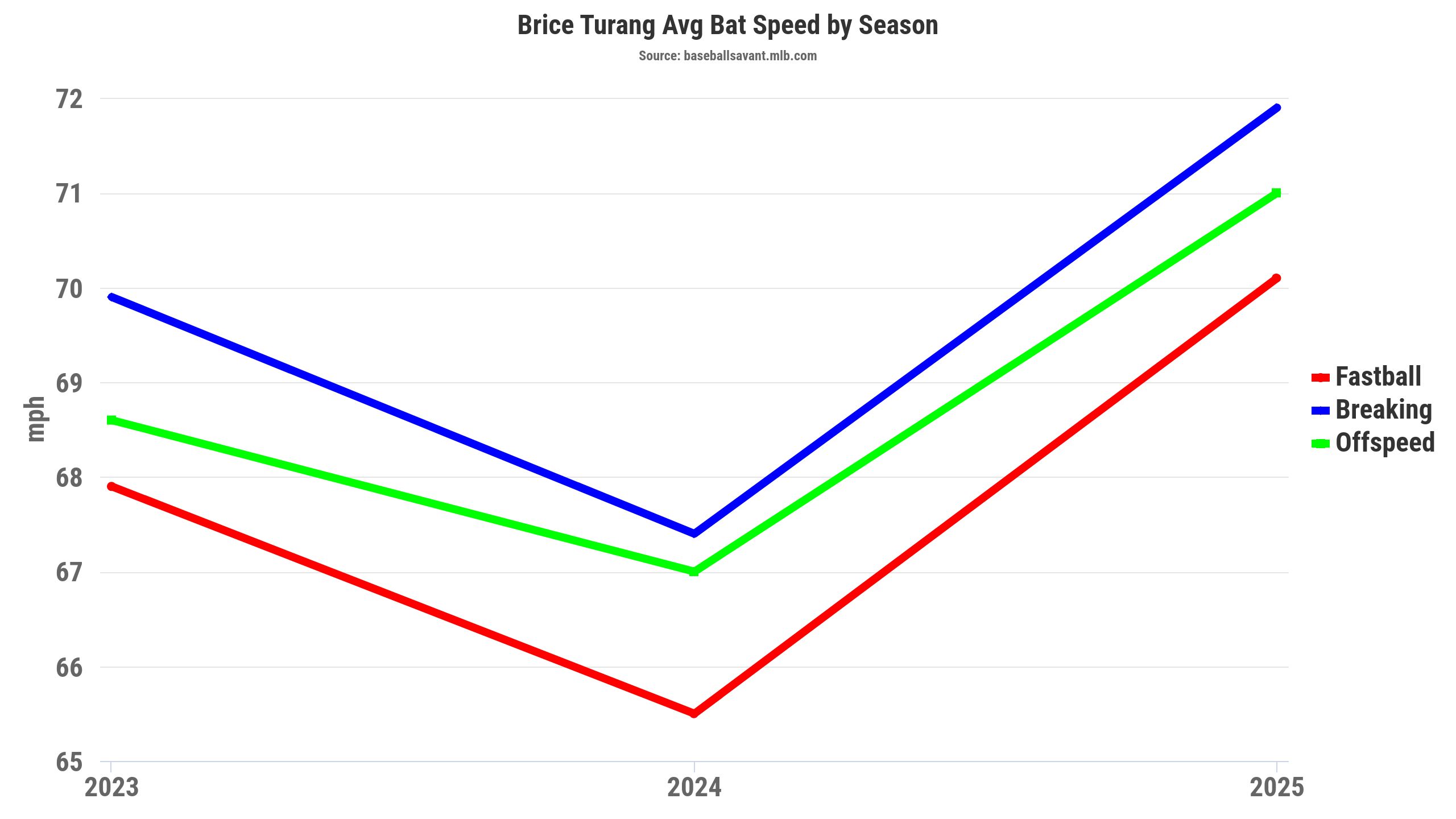
Turang's bat speed went from awful 66-68 mph to decent (70.7 mph), though that's still 1.0 mph below the league norm (71.7 mph). Interestingly, Turang made significantly less contact in 2025, dropping 74 percent, down from 81 percent in 2024. That's notable because it could be an attempt by Turang to trade, making tons of contact while being selective with pitches.
Specifically, Turang was crushing fastballs, with a .423 wOBA (.381 xwOBA), 8.2 percent barrel rate, and 70.1 mph bat speed in 2025. That's significantly better than Turang's skills and results against fastballs in 2024, with a .308 wOBA (.294 xwOBA), 1.9 percent barrel rate, and a 65.5 mph bat speed.
Now we're having to pay up for Turang after nearly posting a 20/20 season in 2025. Most projection systems don't expect Turang's power to continue rising, but average power gives him a new upside level to post a 15/30 season.
Miguel Vargas 1B/3B, Chicago White Sox
- EV50: 99.5 mph
- EV on FB/LD: 93.3 mph
Vargas might be the most surprising name here since he hasn't been known for power. He increased his EV50 by 3.5 mph with a 3 mph improvement in his average EV on FB/LD in 2025. Vargas leaned into the pulled air (23.1 percent) theme in 2025, after 23 percent in 2024. He boasted a 17.5 percent barrel rate, translating to a .713 wOBA (.548 xwOBA) on pulled FB/LD in 2025.
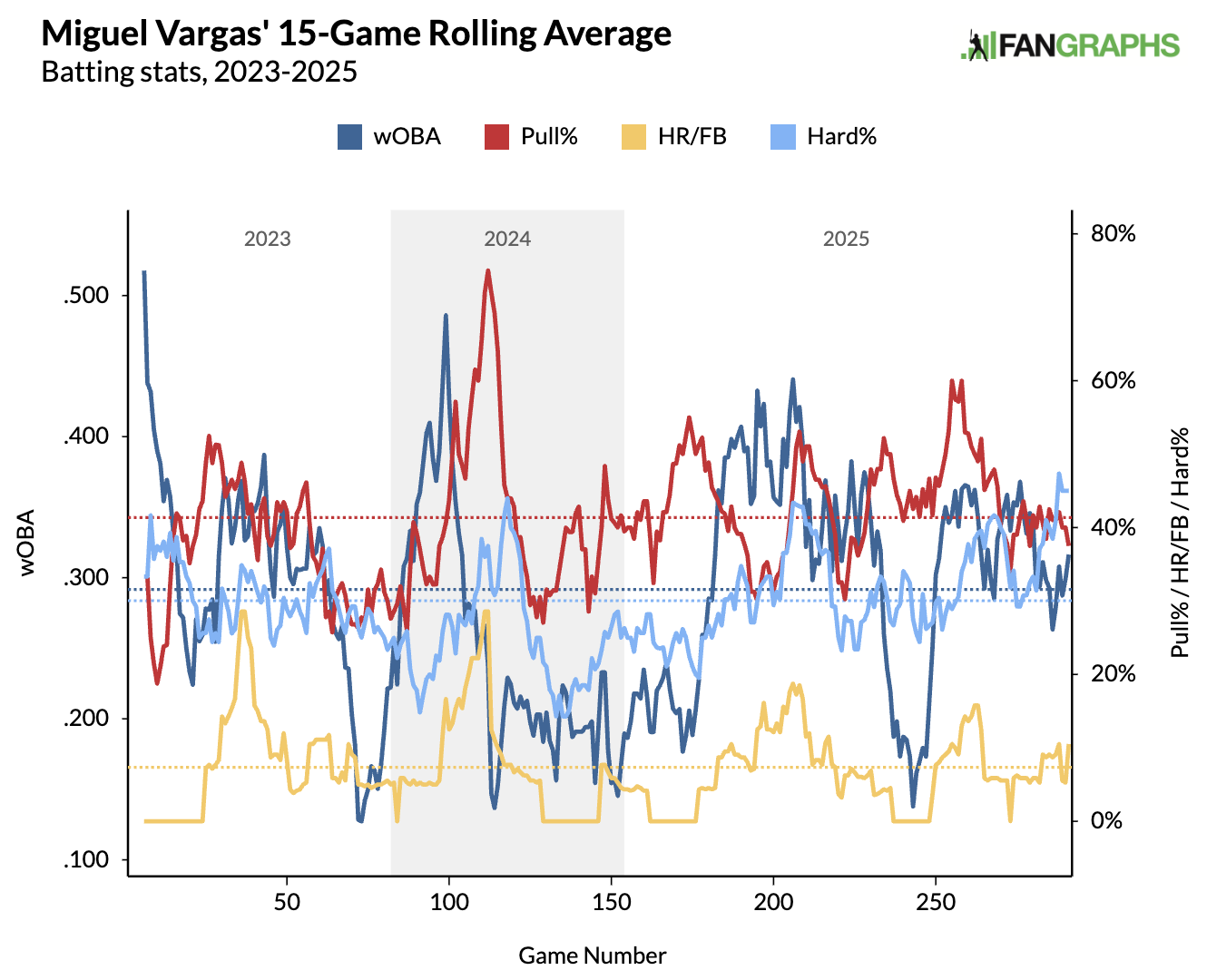
Vargas's exit velocities look better than expected while he maintains strong plate discipline. That's evident in Vargas's 80 percent contact rate and 21 percent chase rate. Power and plate discipline can be a formula for Vargas's success. That, paired with optimal launch angles, with a 51 percent fly-ball rate, can translate into above-average power.
There's potential for 20 home runs and 10 stolen bases for Vargas, which should be solid projected value as a multi-positional option past pick 250 in 15-team leagues.
Daulton Varsho, OF, Toronto Blue Jays
- EV50: 101.9 mph
- EV on FB/LD: 95.5 mph
After missing over three months recovering from shoulder surgery and a strained hamstring, Varsho was efficient, with 20 home runs across 271 plate appearances and a 21 percent home run rate (HR/F). Varsho had high-end exit velocities, evidenced by his 101.9 mph EV50 (No. 88) and 95.5 mph EV on FB/LD (No. 57) among 327 qualified hitters with 150 batted-ball events.
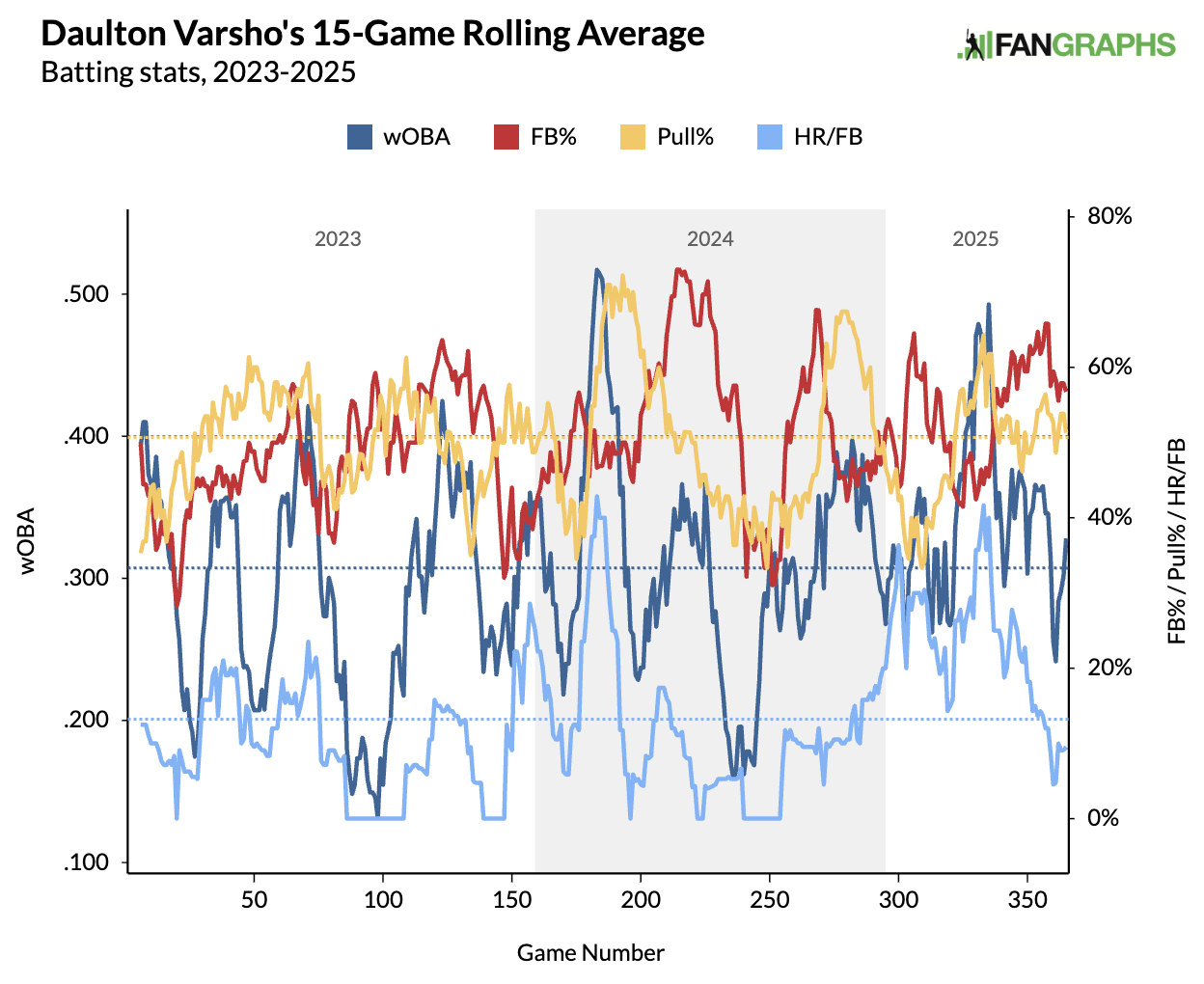
For context, Varsho increased his EV50 and EV on FB/LD by 3-4 points in 2025 compared to 2024. He uses a ridiculously pull-heavy (48.9 percent), flyball (54.7 percent) approach. Since Varsho pulls the ball into the air often and boasts high-end power, he may run lower batting averages. However, Varsho's power skills tend to support his .264 expected batting average (xBA), nearly 30 points above his actual BA in 2025.
Besides the exit velocities, Varsho possesses near-elite bat speed (75.6 mph) and a 56.2 percent fast-swing rate, meaning over 56 percent of his swings were 75 mph or faster. It could be a noisy small sample, but Varsho crushed off-speed pitches by right-handed pitchers in 2025.
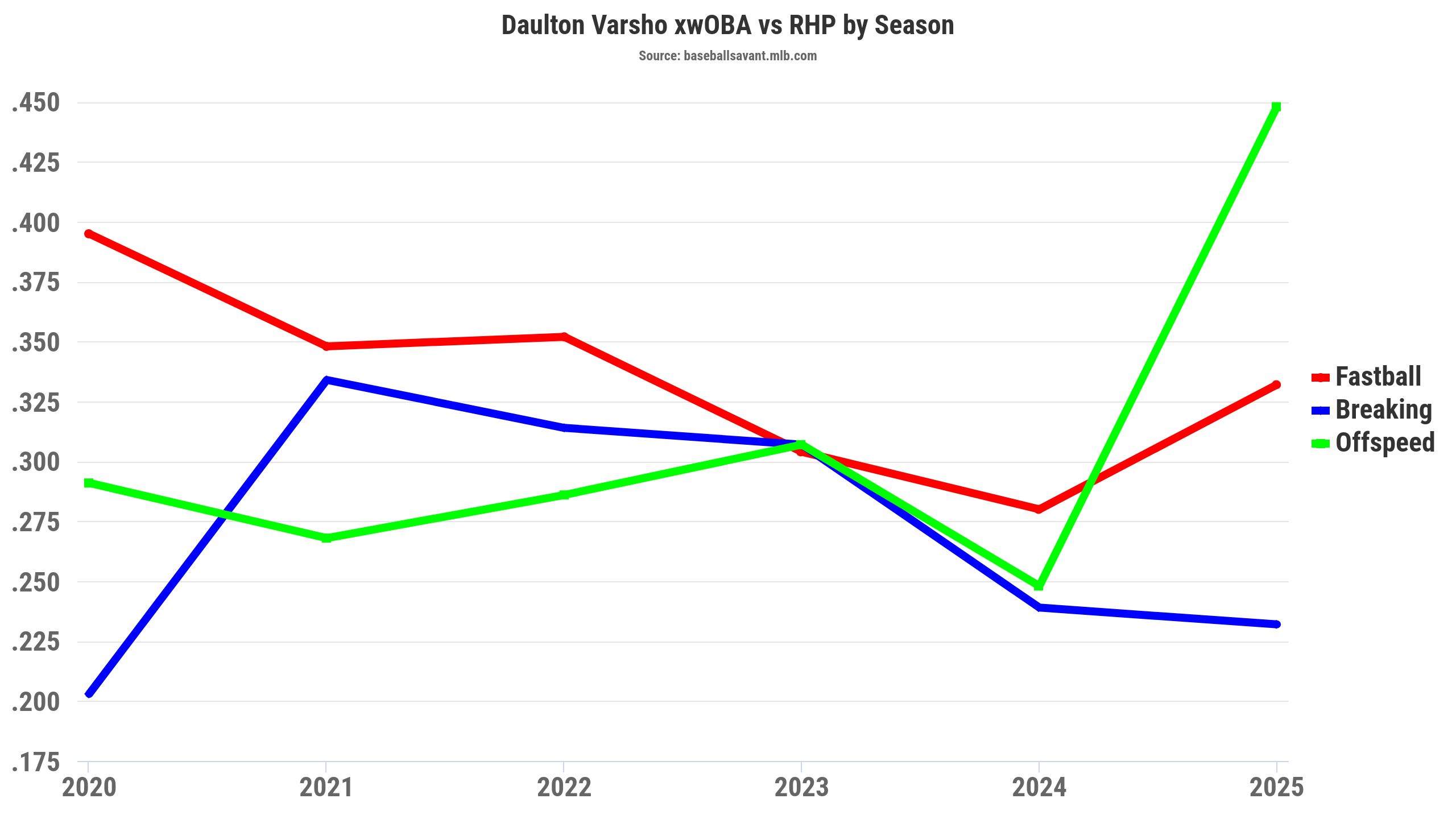
That's evident by Varsho rocking a .550 wOBA (.448 xwOBA) against off-speed pitches from righties in 2025. Varsho was significantly better against off-speed pitches in 2025, with a .305 wOBA (.248 xwOBA) in 2024 and .231 wOBA (.307 xwOBA) in 2023. Let's see if that sustains into 2026.
There's a low likelihood of Varsho being platooned given his elite defense, evidenced by his 95th-percentile Outs Above Average and career 42.9 Defensive Wins Above Replacement (WAR). The power and athleticism are legitimate. Make Varsho a target for power at the outfield position.
More Fantasy Baseball Advice
Download Our Free News & Alerts Mobile App
Like what you see? Download our updated fantasy baseball app for iPhone and Android with 24x7 player news, injury alerts, sleepers, prospects & more. All free!