




 RADIO
RADIO








Dan's favorite SP fantasy baseball breakouts, young starting pitchers with huge upside in 2026. He lists his top fantasy baseball pitcher sleepers and risers.
Welcome to the third and final installment of my "Build-A-Breakout" series that focuses on trying to find the next crop of talented young starting pitchers for the 2026 season by leaning into advanced metrics.
If you're looking for part one, you can find it here, and part two (which focused on fastball quality) here.
In this article, I am going to be looking exclusively at young pitchers without all that much MLB experience to see if we can get out in front of some major breakouts. As always, it's a data-driven piece, so it's not just my opinion or my gut talking. Let's see what the numbers tell us about these young pitchers!
Featured Promo: Save 50% off the regular price with discount code SUMMER, for a limited time. Exclusive access to our Team Sync platform, DFS cheat sheets, Lineup Optimizers, betting/prop picks, and exclusive content from Nick Mariano and Eric Cross! GAIN ACCESS NOW
Evaluating Potential Fantasy Baseball Breakouts
For this final research project, I evaluated only pitchers who were a) 26 years old or younger and b) pitched less than 100 innings at the MLB level in 2025.
The five statistical criteria that I wanted to use were Ball%, SwStr%, Stuff+, my own personal fastball quality grade (from part II of this series), and breaking ball/offspeed pitch whiff rates.
The cutoff for Ball% was 36% because it should (though it doesn't always) translate to a BB% of around 8%. The cutoff for SwStr% was 11%, which is right around the league average and should translate to a K% of 22%. A Stuff+ grade of 100 is right around league average, too.
My fastball grades are decimals between 0 and 1, so a grade of .50 represents an "average" fastball compared to other starting pitchers.
And to qualify in the "Secondary Whiff" column, a pitcher must have at least one breaking ball or offspeed pitch that registered at least a 35% whiff rate last season. Some had two pitches that did, and Eury Perez had three.
My final list is not exhaustive; it includes only pitchers who met the first two criteria (less than 26 years old and under 100 IP). Instead, it displays pitchers who qualified in all five categories (highlighted in green), four categories (highlighted in yellow), as well as some other notable young arms who didn't measure up in two or more categories.
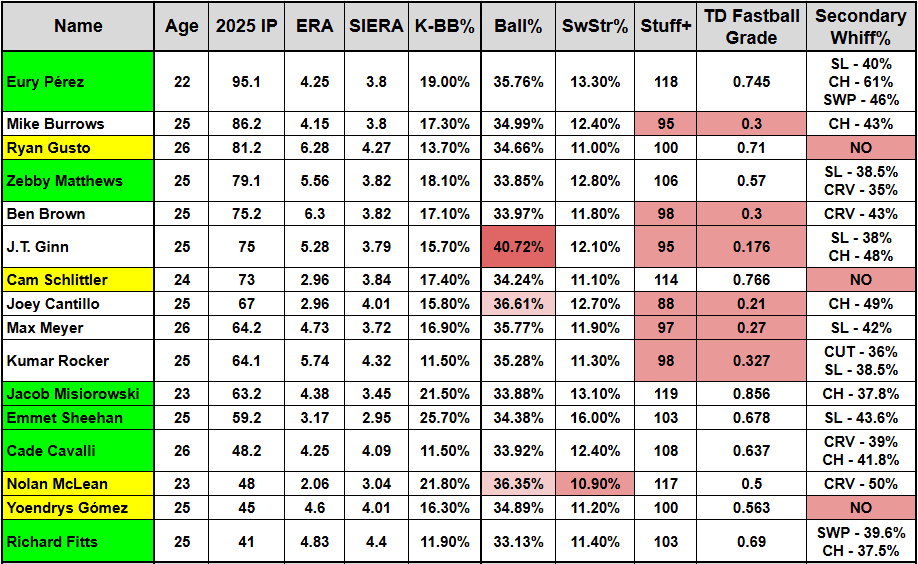
These pitchers are sorted by the number of innings they pitched as starters; innings as relievers were not counted. The first chart shows pitchers who threw 40-95 innings in 2025.
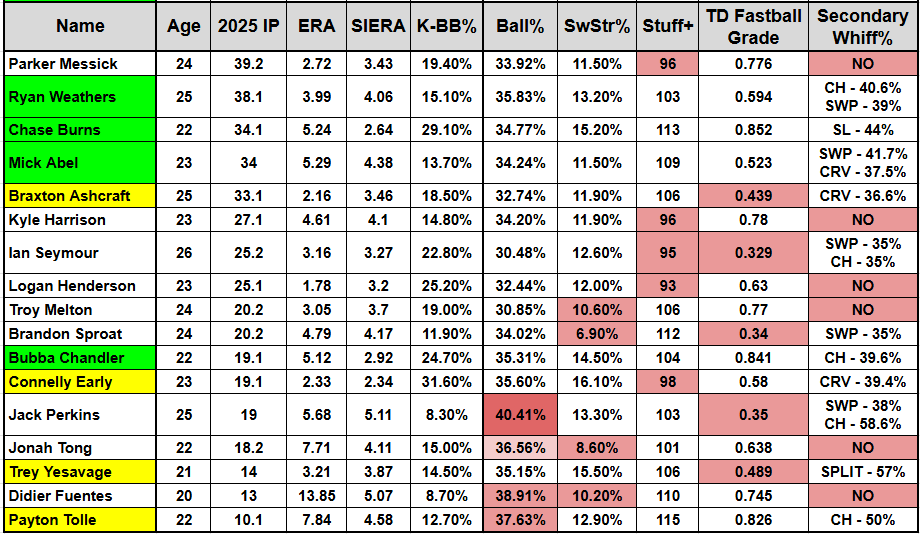
This second group comprises starters who threw 10 to 40 innings in 2025. I am going to break out the most noteworthy potential breakouts into several categories for further discussion.
The A-List Candidates: Early and Middle Round Targets
No one on this list should surprise you, right? How many articles have you already read with at least 2-3 of these names in them as potential breakouts already this preseason?
Perez is the head of the class, and you're going to have to use a pick inside the top-100 to land him. But he absolutely checks every box...and then some. I liken him to someone like Cristopher Sanchez or Spencer Schwellenbach last year - we all knew they'd be really good, but the range of outcomes is still quite wide. He'll need to pitch more like Sanchez than Schwellenbach for you to profit on his draft slot, but there's nothing to suggest that he won't do that.
Sheehan and Misiorowski are one tier behind Perez. If all things were equal, I prefer Sheehan, who has Misiorowski beat in every metric but Stuff+, but the Dodgers' six-man rotation is going to be a thing, as only one major projection source (Steamer) has him projected to eclipse 150 innings.
Chase Burns has all the raw potential in the world, but has some injury concerns that are clouding his outlook. The latest speculation by Reds' beat writer C. Trent Rosecrans is that Burns won't break camp with the Reds and will start the year at Triple-A to get himself right, which, if accurate, is a huge bummer and is going to drive down his ADP in a big way in the next week.
That leaves us with Bubba Chandler, who teased many fantasy managers last season with his upside before finally getting called up by the Pirates late in the season. Chandler will team up with Paul Skenes this year in what should be one of the most compelling, young 1-2 combos of any team in the majors.
Chandler struggled with control a bit in his first few spring starts, but looked like an ace in his most recent appearance, whiffing eight Braves over five frames, while walking just one and allowing only one hit.
Bubba Chandler's 8 Strikeouts.
Dude is electric. ⚡️ pic.twitter.com/rLmncrjHe3
— Rob Friedman (@PitchingNinja) March 12, 2026
His fastball sits at 99 mph, and the changeup can be lethal to lefties. I'd like to see his slider miss bats more often, but he's obviously still a work in progress. Chandler could be the best value of the bunch if he develops some consistency, considering you can draft him about 40-50 picks later than Sheehan or Miz.
One guy I should mention here is Nolan McLean, who is being drafted in the same range as Perez and has massive expectations this season after a fantastic 2025 debut.
I have nothing against McLean, but he outperformed his underlying stats last season, and, to be fair, he only missed the cutoffs for SwStr% and Ball% by a hair. Still, we want to see that SwStr% up around 13-15% for elite strikeout production, not around 11%. I think he'll have a fine season, but he's probably a bit overpriced. I'd rather have Perez.
The other mid-round guy from this list whom I am avoiding is Trey Yesavage. An easy excuse to use would be that the Jays are reportedly going to limit his innings pretty strictly, but that's not the only reason. His splitter was at peak Kevin Gausman levels last season, but his fastball is quite hittable. Pitchers who are really splitter-dependent can run really hot and cold, based on their command of the pitch, and also rely on a lot of chases outside the zone.
We've seen Trey's teammate Gausman have that issue before, and it's enough for me to avoid buying Yesavage at what feels like his ceiling.
The Cheap Fantasy Baseball Breakout Targets
This is the absolute sweet spot for breakouts, as all four of these pitchers are available late in drafts and checked every box. They also shouldn't be total surprises either, as many have featured them already this preseason (myself included), but it certainly makes me feel a bit warmer and fuzzier to see that they passed my statistical test with flying colors.
Let's start with Weathers, who has an opening day spot in the Yankees' rotation sewn up thanks to a multitude of injuries to New York hurlers (Gerrit Cole, Carlos Rodon, Clarke Schmidt). He's had a mixed bag of results in spring training in terms of run prevention, but he's been stacking up strikeouts and showing off some high-90s velocity on his four-seam fastball.
The naysayers will point to his limited innings and injury history, as he's yet to pitch 100 innings despite entering his sixth season in the major leagues. But he has three quality pitches between his fastball, sweeper, and changeup, and has shown some solid command the last two seasons in Miami (and in spring training).
There's every reason to believe that he can be a really good pitcher (and fantasy asset) if he can stay healthy in New York this season.
I've been preaching that Cavalli might be the absolute best value for upside of any pitcher in the draft, considering he often goes well ahead of pick 300. He's a hard-thrower with a plus changeup and curveball, who also can throw a hard sinker and get groundballs. Cavalli has looked fantastic this spring, hurling nine scoreless innings with a 28% K% and just a 6% BB%.
Cade Cavalli this spring:
• 3 starts
• 9 IP
• 1 hit allowed
• 0 runs
• 9 strikeoutsOpponents have a .036 batting average pic.twitter.com/Or5NPcqHWF
— Danny Vietti (@DannyVietti) March 12, 2026
I am all in on him this year and find myself clicking his name in the final few rounds of drafts just about every time. There's literally no risk here and nothing but potential rewards!
And then we have our pair of gas-throwing righties from Minnesota, Abel and Matthews. I think Matthews just might have the higher ceiling, based on his really good breaking stuff and command of the strike zone. However, right now it looks like Mick Abel may have edged him out for the fifth spot in the rotation with his dynamic showing in spring training.
Minnesota should have both big right arms in their rotation at some point this season, but Simeon Woods Richardson is out of minor league options, and they can stash Matthews or Abel at Triple-A without consequence for now. If it comes to fruition that Abel gets the opening day spot and Matthews gets sent down, then Abel is the superior value based on his current ADP, as he's going anywhere from 25 to 50 picks later than Matthews in recent drafts.
I like them both a lot, but Abel should be the priority (assuming he wins the rotation spot) if we are looking to maximize the number of innings we get from each pitcher at the big league level.
They Need Better Secondary Stuff
Here we have a bunch of pitchers who got the yellow tag (other than Messick, who also came in under the threshold for Stuff+) because they were one metric shy of qualifying, and it happened to be the lack of an "out pitch" in their arsenal.
Of the group, I am still very high on Schlittler and Ashcraft, who are guaranteed spots in their team's rotations and who both had some promising batted-ball results that have proven that perhaps they don't need to lean on strikeouts as heavily. There's a big gap there in ADP, however, as Schlittler is off the board at least 100 picks earlier, setting Ashcraft up to be the guy with more potential room for profit.
Schlittler throws an extremely hard cutter, up to as high as 94 mph, to go along with his high-90s four-seamer. But he also threw these two pitches over 70% of the time last year, and could stand to mix in more curveballs or another breaking ball (he's toyed with both a gyro slider and bigger-breaking sweeper) if he wants to get more whiffs.
Cam Schlittler averaged 91.9 mph on his cutter last season.
In the first inning, he hit 96.1, 96.5, 95.7, 94.3, 95.8, 94.5, 94.6 and 93.7 with the cutter.
That'll work.
— Chris Kirschner (@ChrisKirschner) March 6, 2026
Ashcraft has a similar approach, throwing everything in his arsenal 90 mph or faster with only his curveball (at 84 mph) left to provide some velocity differential. His 92 mph slider produced strong results but didn't miss bats as well as his curveball, which had a solid 36% Whiff%. His fastball grade is actually what kept him off the bona fide breakout list, but I honestly think that had less to do with its shape or velocity and more to do with his lack of offspeed pitches to keep hitters off balance.
I like Messick a lot, even if he doesn't have an overpowering pitch or a pitch with a big whiff rate. What he does have is elite command and the ability to throw five or six different pitches for strikes. He deserves a spot in Cleveland's rotation, but is likely to end up in the same spot as Matthews as a casualty of his contract, as he has minor league options left, while fellow lefty Joey Cantillo doesn't, and Logan Allen has pitched well enough (I guess) to be included as well.
Gusto is going to start in the minors for Miami, and Gomez is in the bullpen for Tampa Bay, and haven't really flashed the same kind of upside as some of these others, despite qualifying in multiple categories.
The Super Sneaky Starting Pitchers Sleepers
Here we have one former Boston prospect and two currently on the outside of the Opening Day rotation looking in. Early and Tolle really should be considered for the Boston rotation, but will both start the season at Triple-A despite pitching well in limited samples last fall and looking good this spring.
Early is being drafted in the same round as guys like Messick and Matthews, despite his nebulous outcome. With all three of these guys, you are betting on their talent to force the hands of their organizations and for their minor league stays to be short, because other pitchers in that same range already have rotation spots sewn up.
Tolle, and his blazing 100 mph fastball, can be drafted much later and stashed for when his number is called, or just left on the watch list for now. Both lefties (Tolle and Early) are checking a lot of boxes here, with Tolle's biggest weakness being control, and Early checking in with a Stuff+ rating of 98 that was just barely under my threshold.
Early is a bit more polished right now and probably the first one of the two to come up, but you could argue that Tolle's ceiling is a bit higher as a high-velocity lefty.
But let's bury the lede here, Richard Fitts is a GREEN name on my chart who checked every box! He won't make the rotation out of camp, but he has less talent blocking him in St. Louis than our Boston bros do.
Besides the fun name, St. Louis Cardinals starting pitcher Richard Fitts probably won't have his sinker (33.3% SwK) and four-seam (42.9% SwK), both fastballs lead the arsenal in whiffs. However, Fitts's four-seam possesses above-average induced vertical break (IVB) at 17 inches… pic.twitter.com/sp9ncqrD2N
— Corbin (@corbin_young21) March 5, 2026
The Cardinals are going to roll out Andre Pallante, Michael McGreevy, and Kyle Leahy in their Opening Day rotation. I think Fitts is better than all of those dudes, and I won't be surprised if a strong start at Triple-A gets him a call-up sooner than later. He's not someone you have to draft, unless you are in an NL-only format or really deep league, but keep an eye on Fitts; he could be a solid waiver wire pickup early in the year.
More Fantasy Baseball Advice
Download Our Free News & Alerts Mobile App
Like what you see? Download our updated fantasy baseball app for iPhone and Android with 24x7 player news, injury alerts, sleepers, prospects & more. All free!